Introduction
In September 2020, a group of ENT surgeons in Belgium reported a medical case of a rare entity: ‘several mobile white foreign objects’ in the right ear of a 65-year-old patient with a history of parotid malignancy. Maggots had eaten through the eardrum and eroded the bony structures of his middle ear.Reference Rummens, Van der Mieren, Van Rompaey, Piessens and Somville1
Although today there is an extensive body of scientific literature about aural myiasis, its clinical manifestations, as well as diagnostic techniques and treatment,Reference Sharan and Isser2–Reference Panu, Cabras, Contini and Onnis4 there has not yet been a historical study of the subject. While it is crucial to distinguish present day human health and medicine from that of the past, we believe that a historical investigation of aural myiasis offers a new point of view to the complex relationship between diseases and the environment where humans live.
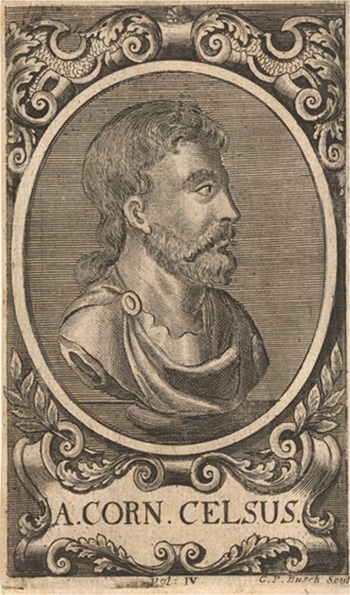
This short study focuses on the Roman encyclopaedist Aulus Cornelius Celsus (circa 25 BCE to circa 50 CE).Reference Prioreschi5 Celsus (Fig. 1) was known for his extant medical work, De Medicina,6 which is believed to be the only surviving section of a much larger encyclopaedia. He made contributions to the history of dermatology by classifying disorders such as myrmecia (i.e. ‘plantar wart’, or verruca), and his name appears often in medical terminology of skin affections (e.g. kerion celsi and area celsi). De Medicina is a primary source on ancient diet, pharmacy, surgery and related fields, and it is one of the best sources concerning medical knowledge in the Roman world. In Guthrie's words, Celsus’ De Medicina is ‘a medical classic with modern flavour, if only its popularity could be revived’.Reference Guthrie7
Portrait of Aulus Cornelius Celsus, by Georg Paul Busch, 1719.

What follows is an introductory study of the history of myiasis. A more comparative analysis of the subject is to be considered in the future, which will provide more data from different cultures and times.
When maggots appear
Aural myiasis, a maggot infestation of the human ear, was described in Roman medical literature as early as 2000 years ago. Aurelius Cornelius Celsus was a Roman author whose De Medicina catalogues medical knowledge of his own time, from diet and exercise to bone fractures and cataract surgery. While the treatise has reached considerable renown in the history of medicine, little is known of its author.
The rhetorician Quintilian described Celsus as mediocri vir ingenio (‘a man of mediocre mind’, Institutio Oratoria, XII, 9, 24), who published a large encyclopaedia covering several disciplines, from agriculture and military science, to rhetoric, philosophy and medicine.Reference Prioreschi5,Reference Daube8 The term ‘encyclopaedia’ in the classical literature did not have today's connotation of a work of universal scope, but rather described a collection of books dealing with various practical subjects presented for the purpose of giving instruction on the whole circle – ἐν κύκλῳ – in other words, a system of all the known arts. Today, unfortunately, only the eight books on medicine have survived.6,Reference Guthrie7
In book VI, Celsus describes the common diseases of the ear, which, compared with the less ‘mischievous’ eye diseases, have the potential to ‘drive the patient to madness and death’:
Hactenus in oculis ea morborum genera reperiuntur, in quibus medicamenta plurimum possint: ideoque ad aures transeundum est, quarum usum proximum a luminibus natura nobis dedit. Sed in his aliquanto maius periculum est: nam vitia oculorum intra ipsos nocent, aurium inflammationes doloresque interdum etiam ad dementiam mortemque praecipitant. (Celsus, De Medicina, VI, 7, 1)
So much, then, for those classes of eye disease, for which medicaments are most successful; and now we pass to the ears, the use of which comes next to eyesight as Nature's gift to us. But in the case of the ears there is a somewhat greater danger; for whereas lesions of the eyes keep the mischief to themselves, inflammations and pains in the ears sometimes even serve to drive the patient to madness and death. (Translation by Spencer, 1935;227,229)6
Among the different kinds of ear conditions, Celsus reports a case of aural myiasis, and suggests some remedies to remove maggots from the ear:
Ubi vero vermes orti sunt, si iuxta sunt, protrahendi oriculario specillo sunt; si longius, medicamentis enecandi, cavendumque ne postea nascantur. Ad utrumque proficit album veratrum cum aceto contritum. (Celsus, De Medicina, VI, 7, 5)
When maggots have appeared, if they are near the surface, they must be extracted by an ear scoop; if further in they must be killed by medicaments, and afterwards care taken that they do not breed. White veratrum pounded up in vinegar serves for maggots in external ear or middle ear. (Translation by Spencer, 1935;237)6
Celsus also recommends pouring wine into the ear to easily remove dead maggots from the concha:
Elui quoque aurem oportet vino, in quo marrubium decoctum sit. Emortui sub his vermes in primam partem auris provocabuntur, unde educi facillime possunt. (Celsus, De Medicina, VI, 7, 5)
The ear should also be washed out with a decoction of horehound in wine. By this procedure dead maggots will be driven forwards into the outer part of the ear, whence they can be readily withdrawn. (Translation by Spencer, 1935;237)6
In addition to this, Celsus suggests that, if the ear passage has been narrowed and thick matter collects within, you should drip honey of the best quality. If this does not help, there must be added 8 g of verdigris scrapings to 65 cm3 of honey; they must be boiled together and so used. Iris root with honey has the same efficacy. So also has galbanum (8 g), myrrh and ox bile (1.33 g each), and wine in enough quantity to dissolve the myrrh (De Medicina, VI, 7, 6).
Beyond maggot infestation, Celsus gives general instructions on how to remove a foreign body that occasionally slips into the ear, such as ‘a small stone or some living thing’ (calculus aliquodve animal). Insects, such as a ‘flea’ (pulex), are removed by engaging them in a flock of wool (lanae paulum) soaked, if necessary, in resin (De Medicina, VI, 7, 9). Irrigation, a blunt hook or probe may be employed for solid objects. In addition, sneezing is said to be useful.
Another technique is to have the patient lie down with their ear on a plank which is then struck with a mallet, causing a vibration that dislodges the object or insect (De Medicina, VI, 7, 9). This procedure had already been described by the Alexandrian physician Apollonius Mys a century earlier.Reference Mettler and Mettler9 In fact, De Medicina was influenced profoundly by, and may have translated directly from, earlier Greek sources, such as the Hippocratic Corpus and the works of Asclepiades.Reference Mettler and Mettler9 Further remedies for aural myiasis are mentioned in another famous source from the ancient Mediterranean medical tradition that is Pliny's Natural History (Naturalis Historia), where the author listed children's urine (Naturalis Historia, XXVIII, 65, 7) and human breast milk (Naturalis Historia, XXVIII, 75, 5–6) as treatments.Reference Rackham, Jones and Eicholz10
While some remedies described in De Medicina may be supported by modern medicine, these are the rare exceptions. Today, alcohol is an agent that can be used to immobilise insect foreign bodies, although it is not the first-line choice.
The ‘Cicero’ of medicine
Past and present scholars have debated whether Celsus wrote from personal experience as a physician, or rather compiled the knowledge of others as an encyclopaedist, in the same way Varro and Pliny did, and whose works – respectively, Varro's Antiquities, Pliny's Natural History and On the Arts by Celsus – were grouped together as a genre by later writers in search of antique precedents. If we were to ask the question, ‘Did Celsus consider himself a physician?’, the answer is an unambiguous ‘yes’. Discussing medical matters, he always writes in first person; he never says, ‘in this case, physicians do such and such’, but always ‘in this case, I do such and such’, as in the following example:
Sed cum ab iis coeperim, quae notas quasdam futurae adversae valetudinis exhibent, curationum quoque principium ab animadversione eiusdem temporis faciam. (Celsus, De Medicina, III, 2, 5)
I start treatment from the moment I realise that symptoms of impending illness are developing, by noticing the same period. (Translation by Spencer, 1935;225)6
It is difficult to deny that Celsus practised medicine when we are confronted with a passage like the one quoted above. Yet, his contemporaries did not consider him a physician, nor did they refer to him often. Galen does not even mention him.Reference Prioreschi5 Further to this point, it is important to keep in mind that, at the time, a physician was somebody, usually Greek, who practised medicine for money. Celsus was certainly not Greek, and he did not take any money while dealing with medicine, as he clarifies in several passages of his work (e.g. De Medicina, III, 4, 9–10).
Celsus’ De Medicina was lost until the fifteenth century, when many authors used it to describe anatomical structures in Latin at a time when Latin became the lingua franca of science, until the end of the nineteenth century. It is not surprising that, in 1478, De Medicina was the first medical text to be printed and widely distributed.Reference Donaldson11,Reference Nutton12 His treatise represents, in a large part, a Latin translation of earlier Greek works.Reference Donaldson11,Reference Nutton13 Nevertheless, the impact of the work is clear, as nearly fifty editions were published between the late fifteenth and early twentieth centuries.6,Reference Nutton12 Celsus’ professional skills were excellent and his knowledge of medicine was exhaustive. He was also endowed with superior literary skills. Indeed, De Medicina is considered a masterpiece for the ‘elegance’ of its Latin prose. Often called the ‘Cicero of medicine’,Reference Dunglison and Dunglison14 Celsus has been considered responsible for the genesis of medical Latin.Reference Langslow, Sabbah and Mudry15,Reference Castiglioni16
Thus, Quintilian's remark, which has generated much discussion among historians,Reference Prioreschi5 may stick out as most incongruous. Given that Celsus’ contributions to medicine are major, nothing is farther from the truth than the remark that Celsus was mediocri vir ingenio.
Celsus is certainly less known for his description of ear maggots than for describing, for the first time, the four cardinal signs of inflammation: rubor, tumor, calor and dolor (heat, redness, swelling and pain; De Medicina, III, 10, 3), terms which modern physicians learn early in their training.Reference Prioreschi5 Although Celsus did not express great interest in pathophysiology, he did acknowledge the importance of understanding the ‘nature of things’ to become a more capable practitioner.Reference Prioreschi5 To him, practice rather than discussion was paramount. He also underlined the need that ‘each person has knowledge of their physical nature’ to adapt their diet more effectively (De Medicina, I, 3, 13):
Ante omnia autem norit quisque naturam sui corporis, quoniam alii graciles, alii obessi sunt, alii calidi, alii frigidiores, alii umidi, alii sicci; alios adstricta, alios resoluta alvus exercet. (Celsus, De Medicina, I, 3, 13)
But above all things everyone should be acquainted with the nature of his own body, for some are spare, others obese; some hot, others more frigid; some moist, others dry; some are costive, in others the bowels are loose. (Translation by Spencer, 1935;237)6
Celsus’ medical tradition in the West
The influence of Celsus’ description of ear maggots on ancient and modern medical practice is unclear, as no commentary about its reception is yet available. ‘Myiasis’, a term derived from ancient Greek (i.e. μυῖα, mya, ‘fly’), was first proposed in the English medical literature by entomologist FW Hope to define diseases of humans caused by dipterous larvae, as opposed to those caused by insect larvae in general: ‘I suggest that the term… Myasis (or the fly-disease) is given to those which originate in Dipterous larvae’ (1840;258). He described two cases of young men with ear maggots in the Caribbean islands.Reference Hope17
Today, aural myiasis is certainly better understood and less common, with fewer than 50 cases reported in the literature between 1992 and 2012.Reference Jervis-Bardy, Fitzpatrick, Masood, Crossland and Patel18 Attracted to warm, moist environments, the female fly migrates from chickens, sheep and other livestock to lay her eggs in the human external ear canal. Larvae grow quickly, feeding on skin and underlying tissue. The resulting odour attracts more flies, each of which may deposit up to 150 additional larvae.Reference Jervis-Bardy, Fitzpatrick, Masood, Crossland and Patel18,Reference Francesconi and Lupi19 Found in the Mediterranean region of Europe and North Africa, Wohlfahrtia magnifica, the most common species responsible for aural myiasis, is perhaps the fly that Celsus described in his passage.Reference Francesconi and Lupi19
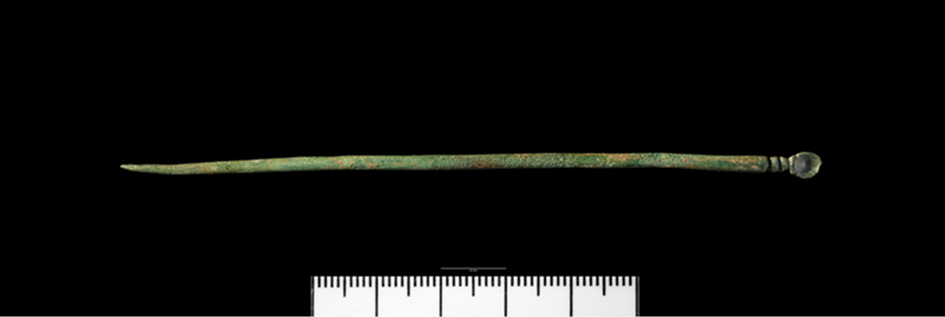
If left untreated, patients with aural myiasis can develop eardrum perforation, middle-ear infection and hearing loss.Reference Hatten, Gulleth, Meyer and Eisenman20,Reference Wagner, Zabala and Choi21 Modern treatment bears some similarities to the recommendations in De Medicina. The first step is to remove visible maggots from the external ear. After manual cleaning, topical liquids are used to inactivate remaining larvae. Although alcohol is still used for this purpose, studies have shown that mineral oil is the safer option.Reference Antonelli, Ahmadi and Prevatt22 Twentieth century physicians also used anaesthetics like cocaine and chloroform to immobilise maggots.Reference Davis23,Reference Huth24 Celsus advocated removing maggots using an ear scoop (Fig. 2), a multi-purpose tool also employed in the extraction of kidney stones from the urethra.6 The number of maggots removed from the ear varies, from as few as 5 to as many as 190.Reference Davis23,Reference Keller and Keller25 Some physicians use topical antibiotics like ivermectin to paralyse remaining maggots. Patients with chronic infestation extending into the mastoid require surgical intervention.Reference Wang, Sun, Kong and Wang26
Roman copper alloy ear scoop (scale represents millimetres). Reproduced with permission of Amgueddfa Cymru – Museum Wales.

Maggot infestation of the ear is a medical problem with importance in the ancient world that earned it a prominent place in Celsus’ description of ear disease. While its prevalence has likely waned over the past two millennia, with fewer people living in close contact with livestock, aural myiasis remains a rare but dangerous affliction of the ear.
Celsus, who was also responsible for Latinising our medical vocabulary, gave us this first description of aural myiasis in the ancient Roman medical literature. His writings retain their intellectual appeal still today, offering a glimpse into the medical landscape of a culture that dramatically influenced modern Western society. Despite the great advances in technology, scientific knowledge and technique enjoyed in the twenty-first century, a fundamental common thread joins Celsus and modern doctors: the motivation to share knowledge of disease and the treatment of patients through writing. After all, the word ‘doctor’ comes from Latin ‘to teach’. By writing stories, we as doctors aim to teach others about patients, while learning about ourselves. In this regard, there is much insight to be gained from an earnest examination of medical history.
Acknowledgement
The authors are thankful to Kostas Kapparis, Department of Classics at the University of Florida, for his comments and suggestions.
Competing interests
None declared.