

Truisms abound concerning the link between healthy journalism and functional democracies. “Democracy dies in darkness” is the Washington Post’s motto, while the Canadian Journalism Foundation's is “As journalism goes, so goes democracy.” In November 2018, the Canadian federal government defended its proposal of tax measures to support news production by stating: “A strong and independent news media is crucial to a well-functioning democracy” (Government of Canada, 2018). At least since the time of Walter Lippmann, the quality of news coverage has been linked explicitly to informed public opinion, political agendas and policy making, a relationship whose mechanics continue to be probed and debated (McCombs, Reference McCombs, Einsiedel and Weaver2017; Ardıç et al., Reference Ardıç, Annema and van Wee2015; Strömbäck, Reference Strömbäck2008; Melenhorst, Reference Melenhorst2015; Wolfe et al., Reference Wolfe, Jones and Baumgartner2013; Tan and Weaver, Reference Tan and Weaver2009; Kim and McCombs, Reference Kim and McCombs2007; Davis, Reference Davis2007).
Recent years, however, have witnessed dramatic alterations in the global information ecosystem. People no longer need to rely on the news media for the formation, debate and expression of opinions; public information is increasingly available directly to anyone, and anyone can easily publish their own opinions or launch a new platform for facts, alleged facts and opinion, almost instantly and with no capital investment. Although information must still pass through definable “gates” and “channels” to travel from private domains to publics, and although news workers are still often involved in these journeys, the processes have become much more complex than in the twentieth century and less reliant on journalists’ decisions about what constitutes “news” (Shoemaker and Vos, Reference Shoemaker and Vos2008: 128–30).
Despite these transformations, Canadians continue to profess significantly more confidence in the trustworthiness of news created by legacy news organizations than do citizens in many other countries, and established media brands continue to be the go-to source for news in this country (Greenspon, Reference Greenspon2017: 42–43; Mitchell et al., Reference Mitchell, Simmons, Matsa and Silver2018: 5; Newman, Reference Newman2018: 118–19; Ekos Research Associates, 2018). It therefore seems reasonable to assume that many (not all) citizens’ understanding of many (not all) politically relevant facts and of the range of available opinions on public policy continues to be shaped to some significant degree by journalists’ choices about newsworthiness, sources and storytelling.
Almost needless to say, these news choices are made under the influence of a wide range of factors. The influences that have been suggested by theorists, critics and observers include (to name a few) the evolution of news routines and cultures, professional assumptions about what constitutes news and how it is most effectively conveyed, the economic and ideological systems within which journalists operate, the ease of reliance on elite sources versus the resource demands of original research, media owners’ financially oriented interest in legitimizing the status quo and delegitimizing the Left, and the regulations and expectations attached to publicly owned or licensed broadcasters (see, for example, Tuchman, Reference Tuchman1978: 209–16; Schudson, Reference Schudson2002: 123–27; Milliband, Reference Milliband1969: 221–24; Shoemaker and Reese, Reference Shoemaker and Reese2014: 44–55; Hackett, Reference Hackett2006: 4–7). The range and potential combinations of these influences can amount to subtle, almost subversive, impediments to journalists’ freedom to live up to their ideals of autonomy, no matter how sincerely these ideals may be held. As Hackett suggested: “The most important form of external influence upon journalism is not explicit and occasional interventions (like an advertiser trying to kill a story, or a source pressing for favourable spin), but rather the long-term restructuring of the ground rules and routines which shape (relatively autonomous) journalism on a workaday basis” (Reference Hackett2006: 7).
Those everyday “ground rules and routines” now include increasing attention to minute-by-minute audience analytics, with demonstrated influence on news judgment (Tandoc and Thomas, Reference Tandoc and Thomas2015; Vu, Reference Vu2014; Welbers et al., Reference Welbers, van Atteveldt, Kleinnijenhuis, Ruigrok and Schaper2016). In this pressure cooker of external influences, journalists’ own role conceptions—and particularly the extent to which they may understand themselves as having a professional role that is differentiated from merely pleasing their employers or audiences—may be seen as a necessary, but perhaps increasingly unlikely, predictor of quality in news content. As Schudson put it: “The desire of journalists to produce news according to their own best judgment can be a significant constraint on commercial motives. It does not always triumph, of course, but as long as journalists are needed to report the news, journalists will have a measure of power in media organizations. They may maintain this power through their vigilance or they may lose it through their fears” (Reference Schudson2002: 123). How strong, then, is the collective commitment of journalists to a sense of socio-political mission? And how potently does that professional mandate constrain the forces inhibiting that mission's fulfilment? These are the driving questions behind our investigation of Canadian journalists’ role conceptions and of the influences they perceive upon their work.
Previous Research
Social psychologists have demonstrated a robust connection between what people say they value, on the one hand, and how they behave, on the other (Feather, Reference Feather1988; Bardi and Schwartz, Reference Bardi and Schwartz2003). Acting in accordance with one's values provides psychological rewards in the form of a sense of consistency (Rokeach, Reference Rokeach1973; Feather, Reference Feather1995). This general truth also applies to the relationship between journalists’ values and their choices at work—a relationship that may be assumed to play out differently in diverse newsmaking cultures (Hanitzsch, Reference Hanitzsch2007; Donsbach, Reference Donsbach2004). These cultures are known to vary significantly among nations and global regions (see, for example, Ahva et al., Reference Ahva, van Dalen, Hovden, Kolbeins, Nilsson, Skovsgaard and Väliverronen2017; Hanusch, Reference Hanusch2009; Preston, Reference Preston2008; Weaver and Willnat, Reference Weaver and Willnat2012), but in economically developed democracies, the idea of a “socially responsible” press that holds special freedoms “in trust for the entire population” (Siebert et al., Reference Siebert, Peterson and Schramm1956: 101) may still broadly be recognized as dominant. Important distinctions among these democracies’ media systems have been theorized, such as the partisan-pluralist tradition rooted in southern Europe and the aspirations toward independent reporting associated with the largely Anglo-American tradition of “liberal” media systems (Hallin and Mancini, Reference Hallin and Mancini2004). Previous work by the authors of this article, together with colleagues in Belgium and Switzerland, investigated the extent to which the legacies of the media systems in those two countries might be associated today with differing role perceptions on the part of journalists in anglophone majorities and francophone minorities (Bonin et al., Reference Bonin, Dingerkus, Dubied, Mertens, Rollwagen, Sacco, Shapiro, Standaert and Wyss2017).
To map the role conceptions of 1,800 journalists in 18 countries in the precursor of the current Worlds of Journalism Study (WJS), Hanitzsch (Reference Hanitzsch2011) used cluster analysis to posit four milieus: “detached watchdogs” focus on informing citizens and monitoring government and business, “critical change agents” seek an impact on social change, and “populist disseminators” work to attract and engage audiences with ideologically neutral purpose; a fourth type, “opportunist facilitators,” occurs mostly in more authoritarian contexts. Such distinctions of emphasis in terms of role have often been associated with journalists’ differing views in particular countries and world regions on relative support for objectivist versus interventionist approaches to political roles (Hanitzsch et al., Reference Hanitzsch, Hanusch, Mellado, Anikina, Berganza, Cangoz, Coman, Hamada, Hernandez, Karadjov, Moreira, Mwesige, Plaisance, Reich, Seethaler, Skewes, Noor and Yuen2011; Donsbach and Klett, Reference Donsbach and Klett1993). More recently, Lauerer and Hanitzsch (Reference Lauerer, Hanitzsch, Hanitzsch, Hanusch, Ramaprasad and de Beerforthcoming) employed a formative approach to constructing indexes of role orientations and perceived influences using the current WJS global data set. They propose four broad role orientations: the monitorial role, the interventionist role, the collaborative role and the accommodative role. Further, they propose six dimensions of perceived influences: political/government influences, organizational influences, procedural influences, economic influences and personal/social influences. The construction of these broad categories is thought to capture the diversity in journalistic cultures that exist around the world.
The first comprehensive study of Canadian journalists’ role conceptions, fielded by Pritchard and Sauvageau in 1996, found evidence of a broadly shared Canadian journalists’ “credo” expressed in five professional values: accuracy, disseminating news quickly, giving ordinary people the chance to express their views, investigating government and providing analysis of complex problems. The study showed considerable similarity in the professional values of journalists at French-language and English-language news organizations, casting doubt on assumptions that English-language journalists might be more oriented toward facts and French-language journalists toward opinion (Pritchard and Sauvageau, Reference Pritchard and Sauvageau1999: 108–11). However, this Canadian credo has yet to be situated in a more global perspective. To what degree do these conceptions differ from journalists globally—or, more specifically, from those within the “liberal” media system that, as classified by Hallin and Mancini (Reference Hallin and Mancini2004), generally aligns with anglophone-dominant developed countries? Thanks to the ongoing Worlds of Journalism Study, we are now in a position to begin answering these questions by comparing Canadian journalists’ responses to those of their peers elsewhere.
There is also reason to probe the degree (if any) to which the Canadian credo has survived the past two decades of profound change. When a panel of approximately 40 per cent of Pritchard and Sauvageau's (Reference Pritchard and Sauvageau1999) respondents were resurveyed seven years later, support for the journalists’ credo had eroded somewhat among journalists at English-language media but not among those at French-language media (Pritchard et al., Reference Pritchard, Brewer and Sauvageau2005). Perhaps significantly, the period covered by those surveys had seen a rise in Internet usage and consolidations in Canadian news-media ownership (Soderlund et al., Reference Soderlund, Brin, Miljan and Hildebrandt2012), but those changes were mere foreshadows of the more landscape-altering birth of social media that followed, with Facebook's launch in 2004 and, the following year, with Google's mastery of the personalized search algorithm (Greenspon, Reference Greenspon2017: 99). With journalists now facing stiffer competition from informal media than from other traditional news sources, measures of achievement have become more diverse, while the availability of real-time audience analytics has heightened journalists’ awareness of the popularity (versus social importance) of their coverage (Bruns, Reference Bruns2005; Peer and Ksiazek, Reference Peer and Ksiazek2011; Tandoc, Reference Tandoc2014; Thompson, Reference Thompson2014; Lee and Tandoc, Reference Lee and Tandoc2017).
The impact of these changes on the news business was dramatic. As advertising revenue, formerly earned in return for news organizations’ investment, began flowing inexorably to Google and Facebook, legacy companies’ profitability fell precipitously. The sheer number of full-time employed journalists shrank in lockstep, and consumers’ exposure to news became increasingly selective and personalized (Fry, Reference Fry2017; Greenspon, Reference Greenspon2017; Drohan, Reference Drohan2016).
Given these harsh realities of the news business today, it seems reasonable to expect a rise in the relative importance attached by today's journalists to luring, finding and satisfying audiences, as compared with a more monitorial role, by which we mean one that involves independently describing, analyzing and interpreting matters of public interest. The time is therefore ripe to return to the question of who today's Canadian journalists are—or at least who they think they are—in terms of their politically relevant role conceptions and the extent to which they claim personal autonomy in deciding on stories, story angles, sources and narrative frames vis-à-vis social and corporate influences on their day-to-day work. These fluctuating influences may include (in addition to the wider national and cultural contexts noted above) organizational factors—for example, news routines, limits on time and other resources, audience-research data, relationships with sources, employers’ business interests, the views of friends and family and public-relations efforts (Hanitzsch et al., Reference Hanitzsch, Berganza, Cangoz, Coman, Hamada, Hanusch, Karadjov, Ruiz, Moreira, Mwesige, Plaisance, Reich, Seethaler, Noor, Vartanova and Yuen2010).
Our study therefore seeks to understand Canadian journalists’ perspectives of their social purpose and the influences on their work within both global and historical contexts, through investigation of two research questions. First, what conceptions do Canadian journalists have of the political role of the news media? And second, to what extent are Canadian journalists’ conceptions of the political role of the news media distinct from those of journalists in other countries? Taking into consideration the work of Hallin and Mancini (Reference Hallin and Mancini2004) and Hanitzsch et al. (Reference Hanitzsch, Hanusch, Mellado, Anikina, Berganza, Cangoz, Coman, Hamada, Hernandez, Karadjov, Moreira, Mwesige, Plaisance, Reich, Seethaler, Skewes, Noor and Yuen2011), we hypothesized that Canadian journalists would identify with a more liberal and detached approach compared to the global population of journalists but that any such difference would shrink when compared to journalists from countries with similar political, economic and cultural systems. Second, how has the Canadian journalists’ credo, as identified by Pritchard et al. (Reference Pritchard, Brewer and Sauvageau2005), changed (if at all) since the end of the twentieth century? Given the current economic pressures faced by news organizations in general, as described above, we hypothesized that journalists’ role conceptions would have shifted in recent years to attach less importance to the normative monitorial credo and greater importance to audience gratification.
Method
The data used in this analysis were collected for the Worlds of Journalism Study (WJS)—a collaborative research effort comprising 67 countries, with a mandate to “better understand the worldviews and changes that are taking place in the professional orientations of journalists, the conditions and limitations under which journalists operate, and the social functions of journalism in a changing world” (Worlds of Journalism, 2017). Each participating country collected data using a standardized set of questions and provided results to an eventual global data set with 27,567 cases. The specific methods of data collection varied somewhat by country, but all data collected met minimum standards set out by WJS methodology protocols. Given the focus on Canadian journalists for this analysis, we will describe here the procedures used within Canada.
In accordance with the WJS guidelines, a stratified random sampling approach was used to reflect the nature of journalistic employment in Canada. Approximately 15 per cent of the sample was selected from among freelance journalists. The sample of freelance journalists was drawn from a list of self-identified journalists registered with the Professional Writers Association of Canada. The remaining sample was selected from among salaried journalists by first stratifying news organizations by size (small, medium and large), randomly sampling news organizations from within each of the strata and then randomly sampling between two and five journalists from within each of these organizations, depending on the size classification. Sampling was also adjusted to ensure inclusion of sufficient journalists working in French (the final proportion was 31.5%), with all other respondents working in English. The sample included journalists working within publicly and privately owned media types (newspapers, magazines, TV, radio, online and agencies) with national, regional and local reach, and both “quality”/broadsheet and popular/tabloid audience orientation. Telephone interviews were conducted between 2014 and 2016. The response rate was 22 per cent, yielding a sample size of 352. This response rate is as expected, given that participation in this study was voluntary. The identity of each research participant was kept confidential, and data were maintained in a secure manner.
Given the research questions specified above, this report focuses on those responses to the WJS questionnaire that shed light on journalists’ politically relevant role conceptions and the influences on their work. Political role conceptions are determined through a self-reported measure of the relative importance of a range of occupational roles. Respondents rated the importance of 21 potential roles on five-point scales (from extremely important to unimportant). Perceived influences on journalistic work were examined by asking about the relative influence of 27 possible influences (also on a five-point scale, from extremely influential to not influential). All questions regarding roles and influences that are included in the WJS questionnaire are included in this analysis. This questionnaire was constructed with the input from research teams in all 67 participating countries and therefore reflects the breadth of possibility with respect to journalistic roles and influences. Our results provide the mean scores for each item. Within the tables, these items are organized thematically, according to the conceptualization proposed by Lauerer and Hanitzsch (Reference Lauerer, Hanitzsch, Hanitzsch, Hanusch, Ramaprasad and de Beerforthcoming) mentioned earlier in this article.
To situate Canadian journalists comprehensively in the global context, we made comparisons against four comparator groups of WJS-participant countries. First, we compare Canadian journalists to those from all of the other 66 participating countries to offer a global comparison. Second, given our desire to compare Canadian journalists to those from countries with similar political and economic systems, we compare Canadian journalists to those from other “developed countries” as defined by the United Nations World Economic Situation and Prospects classification (United Nations, 2018). Third, recognizing the way in which language may relate to a journalistic culture, we offer a comparison group that includes those developed countries for which English is the dominant language (Australia, Ireland, New Zealand, the United Kingdom and the United States). Lastly, we compare Canadian journalists to those from the United States alone, given both the strong cultural and economic connections between the two countries overall and, more specifically, Hallin and Mancini's (Reference Hallin and Mancini2004) assumption of a strong similarity between the two countries’ media systems.
To make these comparisons, analysis of variance tests were used to determine if the differences between the mean scores were statistically significant (p < .05). The means were calculated based on individual responses and not on averaged country mean scores. Thus while all participating countries met the minimum standards in terms of sample sizes, some countries contributed a greater number of journalists to the overall data set than others. The average sample size was 411.45 (sd = 211.78) and the median sample size was 371. The minimum sample size was 90 (Bhutan), and the largest was 1,362 (Denmark). Seventy-five per cent of the participating countries contributed samples ranging from 200 to 600 journalists, and no single country contributed more than 5 per cent to the total sample.
To answer the second research question, which investigates the possibility of changes to the Canadian credo since the end of the twentieth century, we were obliged to employ a more general approach. The questions asked by Pritchard et al. (Reference Pritchard, Brewer and Sauvageau2005) differed in several respects from our internationally standardized questionnaire; their respondents were offered 13 role statements, compared with 21 adopted by global consensus for the WJS questionnaire. Nevertheless, we were able to identify seven role statements that were sufficiently similar between the two studies to be paired up. We then examined the relative rank of importance accorded to these paired roles in each study. The seven pairings may be broadly summarized (in order of the mean scores by 1996 respondents) in the following way: accurate reporting on public affairs, analyzing and interpreting current affairs, allowing people to express their views, scrutinizing business activities, providing news of interest to the widest audience, providing entertainment and relaxation and influencing public opinion. While there are notable challenges and limitations in comparing data that were collected for different purposes and with variations in methodology, we determined that comparing the rankings of these paired statements in 1996 versus 2014–16 could offer high-level insight into the extent to which the Canadian journalists’ credo had either endured or diminished over the raucous intervening period in news-media development.
Results
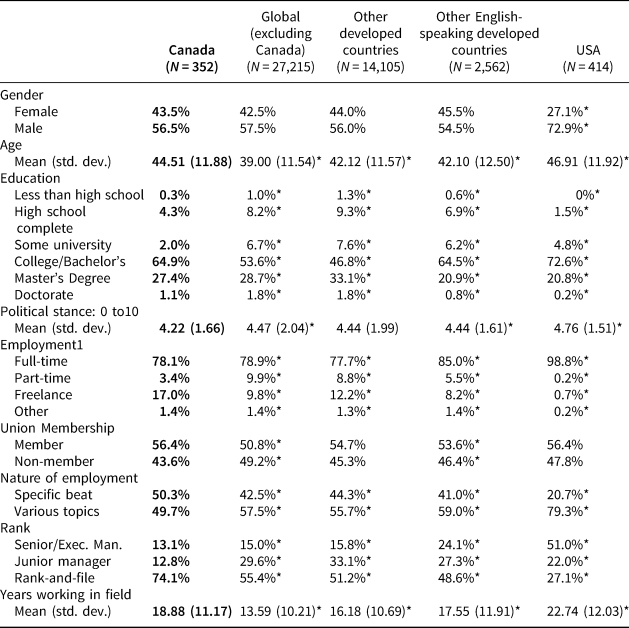
To provide some context for the population of those working in professional journalism, Table 1 presents general demographic, employment and political characteristics. Journalists, both in Canada and elsewhere, are slightly more likely to be male than female. Canadian journalists are more likely than their global peers to have a bachelor's or college degree, although there are no substantial differences with respect to their achievement of graduate degrees in journalism. The Canadians are slightly older, at an average of 44.51 years, than the global mean of 39.00.
Demographic and Employment Profile of Canadian Journalists

1Samples stratified by employment and should therefore not be used to make inferences about the population.
* p < .05 when compared to Canadian population
The data on self-described political stance (measured from 0, representing the left end of the political spectrum, to 10, representing the right end) suggest that Canadian journalists lean, on average, slightly more left of centre (with a mean score of 4.22) than either the global sample (4.47) or even that of English-speaking developed countries (4.44). However, it is noteworthy that 60.5 per cent of journalists who stated their political stance identified themselves in the centre-most range of 4, 5 or 6.
Further, when asked how they voted in the most recent federal election (data not presented in Table 1), 27.1% of the Canadian journalists reported voting for the Liberal party, 23.7 per cent for the New Democratic party, 8.5 per cent for the Conservative party and 13.5 per cent for other parties (including the Green party and the Bloc Québécois), with 4.8 per cent reporting that they did not vote. Important, however, is that a little over 22 per cent of the sample did not respond to this question. (For about 100 respondents, this “most recent” election was in 2011, while others were interviewed after the 2015 election; the fluctuating popularity or otherwise of particular political leaders may have distorted the apparently lopsided spread of party preferences.)
Political and social role orientations
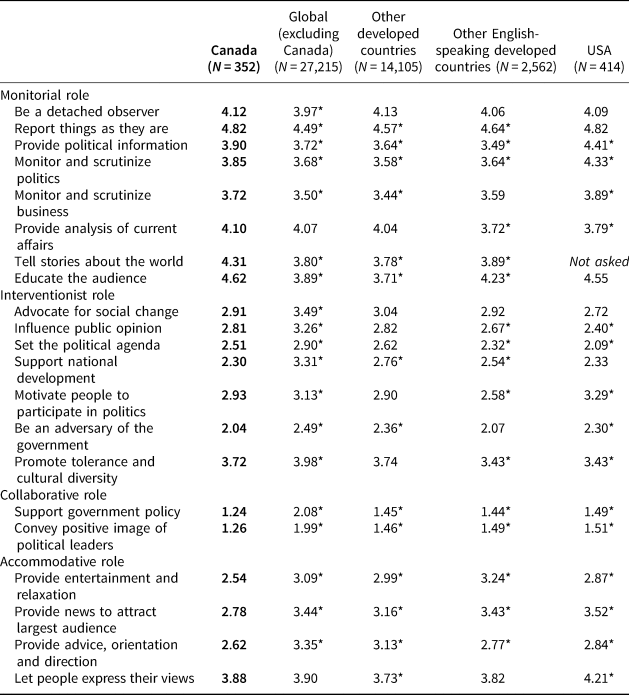
Table 2 provides the mean scores for each of the 21 role orientations, grouped by themes. From a political perspective, our clearest finding concerns the extent to which Canadian journalists are more likely than their peers elsewhere to understand themselves as having a strongly monitorial role, which we understand in much the same way as do Christians et al. (Reference Christians, Glasser, McQuail, Nordenstreng and White2009: 137–40). Under this theme heading, the Canadians believe most strongly that they should “report things as they are” (4.82), tell stories about the world (4.31) as detached observers (4.12), as a way to educate the audience (4.62) and to provide analysis of current affairs (4.10). Their role is one that provides political information (3.90) and monitors and scrutinizes the conduct of both politics (3.85) and business (3.72). Nearly all these mean scores are significantly higher than those from elsewhere in the world at large, from other developed countries and from the English-dominant developed countries. However, the comparison with US journalists is more complex; three of that country's mean scores are higher than Canada's, one is lower and the remainder are similar. It is noteworthy, however, that even though Canadian journalists reported a higher average score for “report things as they are,” all comparison groups ranked this item as the most important relative to other role conceptions queried as part of the survey.
Perceived Roles: Average Score on Scale from 1 (Strongly Disagree) to 5 (Strongly Agree)

*p < .05 when compared to Canadian population
The apparent Canadian exceptionalism on monitorial roles is thrown into sharper relief when contrasted to statements that suggest a role that we (again echoing Christians et al., Reference Christians, Glasser, McQuail, Nordenstreng and White2009) describe as collaborative. This role encompasses functions such as supporting government policy (1.24) and conveying a positive image of political leadership (1.26). Once again, Canadians are not alone among comparator groups in ranking this role as less important than others, but the Canadians’ scores are exceptionally low when compared with other groups—this time, including the United States.
Another consistent difference between the Canadian and all comparator means may be seen in the lower degree of importance that the Canadian respondents placed on accommodative functions.Footnote 1 Their mean scores on items regarding the importance of providing entertainment and relaxation (2.54), providing news that attracts the largest audience (2.78) and providing advice, orientation and direction for daily life (2.62) were lower than for all other comparator groups. However, when examining more interventionist roles, the pattern is more nuanced. Like journalists in developed countries generally, the Canadians are disinclined to support governments or, conversely, to advocate for social change. On the other hand, they support a role of promoting tolerance and diversity more strongly than do others in the English-dominant country group (though still below the world average) and are weaker than others in the English-speaking developed group in rejecting the roles of influencing public opinion and setting the political agenda.
Perceived influences on journalistic work
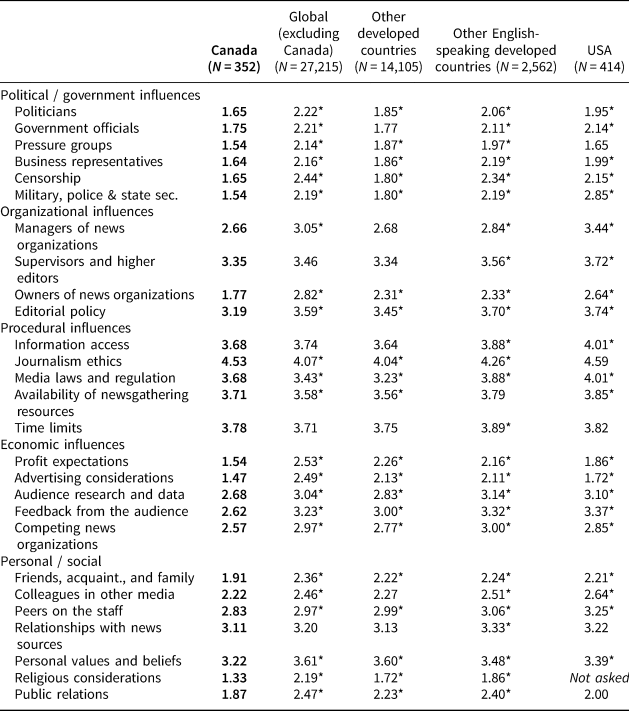
The extent to which journalists report their professional work as being subject to various influences is illustrated in Table 3. These results show that Canadian journalists profess strikingly low levels of influence compared to journalists in other countries. Canadian journalists tended to report “little” to “no” influence upon their work by politicians, government officials, pressure groups and business representatives, with mean scores lower than for all other comparator groupings, including the United States, as are the means for the influence of profit expectations and advertising considerations.
Perceived Influences: Average Score on Scale from 1 (Strongly Disagree) to 5 (Strongly Agree)
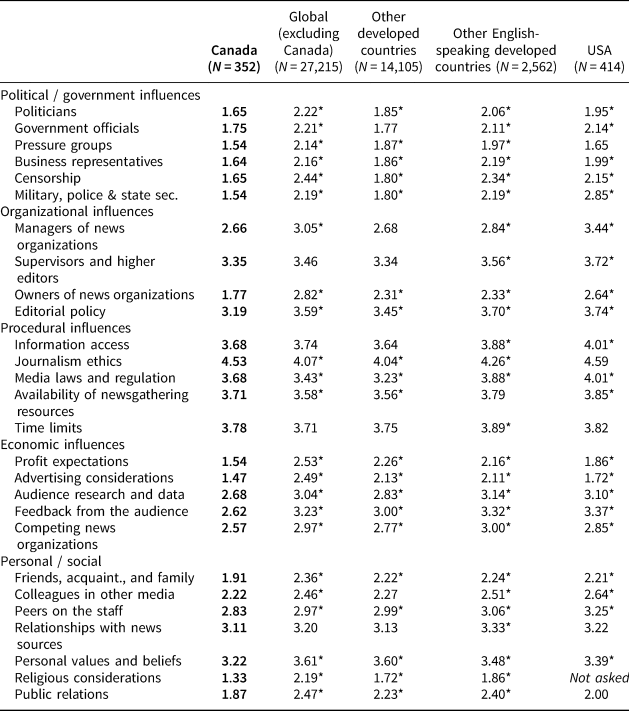
*p < .05 when compared to Canadian population
In general, Canadian journalists report that political, economic, organizational and social factors have relatively little influence on their professional work. The mean scores even for acknowledged influences in these categories, such as editorial policy (3.19) and personal values and beliefs (3.22), tend to only slightly exceed the midpoint (3.0) between agreement and disagreement with the existence of influence, and they remain lower than in all other countries. Unsurprisingly, greater influence is acknowledged for supervisors and higher editors, but even these scores are lower than in comparator countries.
Greater degrees of influence are reported for the procedural aspects of Canadian journalists’ work, especially ethics (4.53), time limits (3.78) and the availability of newsgathering resources (3.71). With the exception of time constraints, the scores in this group are higher compared to journalists worldwide but still lower than those of journalists in other English-speaking developed countries, including the United States. (The influence of time limits is relatively similar across all groups.) However, all groups report these limitations to be among the strongest in comparison to the other influence sources.
Put together, the findings reported so far suggest both similarity and distinctiveness in the ways that Canadian journalists account for their roles and the influences on their work. Canadian journalists are similar to journalists in other countries in terms of the relative rank-order of many political role conceptions and perceived influences. However, Canadian journalists distinguish themselves in the degree of role-importance and of reported influence. Considerations associated with neutrality and autonomy seem especially distinct, as evidenced by the professed lack of political, organizational and economic influences and the importance ascribed to monitoring power, accurate reporting and independent analysis. Contrary to our hypothesis in this respect, a distinctively Canadian emphasis emerged in Canadian journalists’ role conceptions and perceived influences, even when compared to countries with similar political, economic and cultural systems. Except in a few isolated respects (to be discussed below), Canadian journalists profess a distinctively detached, critical and autonomous approach to their work oriented to the public interest.
The credo in historical perspective
Our second hypothesis proved as imperfect as the first. We have noted above the impossibility of a firmly quantitative comparison between the role scores reflected in the Pritchard-Sauvageau credo and those used in our globally comparable study; nor did the earlier study include any questions relating to influences over professional work. Yet a resemblance may be seen almost at a glance between that turn-of-century monitorial credo and the above-described findings from our study, conducted more than 20 years later.
Beyond what immediately meets the eye, this consistency was confirmed using the method of ranking paired variables. The complete list of roles in the panel study of Pritchard et al. was as follows, with the rankings accorded by Canadian journalists overall in 1996 followed by those for 2003, and ties indicated with asterisks: accurately report the views of public figures (1,1); get information to the public quickly (2,2*); provide analysis and interpretation of complex problems (3,4); give ordinary people a chance to express views (4*,5); investigate activities of government and public institutions (4*,2*); discuss public policy while it is being developed (6,6*); be skeptical of the actions of public officials (7,6*); be skeptical of the actions of business (8,8); focus on news of interest to the widest possible audience (9,9); develop the cultural and intellectual interests of the public (10,10); increase circulation or ratings (11,11); provide entertainment and relaxation (12,12); influence public opinion (13,13).
Since providing accurate information was ranked highest among all role values across the entire WJS global sample, it may not be surprising that this same role held top rank among the Canadians in 1996, in 2003 and again in 2014–16. Less predictable is that second place remained constant as well: providing analysis of current affairs. Allowing people to express their views took third place, while scrutinizing business affairs took fourth place, both in 1996 and in 2014–16 (although the latter two roles switched in 2003).
Relative to these four roles implying detached reporting and analysis, lesser importance was accorded by both the turn-of-century respondents and by the contemporary Canadian group to influencing public opinion (which ranked last of all roles surveyed in 1996), providing entertainment and relaxation (last among the paired roles in 2014–16) and providing news of interest to the widest audience. Thus contrary to our hypothesis that these roles would rank higher in the current journalistic context, this very preliminary analysis indicates there is some stability in this credo.
Discussion and Conclusion
Drawing together the results of our global and historical comparisons, it seems clear that a commitment to accuracy in reporting and analysis and a commitment to social and political neutrality are longstanding features of Canadian journalists’ professional self-identification. Even two decades of turbulence and disruptive shifts in the political, economic and social contexts of news-media businesses do not appear to have significantly budged journalists from this position, and attracting, entertaining and influencing audiences remain less important than more politically relevant monitorial roles.
On a global stage, this places the political role conceptions of Canadian journalists firmly in the category of “detached watchdogs,” who define themselves by the role of informing citizens about, and monitoring, government and political institutions (Hanitzsch, Reference Hanitzsch2011). However, the Canadian detachment comes with an asterisk: while neither adversarial to government nor inclined to implicate themselves in social change, they do want to promote tolerance and diversity. Canadian journalists’ account of the influences on their practice is consistent with their distinct emphasis on monitorial roles: as compared with other country groupings, they experience themselves as more influenced by procedural and ethical limitations than by political, business or even managerial influences.
It would be an error to take these findings at face value, as if a person's own account of role or influences is necessarily the last word on the matter. It is unlikely that journalists are quite as “detached” as they might believe. A significant literature points to the role of political and economic elites in shaping news coverage and content (Chomsky and Herman, Reference Chomsky and Herman1979; Bennett, Reference Bennett1990). Shoemaker and Reese (Reference Shoemaker and Reese2014) suggest a much broader range of influences over media content than do journalists themselves—including ideology and cultural narratives, which operate more elusively in the selection and formation of news stories and which serve to reproduce particular interests (Hackett and Zhao, Reference Hackett and Zhao1994).
None of our general findings, therefore, are intended to suggest that assertions of professional role orientations and perceived influences, however sincere, tell the full story of professional orientations in practice. Prima facie, it seems unlikely, for example, that managers and business owners—and the need to attract and satisfy audiences—actually have as little relative influence on news work in practice as is implied by the journalists’ conceived autonomy and, in turn, on the pre-eminence of independent monitorial reporting roles. As Plaisance and Skewes demonstrated (Reference Plaisance and Skewes2003), journalists’ statements about their values and roles sometimes seem so mutually contradictory as to indicate some ambivalence, particularly about the value of an adversarial stance toward power versus the ideal of neutrality. And as Voakes found in comparing journalists’ choices in hypothetical scenarios to their separate, theoretical ratings of lists of social influences, journalists’ ethical choices interact with their own understandings of roles and values in “a dynamic swirl of social factors” (Reference Voakes1997: 21). Yet journalists persist in affirming a collective commitment to monitorial rigour; the way they tend to describe factual verification, for instance, has been described as “a prominent, dynamic figure in the stories that journalists tell of their work” (Shapiro et al., Reference Shapiro, Brin, Spoel and Marshall2016: 45). Some might suspect persistent self-identifying narratives of this kind as pragmatic elements in an always-embattled profession's self-defining “boundary work” (see Berkowitz and Gutsche, Reference Berkowitz and Gutsche2012; Eldridge, Reference Eldridge2014). But it seems more likely, given the above-mentioned social-psychological rewards of moral consistency, that values-narratives will constructively influence both normative professional cultures and journalists’ personal, internalized approaches to their work—their ideology of practice.
If Canadian journalists’ collective account of their independence and detachment is best understood as a values narrative or, indeed, article of faith, it becomes apt that two highly disruptive decades ago, Pritchard and Sauvageau had already settled on the term “credo” (“I believe”) to describe Canadian journalists’ collective orientation to the rapid dissemination of accurate information and analysis of public information and opinion. Like many quasi-religious narratives, this orientation drives an impassioned sense of mission—in this case, a perhaps career-limiting commitment to put the public interest above the interests of news-industry stakeholders.
Understanding the distinctive story that journalists continue to tell themselves about their political role conceptions should therefore prompt new directions of inquiry. How do Canadian journalists’ personal characteristics and the organizational attributes of their employers correlate with professional role conceptions? To what extent might journalists’ political leanings impact the way they understand their work or how they portray different types of influences? There are also structural influences to explore. For example, recognizing that the characteristics of an employer organization can influence the role orientations of journalists (Langlois and Sauvageau, Reference Langlois and Sauvageau1982) suggests a need for further analysis of how role perceptions and norms of practice correlate with working conditions such as union membership, freelance/part-time/full-time status and permanent or contract employment. Given the likelihood of continued transformations in the media and political landscape, we also hope to follow up with the surveyed journalists in this study to examine the degree of stability in their opinions.
Perhaps most important, it is necessary to understand the degree to which, and the manner in which, professional aspirations are reflected in particular choices that journalists make in covering and interpreting political, economic and cultural events, exposing issues warranting political action and policy change, and scrutinizing the effectiveness of democratic institutions. Since we have been describing apparent articles of faith, it may be worth recalling that religious leaders often describe faith as dead unless expressed in works. In the same vein, the next stage of our research will expand our methodology to explore the impact of the Canadian credo upon journalists’ actions in shaping the content of news and, by extension, the public's perception of democratic life.
Author ORCIDs
Heather Rollwagen, 0000-0002-5241-8527
Acknowledgments
The authors wish to thank David Pritchard, who generously provided feedback on earlier versions of this article, as well as the CJPS reviewers for their constructive ideas and helpful comments. We also acknowledge the support of the Social Sciences and Humanities Research Council Insight Grant program.