Implications
Diseases negatively affect feed intake and growth in pigs. This often results in a decrease in feed efficiency, an increase in production costs (e.g. feed and veterinary costs) and an increase in nutrient excretion and in environmental impact. Medication and/or feed additives are often used to limit the negative consequences of diseases. However, the development of sustainable pig production systems requires reducing the use of medication and feed additives. The ability to predict the performance of pigs under a wide range of sanitary challenges allows using management and feeding strategies to minimize the negative consequences.
Introduction
The health status of pigs is often challenged in commercial farms, leading to a lower performance compared with what is potentially possible under good conditions. Several environmental and housing factors are responsible for the reduced performance (Tillon and Madec, Reference Tillon and Madec1985). A wide range of pathogenic agents (Kyriazakis and Houdijk, Reference Kyriazakis and Houdijk2007) such as viruses, bacteria, parasites and fungi, as well as social and climatic conditions (Wellock et al., Reference Wellock, Emmans and Kyriazakis2003) and the degree of hygiene (Williams et al., Reference Williams, Stahly and Zimmerman1997) can reduce feed intake, growth and feed efficiency. The deleterious effects on the performance of these factors, defined hereafter as sanitary challenges, are associated with the stimulation of the immune system, which triggers a series of responses of the animal, including a reduction in feed intake and increases in energy expenditure, body protein synthesis and catabolism and body temperature (Black, Reference Black2009). These responses are mediated through hormones, such as glucagon and corticosterone, and cytokines that regulate nutrient metabolism, immune function and growth (Klasing et al., Reference Klasing, Johnstone and Benson1991). Following a sanitary challenge, nutrient partitioning can be altered away from growth (and in particular from tissue protein accretion) toward metabolic responses in support of immune function (Klasing and Johnstone, Reference Klasing and Johnstone1991; Johnson, Reference Johnson1997; Spurlock, Reference Spurlock1997). The extent and the duration of the pathophysiological responses depend on the type and the intensity of pathogen exposure and on the host's ability to stimulate its immune response (Sandberg et al., Reference Sandberg, Emmans and Kyriazakis2007; Kyriazakis and Doeschl-Wilson, Reference Kyriazakis and Doeschl-Wilson2009). Different concepts and approaches have been developed to represent the effect of disease on feed intake and growth in pigs (Black et al., Reference Black, Bray and Giles1999; Sandberg et al., Reference Sandberg, Emmans and Kyriazakis2006; Kyriazakis and Doeschl-Wilson, Reference Kyriazakis and Doeschl-Wilson2009). However, predicting the effects for each of the major diseases in a production environment requires quantifying how feed intake and growth are affected by different sanitary challenges (Pomar et al., Reference Pomar, Harris and Minvielle1991; Lovatto and Sauvant, Reference Lovatto and Sauvant2003; van Milgen et al., Reference van Milgen, Valancogne, Dubois, Dourmad, Sève and Noblet2008). This is the objective of this study using a meta-analysis of published results.
Material and methods
Data entry
A database (not available but the list of references used in the meta-analysis is indicated in supplementary materials) was constructed using 122 experiments published between 1968 and 2009 reporting the effects of different sanitary challenges on feed intake and growth in pigs. The selection of candidate publications was based on three criteria: (1) experiments should deal with at least one of the six sanitary challenges studied; (2) experiments should report the average daily feed intake (ADFI) and the average daily gain (ADG); (3) experiments should include a control treatment of pigs that were not challenged. For each experiment, information describing the animals (e.g. sex, genetic origin, number of pigs per treatment, weaning age, BW), experimental conditions (e.g. animal housing, diet composition, duration of the experimental periods), ADFI and ADG was included in the database.
A total of six sanitary challenges were considered (Table 1). Digestive bacterial infections (n = 29) corresponded to experimental infections of pigs, mainly with Escherichia coli (E. coli). Pigs were infected orally or intragastrically. Most of the experiments consisted of a single inoculation at the beginning of the experiment, although multiple inoculations were also used (nine experiments used two to eight inoculations). Inoculation doses varied between 108 and 1012 cfu. These doses were considered (by the authors) to be optimal to induce infection, but the dose effect was not tested. Poor housing conditions (n = 20) corresponded to pigs raised under sub-optimal conditions including poor hygiene conditions (n = 13), exposure to extreme temperature (heat or cold stress; n = 5) and limiting space allowance (n = 2). Poor hygiene conditions consisted of keeping pigs in pens that were not cleaned or disinfected after a previous occupation by other pigs, resulting in a moderate inflammation model (Williams et al., Reference Williams, Stahly and Zimmerman1997; Le Floc'h et al., Reference Le Floc'h, Jondreville, Matte and Seve2006). Lipopolysaccharide (LPS) challenges (n = 12) corresponded to experimental inflammation of pigs with LPS from E. coli. Pigs received intramuscularly approximately 200 μg LPS/kg BW through one or more injections. Mycotoxicoses corresponded to dietary intoxications with a single mycotoxin (n = 31) or combinations of two or three mycotoxins (n = 8). The main mycotoxins used were aflatoxin, deoxynivalenol, fumonisin and zearalenon. The toxin contents varied between experiments but also within experiments because half of the experiments tested a dose effect. Parasitic infections (n = 12) corresponded mainly to single experimental infections with different species of digestive parasites (n = 7) or with either blood (n = 1), kidney (n = 1) or skin parasites (n = 3). Except for experiments with skin parasites, pigs were infected orally with varying doses within an experiment to test a dose effect. Respiratory diseases (n = 10) corresponded either to single experimental infections with porcine reproductive and respiratory syndrome virus (PRRSV; n = 5), single experimental infections with respiratory bacteria (e.g. Mycoplasma hyopneumoniae or Pasteurella multocida; n = 3) or both (n = 2). Pigs were infected once intranasally at the beginning of the experiment. Infectious doses were reported only for PRRSV (more than 104 Median Tissue Culture Infective Dose, which was considered to be the optimal infectious dose by the authors).
Number of experiments and treatments for each sanitary challenge in the meta-analysis

LPS = lipopolysaccharide.
Management and analysis of data
Each record of the database corresponded to a group of animals of the same age subjected to the same treatment during a given period in an experiment. If an experiment reported data for different periods, the ADFI and ADG across periods were also included in the database. In some experiments, performance was also recorded during successive measurement periods, and this information was also retained. The six challenges were analyzed separately and several coding variables were used to identify experiments, experimental factors and repeated measurements within an experiment (Sauvant et al., Reference Sauvant, Schmidely, Daudin and St-Pierre2008). The response of the animals to an experimental challenge was calculated relative to that of the control group and expressed as the percentage (i.e. ΔADFI and ΔADG, for, respectively, the relative change in ADFI and ADG). This allowed accounting for a large part of the variation between experiments. Descriptive statistics were performed on the main characteristics for each challenge. Graphical analyses were carried out throughout the meta-analytical process to detect outliers and to maintain a global view on the heterogeneity of the data, the nature of the relationships between and within experiments and the relationship between the variables to select statistical models (Sauvant et al., Reference Sauvant, Schmidely, Daudin and St-Pierre2008).
In all, three analyses were carried out to study the feed intake and growth responses. The first analysis focused on the mean effect of each challenge on ΔADFI and ΔADG measured during the overall experimental period, which was tested using a t-test. The second analysis studied the relationship between ΔADG and ΔADFI using linear (1) and quadratic regressions (2):


The intercept (α) reflects the reduction in ADG not related to the reduction in ADFI, which can be interpreted as an indicator for maintenance. The slope (β) reflects the extent of the change in ADG associated with the reduction in ADFI between challenged and control pigs, and is an indicator of the feed efficiency. Variation between experiments was not explicitly included in the models because the results were expressed relative to the control group. The age of the pig at the beginning of the challenge (i.e. initial age) and the duration of the experimental periods were considered as covariates in the regression analysis. Because the reduction in the growth rate may be age or BW dependent (Coop and Kyriazakis, Reference Coop and Kyriazakis1999; Kyriazakis and Houdijk, Reference Kyriazakis and Houdijk2007), and the duration of the experimental periods varied between studies, the magnitude of the response may also vary. Although the pathogen dose may influence the response of an animal, it was not taken into account, because a dose effect was considered only in the experiments with mycotoxins and parasitic infections. In addition, the types of mycotoxin and parasite differed between experiments. The regression parameters and correlations were considered significant when P < 0.05, whereas P < 0.15 indicated a trend. The covariates were maintained in the regression analysis when the effect was significant. The normality of residuals was tested using the Shapiro–Wilk test and outliers were identified on the basis of residuals, HI leverage and Cook's distance (Sauvant et al., Reference Sauvant, Schmidely, Daudin and St-Pierre2008). These analyses were carried out using the Minitab® Statistical Software, version 15 (2007).
The time necessary to observe a response or first clinical signs may depend on the pathogen and the host's ability to cope with a challenge. In a third analysis, the effect of the duration of the overall experimental period on ADFI and ADG was assessed using linear-plateau (LP) (3) and curvilinear-plateau (CLP) (4) regression models:


The parameters L, a and T1 correspond, respectively, to the plateau value, the difference between intercept and plateau value and the time necessary to reach the plateau. The intercept was defined as the immediate reduction in ADFI and ADG following the challenge (i.e. at time = 0). The parameter T1 corresponds to the time of recovery (i.e. the time required beyond which no further improvement in ΔADFI and ΔADG is observed), whereas parameter L indicates the extent of the recovery. A zero value for L indicates that pigs fully recovered from the challenge. The hypothesis that L differed from zero was tested using an F-test. This analysis was assessed using the PROC NLIN procedure of SAS, version 8.1 (2000).
Results
Experimental data in the database
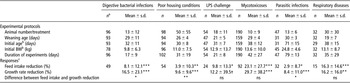
Pigs used in the experiments were weaned between 3 and 4 weeks of age (Table 2) and were mainly of mixed sex and of commercial crossbreds ((Large White × Landrace) × Piétrain or Duroc). Most experimental challenges were initiated 1 to 2 weeks after weaning, except for parasitic infections that started 6 weeks after weaning. The post-weaning period was the most predominant physiological stage, with an average initial BW of 10 kg and an overall experimental duration of 3 to 5 weeks. Most experiments with parasitic infections and approximately 25% of the experiments with mycotoxins were carried out with growing–finishing pigs and the experimental period ranged from 6 to 11 weeks. The ingredient composition of the diets was rarely reported. Some information about the nutrient composition was indicated in experiments testing poor housing conditions or LPS challenge and the CP content was the most frequently reported nutrient (reported in more than 60% of treatments). According to the authors, the nutrient characteristics met or exceeded the nutrient requirements of the animals.
Characteristics of experiments used in the meta-analysis to quantify the effect of a sanitary challenge on feed intake and growth in pigs

LPS = lipopolysaccharide.
aNumber of treatments used for calculating the mean.
bAt the beginning of the experimental challenge.
cThe response was calculated as the difference between challenged pigs and control pigs and expressed as a percentage of the control.
***P < 0.001; **P < 0.01; *P < 0.05; †P < 0.15; ns = non-significant.
Consequences of sanitary challenges on feed intake and growth rate
All sanitary challenges resulted in a significant decrease in ADFI and ADG compared with the control groups, except for the LPS challenge, where a trend (P = 0.14) for a reduction in ADG was observed (Table 2). The most important effects were observed for mycotoxicoses (−23% ADFI, −30% ADG) and respiratory diseases (−16% ADFI, −16% ADG). The smallest effects were observed for parasitic infections (−3% ADFI, −8% ADG) and poor housing conditions (−4% ADFI, −10% ADG). The reduction in ADG was two- to threefold greater than the reduction in ADFI for digestive bacterial infections, poor housing conditions and parasitic infections. The variability in responses was very important, especially for the LPS challenge (the change in ADG varied between −175% and +37%), digestive bacterial infections (−75% to +28% for ADG) and mycotoxicoses (−94% to +26% for ADFI and −164% to +37% for ADG).
Relationship between the reductions in feed intake and growth rate
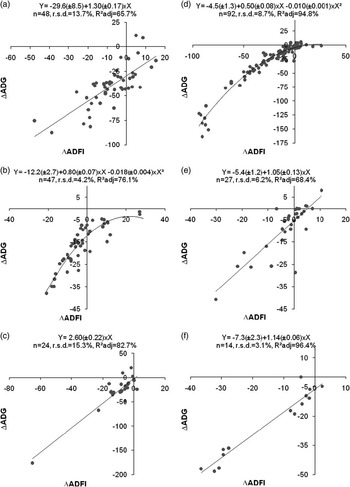
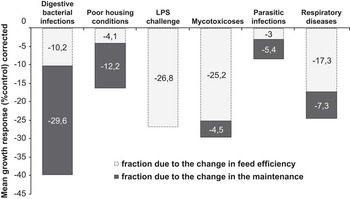
For most sanitary challenges, the relation between ΔADG and ΔADFI was linear, except for poor housing conditions and mycotoxicoses, where the relationship was curvilinear (Figure 1). The initial age and/or the overall experimental duration affected the relationship for challenges other than mycotoxicoses and parasitic infections. The ΔADG decreased with increasing duration of the experimental period for digestive bacterial infections (+0.71% ± 0.23%, P = 0.004), poor housing conditions (+0.08% ± 0.04%, P = 0.04) and LPS challenge (+0.67% ± 0.16%, P < 0.001). The ΔADG also decreased with increasing initial age of pigs for digestive bacterial infections (+0.34% ± 0.20%, P = 0.10), poor housing conditions (+0.20% ± 0.08%, P = 0.01) and respiratory diseases (+0.25% ± 0.06%, P = 0.002). The precision of the regression equations of ΔADG as a function of ΔADFI was reasonable (R 2 > 65%) for all challenges, although a significant part of the variation remained unexplained (Figure 1). The intercept differed significantly from zero and was negative for all challenges, except for the LPS challenge. At the same ADFI, challenged pigs had a lower ADG, indicating an increase in the maintenance requirement. For the LPS challenge, the intercept did not differ from zero and at the same ADFI, challenged and control pigs had the same ADG. However, the estimated slope was substantially greater than one (2.6 ± 0.2), indicating a significant reduction in the feed efficiency. However, one study had a large impact on the value of slope (Figure 1). Respiratory diseases and parasitic infections led to a slight increase in the maintenance requirement, indicated by a reduction in ADG of challenged pigs for the same ADFI (−7.3% ± 2.3% and −5.4% ± 1.2%, respectively). Compared with the control group, a reduction in ADFI in challenged pigs was not accompanied by a reduction in feed efficiency because the slopes were not different from one (1.05 ± 0.13 and 1.14 ± 0.06 for respiratory diseases and parasitic infections, respectively). The greatest increase in maintenance requirement was observed with digestive bacterial infections because ADG was reduced by 29.9% ± 8.5% at the same ADFI. The feed efficiency was also affected by digestive bacterial infections, as indicated by a slope of 1.30 ± 0.17. For poor housing conditions and mycotoxicoses, the responses were curvilinear. Consequently, the more the ADFI decreased in challenged pigs, the more the feed efficiency was reduced. It is possible to partition the response of ΔADG in a component independent of ΔADFI (the intercept) and a component due to the change in ADFI. For digestive bacterial infections and poor housing conditions, 75% of the ΔADG occurred independent of ΔADFI (Figure 2). Although the numerical value of the intercept in parasitic infections was low, it represented almost 70% of ΔADG. For the other three challenges, the intercept explained less than 30% of ΔADG.
Relationship between the change in growth (ΔADG) and feed intake (ΔADFI) of pigs challenged with digestive bacterial infections (a), poor housing conditions (b), LPS challenge (c), mycotoxicoses (d), parasitic infections (e) and respiratory diseases (f). Responses are expressed as results of the challenged pigs relative to that of a control group. The lines represent the linear or the quadratic model adjustments. Estimated parameters differed from zero (P < 0.05), except for the intercept in LPS challenge.

Partitioning of the reduction in the average growth rate following a sanitary challenge between the fraction due to the change in maintenance requirement (i.e. not associated with a reduction in feed intake) or due to the change in feed efficiency (i.e. associated with a reduction in feed intake).

Temporal changes in both responses
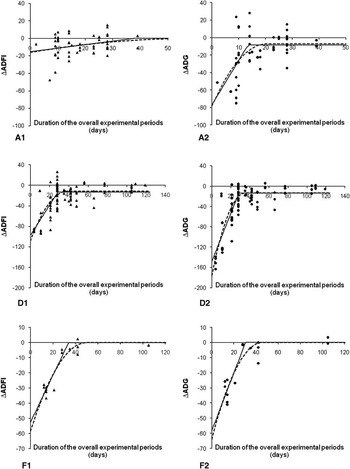
The LP and the CLP models could be used to describe the ΔADFI and ΔADG as a function of the experimental duration for digestive bacterial infections, mycotoxicoses and respiratory diseases, but not for the other three challenges (Figure 3). For all challenges and both responses, the models fitted the data with similar accuracy, although parameter estimates differed (Table 3). The estimates of the immediate reduction in ADFI or ADG (i.e. intercept) were always lower for model LP than for model CLP. The same was true for the time necessary to reach the plateau value. Estimates for the plateau values were slightly higher for model LP than for model CLP. The highest immediate reduction in ADFI and ADG was observed for mycotoxicoses (−98% ± 12.1% to −108% ± 14.8% for ΔADFI and −149% ± 13.7% to −176% ± 16.7% for ΔADG in models LP and CLP, respectively). The immediate reduction in ADG was fivefold greater than the reduction in ADFI for digestive bacterial infections. This ratio did not exceed 1.5 for the other two challenges. The time necessary to reach the plateau value was similar for ΔADFI and ΔADG for mycotoxicoses (30 to 40 days) and for respiratory diseases (30 to 50 days). For respiratory diseases, the plateau value did not differ from zero, indicating that pigs totally recovered. For digestive bacterial infections, growth recovery was incomplete, with an average plateau value of −8% ± 4% during the experimental period, although feed intake recovery was complete (i.e. plateau value not different from zero). The time necessary for total recovery was almost threefold greater for ΔADFI (38 ± 12 and 60 ± 27 days for models LP and CLP, respectively) than for ΔADG (14 ± 3 and 21 ± 5 days for models LP and CLP, respectively). For mycotoxicoses, recovery was incomplete during the experimental period and ADFI and ADG remained on average 13% lower in challenged pigs compared with control pigs for both models.
Relationships between the changes in feed intake (ΔADFI; 1) or growth (ΔADG; 2) and the duration of overall experimental periods in pigs challenged with digestive bacterial infections (A), mycotoxicoses (D) and respiratory diseases (F). Responses are expressed as results of the challenged pigs relative to that of a control group. The lines represent the adjustment with linear-plateau (— LP) and curvilinear-plateau (- - - CLP) models.

Parameter estimates obtained from the LP and CLP models describing the changes in feed intake (ΔADFI) and growth (ΔADG) of pigs challenged with digestive bacterial infections, mycotoxicoses and respiratory diseases relative to the control group as a function of the duration of the overall experimental periods

LP = linear-plateau; CLP = curvilinear-plateau; ADFI = average daily feed intake; ADG = average daily gain; r.s.d. = residual standard deviation.
aThe response was calculated as the difference between challenged pigs and control pigs and expressed as a percentage of the control.
bEstimate and standard error of the difference between intercept and plateau value.
cEstimate and standard error of the time (in days) necessary to reach the plateau.
dEstimate and standard error of the plateau value. *** P < 0.001; **P < 0.01; *P < 0.05, indicate a plateau value significantly different from zero.
eCalculated from the sum of a and L.
Discussion
Methodological considerations
The experiments retained in the meta-analysis consisted of experimental models of infection, stress or inflammation, considered as sanitary challenges, where the response of challenged animals could be expressed relative to that of a control group. We also assumed that the sanitary challenges were validated (i.e. potentially sufficient to induce a response). A disadvantage of our choice to include only experiments with challenged and control pigs is that the number of experiments retained was relatively small. Publications reporting data of health disorders in pigs in association with feeding factors but without a specific experimental challenge were not included in the database.
Approximately half of the experiments in the database tested the effect of the challenge in combination with other experimental factors (e.g. in combination with feeding). However, it was difficult to exploit this information further because the experiments tested different nutritional factors. This probably accounted for a large part of the variation between experiments (Kyriazakis, Reference Kyriazakis2010).
Consequences of immune challenges on feed intake
The amplitude and duration of the reduction in ADFI differed considerably between sanitary challenges, and confirm the results reported by others (Kyriazakis et al., Reference Kyriazakis, Tolkamp and Hutchings1998; Sandberg et al., Reference Sandberg, Emmans and Kyriazakis2006). A reduction in appetite and ADFI is frequently observed following exposure to a sanitary challenge, but the mechanisms implied may differ between challenges. The reduction in ADFI observed for sanitary challenges associated with pathogens (bacteria, virus, parasites) or antigens (LPS) probably results from the activation of the innate immune response through the development of an acute-phase response mediated by cytokines (Klasing, Reference Klasing1998a). The poor housing conditions increase microbial pressure, resulting in a continuous activation of the immune system (Klasing et al., Reference Klasing, Johnstone and Benson1991). Toxins such as deoxynivalenol act directly on brain transmitters implied in appetite regulation (Etienne, Reference Etienne2007).
For a large range of pathogen types and doses that lead to subclinical diseases in a naïve host, reductions in feed intake of 25% have been reported (Kyriazakis et al., Reference Kyriazakis, Tolkamp and Hutchings1998; Sandberg et al., Reference Sandberg, Emmans and Kyriazakis2006). When pigs develop clinical signs after pathogen exposure, a more significant decrease in feed intake and even complete cessation of eating can occur (Kyriazakis and Houdijk, Reference Kyriazakis and Houdijk2007). The intensity and duration of feed intake reduction may differ between challenges and is related to the type and dose of pathogen (Kyriazakis and Houdijk, Reference Kyriazakis and Houdijk2007), but is also influenced by the ability of the pig to cope with challenges (Sandberg et al., Reference Sandberg, Emmans and Kyriazakis2007; Kyriazakis and Doeschl-Wilson, Reference Kyriazakis and Doeschl-Wilson2009).
The immediate reduction in ADFI estimated in this study for pigs challenged with digestive bacterial infections (−15%) is slightly lower than that estimated by Kyriazakis et al. (Reference Kyriazakis, Tolkamp and Hutchings1998). This difference may be due to the limited number of experiments where the experimental period lasted less than 5 days in our study. A stronger reduction in ADFI (−55%) and even a complete cessation of feeding (−100%) occurred for respiratory diseases and mycotoxicoses. Respiratory diseases were mainly caused by PRRSV, which is a virulent pathogen (Zimmerman et al., Reference Zimmerman, Yoon, Wills and Swenson1997) often leading to anorexia for several days (Done et al., Reference Done, Paton and White1996). Mycotoxicoses correspond mainly to diet contamination with aflatoxin or deoxynivalenol, which are known to affect feed intake and can even lead to anorexia for higher doses of mycotoxins (Boudergue et al., Reference Boudergue, Burel, Dragacci, Favrot, Fremy, Massimi, Prigent, Debongnie, Pussemier, Boudra, Morgavi, Oswald, Perez and Avantaggiato2009).
The time of the recovery period, corresponding to the time between the immediate reduction and the constant reduction in ADFI (i.e. the plateau value), was similar for pigs challenged with mycotoxins and respiratory diseases (approximately 30 days) and longer for digestive bacterial infections (at least 40 days). For respiratory and digestive diseases that are associated with pathogens, the duration of the reduction in ADFI depends on the development of the pathogen and reflects the time required for the acquisition and expression of immunity (Coop and Kyriazakis, Reference Coop and Kyriazakis1999). The longer recovery time observed for digestive bacterial infections might be due to the age of challenged pigs, which, in our study, mostly concerned piglets immediately after weaning. Weaning may slow down the maturing of the immune system (Lallès et al., Reference Lallès, Bosi, Smidt and Stokes2007), leading to longer recovery times than in older pigs. Also, digestive bacteria may impair the integrity of the gastrointestinal tract, thereby affecting the digestive capacity of the piglets and thus increasing the time required to recover. In addition, because of abdominal pain caused by digestive infections, the host can develop a feed aversion through a learned association between the sensory properties of the feed and post-ingestive effects (Day et al., Reference Day, Kyriazakis and Rogers1998), leading to longer recovery times. For digestive and respiratory diseases, there was no difference in ADFI between challenged and control pigs after the animals had recovered, which agrees with observations from Kyriazakis et al. (Reference Kyriazakis, Tolkamp and Hutchings1998) and Sandberg et al. (Reference Sandberg, Emmans and Kyriazakis2006). During the challenge, ADG is reduced in challenged pigs, resulting in a lower BW after the challenge compared with that of control pigs. The observation that there is no difference in ADFI once recovered suggests that challenged pigs eat more per kg BW than control pigs. This supports the idea that compensatory feed intake occurs after a sanitary challenge, as suggested by others (Kyriazakis and Emmans, Reference Kyriazakis and Emmans1992). In contrast, ADFI in pigs challenged with mycotoxins did not recover and remained 13% lower compared with that of control pigs. This can be due to the continuous challenge that occurs throughout the experimental period.
Consequences of sanitary challenges on growth
It has been suggested that the growth reduction after a sanitary challenge is not only due to the reduction in ADFI but also due to an increase in requirements related to digestive and metabolic processes (Sandberg et al., Reference Sandberg, Emmans and Kyriazakis2007). The reduction in ADG was proportional to that of ADFI for digestive bacterial infections, parasitic infections, LPS challenge and respiratory diseases. For these challenges, a reduction of 10% in ADFI led to reductions in ADG varying between less than 20% for parasitic infections and respiratory diseases up to 43% for digestive bacterial infections. The reduction in ADFI explained at least 70% of the reduction in ADG for respiratory diseases and less than 30% for digestive bacterial infections. For poor housing conditions and mycotoxicoses, the quadratic term in the regression indicates that the difference in ADG between challenged and control pigs increased when the difference in ADFI became more important. Consequently, the more the ADFI decreased in challenged pigs, the more the feed efficiency was reduced compared with that of the control group.
For digestive bacterial infections, poor housing conditions and parasitic infections, the reduction in ADG may be due to an effect on the gastrointestinal tract and thereby on digestion (Coop and Kyriazakis, Reference Coop and Kyriazakis1999). These challenges may cause intestinal cell damage through proliferation of pathogen or toxins (Klasing et al., Reference Klasing, Johnstone and Benson1991). This can affect the host's ability to digest and absorb nutrients, thereby reducing the availability of amino acids and energy (Turk, Reference Turk1972). Increased endogenous secretions can also result from tissue damage (Sandberg et al., Reference Sandberg, Emmans and Kyriazakis2007), thereby decreasing the apparent protein digestibility as observed during parasitic infections in pigs (Hale et al., Reference Hale, Stewart and Marti1985). In the case of challenges leading to diarrhea (e.g. digestive bacterial infections), the reduction in ADG may also be attributed to water loss. The repair of damaged tissues, as well as the increase in endogenous losses induced by damage, represent a metabolic cost (Sandberg et al., Reference Sandberg, Emmans and Kyriazakis2007) and require nutrients to maintain the integrity of the gastrointestinal tract at the expense of the growth (Klasing et al., Reference Klasing, Johnstone and Benson1991).
Part of the reduction in ADG may also result from the metabolic cost associated with the stimulation of the immune system (Sandberg et al., Reference Sandberg, Emmans and Kyriazakis2007). Energy and amino acids are required for the synthesis of cytokines, antibodies, acute-phase proteins and specific immune cells (Klasing, Reference Klasing1998b). The decrease in ADFI combined with the increase in the nutrient requirements for the immune response may lead to significant changes in metabolism and nutrient fluxes in many organs (Klasing, Reference Klasing1998a). In skeletal muscle, protein synthesis is reduced while protein catabolism is stimulated through the direct action of cytokines (Klasing and Johnstone, Reference Klasing and Johnstone1991). This will contribute to the supply of amino acids to the liver to synthesize acute-phase proteins (Klasing et al., Reference Klasing, Johnstone and Benson1991), but also lead to a reduction in ADG. Sandberg et al. (Reference Sandberg, Emmans and Kyriazakis2007) suggested that the cost associated with the repair of damaged tissues is greater than that associated with immune response. This may explain why bacterial, viral or parasitic challenges have a greater effect on ADG than the LPS challenge.
In our study, recovery was interpreted as the situation in which the ADG of challenged pigs was no longer different from that of control pigs. According to the concept of homeorhesis, an animal under non-limiting conditions has a growth trajectory related to its genetic potential. After a sanitary challenge, the animal deviates from this trajectory but homeostatic regulations ensure that the animal eventually returns to its growth trajectory (Lovatto and Sauvant, Reference Lovatto and Sauvant2003). Total recovery was observed in pigs challenged with respiratory diseases, which supports the idea of compensatory feed intake and compensatory growth (Kyriazakis and Emmans, Reference Kyriazakis and Emmans1992; Lovatto et al., Reference Lovatto, Sauvant and van Milgen2000). However, recovery was incomplete for pigs challenged with mycotoxins, probably resulting from the incomplete recovery in ADFI. Incomplete recovery was also observed with digestive bacterial infections, despite a greater ADFI per kg of BW for challenged pigs. The compensatory feed intake and nutrient supply might be insufficient to cover the important requirements to sustain compensatory growth (Kyriazakis and Emmans, Reference Kyriazakis and Emmans1992). Another explanation is that total recovery may require a longer time than the duration of the experimental period. Also, it cannot be excluded that the growth potential of the animal (most of which are weaned piglets) has been changed following a sanitary challenge (Escobar et al., Reference Escobar, Van Alstine, Baker and Johnson2004).
Conclusion
This meta-analytic approach allowed combining the results of different published experiments on the effect of a sanitary challenge on performance in pigs. For major health disturbances that may occur in commercial pig production, equations were proposed to quantify the reduction in feed intake and growth following a challenge. The reduction in growth is partly due to a reduction in feed intake but also due to changes in digestion and metabolism. The contribution of the latter was most prominent for sanitary challenges that directly affected the gastrointestinal tract. The dynamic pattern in the reductions in feed intake and growth illustrates the responsiveness of the immune system and underlines the necessity to further exploit studies in which the response of animals are recorded during successive measurement periods. The results of this study can also be used to account for the effect of sanitary challenges in predictive growth models of pigs.
Acknowledgments
The authors would like to thank N. Le Floc'h and L. Brossard from UMR1079 for the challenging discussions and help in the statistical analysis. H. Pastorelli was supported by a PhD studentship funded by the Région Bretagne (Rennes, France) and INRA (Paris, France). This study was supported in part by a grant (Contract no. Sv687/10) from the Comité Français d'Evaluation de la Cooperation Universitaire et Scientifique avec le Brésil (COFECUB, France) and the Coordenação de aperfeiçoamento de pessoal de nível superior (CAPES, Brazil), to whom we are grateful.
Supplementary material
The supplementary material referred to in this article is available online at http://www.journals.cambridge.org/anm