Background
From the viewpoint of lifesaving, it is extremely important that emergency medical care functions adequately in the event of a disaster. 1 However, while natural disasters occur frequently in Japan, there are past reports of many cases in which the provision of medical care to victims was insufficient, owing to failures in the communication of information. During the Great Hanshin-Awaji Earthquake of 1995, hospitals in the affected area were damaged; therefore, it was necessary to transport patients to neighboring hospitals, further afield. Reference Nakamura, Mori and Fukuda2 Also, in the 2011 Great East Japan Earthquake, there were reports of problems in the medical system, such as delays in medical intervention due to a lack of information and indirect disaster-related deaths due to the poor evacuation environment. Reference Tsuboi, Hibiya and Tsuboi3–5 Focusing on specific disasters, during the 2007 Niigata Chuetsu-oki earthquake, a small amount of radioactive material was detected leaking from a nearby nuclear power plant. At that time, there was no impact on the public or the environment, but there was also a case where insufficient radiation information was provided to the Japan Disaster Medical Assistant Team (DMAT), and there was a problem with dispatching to the site due to anxiety. Reference Akashi, Kumagaya and Kondo6
Communication infrastructure can be disrupted during a disaster; however, even in such a situation, it is necessary for related organizations involved in disaster response to collect and share information, establish a command chain, and manage medical care provisions. In the UK, an educational system called Major Incident Management and Support (MIMMS) has been established and is used as a model for disaster medical education worldwide. 1 MIMMS emphasizes the importance of the chain of command and communication between related agencies; for example, disaster medical workers learn how to consolidate information and use radios and satellite phones. Reference Kitsuta and Sugiyama7 In Japan, education in accordance with MIMMS is being carried out in DMAT personnel training. In terms of information recording, it is important to collect chronological activity records called “chronological records (CR)” at each institution. Reference Anan, Akasaka and Kondo8 A CR is a record of senders and receivers of information, time, as well as content, and is mainly compiled at the disaster response headquarters of each organization. Reference Tanioka, Okuyama and Nagai9,Reference Takahashi, Saito and Atsumi10 CR are created by logistics staff (LS) who receive various information such as the internet, telephone, and fax communications entering each institution, and share it with the decision-making leaders.
CR will often be handwritten on a whiteboard, making it difficult to share the information obtained by each institution with other institutions. For example, even if the fire department notifies medical institutions by telephone of the number of injured people who need to be transported from the disaster site, only the medical institution that receives the call has this information, and it requires another step for neighboring medical institutions to receive it. In addition, in specific situations, such as a radiation disaster, if the LS receiving the call is not familiar with radiation, it will likely take time to understand the terminology, including the units of the radiation dose. In such a case, there is a possibility that the provision of information to the primary decision maker will be delayed.
Therefore, a chronological record creation system using voice AI (V-CRS) was developed to facilitate the collection of important information in the event of a disaster. V-CRS can convert disaster and medical information obtained by LS from telephone, fax, and the internet into text as a CR through voice recognition using a wearable microphone worn by the LS. An overview of the V-CRS is presented in the next section. In this paper, an overview of the developed V-CRS, as well as test results, was reported, and its usefulness when used by medical institution staff who could be LS.
Methods
Overview of V-CRS
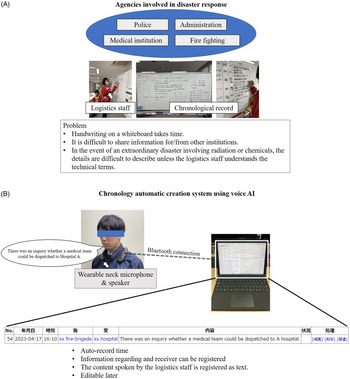
LS in the relevant organizations involved in disaster response hand-write the CR and the associated problems are summarized in Figure 1A. A schematic of the V-CRS developed by the authors is shown in Figure 1B. The functions and development flow of the V-CRS are listed below.
-
1) A bulletin board is established on the internet.
-
2) The user connects the PC to a wearable microphone, as shown in Figure 1B.
-
3) The content that the LS repeats into the microphone is converted into sentences by the Speechnotes function of the Google Chrome app, and the sentences are added to the bulletin board.
-
4) The dates and times of new entries are automatically generated.
-
5) The sender and receiver of the information are registered and can be selected in 1 touch. New registrations are easy to obtain.
-
6) Incorrect text information can be edited later using the keyboard.
-
7) The CR created can be immediately converted into a file (. xlsx,.csv file) that can be edited using Microsoft Office.
Problems in gathering information during disasters and an outline of the chronological record creation system using voice AI (V-CRS) developed by the authors. (A) Problems in collecting information and creating chronology during disasters. (B) An outline of V-CRS.

Utility Study of V-CRS
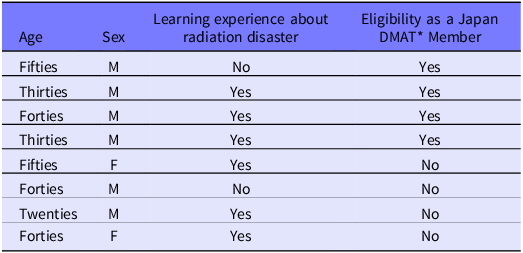
To examine the usefulness of the V-CRS, experiments were conducted on 8 medical personnel who belonged to a medical institution and had experience participating in medical activities and disaster training. Table 1 presents the participants’ information. The attributes are shown separately because the participants had more experience than those who were not DMAT members, as they were required to be trained in handwritten CR during the training program to become a Japan DMAT member.
Subject information and basic attributes

* DMAT means ‘Disaster Medical Assistance Team.’
Details of the experiments are shown below:
-
1) The controller and the participant were each in different rooms, connected by a phone.
-
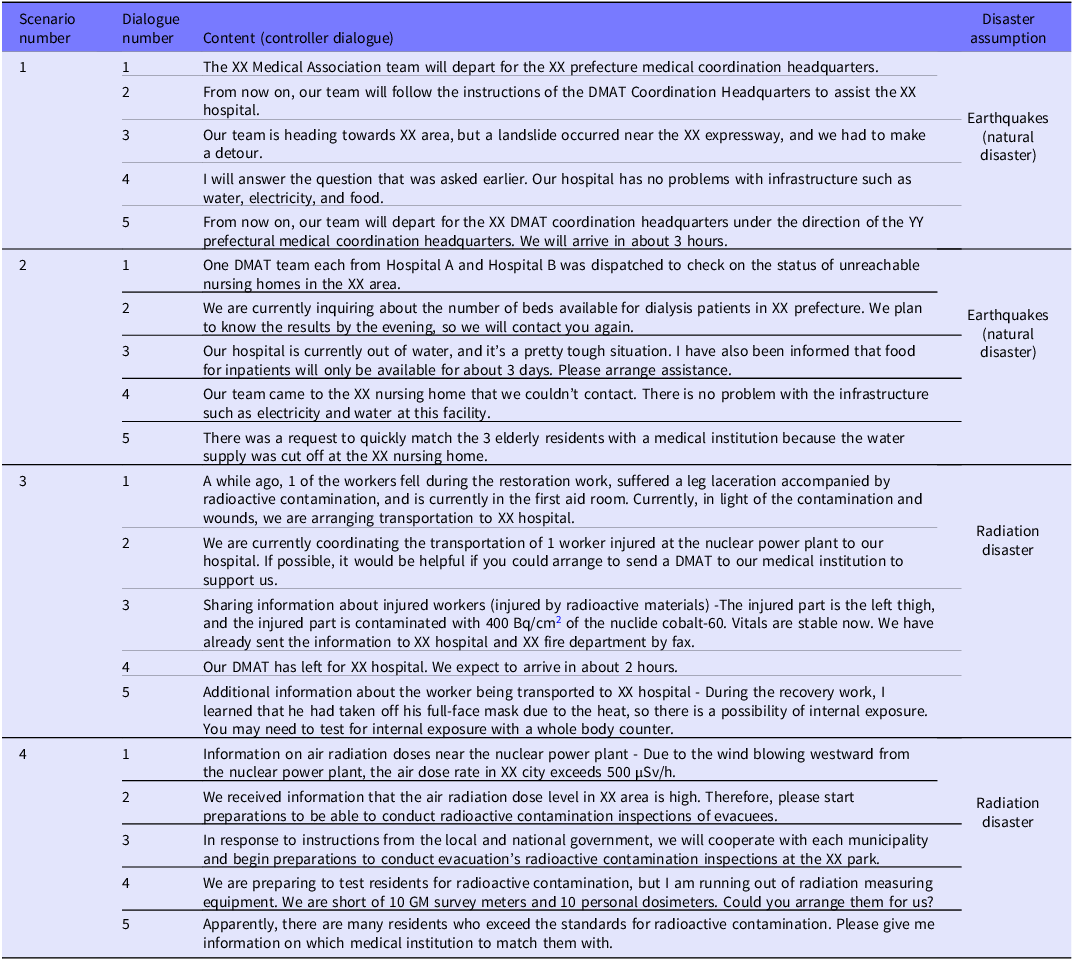
2) The controller sequentially told the participants 4 scenarios, with 5 sentences per scenario, as shown in Table 2.
-
3) The participants then created a CR by: (A) handwriting on a whiteboard, or (B) using the V-CRS.
Scenario details to be described as chronological report

Controllers play various roles such as hospitals, local/ national governments, and dispatched DMAT to make calls.
It is assumed that the subject will work as logistics staff responsible for organizing medical information at the disaster response headquarters of the local government.
‘XX’ and ‘YY’ mean proper nouns.
Since there was a high risk of bias, the participants would remember the scenario content if test B was conducted immediately after test A; hence the interval between A and B was at least 2 months. The order of the scenarios was also changed between A and B, and all phone calls were conducted in Japanese.
After the test, the authors examined whether the time required to create a CR changed between handwritten and V-CRS methods, and whether accurate information could be recorded by each. For numbers 3 and 4, the authors assumed that it would be difficult to describe the physical units, laws, and regulations, as well as names of the measuring instruments without specialist knowledge of radiation. All experiments were conducted between June and October 2021.
Statistical Analysis
Origin 2020Pro (OriginLab, Northampton, MA, USA) was used for t-test processing between the 2 groups, Fisher test, as well as all graphing (including a comparison of the time involved in creating CRs by hand and using V-CRS).
Ethical Considerations
No information leading to the identification of individuals was disclosed to the employees of the medical institutions that participated in the study and completed the questionnaire survey. In addition, we obtained approval from the Ethics Committee of the Hirosaki University Graduate School of Health Sciences to ask individual opinions in the questionnaire survey (Approval No.: 2020-046).
Results
Comparison of Recording Time Between Handwritten CR and V-CRS
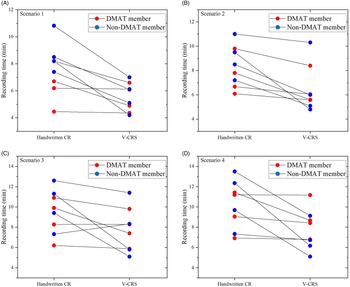
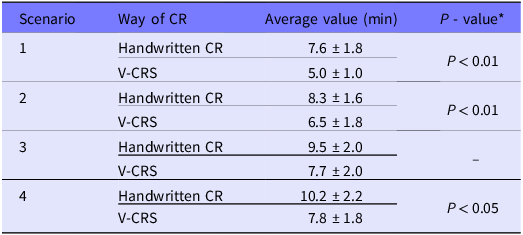
First, all subjects’ CR via handwriting and V-CRS were consistent with the information given by the controller. Therefore, all participants were able to record accurate information in CR. The time required to gather the CR for each subject using handwritten and V-CRS methods is shown in Figure 2. Figure 2A–D is arranged according to the scenario shown in Table 2, and the attribute of the participants indicates whether they are qualified DMAT members. There were participants whose CR recording times were twice as long when using the handwritten method compared to using V-CRS (Non-DMAT personnel shown in Figure 2D, 12.4 min for handwritten CR, and 6.2 min for V-CRS). Table 3 summarizes the results of the statistical analysis of the differences in CR recording times between handwritten and V-CRS methods, regardless of the subject’s attributes. Although no difference was found at a significance level of 0.05, aside from scenario 3 (P = 0.063), the V-CRS was shown to predominantly reduce the CR recording time compared to handwritten CR in Scenarios 1, 2, and 4.
Time required for CR by scenario. (A) through (D) show scenarios 1 through 4, which show how each subject can change between handwritten and V-CRS methods.

Differences in recording time due to differences in chronological record acquisition methods

A t-test was performed on the average recording time of Handwritten CR and V-CRS in each scenario. A P - value of 0.05 or less is considered significant.
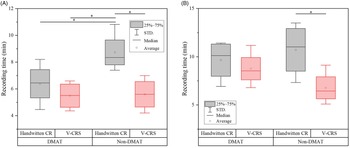
Figure 3 shows the results of the analysis by classifying participant attributes into DMAT and non-DMAT members with training in handwritten CR and experience of working during disasters. Statistical analysis by Fisher’s test between the groups, which summarized the CR recording time by participant attributes, revealed significant differences among several groups in scenarios 1 and 4, and no significant differences among any of the groups in scenarios 2 and 3.
Comparison of time required for CR in scenarios 1 and 4 when categorized by DMAT member qualification. The Fisher test was performed as a multiple comparison test, and combinations with P < 0.05 are marked with an asterisk. Note that there were no significant differences between any of the groups in scenarios 2 and 3.

Questionnaire on the Usefulness of V-CRS
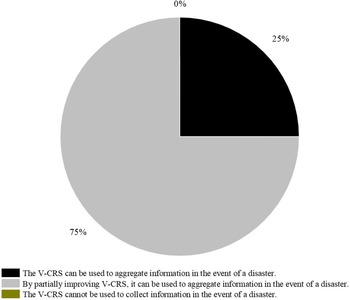
After all the CR recording experiments were completed, each participant was asked via a questionnaire whether the V-CRS developed by the authors could be used to consolidate information at the headquarters of various organizations in the event of a disaster. The results of the questionnaire are shown in Figure 4. Although there were no responses indicating that there was no prospect of utilization, 75% of the participants indicated that there was room for improvement.
Results of a survey of participants on the possibility of using V-CRS to consolidate information at the headquarters of various organizations in the event of a disaster.

The following specific suggestions for improvement were obtained from the participants:
-
1) It would be useful to transcribe not only what the LS says, but also what the caller says.
-
2) Since Speechnotes (which was used for voice transcription) is not available for iOS or Mac OS, it would be ideal if this system could be used with iOS or Mac OS devices using other means.
-
3) If the users had more time to practice V-CRS operations, they would be able to create CRs in less time.
Discussion
In this study, the V-CRS was constructed to support the more efficient consolidation of information gathered at the headquarters of related organizations during a disaster, and its usefulness was examined. The above results indicate that CRs can be recorded in a shorter time by utilizing the V-CRS than by handwriting the CR (Table 3). The results, disaggregated by participant attributes, showed no significant differences in the recording time between handwritten CR and V-CRS for any of the scenarios for DMAT personnel (Figure 3). Since Japanese DMAT members receive training on how to compile CRs during the process of becoming members of the team, Reference Anan, Akasaka and Kondo8 they are accustomed to writing by hand, which may be why they are able to do so quickly. On the other hand, in the post-experiment questionnaire, there was an opinion that CR could be compiled more quickly with more practice in operating the V-CRS; the advantage of using the V-CRS is that the data described can be immediately converted to Microsoft Excel files and quickly shared with other institutions, so there is great potential for future use. The experimental results have also shown that it is effective in situations where technical terms and units are used, such as during a radiation disaster.
Even non-DMAT members, such as the administrative staff of related medical institutions that accept exposed or contaminated casualties in the event of a radiation disaster in Japan, may act as LS in a hospital-based disaster response headquarters. Reference Tsujiguchi, Mikami and Sakamoto11 In Scenario 1 (which simulated an earthquake) and Scenario 4 (which simulated a radiological disaster), the CR recording speed of non-DMAT personnel was predominantly faster with the V-CRS (Figure 3). The fact that there was no significant difference in the time taken by non-DMAT personnel to compile a CR using the V-CRS and the time taken by DMAT personnel to compile a handwritten CR indicates that the V-CRS can be used successfully to consolidate information at the same speed as trained staff. Also, in the case of handwriting, the tidiness of the handwriting may make it difficult to read later, but this is not a problem when using the V-CRS.
Medical support during a disaster includes patient transport, provision of emergency medical care, hospital evacuation, and lifeline support for medical facilities. In the case of the 2016 Kumamoto earthquake in Japan, 2 major earthquakes (magnitude 6.5 on April 14, 2016, and magnitude 7.3 on April 16, 2016) resulted in a series of hospital evacuation requests owing to the increased possibility of the collapse of medical facilities. Reference Takahashi12,Reference Shimoto, Cho and Kurata13 As some medical institutions were able to continue their medical services with lifeline support, there was a need for information sharing among the many organizations involved including medical, government, airline, and helicopter companies, as well as water authorities, and electric utilities. Reference Motomura, Hirabayashi and Matsumoto14 The continuity of operations during a disaster depends on the capacity of the disaster-response headquarters of each institution. Reference Nakajima15 Thus, the larger the disaster, the more important it is to organize information in chronological order at the headquarters of each agency because smooth information sharing among the agencies involved is necessary.
This research shows that the developed V-CRS, with some modifications, has great potential for use in disaster headquarters activities (Figures 2 - 4). The tools developed will make it easier to consolidate information during a disaster, thereby contributing to a stronger command function of the disaster response headquarters. The system has already been modified to reflect some of the comments from the subjects, and plans are underway to implement it in disaster drills organized by local governments in Japan. More stakeholders involved should try this system and make use of it for prompt disaster response. It is hoped that this study will help spread awareness about the importance of information aggregation at the disaster control headquarters, where decisions are made on how to direct various related organizations in the event of a disaster.
Conclusion
A CR system utilizing voice AI was developed to quickly consolidate the information gathered at headquarters during a disaster. As the V-CRS can convert voice information into text, it has been proven through usefulness tests involving DMAT and non-DMAT personnel that anyone can quickly summarize information with some practice in operation, even in situations where technical terms and physical units must be recorded, such as in radiation disasters. Past examples of disasters have shown that the consolidation of information at the headquarters is directly related to the subsequent continuation of commands and operations, making this study highly important. In this study, the V-CRS was shown to be useful for information aggregation during disasters.
Acknowledgements
We would like to thank all the participants of the V-CRS utility study.
Funding statement
This work was supported by the JSPS KAKENHI Grant Number 22K16621, 22K10409 and 23H00633.