Introduction
This paper is set within two recent foci for research attention which are often found within quite distinct disciplines. The first is the dramatic rise in the proportion of independent professionals (IPros), within the wider cohort of self-employed from North America through to Europe and Australia, with IPros now amounting to anything between a fifth and a quarter of the labour markets in these regions (European Commission, 2015; International Labour Office, 2015; OECD, 2015; European Commission, 2016; Eurofound, 2016). Economists, policy makers and macro views as to the implications of this rise characterise much of the research and interest here. The second focus is often much more micro as it looks at the growing attention paid by employers to the well-being of their workers. Here, the issues can range from job satisfaction, work–life balance to the physical and mental aspects of well-being (see e.g., the meta-analyses of Van De Voorde, Paauwe, & Van Veldhoven, Reference Van De Voorde, Paauwe and Van Veldhoven2012; Tims, Bakker, & Derks, Reference Tims, Bakker and Derks2013; Schmitt, Branscombe, Postmes, & Garcia, Reference Schmitt, Branscombe, Postmes and Garcia2014). Often presented under the rubric of human resource management, well-being provides the lens that this paper will use to examine the IPro workforce.
Narrowing the focus from general worker well-being to a workforce typically identified as nontraditional, nonstandard, contingent or even atypical foreshadows some of the concerns that will be dealt with. For instance, although limited, much of the research in this area suggests that it is a workforce characterised by marginalisation and disadvantage – typified by Wilkin’s (Reference Wilkin2013) meta-analysis of research comparing contingent versus permanent worker’s findings of lower job satisfaction and more negative outcomes for contingent workers.
The authors own experience is somewhat different and the aim of this paper then is to examine this tension between ‘common wisdom’ and a personal view that IPro working and well-being provides a rich and enlightening new focus for research. This article is informed by my own experience of independent working as a freelance writer and researcher for over 30 years, with work successfully published in national newspapers, academic papers in leading journals, reports issued by international business schools and universities and over 20 books.
Tying this explicitly to the notion of well-being is the fact that this career has also coincided with bouts of serious mental health issues dealing with anxiety and depression. The overall account provided here, while embedded partially in academic literature and style, is also one where the issue of IPro working and well-being is also a particularly personal one.
Research Background
The notion of working independently – be it under labels from freelancing, contracting to being an IPro, is one that is not only statistically growing in numbers but also one increasingly attracting research. A key one which has informed my interest in the area is the large-scale European and British-based study by Leighton and Brown (Reference Leighton and Brown2013). This argued that, in contrast to popular public opinion that freelance and contract work is ‘second-rate’, nearly all IPros they interviewed were happy about the way they worked and experienced high levels of job satisfaction. It was also this study which reported that many did many did, however, feel unsupported beyond local professional bodies and contractor/freelancing associations and claim they are treated with neglect and even suspicion by policy and law makers.
Further insight is provided by the 2015 study of freelance workers by Wood and Michaelides. Based on diaries completed by nearly 50 freelance workers, together with a weekly survey undertaken by each participant over the 6-month period – the results present a complex picture which challenges the common assumptions and misinterpretations which often dominate perceptions of this way of work. For instance, the fluctuation of hours that is so common in freelance work was revealed to be a key determinant of their mood – with the highest levels of well-being perhaps not surprisingly being when they have more work than normal. ‘Freelance workers are calmer and more enthusiastic when their hours are higher than their normal pattern of working’ (Wood & Michaelides, Reference Wood and Michaelides2016).
The results revealed a stark contrast with the mood experienced when there were challenging demands, whether this was a difficult client or a lack of work, at which time their anxiety levels increase and even the enthusiasm levels experience a drop, with some even falling into depression during this difficult time. The intransigent nature of freelance work, the study claims, can often play havoc with ones’ work–life balance. Although in theory you have the opportunity to work whenever and wherever, in reality it can be difficult to switch off, especially at times when there is a lot of work on.
Demands adversely affect people’s work-life balance, in particular work interferes with fulfilling family and other non-work commitments or pursuits. But so does the enthusiasm generated by longer hours. The enthusiasm may be at the expense of non-work activities, as, for example, people may not readily leave tasks uncompleted to be finished another time (Wood & Michaelides, Reference Wood and Michaelides2016).
A common feature of both these studies is the dual-edged nature of the concerns they raise about the factors that influence IPros sense of well-being. They are a start into providing a more complete picture. To gain a better sense of the nature of the support that would benefit IPros, whether from clients or from policy and law makers, there are some key questions that need to be answered. This next section sets these out and also explores some early initiatives that may provide clearer indications as to where future research may usefully progress.
Some Key Questions
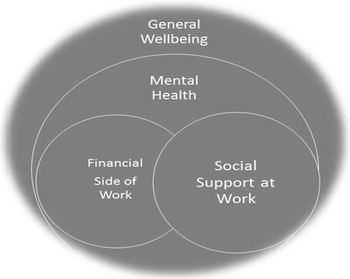
Drawing on both, the wider literature and embedding this in my own lived experience as an IPro, suggests that the following issues and their associated questions provide a starting point which moves from the perspective of well-being down to mental health, and then the impact and consequences for financial and social aspects of working this way.
This fits into a very basic research model which is shown in Figure 1 and illustrates the interaction and interface I see as operating between each of these four areas.
How the factors interact in the life of the independent professional

Taking each of these four areas in turn raises a number of questions. For instance:
-
1. Financial security: What fluctuations in income do IPros experience? Is the income they receive sufficient to meet their essential business and household overheads? Is their income sufficient for them to put money aside for their retirement, for example, by paying into a private pension fund? Do IPros feel financially secure?
-
2. Social support: What sources of social support do IPros rely on? Are they more likely to build their social life around the contacts they make in their client organisations or from other IPros? Do IPros feel socially isolated?
-
3. Mental health: Do IPros feel more or less stressed than full-time and part-time workers? Do a greater proportion of them suffer from depression or anxiety? Are these conditions related to their style of working and/or fluctuations in their financial income? Is self-employment a better option than full-time work for someone managing an enduring mental health problem?
-
4. General well-being: Are IPros more or less likely to take holidays than full-time or part-time workers? Do they experience more or less work/life balance? What is the impact of their style of working on their family life?
Starting with the last one, the notion of well-being, while the two EU/UK-based studies noted above do provide generally positive views of the world of the IPro, there is also a wider and more general literature on well-being and contingent work also noted which is much less positive.
The tension and contradictions between these studies suggests that research into the four areas noted in Figure 1, needs to adopt both qualitative and quantitative methodologies. For example, in examining issues relating to financial security, it would be useful to know how IPros actually accommodate volatility in their earnings. Do they put money side during profitable periods to act as a cushion for lean times – or do they rely on loans or overdrafts from their banks? Are they the principal earner in the household or is the volatility in their income offset by regular earnings from a partner in part-time or full-time work?
Placing this back within the research by Wood and Michaelides (Reference Wood and Michaelides2016) suggests that questions such as to what extent is enthusiasm about an active period at the expense of non-work activities and key family responsibilities. Do partners and/or children share this enthusiasm or does it result in additional tensions as they compensate for the IPros single-minded pursuit of their work?
An important contribution of the Wood and Michaelides (Reference Wood and Michaelides2016) study is the issue of mental health. The study suggests that IPros ‘fall into depression’ during lean times. From my own experience this raises questions such as the extent that this may be due to pre-existing mental health conditions – bearing in mind that one in four people are liable to mental health problems at some point in their lives (World Health Organisation, 2001) – and to what extent is the lack of work the principal cause. Again, what is the impact of this volatility on other members of the household?
Above all, given the stigma about mental illness that still exists in many employing organisations and the problems people with regular episodes encounter with workplace stress and extended periods of sickness leave, is self-employment and freelance working actually a better option?
This question has been recently examined in a number of studies with quite disparate results. Evans-Lacko, Knapp, McCrone, Thornicroft, and Mojtabai (Reference Evans-Lacko, Knapp, McCrone, Thornicroft and Mojtabai2013) study of the impact of economic recession on people with mental health issues across 27 European countries found that economic hardship often does intensify social exclusion of people with mental health problems – most especially, when they are males and individuals with lower education.
The idea of nonstandard employment operating as a ‘bridge’ or a ‘trap’ is well established (see e.g., Natti, Reference Nätti1993; Gash, Reference Gash2008; Watson, Reference Watson2013), the extrapolation of this to the IPro/well-being area seems to provide a possible rich area of insight. This is seen in the study by Dellot (Reference Benach, Vives, Amable, Vanroelen, Tarafa and Muntaner2013). Writing of his own work as an occupational therapist who experiences mental health difficulties, Dellot offers that
The big advantage of self-employment for people who have mental health difficulties is that you are the expert in what your own capabilities are. You are the person who knows what time of the day you’re best working at, how many days a week you can work, whether of not there are things coming up in your particular timeline that mean you might need to take some time out for work. If you’re able to plan your time, accommodate your condition and do that with a minimum of support from outside I think that self-employment can be great (Reference Benach, Vives, Amable, Vanroelen, Tarafa and Muntaner2013).
There is also an emerging view within the wider research into nonstandard employment that such employment needs to be viewed within a more dynamic perspective – that people often move in and out of such employment – that it may in fact operate as a bridge and a trap at different times for different people.
The impact and consequences for this dynamic view being translated into a mental health perspective is seen in the work of Benach, Vives, Amable, Vanroelen, Tarafa, and Muntaner (Reference Dellot2014) and this confirms that the convergence of a wider view than just the financial aspects nonstandard work is needed. The role of support emerges as a key aspect which can be just as or even more important than financial ones.
New Sources of Support
Just what are the sources of support is an important one where answering these questions will give new clues as to the kind of support IPros would profit from, building on a number of initiatives during the last decade. A few of the more inventive initiatives I have identified over the years are alumni schemes, the Dutch initiatives called Broodfonds and Smart. These will each be explained in more detail below.
Alumni schemes
A study of talent management by the author (Devine & Syrett, 2014) highlighted the fact that many international management consultancies organise alumni schemes which provide former employees with social and workplace support during the time they are setting up on their own. One such alumni who previously worked for Bain and Co commented that
They certainly don’t hold you back. They take the attitude that if you are going to leave, you are going to leave. They take pride in the success of their alumni and in my case, they allowed me to continue to work in the office and to use it as a resource centre – and keep my desk for six months. This was critical for me when I was setting something up and short of capital.
Another alumni’s comments added further explanation with the view that
It is also hard to work on your own and it was great to have plenty of smart people around me. It really helped the transition. And they were keen for me to know that if my enterprise did not work out, my old job with them was still these. They stated frequently that they would love to have me back but at the same time they wished me every success in my endeavours to be independent. That is a very nice position to be in.
While these schemes do not explicitly have a mental health component in them the issues of psychological support emerge very clearly. The notion of a wider community of support is developed further in the next example.
Broodfond
In the Netherlands, self-employed workers have also created a system to financially support each other when they fall ill. It is called Broodfond ‘bread funds’, and it works by creating small groups whose participants pay into a mutual sickness fund (http://www.broodfonds.nl/). The first Broodfond group was founded in 2006, and the scheme has now grown to 123 groups with almost 4,200 participants.
Between 20 and 50 individuals can join each Broodfond group, and beyond that a new group must form. The small number ensures the group remains a close community and reduces the incentive of any member to attempt to cheat.
Each member pays a monthly amount into the system based on how much they wish to receive if they fall ill. There are eight payment levels, starting at €33.75 a month for those who require a payout of €750 a month when ill, ranging to €112.50 a month for those needing a €2500 monthly payout. If a freelancer gets physically or mentally sick, there is an own-risk period of 1 month, after which they may receive their monthly support payment from their Broodfond (Dullroy, Reference Dullroy2015).
The system has many clever features that keep it fair and sustainable. A member pays a maximum of 36 contributions, unless their fund requires topping up due to a claim. Each member’s contributions are saved in an individual account, and transfers are made to a needy member if a claim is made. Payouts are called ‘gifts’, which reinforces the concept of mutual support, and members meet twice a year to establish a sense of community. A member who wishes to leave the scheme can withdraw the balance of their account after a 6-month wait.
Each Broodfond is an independently incorporated association, and all 123 groups are assisted by a central administration called the BroodfondsMakers, which operates as a cooperative. Biba Schoenmaker, one of the three founders of the BroodfondsMakers, says
We saw what happened to colleagues who became ill, and what happened to their company. That’s why we started a collective solution for illness.
She and her colleagues took 2 years to fully develop the concept, launching the first experimental group in 2006 with 20 members. As she explains, the concept took time to evaluate because the necessary trial and error required members to need to use the scheme – and this proved a matter of several years.
In the first year we couldn’t find out if it was working because our members didn’t become ill. But later we saw it worked as we wished, and we helped new groups start (Dullroy, Reference Dullroy2015).
In fact, most Broodfonds process very few claims from members. The general Dutch workforce has an absenteeism rate of over 4%, but for members of Broodfonds the rate is around 1%, Schoenmaker says (OECD, 2013).
Aside from the task of devising the fund, another challenge was to obtain permission from the Dutch financial services authority. The regulator had to be convinced that Broodfonds did not constitute a traditional insurance company, which would have triggered crippling requirements. They won the necessary approval, but the risk of tripping over international insurance regulations has slowed expansion. Schoenmaker says they are now investigating the idea of internationalising, starting in the United Kingdom.
SMart
This last example of support is a bit different from the explicitly social support features of the prior two as the focus here is dealing with the well-known self-employed persons’ business issue of late payment. Nearly, every freelancer has a story about a client who delayed or refused to pay an invoice. Chasing down nonpaying clients is time consuming, demoralising and has been clearly linked to exacerbating mental health issues (see e.g., Evans-Lacko et al., Reference Evans-Lacko, Knapp, McCrone, Thornicroft and Mojtabai2013; Benach et al., Reference Dellot2014). My own experience is that outstanding invoices can severely disrupt a freelancer’s livelihood. Rent, loan repayments, insurance bills and groceries still need to be paid, and landlords – unlike freelancers – are hard to ignore.
Addressing this has made progress to some extent at a policy level. For example, in Europe, the European Commission’s Late Payment Directive of 2011 introduced penalties for recalcitrant debtors (https://ec.europa.eu/growth/smes/support/late-payment_en). The directive allows creditors to add an extra €40 to any invoice that is more than 60 days overdue, plus interest on the unpaid amount. But 60 days can still be a long time to wait.
This is where the third example of support comes in as several European countries, freelancers have built mutual invoicing systems that allow them to prosecute nonpaying clients with their collective force. One of them is the Belgium-based SMart, a nonprofit organisation founded in 1998 to assist cultural workers – hence its extended name, Societe Mutuelle pour Artistes (http://smartbe.be/en/). SMart has grown into a sizeable organisation with more than 58,000 members and 155 staff working from 10 offices across Belgium.
SMart is a kind of modern day guild. The society acts as an administration hub, issuing invoices and collecting payments on behalf of its members, who avoid having to set up their own company to operate. It pays members within a few days by pooling some of the income in a mutual guarantee fund, and takes over the responsibility of chasing down nonpaying clients using in-house debt collection staff. For this impressive suite of services, Belgian members pay a €25 annual fee as well as 6.5% from each invoice processed through SMart (see https//www.linkedin.com/company/smartbefr).
SMart was able to develop largely thanks to Belgium’s generous welfare and taxation provisions for artists. But having used this funding base to build its infrastructure, it is now expanding across Europe. It has opened branches in eight other countries – Austria, France, Germany, Hungary, Italy, the Netherlands, Spain and Sweden.
Members outside of Belgium pay higher contribution rates of between 7 and 9% of each invoice issued through SMart. Higher costs and reduced services may make SMart’s international branches less attractive than its Belgian operations. Nevertheless, SMart’s model of mutual services has the potential to ease many of the financial challenges facing Europe’s creative workers. It has been especially helpful to freelancers having to take time off on a regular basis for mental health reasons.
Pension and Social Security Shortfalls
The third area of questioning relates to an issue of concern for the self-employed which is international in nature – the lack of pension provision for self-employed people (see e.g., Frick & Grabka, Reference Frick and Grabka2014; Kautonen, Down, & Minniti, Reference Kautonen, Down and Minniti2014). In the United Kingdom, for instance, the Government has introduced pension reforms, in the form of ‘auto-enrolment’, which will get millions of people saving into pensions for the first time. But not the self-employed. In fact, they stand to lose out. Unlike employees of firms, who will be automatically placed into a pension into which their employer and the Government will contribute, self-employed people get nothing under the flagship reforms. Instead, the changes will hurt those who employ staff, as they will have to fork out for employees’ pension contributions on top of their wages and other business expenses.
The mental health problems of freelancers are exacerbated by the fact that self-employed people miss out on a lifetime of employer contributions, forgoing an average of £91,500 in company pension scheme contributions according to research by Prudential, the pension firm (see http://www.pru.co.uk/pdf/presscentre/self-employed-pension.pdf).
The Pru’s research also found that almost a third (29pc) expected to be entirely reliant on the basic state pension when they retired. But in a further blow, when it comes to the state pension, self-employed people have been able to claim only the basic state payout and have not been eligible for the additional state pension that millions of employees have enjoyed. That will remain the case for anyone retiring between now and 6 April 2016.
However, after that date, the playing field will be levelled as the self-employed will be entitled to the new state pension, which is more generous. This will start at no less than £42.40 a week, as long as they have made at least 10 qualifying years’ National Insurance contributions – up to no less than £148.40 a week for 35 qualifying years.
John Allan, the chairman of the UK Federation of Small Businesses, has articulated the real concern about what the lack of retirement savings among freelancers and self-employed people means. He says
‘More needs to be done to support them if things don’t work out as planned. The Government needs to build on positive steps to include the self-employed in the new state pension by also looking at how other statutory benefits can be extended to these workers, such as maternity pay and sick pay. Ministers also need to give more encouragement to the self-employed to save for retirement, as currently they do not benefit from the new auto-enrolment system’.
‘This continuing downward trend in pension saving by the self-employed is a matter of great concern, more so as the numbers of people opting to work for themselves appear to be on the increase. This decline could be slowed or even possibly reversed if the Government were to offer further tax incentives for self-employed workers to join the auto-enrolment programme or find some other way of making savings provision for their old age’ (Morley, Reference Morley2014).
Specifically focussing on the UK context that I live in, freelancers and the self-employed are also vulnerable in terms of their UK statutory rights. As Professors Julia Rouse and John Kitchen of Manchester Metropolitan University and Kingston University, respectively, pointed out in a recent presentation (Rouse and Kitchen, Reference Rouse and Kitchen2015), while 21,000 self-employed women claim maternity allowance (March 2013–2014), IPros in the United Kingdom enjoy no entitlement to maternity leave and no effective protection against pregnancy/maternity discrimination from partners, customers and suppliers. The result is they are often trapped in low-quality self-employment.
Nor is this lack of social protection confined to the United Kingdom. A recent study on self-employment and old age provision in Germany (Frankus, Reference Frankus2015) found that 46% of solo self-employed women and 44% of men, amounting to over one million people, have no old age insurance at all. This is partly due to an unwillingness to save but, even when the willingness is there, an inability to save due to low income. Once again, those freelancers with mental health problems are particularly vulnerable.
Conclusion
The growth in the numbers of IPros has led to an increasing focus on their well-being. An emerging range of initiatives have emerged over the last decade aim to tackle their financial well-being.
However, more research needs to be undertaken on how the style of working adopted by IPros impacts on their financial, personal and family well-being. This will inform policy, legal and commercial initiatives in their efforts to target appropriate programmes aimed at supporting and enabling this important new category of workers.
This is all the more important because, while many IPros express high levels of job satisfaction, their long-term financial security is threatened by poor pension provision and a lack of statutory rights. As the author can testify based on his own personal experiences as a freelancer of over 30 years standing, IPros face significant challenges in negotiating the right financial security, gaining social support, sustaining physical and mental health, and achieving the right level of work–life balance.
Acknowledgements
The author would like to thank Tui McKeown and Patricia Leighton for their assistance in the preparation of this manuscript.