Rapid molecular diagnostic tests (RMDTs) identify the microorganism(s) causing an infection and, in some cases, a limited number of antibiotic resistance genes, faster than traditional microbiology methods, allowing for earlier optimization of antimicrobial therapy. A meta-analysis of 31 studies found that use of RMDTs in bloodstream infections (BSIs), compared to conventional microbiologic methods alone, was associated with reduced time to effective therapy, mortality risk, and length of stay.Reference Timbrook, Morton, McConeghy, Caffrey, Mylonakis and LaPlante1 However, the mortality reduction was statistically significant only in the presence of antimicrobial stewardship program (ASP) involvement. The impact of RMDTs on outcomes of other types of infection is less clear.Reference Beal, Tremblay, Toffel, Velez and Rand2–Reference Evans, Merkel, Harder and Rose4
The extent to which RMDTs have been adopted by hospitals and the degree to which ASPs are involved in RMDT interpretation and subsequent interventions are unknown. We conducted a survey to assess prevalence of RMDT use, to examine factors associated with RMDT adoption, and to describe antimicrobial and diagnostic stewardship efforts related to RMDTs.
Methods
The survey was developed based on previous studies and optimized via pilot testing by hospital epidemiologists and clinical microbiologists from 6 hospitals. The final version is available in the Supplementary Material (online). The survey was e-mailed to members of the SHEA Research Network (SRN)5 and the American Society for Microbiology ClinMicroNet listserv (CMN)6 and administered May–July 2019 using Qualtrics software (Qualtrics, Provo, UT). Participation was voluntary and anonymous. Unlike the SRN, multiple individuals from a hospital may participate in the CMN. We requested that only 1 member per institution respond to the survey. Because some hospitals participate in the SRN and the CMN, results from each survey were reported separately. Data were analyzed using Stata/IC version 16 software (StataCorp, College Station, TX) and Excel version 2016 software (Microsoft, Redmond, WA). Associations between hospital characteristics and RMDT adoption were assessed using the Pearson χReference Beal, Tremblay, Toffel, Velez and Rand2 test. The Weill Cornell Medicine Institutional Review Board granted an exemption to this study.
Results
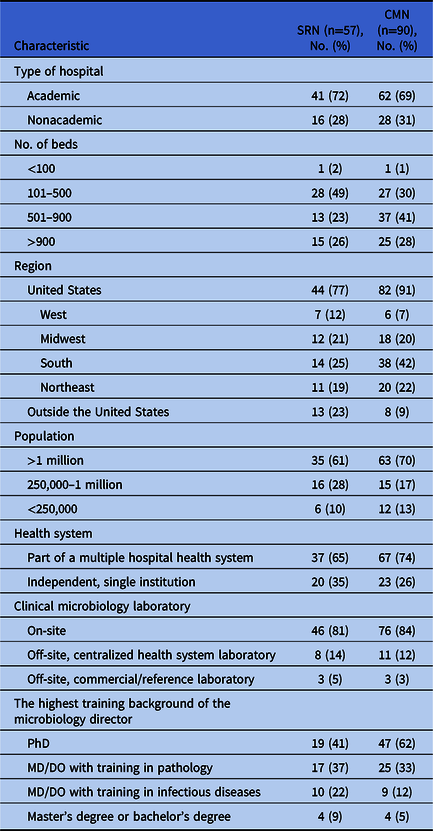
Responses were received from 57 SRN members, for a response rate of 59%, and 90 CMN members, but this response rate could not be calculated because the number of unique institutions participating in the CMN is unknown. Table 1 summarizes the characteristics of participating hospitals. Most were from the United States; most were academic, urban, and part of a multihospital system; and most had an on-site clinical microbiology laboratory.
Characteristics of Participating Hospitals

Note. CMN, ClinMicroNet of American Society for Microbiology Listserv; SRN, The Society for Healthcare Epidemiology of America Research Network.
RMDTs for BSIs
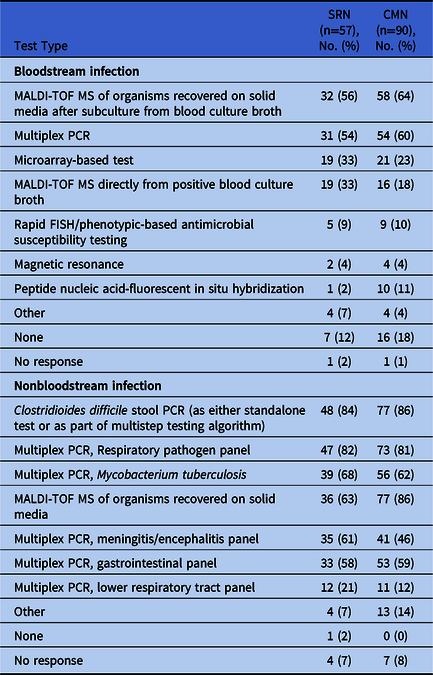
Overall, 50 SRN hospitals (88%) and 73 CMN hospitals (81%) used at least 1 RMDT for BSI. There were no significant associations between characteristics of participating institutions (eg, hospital type, number of beds, or region) and adoption of an RMDT. Matrix-assisted laser desorption/ionization time-of-flight mass spectrometry and multiplex polymerase chain reaction (PCR) were the most commonly adopted RMDTs (Table 2).
Type(s) of Rapid Molecular Diagnostic Tests Used for Diagnosis of Bloodstream Infections and Non–bloodstream Infections at Participating Hospitalsa

Note. CMN, ClinMicroNet of American Society for Microbiology Listserv; MALDI-TOF MS, matrix-assisted laser desorption/ionization time-of-flight mass spectrometry; NAAT, nucleic acid amplification test; RMDT, rapid molecular diagnostic tests; SRN, The Society for Healthcare Epidemiology of America Research Network, PCR, polymerase chain reaction.
a The results include either on-site or off-site utilization of these tests.
Factors frequently reported to have been important in the decision to adopt RMDT included: anticipated improvement in antimicrobial use (SRN, 82%; CMN, 68%), clinical outcomes (SRN, 74%; CMN, 77%), laboratory efficiency (SRN, 52%; CMN, 34%), and overall hospital cost savings (SRN, 24%; CMN, 37%). Also, 42 SRN hospitals (48%) and 37 CMN hospitals (51%) had evaluated the impact of RMDTs. Reported findings included reduced time to antimicrobial de-escalation (SRN, 75%; CMN, 92%), reduced length of stay (SRN, 25%; CMN, 41%), improved laboratory efficiency (SRN, 20%; CMN, 19%), and overall cost reduction (SRN, 13%; CMN, 32%). Approximately one-quarter of participants reported a laboratory-based cost increase. Among hospitals that did not use RMDT, the most commonly cited reasons for nonuse were cost, lack of evidence of improved outcomes, inadequate insurance reimbursement, and insufficient laboratory space.
Among hospitals that used an RMDT for BSI, the laboratories of 40 SRN hospitals (80%) and 57 CMN hospitals (78%) directly notified clinical staff of RMDT results. Approximately 50% of those notified the ASP (Supplementary Table 1 online). Among 47 SRN hospitals and 63 CMN hospitals with both an RMDT and an ASP, 37 (79%) and 52 (83%), respectively, reported that the ASP team routinely reviewed BSI RMDT results. The frequency of review ranged from at least once per week to 24 hours per day, 7 days per week (Supplementary Table 2 online). Additionally, 27 SRN hospitals (54%) and 31 CMN hospitals (42%) provided guidelines for optimization of therapy based upon RMDT results. The location of guidelines varied and included a website, the electronic medical record, and a handbook (Supplementary Table 1 online).
RMDT for non-BSI
Overall, 52 SRN hospitals (91%) and 83 CMN hospitals (92%) used 1 or more RMDTs for non-BSIs. Clostridioides difficile nucleic acid amplification tests and multiplex PCR for respiratory pathogens were the most commonly adopted tests (Table 2). There were no significant associations between hospital characteristics and adoption of an RMDT for non-BSI. Less than half of hospitals had guidelines for interpretation of RMDT results (Supplementary Table 3 online). Some hospitals restricted clinicians’ ability to order a non-BSI RMDT based on factors such as nosocomial versus community-acquired infection, medical condition (eg, immunocompromised host), recent testing, and requirement for authorization (Supplementary Table 4 online).
Discussion
RMDTs for BSIs and non-BSIs have been widely adopted by the surveyed hospitals. Consistent with previously published observational studies,Reference Timbrook, Morton, McConeghy, Caffrey, Mylonakis and LaPlante1 many participants reported positive clinical, logistic, and financial outcomes in association with implementation of an RMDT for BSI. Adoption of an RMDT may reduce overall healthcare costs, but most hospitals without an RMDT for BSI reported the cost of new technology as the reason that an RMDT had not been implemented, perhaps due to budgetary silos, which may not account for potential overall cost savings.Reference Messacar, Parker, Todd and Dominguez7 Some participants indicated that their hospital had restricted use of an RMDT for non-BSIs to specific clinical scenarios and/or patient populations in which the result is most likely to provide clinical benefit. Such diagnostic stewardship strategies may help to maximize the healthcare value of RMDTs.Reference Messacar, Parker, Todd and Dominguez7–Reference Patel and Fang9
Previous studies suggest that RMDT-based ASP interventions can reduce mortality and time to effective therapy and can improve antimicrobial use in BSI to a greater extent than the use of an RMDT alone.Reference Timbrook, Morton, McConeghy, Caffrey, Mylonakis and LaPlante1 In most hospitals using an RMDT for BSI, the ASP team routinely reviewed RMDT results, and the laboratory directly notified the ASP team of the results in about half of these hospitals. Other reports suggest that guidelines for RMDT interpretation and antimicrobial selection may help hospitals achieve the benefits of RMDT.Reference Messacar, Parker, Todd and Dominguez7,Reference Donner, Campbell, Lyden and Van Schooneveld10 However, clinicians must utilize these guidelines for them to influence clinical care.Reference Donner, Campbell, Lyden and Van Schooneveld10 Approximately 50% of participating hospitals reported having guidelines for BSI RMDT, and fewer had guidelines for non-BSI RMDT. Although utilization of these guidelines was not assessed, there were differences among hospitals in terms of their availability. Guidelines were located within the laboratory results section of the electronic medical record (ie, the location providing the easiest access to clinicians within their usual workflow) in <40% of hospitals. Thus, there appeared to be opportunities to improve availability of and access to these clinical decision-support tools.
Our study has several limitations. The relatively small sample size potentially limits the generalizability of the findings and the ability to detect differences between hospitals that had and had not adopted an RMDT. The findings may not be applicable to small, nonacademic hospitals in rural settings or outside the United States. Participation was voluntary, possibly leading to participation bias. Finally, we cannot be certain that CMN data do not contain multiple responses from individual institutions.
In conclusion, RMDTs for BSIs and non-BSIs have been widely adopted by the participating hospitals, and many reported that they had observed positive clinical, logistic, and financial outcomes associated with implementation of these tests. Although most hospitals involved their ASP and/or have developed clinical guidelines to increase the likelihood that RMDT results will lead to timely and appropriate interventions, opportunities to more fully realize the benefits of RMDTs remain in many hospitals.
Supplementary material
To view supplementary material for this article, please visit https://doi.org/10.1017/ice.2020.1230
Acknowledgments
We thank Valerie M. Deloney, MBA, and SRN institutions for taking part in this survey. We thank Dr Michael Miller and CMN participants for taking part in this survey. We also thank Sunday Clark, ScD, for assistance with survey development and the hospital epidemiologists and clinical microbiologists who participated in the pilot study.
Financial support
This work was supported in part through the National Institute of Allergy and Infectious Diseases (grant no. T32AI007613 to M.K.), by the National Institute of Health/National Center for Advancing Translational Sciences (grant no. UL1TR002384 to M.K.), and by the National Institute of Heath/National Cancer Institute Cancer Center (grant no. P30 CA008748 to N.E.B.).
Conflicts of interest
M.S.S. reports personal fees from Roche Diagnostics outside the submitted work. L.F.W. reports consulting fees from Roche Molecular Systems and Shionogi, as well as grants from Accelerate Diagnostics, BioFire Diagnostics, and Hardy Diagnostics outside the submitted work. All other authors report no conflicts of interest relevant to this article.