Hepatitis C virus (HCV) is recognized as a major cause of chronic liver disease worldwide. HCV infection is more frequent in renal transplant recipients and dialysis patients than in the general population with prevalences varying according to the geographical areas.Reference Vallet-Pichard and Pol 1 In these patients, HCV is an important cause of morbidity and mortality.Reference Santoro, Mazzaglia, Savica, Li Vecchi and Bellinghieri 2 The prevalence correlates with the duration of hemodialysis and the number of units of transfused blood products.Reference Jadoul, Poignet and Geddes 3 The incidence of nosocomial HCV infection has been reduced with follow-up based on serologic and virologic tests and strict hygiene policies.Reference Saune, Kamar and Miedouge 4 However, nosocomial transmission in hemodialysis units occasionally happens and the natural history of HCV infection in dialysis is not fully understood.
Here, we investigated a case of HCV transmission that occurred in a dialysis unit by using epidemiologic and molecular methods. Phylogenetic analysis of the NS5b and hypervariable region-1 (HVR-1) nucleotide sequences was performed in order to confirm epidemiologic linkages between 2 patients. Deep sequencing of the HVR was performed on samples from the source and the newly infected patient shortly after transmission to assess the distribution of viral species.
METHODS
The study project was approved by the local research ethics committee.
HCV Antibody Detection and RNA Quantitation
Patients are routinely tested for HCV antibodies twice a year with the Architect anti-HCV test (Abbott) and 4 times a year for HCV RNA quantitation using COBAS AmpliPrep/COBAS TaqMan HCV Quantitative Test, version 2.0 (Roche Molecular Diagnostic Systems). Genotyping was performed with a commercial probe-hybridization assay (InnoLipa HCV; Innogenetics) or by sequencing of the NS5b region.Reference Laperche, Lunel and Izopet 5 Briefly, RNA was extracted from the stored sera by EasyMag (bioMérieux) and was reverse transcribed to cDNA. One-step real-time polymerase chain reaction assay (PCR) amplification was performed with degenerate primers (PR3 and PR4) and Superscript III RT/Platinum Taq Mix (Life Technologies) followed by a heminested PCR with primers PR3 and PR5 in the second round (Online Supplementary Table 1). PCR-amplified fragments of the NS5b gene were purified and directly sequenced on an automatic DNA sequencer (Abi Prism 3130 XL; Applied Biosystems) in both directions with primers PR3 and PR5. The genotype of each sample was determined by comparison with those of HCV prototype strains from GenBank. Phylogenetic trees were constructed from the sequences by using the NJ method and bootstrapping was performed with 500 replicates.
HVR-1 Deep Sequencing
The HVR-1 domain, at the junction between the coding regions for envelope glycoproteins E1 and E2, exhibits a sufficiently high degree of variability to distinguish between HCV isolates of the same subtype.Reference Hijikata, Kato, Ootsuyama, Nakagawa, Ohkoshi and Shimotohno 6 For bidirectional pyrosequencing purposes, we amplified the HVR-1 by a 2-step nested PCR with primers from published sequencesReference Esteban, Gomez and Martell 7 adapted to genotype 5a by comparison with available 5a HVR-1 sequences. Briefly, total RNA was extracted from serum samples and cDNA was generated using a Superscript III One-Step RT-PCR System with Platinum Taq DNA Polymerase (Life Technologies). The first-round PCR products were further amplified with Expand High Fidelity Enzyme (Roche) to ensure accuracy. The primers are described online in supplementary Table 2. Pyrosequencing was performed with a 454/ GS Junior platform (Roche). To minimize variation due to PCR, 2 replicate real-time PCRs were performed for each sample and subsequently pooled for sequence analysis. Only reads covering the entire length of the amplicon were included in the sequence analysis. Amplicon Variant Analyzer, version 2.9, software (Roche) was used for sequencing data analysis. Sequence comparisons were performed on a 185-nucleotide segment encompassing the HVR-1 region.Reference Esteban, Gomez and Martell 7 Nucleotide sequences were aligned with Multiple Alignment using Fast Fourier Transform.Reference Katoh, Misawa, Kuma and Miyata 8 Phylogenetic trees were constructed as above. Genetic diversity within variants was measured by nucleotide pairwise distance, which is the proportion of nucleotide sites at which 2 sequences are different.
Epidemiologic Investigation
The medical records of the patients were reviewed. Physicians and nurses of the hemodialysis unit were interviewed to go over the dialysis procedures and adherence to infection-control rules. In addition, an audit on hygiene practices was conducted after the transmission event. The audit covered hygiene, standard precautions, sequences of care, sorting and disposal of waste, procedures, and risk of injury.
RESULTS
Identification of the Putative Source Patient
In September 2013, the HCV seroconversion in a dialysis unit of a patient, called F, strongly suggested nosocomial contamination. We investigated in order to trace and confirm this transmission.
Molecular Investigation
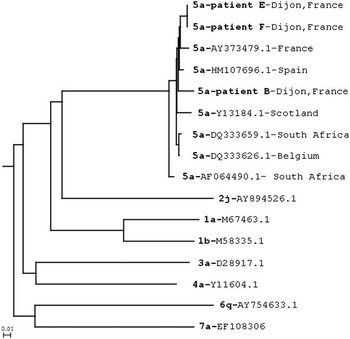
Among the 98 patients treated in this dialysis unit, 5 (patients A to E) were chronically HCV-infected. Four had been previously genotyped during routine follow-up. Patient A had genotype 1a, patient B had genotype 5a, and 2 patients, C and D, had genotype 1b. The genotype of patient E was unknown when the seroconversion of patient F was discovered, but subsequent sequencing of the NS5b region determined a 5a genotype. Genotyping for the newly infected patient, F, was performed on the first serum sample harvested after seroconversion for which HCV RNA was detectable. It was also genotype 5a. Two patients, patients B and E, were therefore putative contaminators. Unlike the NS5b nucleotide sequence (339 nucleotides) of patient B, that of the HCV-positive patient E was found to be similar to that of the newly infected patient, suggesting that patients E and F were infected by the same isolate. The tree obtained with the NJ method is shown in Figure 1.
Phylogenetic tree derived from analysis of a partial NS5b region. Isolates from patients B, E, and F are indicated in bold. The generated tree includes isolates of genotype 5a indicated by the country of origin and selected sequences from Genbank or the European Molecular Biology Laboratory representatives of each genotype. Sequences from the NS5b region of patients E and F were similar; the sequence of patient B was different. This finding is consistent with a common epidemiologic origin for patient E and F.

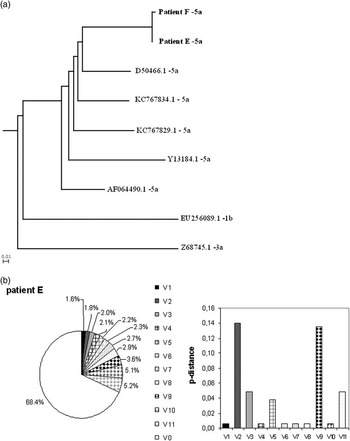
Considering the differences in the NS5b sequence between patient F and patient B and in their dialysis schedule, patient B was excluded from further analysis. In order to confirm that genotype 5a HCV had been transmitted from patient E to F, we performed sequence analysis of a high-diversity region in the HCV genome, the envelope HVR-1. The intrahost HCV populations in both patients were characterized by deep-amplicon sequencing of HVR-1, using 454/Roche pyrosequencing on sera collected at a time close to the transmission time (<3 months). The conditions to call a variant were (1) bidirectional coverage of sequencing reads and (2) cutoff for genetic variants set at 1%. Twelve variants were detected in patient E. Patient F had a unique HVR-1 population (100%) that was similar to the most prevalent variant (approximately 50%) of patient E (Figure 2). A single synonymous mutation (GGA vs GGG) was detected on the analyzed region, outside HVR-1, amino acid position 418 in the E2 protein. The source patient E displayed a greater number of variants and wider genetic diversity (mean pairwise distance =0.0364 vs 0) than patient F (Figure 2). We thus showed a narrowing in viral genetic diversity after transmission.
Sequences of hypervariable region-1 of genotype 5a of the newly infected patient and the source patient were compared. a , Phylogenetic analysis of nucleotide (n=185) sequences encompassing the hepatitis C virus hypervariable region-1. The tree includes the sequence from patient F and the major variant of patient E (both indicated in bold), and selected hepatitis C virus sequences from Genbank from genotype 5a, 1b, and 3a. b , Comparison of viral complexity in serum samples in patients E and F, hepatitis C virus variants; only variants of hypervariable region-1 detected by pyrosequencing with a frequency greater than 1% are represented. Patient E presented 12 variants (V0 to V11) while patient F presented 100% of variant V0. Genetic diversity within variants in patient E is calculated by nucleotide pairwise distance (p-distance).

Epidemiologic Investigation on Date of Contamination and Risk Factors for HCV
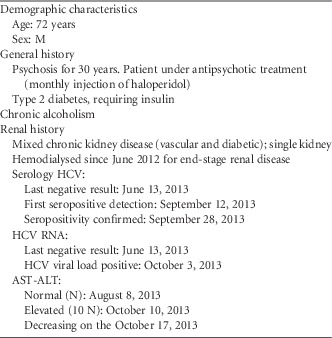
Patient F was found to be anti-HCV antibody negative for the last time on June 13, 2013. He had normal levels of transaminases in August (Table 1). Patient F was found to be seropositive for the first time on September 12. The seroconversion to HCV antibody was thus observed in this patient over a 3-month period. Patient F had elevated alanine aminotransferase values in the middle of October. A newly elevated aminotransferase level is sensitive for acute hepatic infection. Positive HCV viral RNA load was first detected on October 3 (6.53 log). This high viral RNA load suggests that productive infection was rapidly initiated. From these elements, the contamination probably occurred between the beginning of May and the end of August 2013.
Characteristics of Patient F

NOTE. ALT, alanine aminotransferase; AST, aspartate aminotransferase; HCV, hepatitis C virus.
The weekly sessions of hemodialysis (Tuesday, Thursday, Saturday) were similar for both patients E and F. Patient F had 2 unexpected bleeding episodes on fistula requiring emergency long compression (40–50 minutes). One occurred on May 28, when both patients E and F were dialysed in the same room, in a room of 8 noncontiguous beds, and were cared for by the same staff. This bleeding episode was probably the contamination event. Patient E was a dialysed HCV patient in the chronic phase of infection and presented a high HCV viral load at this period (6.3 log). The medical staff were interviewed and hygiene practices were reviewed. Although the bleeding episode seemed to be the HCV transmission event, other potential sources of contamination were examined. Patient F had not been transfused since June 2012, had no sexual relationships, and did not report any accidental exposure to blood at home. He had no surgery or invasive procedures during this period. He was not dialysed in another hospital. Possible sources of contamination were the daily insulin dose and the monthly administration of haloperidol. However, there was no evidence to support HCV transmission outside the dialysis unit. The unit uses dedicated hemodialysis machines for HCV seropositive patients in accordance with the “Recommendations of the SFHH (Société Française d’Hygiène Hospitalière), December 2004.” The suspected transmission pathway was therefore transmission by caregivers during the bleeding episode of May 28 via hands and/or instruments (eg, scissors, clamps). Probably a major role in the transmission was the nonobservance of rules concerning the use of sterile gloves because of the emergency. Several factors may have contributed to the transmission. A previous audit on hygiene practices was performed in 2010 and pointed out some shortcomings in the protection of caregivers and in environmental disinfection. Following this case of transmission, hygiene practices were evaluated during days and nights on 31 connections and disconnections of arteriovenous fistula. Again, potential breaches were noted, such as inadequate hand hygiene of caregivers. The sequence of care before the procedure was not always compliant, with inadequate cleaning and disinfection; wipes for surface cleaning were often too wet with detergent-disinfectant; sterile packages containing medical devices, needles, and fields were put on the patient with the risk they would fall on the floor. Protocols were updated. Nurses and caregivers were reminded about the standard precautions to apply and a protocol was set up to decrease the quantity of infectious waste. Improvements regarding patients’ arm and hand hygiene were necessary. No other cases of HCV transmission from infected patients have been documented in this hemodialysis unit, either among patients or among staff.
DISCUSSION
One patient in our hemodialysis unit became HCV seropositive and was found to be infected by genotype 5a. Phylogenic and epidemiologic analysis identified the source patient. Genotype 5a is the predominant genotype in South Africa and is sporadically found elsewhere.Reference Chamberlain, Adams, Taylor, Simmonds and Elliott 9 In France, its prevalence is usually very low (0–3%).Reference Henquell, Guglielmini and Verbeeck 10 Surprisingly, among the 5 anti-HCV-positive patients treated in our hemodialysis unit, 2 carried a 5a genotype, and both were of French origin. This is the first and only case of nosocomial HCV transmission detected in this unit since HCV testing became available in 1992. Contamination probably occurred during the compression procedure for the bleeding episode of patient F. The high level of viremia of the source patient E may also have played a part in the transmission. The audit for risk factors and healthcare practices at the time of the transmission did not reveal a precise event. Our investigation was retrospective and we had to rely on staff interviews and reviews of medical charts. Similarly, during 2 outbreaks in France,Reference Le Pogam, Le Chapois, Christen, Dubois, Barin and Goudeau 11 , Reference Savey, Simon, Izopet, Lepoutre, Fabry and Desenclos 12 an epidemiologic survey attributed transmission to multiple possible and successive causes related to deficient hygiene. Interhuman transmission via healthcare workers’ hands or via contaminated medical devices is the main route of contamination in hemodialysis centers.Reference Savey, Simon, Izopet, Lepoutre, Fabry and Desenclos 12 It has been shown that standard infection control precautions alone are sufficient to prevent nosocomial transmission.Reference Saune, Kamar and Miedouge 4 , Reference Jadoul and Barril 13 Following the case of transmission in our hemodialysis unit, we conducted a prospective analysis over 3 months to reassess our healthcare practices. The audit showed some breaches of infection control. Cross-infection probably did not result from a lack of dialysis machine sterilization because HCV seropositive patients use dedicated machines in this unit. Besides, there was no staff turnover at the time of the transmission that may have contributed to reduced adherence to standard precautions, as reported by Fissell et al.Reference Fissell, Bragg-Gresham and Woods 14 A high prevalence of HCV infection also contributes to transmission to patients.Reference Petrosillo, Gilli and Serraino 15 However, in this hemodialysis unit, HCV prevalence is rather low (5.1%) and consistent with that reported in northern Europe.Reference Marinaki, Boletis, Sakellariou and Delladetsima 16 This single transmission event should alert us to the need to remain vigilant regarding adherence to precautionary measures and hygiene.
The HCV genome mutates at a high rate, resulting in a large range of variants called quasispecies during infection.Reference Ogata, Alter, Miller and Purcell 17 In the HCV genome, the HVR-1 has the greatest diversity.Reference Kurosaki, Enomoto, Marumo and Sato 18 Under immune pressure, the sequence changes occur almost exclusively within HVR-1.Reference Farci and Purcell 19 Therefore, this region was analyzed to sample diversity. We found greater diversity in the HVR-1 of the source patient E, with at least 12 quasispecies, than in the case patient F. Only the major variant from patient E was transmitted to patient F. Similarly, sequences of HVR-1 in the dialyzed source and recipient patients were found to be identical using Sanger sequencing methods, suggesting that they were infected with the same HCV molecular variant.Reference Halfon, Roubicek and Gerolami 20 , Reference Lanini, Abbate and Puro 21 Identical HVR-1 sequences of HCV were also detected in transfusion recipients and their respective blood donors.Reference Lin, Seeff, Barbosa and Hollinger 22 , Reference Manzin, Solforosi and Petrelli 23 In contrast, when transmission occurred via needle-sticks, low divergence was observed in case patients, but it was a minor variant from the donors that was predominant in the recipients, with mutations located in HVR-1.Reference D’Arienzo, Moreau and D’Alteroche 24 – Reference Saito, Watanabe and Shao 26 In these last studies, the recipients were all immunocompetent. The transmission pathway or the immunologic status of patients surely influences intrahost variability in recipients. As suggested, viral phenotypic determinants may confer fitness for transmission in immunocompetent patients, leading to preferential selection of some variants.Reference D’Arienzo, Moreau and D’Alteroche 24 – Reference Saito, Watanabe and Shao 26 Animals have also been used to study HCV transmission. In chimpanzees inoculated with human sera, it was the major quasispecies of the inoculum that was transmitted.Reference Sugitani, Nishimura, Mizuno and Shikata 27 In an experimental transmission of HCV in a mouse model, the preponderant HVR-1 variant was identical to that of the donor plasmaReference Brown, Hudson and Wilson 28 even though differences in entry fitness were associated with 4 amino acid residues close to but outside HVR-1.
All these studies showed a reduction in viral diversity in the recipient patients. Our deep-sequence analysis of the source and newly infected patients supports the idea of a genetic bottleneck—that is, a reduction in genetic variation due to extinction of a significant number of viral variants, associated with HCV transmission. Recently, deep amplicon sequencing or single gene amplification methodology in early-contaminated hosts has revealed that transmission is dominated by a bottleneck, with only 1 or 2 viral variants successfully establishing acute infection.Reference D’Arienzo, Moreau and D’Alteroche 24 , Reference Bull, Luciani and McElroy 29 , Reference Wang, Sherrill-Mix, Chang, Quince and Bushman 30 Variants from both the source and newly infected patients in HCV transmission cases have rarely been investigated by deep sequencing or single gene amplification.Reference D’Arienzo, Moreau and D’Alteroche 24 The seeding of selected transmitted variants has been suggested to result either from a founder effect, with one or only a few variants being transferred, or from a larger number of variants undergoing a selective sweep due to differences in fitness constraints.Reference Bull, Luciani and McElroy 29 In our study, a single variant was found in patient F and the period after transmission was too short for a sweep effect, so our findings suggest a founder effect. Additional case studies involving immunocompetent and/or immunodeficient patients will be required to further characterize the transmission of viral quasispecies.
We concluded that patient F had been infected with HCV genotype 5a from patient E while they were both undergoing dialysis in the same room. No other new HCV infection was detected among the healthcare workers or patients in the hemodialysis unit. Our data demonstrated (1) the linkage of donor-recipient, (2) the probable route of contamination, and (3) that a unique and dominant HCV quasispecies from the donor was successfully transmitted to the recipient. It would be interesting to analyze the molecular evolution of HCV quasispecies to further document viral transmission in a dialysis context and see whether minor variants would emerge in newly infected patients. A series of well-characterized transmission cases could potentially help to predict outcomes.
ACKNOWLEDGMENTS
We thank Philip Bastable for editorial assistance.
Financial support. The Centre Hospitalier Universitaire Dijon.
Potential conflicts of interest. All authors report no conflicts of interest relevant to this article.
SUPPLEMENTARY MATERIAL
To view supplementary material for this article, please visit http://dx.doi.org/10.1017/ice.2015.263.