I. Introduction
On June 8, 1983, the US Supreme Court issued its decision in Illinois v. Gates (462 U.S. 213 [1983]), dramatically changing its doctrine on the question of whether evidence uncovered with the assistance of confidential informants could be admitted into court. The Gates decision ended the 19-year reign of the specific and restrictive Aguilar-Spinelli doctrine. Under the Court’s decisions in Aguilar v. Texas (378 U.S. 108 [196]) and Spinelli v. United States (393 U.S. 410 [1969]), such evidence could be used only if the prosecution could establish the credibility of the informant and explain how the informant had learned the relevant information (i.e., the informant’s “basis of knowledge”). Gates dropped these specific requirements in favor of a “totality of circumstances” standard, under which the prosecution could use any relevant factors to argue that the evidence provided by the confidential informant should be used.
The switch from Aguilar-Spinelli to Gates provides an opportunity to study how changes in higher court doctrine influence decision making in lower courts. The extent to which the higher courts can steer the decisions of lower courts is an important question in scholarship on judicial politics. If the lower courts do not follow the lead of the higher court, then its decisions will not direct how the law is implemented on a case-by-case basis, coherence in the system will break down, and higher court decisions will be important mainly for symbolic reasons. Although research indicates that lower courts are broadly responsive to Supreme Court doctrine (Gruhl Reference Gruhl1980; Klein and Hume Reference Klein and Hume2003), the implementation of precedent may be influenced by lower court judges’ ideologies (Smith and Tiller Reference Smith and Tiller2002; Hettinger, Lindquist, and Martinek Reference Hettinger, Lindquist and Martinek2004), as well as other factors such as their desire for leisure time, an idiosyncratic notion of the law, or local public opinion (Baum Reference Baum1994; Posner Reference Posner2008).
Higher courts generally have few tools to pressure lower court judges into conforming to their rulings. Higher court judges often cannot fire or reduce the pay of lower court judges, and they may lack the capacity to review even a significant fraction of lower court decisions. Higher courts must rely on their own persuasive power and managerial savvy and the willingness of lower court judges to implement their decisions voluntarily. We argue that one choice a higher court can make in its effort to control lower courts is whether to phrase doctrines in the form of detailed rules or more open-ended standards.
The Gates decision changed the form of the Supreme Court’s doctrine on the use of evidence derived from confidential informants. The Aguilar-Spinelli doctrine is a rule. It identifies two factors supporting the validity of tips from confidential informants and directs lower courts to uphold the subsequent evidence only if those two factors are present. The Gates doctrine is a standard. It allows judges much more leeway in determining the set of factors relevant to the legitimacy of the informant’s tip, and it allows them to weight these factors as they see fit. The theoretical dichotomy between rules and standards is well established (Sullivan Reference Sullivan1992; Tiller and Cross Reference Tiller and Cross2006; Cross, Jacobi, and Tiller Reference Cross2012; Lax Reference Lax2012), but the different consequences of rules and standards have not been explored empirically. In this article, we show that lower court judges were attentive to the doctrinal commands issued in Aguilar and Spinelli and that the specificity of the Aguilar-Spinelli rule dampened the effects of judges’ ideologies. After the Gates decision, however, the effects of lower court judges’ ideologies increased.
In addition to the change from a rule to a standard, the Gates decision signaled a conservative change in the Supreme Court’s search-and-seizure doctrine (Kritzer and Richards Reference Kritzer and Richards2005). By allowing more evidence of guilt to be admitted in court, Gates strengthened the prosecution’s side. If the lower courts heeded the Supreme Court’s directions, Gates should generate an increase in the likelihood that challenged evidence would be admitted compared to Aguilar-Spinelli. In fact, this is exactly what happened. After the Gates decision, courts were more likely to admit evidence generated through confidential informants.
Our results suggest that the lower courts react meaningfully and in predictable ways to changes in the form and substance of higher court doctrine. In the data we examine, lower court judges seem to be faithfully implementing the Court’s instructions. Our findings also corroborate the theoretical argument that when the Supreme Court gives lower courts more latitude by articulating its doctrine in the form of a standard, the ideology of the lower courts is more influential (Cross et al. Reference Cross2012; Lax Reference Lax2012). Although our data come from the US federal courts, the conclusions seem applicable to any judicial hierarchy in which higher courts issue decision rules to lower courts.
The next section of this paper discusses previous research into compliance with Supreme Court rulings by lower courts and the effects of articulating doctrine in the form of rules versus standards. Section III explains and presents our expectations for circuit court reactions to Gates. Section IV describes our data and our method. Section V presents our quantitative tests and results. The paper concludes with a summary of our findings, some broader implications of the findings, and our thoughts on the future directions for research into higher court control of lower courts.
II. Previous Research
A. Measuring Implementation of Legal Doctrine
Law and courts scholars have focused a great deal of effort on both theoretical and empirical studies of the extent to which the Supreme Court can direct lower court behavior in policy and outcomes. The basic question is whether higher court precedent can overcome lower court judges’ commitments to their own preferred legal policies and the inherent difficulty of precisely describing directions to the lower courts (Lax Reference Lax2012, 772). Among the research finding high levels of Supreme Court influence on lower courts are Gruhl’s (Reference Gruhl1980) study of libel law, Songer, Segal, and Cameron’s (Reference Songer1994) investigation of search and seizure law (see also Klein and Hume Reference Klein and Hume2003), and Songer and Sheehan’s (Reference Songer and Sheehan1990) analysis of compliance with the Supreme Court’s Miranda v. Arizona (284 U.S. 436 ([1966]) and New York Times v. Sullivan (376 U.S. 254 [1964]) decisions. In contrast, Baum (Reference Baum1977–78) found that existing scholarship painted a picture of lower court judges showing “little regard” for Supreme Court doctrine and the judicial system in “near-anarchy” (Reference Baum1977–78, 208).Footnote 1
Scholarly inquiries into lower court implementation of Supreme Court decisions have focused on either congruence or responsiveness as an indicator of lower court obedience (Songer et al. Reference Songer1994). Congruence means lower courts apply the same substantive criteria to a case as the Supreme Court would if the Court were deciding the case. The same factors would be important and would be evaluated the same way by higher and lower courts. Responsiveness is shown by a shift in the pattern of case dispositions made by lower courts following a relevant Supreme Court decision (Songer and Sheehan Reference Songer and Sheehan1990, 298). Broadly speaking, responsiveness has been tested by determining whether a liberal (or conservative) decision by the Court in a given policy area is followed by a shift in lower court dispositions toward more liberal (or conservative) outcomes.
Congruence is the strictest standard to which one may hold the lower courts, and it is also the most difficult to test systematically. Testing for congruence requires the researcher to compare the factors that influenced the lower court’s decision with the factors that the higher court intended to influence the decision. This kind of testing requires the researcher to decide whether the lower court treated relevant factors exactly as the higher court would have (Gruhl Reference Gruhl1980, Reference Gruhl1981). Luse et al. (Reference Luse, Martinek and Benesh2009) find a high degree of congruence between the Supreme Court’s Lemon v. Kurtzmann (403 U.S. 602 [1971]) decision and the criteria applied by lower courts. Gruhl (Reference Gruhl1980) concludes that circuit courts correctly applied the relevant legal test in 27 of the 29 cases considered (517). Looking specifically at search and seizure cases, Songer et al. (Reference Songer1994) find that many of the factors that were important determinants of Supreme Court decisions were also important in circuit court decisions (682–85). Likewise, Benesh (Reference Benesh2002) finds that the factors emphasized by the Supreme Court in confession cases were also emphasized by circuit court judges. Overall, these studies have found a high level of congruence between Supreme Court and circuit court decisions.
It is notable that, with the exception of Songer et al.’s (Reference Songer1994) broad study of search and seizure cases, all these findings of congruence focused on Supreme Court doctrines articulated as rules rather than as standards. That is, Lemon v. Kurtzmann articulated a multipart rule for implementing the Constitution’s Establishment Clause (US Constitution, Amendment 1; Luse et al. Reference Luse, Martinek and Benesh2009), and New York Times v. Sullivan articulated the “actual malice” test for evaluating claims of libel against public officials (Gruhl Reference Gruhl1980, 505). Both these doctrines lay out specific findings lower courts must make in order to reach a decision. Studies of congruence, which focus on lower court implementation of the specific elements of a doctrine, are only feasible if the doctrine lays out specific questions the lower courts must answer. That is, studies of congruence are possible only if the doctrine is stated in the form of a rule.
Responsiveness as a measure of compliance focuses on whether the Supreme Court is effectively steering case dispositions in the federal judicial system. For example, if the Supreme Court changes its policy on the issuance of search warrants to make it easier for police to obtain warrants, responsiveness would be shown by a subsequent increase in the proportion of search warrants upheld in the lower courts. Songer et al. (Reference Songer1994) find circuit courts to be quite responsive to changes in doctrine by the Supreme Court. As the Supreme Court’s doctrine on search and seizure became more conservative from 1968 to 1990, the probability of a search being upheld in the circuit courts increased by 23% (688).
Beyond Supreme Court precedent, the other major systematic influence on circuit court decisions emphasized by previous research is judge ideology (Songer et al. Reference Songer1994). While panel ideology has frequently been shown to be an important influence on circuit court decisions (Goldman Reference Goldman1975; Cross Reference Cross2003; Zorn and Bowie Reference Zorn2010), research focused on the effects of precedent has often failed to find that panel ideology significantly affects panel decisions (Benesh and Reddick Reference Benesh2002; Corley Reference Corley2009; Westerland et al. Reference Westerland, Segal and Cameron2010; but see Luse et al. Reference Luse, Martinek and Benesh2009).
Overall, the existing research on lower court compliance with Supreme Court doctrine and the impact of ideology on lower court decisions shows some inconsistency. We theorize that distinguishing between Supreme Court doctrines articulated as rules (which are likely to generate greater compliance and limit the effect of ideology in the lower courts) and doctrines articulated as standards (which are likely to allow more for the exercise of ideology by lower court judges and therefore reduce compliance) may help clarify the roles of both of these factors.
B. Factors Linked to Effectiveness of Precedent
The clarity with which a high court articulates doctrine affects lower court implementation of the decision. Lawrence Baum, among others, has offered measures of opinion clarity in order to show that clear opinions more likely engender compliance than unclear ones (Baum Reference Baum1976; Combs Reference Combs1982; Carp and Stidham Reference Carp1985; Spriggs Reference Spriggs1997), and formal models have been built around stylized notions of opinion clarity (Jacobi and Tiller Reference Jacobi and Tiller2007; Lax Reference Lax2012). On the other hand, vague or ambiguous opinions have less traction in the lower courts and may lead to the implementation of the subordinate’s preferences instead of the superior’s (Spriggs Reference Spriggs1997; Eakins and Swenson Reference Eakins2007). A clear policy is less likely to be ignored or evaded by an unreceptive lower court judge because, as Spriggs (Reference Spriggs1997) notes in the context of agency action, clear decisions specify the policy change that is expected out of the implementing population as well as the consequences of disobedience. On the other side of the coin, lower court judges who desire to follow the Supreme Court policy dutifully—as the legal model (Johnson Reference Johnson1987) or team model of judging (Kornhauser Reference Kornhauser1994–95) would predict—must also have a clear policy signal in order to know precisely what is to be done by them in a given case.
There are multiple possible impediments to an opinion’s clarity. First is the opinion’s relationship to decisions in the same area of law—the more decisions the Court hands down in a single legal area, the more likely it is that the Court will produce mixed signals (Benesh and Reddick Reference Benesh2002; Hansford and Spriggs Reference Hansford and Spriggs2006). Second, policy can be blurred by the compromise often required by opinion crafting on a collegial court (Carp and Stidham Reference Carp1985; Lax Reference Lax2007; Corley Reference Corley2009), as evidenced by the effect of concurring or dissenting behavior (Spriggs Reference Spriggs1997; Corley Reference Corley2009; Westerland et al. Reference Westerland, Segal and Cameron2010). Third, certain legal approaches taken by the Court, such as the adoption of a “balancing test” or some sliding scale between two (or more) competing values that must be weighed by the lower court, may fail to signal a preferred Supreme Court outcome (Jacobi and Tiller Reference Jacobi and Tiller2007; Lax Reference Lax2012). These notions have been the basis of recent theoretical investigation (Jacobi and Tiller Reference Jacobi and Tiller2007; Staton and Vanberg Reference Staton2008; Lax Reference Lax2012). Combs (Reference Combs1982) uncovered how ambiguity in Supreme Court precedent on school desegregation empowered significant discretion in courts of appeals to make policy on their own. Furthermore, the literature on jurisprudential regimes suggests that the content of legal doctrine, if narrowly drawn, can serve to constrain future courts in the application of that doctrine to future cases (Richards and Kritzer Reference Richards2002, Reference Richards2003; Kritzer and Richards Reference Kritzer and Richards2005; Luse et al. Reference Luse, Martinek and Benesh2009).
The literature on judicial policy clarity and ambiguity provides a bridge to our theory of rules versus standards. Like a clear policy, a rule limits the discretion of those who must implement it. A rule, like a clear policy, sends an unambiguous signal to lower courts about how they should evaluate a certain type of case. Like a vague or ambiguous policy, a standard opens up the range of possible lower court responses because the policy fails to specify what factors a lower court must emphasize in its decision making. This presents an opportunity for the lower court to apply its own criteria (and ideology) to the case. As we explain in the next subsection, judicial instructions in the form of rules offer more clarity compared to instructions in the form of standards, which offer more latitude.
C. Articulating Precedent through Rules and Standards
The different qualities of legal rules versus legal standards have been recognized since at least the 1970s (Kennedy Reference Kennedy1976; Twerski Reference Twerski1982). In legal scholarship, a rule is a relatively precise decision rule issued by a higher court. Rules identify particular facts and make those facts conclusive in deciding the legal question.Footnote 2 They limit the set of facts that can be considered relevant. Standards, on the other hand, are more flexible in terms of the factors that can be relevant to the outcome and how determinative each factor will be. Rules are by their nature clearer than standards, in that they specify the factual findings that are necessary to the disposition of a case rather than simply authorizing the lower court to decide for itself what factors are of consequence in each case.
Sullivan’s review of the Supreme Court’s Reference Sullivan1991 term describes the rules-standards dichotomy in terms of the latitude each approach offers judges. Rules require judges to “respond in a determinate way to the presence of delimited triggering facts,” while standards allow judges to “take into account all relevant factors” (Sullivan Reference Sullivan1992, 58). Rules strictly delineate fact situations into categories and map those categories into particular outcomes. Standards are akin to balancing tests, allowing decision makers to weigh the degree to which particular factors are relevant and important to the particular dispute. Standards place more trust in decision makers to apply the overarching principle to particular fact situations. Feldmand and Harel (Reference Feldman2008) present empirical evidence showing that rules are more effective than standards at pushing people to follow a policy that conflicts with their personal goals.
The way that rules and standards, respectively, play out in the lower courts has been tackled theoretically by a couple of papers but has never been investigated empirically. Cross et al. (Reference Cross2012) describe the factors that would influence rational justices’ choice of rules or standards as doctrinal forms. A major factor is the ideological composition of the lower courts, because standards would allow lower court judges more latitude to decide cases consistently with their policy preferences without violating the Court’s doctrine. Baker and Kim (Reference Baker and Kim2012) and Lax (Reference Lax2012) both develop formal models suggesting that a major factor in the Supreme Court’s choice of doctrinal formats is whether the Court wishes to restrain the ideological tendencies of the lower federal courts. All these works indicate that Supreme Court doctrine in the form of a standard will decrease uniformity among lower court decisions and increase the influence of lower court judges’ ideologies.Footnote 3
The Aguilar-Spinelli doctrine is a prototypical rule. It identifies two requirements, the credibility of the informant and the informant’s basis of knowledge, which must be satisfied in every case if a search based on an informer’s tip is to be upheld. The Aguilar-Spinelli decision rule cleanly divides case space (Lax Reference Lax2011) into two parts. If its two requirements are satisfied, the evidence should be admitted; if either requirement is not satisfied, the evidence gathered in the search should be excluded. The Gates “totality of circumstances” doctrine is a classic example of a standard. It opens up the field of potentially relevant factors to include anything the judge finds relevant and allows the judge to decide what weight each factor should have in reviewing a search. As such, it recognizes that every case will be factually different and allows judges to use their individual judgment. It is reasonable to expect that the views and values of the individual judges will have a larger impact under the Gates standard than under the Aguilar-Spinelli rule.
III. Research Questions
We are interested in lower courts’ reactions to the replacement of the Aguilar-Spinelli rule with the Gates standard. Our empirical analyses will focus on observable indicators that lower courts responded to the change in doctrine. We will focus on three related empirical questions.
A. Did Lower Courts Cite the Relevant Precedent?
As a preliminary inquiry, we analyze whether the lower courts are consistently citing and articulating the precedent appropriate to the time. This question sheds light on whether lower courts agree on the governing precedent for disputes involving evidence provided by confidential informants. If there is no broad agreement on which precedent governs these types of disputes, a change in Supreme Court doctrine is unlikely to have broad effects.
Furthermore, ignoring the governing precedent could be a tactic for avoiding its implications. Articulating the rule or standard illuminates the decision-making process and makes compliance or noncompliance more evident. So courts wishing to avoid the consequences of a particular legal rule or standard may be less likely to articulate that standard.
B. Did the Transition from Aguilar‐Spinelli to Gates Cause Lower Courts to Admit More Evidence?
Our second question focuses on the overall responsiveness of lower courts to Gates. We ask whether all lower court panels, liberal and conservative, showed a change in their decision patterns after Gates. Part of this involves measuring the constraining effect of the Aguilar-Spinelli doctrine by unpacking the way that it was implemented in the circuit courts. We examine whether circuit courts were carrying out the analyses called for in Aguilar-Spinelli and whether their overall decisions were consistent with the doctrine. A finding that lower court judges were consistently carrying out the analyses called for in Aguilar-Spinelli and reaching conclusions consistent with the doctrine would suggest that lower courts were attentive to the doctrine and would provide some evidence that the doctrine constrained their decisions.
We also evaluate whether the changeover from Aguilar-Spinelli to Gates resulted in a higher proportion of decisions admitting, rather than excluding, the challenged evidence. If both conservative and liberal panels reacted to Gates in this way, it would indicate that they were influenced by the conservative substantive change signaled by Gates. This would suggest that even liberal judges viewed Gates as a directive to allow the police more latitude in using confidential informants and would be evidence that the substantive content of a doctrine is more important than the format in which the doctrine is articulated (i.e., standard or rule). On the other hand, if we see no change in the circuit courts’ decision patterns after Gates, this will suggest that the Aguilar-Spinelli rule was not constraining lower courts and that neither the substance nor the format of the Gates standard influenced them.
C. Did Conservative Circuit Court Panels React More Dramatically than Liberal Panels to Gates?
Finally, we focus on whether the Gates standard facilitates the exercise of lower court ideology more than the Aguilar-Spinelli rule. As discussed above, the transition from the Aguilar-Spinelli doctrine to the Gates doctrine was a change from a rule to a standard. Standards are expected to allow more latitude for the operation of the judges’ policy preferences. The Gates decision freed the lower courts from the constraining and liberal Aguilar-Spinelli test, so the change in behavior as a result of Gates should be particularly dramatic among conservative judges, who are ideologically more inclined to uphold police searches. Specifically, we expect that the behavior of conservative judges will change more dramatically as a result of Gates than the behavior of liberal judges.
IV. Data and Method
We investigated these questions using a data set of US courts of appeals opinions in search-and-seizure cases in which the adequacy of information provided by a confidential informant was disputed. In all these cases, information supplied by a confidential informant was used to justify the disputed search. The court’s task was to determine whether the information satisfied the Supreme Court’s standards for providing “probable cause” for the search. The cases span the period 1951–99. Our goal was to collect all cases in the courts of appeals for which the Aguilar-Spinelli and Gates decisions were relevant precedent based upon their facts, not merely the cases citing Aguilar, Spinelli, or Gates.
We generated this data set using a Lexis-Nexis search for cases in which the terms “probable cause” and “confidential informant” both appear.Footnote 4 We read the opinions from these cases and selected for analysis those cases in which the circuit court resolved a dispute over the adequacy of the information provided by a confidential informant to furnish probable cause, yielding 342 cases for analysis. We coded each case in our sample for the following characteristics: circuit, the identity and ideology of the panel’s judges, the panel outcome (search upheld/search not upheld), the case’s outcome at the district level, the level of government (state or federal) that prosecuted the case, the type of crime involved, whether a warrant was issued, and the place of the search. For appeals court judge ideology, we used the Giles, Hettinger, and Peppers ([GHP] Reference Giles and Hettinger2001) scores; for district judges who participated by designation, we incorporated in the district judge scores of Boyd (Reference Boyd2010), whose scores are a compilation of measures from Poole (Reference Poole1998, Reference Poole2009), Giles et al. (Reference Giles and Hettinger2001), Epstein et al. (Reference Epstein, Martin and Segal2007), and Federal Judicial Center (2007). Finally, we coded each case for the presence or absence of the application either of the two-pronged Aguilar-Spinelli test or of the “totality-of-the-circumstances” test of Gates. We did this by determining whether the court’s opinion either specifically discussed each prong of Aguilar-Spinelli or explicitly mentioned “totality of the circumstances,” regardless of the ultimate outcome of the case.Footnote 5 Since we wanted to understand the relationship between a court’s articulation of a rule or a standard and the case’s outcome, the dependent variable in this analysis is whether or not the circuit court panel upheld the challenged search.
We tested for intercoder reliability by having two coders independently code 32 randomly selected cases from all time periods of our study on the threshold issue of whether a case’s facts warranted its inclusion in our study. That test yielded agreement on 28 of the 32 cases (87.5%).
V. Results
A. The Cross Tabulations
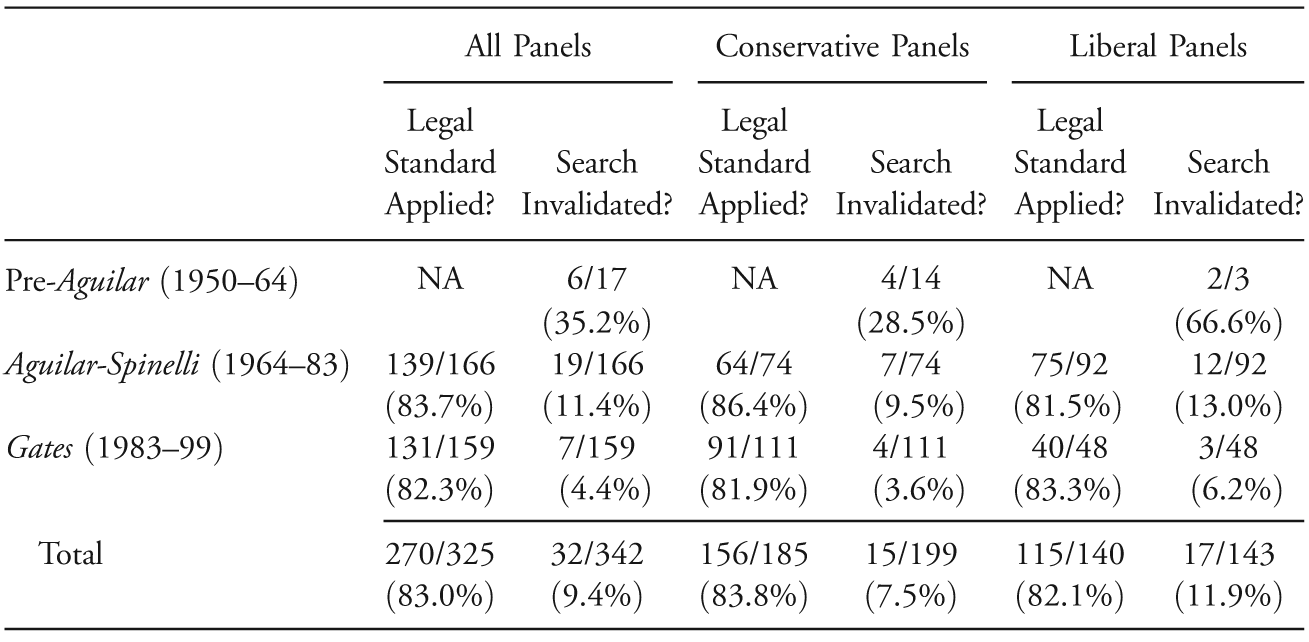
The cross tabulations in table 1 shed light on all three of our questions. Our first question focuses on whether lower courts consistently cite the relevant legal standard. We find that they do. One hundred and thirty-nine of the 166 cases decided during the Aguilar-Spinelli period explicitly articulated and discussed the two-pronged Aguilar-Spinelli test. The Gates “totality of circumstances” standard was explicitly applied in 131 of the 159 cases decided after the Court issued the Gates decision. Both these proportions are over 80%, indicating that judges articulated the relevant legal standard in the vast majority of cases. This supports an assumption of our research question. By studying the effect of doctrine and whether it is formulated as a rule or a standard, we are assuming that the lower courts agree on the relevant, reigning standard. If judges were not consistently citing the relevant standard, the form and substance of the standard would matter much less. The consistency with which lower court judges agree on and apply the relevant legal standard indicates a unified approach to this category of legal dispute. The Supreme Court has effectively communicated the reigning doctrine. Both conservative and liberal judges view the same precedents and doctrines as controlling in these cases. Judges are not reaching for obscure precedents to explain and justify their decisions.
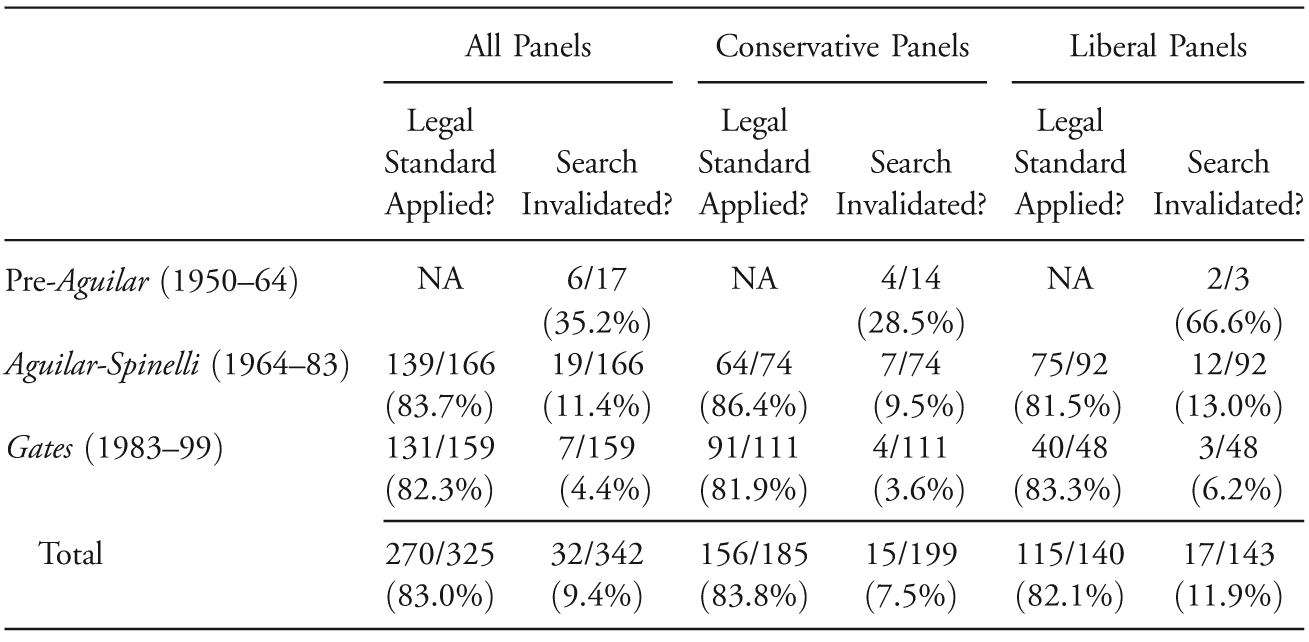
Furthermore, a failure to articulate the relevant legal standard is not associated with evading the implications of the doctrine. Under the Aguilar-Spinelli regime, the lower courts invalidated 11.5% of the searches when articulating the Aguilar-Spinelli rule and 11.1% when failing to articulate the test. Under the Gates regime, the circuit courts invalidated 4.7% of the searches when applying the “totality of circumstances” standard and 3.2% when not articulating the standard. Neither of these differences is close to statistically significant.
This result suggests that judges are not strategically ignoring particular precedents and legal tests to avoid their consequences. Any differences in decision patterns based on judges’ ideologies or policy preferences must be due to differences in the application of precedent, not by the choice of precedent or by evasion. It may be that lower court judges understand that omitting mention of a relevant landmark precedent is a red flag that will draw the attention of reviewing courts. Such an omission may give whistle-blowers either on or off the lower court leverage in their request for Court review of the decision (Cross and Tiller Reference Cross1998).
Our second question asks whether the Gates decision led to an increase in decisions admitting evidence obtained through confidential informants. Table 1 also helps to answer this question. During the Aguilar-Spinelli era, the circuit courts excluded the evidence in 11.4% (19 out of 166) of the cases. After Gates, circuit panels excluded evidence from just 4.4% (seven out of 159) of the cases. This difference is statistically significant, suggesting that lower court judges did respond to the Gates decision.
Table 1 also shows how liberal and conservative judges, respectively, reacted to Gates. Our measure of ideology is the median GHP score on the three-judge circuit court panel. Any median above zero is classified as conservative; medians below zero are classified as liberal. Breaking it down by ideology, we see that, among conservative panels, the rate of excluding evidence decreased from 9.5% before Gates to 3.6% after Gates. Among liberal panels the change was smaller, from 13.0% before Gates to 6.2% after Gates. The effect of Gates is significant among conservative panels (p = .10) but not among liberal panels. These results suggest that Gates did indeed influence the patterns of decisions in lower courts, particularly among conservative panels. We will return to this issue below, when we analyze the effects of the Gates decision with a multivariate regression.
Table 1 also shows data relevant to the question of whether the reactions of conservative and liberal panels to Gates were different from one another. Table 1 shows that under Aguilar-Spinelli, liberal panels excluded the challenged evidence in 12 out of 92 cases while conservative panels excluded the evidence in seven of 74 cases. Although liberal panels did exclude the evidence in a higher proportion of cases, the difference is not statistically significant. The situation is similar under Gates. Although liberal panels excluded evidence in a larger proportion of cases than conservative panels (three out of 48 cases compared to four out of 111), the difference is not statistically significant.
B. Did the Aguilar‐Spinelli Rule Constrain Lower Courts?
Another way of assessing the impact Gates had on lower court panels is to examine how the Aguilar-Spinelli doctrine operated in the lower courts. This will shed light on whether overruling that doctrine would have effects on patterns of lower court decisions. We find a very tight connection between the lower courts’ responses to the two elements of Aguilar-Spinelli and their decisions allowing or excluding the challenged evidence. When panels found the confidential informant to be credible, they overwhelmingly upheld the challenged searches. After a finding of credibility, liberal panels allowed the evidence in 60 out of 61 cases and conservative panels allowed the evidence in 54 out of 55 cases. When panels found the informant to lack credibility, they were much more likely to exclude the evidence. In such situations, liberal panels excluded the evidence in five out of six cases, and conservative panels excluded the evidence in three out of five cases.Footnote 6
Likewise, when lower courts found that the confidential informant had an adequate basis of knowledge for the information he or she provided, they overwhelmingly upheld the challenged searches. Liberal panels allowed the challenged evidence all 53 times after they found an adequate basis of knowledge, while conservative panels allowed the evidence in 42 of 43 cases after such a finding. After finding the basis of knowledge inadequate, liberal panels excluded the evidence eight out of nine times, while conservative panels excluded the evidence three out of four times.
These results indicate a high degree of congruence between the criteria emphasized by the Court in Aguilar and Spinelli and the criteria applied by lower courts. Aguilar and Spinelli identified credibility and basis of knowledge as relevant criteria, and lower courts seem to be treating these factors as important and applying them in the way indicated by the Supreme Court. Of course, these results are not proof that the Aguilar-Spinelli rules influenced outcomes. The judges could have chosen the outcomes they preferred for other reasons and then devised ways to satisfy the Aguilar-Spinelli prongs while still achieving their preferred outcome. However, if the Aguilar-Spinelli rules motivated lower court judges to discuss the informant’s credibility and basis of knowledge, they required judges to explain which facts they found credible and relevant to their conclusions. It appears that these rules successfully induced judges to “show their work” in their opinions. This would make it more apparent to higher courts if the opinion ignored or misrepresented relevant information, raising the cost of noncompliance. Overall, the Aguilar-Spinelli rule seems to have worked well in guiding lower courts to implement the doctrine.
C. Multivariate Analysis of the Effect of Gates
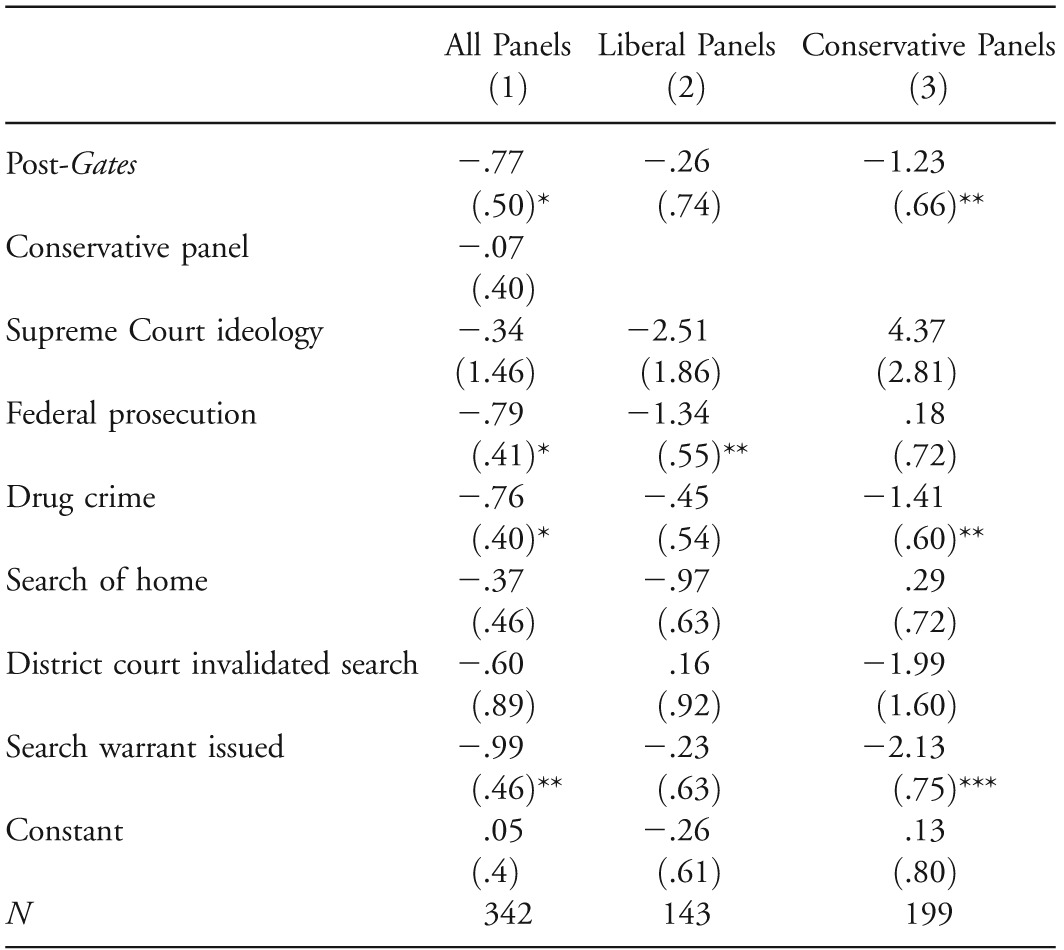
We now turn to a multivariate analysis of the effect of the Gates decision. This effect can be seen in table 2, which reports the results of a logit estimation of the effects of relevant factors on circuit courts’ decisions to uphold or invalidate police searches which were based on evidence supplied by confidential informants.Footnote 7 Table 2 includes three separate analyses, to show the effects of the factors on all panels, liberal panels, and conservative panels, respectively. The binary dependent variable is coded 1 if the court threw out evidence from the challenged search and 0 if the court allowed the evidence to be admitted in court. Supreme Court Ideology is the Judicial Common Space median on the Court for the year in which the case was decided. The rest of the independent variables are all dummy variables:
-
• Post-Gates is a dummy variable indicating that the case was decided in the circuit courts after the Supreme Court issued Gates.
-
• Conservative Panel indicates that the median judge on the circuit court panel deciding the case had a positive GHP ideology score.
-
• Federal Prosecution indicates the crime was being prosecuted by the federal government rather than by state or local law enforcement.
-
• Drug Crime indicates the crime being prosecuted involved illegal possession or distribution of drugs.
-
• Search of Home indicates that the challenged search took place in the residence of the accused.
-
• District Court Invalidated Search indicates that the lower court threw out the evidence from the challenged search, and the prosecution is appealing that decision.
-
• Search Warrant Issued indicates that the search was conducted after a judge or magistrate issued a search warrant, rather than under exigent circumstances (Huff Reference Huff2009) based on the judgment of law enforcement officials.

Note.— N = number of circuit court decisions. Standard errors are in parentheses.
* p < .10.
** p < .05.
*** p < .01.
The coefficients in table 2 show that the effects of the Gates decision were limited to conservative panels. Since Gates lowered the legal bar for admitting evidence, we expect a negative coefficient on the Post-Gates variable. The coefficient for Post-Gates is indeed negative and significant among all panels (first column of numbers) if we use a very forgiving test (p = .06, one-tailed test).Footnote 8 Among liberal panels, it is not significant. Among conservative panels, however, the effect of Gates is statistically significant and substantively large.Footnote 9 The probability that a conservative panel would exclude evidence before Gates was 5.4%. After Gates, that probability plunged to 1.9%, about a third of its pre-Gates level.Footnote 10 These results suggest an ambiguous answer to our second question, because Gates did lead to an increase in the likelihood that challenged evidence would be admitted, but this increase was limited to conservative panels. The results suggest that the answer to our third question is “yes,” because they show that conservative panels became notably less likely to exclude evidence after the Gates decision. Within these results from conservative panels, however, it is impossible to separate out the effect of a shift in doctrine in a conservative direction from the transition from a rule to a standard. In the context of a shift from rule to standard that is simultaneously a conservative shift in doctrine, both factors would push conservative panels to uphold searches.Footnote 11 The fact that the Gates doctrine was stated in the form of a standard is important because it allowed liberal panels significantly to avoid its substantive effects.
Beyond these variables of primary focus, a few interesting patterns are evident in table 2. There is no significant relationship between the ideology of the panel and the outcome. Although the coefficient on Conservative Panel in the column 1 is negative, indicating that conservative panels were less likely to throw out evidence, the relationship is not close to significant. This matches the results presented in table 1. Judge ideology is not an overwhelming influence in these types of cases. Liberal panels show a statistically significant tendency to uphold searches conducted by federal as opposed to state or local law enforcement, and conservative panels show a statistically significant pattern of upholding searches investigating drug-related crimes and searches conducted pursuant to a search warrant. All these trends are intuitively plausible, but it is not clear why they would differ by judge ideology.
The results in terms of responsiveness are a bit more complicated. Conservative panels clearly responded to Gates, showing a statistically significant increase in the probability of admitting evidence. The fact that liberal panels did not shift significantly to the right after Gates suggests a lack of responsiveness to Gates. However, the open-ended phrasing of the Gates standard invites judges to take into consideration any circumstances they deem relevant to the reliability of the information provided by the confidential informant. So liberal judges were not necessarily disobeying Gates if they considered more factors, or gave greater weight to the factors, that pointed toward excluding evidence.
VI. Conclusions and Implications
This paper investigates the effects of higher court doctrine on decisions by lower court judges. We focus on the transition from the Aguilar-Spinelli rule to the Gates standard in challenges to searches based on information provided by confidential informants. Overall, the results paint a picture of federal courts faithfully implementing the legal doctrine articulated by the Supreme Court. In an overwhelming proportion of the cases, lower courts cited the relevant precedent and articulated the relevant legal rule or standard. Lower court compliance was evident in terms of congruence and responsiveness, although the broad nature of the Gates doctrine did not force liberal panels to change their decision patterns from liberal to conservative.
The detailed, two-pronged Aguilar-Spinelli test seems to have constrained judges. The statistically significant change in conservative panels’ post-Gates decisions is evidence of this constraint, as is the relationship between the courts’ answers to the two prongs of the Aguilar-Spinelli test and the outcomes of the cases. The fact that the Gates doctrine was implemented as a standard allowed conservative panels to follow their policy preferences toward allowing more challenged evidence to be used in court, yet it did not force liberal panels toward more conservative decisions. This supports our theoretical argument that ideology is constrained by precedent in the form of rules but unleashed by precedent in the form of standards.
Both the form and the substance of Supreme Court doctrine seem to influence decisions in the lower courts. Supreme Court opinions can steer decisions in the lower courts by specifying decision rules that tell the lower courts which factors should be considered important and how those factors should relate to case dispositions. When Court doctrine allows more latitude for lower court judges to decide which factors are important and how those factors should bear on case dispositions, the ideological preferences of lower court judges exert more influence. Recognition of the differences between rules and standards may help clarify a tension in the literature on lower court compliance between evident lower court loyalty to Supreme Court precedent in some circumstances but equally evident attitudinal voting in others.
This research is, as far as we know, the first attempt to compare empirically the effects of rules versus standards on lower court decisions. The conclusions should be considered tentative until they are supported by studies of other areas of legal policy. For instance, the Court’s move from the fairly rigid Roe v. Wade (410 U.S. 113 [1973]) trimester structure in abortion rights cases to the “undue burden” standard of Planned Parenthood v. Casey (505 U.S. 833 [1992]) may have resulted in a change to more attitudinal voting in the lower courts. Also, the Court’s recent abandonment of the two-step test of whether a state official is entitled to qualified immunity under federal law in favor of a less rigid standard may also allow for a study similar to this one.Footnote 12 One way to isolate the effect of an ideological shift in doctrine from the shift from a rule to a standard (or vice versa) would be to locate an area of law in which the Supreme Court, or any supervisory court, changed the form of the doctrine but did not simultaneously change the ideological direction of it.
With the data we have, we can only speculate as to why the Supreme Court would have chosen to allow more latitude on the issue of confidential informants in 1983. The justices may have believed that the lower courts had become sufficiently supportive of law enforcement that they could be relied upon to use the discretion granted to them by Gates to admit more challenged evidence. One avenue for future research would be empirical investigation into whether higher court judges manipulate the form of their doctrines to take advantage of the ideological profile of the lower courts. That is, a court may be more likely to articulate doctrine in the form of constraining rules when it is ideologically out of sync with the lower courts and more likely to package doctrine in the form of open-ended standards when the ideology of the lower courts matches that of the higher court majority. Whether higher court judges even have knowledge of patterns in the decisions and the staffing of the lower courts when they initiate a new standard is a fertile area also opened up by our findings.