An individual’s positive self-conception as a member of an organization is considered as an intangible asset and a significant resource for contributing to employee self-improvement and in-role performance (Judge, Erez, & Bono, Reference Judge, Erez and Bono1998). Organizational-based self-esteem (OBSE) denotes an individual’s belief about their self-worth as an organizational member. There has been increasing attention concerning OBSE as a strong predictor of employee in-role performance (Pierce & Gardner, Reference Pierce and Gardner2004) with a number of studies conducted in diverse contexts supporting this perspective (e.g., Pierce & Gardner, Reference Pierce and Gardner2004; Bowling, Eschleman, Wang, Kirkendall, & Alarcon, Reference Bowling, Eschleman, Wang, Kirkendall and Alarcon2010).
Although there is a relatively large stream of research supporting a positive relationship between OBSE and in-role performance, scarce research has identified the mediating factors that link this positive relationship despite scholars underscoring the importance of these factors (Van Dyne, Vandewalle, Kostova, Latham, & Cummings, Reference Van Dyne, Vandewalle, Kostova, Latham and Cummings2000). Additionally, as the properties of OBSE are considered to be relatively stable and resistant to change once established (Trzesniewski, Donnellan, & Robins, Reference Trzesniewski, Donnellan and Robins2003; Pierce & Gardner, Reference Pierce and Gardner2004; Hui, Lee, & Niu, Reference Hui, Lee and Niu2010), extant research does not delineate the intervening link which explains how OBSE contributes to high productivity and in-role performance. This lack of knowledge regarding the linkage between OBSE and in-role performance presents a critical research gap for organizations to utilize OBSE. Therefore, the purpose of this study is to understand how OBSE contributes to an enhanced in-role performance by examining the learning behaviors of employees. Through an understanding of this linkage, a positive self-perspective might be more fully encouraged and realized within organizations.
This study is undergirded by self-consistency theory (Korman, Reference Korman1970) which posits that individuals have propensities for engaging in behaviors that are consistent with their self-conceptions. Thus, it is hypothesized that employees with high OBSE tend to participate in self-development activities to strengthen core skills and increase their knowledge. Overall, this accumulated expertise of an employee contributes to greater levels of in-role performance (Walumbwa, Cropanzano, & Hartnell, Reference Walumbwa, Cropanzano and Hartnell2009). The authors of this study purport that an individual’s voluntary engagement in employee learning behavior (Walumbwa, Cropanzano, & Hartnell, Reference Walumbwa, Cropanzano and Hartnell2009; Bezuijen, Dam, Berg, & Thierry, Reference Bezuijen, Dam, Berg and Thierry2010) mediates the relationship between OBSE and in-role performance.
The contextual influences within an organization also may act as a boundary condition to enhance or restrict employee learning behavior which is derived from OBSE (Tett & Burnett, Reference Tett and Burnett2003; Hirst, Van Knippenberg, Chen, & Sacramento, Reference Hirst, Van Knippenberg, Chen and Sacramento2011). This study, therefore, also examines perceived delegation as a situational factor influencing the relationship among OBSE, learning behavior, and in-role performance. Perceived delegation is regarded as an experienced organizational contextual influence for supporting and encouraging employee participation in decision-making processes (Chen & Aryee, Reference Chen, Ho, Lin, Chung, Chao, Chou and Li2007).
First, this article will describe the theoretical background of self-consistency theory relevant for informing the study’s first hypothesis concerning the following relationships: (a) OBSE and in-role performance; and (b) OBSE and employee learning behavior. Second, the mediating role of learning behavior, as a linkage between OBSE and performance, is detailed with a statement of the second and third hypotheses. A description of the organizational contextual influence of perceived delegation as a mediating role, informed by self-consistency theory, is followed by a statement of the fourth hypothesis. The study methods and results are delineated with a discussion, and lastly, implications for further research and improved practice are described.
Theoretical background and hypotheses
OBSE and in-role performance
Self-conception is regarded as a fundamental source of motivation with properties comparable to the schemas that guide individuals’ perspectives, attitudes, and behaviors (Swann, Chang-Schneider, & McClarty, Reference Swann, Chang-Schneider and McClarty2007). As an element of the construct of self-conception, self-esteem has garnered substantial attention and now occupies a prominent place within the positive organizational behavior field (Mruk, Reference Mruk2006). Pierce, Gardner, Cummings, and Dunham (Reference Pierce, Gardner, Cummings and Dunham1989) first introduced OBSE based on the following premises: (a) self-esteem is constructed as a multifaceted conceptualization of self (Pierce & Gardner, Reference Pierce and Gardner2004); and (b) specific aspects of self-esteem are more relevant than global measures (Tharenou, Reference Tharenou1979; Van Dyne et al., Reference Van Dyne, Vandewalle, Kostova, Latham and Cummings2000). The construct of OBSE, concerned with an individual’s self-worth and efficacy as an organizational member, suggests that employees who report high OBSE identify with the following statements: ‘I am taken seriously around here’ and ‘I make a difference around here’ (Pierce et al., Reference Pierce, Gardner, Cummings and Dunham1989).
The nomological network of OBSE (Gardner & Pierce, Reference Gardner and Pierce1998; Lee & Peccei, Reference Lee and Peccei2007; Scott, Shaw, & Duffy, Reference Scott, Shaw and Duffy2008; Panaccio & Vandenberghe, Reference Panaccio and Vandenberghe2011; Norman, Gardner, & Pierce, Reference Norman, Gardner and Pierce2015; Chen et al., Reference Chen and Aryee2016) has expanded significantly since its inception. Studies regarding the direct relationship between OBSE and in-role performance also have proliferated (Van Dyne et al., Reference Van Dyne, Vandewalle, Kostova, Latham and Cummings2000; Chen, Goddard, & Casper, Reference Chen, Goddard and Casper2004; Van Dyne & Pierce, Reference Van Dyne and Pierce2004; Sekiguchi, Burton, & Sablynski, Reference Sekiguchi, Burton and Sablynski2008; Rank, Nelson, Allen, & Xu, Reference Rank, Nelson, Allen and Xu2009; Liu, Hui, Lee, & Chen, Reference Liu, Hui, Lee and Chen2013; Sui & Wang, Reference Sui and Wang2014); and, a meta-analysis specified strong supporting evidence for a positive relationship between OBSE and individual performance (Bowling et al., Reference Bowling, Eschleman, Wang, Kirkendall and Alarcon2010).
The relationship between OBSE and in-role performance can be explained by self-consistency theory which posits that individuals tend to engage in behaviors and roles which are pertinent to, or coherent with, their self-conception (Korman, Reference Korman1970; Brockner, Reference Brockner1988). Specifically, employees with high OBSE tend to preserve their positive self-conceptions by behaving in manners consistent with these views. Additionally, as a means to further their positive self-conception, these individuals also are likely to perform their roles at high levels (Pierce et al., Reference Pierce, Gardner, Cummings and Dunham1989).
Based on the utility of OBSE contributing to in-role performance, studies consistently emphasized the importance of managerial interventions to reinforce an individual’s sense of value to an organization (e.g., Pierce et al., Reference Pierce, Gardner, Cummings and Dunham1989; Pierce, Gardner, Dunham, & Cummings, Reference Pierce, Gardner, Dunham and Cummings1993; Carson, Carson, Lanford, & Roe, Reference Carson, Carson, Lanford and Roe1997; Gardner & Pierce, Reference Gardner and Pierce1998; Van Dyne et al., Reference Van Dyne, Vandewalle, Kostova, Latham and Cummings2000; Sekiguchi, Burton, & Sablynski, Reference Sekiguchi, Burton and Sablynski2008). The managerial interventions which promote positive self-concepts include: (a) clarifying employees’ roles; (b) providing employees with opportunities for success; and (c) sending implicit signals or explicit messages (e.g., verbal support or recognition) to ensure that employees are aware of their worth and value (Gardner & Pierce, Reference Gardner and Pierce1998). The authors of this study recognize the practical utility of managerial interventions concerning OBSE and in-role performance to advance organizational purposes and performance. However, we contend that the sole emphasis on interventions to promote OBSE, which take considerable time for results, might not appeal to managers and others considering the trait-like property of OBSE.
Employees who are new to organizations accrue numerous experiences through successes and failures which influence an individual’s OBSE (Pierce & Gardner, Reference Pierce and Gardner2004). This element of an individual’s self-concept is at first unstable but then increasingly becomes more resistant to change and constant (Pierce & Gardner, Reference Pierce and Gardner2009). Pierce and Gardner (Reference Pierce and Gardner2009) noted that early developmental stages of OBSE are perceived as state-like and, through the passage of time, OBSE increasingly becomes trait-like. Although there is scarce research regarding the stability of OBSE, empirical studies of global self-esteem instead can support this notion. Global self-esteem, or an individual’s own comprehensive self-assessment or self-worth, also is regarded as trait-like (Pierce & Gardner, Reference Pierce and Gardner2009). For example, global self-esteem is considered as relatively stable and resistant to change once formed (Campbell, Reference Campbell1990), which is similar to OBSE. A meta-analysis study identified that the establishment of global self-esteem shows a positive developmental trend from childhood to adolescence followed by a substantially stable pattern through adulthood (Trzesniewski, Donnellan, & Robins, Reference Trzesniewski, Donnellan and Robins2003).
Thus, based on the assumption that OBSE is relatively stable once established, this study investigates the process of how employee positivity leads to increased performance. True to the purpose of the researcher and practitioner, through an understanding of this mechanism the utility of a positive self-conception in one’s work-life might be more fully realized. In this next section, we will discuss how the learning behaviors of employees act as a process variable.
OBSE and employee learning behavior
OBSE is regarded as a powerful source of work motivation in guiding the attitudes, concerns, and behaviors of employees for (a) engaging in specific tasks; (b) determining the amount of effort to utilize; and (c) approaching the conduct of their work once engaged in a chosen task (Judge, Erez, & Bono, Reference Judge, Erez and Bono1998). A specific area of interest regarding OBSE examines the capacity for learning behavior to be a discretionary engagement in ongoing activities concerning the mastery of new knowledge, skills, and abilities for immediate or future dividends (Walumbwa, Cropanzano, & Hartnell, Reference Walumbwa, Cropanzano and Hartnell2009; Bezuijen et al., Reference Bezuijen, Dam, Berg and Thierry2010). As self-consistency theory implies (Korman, Reference Korman1970) employees with high OBSE are motivated to realize satisfying activities which preserve their sense of value within organizations. For example, an individual may strengthen their self-worth through activities such as sharing new knowledge with others, showing proficiency of specific skills gained, and suggesting original ideas at work.
We argue that employees with high OBSE who engage in self-development activities are driven by their internal motivations to preserve their perceived status even during unexpected organizational changes. These changes could influence particular job responsibilities and accompanying employment status, such as their specific position and its value within an organization. This is relevant considering the current context for fast-paced and turbulent global business environments where certain expertise can rapidly become outdated (Scholarios et al., Reference Scholarios, Van der Heijden, Van der Schoot, Bozionelos, Epitropaki, Jedrzejowicz, Knauth, Marzec, Mikkelsen and Van der Heijde2008). The obsolescence of specific skills in these environments can result in employees’ losing their valued status during organizational changes. According to the study using panel data on workers in Dutch industry (Allen & De Grip, Reference Allen and De Grip2012), rapid changes in technology induce skill obsolescence and loss of employment. Consequently, these employees are aware that the continuous acquisition of new knowledge and skills is a strategy for avoiding unexpected predicaments in the future. Thus, the first hypothesis for this study is detailed as:
Hypothesis 1: There is a positive relationship between OBSE and learning behavior.
Mediating role of learning behavior between OBSE and in-role performance
Several job performance models have identified the antecedents, intervening processes, and situational effects on behavioral outcomes in the workplace (Motowildo, Borman, & Schmit, Reference Motowildo, Borman and Schmit1997; Tett & Burnett, Reference Tett and Burnett2003). Although the specific foci of these models vary, there is a shared perspective that individual dispositional and trait-like characteristics (e.g., personality, cognitive ability, and self-conception) are directly linked to job performance; and, indirectly associated with knowledge, skills, and discretionary behaviors. For example, Motowildo, Borman, and Schmit (Reference Motowildo, Borman and Schmit1997) noted that job knowledge, skills, and behaviors that are acquired in the workplace would overall affect employee performance. This increases the likelihood that employees will perform positive-valued behaviors because these accumulated competencies help to produce desirable outcomes including better products and services.
Employee learning behavior is a key element of this process as it directly relates to acquiring and revising job-related competencies (George & Jones, Reference George and Jones1997). By assimilating the accumulated knowledge and skills, employees deepen their level of expertise (Walumbwa, Cropanzano, & Hartnell, Reference Walumbwa, Cropanzano and Hartnell2009). Through learning, the accrued human capital of an individual results in employees who are more adaptable to new tasks or jobs (Chen, Thomas, & Wallace, Reference Chen, Thomas and Wallace2005). Additionally, as a result of learning processes, these individuals consequently may develop innovative and beneficial ideas to apply in the workplace (Gong, Huang, & Farh, Reference Gong, Huang and Farh2009).
Overall, employee learning behavior is considered as essential for improved performance (Arthur, Bennett, Edens, & Bell, Reference Arthur, Bennett, Edens and Bell2003). Therefore, we propose that employees with high OBSE, who behave in manners consistent with their self-conceptions, will exhibit greater interests in accumulating expertise resulting in increased individual in-role performances. The study hypotheses regarding the mediating role of learning behavior between OBSE and in-role performance are delineated as:
Hypothesis 2: There is a positive relationship between learning behavior and in-role performance.
Hypothesis 3: Learning behavior will mediate the relationship between OBSE and in-role performance.
Moderated mediating role of perceived delegation
Although this study contends that the relationship between OBSE and in-role performance is mediated by employee learning behavior, we also anticipate that the strength of this relationship will vary among employees in different organizational contexts (Mischel, Reference Mischel1973; Tett & Burnett, Reference Tett and Burnett2003). Mischel (Reference Mischel1973) specified that individual differences such as personality are not identical across various contexts; therefore, human behaviors are a product of the person and the situation. Further, situational forces on personality and behavior are distinguished by two bipolar continua: (a) weak situations and (b) strong situations (Mischel, Reference Mischel1973).
Weak situations are delineated by a low level of a structure imposed on individuals where employees perceive more opportunities to practice self-direction and control. Mischel (Reference Mischel1973) denoted that under these conditions, latent potentials residing within individuals can be activated; consequently, trait or trait-like characteristics occupy a central role in shaping behaviors and actions. By contrast, strong situations which induce conformity serve to trigger or drive behaviors, because these circumstances restrict cues for trait-specific individual expression.
The motivational path from OBSE through learning behavior to in-role performance is restricted or enriched depending on the organizational contextual influence of employee-perceived delegation (Tett & Burnett, Reference Tett and Burnett2003; Hirst et al., Reference Hirst, Van Knippenberg, Chen and Sacramento2011). A core concept of perceived delegation emphasizes the decentralization of power for employees with respect to decision-making (Conger & Kanungo, Reference Conger and Kanungo1988). Delegation is realized through (a) managerial leader behaviors (Chen & Aryee Reference Chen, Ho, Lin, Chung, Chao, Chou and Li2007), (b) management practice (e.g., management by objectives, quality circles; Bae, Chen, David, Lawler, & Walumbwa, Reference Bae, Chen, David Wan, Lawler and Walumbwa2003), and (c) decentralized organizational structure (Gordon, Reference Gordon1991). Further, employee delegation is actualized through the allocation of broader responsibilities and relevant authorities; or, through processes for empowering employees to be responsible for specific actions and tasks (Chen & Aryee, Reference Chen, Ho, Lin, Chung, Chao, Chou and Li2007). Delegation is critical because, in a participative organizational context, or a weak situation, there is an increase in employee initiatives which are vital for organizations in fast-paced and turbulent environments (LePine & Van Dyne, Reference LePine and Van Dyne2001).
An employee’s perception of the degree of their involvement in decision-making, or the amount of latitude concerning work discretion, might moderate the relationship between OBSE and learning behavior. Employee delegation by management can create an environment, considered as a weak situation, which provides employees with opportunities to suggest new ideas, solve complex or persistent problems, and initiate new processes (Chen & Aryee, Reference Chen, Ho, Lin, Chung, Chao, Chou and Li2007). In this environment, OBSE is less constrained to influence learning behaviors.
Moreover, employees with high OBSE aspire to add value to organizations, which is consistent with their self-conceptions (Pierce et al., Reference Pierce, Gardner, Cummings and Dunham1989) and to satisfy this motivation, these employees are more likely to engage in learning activities. By contrast, organizations with low levels of perceived delegation, or strong situations, result in employees identifying fewer opportunities for providing unique and valuable contributions. Therefore, as initiated by OBSE, employees’ motivations are then restricted for affecting individual engagement in learning activities.
We anticipate that perceived delegation will moderate the relationship between learning behavior and in-role performance. Specifically, in weak situations with limited directives for courses of action, employees will test new ideas or apply their skills consequently improving in-role performance through learning behaviors. On the contrary, highly structured situations with lower levels of the perceived delegation will signal employees through prescribed rules and procedures. In these settings, volitional learning behaviors are less likely to contribute to in-role performance. It is presumed that perceived delegation will positively moderate the relationship between OBSE, learning behavior, and in-role performance. Therefore, it is likely that perceived delegation will influence the strength of the relationship between OBSE and in-role performance and exhibit a pattern of moderated mediation. This study’s hypothesis regarding the mediating role of perceived delegation is delineated as:
Hypothesis 4: Perceived delegation will moderate the strength of the mediated relationship between OBSE and in-role performance through learning behavior, such that the mediated relationship will be stronger under high-perceived delegation rather than low-perceived delegation.
Methods
Sample and procedures
The human resource (HR) department of a Korean company distributed questionnaires to employees and requested to return completed surveys within 3 weeks. The participants in the study were guaranteed member anonymity, respondent data confidentiality, and informed that study results might be published solely for research purposes. Study participants were encouraged to provide employee numbers and names to match a completed questionnaire with individual performance review data. Some respondents turned in questionnaires but declined to identify themselves by name and employee number, therefore, the final total of usable questionnaires was reduced to 293.
The sample consisted of 75.7% male respondents (n=224), and 24.3% female respondents (n=69). The positions of the participants within the company were comprised of: (a) 31.6% assistant managers, (b) 29.2% employees, (c) 21.3% agent managers, and (d) 17.9% middle and high-level managers. The job positions were from the following areas: (a) management/administration (30.2%), (b) sales (49.8%), (c) manufacturing/operations (11.6%), and (d) research/development (4.3%). Among the respondents’ educational levels, 86.4% had 4-year university degrees; 10.6% had graduate degrees (masters or doctoral), and 1.0% had high school diplomas. Overall, the average age of the sample was 33 years with a notable, 62-month tenure at the company.
Measures
The variables in this study were measured utilizing a 7-point scale ranging from 1=‘strongly disagree,’ to 7=‘strongly agree’.
OBSE
OBSE was assessed using 5 items from a validated Korean version of a scale based on the work of Oh, Park, and Ong (Reference Oh, Park and Ong2013). Sample items included: ‘I count around here’ and ‘I am valuable around here.’ The internal reliability coefficient was 0.85.
Learning behavior
Employee learning behaviors were measured used a 7-item scale from Bezuijen et al. (Reference Bezuijen, Dam, Berg and Thierry2010). Sample items included: ‘I continually learn new skills for my job;’ ‘I am working to extend my knowledge and skills;’ and ‘I perform learning tasks that are not part of my job.’ The internal reliability coefficient was 0.86.
Perceived delegation
To capture employees’ perceptions of the level of delegation, we used using 5 items from a Korean version of a validated scale by Yukl and Lepsinger (Reference Yukl and Lepsinger1990) which was adapted by Lee and Yoo (Reference Lee and Yoo2011). Specifically, Lee and Yoo (Reference Lee and Yoo2011) changed a reference point from my boss to the organization for their research purposes since the original construct of delegation by Yukl and Lepsinger (Reference Yukl and Lepsinger1990) described a category of leader behavior. Sample items included: ‘the organization encourages me to determine for myself the best way to carry out an assignment or accomplish a task;’ ‘the organization asks me to take primary responsibility for planning a major activity or project for the work unit;’ and ‘the organization delegates to me the authority to make important decisions and implement them.’ The internal reliability coefficient was 0.90.
In-role performance
We used the results of periodic performance ratings (e.g., Gardner, Dyne, & Pierce, Reference Gardner, Dyne and Pierce2004; Jehn & Bezrukova, Reference Jehn and Bezrukova2004; Fletcher, Major, & Davis, Reference Fletcher, Major and Davis2008), which were conducted by the management department of the host organization. The host company conducts official performance ratings twice a year and the performance appraisal data for this study was collected from the HR department. Performance ratings were calculated from the codes derived from employee performance reviews whereas, 5 indicates an exceptional level of performance and 1 represents an unsatisfactory level of performance. The employees’ immediate supervisors initially rated their individual performance and, the second level of management reviewed and completed the final ratings for each employee.
The statistical results suggested that the ratings were not identical across the employees (mean 3.37; SD 0.70; nonsignificant skewness parameter −0.47). Some scholars have expressed concern regarding the validity of performance ratings due to issues such as poorly skilled raters and psychometric deficiencies in the ratings (Murphy, Cleveland, Skattebo, & Kinney, Reference Murphy, Cleveland, Skattebo and Kinney2004). However, others have noted that performance ratings also can be a good indicator of in-role performance (Gardner, Dyne, & Pierce, Reference Gardner, Dyne and Pierce2004).
Control variables
Participants’ demographic variables such as gender, age, tenure, education, and job position were statistically controlled to mitigate the potential effects on variables within the model. All of the data, except in-role performance data, came from a single source which is potentially contaminated by common method variance (Podsakoff, MacKenzie, Lee, & Podsakoff, Reference Podsakoff, MacKenzie, Lee and Podsakoff2003). Further, the hypothesized model of the present study involves a mediating factor, which assumes a direct or indirect causal relationship between OBSE and in-role performance through learning behavior. This limitation could reduce confidence regarding the results of this study. We attempted to lessen common method bias problems by employing a statistical control. Podsakoff et al. noted that one of the variables that is ‘frequently assumed to cause common method variance are the respondent’s affective states’ (Reference Podsakoff, MacKenzie, Lee and Podsakoff2003: 889). Therefore, positive and negative affectivity, which could have potentially influenced the relationship between OBSE and learning behavior, was controlled for using the Positive and Negative Affect Scale (Watson, Clark, & Carey, Reference Watson, Clark and Carey1988). The internal consistency reliability was 0.82 and 0.86.
Results
Preliminary analyses
We examined the internal consistency of all measures using Cronbach’s α except the performance ratings. The reliability coefficients ranged from 0.82 to 0.90, which demonstrated an acceptable level of internal consistency. A confirmatory factor analysis was conducted to provide support for the discriminant validity among the independent (OBSE), mediating (learning behavior), moderating (perceived delegation), and control variables (positive and negative affect). Based on the criteria of Browne and Cudeck (Reference Browne and Cudeck1993) and Loehlin (Reference Loehlin1998), the following model fit indexes indicated an acceptable fit: χ2=414.25; χ2/df=3.98; confirmatory fit index (CFI)=0.90; incremental fit index (IFI)=0.91; root mean square error of approximation (RMSEA)=0.09 (model 1). Additionally, the confirmatory factor analysis results revealed that the relationship between each indicator variable and the respective variable were statistically significant (p<.01), confirming convergent validity. Because of the relatively high correlation between OBSE and learning behavior, we compared the fit of the proposed model with alternative models. The first alternative model was a three-factor model with OBSE, learning behavior, and perceived delegation loaded on one factor (model 2). The second alternative model was a four-factor model with the correlation of OBSE and learning behavior set to one (model 3). The third alternative model is a four-factor model where OBSE and perceived delegation loaded on one factor (model 4). Each of the alternative models displayed a worse fit than the hypothesized measurement model.
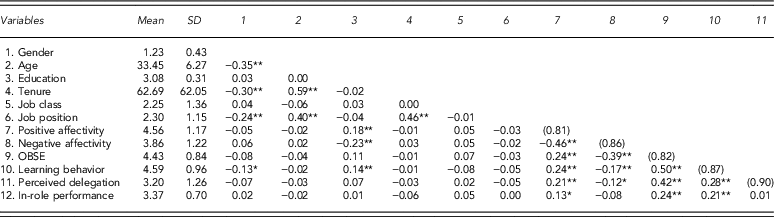
Table 1 displays the means, standard deviations, and zero-order correlations of the variables used in the study, with coefficient αs diagonally indicated on the table. As expected, the bivariate correlations exhibited that OBSE is positively related to learning behavior (r=0.50; p<.01) and in-role performance (r=0.24; p<.01); and, there is a positive relationship between learning behavior and in-role performance (r=0.21; p<.01). Although not the focus of our hypotheses, the results also show that positive affectivity is positively related to OBSE (r=0.24; p<.01) and learning behavior (r=0.24; p<.01), while negative affectivity is negatively related to OBSE (r=−0.29; p<.01) and learning behavior (r=−0.17; p<.01). A high correlation (r=0.48; p<.01) between OBSE and learning behavior suggested a possible multicollinearity issue thus, multicollinearity was checked using variance inflation factor scores. All factors’ variance inflation factor scores were below 1.93 and under the most rigorous cutoff value of 2.50. These scores indicate that multicollinearity was not an issue in this study.
Means, standard deviations and correlations

Note. N=293.
OBSE=organization-based self-esteem.
Education level: 1=middle school, 2=high school, 3=university degree, 4=graduate degree and higher; Job classification: 1=administration/support, 2=sales, 3=R&D, 4=manufacture, 5=technical post, 6=etc.; Position level: 1=employee, 2=assistant manager, 3=agent manager, 4=manager, 5=deputy manager, 6=general manager, 7=director.
Cronbach’s α is in parentheses on the diagonal.
*p<.05; **p<.01.
Additionally, we checked the potential for contamination regarding common method variance by employing two techniques (Podsakoff et al., Reference Podsakoff, MacKenzie, Lee and Podsakoff2003). First, we conducted Harman’s one-factor test by using an unrotated factor solution and loaded all the measurement items onto one factor. If a single factor appeared, or one general factor which accounted for the majority of variables, a substantial amount of common method variance was considered to exist. The unrotated factor analysis, with the eigenvalue-greater-than-one criterion, exhibited five distinct factors. It also revealed that a one-factor model of the unrotated solution explained 26.5% of the variance. The results indicated that no substantial amount of common methods variance was present.
Second, by treating positive and negative affectivity as control variables, we compared the differences of partial correlation between the predictor (OBSE) and the mediating variable (learning behavior), which were collected from a single source. Zero-order correlations between OBSE and learning behavior went from r=0.50 (p<.01) to both r=0.36 (p<.01) and r=0.48 (p<.01) while controlling for positive and negative affectivity, respectively. The key relationship maintained its statistical significance, although both affectivity variables were controlled in the partial correlation. With these results, we concluded that common method variance likely is not to be present.
Hypothesis testing
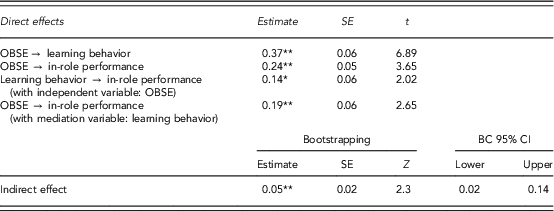
We tested the hypothesized model of the present study using structural equation modeling in AMOS-20. All the control variables, including the demographic and affectivity variables, were incorporated in the model. The analysis specified that the proposed model provided an acceptable fit to the data (χ2=416.63; χ2/df=3.04; CFI=0.91; IFI=0.92; RMSEA=0.08). Table 2 presents the summarized results of the direct and indirect effects of the model. As extant literature has evidenced, this study also found there to be a positive relationship between OBSE and in-role performance (β=0.24, p<.01). OBSE was positively related to learning behavior (β=0.37, p<.001) and learning behavior also revealed a positive association with in-role performance (β=0.14, p<.001). Thus, Hypotheses 1 and 2 of this study were supported.
Standardized direct and indirect effects of the hypothesized model

Note. N=293,
BC=bias-corrected; CI=confidence interval; OBSE=organization-based self-esteem.
*p<.05; **p<.01.
To test Hypothesis 3, we performed a bootstrapping analysis to assess the significance of the indirect effects (Shrout & Bolger, Reference Shrout and Bolger2002). The results showed that the indirect effect of OBSE on in-role performance through learning behavior was supported (β=0.05, p<.01; bootstrap bias-corrected 95% confidence interval [0.02, 0.14]; see Table 2). It also showed that learning behavior partially mediated the relationship between the independent and criterion variable. Hypothesis 3 of this study also was supported.
Hypotheses 4 postulated that the indirect effect of learning behavior regarding the OBSE and in-role performance relationship would be strengthened by high-perceived delegation. To test our moderated mediation hypotheses, we examined three conditions (Preacher, Rucker, & Hayes, Reference Preacher, Rucker and Hayes2007). First, we examined the significant effect of OBSE and learning behavior on in-role performance (Condition 1). We also tested the significant interaction between (a) OBSE and perceived delegation in predicting learning behavior and (b) learning behavior and perceived delegation in predicting in-role performance (Condition 2). Lastly, the different and conditional indirect effects of OBSE on in-role performance via learning behavior across low and high levels of the perceived delegation were studied (Condition 3).
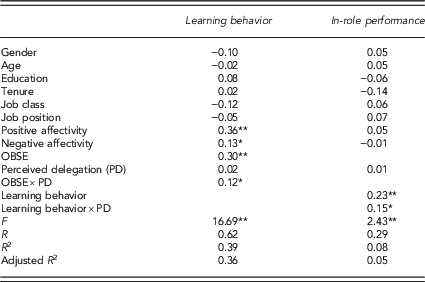
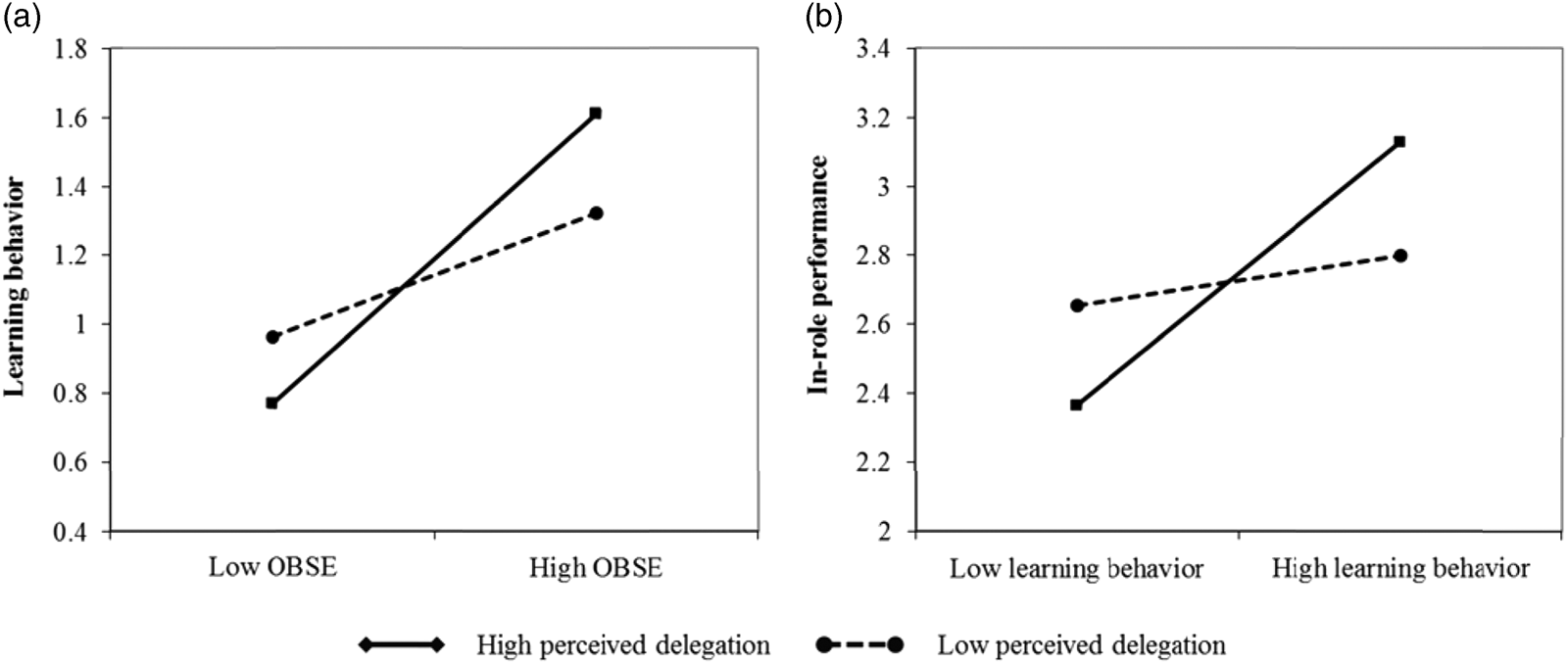
The results of Hypotheses 1 and 2 supported Condition 1 for demonstrating the mediation. Further, to assess Condition 2 we examined the moderated regressions for learning behavior and in-role performance. Table 3 shows that the interaction terms for OBSE with perceived delegation were significant in predicting learning behavior (β=0.12, p<.05). We also detected that the interaction of learning behavior with the moderating variable was significant in predicting in-role performance (β=0.15, p<.05). To better understand the relationship of this interaction, we plotted the regression lines (Figure 1) and determined that Condition 2 was satisfied.
Regression results for testing moderation for learning behavior and in-role performance

Note. N=293.
OBSE=organization-based self-esteem.
*p<.05; **p<.01.
The plotted regression lines of interaction terms. (a) Interaction between organization-based self-esteem (OBSE) and perceived delegation for learning behavior. (b) Interaction between learning behavior and perceived delegation for in-role performance.

Preacher, Rucker, and Hayes’ (Reference Preacher, Rucker and Hayes2007) statistical significance test was used to examine additional valid evidence and the high and low levels of the perceived delegation were operationalized as 1 SD above and below the mean of the variable. The results displayed that the conditional indirect effect of OBSE was stronger and significant in the high-perceived delegation condition (β=0.09, SE=0.03, z=3.14, p<.01) and was weaker and insignificant in the low-perceived delegation condition (β=0.01, SE=0.01, z=0.72, ns). Condition 3 was satisfied. Thus, Hypothesis 4, which predicted the moderated mediation role of perceived delegation, was supported.
Discussion
The present study examined the intervening process that creates a relationship between OBSE and in-role performance. Employees who voluntarily and actively acquire new knowledge and skills to enhance their expertise consequently exhibited high levels of performance. This study’s findings provide evidence that employee learning behavior is a link between OBSE and in-role performance.
Since Mischel (Reference Mischel1973) purported that individual behaviors are not isolated from their environmental context, this study also investigated situational forces which promote or restrain the path from OBSE to performance. We found that the positive relationship between OBSE, learning behavior, and in-role performance was stronger under the condition of high-perceived delegation. Figure 1a demonstrates that employees with high OBSE engage in learning behaviors more often compared to those with low OBSE and that this occurs in situations where employees perceive: (a) greater involvement in decision-making or (b) more discretion to initiate and perform tasks.
Overall, the plotted regression lines confirmed the study’s hypotheses, however, the pattern of employees with low OBSE should be noted. The findings specified that employees who perceive themselves as having less value within an organization would engage in learning behaviors slightly more in strong situations of low-perceived delegation compared to those in weak situations of high-perceived delegation. According to self-consistency theory, employees with low OBSE are less likely to engage in learning activities consistent with their self-conceptions. This occurs in weak situations with highly delegated tasks whereby an individual’s traits could be activated (Mischel, Reference Mischel1973) compared to strong situations where contextual influences are significant in shaping employee learning behaviors (Pierce & Gardner, Reference Pierce and Gardner2009). However, some employees with low OBSE who perceive low levels of the delegation also will exhibit learning behaviors relative to carrying out orders by supervisors or following organizational procedures.
The study findings also delineated that perceived delegation moderated the relationship between learning behavior and in-role performance (Figure 1b). The variance of the slope is small regarding low-perceived delegation which indicates that learning behavior is relatively insignificant to in-role performance; particularly, in circumstances where employees have less discretion to initiate and perform tasks. High-perceived delegation, conversely, has a steep slope which suggests that a weak situation strengthens the positive association between learning behavior and in-role performance. Interestingly, employees with low-learning behaviors who experienced highly delegated situations were underrated compared to those with the low-perceived delegation. This implies that employees who are given more discretion by their supervisors are expected to exceed average levels of work performance through utilization of original ideas and value-creation, which essentially requires learning activities.
Implications for research and practice
This study examines the intervening process of learning behaviors as a linkage between OBSE and in-role performance. By employing learning behaviors as a linkage, we investigated how organizations can enhance employees’ positive self-conceptions for desirable outcomes. In terms of sublimating the motivations and behaviors of employees who currently hold high OBSE (i.e., high potential talent; Gardner & Pierce, Reference Gardner and Pierce1998; Ready, Conger, & Hill, Reference Ready, Conger and Hill2010; Dries, Reference Dries2013), future research should consider other mediating processes such as career-related variables, satisfaction constructs, and social network concepts.
Further, other research approaches from interpretive or constructivist perspectives might provide additional insights regarding the relationships between learning behaviors, OBSE, and in-role performance. For example, subsequent qualitative research that investigates OBSE through an interpretive and constructivist paradigm may provide insight into how individuals interpret and understand the degree of their contributions and overall value to an organization. The exploratory qualitative inquiry, focused on role interpretations, and perceived managerial delegation, also might yield interesting results regarding the interaction between OBSE and specific factors that would be relevant to HR and organizational supervisors.
The results of the study provide several implications for future research. Pierce et al. (Reference Pierce, Gardner, Cummings and Dunham1989) noted that OBSE motivates employees to exhibit high in-role performance consistent with their self-conception; however, in-role performance also is expected to be one of the causes for determining the level of OBSE. The in-role performance level can provide a signal for each employee’s level of competence, subsequently influencing beliefs about their individual value to an organization. We interpret this as the reason why the direct relationship between OBSE and in-performance solely has been studied instead of the intervening processes between these two variables, which would require a linkage between cause and effect. Additional research that utilizes a longitudinal study design could firmly examine this assumed causal relationship.
Further, previous literature has stated the importance of managerial interventions in promoting employee OBSE. However, considering that the properties of OBSE are stable and resistant to change (Pierce & Gardner, Reference Pierce and Gardner2004, Reference Pierce and Gardner2009), such managerial interventions would be relatively minimal. The study findings provide multiple implications for practice relevant to how managers can develop and support employees with high OBSE and achieve enhanced performance outcomes. Also, there are implications regarding the management of talented employees who have perceptions regarding their competence and value to an organization (Dries, Reference Dries2013), which is a core issue for HR practitioners and their organizations. For example, HR practitioners and their organizations could support volitional learning behaviors through formal training and development-focused performance feedback. Supervisors also can serve a critical role in promoting employee learning by providing new work experiences and developmental challenges (McCauley, Ruderman, Ohlott, & Morrow, Reference McCauley, Ruderman, Ohlott and Morrow1994). Lastly, supervisors could foster employee discretion for the development and application of their original ideas to increase overall organizational outcomes.
Limitations
Interpretation of the research findings should be considered regarding possible limitations of this study. The first limitation is that a causal relationship between OBSE and learning behavior could not be assured because of the cross-sectional study design. Relying on the premise that OBSE has an enduring and stable structure that preserves itself against change (Gardner, Dyne, & Pierce, Reference Gardner, Dyne and Pierce2004), we assumed that OBSE exerts a positive influence on learning behavior and in-role performance. However, the opposite causal relationship might also be possible (Pierce et al., Reference Pierce, Gardner, Cummings and Dunham1989).
This study also utilized periodic performance review data as dependent variables. Although some scholars have stated concerns regarding the reliability of this kind of data, the authors reason that the data of the current study is relatively valid through several observations. First, the statistics of the mean, standard deviation, and skewness parameter indicate that there are enough significant variances between individuals. Second, the organizational culture and practices of the host company historically have emphasized fairness and objectivity with respect to the performance appraisal process. The HR officer of the host company officially noted that this is one source which contributes to enhancing the company’s overall competitive advantage. Further, as the literature suggests, performance ratings can be strong indicators of in-role performance (Gardner, Dyne, & Pierce, Reference Gardner, Dyne and Pierce2004).
Conclusions
Overall, scholars have delineated the importance of an individual’s positive self-conception as a significant resource for contributing to in-role performance within organizations (Judge, Erez, & Bono, Reference Judge, Erez and Bono1998; Pierce & Gardner, Reference Pierce and Gardner2004). Although research demonstrates the utility of a positive relationship between OBSE and in-role performance, an extant empirical inquiry has not identified the intervening process which provides a crucial linkage for creating this relationship. Previous study findings have defined managerial interventions as a means to enhance OBSE; therefore, this study provides a significant contribution by investigating how to potentially utilize OBSE to enhance in-role performance and subsequent organizational effectiveness. Specifically, HR and managers play an important role in providing learning opportunities for employees, enhancing perceived delegation, and developing employees’ perceptions of their overall contributions and value to an organization. The study’s findings illuminate the central role that HR managers have for harnessing employee learning behaviors as a critical resource through the contextual influence of perceived managerial delegation.
Acknowledgments
None.
Financial Support
None.
Conflicts of Interest
None.