Introduction
Since the 1980s, increasing emphasis has been placed on human resource management (HRM) as a tool for achieving and maintaining a competitive advantage. Interest in strategic management of people in organizations has grown over the last three decades, apparently in parallel with economic globalization, technological development and global competition. In this context, HRM has become a critical factor, not only because of its role in the implementation of business strategy but also because of its potential as a source of competitive sustainable advantage (Pfeffer, Reference Pfeffer1994; Becker & Huselid, Reference Becker and Huselid1999). It has taken the place of other, traditional competitive tools – mostly physical assets, which are now less effective (Ulrich, Reference Ulrich1987).
Although there is a widespread consensus on the strategic relevance of HRM, the debate is still open as to how to maximize and sustain its contribution to business performance (Boxall, Reference Boxall2012). The debate has now polarized around two models (Lengnic-Hall, Lengnic-Hall, Andrade, & Drake, Reference Lengnic-Hall, Lengnic-Hall, Andrade and Drake2009; Clinton & Guest, Reference Clinton and Guest2013): (a) the ‘best practice’ (or universalistic) approach, related to theories on the convergence of national systems of industrial production and relations around ‘one best way,’ and (b) the ‘best fit’ (or contingency) approach, mainly concerned with divergence in the organization of work and/or business systems at the microinstitutional level of the company. The universalistic approach claims there are some human resources (HR) practices that are universally valid, transferable and superior; that is, when they are adopted by an organization, whatever its internal or external circumstances, they systematically have a positive effect on business performance (Osterman, Reference Osterman1994; Pfeffer, Reference Pfeffer1994; Huselid, Reference Huselid1995). The contingency approach, however, sustains that the influence of HR practices on business performance depends on a number of contextual variables, especially the strategy adopted by the organization, its organizational structure and the institutional setting (Delery & Doty, Reference De Saá-Pérez and Díaz-Díaz1996; Larraza-Kintana, Urtasun-Alonso, & García-Olaverri, Reference Larraza-Kintana, Urtasun-Alonso and García-Olaverri2006; Camps & Luna-Arocas, Reference Camps and Luna-Arocas2009; Rodríguez-Ruiz & Martínez-Lucio, Reference Rodríguez-Ruiz and Martínez-Lucio2010). This approach assumes that firms that achieve the best fit between the two types of variable – HR practices and contextual or contingency factors – will obtain better performance. Although the two approaches seem contradictory, it has also been argued that both have merit, that they may be complementary (Jeong & Choi, Reference Jeong and Choi2016) and that organizations benefit from attention to each (Rau, Reference Rau2012). Youndt, Snell, Dean, and Lepak (Reference Youndt, Snell, Dean and Lepak1996) sustain that the universalistic approach helps researchers to document the benefits of HRM in any context, ceteris paribus, whereas the contingency approach allows them to carry out more in-depth analysis of organizational phenomena, facilitating the development of more specific theories on HRM from the contextual point of view, and allowing more precise findings on the use of HR practices. Along these same lines, Becker and Gerhart (Reference Becker and Gerhart1996) argue that the universalistic and contingency approaches are not opposites but, rather, act at different levels in HRM systems, depending on the element analyzed (general principles/domains, policies and practices). Jeong and Choi note that ‘the main assumptions of the perspectives are neither antithetical nor mutually exclusive, and support for one perspective over another is ultimately an empirical issue’ (Reference Jeong and Choi2016: 333).
Within HRM systems, high-involvement work practices (HIWPs) receive high priorityFootnote 1 , although there is no consensus among researchers as to how to define them precisely, nor what factors they compriseFootnote 2 . This study conceives HIWPs as HR practices that mainly emphasize the structural aspects of work organization, serve as mechanisms to motivate the discretionary effort made by employee at work, and are likely to influence the opportunities employees have to contribute to their organization’s objectives (Lawler, Reference Lawler1986; Osterman, Reference Osterman1994; MacDuffie, Reference MacDuffie1995; Pil & MacDuffie, Reference Pil and MacDuffie2000; Marler, Reference Marler2012).
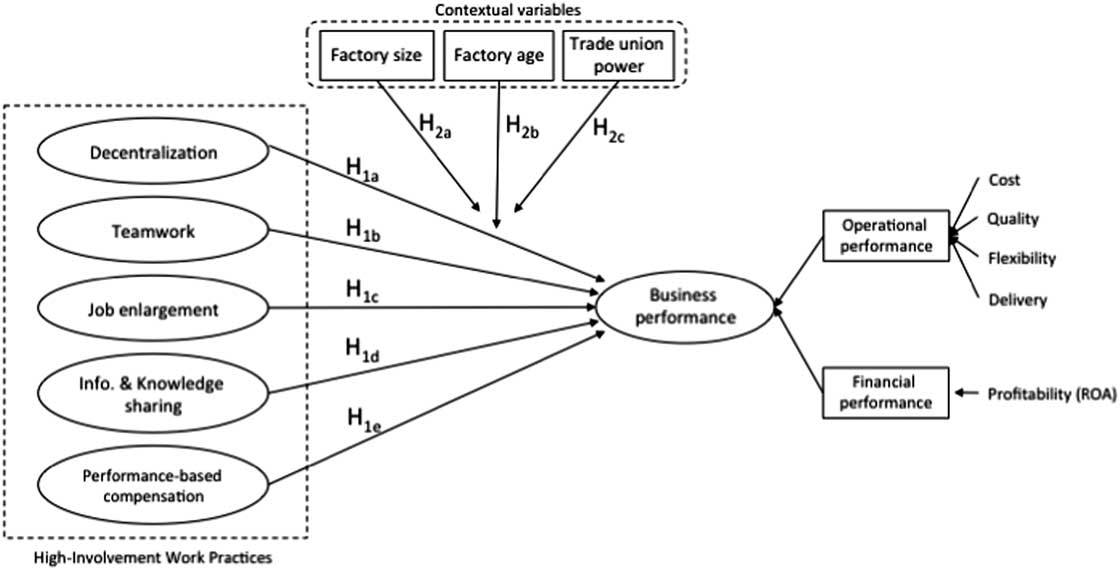
Taking the above into account, this study aims to answer two main questions. First, it explores, in a large sample of Spanish manufacturers, to what extent five individual HIWPs (decentralization, teamwork, job enlargement, information and knowledge sharing and performance-based compensation) directly improve operational performance (cost, quality, flexibility and delivery) as well as financial performance (return on asset). Second, it analyzes whether factory age, factory size and trade union power (as contextual variables) have moderating effects on the relationship between HIWPs and operational and financial performance. Our results show that three of the five HIWPs considered in this study have direct effects on at least one of the business performance measures analyzed, but we also find that three contextual variables (age, size and trade union power) have moderating effects on the relation between HIWPs and financial performance.
This study seeks to contribute to the previous literature on HRM by adopting an integrative and complementary approach between the universalistic and contingency perspectives to the analysis of the effectiveness of HIWPs and their impact on operational and financial performance. Thus, our paper contributes to the debate over the respective merits of the universalistic and contingency frameworks by showing that both are not necessarily incompatible; rather, they can be complementary. We also acknowledge that there are many different types of relationships among HRM practices – additive, synergistic, substitutive – (Delery, Reference Delery and Doty1998) and that there is no theoretical or empirical consensus on the exact practices that make up a coherent HRM system (Becker & Gerhart, Reference Becker and Gerhart1996; Lepak, Liao, Chung, & Harden, Reference Lepak, Liao, Chung and Harden2006). Our aim in this research work is neither to identify systems of practices (bundles) that lead to particular firm resources and higher performance nor to find a plausible horizontal fit of HRM practices. Our focus, rather, is on the individual practices that firms set up at operational level to enhance performance, dealing with the possible moderating effect of the three internal contextual variables highlighted by Singh, Darwish, Costa, & Anderson (Reference Singh, Darwish, Costa and Anderson2012). The study selects and considers the deployment of current HIWPs by a large sample of Spanish firms from different industries. So, it offers a broader view about the type of contemporary HR practices that are successful in the Spanish industrial sector, and in a European manufacturing context. From a practical point of view, our results may also guide managers when assigning their firms’ limited resources to the most relevant HR practices in each particular setting, considering internal characteristics such as firm age, firm size and trade union power.
The paper is structured as follows. This introduction is followed by a review of the literature on the effectiveness of HR practices: based on this literature review, the hypotheses to be tested are posited. Next, the empirical research methodology is presented (data collection and measurement of variables), the analyses are carried out and the results are given. Finally, these findings are discussed, the main conclusions are drawn, and limitations of the study, as well as possible lines for future research, are described.
Theoretical Background and Hypotheses
HR and HIWPs
Establishing a HRM system in business requires, to some extent, including two main types of practice – work practices related to the context in which the firm’s operating activity takes place, and personnel management practices which are linked to employees and to their performance in the tasks entrusted to them (Godard, Reference Godard2004). Therefore, work practices have a lot to do with the way in which work is organized, including its formal structure (i.e., job design) and the mechanisms that allow or help workers to become involved in problem solving and in managing work processes: skill development and participation mechanisms (Boxall, Reference Boxall2012). Such work practices, which are designed to offer workers opportunities to participate in decision making in their workplace, have often been considered the key element for high performance (Wood & de Menezes, Reference Wood and de Menezes2008). Personnel management practices, on the other hand, include any practices adopted to, for example, recruit, select, motivate, develop and retain employees or to terminate their contracts. However, in spite of these differences, it is often difficult to make a clear distinction between personnel management practices and work practices because they are closely related, may be complementary and/or there may be many synergies among them (Zacharatos, Barling, & Iverson, Reference Zacharatos, Barling and Iverson2005; Boxall & Macky, Reference Boxall and Macky2009).
Acknowledging the interface between operations and HRM (Boudreau, Hopp, McClain, & Thomas, Reference Boudreau, Hopp, McClain and Thomas2003), this paper analyzes a set of practices that are mainly related to work systems (MacDuffie, Reference MacDuffie1995) and, especially, to HIWPs in the operations area. In essence, HIWPs aim to turn round the classic Taylorist design of bureaucratic organizational models based on control and decision-making processes and/or problem solving by the management (Guerrero & Barraud-Didier, Reference Guerrero and Barraud-Didier2004; Boxall, Reference Boxall2012). The move toward high-involvement objectives aims to take advantage of employees’ capacity for self-management and problem solving. However, as stated by Becker and Gerhart (Reference Becker and Gerhart1996), Wood (Reference Wood1999), Guerrero and Barraud-Didier (Reference Guerrero and Barraud-Didier2004), and Zacharatos, Barling, and Iverson (Reference Zacharatos, Barling and Iverson2005), there is much confusion and debate about the set of management practices that have been linked or should be linked to high-involvement HR systems. The great variety of HR practices that have been identified was pointed out in the study by Becker and Gerhart (Reference Becker and Gerhart1996), in which they analyze five of the main research articles in this field. All of these studies were carried out in the United States, and they differ with regard to the practices considered and, in some cases, differ as to whether a practice, such as variable pay, has a positive or negative effect on business performance. The divergence of practices in the literature has also been described by Posthuma, Campion, Masinova, and Campion (Reference Posthuma, Campion, Masinova and Campion2013), who identified 14 ‘core,’ 28 ‘broad’ and 19 ‘peripheral’ HIWPs in their analysis of 193 peer-reviewed articles published over 20 years (1992–2012), and by Perelló-Marín and Ribes-Giner (Reference Perelló-Marín and Ribes-Giner2014), who identified a list of 42 HIWPs from a literature review for the period 2000–2012.
Some of the high-performance practices identified in certain countries are a legal requirement in others – such as an employee grievance procedure, which Huselid (Reference Huselid1995) considers a high-performance indicator in the United States, while in the United Kingdom it is a legal requirement. It therefore cannot be considered a differentiating element in firms that improve their performance (Boxall & Purcell, Reference Boxall and Purcell2008). The socio-cultural differences that exist between regions can also lead certain HIWPs that are identified in one country to be conceived differently in others (Ahmad & Schroeder, Reference Ahearne, Mathieu and Rapp2003; Dávila & Elvira, Reference Dávila and Elvira2005; Marler, Reference Marler2012; Posthuma et al., Reference Posthuma, Campion, Masinova and Campion2013). From an institutional perspective, it is necessary to consider not only the nature of industrial relations and union organization at workplace and company levels, but also how actions at such levels are influenced by broader regulatory arrangements covering employment and work practices, and the geographical or historical context (Blyton & Martínez-Lucio, Reference Blyton and Martínez-Lucio1995; Rodríguez-Ruiz & Martínez-Lucio, Reference Rodríguez-Ruiz and Martínez-Lucio2010). These factors may neutralize or invert the theoretical positive effect of HR practices on business performance, challenging their preassumed universal applicability (Marchington & Grugulis, Reference Marchington and Grugulis2000; Bryson, Forth, & Kirby, Reference Bryson, Forth and Kirby2005). Moreover, considering that work systems and HIWPs vary significantly depending on firms’ activity, type of organization or hierarchical level (Melián-González & Verano-Tacoronte, Reference Melián-González and Verano-Tacoronte2008; Boxall, Reference Boxall2012), it can be affirmed that there is no clear consensus on the existence of a set of ‘best practices’ in HRM, nor a concise definition about which particular practices can be called ‘high-performance/involvement work practices’ (i.e., practices that enhance employee involvement and commitment and consequently lead to better business results). Additionally, a limitation inherent in the constant development of new HIWP models is that it becomes increasingly difficult to draw comparisons between different research studies, a fact that has been highlighted in recent meta-analytic studies (e.g., Subramony, Reference Subramony2009; Jiang, Lepak, Hu, & Baer, Reference Jiang, Lepak, Hu and Baer2012).
While it is difficult to identify a common body of HIWPs (Wood, Reference Wood1999; Guerrero & Barraud-Didier, Reference Guerrero and Barraud-Didier2004; Marín-Garcia & Conci, Reference Marín-García and Conci2009; Perelló-Marín & Ribes-Giner, Reference Perelló-Marín and Ribes-Giner2014) and empirical studies use a large variety of indicators and even different conceptualizations (Boselie, Dietz, & Boom, Reference Boselie, Paauwe and Jansen2005) without agreement on how to measure HR practices (Paauwe, Reference Paauwe2009), the selection of HR practices in our study is theoretically driven by the people-performance framework underlying the ability/motivation/opportunity model. This model focus on employees’ abilities (they can do the job because they possess the necessary information, knowledge and skills), motivations (they will do the job because they want to and are given adequate incentives to do so) and opportunities to participate (the work environment provides the necessary support and avenues for expression) (Boxall & Purcell Reference Boxall and Purcell2008; Subramony, Reference Subramony2009; Jiang et al., Reference Jiang, Lepak, Hu and Baer2012); Additionally, it was constrained by the data available from a survey conducted in the framework of a wider research project, addressed to the analysis of the main manufacturing strategies and policies of industrial firms in Spain. Thus, we consider five high-involvement HR practices focused on increasing the ability and power of workers to take decisions, improving the information and knowledge they need, and compensating them for all of this: (1) decentralization, (2) teamwork, (3) job enlargement, (4) information and knowledge sharing and (5) performance-based compensation. These practices also involve four basic variables – power, information, knowledge and rewards – highlighted by Lawler (Reference Lawler1986).
Decentralization is aimed at delegating decision-making authority and responsibility to a lower level in the hierarchy and facilitating employee participation and opinion using upward feedback mechanisms (Wood, Van Veldhoven, Croon, & de Menezes, Reference Wood, Van Veldhoven, Croon and de Menezes2012). Teamwork is a practice that is becoming commonplace in manufacturing plants, and figures prominently in the bundle of innovative HR practices that positively impact organizational and business performance (Osterman, Reference Osterman1994). Job enlargement refers basically to a situation when workers are rotated around different positions and are assigned some extra duties to be performed during their normal routine (with appropriate training) (Dessler, Reference Dessler2005). Information and knowledge sharing has long been recognized as a valuable resource for firms and has been a focus of significant attention in the human capital literature, in particular the issues of knowledge generation, leverage, transfer and integration (Wright, Dunford, & Snell, Reference Wright, Dunford and Snell2001). Finally, performance-based compensation systems include a wide range of performance-based pay practices – from piecework incentive systems to merit pay and skill-based pay – and can be used as a strategic tool for improving organizational effectiveness (Lawler, Reference Lawler1986).
HIWPs and business performance
Together with personnel management practices, the HIWPs that make up HRM systems affect business performance at different levels. At the first level, they affect employees’ skills, motivation and opportunities. HIWPs also improve the internal social structure of organizations, which facilitates communication and cooperation among employees and, in turn, improves organizational performance (Evans & Davis, Reference Evans and Davis2005). As stated by Huselid (Reference Huselid1995), improved employee knowledge promotes personal skills, while decentralization and information sharing increase employees’ opportunities for making a relevant contribution. A performance-based compensation system may improve motivation, which may also be positively enhanced by decentralization, communication of relevant information and the dissemination of organizational knowledge. Therefore, at the most basic level, HIWPs act on organizations through their impact on workers’ skills and knowledge, their motivation and their self-fulfillment opportunities. However, at a higher level, HIWPs also affect another range of more general or collective variables, helping to develop organizational skills, with effects on operational and financial performance. The reasoning behind this link between HIWPs and business performance is relatively intuitive and is based on theoretical arguments from several disciplines. From microeconomics, the theory of human capital (Becker, Reference Becker1964) sustains that employees have knowledge, skills and talents that provide economic value to the organization in the sense that investments in workers can be justified by an increase in their productivity; that is, increases in productivity resulting from investments in human capital depend on the contribution employees make to the company. So, the greater the potential employee contribution, the more likely it is that the company will invest in human capital through management practices and that such investments will lead to higher productivity and better business results. In the economics of organization and strategic management, the resources approach considers that HR (which are internal) may amount to a sustainable competitive advantage for the company (Barney, Reference Barney1991). In order for HR to become strategic and to lead to such a competitive advantage, the company must adopt practices that will involve, motivate and retain employees. Such theoretical arguments have been strengthened by empirical evidence, and support the universalistic approach in the HRM literature.
The pioneer studies dealing with the relationship between HR practices and outcomes appeared about two decades ago (Arthur, Reference Arthur1994; Huselid, Reference Huselid1995; MacDuffie, Reference MacDuffie1995; Becker & Gerhart, Reference Becker and Gerhart1996). Since then, there has been extensive literature about the relationship between HR practices and different levels of organizational performance (e.g., Appelbaum, Bailey, Berg, & Kalleberg, Reference Appelbaum, Bailey, Berg and Kalleberg2000; Boselie, Paauwe, & Jansen, Reference Boselie, Dietz and Boom2001; Guest, Reference Guest2011). Some papers consider the impact of HR practices on the outcomes that are most directly related to HR in an organization, for example, employee skills and abilities (Batt, Reference Batt2000; Cabello-Medina, López-Cabrales, & Valle-Cabrera, Reference Cabello-Medina, López-Cabrales and Valle-Cabrera2011), motivation and commitment (Ahmad & Schoeder, Reference Ahearne, Mathieu and Rapp2003; Gardner, Wright, & Moynihan, Reference Gardner, Wright and Moynihan2011) and labor turnover (Stavrou, Reference Stavrou2005; Gardner, Wright, & Moynihan, Reference Gardner, Wright and Moynihan2011). Others deal with the relationship between HR practices and operational outcomes, for example, productivity (Huselid, Reference Huselid1995; MacDuffie, Reference MacDuffie1995; Ichniowski & Shaw, Reference Ichniowski and Shaw1999; Guest, Michie, Gonway, & Sheehan, Reference Guest, Michie, Gonway and Sheehan2003; Patterson, West, & Wall, Reference Patterson, West and Wall2004; Datta, Guthrie, & Wright, Reference Datta, Guthrie and Wright2005), flexibility (Urtasun-Alonso, Larraza-Kintana, Garcia-Olaverri, & Huerta-Arribas, Reference Urtasun-Alonso, Larraza-Kintana, Garcia-Olaverri and Huerta-Arribas2014), innovation (Jiménez-Jiménez & Sanz-Valle, Reference Jiménez-Jiménez and Sanz-Valle2008; De Saá-Pérez & Díaz-Díaz, Reference Delery2010; Cabello-Medina, López-Cabrales, & Valle-Cabrera, Reference Cabello-Medina, López-Cabrales and Valle-Cabrera2011; Chowhan, Pries, & Mann, Reference Chowhan, Pries and Mann2016), speed of delivery (Paul & Anantharaman, Reference Paul and Anantharaman2003) and customer service and quality (Gibson, Porath, Benson, & Lawler, Reference Gibson, Porath, Benson and Lawler2007; Beltrán-Martín, Roca-Puig, Escrig-Tena, & Bou-Llusar, Reference Beltrán-Martín, Roca-Puig, Escrig-Tena and Bou-Llusar2008; Wickramasinghe & Gamage, Reference Wickramasinghe and Gamage2011). Finally, several research papers have also analyzed how HR practices contribute to fulfillment of the economic goals of organizations, including typical financial outcomes such as sales growth (Youndt et al., Reference Youndt, Snell, Dean and Lepak1996; Batt, Reference Batt2000), market performance (Rodwell & Teo, Reference Rodwell and Teo2008;), return on assets/investment (Guest et al., Reference Guest, Michie, Gonway and Sheehan2003), profitability (Guerrero & Barraud-Didier, Reference Guerrero and Barraud-Didier2004) and overall financial performance (Delery & Doty, Reference De Saá-Pérez and Díaz-Díaz1996; Gibson et al., Reference Gibson, Porath, Benson and Lawler2007).
In the light of the theoretical and empirical background and recent meta-analytic findings (Combs, Liu, Hall, & Ketchen, Reference Combs, Liu, Hall and Ketchen2006, Subramony, Reference Subramony2009; Jiang et al., Reference Jiang, Lepak, Hu and Baer2012), the HIWPs analyzed in our study can be expected to positively affect operational and financial performance. Therefore, the following general hypothesis is posed:
Hypothesis 1: Decentralization, teamwork, job enlargement, information and knowledge sharing and performance-based compensation have a positive effect on business performance.
If we focus on the work practices addressed, the literature outlines their relationship with business performance. First, some researchers have suggested that decentralization may influence employees’ beliefs regarding their organization’s interest in the welfare of its workforce, leading them to reciprocate by developing positive, emotional bonds with the firm and exerting discretionary effort on its behalf (Eisenberger, Huntington, Hutchison, & Sowa, Reference Eisenberger, Huntington, Hutchison and Sowa1986; Maynard, Gilson, & Mathieu, Reference Maynard, Gilson and Mathieu2012). These favorable job attitudes and behaviors are likely to result in lower levels of labor turnover (Arthur, Reference Arthur1994) and to positively influence performance outcomes, including productivity (Patterson, West, & Wall, Reference Patterson, West and Wall2004), customer satisfaction (Mathieu, Gilson, & Ruddy, Reference Mathieu, Gilson and Ruddy2006), sales (Ahearne, Mathieu, & Rapp, Reference Ahmad and Schroeder2005) and ultimately firm-level financial performance. Having a voice in decision making and being able to use feedback mechanisms can help employees view themselves as a key part of the organizational system, leading them to accept increased responsibilities and to engage in work processes. Decentralization can be expected to have positive effects on employee behavior and, consequently, on business outcomes. Therefore, the following subhypothesis can be posed:
Hypothesis 1a: Decentralization positively impacts business performance.
Second, work teams – which may have different types of autonomy – are considered a key tool for continuous improvement in work operations. Allowing work teams to manage the production of a component or provision of a specific service can help identify and solve work-related problems, improve quality and productivity (Banker, Field, Schroeder, & Sinha, Reference Banker, Field, Schroeder and Sinha1996), and enhance employees’ sense of responsibility and autonomy within the constraints of their work role. Work teams and flexible job design also impact the internal social structures of organizations by linking people who do not typically interact with each other, which facilitates information sharing and resource exchange, enhancing quality, flexibility and efficiency (Evans & Davis, Reference Evans and Davis2005). Thus, we hypothesize that
Hypothesis 1b: Teamwork positively impacts business performance.
Third, job enlargement is considered a horizontal restructuring method that contradicts the principles of specialization and the division of labor to add greater variety to activities, thus reducing monotony and enhancing workforce flexibility. The literature suggests that it may affect the motivation, satisfaction and commitment of employees (Hellgren & Sverke, Reference Hellgren and Sverke2001). Although several studies have considered its possible negative effects, for example, on workers’ stress levels (Thompson & Harley, Reference Thompson and Harley2007), the evidence, nonetheless, has predominantly shown positive associations with organizational outcomes (Wood et al., Reference Wood, Van Veldhoven, Croon and de Menezes2012), which lead us to expect
Hypothesis 1c: Job enlargement positively impacts business performance.
Fourth, information and knowledge sharing is related to the training and development of employee skills and the exchange of information throughout the organization. It is important because it is directly linked to the functional capacity of the organization, clarifies goals, decreases uncertainty and helps connect work with organizational strategy. Information and knowledge sharing helps to establish shared mental models among employees, which facilitates cooperation and decision making. Therefore, this paper infers that
Hypothesis 1d: Information and knowledge sharing positively impacts business performance.
Finally, performance-based compensation directs employees’ efforts toward the accomplishment of work objectives, thus aligning the interests of employees with those of stakeholders and encouraging them to achieve high levels of performance (Huselid, Reference Huselid1995). There are at least two possible explanations for this. First, individuals and teams are more likely to exert high levels of sustained effort when they work toward the attainment of specific goals and are adequately rewarded for task performance. Second, theories based on the notion of employment as a social exchange suggest that the availability of reward systems based on problem-solving and target-based remuneration can help employees to perceive their contributions as valuable for the organization and encourage them to reciprocate by adopting positive attitudes toward the firm. These favorable attitudes and behaviors can affect performance outcomes such as customer satisfaction, productivity and sales (Schneider, Ehrhart, Mayer, Saltz, & Niles-Jolly, Reference Schneider, Ehrhart, Mayer, Saltz and Niles-Jolly2005), which would lead us to expect
Hypothesis 1e: Performance-based compensation positively impacts business performance.
Effect of contextual variables on the relation between HIWPs and business performance
Scholars and practitioners affirm that when organizations adopt certain HR practices, they do not always achieve success, but there is no consensus on the reason for success or failure. According to the contingency approach, the impact of HR practices on business performance may be enhanced or limited by a number of internal and external contextual variables or factors. Several researchers have examined the impact of different contextual moderators on the relationship between HIWPs and business performance, concluding that ‘context matters.’ For example, Konrad and Mangel (Reference Konrad and Mangel2000) examined work–life practices and found that their effects were greater in firms with large numbers of women and professional workers. Datta, Guthrie, and Wright (Reference Datta, Guthrie and Wright2005) found that industry-specific variables such as capital intensity, growth rate and the level of product differentiation affect HIWP effectiveness. Batt (Reference Batt2000) showed greater benefits from HIWPs among employees working with higher valued-added customers. Combs et al. (Reference Combs, Liu, Hall and Ketchen2006) observed a higher impact of HIWPs in manufacturing than in service firms, and Jeong and Choi (Reference Jeong and Choi2016) highlighted that the presence of an influential HR function can intensify the effect of HPWSs on firm performance.
Sousa and Voss (Reference Sousa and Voss2008) identify four relevant groups of contingency variables that have been behind research on operations management: national context and culture, firm size, strategic context and other organizational variables. Firm age and organizational size, as well as the power exerted by trade unions are included among what are described as ‘environmental contingencies’ by Ketokivi and Schroeder (Reference Ketokivi and Schroeder2004), and have often been considered as control or moderating variables in previous empirical studies, with limited conclusive results. Such elements are decisive in forming an institutional framework at firm level and partly determining organizational structure in the workplace (Ortiz, Reference Ortiz2002), so they may have a great influence on HR practices and, consequently, on their effect on business performance (Singh et al., Reference Singh, Darwish, Costa and Anderson2012). Thus, we propose our second general hypothesis:
Hypothesis 2: Factory age, size and trade union power positively moderate the effect of decentralization, teamwork, job enlargement, information and knowledge sharing and performance-based compensation on business performance.
Organization size is frequently included as a contingent variable in studies that aim to analyze the adoption of certain management practices and how they relate to business performance. In the HRM literature, there seems to be some evidence that organization size correlates with the orientation of HR processes and the adoption of innovative practices, especially because of its link with the availability of financial resources (e.g., Youndt et al., Reference Youndt, Snell, Dean and Lepak1996; Guthrie, Reference Guthrie2001; Newton, Reference Newton2001). Specifically, in the Spanish context, Bayo-Moriones and Merino-Díaz de Cerio (Reference Bayo-Moriones and Merino-Diaz de Cerio2001) studied the differences in HRM style between small and larger firms, concluding that some HR practices vary depending on the size of the firm. In Belgium, Sels, De Winne, Maes, Delmotte, Faems, and Forrier (Reference Sels, De Winne, Maes, Delmotte, Faems and Forrier2006) find an overall positive effect of HPWP on firm profitability, but they also conclude that although greater use of HPWP is associated with increased productivity, this effect may be offset by increased labor cost, especially in smaller firms. In this line, De Grip and Sieben (Reference De Grip and Sieben2009) suggest that HIWPs are unlikely to improve financial performance within microbusinesses as they lack the necessary economies of scale to spread the cost of developing and operating such practices. This leads us to infer that
Hypothesis 2a: Factory size positively moderates the effect of decentralization, teamwork, job enlargement, information and knowledge sharing and performance-based compensation on business performance.
In the field of HRM, firm age is a relevant contingent variable associated with the degree of organizational flexibility, which may determine the degree of adoption and effectiveness of certain work/personnel practices (Ichniowski & Shaw, Reference Ichniowski and Shaw1995). This argument is backed by Fabling and Grimes (Reference Fabling and Grimes2010), who find that the adoption of a suite of high-performance practices (specific practices pertaining to staff training and performance pay) has a causal impact on firm outcomes, and that the strength of the relationships differs by firm size and age. Thus, we hypothesize that
Hypothesis 2b: Factory age positively moderates the effect of decentralization, teamwork, job enlargement, information and knowledge sharing and performance-based compensation on business performance.
The effect of worker unionization on business performance has been controversial in previous studies – see Bryson, Forth, and Kirby (Reference Bryson, Forth and Kirby2005) and Liu, Guthrie, Flood, and MacCurtain (Reference Liu, Guthrie, Flood and MacCurtain2009) for further discussion. While some authors sustain that its effect may be positive (Freeman & Medoff, Reference Freeman and Medoff1984; Cooke, Reference Cooke1994), others argue the opposite (Huselid, Reference Huselid1995; Kock & McGrath, Reference Kock and McGrath1996). The role of unions in supporting or inhibiting the introduction of new work systems has also been subject to much debate. Some researchers and practitioners view unions as social agents that are inimical to new work practices, preventing such practices from attaining their full potential and thereby enhancing organizational performance. Others sustain not only that trade unions and new work practices are not antithetical, but also that the presence of a union at the workplace may support the introduction and continued existence of such practices, and the resulting enhanced performance. McNabb and Whitfield (Reference McNabb and Whitfield1997) observed that the joint effect of union presence with both flexibility and team working is positive for financial performance, even though the effect of union presence on its own is negative. In a related work, McNabb and Whitfield (Reference McNabb and Whitefield1998) find unions have a positive effect on workplace financial performance in the presence of upward problem-solving groups, which are one form of HIWP, and have negative effects in their absence. Bryson, Forth, and Kirby (Reference Bryson, Forth and Kirby2005) find that the positive effect of HIWPs on labor productivity is restricted to unionized workplaces, and seems more readily explained by ‘concessionary wage bargaining’ than ‘mutual gains.’ Cooke’s (Reference Cooke1994) study indicated that employee participation programs contributed more to value added per employee in unionized firms than in nonunionized firms, while gainsharing programs contributed more to performance in nonunionized firms. In this work, we hypothesize that (Figure 1)
Hypothesis 2c: Trade union power positively moderates the effect of decentralization, teamwork, job enlargement, information and knowledge sharing and performance-based compensation on business performance.
Conceptual model and hypotheses

Methodology
Data collection
The information needed to test our hypotheses was obtained from a survey conducted as part of a wider research project aiming to analyze the main manufacturing strategies and policies of industrial firms in Spain. The target population for the study was made up of 1,234 Spanish manufacturers that employed over 100 workers, according to the Amadeus-SABI (2003) databaseFootnote 3 .
Our questionnaire was based on the prior literature and the conclusions obtained from a previous case studyFootnote 4 (Vazquez-Bustelo & Avella, 2006). It was revised by six experts (four in operations management and two in survey design) and validated by a pretest on a sample of 10 firms from the target population. Information was requested on the production area (factories or production plants) using questionnaires addressed to the factory manager, operations manager, production manager or similar position. In total, 265 valid questionnaires were returned, giving a rate of response of 21.47%. Following the procedure suggested by Armstrong and Overton (Reference Armstrong and Overton1977), t-tests indicated the absence of nonresponse bias in the study. Also, the experience of the questionnaire respondentsFootnote 5 , and their responsibility in the company and in their positions allow us to confirm the study’s internal validity, that is, that the information was obtained from reliable sources.
Measurement of variables
HIWPs
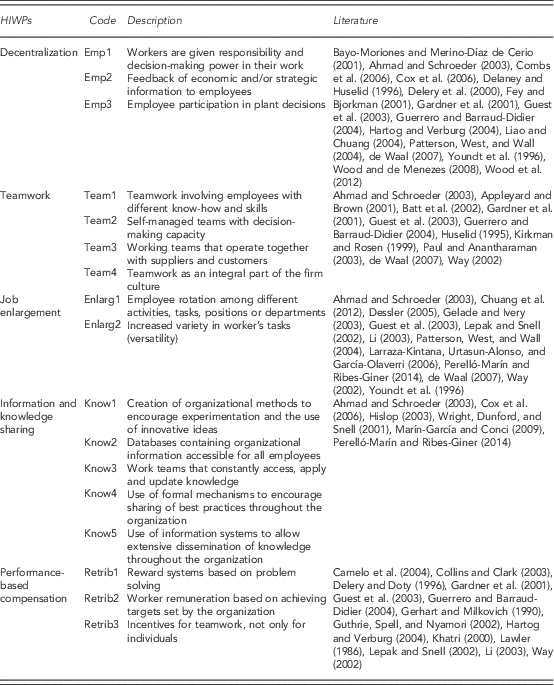
Each of the five HR practices identified – decentralization, teamwork, job enlargement, information and knowledge sharing and performance-based compensation – was measured using multi-item scales, as shown in Table 1.
High-involvement work practices (HIWPs)

Note. For each of the 17 items considered for measuring the five practices, the survey respondents were requested to indicate to what extent they applied, with 1=not applied/low degree of application, 3=medium degree of application and 5=high degree of application.
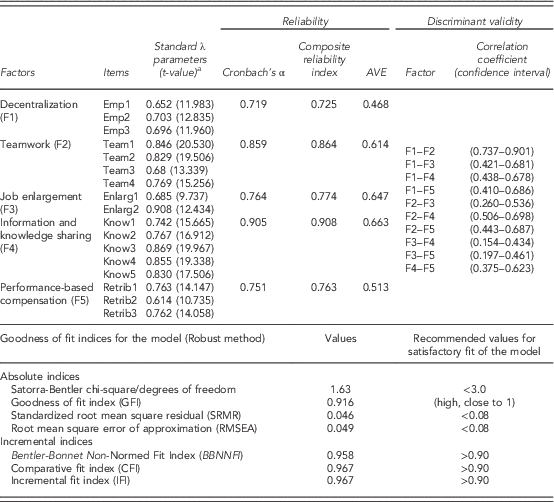
In order to empirically validate the multi-item scales, confirmatory factor analysis was carried out using the robust maximum likelihood estimation. This analysis confirmed, as shown in Table 2, the existence of five factors associated with the above-mentioned HR practices.
Confirmatory factor analysis (CFI)

Note. AVE=average variance extracted.
a All the values are significant at p<.001.
The reliability of the scales was analyzed using Cronbach’s α coefficient, the composite reliability index, and the average variance extracted. In all cases, Cronbach’s α was over 0.7, this being the usual criterion for identifying strict internal consistency (Nunnally, Reference Nunnally1978). The composite reliability index also exceeded this figure. The average variance extracted was also very close to, or above 0.5, the usual cut-off point (Hair, Black, Anderson, & Tatham, Reference Hair, Black, Anderson and Tatham1998).
After studying the composition of the scales and testing their reliability, the convergent and discriminant validity were analyzed. In this study, convergent validity was assessed using confirmatory factor analysis. As shown in Table 2, all the standardized factor loadings were statistically significant at the 99% confidence level (t>1.96, weak condition at 95%) and all exceeded 0.5 (strong condition), demonstrating high convergent validity (Anderson & Gerbing, Reference Anderson and Gerbing1988). In order to test the discriminant validity, we followed the approach suggested by Anderson and Gerbing (Reference Anderson and Gerbing1988). As shown in Table 2, none of the confidence intervals for each bivariate correlation of factors include 1.0, which reveals divergence across factors and supports the discriminant validity of the proposed scales.
Business performance
Organizational performance has often been used as a dependent variable in studies on HIWPs. However, it has been conceived in very different ways, including different types of performance measures as well as short- and long-term markers (Boxall & Macky, Reference Boxall and Macky2009; Paauwe, Reference Paauwe2009). The evidence does not support the claim that the relation between HIWPs and organizational performance is affected by the researchers’ choice of organizational performance measures (Combs et al., Reference Combs, Liu, Hall and Ketchen2006). However, measuring business performance is one of the main problems for researchers when trying to analyze the effect of HR practices in an organization, and every piece of research in this field has to face the challenge of performance quantification (Rodríguez-Ruiz & Martínez-Lucio, Reference Rodríguez-Ruiz and Martínez-Lucio2010).
In this study, the effect of HIWPs on business performance was analyzed not only using four dimensions of operational performance frequently used in the literature, but also including financial performance, a ‘conditio sine qua non’ for advancing the HRM field (Paauwe, Reference Paauwe2009). Given the multisector nature of the sample, and bearing in mind that our unit of analysis is the factory or production plant, subjective performance measures were used because there are no standard measures of business performance that can be reliably compared (Juárez Tárrega, Reference Juárez Tárrega2011). Also there is a high risk of obtaining a low response rate if questions on objective performance are included in the questionnaire.
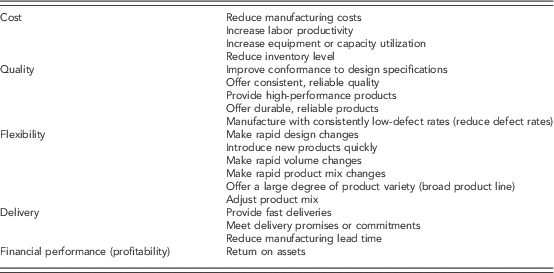
In order to measure operational results, the respondents were requested to state the degree of strength reached in comparison with their competitors for the following variables: cost, quality, flexibility and delivery. The composition of these scales is given in Table 3 and, to validate them, a procedure similar to that described above for the HIWPs was used. These analyses make it possible to test the dimensionality, reliability and validity – both convergent and discriminant – of the operational performance scales used, with similar criteria to those described above.
Operational and financial performance

Note. Survey respondents were requested to indicate performance on a 5-point multi-item scale (1=lower; 3=equal; 5=higher) in comparison with the competition.
A subjective measure of return on asset, one of the most widely used financial indicators in the HRM literature (Juárez Tárrega, Reference Juárez Tárrega2011), was also considered to measure financial performance. Reliability for this subjective performance measure was assessed by correlating the self-reported measures provided by the respondents with objective data on financial performance (return on asset) taken from secondary sources (for a broad subsample of companies). The analyses showed significant correlations at the p<.01 level, indicating the reliability of the data supplied.
Moreover, since in our analyses we used self-reported measures for the independent (HIWPs) and the dependent variables (operational and financial performance), the possibility of common method variance bias was tested, using several complementary tests. First, to analyze the propensity of respondents to try to maintain consistency in their responses (consistency motive) (Podsakoff, MacKenzie, Lee, & Podsakoff, Reference Podsakoff, MacKenzie, Lee and Podsakoff2003), we adapted Harman’s single-factor test (Harman, Reference Harman1976), with results indicating that this source of common method variance is not a major problem in our study, and offering preliminary evidence that managers responded to the survey giving different answers to the different questions and without any apparent problems for consistency. However, due to the limitations of Harman’s test and the fact that we used self-reported measures for predictor variables and outcomes in our model, we also controlled for the effects of a single unmeasured latent method factor (Podsakoff et al., Reference Podsakoff, MacKenzie, Lee and Podsakoff2003). We performed a confirmatory factor analysis adding an unobserved first-order factor with all the variables considered in our theoretical model, observing that trait loadings do not change from significant to nonsignificant after introducing the common method factor in the model. However, since some method factor loadings were also significant, we performed a third test to evaluate the presence and estimate the amount of trait and method variance in measures, using Widaman’s (Reference Widaman1985) nested models procedure described by Cote and Buckley (Reference Cote and Buckley1987). Results indicated that on average only 15.4% of the variance was attributable to the common method effect. These findings seem to show that the trait factors effect is considerably larger than the method factors effect, and support the idea that common method variance does not seem to be a major problem in our study.
Control and moderating variables
Because of potential industry differences in HIWPs and outcome measures, analyses in the study controlled for this factor. Dummy codes representing five industries were created. These industries and the percentage of sample firms in each industry are as follows: chemical (11.7%), electrical, electronic and communication (26.5%), metal mechanic (34.4%), vehicles and transport (19.4%), furniture and other (8%).
In view of the preceding background, and since the factory is our unit of analysis, this study considers factory size, factory age and trade union power as variables that may moderate the link between HIWPs and business performance. As in previous research, factory size is operationalized by the logarithm of the number of employees; factory age is measured by the number of years that the factory has been in operation, and trade union power is operationalized by requesting plant managers to state, on a 5-point Likert scale (1=none; 2=not much; 3=large; 4=very large, 5=extremely large), the degree of power of trade unionsFootnote 6 in the factories or plants.
Analysis and Results
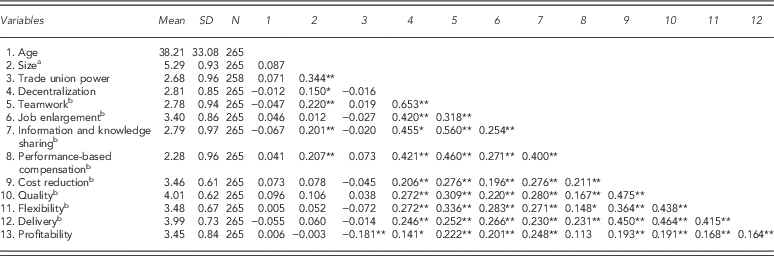
Table 4 shows the mean, standard deviation, sample size and Pearson’s correlation coefficient for the variables included in the study.
Descriptive statistics

Note. Mean, standard deviation and Pearson’s correlations.
a Logarithm of the number of employees.
b Factors computed by their arithmetical mean.
**Significant correlations at .01 (bilateral).
*Significant correlations at .05 (bilateral).
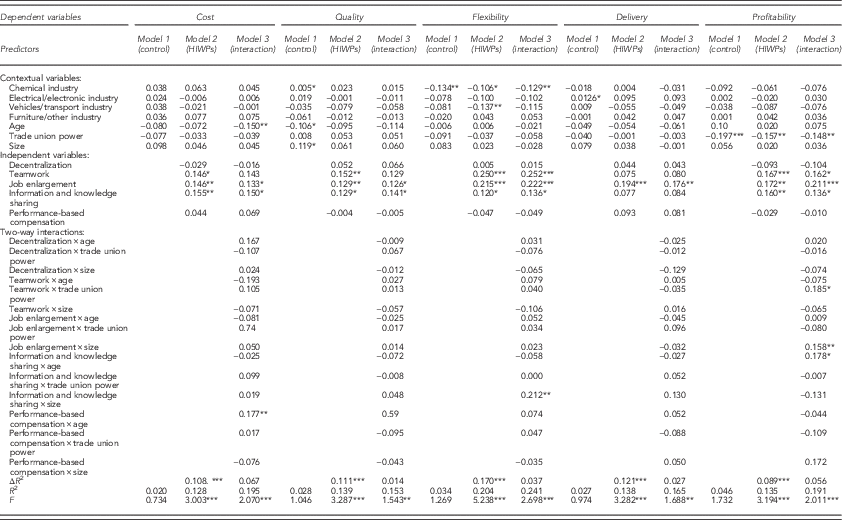
Considering the nature of the scales, and the high number of variables and interaction terms simultaneously analyzed, a moderated hierarchical regression analysis was carried out in order to isolate the main effects of HIWPs on business performance, and to measure separately the moderating effect of the contextual variables considered in the link between such HR practices and performance. The same general approach was adopted for each of the dependent or criterion variables (business performance measures) (Table 5).
Results of the regression analyses for each of the performance measuresFootnote a , Footnote b , Footnote c

Note. HIWPs=high-involvement work practices.
a N=258.
b Metal/mechanical industry is the omitted benchmark industry variable.
c Standardized regression coefficients are reported.
*p<.1; **p<.05; ***p<.01 (two-tailed test).
In the first step (Model 1), only the industry, age, trade union power and size were included in the regression analysis to control for any main effect caused by them on performance. This step may also show whether these contextual variables act as quasi moderator variables or pure moderator variables in our model (Sharma, Durand, & Gur-Arie, Reference Sharma, Durand and Gur-Arie1981). In the second step (Model 2), HIWPs were included in the regressions as predictor (or independent) variables in order to test the universalistic approach regarding such practices. The existence of significant effects in this model would support Hypothesis 1. In the third step (Model 3), the cross-product (interaction effects) of each of the HIWPs and the contextual variables were added to the regression to analyze their predictive power. The simultaneous inclusion of the 15 interaction terms allows us to control for possible collinearity among the variables (Aiken & West, Reference Aiken and West1991). Significant effects in these terms indicate that the contextual variables analyzed moderate the link between the HIWP under consideration and the performance measure, offering arguments that support contingency approaches to HRM, and thus backing Hypothesis 2. Identification of significant interaction effects only among certain pairs of practice/contextual variable links might indicate that these are more relevant explanatory factors for business performance than others. Following the recommendations made by Dawson (Reference Dawson2014), we use mean-centered variables.
The results show that teamwork, job enlargement and information and knowledge sharing are the practices that have universal effects. More specifically, teamwork is closely related to flexibility (p<.01), quality (p<.05) and profitability (p<.01), and marginally related to cost reduction (p<.10). Job enlargement is the HIWP that has the largest number of universal effects. In fact, it is positively and significantly related to all the performance measures considered in this study. Information and knowledge sharing has a significant effect at 95% with regard to cost reduction and profitability, and is moderately and directly related to quality and flexibility (p<.10). Finally, decentralization and performance-based compensation do not seem to have statistically significant relationship with the business performance measures considered. Specifically, Hypotheses 1b to 1d have been verified and, taken together, these results partially support Hypothesis 1 and suggest that the adoption of certain HIWPs (more specifically, teamwork, job enlargement and information and knowledge sharing) can be a valuable tool for strengthening or improving levels of operational and financial performance in a universalistic way. As in other studies that attempt to explain business performance, the predictive power (R 2) of the models is low, because operational and financial performance depends on many factors and circumstances other than those studied herein (Lenz, Reference Lenz1981; Capon, Farley, & Hoening, Reference Capon, Farley and Hoening1990).
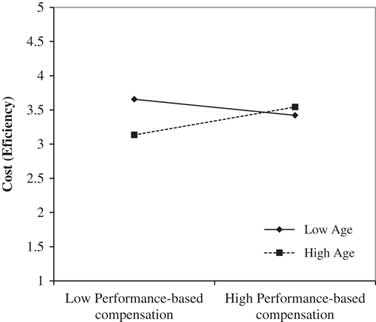
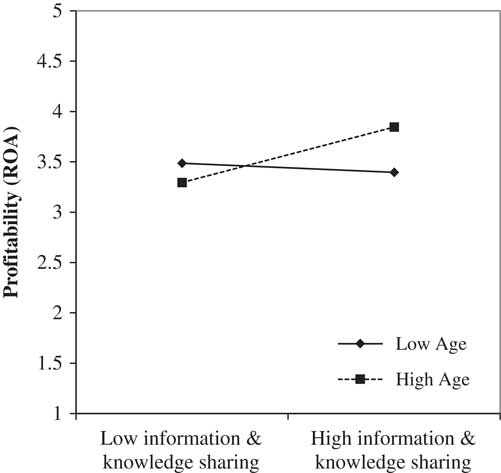
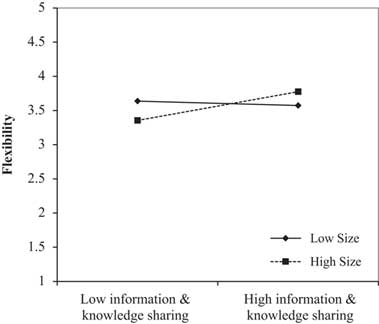
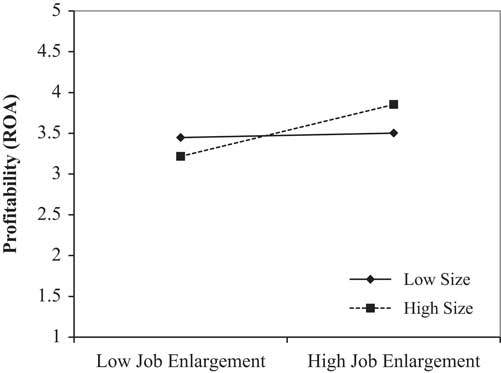
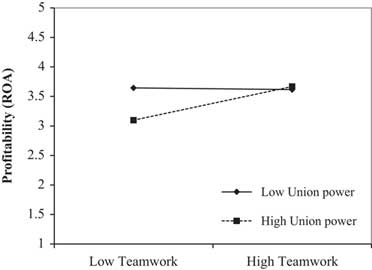
In addition to the direct individual links between the different HIWPs and business performance measures, our results partially support the contingency approach. Although the inclusion of the interaction terms does not involve significant increases in R 2 for each of the models analyzed (as expected by the number of predictive variables included), statistically significant individual interaction effects were observed. The results indicate the existence of significant interaction effects for each of the three contextual variables considered in this research. More specifically, the relation between performance-based compensation and cost reduction seems to be moderated by plant age (b=0.177, p<.05). Also, this contextual variable marginally moderates the link between information and knowledge sharing and profitability (b=0.178, p<.10). Size significantly moderates the relation between information and knowledge sharing and flexibility (b=0.212, p<.05). It also moderates the link between job enlargement (b=0.158, p<.05) and profitability. Finally, trade union power marginally influences the association between teamwork and profitability (b=0.185, p<.10). To plot the interactions, we followed the suggestions provided in the literature (Dawson, Reference Dawson2014). Specifically, we used nonstandardized regression coefficients to predict the indicators of business performance, so predictors vary from the mean ±1 SD. Using the calculated results, we plotted the relationships among the dependent variables, independent variables and moderation variables at low and high levels.
The results show higher efficiency under high levels of performance-based compensation when the manufacturing plants are older (Figure 2). The analyses indicate that the relationship between profitability and information and knowledge sharing is stronger at high age levels (Figure 3). We can appreciate higher levels of flexibility as we move from low to high levels of information and knowledge sharing in larger plants (Figure 4). It is also observed that larger manufacturing plants achieve higher financial performance (profitability) when adopting higher job enlargement implementation (Figure 5). Results determine that in high-unionized settings, profitability notably increases as the level of teamwork is higher (Figure 6). Thus, Hypotheses 2a to 2c are partially supported.
Moderating effect of age on the performance-based compensation–cost (efficiency) relationship (two-way interaction with mean-centered variables)

Moderating effect of age on the information and knowledge sharing–profitability relationship (two-way interaction with mean-centered variables)

Moderating effect of size on the information and knowledge sharing–flexibility relationship (two-way interaction with mean-centered variables)

Moderating effect of size on the job enlargement–profitability relationship (two-way interaction with mean-centered variables)

Moderating effect of union power on the teamwork–profitability relationship (two-way interaction with mean-centered variables)

Discussion
First, our findings provide evidence on the positive and systematic link that teamwork has with cost reduction, quality, flexibility and profitability. This result supports previous outcomes described in the literature, which identify teamwork as one of the ‘best practices’ in HRM (Pfeffer, Reference Pfeffer1994; MacDuffie, Reference MacDuffie1995). Adoption of a teamwork system leads to a change in workers’ attitudes regarding responsibility, control and variety of the work or tasks they carry out, so teamwork becomes an instrument that can motivate and encourage participation by workers by improving their working conditions and giving them a more relevant role in production. Teamwork tends to increase opportunities for self-management and discretionary freedom, especially when tasks are fairly complex and varied. It can also promote and increase cooperation among workers. Taken together, these factors may explain the main effects of this practice on the different business performance measures considered. Moreover, contingent analysis has shown that its effect on profitability is positively and significantly moderated by the influence exerted by trade unions. The results show that in Spanish factories in which trade unions have a marked (above-average) influence, adoption of a teamwork system makes it possible to achieve higher levels of profitability. It seems, therefore, that the best financial performance can be achieved when the adoption of teamwork has trade union support, especially in factories in which unions have great power or influence and which, in general, are characterized by well-defined job profiles and employment of older workers (Kochan, McKersie, & Cappelli, Reference Kochan, McKersie and Cappelli1984). This is consistent with an agency-role theory of unionism according to which economic performance can be improved when unions act as monitors and enforcers of employment contracts (Kaufman, Reference Kaufman2004; Bryson, Forth, & Kirby, Reference Bryson, Forth and Kirby2005). It is also in line with the observations made by Pagell and Handfield (Reference Pagell and Handfield2000) in the US automobile industry when they recognized that collaboration between trade unions and the factory management led to successful Total Quality Management, which gives priority to teamwork as an HRM method (Wood & de Menezes, Reference Wood and de Menezes2008; Wickramasinghe & Gamage, Reference Wickramasinghe and Gamage2011). Considering the strong influence that industrial relations have on the adoption of teamwork (Rolfsen, Reference Rolfsen2013), managers of highly unionized plants who wish to reap full benefit of teamwork should aim to obtain maximum support from the trade unions by giving them a role in the adoption of teamwork, thus legitimating this practice for the workers (Godard, Reference Godard2004). In fact, as Ortiz (Reference Ortiz2002) points out, union opposition (or its lack of involvement or passivity) may be a decisive factor in the failure of autonomous work groups and teamwork. This indicates how important it is for the management to abandon the traditional confrontation approach and cooperate with trade unions if they wish to improve profitability by adopting teamwork (Edwards & Wright, Reference Edwards and Wright2001). Nevertheless, when managers aim to implement projects and practices in one or more countries, they have to cope with different industrial relations environments, in which worker representation and rights at the macro and micro levels have been constructed around different identities and institutions (Martínez-Lucio & Weston, Reference Martínez-Lucio and Weston2001). It has been observed that the implementation of certain HR practices, and more specifically teamwork, may give rise to different union reactions depending on the country. As Blyton and Martínez-Lucio (Reference Blyton and Martínez-Lucio1995) point out, whereas in the United Kingdom teamwork has been seen in part as a means of reducing union power over job controls, management in Spain have registered a concern that a possible outcome of teamwork would be an increase in trade union power at a level at which it has never previously been strong. In any case, in an institutionalized context, organizations can benefit from a proactive and innovative attitude toward unions and regulations, instead of seeing such institutional factors as a restraint and threat (Boselie, Paauwe, & Jansen, Reference Boselie, Dietz and Boom2001). Therefore, in order to leverage teamwork outcomes, it seems necessary to develop a new system of industrial relations based on collaboration between the management and the trade unions in contexts in which the adoption of HIWPs tends to coexist with trade unionized worker groupings (Wood, Reference Wood1996).
Second, findings from this study also indicate that job enlargement, which involves not only the rotation of workers among different activities, tasks or departments but also expansion of the number of tasks to be carried out by them (versatility), is another of the best HR practices, with universal positive effects regarding cost, quality, flexibility, delivery and profitability. This supports previous findings about the positive effect of enriched job design on financial performance, productivity and quality (e.g., Wood et al., Reference Wood, Van Veldhoven, Croon and de Menezes2012). The effect of job enlargement on operational performance is, to some extent, as expected, especially if this practice is considered necessary for adopting teamwork systems. In fact, the results of this research show a significant correlation between the two practices, and both have been classified in the category of ‘long-term’ offensive (instead ‘short-term’ defensive) flexibility strategies (Blyton & Martínez-Lucio, Reference Blyton and Martínez-Lucio1995). Regarding the link between job enlargement and profitability, it was observed that the latter mainly improved in firms with larger factories. In plants of above-average size, which traditionally have centralized working structures and are based on the principles of specialization and labor division, redesigning jobs with the aim of enlarging or enriching them seems to improve profitability. Several theories suggest that the lack of motivation and the alienation caused by detailed division of labor may cause serious inefficiencies, which hold back profitability. This would explain the greater positive effects of job enlargement in large-size factories. In the specific case of Spain, where several institutional forces (e.g., nature of labor markets and policies, legal regulation of employment relationships, union–management relations and job control structures within the workplace) have traditionally led to the adoption of a short-term defensive flexibility strategy – based on numerical forms of flexibility, such as temporary work (Shire, Mottweiller, Schönauer, & Valverde, Reference Shire, Mottweiller, Schönauer and Valverde2009) – this result may have practical implications, boosting long-term investments and actions to promote functional forms of flexibility.
Our findings also suggest that information and knowledge sharing can be a powerful tool for achieving improvements in operational performance (cost, quality and flexibility) and profitability. Support for experimentation and the development of innovative ideas for generating new knowledge, and identifying, coding, recording and disseminating it may be essential in improving operational and financial performance. Quality improvement, increased operational flexibility and cost reduction can be positively affected by the adoption of information and knowledge sharing, which will eventually improve profitability. The positive effect observed for flexibility and profitability is especially noted in larger and older plants, respectively. This finding could be justified by the fact that, among others, having databases with organizational information accessible to all workers or establishing formal mechanisms allowing best practices to be shared throughout the organization, allow solutions to be found to the problems resulting from functional specialization and centralization that are common in larger and older organizations. It is in this type of organization, usually characterized by the existence of functional, specialized and relatively ‘watertight’ areas or departments, where the adoption of information and knowledge sharing seems to be especially effective for enhancing operational flexibility and leveraging profitability. As Godwyn and Gittell (Reference Godwyn and Gittell2011: 208) point out, shared information and knowledge can foster ‘relational coordination’ and ‘serve to overcome the silos of bureaucratic organizations by connecting employees directly,’ both of which in turn predict higher flexibility and profitability outcomes.
This study also reveals that, of all the HIWPs analyzed, decentralization and performance-related compensation are those that have the smallest direct impact on the performance measures. In our research, neither of them alone shows statistically significant universal relations with operational and financial performance. Although the analyses carried out do not determine the causes of this lack of relation, it might be explained by the fact that such practices are not effective if adopted in isolation, that is, without the support of other HR practices or the adoption of certain complementary management policies. The potential universal effect of decentralization and performance-related compensation on business performance might require them to be used in the framework of a more sophisticated system of HR practices that are both consistent with, and complement, each other (Edwards & Wright, Reference Edwards and Wright2001; Camelo, Martín, Romero, & Valle, Reference Camelo, Martín, Romero and Valle2004). Whatever the reason, the results obtained must be treated with caution when classifying these two practices as belonging to the set of so-called ‘best practices’ in HRM. However, from a contingent point of view, it is observed that performance-related compensation is especially efficient in older organizations focused on reducing costs. Although additional research would be required, in principle this result might be attributed to the fact that in older-than-average factories, performance-related monitoring and remuneration systems may acquire a control function (Kessler & Purcell, Reference Kessler and Purcell1992), as observed by Martí-Audí, Valverde, and Heraty (Reference Martí-Audí, Valverde and Heraty2013) in the Spanish call center sector. In the case of Spanish manufacturers, performance-related payment is frequently considered to increase the productivity of both labor and equipment and/or to reduce inventories, so is being adopted effectively and coherently in the framework of a business model that aims to reduce operational costs.
Conclusions, Limitations and Future Research
This study contributes to the strategic HRM literature by adopting an integrative and complementary approach between the universalistic and contingency frameworks for analysis of the effectiveness of HIWPs. It considers that both frameworks might be compatible and useful, and that organizations may benefit from attention to each. Thus, our paper contributes, to some extent, to the traditional debate between the alternative views of HRM in terms of US/universalistic/hard/less industrial relations-oriented approaches on the one hand, and European/contingency/soft/more industrial relations-oriented perspectives, on the other. It covers the analysis of HIWPs in the manufacturing field as a set of HR practices focused above all on the structural aspects of labor organization (i.e., working system and job design). By means of an exhaustive literature review, we lay out a conceptual model with two general hypotheses that are empirically tested. We use moderated hierarchical regressions and data from 265 manufacturers to provide additional empirical evidence on the relationship between HIWPs and various dimensions of operational performance (cost, quality, flexibility, delivery) and financial performance (profitability) in a wide range of industrial firms in Spain, as well as the positive moderating effect of three contextual variables (size, age and trade union power) on this link.
From a universal approach, it was noted that three of the five HIWPs considered in this study have direct effects on at least one of the business performance measures analyzed. From a contingency approach, we found that the three contextual variables (age, size and trade union power) had positive moderating effects on the relation between HIWPs and business performance. Therefore, our findings suggest that organizations should foster the deployment of certain ‘high-performance’ HR practices, leading firms to converge in some HRM dimensions, as the universalists claim (isomorphism). Nevertheless, the findings from this study also support the initial proposition that some contextual factors can help leverage (or mitigate) the positive effects of such work practices on business performance. Thus, firms should consider their fit with the specific setting (as the contingency postulates suggest), mainly in decisions regarding resource allocation and the transfer of practices to different operational or business units. In sum, this study offers a broader view about the type of contemporary HR practices that are successful in the Spanish industrial sector, and in a European manufacturing context, considering internal company characteristics, such as firm age, firm size and trade union power.
From a practical point of view, our findings may help managers decide how to assign the company’s limited resources to the most relevant HRM practice, depending on contingency factors (or specific firm characteristics), and priority outcomes. However, our study has limitations that open up new lines for future research.
Theoretically, the specific effect of an HRM practice or tool may depend on the degree to which it is used together with other practices or tools and even the order in which it is adopted (Edwards & Wright, Reference Edwards and Wright2001). This aspect is not addressed in the study but offers new possibilities for future research. Moreover, we only considered the moderating effect of three contextual variables (size, age and trade union power) on the relation between HIWPs and business performance in the production plants analyzed. It is very possible that other contextual factors (e.g., technology, strategy, management style, company culture, competition and growth in the sector, among others) might also affect this relation. Organizational and financial performance can both be influenced by a whole range of factors, and the HRM–performance relationship might also be affected by a plethora of mediating variables (i.e., employee skills and attitudes, effective strategy implementation, etc.) which demand future research.
From a methodological point of view, this study uses management perceptions to measure the variables. Although subjective measurement of performance is a procedure that is widely used in business management research, and the reliability of the subjective scales used has been compared with objective information from secondary sources, the exclusive use of subjective measures in our analysis might be considered a limitation. Since in our study size is considered a moderator variable, using a sample of manufacturers that employed over 100 workers may limit our findings. Also, a longitudinal study rather than a cross-cutting one would be more robust with regard to the relations identified, for which any bi-directionality or causal reciprocity should be evaluated (Paauwe, Reference Paauwe2009). A systematic examination of such issues and the replication of research with different procedures (i.e., SEM techniques) is central to developing our understanding of how HIWPs act, and provides avenues for future research in this area.
Acknowledgment
This work was supported by The Spanish Ministry of Economy and Competitiveness under Grant ECO2012-33204.