INTRODUCTION
As languages associated with contrasting ideologies of tradition and modernity, Hindi and English have become central to the discursive production of sexual identity in northern India. Although the roles played by these two languages are in flux, the upper middle classes in Delhi continue to prefer English to Hindi for the expression of sexuality (cf. Puri Reference Puri1999:127–32). This pattern is not new: the sexualization of English has its roots in the purging of sexual terminology from Indian languages that began with British colonialism and gained momentum in nationalist formations of Indian identity following independence in 1947 (see e.g. Gupta Reference Gupta2001). As a colonialist language of privilege, English escaped this censoring to become the default language of sexual expression for many educated elites. When India liberalized the economy in 1991, the entry of transnational satellite programming into middle class homes affirmed the connection between English and sexuality. If middle class identity consolidated around the commercialization of sexuality that came with privatization (Srivastiva Reference Srivastava2007), English was the language of that consolidation. This article draws from fieldwork among Delhi's expanding middle classes during the first decade of the millennium to explore the role of English in the joking routines of lesbian, bisexual, and transgender youth who see themselves as sexual moderns. Fueled by the ethnic stereotype of the Sikh Sardarji, their humor assumes that sexual modernity is forged in English.
The fieldwork on which this article is based took place during a historically significant time for LGBT rights in India. On July 2, 2009, after entertaining eight years of legal petitions, affidavits, and interventions, the Delhi High Court declared Section 377 of the Indian Penal Code unconstitutional (Naz Foundation v. Govt. of NCT of Delhi). The statute, authored in British colonialist rule by Lord Macaulay and on the books since 1860, criminalizes ‘unnatural’ sexual offenses, defined in the text of the law as ‘carnal intercourse against the order of nature with any man, woman, or animal’.Footnote 1 In the two decades preceding the High Court's 2009 decision—a period associated with the emergence of middle class gay identity in urban India—the statute had increasingly been used to target communities categorized in the public health literature as MSM (men who have sex with men), including gay men, transgender kotis, and third sex hijras. In late 2001, brutal acts of police violence against these groups motivated the Naz Foundation, a Delhi NGO focused on HIV-AIDS outreach with MSM communities, to file a legal petition that challenged the statute's constitutionality. This challenge became a priority earlier that year when the Lucknow police used Section 377 to raid the offices of two NGOs involved in safe-sex outreach and arrest four staff members (Sheikh Reference Sheikh2013). Fueled by the media, the chief judicial magistrate characterized the staff members as ‘polluting the entire society’ and detained them for forty-seven days under inhumane prison conditions until a higher court intervened. My fieldwork with a small women's NGO loosely associated with the Naz Foundation began the year before the petition was filed and continued over the next eight years through the time of the 2009 ruling. Nanhi,Footnote 2 one of the NGO's two founders, had made it her mission to provide refuge to same-sex couples across the class spectrum, moving beyond the usual English-medium clientele of similar women's organizations in Delhi.Footnote 3
The long legal battle that followed the Naz petition inspired intense public debate over the validity and morality of homosexuality. As several commentators have noted, the case ‘triggered… a wider conversation on LGBT rights in living rooms, offices, and tea shops across the country’ (Narrain & Eldridge Reference Narrain and Eldridge2009:4), transforming a citizenry mythologized as avoiding sex talk into a citizenry that talks about sex, and queer sex at that. Dr. Indira Sharma, former president of the Indian Psychiatric Society, famously made this point when reflecting on the case in 2014, one year after the Indian Supreme Court overturned the Delhi High Court's 2009 decision and recriminalized homosexuality: ‘The manner in which homosexuals have brought the talk of sex to the roads makes people uncomfortable. It's unnatural. Our society doesn't talk about sex. Heterosexuals don't talk about sex. It is a private matter’ (Iyer Reference Iyer2014). For the youth I knew in Delhi, ostracized by their families both socially and economically for sexual and gender difference, much of the talk surrounding Section 377 was deeply troubling. Spokespersons from diverse religious traditions, ethnic backgrounds, and social classes joined the government in characterizing LGBT subjectivity as immoral, non-Indian, backwards, and—perhaps of most concern—unworthy of human rights.
This is the context of a Sardarji joke that circulated on the mobile phones of urban youth in the fall of 2008, precisely at the time that the Delhi High Court was hearing the final set of arguments on the Naz petition. Like other jokes in this genre, the humor plays on the widely recognized caricature of the naive Sikh man (addressed by the nobility title sardār followed by the honorofic jī), who in this case lacks the habitus to understand forms of English associated with modernity.
(1) ‘Sex at home only’
(Received in Delhi, October 22, 2008; text in original English)


The joke's popularity is best explained by contextualizing it within an emergent LGBT identity politics. When the Sardarji interprets the English term homosexual to mean ‘sex at home only’, he displays ignorance not just of English, but also of the sexual ideologies that circulate through it. The humor comes from his misunderstanding of sexual identity (‘homosexual’) as a home-based sexual practice (‘sex at home only’), an interpretation that fails to recognize the sexual identity categories that for the Indian globalized middle classes are the very stuff of modernity. My research in northern India since 1993 among groups associated with non-normative systems of gender and sexuality (e.g. Hall Reference Hall, Livia and Hall1997, Reference Hall2005, Reference Hall, Pichler and Eppler2009) suggests that the association of sexuality with identity occurred during two decades of intensive HIV-AIDS activism in urban centers like Delhi and Mumbai. When public health NGOs named, defined, and delineated sexual identity categories in order to organize outreach programs, apply for funding, and track the spread of the illness, they effectively transformed queer sexuality from a practice to an identity (see also Boellstorff Reference Boellstorff2011). Queer theorists have importantly critiqued how these kinds of transformations must decenter sexual practice in order to achieve legitimacy in the nation-state, yet emphasis on identity can empower a political movement.
This brings us to language and normativity, the topic of this journal's special issue. From its initiation in the early 1990s, queer theory has been centrally concerned with the normative discourses that sustain categories of gender and sexuality. This has come to be called normativity, the set of conditions that naturalize heterosexuality and binary gender as the unmarked norm (cf. Raymond, this volume). A thought-provoking line of inquiry in queer theory has considered how normativity is sustained through discursive configurations of time and space. Freeman (Reference Freeman2010) illustrates this through the concept of chrononormativity, a use of time to bind the collective and delimit difference, while Halberstam (Reference Jack2005) uncovers relations of time and space in metronormativity, a discourse that positions the urban as superseding the rural. These forms of normativity figure strongly in the joking routines of Delhi youth, though for reasons specific to India's expanding middle classes. Behind their humor is a teleological narrative of progress that situates certain social types as more advanced than others: global over local, urban over rural, Hindu over Sikh, middle class over lower class, and English-speaking over Hindi-speaking. The routines thus exemplify what linguistic anthropologists describe as ‘scale-making’ (Carr & Lempert Reference Carr, Lempert, Carr and Lempert2016; Gal Reference Gal, Carr and Lempert2016), the ideological positioning of social actors and their imagined life worlds across scales of difference. In fact, normativity could be viewed as a scalar project: its hegemony emerges in relation to other time-space frames and the people and practices thought to inhabit them. Discourse analysts building on Bakhtin (Reference Bakhtin and Holquist1981) would identify these frames as chronotopes, a term that literally means ‘time-space’ (Agha Reference Agha2007; Blommaert Reference Blommaert2015; Lempert & Perrino Reference Lempert and Perrino2007a; De Fina & Perrino Reference De Fina and Perrino2019).
Yet normative framings of time and space may also be directed to projects of political emancipation (cf. Cashman, this volume; Lazar Reference Lazar2017). The youth who are the focus of this article rely on a normative narrative of progress to assert sexual modernity and thereby counter marginalization. Although their humor retains many of the narrative's hierarchizing assumptions, it also shifts the scale on which progress is based to that of sexual knowledge. An urban middle class timeline prioritizing the center over the periphery is exploited to establish queer time, a use of time and space ‘in opposition to the institutions of family, heterosexuality, and reproduction’ (Halberstam Reference Jack2005:1). My purpose in this article is not to critique this discourse strategy as perpetuating normativity (it necessarily does), but to uncover the social, semiotic, and affective complexities that make norms what they are while also changing them (Hall Reference Hall2013; Wiegman & Wilson Reference Wiegman and Wilson2015). In the case discussed here, anti-normative stances toward sexuality become intelligible through the normativity of an urban progress narrative. When this dialectic is analyzed in the dynamics of interaction, we are compelled to acknowledge not just the homogenizing effects of normativity but also normativity's involvement in the discourses that oppose it. In brief, normativity is never still.
LGBT youth in Delhi, marginalized for rejecting the very procreative acts targeted in their punch lines, harness ideologies of language, region, ethnicity, and class to position queer subjects at the forefront of Indian modernity. By telling sex-based jokes, youth in the expanding middle classes emerge as sexual moderns who speak knowledgeably about a topic historically viewed as unspeakable. In contrast, the heterosexuals featured in their jokes, caricatured in the figure of the Sardarji, are only ‘accidentally’ modern—that is, they reproduce the semiotic forms of sexual modernity without understanding the meaning of this production. This article thus analyzes sexual modernity as constituted in everyday interaction through competing configurations of place, time, and personhood. The first section outlines the central role taken by English in middle class expressions of sexual modernity after the turn of the millennium. The second section describes the framing of time and space that informs the telling of Sardarji jokes as well as the unrest they bring. The third section examines the appearance of this same framing in the urban media's narration of a village love story between two women, a case held up as evidence for why Section 377 must be overturned. The analysis reveals how the discursive production of sexual modernity is complexly intertwined with normativity, relying on its hierarchical semiotics even as it advances a vision of emancipation.
SEXUAL MODERNITY IN THE GLOBAL CITY
In the new millennium the Indian economy entered the world stage as a cost-effective resource for English-based technologies of communication. Consequently, the prestige of English was reimagined. As demand for competent English speakers outpaced supply, the aspiring middle classes began to view English as a more attainable medium for upward mobility. When growing numbers of Indians migrated to global megacities like Delhi and entered the English-based workforce, so too did a wide range of English competences. Speakers with diverse forms of what Blommaert (Reference Blommaert2010) has called truncated repertoires found themselves competing for jobs alongside elites who grew up speaking English in the home. The market forces in India's new globalized economy thus put English competence on display, valorizing some varieties of English and demoting others. For example, the call center managers that I interviewed during this time period privileged northern varieties of Indian English over southern varieties, characterizing speakers of Dravidian languages as hopelessly ‘unable to get the South Indian out of their English’. At the same time, these same managers rejected grammatically competent English speakers from Hindi-speaking North Indian backgrounds who failed to speak comfortably about topics associated with a globalized middle class habitus. In fact, when interviewing potential employees, managers tested this comfort level by incorporating questions regarding leisure activities seen as ‘modern’—hobbies, cross-sex friendship, Western music, and movie-going. Candidates who failed to show English-based fluency in this particular middle class vision of modernity—what Bourdieu (Reference Bourdieu1984) might characterize as the ‘linguistic ease’ associated with the upper classes—rarely got the job.
As a response to expanding regional and socioeconomic rings of English admixture, Delhi's globalized middle classes have sought out a new level of distinction that places weight on the indexicality of English. For India's English speakers, middle classness has long been produced through communicative competence, defined by Hymes (Reference Hymes, Pride and Holmes1972) as the ability to use language (in this case, English) in socially as well as grammatically appropriate ways.Footnote 4 But middle classness is also produced by what might more specifically be termed indexical competence: knowledge of the social meanings associated with varied semiotic forms as well as the conventions for combining those forms to convey broader social information. Because this competence is imagined differently across the indexical orders that Silverstein (Reference Silverstein2003) describes as cultivated in social interaction (see also Eckert Reference Eckert2008), it involves processes of valuation that are necessarily relational (cf. Blommaert Reference Blommaert2007; Hall Reference Hall2014; Reyes Reference Reyes2017). For urban youth in India's globalized middle classes, English is not just a language of upward mobility; it is also indexical of a wide range of purportedly progressive ideological positions on a variety of topics, especially those having to do with gender and sexuality. To return to the ‘sex at home only’ joke, the Sardarji's mistake regarding the English term homosexual is not simply semantic. His definition of the term as ‘home’-based sexual practice misses the indexical force of English as a language pointing to global categories of sexual identity.
The scalar play of the local within the global is evident across the broader genre of jokes incorporating the Sardarji character. This ‘figure of personhood’, in Agha's (Reference Agha2011) terminology, is viewed as humorous precisely because he brings local configurations of time and space into places associated with modernity (cf. de Koning & Vollebergh's Reference de Koning and Vollebergh2019 ‘ordinary iconic figure’). Indeed, an early joke in this genre, recorded by Mooney (Reference Mooney2011:199) in her work on Jat Sikh identity in Punjab, places the Sardarji in the setting of Neil Armstrong's moon landing in 1969, an event establishing modernity as a nationalist project through the spectacle of a triumphant technology. When Neil Armstrong climbs down the ladder and takes his giant leap for mankind, a Punjabi taxi-driver drives up to him, rolls down his window, and asks cheerfully, ‘You need a ride?’. As Mooney (Reference Mooney2011) points out, the joke highlights the global persistence of Sikh diaspora; after all, it is the taxi driver, not Armstrong, who got to the moon first. Middle class Indians often cite jokes like these when underscoring the ‘affectionate’ nature of Sardarji humor; certainly, the Sardarji is often jolly and well intentioned, even if naive. Yet the Armstrong joke also recalls a marginalizing form of ethnic humor, well documented in urban centers of industrialized nation-states, that satirizes migrant groups as mired in ‘earlier’ orders of indexical meaning. In this sense, the Sardarji is what Collins (Reference Collins2000) would call a controlling image—a negative symbol developed to support a ‘political economy of domination’ that in this case targets Sikh migrants. Mooney notes that the figure of the Sardarji is readily appropriated as modernity's anomaly, given Sikh involvement in a widespread urban diaspora that remains primordially associated with an agrarian past. The tropic conflation of the Sardarji with tradition also stems from Sikhs’ association with martial history—a link reportedly crafted by British colonialists to attract Sikh recruits and advance military interests in Punjab (Mooney Reference Mooney2011:49). In fact, the categories of farmer and soldier are merged in narratives of Sikh masculinity (Roy Reference Roy, Jacobsen and Myrvold2016), perhaps explaining the Sardarji's frequent association in such jokes with ‘misplaced’ virility.
These kinds of jokes are especially popular in Delhi, where Sikhs with ties to rural Punjab have secured a strong urban presence. Although Punjabi Sikhs are represented across all classes and professions in Delhi, formulaic jokes have a way of reproducing the same scripts. The script that is the focus here places the Sardarji outside discourses of modernity. The Neil Armstrong joke is one such example: The Sardarji is satirized not just for bringing the country into the city, but for bringing the city into one of the most widely mediatized global settings in the twentieth century. It seems that whatever the spatial and temporal frame, the Sardarji operates from a deictic center rigidly bound to habit and tradition. Instead of an astronaut walking on the moon, he sees a man in need of a taxi. He thus resists the dislodging of time and space from local spheres of interaction that for globalization theorists is a key feature of modernity. Giddens (Reference Giddens1991), for instance, suggests that late capitalist processes have produced a ‘space-time distantiation’ by which space and time are ‘stretched’ away from individualized contexts and standardized into a ‘world-historical framework of action and experience’ (21). The Sardarji is portrayed as having missed this standardization. Perhaps more critically, he lacks the reflexivity to know that his semiotic interpretations are grounded in another space and time.
By now it should be apparent that I view modernity as performative—that is, as constituted through discourse. My understanding of modernity is not limited to the narrative of progress that has its origins in the European Enlightenment, although I draw inspiration from scholars who have theorized its logic and reach (e.g. Giddens Reference Giddens1991; Latour Reference Latour1993; Bauman Reference Bauman2000; Bauman & Briggs Reference Bauman and Briggs2003; Rampton Reference Rampton2006). Rather, I view modernity as a shared ethos cultivated through social positioning toward what frames a modern subjectivity (see also Spitulnik Reference Spitulnik and Bruce2002; Mcintosh Reference Mcintosh2010; Besnier Reference Besnier2011; Koven Reference Koven2013). In his essay ‘What is Enlightenment?’, Foucault characterized modernity as an ‘attitude’ engaged in an ongoing dialectic with ‘attitudes of countermodernity’ (Reference Foucault and Rabinow1984:34). This formulation is often credited with motivating anthropology's turn to ‘modernities’ (see Thomassen Reference Thomassen2012) and later to ‘gendered modernities’ (Hodgson Reference Hodgson and Hodgson2001). For many discourse analysts, attitudes are ways of thinking and feeling that are expressed through the taking of epistemic and affective stances in interaction (Du Bois Reference Du Bois and Englebretson2007; Jaffe Reference Jaffe and Jaffe2009). If modernity is an attitude, then it should materialize in the moment-by-moment stances that saturate everyday talk. Some discourse analysts have joined social theorists in using the term banal to capture the ways that everyday discourse naturalizes the hierarchies inherent in broad-scale social processes, whether nationalism (Billig Reference Billig1995), globalization (Thurlow & Jaworski Reference Thurlow and Jaworski2010), homonationalism (Milani & Levon Reference Milani and Levon2016), or sexed signs (Milani Reference Milani2014). I suggest that the constitution of modernity is likewise so prevalent in discourse that it goes largely unnoticed. What might we uncover if we were to study everyday interaction as a site in which subjectivities become complexly temporalized?
Over the past decade, linguistic anthropologists have explored temporality in discourse by reviving Bakhtin's (Reference Bakhtin and Holquist1981) idea of the novelistic chronotope. Using this concept, Bakhtin emphasizes the ‘intrinsic connectedness’ (Reference Bakhtin and Holquist1981:84) of temporal and spatial relations in the constitution of literary genres, and also the centrality of this connectedness to the identities of the characters developed therein (Woolard Reference Woolard2012). For example, Bakhtin shows how the ‘adventure-time’ of the ancient Greek romance novel requires a hero and heroine whose identities remain unchanged as they passively endure a series of random events in an ‘extratemporal hiatus’ that exists outside of biographical time (Reference Bakhtin and Holquist1981:84–110). Their survival, as lovers, across a geographically expansive series of challenging events, merely affirms the love-struck identities that they initially held. This interdependence of chronotope and character motivated Agha's tripartite definition of chronotopes as ‘depictions of place-time-and-personhood’ (Reference Agha2007:321). Much of the ethnographic work on chronotopes in spoken interaction accordingly uncovers the ways that subjectivity emerges within the time-space relations constituted in discourse (e.g. Davidson Reference Davidson2007; Woolard Reference Woolard2012). Other work uncovers the ways that languages themselves carry chronotopic associations, particularly in national or diasporic contexts where they become iconic of the social groups that speak them (Eisenlohr Reference Eisenlohr2006; Das Reference Das2016). These associations are necessarily scalar. As Irvine (Reference Irvine2004:107) observed, temporal orders ‘do not appear in isolation but rather… in combinations of or in opposition to some vision of an alternative’ (see also Lempert & Perrino Reference Lempert and Perrino2007b; Koven Reference Koven2013; Wirtz Reference Wirtz2016).
Bakthin's observation that chronotopes are ‘always colored by emotions and values’ (2001:243) resonates with Foucault's designation of modernity as an attitude. Chronotopes such as these are available for emplotment across progress narratives that temporalize some depictions of place-time-and-personhood as more advanced than others (cf. Mcintosh Reference Mcintosh2010 on ‘tempopolitics’). In this respect, modernity is a particular kind of chronotope. Modernity is a depiction of place-time-and-personhood presented as progress over competing depictions. Competition is important, because there is no modernity without a foil. This definition of modernity accounts for what Hodgson (Reference Hodgson and Hodgson2001:8) identifies as two features shared by modernities more generally: a belief in ideologies of progress and improvement, and efforts by the believers of these ideologies to persuade others of their superiority. The definition also allows for the process by which ‘invented traditions’ (Hobsbawm & Ranger Reference Hobsbawm and Ranger1983) may likewise be advanced as modernity. A faction of the middle classes in Delhi may associate English with modern ideas about gender and sexuality, but many Hindu nationalists who are also middle class view English as a carrier of moral decay, instead advocating a pure, nonhybridized Hindi for the expression of modernity. This reminds us that middle class Indians’ notions of modernity are not always coherent. Even the version of sexual modernity described in this article, while recognized across many youth cultures in Delhi, demonstrates internal contradictions. To borrow from Das, who analyzes competing ethnolinguistic chronotopes in the identity discourses of Indian and Sri Lankan Tamil migrants in Montreal, ‘narratives of modernity are fundamentally heteroglossic’ (Reference Das2016:34, original emphasis; see also Inoue Reference Inoue2002).
Formulaic jokes, sometimes called punch-line jokes, are an optimal site for the everyday production of sexual modernity. The exchange of sex-based jokes enables tellers and recipients to display sexual expertise and thus claim membership in broader communities that are centrally constructed around sexual identity (see also Queen Reference Queen2005). Countless scholars have theorized the role of humor in producing solidarity and in expressing resistance (e.g. Bakhtin Reference Bakhtin and Iswolsky1984; Scott Reference Scott1985; Stallybrass & White Reference Stallybrass and White1986; see Goldstein Reference Goldstein2003/2013 for review), but of course humor also plays a role in identity formation. From an interactional standpoint, identity emerges within episodes of joke telling as speakers and hearers position themselves in relation to the specialized knowledge they display. Over time, the taking of interactional stances toward this knowledge may shape distinct identity positions, as Bucholtz, Skapoulli, Barnwell, & Lee (Reference Bucholtz, Skapoulli, Barnwell and Janie Lee2011) have illustrated with respect to science-based joking routines exchanged in a US college class. For the youth of my study, sex-based joking routines enable the affirmation of an alternative sexual subjectivity. This affirmation aids youth whose lives are threatened by normative prohibitions against sexual expression.
Yet because these routines articulate a form of modernity, they require a spatiotemporal foil. The image of the Sardarji, a figure often satirized as technologically naive, is easily appropriated as the naive counterpart to a sexually modern self. Davies (Reference Davies1990), a prominent cross-cultural theorist of ethnic humor, cites Sardarji jokes collected in India since the 1960s to suggest that jokes based on scripts of ‘stupidity’ often reflect widespread anxieties surrounding urban industrialization. For Davies, humor in this genre—for instance, jokes that spoof the Sardarji's failure to board a train (recorded in Gujarat, 1970s; see Davies Reference Davies1990:13) or his use of the wrong end of a nail (recorded in Kashmir, 1980s; see Davies Reference Davies1990:27)—manage the knowledge gap that all of us experience in times of rapid technological advance and are thus as much about joke tellers as they are their targets. Yet humor may also manage the knowledge gap that emerges within rapidly shifting sexual landscapes, such as the one found in postliberalization Delhi. By the time of my 2008 fieldwork, sexual jokes featuring the Sardarji were well integrated into the everyday interactions of youth in the expanding urban middle classes—many of whom had migrated to Delhi from elsewhere and were experiencing the hierarchizing effects of globalization on a daily basis. Earlier work on Sardarji jokes attributes their allure to an insecure Hindu middle class threatened by the success of enterprising Sikhs in a competitive postindependence economy (Handoo Reference Handoo, Röhrich and Wienker-Piepho1990; Sen Reference Sen2004). Perhaps these jokes have also come to reflect middle class anxieties towards a globalizing India—trafficking in modernity but limited by a perceived late arrival.
This brings us back to the topic of sexual knowledge and its intertwinement with middle class youth identity. When diverse Indian citizens unaccustomed to speaking publicly about sex responded to the distribution of sexual information in a new digital age, the knowledge gap surrounding sexuality became a matter of everyday conversation. The youth in my study often characterized sexually naive peers and family members as lacking jānkārī (commonly transliterated as jaankari), a Hindi term used for a person's ‘knowledge’, ‘acquaintance with’, or ‘knowhow’ of a subject. An easy way to display jaankari was to tell scripted jokes that prioritized middle class stances toward sexual knowledge, often at the expense of rural, ethnic, or lower class figures. Barrett (Reference Barrett, Hall and Barrett2020) reminds us that sexual representations of working class groups often arise in the middle classes, as seen, for example, in practices of ‘slut shaming’ in US colleges. Sexual representations of ethnic groups similarly point to middle class imaginings, including the increasingly common ‘homonationalist’ representation of ethnic minorities as homophobic (Jones Reference Jones2016; Milani & Levon, this volume). Sexual representations are thus importantly linked to ideologies of place, time, and personhood, and it is to this point that I now turn.
PLACE, TIME, AND PERSONHOOD IN SARDARJI JOKES
A common trope that surfaced in the sexual joking routines of Delhi's expanding middle classes at the time of my fieldwork is that of a Hindi-speaking Sardarji entering the English-dominant space of a beach and misinterpreting its social semiotics. Like the moon in the Neil Armstrong joke, the beach is a notoriously globalized space in the Indian imaginary, offering a form of leisure to Western tourists unavailable to the vast majority of Indians themselves. Scholars from diverse disciplines have recognized the peculiar mix of global and local that constitutes the beach in international tourism (e.g. Löfgren Reference Löfgren1999; Baerenholdt, Haldrup, Larsen, & Urry Reference Baerenholdt, Haldrup, Larsen and Urry2004). In India most tourist beaches are situated adjacent to rural communities and are accordingly marketed as sites of local tradition, even as they promote a semiotics of leisure that is recognizably global. It was only in the decade preceding this fieldwork that the Indian government, as part of the liberalization of the economy initiated in 1991, began to market its beaches for international tourism. Although images of scantily dressed Western hippies on the beaches of Goa had circulated since at least the 1960s, the government's designation of the 1990s as the ‘Decade of tourism’ brought new visibility to the beach as an English-speaking globalized space—one that came to be characterized by Hindu nationalist organizations as emblematic of Western immorality and promiscuity. Not coincidentally, India developed its shores for Western consumption during the same decade that metropolitan centers like Delhi began to experience unprecedented rates of rural-to-urban migration.
These are the spatial tensions that frame Sonia's beach joke in the following example, told to a small group that included myself, Nanhi, and three youth seeking refuge from troubling events at home and school. Sonia, the first person in her Delhi-based family to attend an English-medium college, had become critically depressed when a vicious rumor circulated across campus that she had ‘masturbated on another girl’ at a public forum. At the time of this fieldwork, Sonia identified as bisexual to a few close friends but had never engaged in sexual relations of any kind. She explained to me that telling jokes helped her counter the isolation she felt at college, and she thought better of herself when she made people laugh. We see her work toward this goal in the joke below: when her first telling is met with silence (line 8), she tells the joke again with more drama (lines 12–20), ultimately winning laughter from the audience (lines 21–23). In both renditions, a drunk Sardarji, with beer can in hand, strolls down the beach and misinterprets a man's performance of pushups as a sexual act.Footnote 5
(2) ‘Doing pushups’
(Recorded in Delhi, May 2008; English in standard font; Hindi in italics; Punjabiized Hindi in bold italics)

In the opening lines of each rendition, the Sardarji appears secure in the trappings of an English-based modernity: He is ‘drunk’ on the ‘beach’ with a ‘can’ of ‘beer’. But in the end, he misreads the activities that take place around him as sexual when they are not, cursing at a man for having sex without a partner when he is simply ‘doing pushups’. It is not surprising that Sonia, whose embodiment was also wrongly interpreted by peers as sexual, adopts this as her signature joke. The Sardarji's misreading betrays his grounding in another time and place, one that missed the middle class adoption of Western-style exercise regimes in the early millennium (see Brosius Reference Brosius2010). Like the taxi driver on the moon, migrants to India's expanding cities are depicted in these routines as circulating in the spaces of modernity without understanding the meaning of what they encounter. If the nouveaux riches fail to understand the meaning of capitalism, displaying newly acquired economic power through crass practices of conspicuous consumption, these nouveaux moderns fail to understand the meaning of globalization.
Yet beaches in India are not just global spaces, they are also middle class spaces. This connection has been forged since the turn of the millennium by government-sponsored beautification projects designed to keep the poor away from beachfronts, emblematized in the controversial planning of a 120-foot-high watchtower at Chowpatty in Mumbai in the late 1990s (Fernandes Reference Fernandes2004). Sonia's joke affirms this class-based spatiality in its linguistic design: a leisurely middle class globality expressed in English lexemes (drunk, beach, can, beer, pushups) is confronted by a brusque lower class rurality expressed in a Punjabiized taboo register (khote da putra ‘idiot’; lit. son of a donkey; behan cod ‘sister fucker’). The punch line that transforms the Sardarji's Hindi into an object of laughter makes it clear which semiotic system is out of place in this global environment.
The most revealing clue to the joke's architecture, however, lies in the way Sonia upgrades the narrative in the second telling. Both versions exemplify Hinglish, a hybrid variety of Hindi and English spoken by the expanding middle classes in northern cities such as Delhi (Kothari & Snell Reference Kothari and Snell2011; Roy Reference Roy, Wee, Robbie and Lim2013; Parshad, Bhowmick, Chand, Kumari, & Sinha Reference Parshad, Bhowmick, Chand, Kumari and Sinha2016), yet they represent different ends of a Hinglish continuum. The first version reveals hybridity at the level of lexemes, exemplifying the dense code-mixing pattern associated with urban youth (see especially lines 1–3). The second version reveals hybridity at the sentential level, exemplifying a more traditional, serialized code-switching pattern. When Nanhi fails to get the joke the first time (lines 10–11), Sonia introduces the second pattern to clarify the language ideologies informing the punch line: English sets the global stage (lines 12–17) and Hindi marks the out-of-place intruder (lines 18–20).
This ideological contrast is further supported by the Sardarji's upgrade of the abuse term to behan cod (commonly transliterated as behan chod), an especially vulgar term that was off-limits to middle class women in the preceding decade. In the mid 2000s, female college students began to adopt a Hindi/Punjabi taboo register as part of a progressive youth style that they labeled ‘modern’ (Hall Reference Hall2011). Formulaic jokes featuring the Sardarji enabled safe, citational uses of this register, facilitating the rise of a youthful feminism liberated from the censorship of previous generations. In this sense, modernity and style are parallel concepts, sharing many of the same temporal concerns, even if style is the favored term for studies of consumption-oriented youth cultures in Western contexts (e.g. Shankar Reference Shankar2008; Bucholtz Reference Bucholtz2011; for an application to Indian youth, see Nakassis Reference Nakassis2016). Sonia's competence in the sexual meanings conveyed by Hindi and English situates her within a broader community of upwardly mobile urban youth. In this way, jokes such as these, revitalized by digital media at the turn of the millennium, became resources for the production of a complex form of middle class cosmopolitanism.
The humor in these punch lines arises from an interpretive malapropism: the Sardarji misinterprets one semiotic form as carrying the meaning of another semiotic form that is similar in sound or appearance. While the form at issue in the ‘doing pushups’ joke is embodied, many of the forms highlighted for misunderstanding are English-based, as seen in the opening ‘sex at home only’ joke. This is the case in the following example, when Vikash, a member of the audience in the previous example, offers a contribution that requires knowledge of English, Hindi, and Punjabi.
(3) ‘Will you take a sandwich?’
(Recorded in Delhi, May 2008; English in standard font; Hindi in italics; Punjabi in bold italics)

The joke's linguistic complexity is expected of Vikash, who had just been awarded a prestigious science fellowship in the United States where he hoped to live as an openly transgender man. Five years earlier, he had left his small hometown with only 150 rupees in his pocket after his father, on the day of graduation, told him he had to get married. He had never heard the word transgender (or the more popular acronym TG) before coming to Delhi. The diligence he had given to his studies to escape judgments about his boyish behavior provided him with a resource when he arrived in the city: he worked as a tutor and eventually graduated with a physics degree from one of Delhi's most prestigious universities. The humor in his joke comes when the Sardarji misunderstands the second syllable of the English word ‘sandwich’ as the Punjabi postposition vic ‘in’. In the reanalysis, the waitress's question ‘Will you take a sand vic?’ is heard as ‘Will you take it in the sand?’. The Sardarji's trilingual punch line follows: ‘Not in the sand, I'll take it in the room’. As in the ‘sex at home only’ example, an incorrect reading of an English noun (this time one associated with Western cuisine instead of a Western identity category) betrays an inability to understand the semiotics of modernity more generally. The Sardarji's adherence to an ideology linking Westernized spaces to sexual activity—an association also held by Hindu nationalists supporting Section 377—displaces him from the truth of sexual modernity, making his appearance on the global beach at best accidental.
The preceding two examples invite comparison with a related line of jokes that feature a Sardarji who leaves the city for the countryside. In this thematic reversal, the Sardarji interprets the village activities around him as not sexual when they very definitely are. For instance, in one of these jokes, the Sardarji is called to his home village to retrieve an inheritance from his ailing father. Wearing Bermuda shorts and drinking a beer, he sets up shop shortly after arrival under a garden umbrella, as if he were at the beach. When night falls, mountain thieves lured by his conspicuous display steal his belongings and tie him up next to a baby goat. When they release him the next morning, they ask him why he was screaming throughout the night. He responds, ‘Because all night long I was trying to tell this baby goat, I'm not your mother! I'm not your mother!’ As in the ‘Doing pushups’ example, the Sardarji misreads an embodied practice, but this time the semiotic form in question involves his own genitalia: he interprets a goat sucking on his penis as an instance of breastfeeding between child and mother.
This joke provides a strong example of what Bakhtin (Reference Bakhtin and Iswolsky1984:309) identifies as the grotesque image, a literary trope traced to the medieval carnival that reduces political conflicts to human anatomy and turns the bodily hierarchy ‘upside down’. But the Sardarji is also what Stallybrass & White (Reference Stallybrass and White1986) call a ‘low-Other’—a depiction that in its vulgarity maintains the hierarchy of the high elite, or in this case, the urban middle classes. The grotesque image is thus also a controlling image: Not only does the joke reduce rural life to bodily functions, it positions villagers as lacking the jaankari to understand what their own bodies are doing. Whereas in the city the Sardarji sees obscenity in what is decent, in the country he sees decency in what is obscene (cf. Krikmann Reference Krikmann2006:35). In this sense, the Sardarji shares with joke tellers a moral geography that views the city as sexually active and the country as sexually ignorant. But his rigidity with respect to this sexual mapping prevents him from seeing what is actually going on. In contrast, the middle classes who ‘control’ the grotesque image by telling such jokes emerge as experts with respect to the spatiotemporal frames that constitute an urban sexual modernity. Somewhat ironically, the display of this expertise is especially important for youth who have themselves migrated from nonurban backgrounds. The routines provide struggling newcomers with a form of sociosexual capital (Bucholtz & Hall Reference Bucholtz and Hall2008; Hall Reference Hall, Pichler and Eppler2009) by enabling them to demonstrate the indexical competence expected of the middle classes more generally. Tellers and recipients display this competence by drawing links between semiotic form and social meaning seen as necessary to the expression of a modern self.
Sardarji jokes’ association with modern youth style has made it difficult to take a principled stance against this genre of humor, especially among Sikh youth. This predicament is dramatized as a generational conflict in Kambdi Kalaai (Kaur Reference Kaur2006), a family film advertised as ‘a first ever film on Sikh diaspora’. In a prominent scene, the daughter returns from college and begins to tell a Sardarji joke to her younger brother. When the grandfather objects, she responds in Hinglish, ‘Oh come on, dādājī, yah modern zamānā hai!’ (Oh come on, grandpa, this is the modern era!). The film marks an early moment in Sikh activism against Sardarji jokes, waged in response to the rapid escalation of these jokes in film and digital media. In fact, the year before the film's release, the Bollywood thriller Shabd (Yadav Reference Yadav2005) became embroiled in controversy for featuring the start of a Sardarji joke in a flirtatious scene between two college teachers. When the admiring male teacher tries to cheer up his female colleague with the three words ek sardār thā… (there was a Sardar…), the two fall into over twenty-five seconds of laughter (up close, in slow motion, backed by romantic music). The scene reveals the link between the telling of these jokes and the display of sexual modernity. At the same time, these three words recall a tradition of invoking the Sardarji as an object of ridicule, and this is what fueled the controversy.
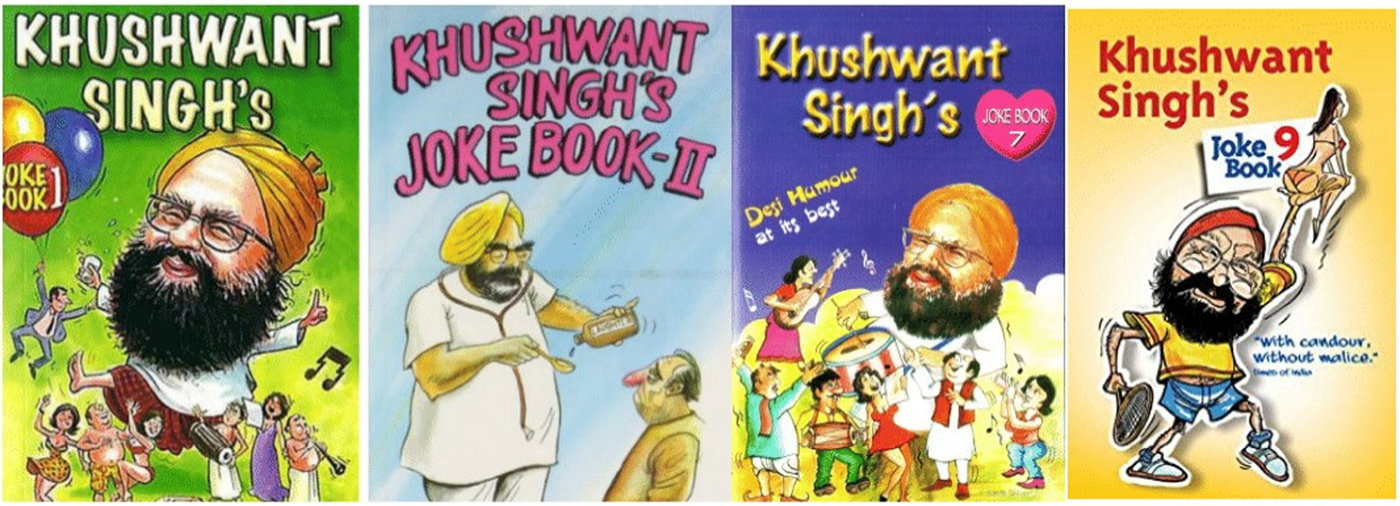
Some of the middle class youth I knew during this time period hesitated to tell these jokes, while others, like the daughter in Kambdi Kalaai, seemed unaware that they might be viewed as ethnically offensive. This is in part because Khushwant Singh, a popular Delhi-educated author who is Sikh himself, repeatedly praised the Sikh community in his popular ‘Joke book’ series for forging and embracing this genre of ethnic humor (Singh Reference Singh1987–2012; see Figure 1). When the daughter in Kambdi Kalaai further protests ‘Oh come on, Dadaji, Sikhs are known to laugh at themselves’, she channels a phrase frequently used by Singh when defending the genre. A similar joviality emerges in controlling images associating Sikhs with the fun-loving, high-energy sounds of bhangra, a music genre originating in the Punjabi harvest dance that likewise conjures ‘rusticity’ (Roy Reference Roy2010). Even now, Singh remains the originating author of many jokes displayed on santabanta.com, a controversial website specializing in the wide-scale distribution of Sardarji text messages (Santa and Banta are the names of two stock Sardarji characters). As the decade approached its conclusion, the Sikh community felt compelled to speak out. A particularly egregious event transpired in 2007, when Reliance Communications, India's second largest mobile phone carrier at the time, circulated a ‘Joke of the day’ text message to forty-million subscribers that compared a Sardar to a donkey (O'Connor Reference O'Connor2007). By naming ‘a tail’ as the only difference, the punch line forwarded a highly offensive temporal slur about Sikhs, this time involving evolutionary inferiority. After the Sikh community organized protests from Punjab to Meerut, Reliance Communications responded with a formal apology.
Cover art for volumes 1, 2, 7, and 9 of Singh's ‘Joke book’ series.

The current climate in Delhi with respect to these jokes is very different from what I observed a decade ago, given the intervening tide of Sikh activism. In 2015, a fifty-four-year-old female Sikh lawyer based in Delhi filed a petition before the Supreme Court to ban Sardarji jokes across media platforms as a form of racial bullying (Harvinder Chowdhury v. Union of India). Although the Supreme Court ultimately ruled in 2017 that it was not its place to ‘lay down moral guidelines for citizens’, the debate that the case inspired has made the urban middle classes more aware of what is at stake for the Sikh community. One of my ongoing concerns with ethnographic methodology is that examples of language practice recorded elsewhere and in the past are inevitably interpreted through the lens of one's present location. Yet the meaning of ethnic jokes arises from specific social, cultural, and political histories. As one example, Sanchez (Reference Sanchez2016) describes how factory workers in an eastern India industrial town tell religious and ethnic jokes to create ‘interethnic sociality’ and defend against the pressures of communal violence. From my own vantage point as a US citizen in the Trump era, where vicious insults disguised as jokes regarding disability, race, and gender helped win the 2016 presidency (Hall, Goldstein, & Ingram Reference Hall, Goldstein and Ingram2016), I am pleased that the Indian Supreme Court agreed to hear such a case. I suspect that if I were to visit Delhi today, I would find a new form of sexual modernity that acknowledges Sikh campaigns against the genre and rejects this form of humor. However, as in the example of Trump, the controlling images contained in formulaic jokes can easily be revitalized by a turn to nostalgia (Goldstein & Hall Reference Goldstein and Hall2017), even when a broad swath of society has declared them dead.
SEXUAL MODERNITY AND SECTION 377
Formulaic jokes are massively distributed, yet as we have seen, they also take on specialized meanings as they enter into localized interactions forged within specific communities. As Goldstein (Reference Goldstein2003/2013) has shown in her discussion of the meaning of laughter for poor residents in a Brazilian favela, humor is a crucial site for challenging social hierarchy and establishing an alternative subjectivity. Jokes are never purely formulaic: As with all ritualized speech acts, they are performative, reproducing the conventions that make them recognizable as a genre while transforming those conventions to fit new social contexts. The spatiotemporal logic behind Sardarji jokes is central to the constitution of the urban middle classes more generally, providing the backdrop for the Delhi High Court's 2009 decision to declare Section 377 unconstitutional.
The genre of humor analyzed in the previous section became especially popular after Nanhi provided refuge to a young couple from a small coal-mining colony in the state of Maharashtra. Rupa and Gauri had lived as inseparable childhood friends in back-to-back houses for seven years, but then Gauri told Rupa that she loved her. As the two relayed to me in an interview in late 2009, they continued their friendship over the next year against their parents’ wishes, but Gauri's family ultimately forbade any further contact, one day assaulting her physically when she defied them. At that point, the teenagers stole off to a neighboring temple town and married each other as bride and groom. This act set them on an unanticipated path of alienation from family, friends, and neighbors. When they returned home wearing signs that identified Gauri as a married Hindu woman—a mangal sutra tied around her neck, red sindoor down the part of hair—the parents’ screams of disapproval alerted the village to what had happened. The girls described to me how the police arriving from the neighboring city, instead of offering protection, interrogated them about sex: ‘You are two girls, what can you do? How will you have children? How will you have sex?’ (tum laṛkī laṛkī ho, tum kyā kar sakte ho? bacce kaise paidā karoge? sex kaise karoge?). After an escalating media presence intensified the situation, a group of neighbors told Rupa that they would burn her house down if she stayed in the village, and the girls fled to the jungle to hide. They lived there for three days, drinking water out of a sewer, before an NGO for gay men found them and provided assistance. One week later, Rupa and Gauri arrived at Nanhi's doorstep in Delhi with no money and a small bag of clothes.
Rupa and Gauri's wedding took place one month before the Delhi High Court handed down its highly anticipated decision regarding Section 377. The girls’ story quickly captured the attention of journalists in the urban English-medium press, who showcased it to argue for the importance of overturning this ‘outdated’ colonial-era statute. Across these representations, the teenagers emerge as romantic escapees from another place and time. This is the adventure time of Greek romance novels discussed by Bakhtin (Reference Bakhtin and Holquist1981), except that the ‘extratemporal hiatus’ endured by these ‘cupid-struck… lovebirds’ (as one news report identifies them; Bose Reference Bose2009a) occurs in the space between village and city, past and present, traditional and modern. The narrative in this way became a foil for the expression of urban middle class modernity, with the journey's endpoint, Delhi, positioned teleologically as a destination of sexual freedom. While the Hindi-medium press stayed close to the facts of the case, using simple headlines such as ‘2 girls marry each other’ (2 laṛkiyõ kī āpas mẽ śādī) (Nava Bharat 2009), the English-medium press (whose readers tend to come from the urban middle classes) dramatized the story as a daringly romantic affront to village backwardness: ‘Same sex wedding jolts village’ (S. Bose Reference Bose2009a); ‘Villagers dumbstruck at girls’ arrogant act’ (S. Bose Reference Bose2009b); ‘‘Daredevil’ couple defied relatives’ (S. Bose Reference Bose2009c),‘‘Married’ girls ready to die but not part’ (S. Bose Reference Bose2009d). Certainly, Rupa and Gauri faced life-threatening hardships in their flight from the village to the city, yet urban same-sex couples also experience extreme forms of violence. Nevertheless, the news reports equated Section 377 with a village mentality, warning that this brand of rural trauma could reach the city if this statute remained law.
The portrayal of rural life by English-medium journalists was centrally concerned with the issue of sexual expression. As the date of Delhi's gay pride day approached and promised much larger crowds than the preceding inaugural year due to the impending 377 ruling, journalists increasingly juxtaposed the village's silencing of Rupa and Gauri with the city's promise of sexual expression. As one news report put it, ‘The coming out party may be becoming bigger in urban India but for many, the closet door is still firmly shut’ (Women in love 2009). Rupa and Gauri were portrayed as sexual rebels, defying local norms by ‘walk[ing] hand-in-hand in the narrow lanes of their village’ (S. Bose Reference Bose2009a) and even ‘kissing a couple of times’ on the temple's bench (S. Bose Reference Bose2009b). Yet much like we saw in the figure of the Sardarji, they were also depicted as unable to put their relationship into words. In fact, the Times of India article mentioned above recreates a fifteen-day diary, written in the first person, of what the ‘more vocal of the two might have written when she and her lover were run out of their village’. The girl's unspoken thoughts are transformed into a reflexive English-speaking urban voice that comes to embrace a modern self.
Through news reports such as these, Rupa and Gauri's migrant journey from the country to the city was transformed into a coming out journey from silence to expression. For many readers, their journey paralleled the lesbian journey depicted a decade earlier in Deepa Mehta's controversial film Fire (Mehta Reference Mehta1996), still emblazoned on the public memory for the battle it incited between Hindu nationalists and the burgeoning LGBT community (B. Bose Reference Bose2000; Kapur Reference Kapur2000; Ghosh Reference Ghosh2010). Two mutually reinforcing progress narratives—one leading to the urban middle classes, the other to self-disclosure—found their endpoint in an urban modernity allowing LGBT expression (cf. Gopinath Reference Gopinath1998). Five days after the gay pride celebration ended, the Delhi High Court announced its decision to overturn Section 377. In a celebratory article entitled ‘Together forever’ (Tripathi Reference Tripathi2009), a newly articulate Rupa and Gauri (although described by the author as ‘simple girls from a quaint mining hamlet [who] don't really understand the nitty-gritties of Article 377 and its implications’) are cited one last time: ‘This judgment has made us feel safer and stronger. We don't need to hide ourselves anymore’.
The youth in Nanhi's NGO rarely used the term coming out, possibly because each of them had experienced the heartbreaking effects of what disclosure can bring. Instead, they conceptualized their journey through the metaphor of leaving home and coming to a place of jaankari. Living as lesbian, bisexual, or TG required rejecting the expectation of heterosexual marriage imposed upon them by their extended families. Anthropologists have powerfully documented the trauma experienced by Indian women living outside the ‘compulsory norm’ of marriage (Lamb Reference Lamb2018). The youth in this study did not have the financial solvency to survive the downwardly mobile effects associated with this asocial move, yet they embraced the path they had taken even as they longed to return home.
The Naz petition had framed its case around a personal right to privacy (cf. Nagar & DasGupta Reference Nagar and DasGupta2015): Gay men should have the right to have sex in the privacy of their own home. But this approach troubled MSM activists from the lower middle classes for privileging the home as the rightful place of a sanctioned sexuality. The transgender kotis I knew in Delhi kept their relations with men separate from the homes where they lived with their wives and extended families (Hall Reference Hall2005). In their view, the sex that needed to be protected was what occurred publicly in spaces such as parks, bus stations, ruins, and graveyards. This too explains the popularity of the ‘sex at home only’ text message. The meme-like reproduction of the joke's punch line in daily conversations did more than spoof the Sardarji's English: it also proffered a critique of heterosexual spatiality and the privilege accorded to it. ‘We should go to court and testify with this joke’, Nanhi once said in reference to 377 deliberations. ‘The Sardarji comes under this!’. Few could have predicted that the Delhi High Court, in its 2009 landmark ruling, would rewrite the very meaning of constitutional privacy as embodied instead of spatialized, thereby protecting sexual activity outside as well as inside the home. In the words of the Court: ‘A person cannot leave behind his sense of gender or sexual orientation at home. … The Constitution does not presuppose that a holder of rights is an isolated, lonely, and abstract figure possessing a disembodied and socially disconnected self’ (cited in Alternative Law Forum 2009:13–14).
Nanhi's NGO had joined gay male organizations in protesting Section 377, even though women were rarely considered targets of the statute. Historians have outlined the ways that Hindu nationalists in the nineteenth and twentieth centuries connected women's sexuality to the home as the idealized site of Indian culture (Chatterjee Reference Chatterjee, Sangari and Vaid1989; Mani Reference Mani, Sangari and Vaid1998; Sarkar Reference Sarkar2003). That the Hindi term bāzārū aurat means both ‘market woman’ and ‘prostitute’ is a testament to the strength of this recasting (see Hall Reference Hall, Livia and Hall1997): women who enter public space are often seen as untethered and thus sexually suspect. The youth in my study recognized this connection; they had each experienced the ‘shame’ of leaving home. In fact, they found it ironic that a law had been proposed to legalize same-sex sex in the homes that would never include them. In this regard, I cite one last Sardarji joke, which followed the ‘sex at home only’ text message and quickly surpassed its popularity.
(4)

In this new stage of the joke, the wife of the Sardarji counters her husband's commitment to have sex at home: ‘Thank God I am not!’ As in the previous examples, the punchline spoofs the unimaginative spatiality of heterosexuality, but this time through the voice of a woman who refuses to limit her sexuality to the private sphere. Paralleling the journey of the youth I knew in Delhi, the Sardarji's wife now lives in queer time, external to the temporal rhythms of home, family, and lineage.
Shortly after settling into Nanhi's NGO, Rupa and Gauri revealed that they had in fact never kissed, much less had sex. Rupa had said as much to the police in the interrogation: ‘Is it so necessary that we have to have sex?’ (zarūrī hai ki sex karnā hī vo hai?). The girls’ naiveté regarding sex became a frequent topic of discussion when I was in Delhi. As villagers from rural India with a limited command of English, Rupa and Gauri's lack of jaankari confirmed the progress narrative that is the focus of this article. But since all group members were traversing a similar path—that is, a path from a place of unknowing to a place of knowing—Rupa and Gauri's story was, quite simply, everyone's story. NGO members referenced it to narrate their own progress and position themselves at the more expert end of sexual modernity. As in their joking routines, this progression was often indicated by a shift to English.
In this way, LGBT youth in Delhi's expanding middle classes spoke back to widely publicized attacks on the community as the case moved on to the Supreme Court. When politicians like B. P. Singhal, senior leader of the conservative BJP party, advanced a competing modernity that condemned same-sex sexuality as un-Indian and called for a ‘spiritual evolution’, these youth simply positioned his comments at the naive end of the timeline, as relics from another time and place. This was an effective interactional strategy that could be applied beyond the Indian context, as I discovered one day when expressing my appreciation for Nanhi's signature joke: ‘I like that joke,’ I said. ‘I like ‘Sex at home only’!’ She paused, looked pointedly at each person in the room, and offered her response: ‘I know.’ When the group broke into laughter, I realized that I had just been transported to a backwards chronotope: the boring lesbian bound to the home with partner and child, the bumbling American whose poor Hindi kept her from getting the joke, the researcher whose constant questions about sexuality revealed a hilarious lack of jaankari. This closing vignette reminds us that sexual modernity, produced competitively through the display of sexual expertise, is a discursive strategy that we are all likely to engage in, even if the stances we take depend on the unique social assemblages that situate us in time and space. My own writing of this article, for instance, could be analyzed as contributing to a form of sexual modernity that emerged in Western academia with the rise of queer theory, which carries with it its own set of hierarchizing assumptions.
CONCLUSIONS
As an ethnographer of language and social life, I understand interaction to involve much more than talk itself, encompassing legal documents, journalism, political platforms, and even formulaic jokes circulating as text messages. In analyzing these texts, I have contextualized them within early twenty-first century Delhi and attempted to clarify the importance of sexuality to the urban expression of a modern self. Central to this expression is the use of English, a language newly associated with sexual modernity in the global restructuring that followed economic liberalization. Its indexical weight is seen at the turn of the millennium in the multilingual play of ethnic jokes involving the Sardarji, a figure of personhood who is depicted as interpreting the global city from a sexually naive place and time. Lesbian, bisexual, and transgender youth, ostracized by their families for rejecting a heteronormative future, told these jokes to display a form of indexical competence associated with broader middle class belonging. The Sardarji's miring in a vernacular chronotope involving tradition and rurality became the foil for an English-based sexual modernity. As we saw in the media coverage of Rupa and Gauri's flight to the city, the imposition of a rural-to-urban progress narrative onto LGBT subjectivity has been extraordinarily powerful, both politically and personally, even as it promotes teleological readings of ethnicity, language, region, and class. In this regard, it is perhaps relevant that on September 6, 2018, a five-judge bench of the Indian Supreme Court unanimously struck down Section 377, decriminalizing homosexuality for good.
Social meaning cannot arise from nowhere; it evolves through indexical orders that presuppose the past while projecting new futures. Likewise, sexual modernity constitutes itself against normativity, yet as we have seen, this constitution cannot escape the hierarchizing semiotics of normative life. This is the tension that is the focus of this article. The struggle to become a legible state subject in India was advanced by engaging tradition as a backwards chronotope and caricaturing it through images such as the Sardarji. At the same time, the appropriation of a rural-to-urban progress narrative helped change the tide on LGBT human rights in India, due to the resonance of this timeline within the expanding middle classes. I value the queer critique of LGBT movements that seek equality in the marginalizing institutions of normativity (the campaign for gay marriage comes to mind), but this perspective cannot easily speak to the precarity experienced by the youth I knew in Delhi. My contextualized analysis of everyday sexual modernity reveals that norms, no matter how benign or troubling, are deeply and complexly imbricated in projects of emancipation.
APPENDIX: TRANSCRIPTION CONVENTIONS
- end of line
intonation break
- (0.0)
timed pauses in seconds
- ,
rising continuing intonation
- .
falling concluding intonation
- underline
emphasis
- [ ]
overlap
- <x>
{discourse action occurring across bracketed segment}