In the last third of the 19th century, Berlin was the undisputed capital of the German clothing and fashion industry on an international scale. It was particularly the ready-to-wear clothing industry that had developed into one of the most profitable industries of the German Reich's capital. This clothing industry, which was successful at all price levels, was accompanied by a broad trade network with retail stores and department stores, wholesalers and distributors, as well as an extremely popular fashion fair, ‘Durchreise’ (Transit), which took place twice a year. Parallel to this focal point of the clothing industry, several publishing houses were established that specialized in the production of fashion newspapers and magazines for different target groups.
Publisher Franz Lipperheide (1838–1906) and his wife Frieda (1840–1896), née Gestefeld, were one of the success stories in this context.Footnote 1 In 1865, they founded the publishing house Franz Lipperheide in Berlin, publishing the journal Die Modenwelt: Illustrirte Zeitung für Toilette und Handarbeiten starting in September 1865. This journal, which was published every two weeks under the editorial management of Frieda Lipperheide, quickly became the most-read fashion journal in Berlin. With many subscribers both in Germany and beyond, there were several foreign-language editions, Die Modenwelt was a long-lasting commercial success for the Lipperheides. By the company's 25th anniversary in 1890, it published a total of 12 international editions of the journal with around 500,000 subscribers in Scandinavia, Italy, France, Russia, and North and South America.Footnote 2 Some of their other successful publications included the Illustrirte Frauenzeitung, as well as around a dozen text books and pattern books for handicrafts.Footnote 3
The economic success of their publishing house allowed Franz and Frieda Lipperheide, to create extensive private collections that reflected their deep interest in cultural-historical topics as well as textile art. In addition to the collection of source material for costume studies, which is now known as the ‘Sammlung Modebild—Lipperheidesche Kostümbibliothek’ (Fashion Image Collection—Lipperheide Costume Library)Footnote 4 and is the focus of this article, Frieda Lipperheide began to build a significant textile collection in the 1870s that contained historical lace, embroidery, costumes, and liturgical robes from all over Europe for use in her publications on handicrafts.Footnote 5 Other parts of the collection, such as furniture and historical weapons, were later dispersed through donation by Franz Lipperheide (antique helmets presented to Berlin's Antikenmuseum in 1905) or through auction, by his second wife Elisabeth (1867–1932), née Rouge, after Franz Lipperheide's death.
In 1889, Franz Lipperheide wrote his first request to the Prussian Ministry of Culture in an effort to ensure the permanent preservation of his ‘Sammlung für Kostümwissenschaft’ by means of a donation contract. The contract that was eventually signed in 1892 guaranteed that the entire collection – including the library, drawings and prints as well as paintings – would be preserved in the former library of the Kunstgewerbe-Museum of the Berlin Royal Museums, the present-day Kunstbibliothek, Staatliche Museen zu Berlin. In the contract, Lipperheide stipulated that the collection would bear his name, be accessible to the public and systematically expanded in the future.Footnote 6
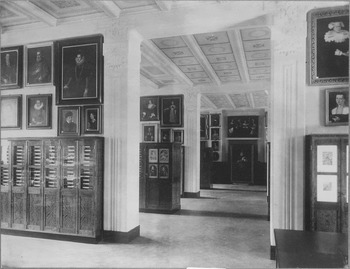
In the autumn of 1896, the collection in the Lipperheides’ private residence on Potsdamer Strasse became accessible to the public; in October 1899, under the supervision of the library at the Kunstgewerbe-Museum, a public reading room at Flottwellstrasse 4 in the Schöneberg neighbourhood was opened. In the spring of 1906, the Lipperheidesche Kostümbibliothek was given prestigious rooms on the ground floor of the new library annex of the Kunstgewerbe-Museum at Prinz-Albrecht-Strasse 7a, including a complex of study rooms as well as storerooms and office spaces. The furnishings, including the birch cabinets with inlays that are preserved to this day, were designed by Alfred Grenander and manufactured by the Berlin cabinetmaker Ludwig Lüdtke.
Study room of the Lipperheidesche Kostümbibliothek 1907. Photo: anonymous.

In March 1900, a few months after the donation of the collection, the first special exhibition of the holdings of the Lipperheidesche Kostümbibliothek was presented in the atrium of the Kunstgewerbe-Museum, featuring 1,800 objects that offered an overview of the diverse and rich collection. Other thematic exhibitions, based on works from the collection, were organized regularly in subsequent decades.Footnote 7
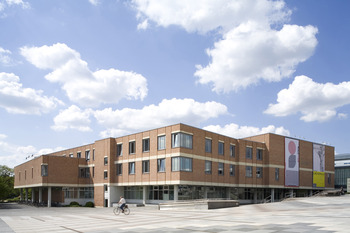
In 1934, the state's secret police decreed that the entire library building be vacated so the grand building so it could be used by the new government. It was possible to maintain provisional operations until 1939, when the holdings were evacuated and secured at various safe locations by library staff. It was not until 1954 that it was possible to make the holdings of the Lipperheidesche Kostümbibliothek accessible to the public again in a temporary location at Jebensstrasse 2. When the Kunstbibliothek moved to the Kulturforum at the Staatliche Museen zu Berlin in 1993, the Lipperheidesche Kostümbibliothek was given spacious storerooms, a study room with forty work stations and an exhibition space, to be shared with the other special collections at the Kunstbibliothek.
The Kunstbibliothek at the Kulturforum c Staatliche Museen zu Berlin. Photo: Maximilian Meisse.

The ‘Sammlung für Kostümwissenschaft’ collection created by Franz Lipperheide from the 1870s onwards is fully documented by preserved inventory books that list all books and journals as well as prints and drawings acquired before 1899, when the collection was given to the library of the Kunstgewerbemuseum, the present Kunstbibliothek. Lipperheide aimed to create the most comprehensive compilation of written and visual testimony possible as was required for “specialist studies in the most varied areas of dress and costumes”.Footnote 8 He was not only interested in the sources that related directly to costumes, fashion and all types of clothing from the 15th century up to the present. He was particularly interested in including cultural-historical topics like festivities and ceremonies, sports and games, caricatures and satire, dance and theatre, table traditions and general historical sources in the collection. When the first volume of the catalogue of books was printed in 1896, Lipperheide's ‘Sammlung für Kostümwissenschaft’ included the following holdings: 5,560 monographs, 2,185 journals, 840 almanacs, 45 manuscripts, 23,750 prints and reproduction prints, 2,750 drawings, 2,580 photographs, 686 oil paintings, and 200 miniature portraits.Footnote 9
Thanks to the continuous acquisitions made over the following 120 years, the present ‘Sammlung Modebild – Lipperheidesche Kostümbibliothek’ contains around 25,000 monographs, 25,000 volumes of journals, 120 manuscripts and albums, approximately 150,000 prints, about 20,000 drawings, and about 50,000 photographs. Fortunately, the losses during the evacuation of the collection in the Second World War were relatively low. It was only the entire collection of almanacs that was lost after 1945, and to date, around 250 volumes have been newly acquired. The collection of paintings and miniatures was also lost in the course of the evacuation during the Second World War and the subsequent return to East Berlin.Footnote 10
The Book Collection
Franz Lipperheide's inventory of books begins in 1879. The numerous entries up until 1881 presumably also include acquisitions in earlier years, since the high annual expenditure of around 30,000 Mark was not matched in later years. In this early period, Lipperheide laid the foundations of his collection of books and journals by acquiring numerous historical reference books and manuscripts. From 1882 onwards, he broadened his collection by acquiring missing source works and more recent costume-historical and cultural-historical literature as well as a series of facsimile editions. Franz Lipperheide acquired most of his books and journals from antiquarian bookshops, art dealers and auction houses in German cities, but also in Vienna and Paris, in Italy and England. Only a few purchases from private collections are documented. However, as a publisher himself, Franz Lipperheide was able to obtain most of the new editions as gifts for his collection from German and international publishing houses.
Classification
To organize his growing holdings, Franz Lipperheide devised a unique classification system with thirty main groups and numerous subgroups, which continues to be used for the systematic arrangement of the library. During the catalogue revision of 1965, the shelfmark system, which was originally purely numerical, was changed into an alphanumeric system, with the items then sorted chronologically by the year of publication.Footnote 11
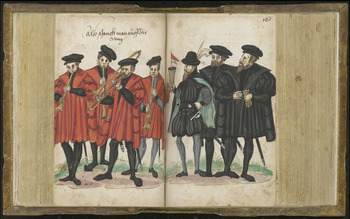
Group A is devoted to general works on the history of clothing and includes both printed books and manuscripts.Footnote 12 It includes every title of the so-called Trachtenbücher (costume books) published in the 16th century, starting with the Recueil de la diversité des habits (Paris, 1562), followed by the books by Ferdinando Bertelli and Cesare Vecellio published in Venice, Hans Weigel's Trachtenbuch (Nuremberg, 1577) and Jean-Jacques Boissard's Habitus Variarum Orbis gentium (Mechelen, 1581). One of the highlights of the manuscripts collection is the Trachtenbuch by Sigmundt Heldt (Nuremberg, 1560–80) with its 867 hand-coloured costume drawings.
Reference works on clothing include the works of Jacques Grasset de Saint-Sauveur and the ten-part Versuch über das Kostüm der vorzüglichsten Nationen (Vienna, 1796–1837) by Robert von Spalart. Franz Lipperheide acquired Giulio Ferrario's personal copy of his 21-part costume history Il costume antico e moderno (Milan, 1817–34), which includes numerous drawings and proof prints of the plates.
An unexpected abundance of valuable visual works is found in Group C, which is devoted to the medieval and modern era in general. Franz Lipperheide acquired a full set of early prints, among them more than 20 incunabula, such as the colour illustrated Neunte Deutsche Bibel by Anton Koberger (1483) and the first edition of the so-called Schedel'sche Weltchronik (Schedel's World History; 1493). In addition to the two-volume bible known as the Froschauer-Bibel (Zurich, 1531), the collection contains other German Bible editions as well as illustrated editions of numerous Latin classics, Jacob de Voragine's Legenda Aurea (Paris, 1505), Christian devotional literature mostly in German editions as well as various newer authors like Boccaccio, Paolo Giovio and Sebastian Münster or artists like Jost Amman and Jean-Jacques Boissard.
From the 17th century, the Lipperheidesche Kostümbibliothek not only contains all 21 volumes of the extensive chronicle Theatrum Europaeum (Frankfurt am Main, 1646–1738) but also Matthäus Zeiller-Merian's Topographia in 32 volumes (Frankfurt am Main, 1643–1726). Published volumes of print series by Jacques Callot, Crispin de Passe, Stefano della Bella and Wilhelm Baur are all evidence of Lipperheide's wide-ranging contacts to traders throughout Europe.
Sigmund Heldt: Abconterfaittung allerlei Ordenspersonen in iren klaidungen… Nürnberg 1560–1580. Lipp Aa 3. Photo: Dietmar Katz.

Travel reports, from the 16th century onwards, take up considerable space in the Lipperheidesche Kostümbibliothek: Nicolas de Nicolai's journey to the Orient is documented in the German edition (1576), and Jean Nieuhoff's journey to China in the French edition (1665). The volumes on America published by Theodor de Bry in Frankfurt (1591–96) are included, and James Cook's South Pole expedition is illustrated in the two volume, 1777 edition. The splendid nine volumes of The Antiquities of Mexico (London, 1831–48) as well as the rare engravings by Antoine Ignace Melling in Voyage pittoresque de Constantinople (Paris, 1819) are some of the most beautiful 19th century travel reports.
Within the classification scheme, groups D to M include works on the history of clothing and culture of specific countries and continents from the 16th century to the present. The holdings on Germany and France, the Ottoman Empire, China and North and South America are particularly rich.
The vast literature on accessories, cosmetics and aesthetics is classified within the subgroups of Group N, followed by literature on ‘costumes for different occasions’ (as it was called by Franz Lipperheide) in Groups O to U: social clothing, military uniforms, sportswear, dance and stage costumes. Group V contains literature on etiquette as well as books on eating and drinking culture. The rich collection of original dress codes and sumptuary laws is found under the letter W. Franz Lipperheide was especially interested in acquiring caricatures from France, England and Germany; they form Group X. Under the letter Y, works dealing with the manufacture of textiles and clothes including handicraft techniques are included. The final Group Z encompasses the extensive collection of almanacs and journals, which are also sorted chronologically by year of first publication.
It is the abundance of historical reference works on cultural history for use in research on the history of clothing that makes the Lipperheidesche Kostümbibliothek so unusual. The journal collections, in particular, are unique. The collection starts with the European fashion journals of the late 18th century, including the Cabinet des Modes from Paris, the Gallery of Fashion from London and the Journal des Luxus und der Moden from Weimar. The 19th century is represented with a variety of international titles, among them numerous caricature journals such as La Caricature, Punch or the London Charivari and Kladderadatsch. Among the fashion journals are trade journals like the Europäische Modenzeitung for men's tailors, Le Coiffeur européen for the hairdressing industry or the Kindergarderobe for children's clothing, published by John Henry Schwerin.
After the collection became public, the journal collection continued to be enlarged consistently in the 20th century: for example, nearly all volumes of the American, French, British and German editions of Vogue magazine are available. In addition, there are complete collections of important German journals such as Die Dame, Elegante Welt (today Madame), Brigitte and Burda-Moden. The research journals Fashion Theory, Zeitschrift für historische Waffen- und Kostümkunde, as well as the annuals published by the international costume societies, are available in their entirety. All the existing journal collections of the Lipperheidesche Kostümbibliothek are recorded in the Zeitschriftendatenbank (the German journal database which lists the journal holdings of most libraries in Germany; many libraries do not include their journals in their library catalogue) under the B11 identifying code of the Kunstbibliothek with the addition “Lipp”, to indicate the particular collection.
The Collection of Prints and Drawings
Franz Lipperheide acquired around 30,000 individual works on paper with the aim to complement the subjects covered in his library. In addition to buying numerous prints featuring the library's various areas of concentration, such as fashion, workers' uniforms, folk costumes, military uniforms and stage costumes, Franz Lipperheide also focused on historical portraits made in France, England and Germany. Among the approximately 15,000 works, which are partially catalogued, the portraits of the German Reformation period, the Nuremberg councillors of the 17th century, the 18th-century English mezzotints as well as numerous Augsburg portrait engravings, are worth mentioning.
The drawing collection of the Lipperheidesche Kostümbibliothek offers an extensive collection of garment sketches from the early modern period, genre scenes of the 18th and 19th century as well as international stage and costume designs from the 17th to the 20th centuries, by Filippo Juvarra and the Galli-Bibiena brothers among others. The 20th-century acquisitions focus on artistic fashion illustrations, designs for stage costumes and design drawings for fashion collections.
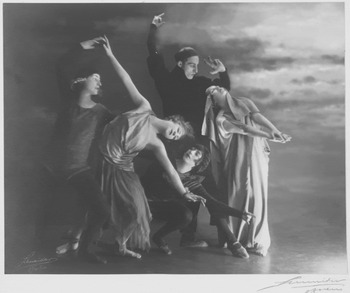
Franz Lipperheide recognized the significance of photography as a visual medium for fashion and clothing; more than 2,000 small-format carte-de-visite photographs originate from his collection and show portraits as well as rural scenes staged in the studio. The present collection of photographs comprises around 60 photo albums with portrait, travel and dance photography as well as more than 100 portfolios of fashion photographs from German and international ateliers. Many of these photographs are from press archives and were originally intended to be published in fashion journals. The photographic collection is also noteworthy for the circa 300 Japanese photographs from the late 19th century,Footnote 13 as well as a collection of about 400 dance photographs from the 1920s.Footnote 14
Ernst Schneider: Tanzbühne Rudolf von Laban: Narrenspiegel 1926. Photo: Dietmar Katz.

Catalogues and Publications
The library collections of the Lipperheidesche Kostümbibliothek were first published in a two-volume collection catalogue by Franz Lipperheide.Footnote 15 This rare catalogue is considered an essential bibliography for the cultural history of clothing and fashion, and due to its scholarly precision, it is still a valid reference book today. A new edition of the catalogue was released in 1965, with a supplement listing all the books and journals acquired since the beginning of the century.Footnote 16 The appendix contains a concordance of the original numerical signatures with the new alphanumerical signatures, as well as a list of war losses. Since 1993, all the new acquisitions of books and journals in the Kunstbibliothek, including the Lipperheidesche Kostümbibliothek, have been catalogued directly into the library's computer catalogue and can be accessed online.Footnote 17
The collection and exhibition catalogues of the Lipperheidesche Kostümbibliothek make it possible to appreciate the thematic richness of the collection.Footnote 18 In the decades following the Second World War, the focus of exhibitions was on cultural-historical topics like caricatures, mask costumes, equestrianism, stage designs or seafaring; whereas exhibitions in the 21st century have focused on fashion over the past 150 years. At the same time, parts of the collection of prints and drawings, including portraits, fashion caricatures and fashion photographs from 1900 to 1945, have been studied in detail in recent development projects and published on the museum database. Participation in the European online portal Europeana Fashion makes the collection of prints available to a wider audience.Footnote 19
All of this provides further proof of how perspicacious Franz Lipperheide's concept of collecting was. His direct involvement in the successful fashion industry in Berlin, and its coverage in the media in the last third of the 19th century, enabled him to create an enduring documentation of fashion – often discredited for being ephemeral – with his Sammlung für Kostümwissenschaft.