More than 440,000 adults contract a healthcare-associated infection (HAI) in the United States each year, at a cost of nearly $10 billion.Reference Zimlichman, Henderson and Tamir 1 HAIs are classified as a “never event” by the Centers for Medicare and Medicaid Services, which stopped reimbursing US hospitals for such events in October 2008 as part of the Deficit Reduction Act of 2005.Reference Brown, Doloresco Iii and Mylotte 2 Although recent estimates have suggested that the rate of infections due to methicillin-resistant Staphylococcus aureus (MRSA) has declined in the last decade, this antimicrobial-resistant pathogen remains one of the most common sources of HAI in the United States.Reference Dantes, Mu and Belflower 3
Estimates of the burden associated with HAIs can be useful in making resource allocation decisions, in evaluating treatment and prevention efforts, and for comparisons with other conditions. A number of studies have estimated the incremental cost attributable to MRSA HAIs, but these estimates are incomplete or unreliable for several reasons. For example, many estimates have been limited to inpatient costs for the hospital stay during which the HAI occurred.Reference Noskin, Rubin and Schentag 4 , Reference Shorr, Tabak, Gupta, Johannes, Liu and Kollef 5 Without the post-discharge component of MRSA HAI costs, the resources required to treat patients with these hospital-acquired events cannot be completely assessed. Studies that have estimated post-discharge outcomes have either not included costs as an outcome;Reference Emerson, Eyzaguirre, Albrecht, Comer, Harris and Furuno 6 , Reference Dick, Liu and Zwanziger 7 have used charges rather than costs, which are overestimates of costs;Reference Anderson, Kaye and Chen 8 have been limited to a single hospital;Reference Filice, Nyman and Lexau 9 or have focused only on surgical site infections (SSIs) diagnosed post-discharge.Reference Graves, Halton and Curtis 10 , Reference Perencevich, Sands, Cosgrove, Guadagnoli, Meara and Platt 11
The objective of our study was to estimate the post-discharge costs and healthcare utilization among patients with MRSA HAIs compared with a control group of patients without such an infection during a 1-year period following hospital discharge. We hypothesized that having an MRSA HAI would lead to greater post-discharge healthcare costs and utilization.
Methods
Study Design and Population
We employed a historical cohort study design and used data from the national Department of Veteran Affairs (VA) healthcare system, the largest integrated healthcare system in the United States.Reference Neily, Mills and Young-Xu 12 We constructed a cohort of patients admitted to 1 of 123 VA hospitals in the United States between October 1, 2007, and September 30, 2010. The 365 days prior to admission to the hospital was the baseline period during which covariates were captured for each patient and prior VA encounters were identified. Healthcare cost and utilization outcomes were measured during the 365-day period following discharge.
Patients could have had multiple hospitalizations during the time frame of our study. However, we selected the first hospitalization, the index hospitalization, for our analysis. Patients were excluded from the cohort if they died during this index hospitalization or if the length of stay exceeded 90 days. Patients discharged from the hospital in ≤2 days were excluded because they were not eligible for predischarge HAIs as defined in this study. Finally, because our goal was to identify incident MRSA HAIs, we also excluded patients with a prior positive clinical culture for MRSA and patients without at least 365 days of observation in the VA prior to their index hospitalization (during which a positive test for MRSA could have occurred). Our final cohort consisted of 369,743 patients.
Data
Microbiology
Beginning on October 1, 2007, the VA implemented a nationwide MRSA Prevention Initiative with a goal of reducing MRSA HAIs.Reference Jain, Kralovic and Evans 13 The program called for all patients admitted to a VA acute care facility to be screened for MRSA colonization upon admission, transfer, and discharge. The results from these tests are entered into the VA electronic medical record. Our team developed a natural language processing system to extract microorganisms mentioned in these reports as well as antibiotic susceptibilities allowing us to identify positive MRSA cultures at all VA hospitals.Reference Jones, DuVall, Spuhl, Samore, Nielson and Rubin 14
Costs and Utilization
Healthcare cost and utilization data were obtained from the VA Decision Support System (DSS), which is an activity-based accounting system. Physicians and managers report their activities to this system, which are then used to distribute costs from the VA payroll and general ledger.Reference Prosser, Ray, O’Brien, Kleinman, Santoli and Lieu 15 These personnel costs are combined with the costs of intermediate goods to generate the costs for each inpatient and outpatient encounter and are then made available for research purposes.
Patient Demographic and Clinical Characteristics
Patient demographic data were obtained from the VA Corporate Data Warehouse, the national repository for electronic data from several different administrative and clinical data sources in the VA. 16 Clinical data such as International Classification of Disease (ICD-9) codes were obtained from VA Medical SAS datasets.
Outcome Variables
Our outcome variables included outpatient, inpatient, and pharmacy costs as well as utilization in the VA during the 365-day period following the index hospitalization. Cost outcomes were converted to 2013 US dollars using the Personal Consumption Expenditures (PCE) price index constructed by the US Bureau of Economic Analysis.Reference McCully, Moyer and Stewart 17 VA DSS data allows inpatient costs to be separated into fixed and variable costs, a distinction that is important in the estimation of HAI-attributable costs.Reference Graves, Harbarth, Beyersmann, Barnett, Halton and Cooper 18 Fixed costs are associated with long-term obligations and are difficult to change in the short run; examples in healthcare include contractual commitments, such as staff employment or lease agreements on diagnostic devices, and physical commitments, such as investments in buildings and infrastructure. Because variable costs, such as drugs and consumables, can be avoided in the short run, they therefore represent expenditures that could be saved if an HAI is prevented. We reported both total and variable inpatient costs.
Outpatient and pharmacy utilization were defined as the number of outpatient encounters and the number of outpatient prescriptions, respectively. Inpatient utilization was defined in 2 ways: whether or not the patient had an inpatient admission and the number of days spent in the hospital.
Independent Variables
The key independent variable in our models was an indicator for a positive MRSA culture. According to the US Center for Disease Control’s National Healthcare Safety Network’s surveillance definition, infections diagnosed within the first 48 hours of a hospital stay were classified as community associated, while those diagnosed after the first 48 hours were classified as healthcare associated.Reference Horan, Andrus and Dudeck 19 Extending this same time window to the post-discharge period, we assumed that positive MRSA cultures identified within 48 hours after hospital discharge were also healthcare associated. Therefore, we defined healthcare-associated MRSA as any positive MRSA culture identified between 48 hours after admission and 48 hours after discharge. We also excluded from our definition any positive cultures that were obtained from the nares or from a surveillance test. However, these positive cultures very likely include both true MRSA infections and non–infection-related MRSA colonizations, thus causing the overestimation of the number of MRSA infections. A recently published algorithm that uses electronic data in the VA classifies positive MRSA cultures as infections if they were from a sterile site such as blood, bone, or device or if the patient had a pharmacy record for MRSA-active antimicrobials at any point during the 5 days before or 5 days after the positive MRSA culture.Reference Branch-Elliman, Strymish and Gupta 20 We used this algorithm to further classify the positive MRSA cultures as healthcare-associated infections (MRSA HAIs) or not (MRSA colonizations).
We controlled for potential confounders, including demographic characteristics (age, race, marital status, insurance status, gender), VA healthcare costs in the 365 days prior to admission, length of stay at risk for MRSA infection during index hospitalization, admitting diagnosis for index hospitalization, indicator for surgery within first 48 hours of index hospitalization, and comorbidities. Comorbidities were measured using a risk score that combined the Charlson and Elixhauser measures by considering conditions present in either of the 2 comorbidity indices. Gagne et alReference Gagne, Glynn, Avorn, Levin and Schneeweiss 21 showed that this combined index predicts 1-year mortality better than either score by itself.
Statistical Analysis
Descriptive Statistics and Unadjusted Costs and Utilization
Descriptive statistics and unadjusted costs and utilization outcomes were used in our statistical analysis. To compare characteristics between patients with and without positive MRSA cultures, we used χ2 tests for dichotomous and categorical variables, t tests for normally distributed continuous variables, and Wilcoxon-Mann-Whitney tests for skewed continuous variables such as costs and utilization outcomes.
Cost Regressions
Because most of the patients in our cohort (>90%) had at least 1 outpatient encounter or prescription during the outcome evaluation period, we used a generalized linear model (GLM) with a log linkReference Manning, Basu and Mullahy 22 for outpatient and pharmacy cost regressions. However, fewer than half of the patients in our cohort had an inpatient admission during the outcome evaluation period. Therefore, we used a 2-part regression model for inpatient costs that estimates (1) the probability of incurring any costs, and (2) the continuous cost, conditional on costs being non-zero.Reference Mullahy 23 For the second part of this 2-part model, we used a GLM with a log link. Using a modified Park test,Reference Jones 24 we determined that γ was the most appropriate distribution for the cost data.
Utilization Regressions
The number of outpatient encounters and prescriptions were modeled using negative binomial regression, while the number of inpatient days and proportion of patients with a hospital readmission were modeled using zero-inflated negative binomial regression and logistic regression, respectively.
Propensity Score Matching
We ran the regressions outlined above on a subgroup of propensity score-matched patients to balance observable characteristics between patients with and without a positive MRSA culture. Using multivariable logistic regression, we modeled the probability of developing a positive MRSA culture as a function of the independent variables mentioned above, which were considered to be risk factors for post-discharge cost or confounders in the relationship between positive culture and post-discharge cost.Reference Austin, Grootendorst and Anderson 25 One-to-one, nearest neighbor matching was conducted using a small caliper width (10% of the standard deviation of the propensity score; 20% is recommended) to ensure tight matches and only on patients whose propensity score fell within the region of common support.Reference Lunt 26 , Reference Austin 27 Covariate balance was evaluated using standardized differences of means, a comparison method that is not influenced by sample size.Reference Austin 28
Results
Patient Characteristics
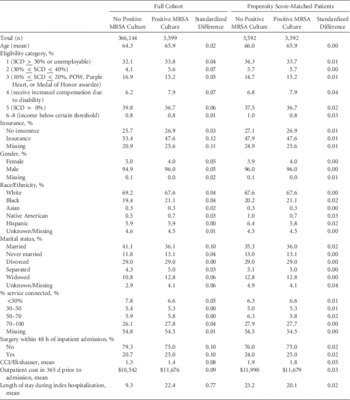
Table 1 depicts the characteristics of the 369,743 patients that met our inclusion criteria, 3,599 of whom (1.0%) had a positive MRSA culture. Among the patients with a positive MRSA culture, the average age was 64.3 years (94.9% were male); for patients without a positive MRSA culture, the average age was 65.9 years (96.0% were male). Patients with a positive culture were more likely than those without to have had surgery during the first 48 hours of their hospitalization (25.0% vs 20.1%), to have had higher outpatient costs during the year prior to admission ($11,676 vs $10,542), and to have had a greater length of stay during the index hospitalization (22.4 vs 9.3 days). The propensity score-matching process resulted in 3,592 patients both with and without a positive MRSA culture. A small number of patients with a positive culture were not matched because their propensity score fell outside the region of common support. The characteristics of matched patients are presented in Table 1, and these data demonstrate considerably less variation between the 2 groups.
Characteristics

NOTE. SCD, service-connected disability; POW, prisoner of war; CCI, Charlson comorbidity index; LOS, length of stay.
Cost Outcomes
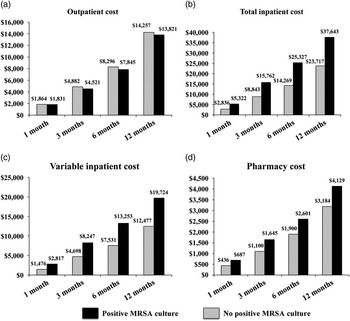
The unadjusted mean outpatient, pharmacy, inpatient total, and inpatient variable per-patient costs for matched patients with and without positive cultures during the index hospitalization are shown in Figure 1. At 12 months post-discharge, patients with a positive culture had greater mean pharmacy ($4,129 vs $3,184; P<.0001), inpatient total ($37,643 vs $23,717; P<.0001), and inpatient variable costs ($19,724 vs $12,477; P<.0001).
Unadjusted mean costs at 1, 3, 6 and 12 monts post-discharge, n=7,184

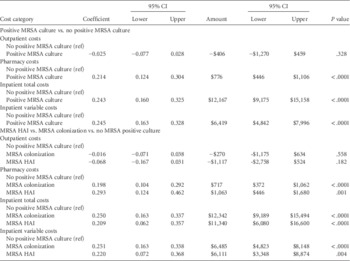
After controlling for confounders, we found that a positive MRSA culture was associated with an increase in pharmacy costs of $776 (P<.0001) and an increase of inpatient costs of $12,167 (P<.0001) within 1 year after discharge (Table 2). Of the increase in inpatient costs, $6,419 (P<.0001) were variable costs. Compared with patients without a positive MRSA culture, the impact on cost was similar in magnitude in patients with MRSA colonization and HAI.
Results of Multivariable Generalized Linear Model Regressions Comparing Costs During 365-Day Post-Discharge Period in Patients With and Without Positive MRSA Culture and by Category of MRSA HAI (Propensity Score-Matched Subgroup n=7,184)

NOTE. All regressions include the following independent variables: age, marital status, race, insurance status, VA eligibility, % service connected disability, outpatient costs in previous 365 d, comorbidities, surgery within 48 h of admission for index hospitalization, length of stay during index hospitalization, admitting diagnosis code, and VA hospital fixed effect. Coefficients are interpreted as a percent difference in costs between patients with and without a positive MRSA culture. MRSA colonization, N=3,001; MRSA HAI, N=591.
Utilization Outcomes
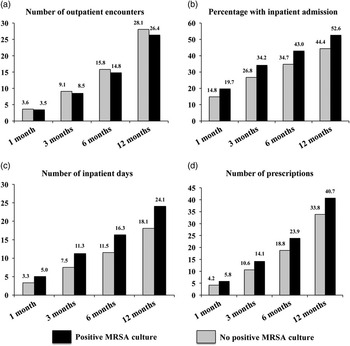
The unadjusted mean number of outpatient encounters, prescriptions, and inpatient days per patient, as well as the percentage with at least 1 inpatient stay for patients with and without a positive culture for MRSA, are shown in Figure 2. At 12 months post-discharge, patients with a positive culture had, on average, slightly fewer outpatient encounters (26.4 vs 28.1; P<.0001) but a greater likelihood of readmission (52.6% vs 44.4%; P<.0001), more days spent in the hospital (24.1 vs 18.0; P<.0001), and more prescriptions (40.7 vs 35.1; P<.0001).
Unadjusted mean healthcare utilization at 3, 6 and 12 monts post-discharge, n=7,184

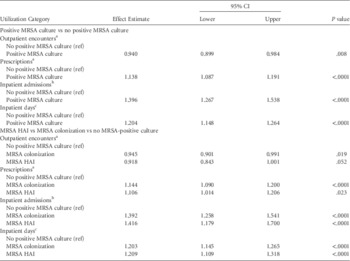
After controlling for confounders, we found that a positive MRSA culture was associated with a 13.8% increase in the number of prescriptions (P<.0001), a 39.6% increase in the odds of having a readmission (P<.0001), and 20.4% more inpatient days (P<.0001) in 12 months post-discharge compared with those without a positive culture (Table 3). Interestingly, those with a positive culture had 6.0% fewer outpatient encounters (P<.0001). Similar results were found when separating MRSA positive cultures into those that were and were not infections.
Results of Multivariable Regressions Comparing Healthcare Utilization During 365-Day Post-Discharge Period in Patients With and Without MRSA HAI (Propensity Score-Matched Subgroup, n= 7,184)

NOTE. All regressions include the following independent variables: age, marital status, race, insurance status, VA eligibility, % service connected disability, outpatient costs in previous 365, comorbidities, surgery within 48 hours of admission for index hospitalization, length of stay during index hospitalization, admitting diagnosis code, VA hospital fixed effect. Estimates from negative binomial regressions are presented as incremental rate ratios while estimates from the logistic regression are presented as odds ratios. MRSA colonization, N=3,001; MRSA HAI, N=591.
a Negative binomial regression.
b Logistic regression.
c Zero-inflated negative binomial regression.
Discussion
We identified the impact of positive MRSA cultures on post-discharge healthcare costs and resource utilization during the first year following a VA inpatient stay in a nationwide cohort of veterans. These positive cultures were associated with significantly greater post-discharge costs and utilization in pharmacy and inpatient services. The impact was similar in patients with and without MRSA HAIs, as identified using an electronic algorithm. These results shed light on the long-term burden of infections on health systems. The increased post-discharge costs associated with the infections may represent resources that could be used for other purposes and imply decreased quality of life for patients underscoring the importance of infection control and prevention efforts in the healthcare setting. There are several possible explanations for the long-term impact of MRSA HAIs on healthcare utilization. First, the elevated costs following discharge may be due to recurrent infections, which are common in patients with MRSA HAIs.Reference Huang, Hinrichsen and Datta 29 Second, recent evidence suggests that patients with Staphylococcus aureus HAIs are at greater risk for expensive long-term disabilities such as chronic ventilator dependence and dialysis-dependent end-stage renal disease.Reference Su, Chang, Yan, Tseng, Chien and Fang 30
In the mid-2000s, 1 in 5 Medicare beneficiaries were readmitted to the hospital after discharge, costing Medicare $17.4 billion annually.Reference Jencks, Williams and Coleman 31 Beginning in fiscal year 2013, the Medicare Hospital Readmissions Reduction Program established in the Patient Protection and Affordable Care Act imposed financial penalties on hospitals to reduce preventable 30-day readmissions.Reference Hawkes, Richardson, Ipp, Schuh, Adachi and Tran 32 Our results show that positive cultures for MRSA increased the risk of readmission by 39% at 1 year and by 42% (unreported result) at 30 days, suggesting that infection prevention efforts could have substantial financial impacts on healthcare systems.
Our results add to the small body of literature examining HAIs and post-discharge outcomes. To our knowledge, only a handful of previous studies have addressed this relationship. First, using 8 years of data at a single facility, Emerson et alReference Emerson, Eyzaguirre, Albrecht, Comer, Harris and Furuno 6 found an elevated risk for readmission within 1 year following discharge for hospitalized patients with a positive clinical culture for MRSA, vancomycin-resistant enterococci, or Clostridium difficile (hazard ratio [HR], 1.45; 95% confidence interval [CI], 1.38–1.5]). Second, Anderson et alReference Anderson, Kaye and Chen 8 found an increased risk of readmission (unadjusted odds ratio [OR], 30.2; P<.0001) and inpatient charges (adjusted charges, $24,113) within 90 days in a cohort of patients admitted to 1 of 7 hospitals in North Carolina with MRSA SSIs compared with those without an infection.Reference Anderson, Kaye and Chen 8 Finally, Filice et alReference Filice, Nyman and Lexau 9 found that patients with MRSA HAIs had 53% higher costs compared with those with a methicillin-susceptible Staphylococcus aureus (MSSA) HAI at the Minneapolis VA Medical Center during the first 6 months after infection.
Other studies that have estimated the costs of healthcare-associated infections have focused solely on predischarge costs. For example, a recent meta-analysis estimated the cost attributable to MRSA SSIs to be $42,300 per patient hospitalization, and for MRSA central-line bloodstream infections the cost has been estimated to be $58,614.Reference Zimlichman, Henderson and Tamir 1 Another study used data from 59 US hospitals, along with cost-to-charge ratios, and identified an adjusted difference of $7,731 per patient hospitalization in patients with MRSA compared to MSSA ventilator-associated pneumonia.Reference Shorr, Tabak, Gupta, Johannes, Liu and Kollef 5
In our study, we improved on these previous estimates in several important ways. First, we included patients from >100 hospitals in all 50 states, making this is one of the largest analyses of attributable costs of HAIs ever conducted. Second, the construction of such a large patient cohort was facilitated by our unique dataset of microbiology reports to identify positive MRSA cultures. To identify MRSA HAIs, previous cost studies have either relied on ICD-9 codes, which are notoriously inaccurate for MRSA,Reference Schweizer, Eber and Laxminarayan 33 or manual chart review,Reference Filice, Nyman and Lexau 9 which can be expensive and time-intensive. Third, we used propensity score matching to reduce the imbalance of observable characteristics between patients with and without positive cultures.
Estimates of the cost of care for conditions such as MRSA HAIs are important for a number of reasons.Reference Rice 34 First, they are a measure of burden of disease with dollars as a particular metric. Second, these estimates are used to justify intervention efforts, to determine allocation of research funding, and to assist in policy efforts related to prevention and control practices. Finally, estimates of costs can provide a valuable economic foundation for program evaluation. To be useful in determining the cost savings of infection prevention efforts, it is important to differentiate between fixed and variable costs associated with these events. Variable costs are those that could be saved if infections could be avoided and, therefore, are most relevant here. Combining our estimates of post-discharge pharmacy and variable inpatient costs indicate that MRSA HAIs are associated with an increase in total, avoidable costs of $7,196 per patient. With an estimated 69,960 invasive MRSA HAIs that do not result in predischarge mortality occurring each year in the United States, our results suggest that these infections have led to more than $500 million in additional costs when accounting for the post-discharge time period.Reference Hidron, Edwards and Patel 35 , Reference Klevens, Morrison and Nadle 36
Our study had several limitations. First, even though 28–47% of veterans receive some healthcare in non-VA facilities,Reference Borowsky and Cowper 37 – Reference Liu, Bolkan, Chan, Yano, Rubenstein and Chaney 39 the healthcare encounters considered in our study were limited to those that occurred within the VA. Therefore, the costs and utilization captured in our study likely represent an underestimate of the total healthcare consumption by the patients in our cohort. Second, patients in our cohort may not be representative of hospitalized patients in the United States in general due to a higher proportion of elderly male patients with complex chronic conditions, thus limiting the generalizability of our results. And finally, even though we took care to exclude positive cultures taken from the nares or obtained through a surveillance test in our definition of positive MRSA cultures, our definition of MRSA HAI likely included both true MRSA infections and non–infection-related MRSA colonization. Therefore, we likely overestimated MRSA infections. To address this concern, we used an electronic algorithm to identify HAIs as positive MRSA cultures from sterile sites or those associated with MRSA-active antibiotics.
In conclusion, in this study, we estimated the incremental post-discharge outpatient, pharmacy, and readmission costs among patients with an MRSA HAI compared with those without a MRSA HAI for a cohort of hospitalized veterans. We found that these costs can be substantial, at more than half a billion dollars in the United States per year, adding to the previous estimates of the burden of MRSA HAIs.
Acknowledgments
The views expressed in this article are those of the authors and do not necessarily reflect the position or policy of the Department of Veterans Affairs or the United States government.
Financial support: The research reported here was supported by the Department of Veterans Affairs, Veterans Health Administration, Office of Research and Development, Health Services Research and Development Service (CDA 11-210).
Potential conflicts of interest: The authors have no conflicts of interest to report.