Introduction
Tephritid flies (Diptera: Tephritidae) are known to undergo rapid host shifts and host race formation that may lead to speciation in sympatry. Insect host races are genetically differentiated populations that show high host plant fidelity and adaption. They represent intermediate levels between polymorphic populations and distinct species; they also show reduced level of gene flow between them (Berlocher and Feder Reference Berlocher and Feder2002; Drès and Mallet Reference Drès and Mallet2002). In fact, “host-related divergence”, which can lead to ecological speciation, has been responsible for the great diversity of phytophagous insect species, like flower-head-infesting tephritids (Stireman et al. Reference Stireman, Nason and Heard2005).
One of 18 tephritid species associated with thistles (Asteraceae) in Lebanon, Terellia serratulae (Linnaeus) (Diptera: Tephritidae) is polyphagous, infesting three genera of thistles: Carduus Linnaeus, Cirsium Miller, and Picnomon Adanson (Asteraceae) (Knio et al. Reference Knio, Kalash and White2002). This tephritid is widespread throughout the world (Freidberg and Kugler Reference Freidberg and Kugler1989; Korneyev and Dirlbek Reference Korneyev and Dirlbek2000; Knio et al. Reference Knio, Kalash and White2002), and is reported to be univoltine (Redfern Reference Redfern1968; Michaelis Reference Michaelis1986; White Reference White1988; Kinkorova Reference Kinkorova1991), or multivoltine (Baloch and Khan Reference Baloch and Khan1973). Females of T. serratulae oviposit in open flower heads without gall formation. Its larvae feed on achenes and receptacle tissue and overwinter in a cocoon made of pappus hairs (Michaelis Reference Michaelis1986; Kinkorova Reference Kinkorova1991).
In Lebanon, the different host plants of T. serratulae differ in their phenology; some are restricted to specific elevations. Carduus species flower from early March until June (from sea level to 1200 m), Picnomon acarna (Linnaeus) Cassini flowers from early June to early August (950–1700 m), Cirsium phyllocephalum Boissier and Blanche flowers from mid-June until October (500–1750 m), and Cirsium leucocephalum penicillatum (Koch) Greuter (Cirsium lappaceum Lamarck) flowers from late July until mid-October (1300–2500 m). The different host plants occur in sympatry mainly at mid-elevation (Knio et al. Reference Knio, Kalash and White2002).
Females T. serratulae reared from the different host plants show polymorphism in their body and ovipositor size. Different populations associated with specific host plants may show specific adaptions, and may represent different host races representing sympatric populations inhabiting different host plants and showing genetic differentiation (Drès and Mallet Reference Drès and Mallet2002).
In this study, we explore host adaptations in the polyphagous species, T. serratulae. We aim to assess the extent of morphometric and genetic variations among the different host-associated populations of T. serratulae in Lebanon.
Materials and methods
Flower head collection and fly rearing
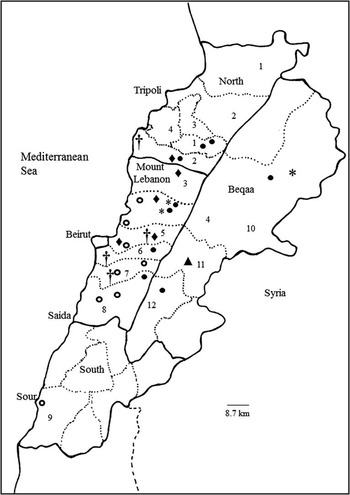
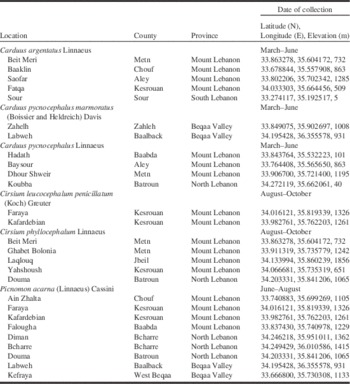
Flower heads of Carduus, Cirsium, and Picnomon were collected from various locations in Lebanon from sea level to 2500 m (Fig. 1; Table 1). Due to the scarcity and morphological similarity among the three Carduus species, they were combined for the purpose of this study.
Map of Lebanon showing the sites of collections of the host plants of Terrelia serratulae: Carduus argentatus (o), C. pycnocephalus (†); C. pycnocephalus marmoratus (▲); Cirsium leucocephallum (*); Cirsium phyllocephalum (♦); and Picnomon acarna (∙). North Lebanon: (1) Bcharre County; (2) Batroun County. Mount Lebanon: (3) Jbail County; (4) Kesrouan County; (5) Metn County; (6) Baabda County; (7) Aley County; (8) Chouf County. South Lebanon: (9) Sour County. Beqaa Valley: (10) Baalback County; (11) Zahle County; (12) West Beqaa County.

Sites of collections of flower head samples belonging to the different host plants of Terellia serratulae in Lebanon.

Samples of 50–100 flower heads per plant species per site were brought back to the laboratory after each sampling trip. The thistles were identified using Post (Reference Post1933) and by comparing with specimens at the Post Herbarium at the American University of Beirut. Flower heads belonging to the same species and collected in the same locality and on the same date were placed in individual glass-topped sleeved insectary cages (35×35×37 cm) under fluorescent light (12 hours/12-hour cycle) and were monitored daily for the emergence of adult flies (Goeden Reference Goeden1985). Emerged flies were collected and identified using White (Reference White1988) and Freidberg and Kugler (Reference Freidberg and Kugler1989). Those to be used for morphometric comparative studies were stored at−20 °C and those to be used for genetic studies were stored at −70 °C. Voucher specimens of the flies were deposited at the Natural History Museum, American University of Beirut, Lebanon.
To compare the flower head characteristics of the different host plants exploited by T. serratulae, 42–45 flower heads were dissected to record the following parameters: maximum flower head width, flower head length, receptacle width, and number of seeds per flower head.
Comparative morphometry of the adults
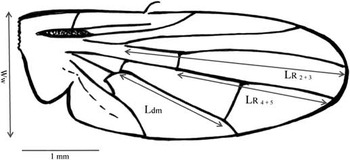
Two head (length and width) and four wing (width at the level of stigma, length of the discal medial cell (dm), length of the third radial cell (R4+5), and length of the second radial (R2+3) cell) parameters were measured and compared among adult fly populations emerging from the different hosts: 45 Carduus-associated flies (25 males, 20 females), 43 C. leucocephalum-associated flies (17 males, 26 females), 44 C. phyllocephalum-associated flies (20 males, 20 females), and 42 P. acarna-associated flies (15 males, 27 females) (Fig. 2).
Wing measurements for the morphometric studies on Terrelia serratulae adults. Ww, width at the level of the stigma; Ldm, length of the discal medial cell (dm); L4+5, length of the third radial (R4+5) cell; L2+3, length of the second radial (R2+3) cell.

Morphology and morphometry of the aculeus
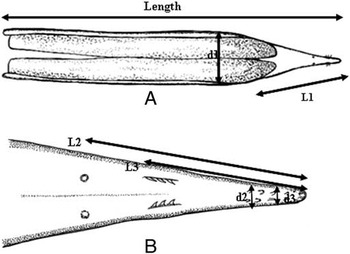
Dissection of ovipositors was performed according to White (Reference White1988) with some modification. The length of the aculeus was measured under a stereomicroscope (Leica Zoom 2000, Leica Microsystems, Suffolk, United Kingdom) and six other measurements (Fig. 3) were recorded under a compound microscope (Leica CME): d1 (maximum width of aculeus), d2 (tip width taken 0.03 mm from tip), d3 (tip width taken at 0.007 mm from tip), L1, L2, and L3. The lengths L1, L2, and L3 were used to calculate three ratios, ratio 1 (R1=L2/L1), ratio 2 (R2=L3/L2), and ratio 3 (R3=L3/L1), which represent the location of the ventrolateral grooves and chemosensillae on the tip of the aculeus. The distances d2 and d3 represent the width of the aculeus at the tip.
Ovipositor measurements of Terrelia serratulae females. (A) d1, maximum ovipositor width; L1, length of ovipositor tip. (B) d2, tip width taken at 0.03 mm from tip, d3, tip width taken at 0.007 mm from tip; L2, length from tip to round sensillae; L3, length from tip to ventrolateral grooves.

DNA extraction
DNA was extracted from flies stored at −70 °C following the extraction method in Smith et al. (Reference Smith, Al-Zein, Sayar and Knio2009). Each fly was placed in a 1.5 mL eppendorf tube with 200 μL of grinding buffer (10 mM Tris-HCL pH 7.8, 10 mM EDTA pH 8, 60 mM NaCl, 300 mM sucrose) and crushed and ground with a glass rod for approximately one minute on ice. Lysis buffer (200 μL: 300 mM Tris-HCL pH 7.8, 1% SDS, 20 mM EDTA pH 8) was added, and the sample was mixed. The sample was kept on ice for 5–30 minutes, after which it was centrifuged at 15 000 rpm for five minutes. The supernatant (200 μL) was transferred to a new tube, and 260 μL of 4 M NaCl were added and mixed. The tube was centrifuged at 15 000 rpm for five minutes, and 400 μL of supernatant were transferred to a new tube over which 800 μL of 100% ethanol were added. The tube was then kept on ice for five minutes and centrifuged at 15 000 rpm for five minutes. The supernatant was discarded and the pellet was washed with 500 μL of 75% ethanol followed by 150 μL of 75% ethanol. After a final centrifugation for five minutes at 15 000 rpm, the supernatant was removed, and the DNA pellet was left to dry at room temperature in open air. DNA pellets were resuspended in 200 μL of TE (10 mM Tris-HCL pH 7.8, 1 mM EDTA pH 8) and stored at−20 °C.
Amplification and sequencing of mtDNA fragments
A 690 base-pair fragment of the mitochondrial ND1 (Nicotinamide adenine dinucleotide dehydrogenase subunit 1) gene and a 692 base-pair fragment of the mitochondrial COXI (cytochrome oxidase 1) gene were amplified and sequenced. For the ND1 gene fragment amplification, the primers used were those of Smith et al. (Reference Smith, McPheron and Kambhampati2002): ND1-F1,2 (degenerate pair: 5′-ATC ATA ACG AAA CCG AGG TAA and 5′-ATC ATA ACG AAA TCG AGG TAA), and ND1-R1 (5′-CAA CCT TTT AGT GAT GC), in addition to a reverse primer ND1-R2 (5′-CAA CCT TTT TGT GAT GC). The primers used for the COXI gene fragment amplification were those of Sayar et al. (Reference Sayar, Smith, White and Knio2009): COXI-F (5′-TCA ACW AAT CAT AAA GAT ATT GG) and COXI-R (5′-CCA AAR AAT CAA AAT AAA TGT TG), where Y=C+T, W=A+T, and R=A+G. Each amplification was conducted in a 50 μL volume containing 2 μL of DNA template, 5 μL of polymerase chain reaction (PCR) buffer (50 mM KCL, 10 mM Tris-HCL pH 8.3 at 25 °C), 2.5 μL of 500 mM forward primer mix, 2.5 μL of 500 mM reverse primer mix, 5 μL of 200 μM each dNTP mix, 3 μL of 1.5 mM MgCl2, 28 μL of distilled water, and 2 μL (4 unit) of Taq polymerase. The amplification reaction was performed in a Bio-Rad DNA engine thermocycler programmed as follows: one cycle at 94 °C for four minutes; 35 cycles at 93 °C for 30 seconds, 50 °C for 30 seconds, and 72 °C for 45 seconds; and one cycle at 72 °C for 10 minutes. After the amplification reaction was complete, the PCR products were run on a 1% agarose gel to check that the reaction was successful. A volume of 25 μL of PCR product was then purified using a commercial kit (Illustra DNA and Gel Band Purification Kit, GE Healthcare, Buckinghamshire, United Kingdom). One microlitre of this purified product was then prepared for sequencing by adding 3.5 μL of distilled water and 1 μL of a 5 μM forward primer mix of either ND1 or COXI. DNA samples were sequenced using the BigDye® Terminator v.1.1 Cycle Sequencing Kit (Applied Biosystems, Foster City, California, United States of America) under standard conditions. The labelled products were subjected to electrophoresis on an ABI 3130 Genetic Analyzer sequencing system (Applied Biosystems) at Unité de Génétique Médicale sequencing service of Université Saint Joseph, Beirut, Lebanon. The obtained sequences were then visually inspected for errors using the ChromasLite application and manually edited. Any portion of the sequence having a questionable chromatogram was removed, and any misread peaks in the chromatogram were corrected. The sequences were then aligned and trimmed using BioEdit 7.2.5 (Hall Reference Hall1999). Haplotypes were identified and sequences of each haplotype were deposited in Genbank (www.ncbi.nlm.nih.gov/genbank/). The alignment was then imported to PopART and two haplotype networks were generated, one for the ND1 sequences and one for COXI sequences. Integer neighbour joining with a reticulation tolerance of 0.5 was used to construct the networks (French et al. Reference French, Yu, Biggs, Holland, Fearnhead and Binney2013).
Statistical analysis
Statistical analyses were conducted using SPSS v. 16.0 (SPSS Inc. 2007) at a 95% confidence level. Whenever a statistical test required that the data are normally distributed, the data was first tested for normality using a one-sample Kolmogorov–Smirnov test. Most flower head characteristics were not normally distributed and were therefore analysed using Kruskal–Wallis test. Ovipositor length and all four wing measurements were normally distributed whereas head measurements and ovipositor tip measurements did not show a normal distribution. However, despite the fact that the normality assumption was not met for every parameter measured, differences in head and wing measurements for the different populations of T. serratulae were tested using multivariate analysis of variance (MANOVA) to examine the effect of gender and host plant on each morphometric parameter. One-way analysis of variance (ANOVA) was conducted to determine differences in ovipositor length in females reared from different host plants.
To determine whether the four populations of T. serratulae could be separated morphometrically based on the measured head and wing parameters, canonical discriminant analysis was performed using SPSS. This analysis was performed for males only, females only, males and females combined, and for females including the measurements of the ovipositor length. Biplots of functions 1 and 2 of the canonical discriminant analysis with the calculated vectors of predictor variables were generated using R (R Development Core Team 2008). Confidence intervals around the centroids were plotted at 95% confidence level. Biplots with sample confidence ellipses (P=0.68) were generated using MYSTAT.
MANOVA was carried out to determine differences in four aculeus tip measurements from females reared from different host plants. Post hoc comparisons were conducted using Tukey’s honest significant difference (HSD) test.
Spearman’s ρ correlation coefficient was calculated to check correlation between mean flower head size and mean head and body measurements of T. serratulae reared from different plant hosts, and between mean flower head size and mean ovipositor size (length and width).
Results
Plant hosts
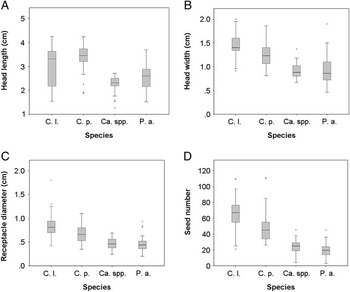
The flower head characteristics of the different host plants exploited by T. serratulae are summarised in Figure 4A–D. There were significant differences in all measured flower head parameters among the four plant species (Fig. 4). Carduus species had the smallest globular flower heads whereas Cirsium species had the largest and most globular ones. The flower heads of P. acarna were somewhat distinct being tubular, narrow but long, and surrounded by a distinct canopy of tough spines. In size, they were close to the flower heads of Carduus species, but longer and narrower at the top. They also enclosed the least number of seeds.
Boxplots of the flower head parameters of the different host plants of Terellia serratulae. (A) Head length (mm). (B) Head width (mm). (C) Receptacle width (mm). (D) Total number of seeds. χ2 values from Kruskal–Wallis test, 89.09 for head length, 127.22 for head width, 101.7 for receptacle width, and 157.5 for seed number. P<0.0001 for all measured flower head parameters among the four plant species. C. p., Cirsium phyllocephalum; C. l., Cirsium leucocephalum; Ca. spp., Carduus species; P. a., Picnomon acarna.

Morphometric variation in Terellia serratulae
Comparative morphometry of the adults
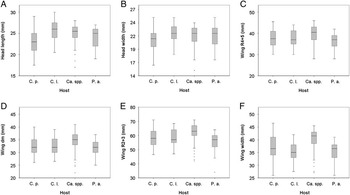
The head and wing measurements of T. serratulae reared from different plant hosts showed greater head size in the relatively larger flower heads of Cirsium leucocephalum (Fig. 5A–B) and greater wing size in Carduus species (Fig. 5C–F). The length of third radial cell R4+5 and discal medial cell dm were smaller in the relatively smaller flower heads of P. acarna; but they were quite variable in the small heads of Carduus species.
Boxplots of head and wing measurements (mm) of Terellia serratulae reared from different host plants. (A) Head length. (B) Head width. (C) Wing width. (D) Length of third radial cell (R4+5). (E) Length of discal medial cell (dm). (F) Length of the second radial cell (R2+3). C. p., Cirsium phyllocephalum; C. l., Cirsium leucocephalum; Ca. spp., Carduus species; P. a., Picnomon acarna.

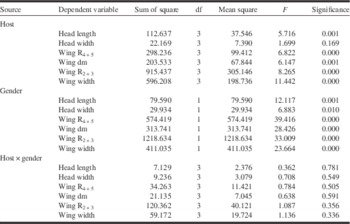
A MANOVA was performed to study the effect of host plant and gender on the head and wing parameters measured (Supplementary Table 1). The effect of the host plant was found to be significant for all parameters except head width. The analysis also revealed a significant effect for gender reflecting sexual dimorphism typical of Tephritidae, where the females are generally larger than the males (Boulétreau-Merle et al. Reference Boulétreau-Merle, Allemand, Cohet and David1982). However, the effect of host plant and gender combined was not significant (Table 2).
Results of the MANOVA analysis of the effect of host and gender on head and wing measurements for the different populations Terellia serratulae adults.
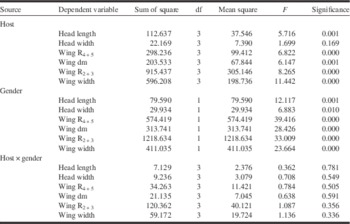
MANOVA, multivariate analysis of variance.
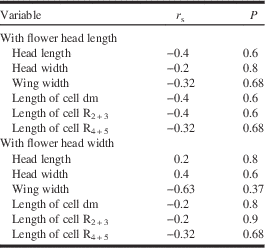
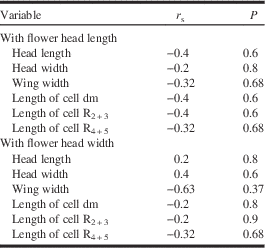
No significant correlations were detected between the means of any of the six body measurements and mean flower head length and width (Table 3). However, the correlations between each of head length and length of cell R2+3 with mean flower head length were moderate. Correlations with mean flower head width were moderate to strong in case of length of cell R4+5 and wing width, respectively.
Correlation between mean head and wing measurements and mean flower head size as measured by Spearman’s ρ correlation coefficient.
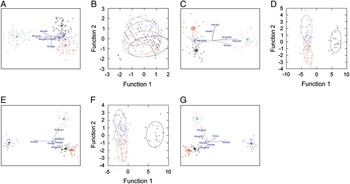
Canonical discriminant analysis using the six morphometric parameters measured on a total of 174 flies showed that the different host-associated populations clustered into four groups with flies associated with Carduus being distinct (Fig. 6A). Significant mean differences were observed (P<0.05) for all predictors on the dependent variable (host plant type) except head width (P=0.178). The analysis revealed that wing width and head length are most useful for discriminating the different populations of flies with nearly 70% accuracy. A biplot of individual flies on the discriminant dimensions was constructed to visually display the degree of separation of the different fly populations.
Biplots from the canonical discriminant analysis of different body parameters. (A–B) Analysis for both males and females. (C–D) Analysis for males alone. (E–F) Analysis for females alone. (G) Analysis for females alone but considering ovipositor length as an extra discriminating variable. In A, C, E, and G, calculated vectors of predictor variables are also shown. Circles represent the confidence intervals of the group centroid at 95% confidence level. In B, D, and F, sample confidence ellipses (P=0.68) are shown. Ο, Cirsium phyllocephalum; Δ, Cirsium leucocephalum; x, Picnomon acarna; +, Carduus species.

Canonical discriminant analysis was also carried out for females and males separately (Fig. 6C–G). For the males (n=77), significant mean differences were observed (P<0.05) for all predictors on the dependent variable (host plant type) except head width and discal medial cell length that yielded insignificant mean differences (P=0.116 and 0.051, respectively). Wing width and head length were most useful for differentiating the four populations of flies with nearly 78% accuracy (Fig. 6C–D). For the females (n=97), significant mean differences were observed (P<0.05) for all predictors on the dependent variable (host plant type) except head width, which yielded an insignificant mean difference (P=0.914). Wing width and head length were most useful in discriminating the populations of flies, with 72% accuracy (Fig. 6E–F).
Comparative morphometry of female terminalia
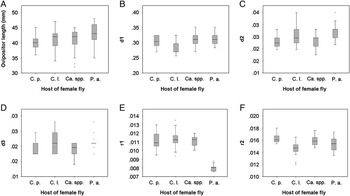
The ovipositor length varied according to the host plant exploited. It was longer in females reared from P. acarna (Fig. 7A). One-way ANOVA showed that the effect of host plant on ovipositor length was significant at the P<0.05 level (F=4.152, P=0.008) (Table 4). Correlation between mean ovipositor length of females reared from different plant hosts and mean flower head size was found to be strong but not statistically significant (r s=−0.8; P=0.2 and r s=−0.6; P=0.4, for correlation with flower head length and width, respectively).
Boxplots of Terellia serratulae reared from different host plants. (A) Ovipositor length (mm). (B) Ovipositor tip d1 measure. (C) Ovipositor tip d2 measure. (D) Ovipositor tip d3 measure. (E) Ovipositor tip ratio 1. (F) Ovipositor tip ration 2. C. p., Cirsium phyllocephalum; C. l., Cirsium leucocephalum; Ca. spp., Carduus species; P. a., Picnomon acarna.

The effect of different plant hosts on ovipositor length in Terellia serratulae females.

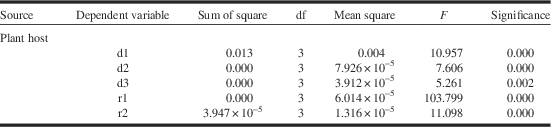
To further examine differences in ovipositor morphology among flies associated with the different host plants, measurements pertaining to ovipositor width, tip width and position of the sensillae, were taken (Supplementary Table 2, Fig. 7B–F) and statistically compared using MANOVA. All five measurements were statistically significantly different among females reared from different host plants (Table 5). The ovipositor tip was distinctly narrow in females reared from P. acarna, a possible adaptation to the tubular and narrow flower heads exploited (Fig. 7E).
Results of the MANOVA analysis on differences in ovipositor tip parameters for the different populations Terellia serratulae females.
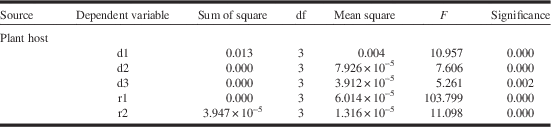
MANOVA, multivariate analysis of variance.
A canonical discriminant analysis restricted to female flies was conducted with ovipositor length added to the list of discriminating variables (n=95). Significant mean differences were observed (P<0.05) for all predictors on the dependent variable (host plant type) except head width (P=0.896). In this analysis, ovipositor length improved the discrimination among the four populations of female flies to 81% accuracy. The biplot reveals that when this parameter is added, flies associated with P. acarna and Carduus species were well discriminated whereas those associated with Cirsium species displayed some overlap (Fig. 6G).
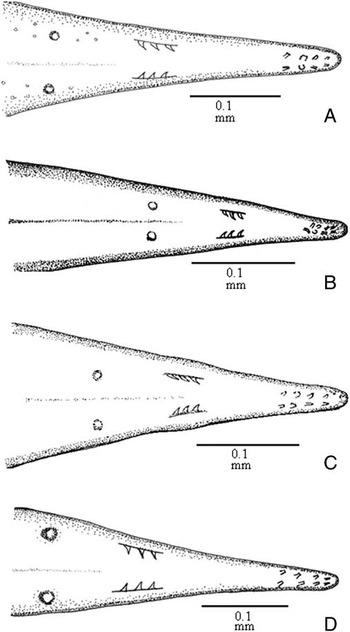
The morphometric studies conducted on the aculeus of each T. serratulae population revealed that their morphologies differed significantly, with the P. acarna-associated population being most distinct from the rest (Fig. 8). Post hoc comparisons indicated that the aculeus of P. acarna-associated flies has the smallest R1 and R3 ratios (P<0.05 for all comparisons), revealing that its ventrolateral grooves and circular chemosensillae are localised closest to the tip. Further comparisons revealed that the aculeus of P. acarna-associated flies has a significantly wider tip (larger mean d2) than that of C. phyllocephalum and Carduus species-associated populations (P<0.05). Post hoc comparisons using Tukey’s HSD also showed that the aculeus of flies associated with C. leucocephallum is smallest in width (smallest mean d1) and has the smallest R2 ratio (P<0.05) revealing that its chemosensillae and ventrolateral grooves lie closest to each other. Its aculeus also has the second smallest R3 ratio after P. acarna-associated flies reflecting that its round chemosensillae are also localised relatively close to the aculeus tip. Comparisons using Tukey’s HSD indicated that the aculeus tip of Carduus species-associated flies is significantly narrower (smaller mean d3) than that of C. leucocephallum and P. acarna-associated flies (P<0.05).
Ovipositor sketches of Terellia serratulae females emerging from the four different host plants. (A) Carduus pycnocephalus. (B) Picnomon acarna. (C) Cirsium leucocephallum. (D) Cirsium phyllocephalum.

mtDNA variation
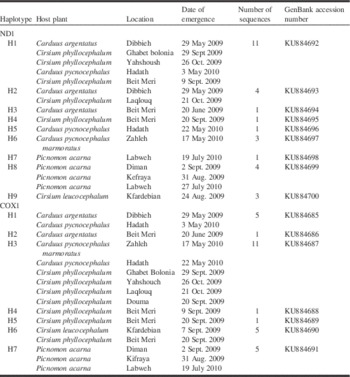
A 442 base-pair region of the mtND1 fragment (corresponding to RefSeq NC_001709 11951–12392) could be read in all 29 sequences and was used for comparison. Nineteen SNPs corresponding to nine haplotypes were observed (Table 6, Supplementary Table 3). For the mtCOXI fragment, a 546 base-pair region (corresponding to RefSeq NC_001709 1572–2114) could be read in all 29 sequences and was used for comparison. Twenty-four SNPs corresponding to seven haplotypes were observed (Table 6, Supplementary Table 4).
Haplotypes observed at the ND1 gene fragment and COX1 gene fragment.

Note: All samples were collected by the authors and voucher specimens deposited at the Natural History Museum, American University of Beirut, Lebanon.
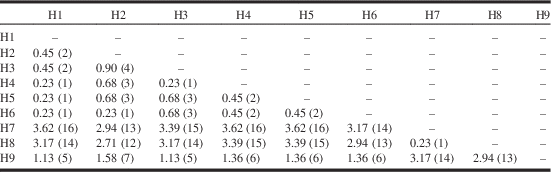
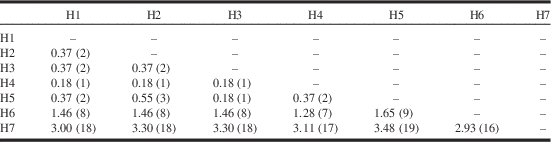
The ND1 haplotypes showing the most sequence divergence were haplotypes seven (P. acarna from Labweh) and eight (P. acarna from Diman, Kifraya, and Labweh), which were found to be very different from the other haplotypes, showing a per cent sequence divergence of 3.62% for H7 and 3.39% for H8 (Table 7). The COXI haplotype showing the most sequence divergence was haplotype 7 (P. acarna from Diman, Kifraya, and Labweh), which was found to differ significantly from other haplotypes, showing a per cent sequence divergence of 3.48% (Table 8). Results from both ND1 and COXI analysis therefore revealed that flies emerging from P. acarna seem genetically different from members of all other populations examined in this study.
Sequence divergence among the nine ND1 haplotypes (H1–H9).
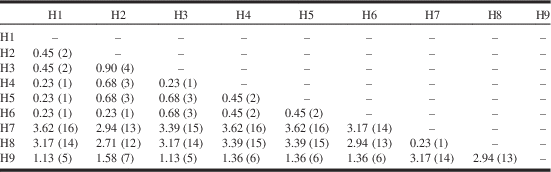
Note: Numbers indicate per cent nucleotide differences; numbers of nucleotide differences (SNPs) in parentheses.
Sequence divergence among the seven COX1 haplotypes (H1–H7).
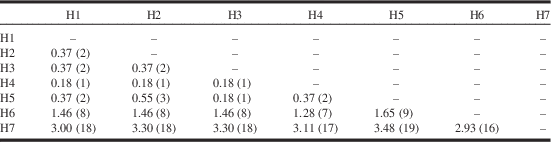
Note: Numbers indicate per cent nucleotide differences; numbers of nucleotide differences (SNPs) in parentheses.
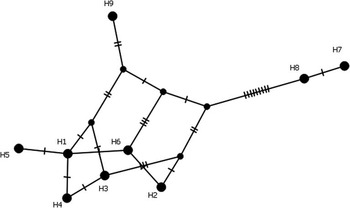
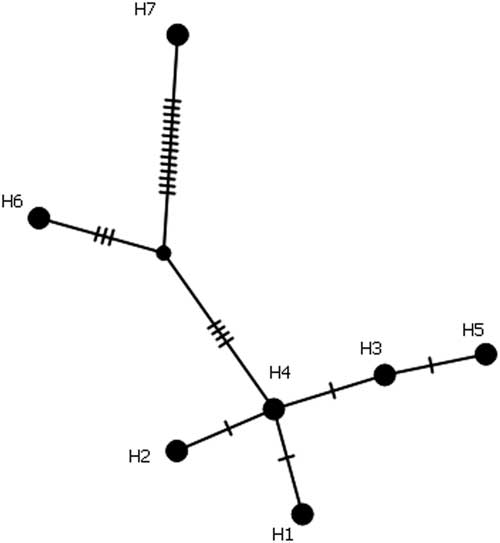
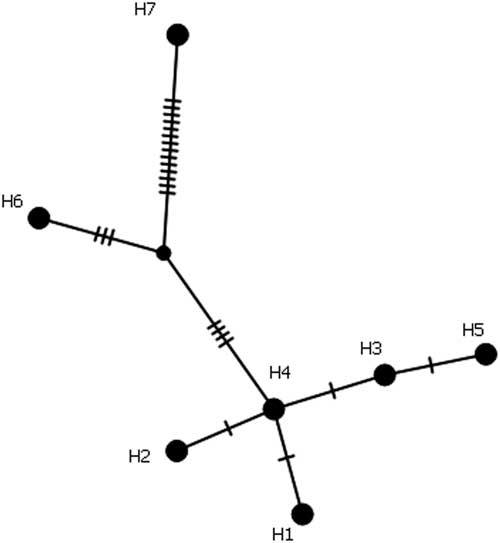
The ND1 haplotype network revealed that the two distinct haplotypes from P. acarna, H7 and H8, are close to each other and quite separate (at least 12 SNPs) from the bulk of the haplotypes (C. phyllocephalum and Carduus species). It also revealed that the haplotype from Cirsium leucocephalum (H9) is also distinct but closer to the bulk of the haplotypes (Fig. 9). The COXI haplotype network revealed two clusters of haplotypes (Fig. 10). The haplotype corresponding to flies reared from P. acarna (H7) seems to be relatively distinct from the rest of the haplotypes. Further work is needed to understand gene flow among flies from the different plant hosts.
ND1 haplotype network generated by integer neighbour joining. H1–H9 represent the haplotypes described in Table 6.

COXI haplotype network generated by integer neighbour joining. H1–H7 represent the haplotypes described in Table 6.
Discussion
The polyphagous fruit fly, T. serratulae, exploits the flower heads of thistles belonging to three genera in Lebanon. Its host plants bloom at different times, from early spring to fall, and they occur at different elevations (Knio et al. Reference Knio, Kalash and White2002). The species was found to consist of different populations, each adapted and closely associated with the phenology and physical attributes of its host.
Results suggest that intraspecific variation in ovipositor morphology and morphometry was associated with flower head dimensions, extent of seed packing, and flower head shape of each population’s host plant. Females reared from P. acarna had long ovipositors with blunt tips, whose chemosensillae were localised closest to the tip. These mechano-chemosensillae are used by the female to locate and assess the quality of a potential host plant for oviposition (Stoffolano Reference Stoffolano1989). As such, the ovipositor morphology of this population might reflect an adaptation of the female to its oviposition substrate. Picnomon acarna distinctively tubular flower heads are long, narrow, and surrounded by spines. They are loosely packed in comparison to the other host plants, and contain few seeds. The upper surface of the flower heads forms a very narrow platform making positioning difficult during egg laying; hence, the females need to curve the long ovipositor in order to place the eggs within the florets. This likely explains why the ovipositor of this population of flies was greatest in length. Furthermore, ovipositors need not be narrow to fit through the uncrowded flower heads of P. acarna, which may explain the blunt ovipositor tip of this fly population. In comparison, the large flower heads of C. leucocephallum have the widest receptacles and the greatest number of seeds, making them tightly packed. Females emerging from this host had the most slender ovipositors that were intermediate in length and tip width, and whose chemosensillae were localised close to each other. Zwölfer (Reference Zwölfer1972) suggested that female flies infesting large flower heads would need a narrow aculeus tip to oviposit their eggs deep within such a flower head. The ovipositor morphology of the C. leucocephallum-associated population is consistent with large, crowded flower heads of its host as reflected by its most slender ovipositors. The narrowest ovipositor tips were found in Carduus species-associated and C. phyllocephalum-associated flies, which neither differed in ovipositor length nor chemosensillae localisation.
Canonical discriminant analysis based on two head and four wing parameters, in addition to ovipositor length, separated T. serratulae females into three distinct clusters with 81% accuracy: one cluster for P. acarna-associated females, one for Carduus species-associated females, and one for C. leucocephallum and C. phyllocephalum-associated females. The results of the morphometric comparisons and the canonical discriminant analysis collectively reveal that ovipositors of flies associated with Cirsium species are similar whereas those of Carduus-associated flies and P. acarna-associated flies are distinct. Our data suggest that the females of each T. serratulae population have morphologically adapted to their hosts. Fletcher (Reference Fletcher1989) argued that non-frugivorous tephritids and their host plants co-evolve such that females acquire ovipositors that are optimally structured to deposit their eggs into the flower heads of their host plant. Zwölfer (Reference Zwölfer1988) also reported that the oviscapes of female tephritids of the genus Terellia correlate with the dimensions of the flower heads of their host plant. The difference in ovipositor morphology among the different T. serratulae populations demonstrates host adaptation and suggests possible reproductive isolation considering that the host plants differ in phenology. Intraspecific variation in ovipositor morphology related to host plant characteristics was also determined in two other tephritids in Lebanon: Chaetostomella cylindrica (Robineau-Desvoidy) and Terellia fuscicornis (Loew). The Onopordum illyricum (Linnaeus)-associated population of C. cylindrica had longer and blunter ovipositors than the population associated with Notobasis syriaca (Linnaeus), which was attributed to the larger flower head size of O. illyricum (Knio et al. Reference Knio, White and Al-Zein2007; Smith et al. Reference Smith, Al-Zein, Sayar and Knio2009). Similarly, the artichoke-associated population of T. fuscicornis had longer and blunter ovipositors than the population associated with Silybum marianum (Linnaeus), reflecting the larger flower heads of the artichoke host (Sayar et al. Reference Sayar, Smith, White and Knio2009).
In addition to the comparative morphometric studies, mitochondrial DNA sequencing revealed some genetic differentiation among the different T. serratulae populations, with the P. acarna-associated population being the most distinct. There was more than 3% divergence between some haplotypes. Hebert et al. (Reference Hebert, Cywinska, Ball and deWaard2003) proposed that any mitochondrial DNA sequences having a per cent sequence divergence of 2% or more are to be considered different species, though not all agree with this limit (Cognato Reference Cognato2006). In contrast to T. serratulae in Lebanon, its congener T. fuscicornis did not differ genetically at two mitochondrial genes (ND1 and COXI) and one nuclear gene (18S) studied, despite showing significant behavioural and morphometric variation. This genetic similarity was thought to be indicative of a recent host shift in T. fuscicornis (Sayar et al. Reference Sayar, Smith, White and Knio2009). However, in the case of the C. cylindrica, a 7.1% sequence divergence was determined among the two distinct host races studied, in addition to morphometric and behavioural variation; however, because this species is widespread in the western Palaearctic and seems to be a polymorphic complex of species and host races, a thorough study is needed before any taxonomic revision is undertaken (Knio et al. Reference Knio, White and Al-Zein2007; Smith et al. Reference Smith, Al-Zein, Sayar and Knio2009).
Together with the morphometric studies, the molecular data strongly support that the population of T. serratulae associated with P. acarna constitutes a distinct host race, possibly on its way to evolving into a separate species. Considering a rate of 0.8–1.6% change per one million years (Sharp and Li Reference Sharp and Li1989), we estimate that the mitochondrial lineage of the P. acarna-associated race diverged around 2.2–4.5 million years ago. Flies associated with C. leucocephallum, whose distribution is restricted to a few high elevation sites in Lebanon, were morphometrically differentiated from the rest of the populations. On the other hand, flies reared from Carduus species and C. phyllocephalum showed little morphometric and genetic variation as both hosts are widely distributed. Notably, in Lebanon, the Carduus species-associated population of T. serratulae is low in density (personal observation) and is the first of the fly populations to emerge, early in the spring. All other host plants of T. serratulae bloom in the summer and fall. In addition to some degree of temporal isolation, the different hosts of T. serratulae also have a diverse geographical distribution, though it must be noted that P. acarna and Carduus species existed in sympatry in Bekaa in April of 2010, and P. acarna, C. leucocephallum, and C. phyllocephalum were reported in sympatry in Faraya in September 2009. The case of T. serratulae meets three out of four criteria of host race formation proposed by Drès and Mallet (Reference Drès and Mallet2002) namely consistent host associations, sympatry, and genetic variation at more than one-gene locus. The extent of genetic variation is relatively low compared to other cases such as C. cylindrica, but that may be because the populations of T. serratulae have begun to diverge more recently. The fourth criteria, the persistence of gene flow, is yet to be investigated in order to clarify at what stage lies T. serratulae on the continuum of speciation.
Host adaptations and differences in host phenology are considered to contribute greatly to host race formation and speciation in phytophagous insects (Tauber and Tauber Reference Tauber and Tauber1989; Feder and Filchak Reference Feder and Filchak1999) and as such, the differences in flower head morphology and possibly in phenology of the plant hosts, in addition to the fact that T. serratulae may be univoltine, contribute considerably to host adaptation, host race formation, and potentially speciation. This is in accordance with Whipple et al. (Reference Whipple, Abrahamson, Khamiss, Heinrich, Urian and Northridge2009) who described phenological differences among host plants as “rich opportunities for speciation”.
Further studies should be conducted to elucidate the status of the P. acarna-associated population, which seems distinct. Our future studies will focus on the natural history and ecology of T. serratulae on P. acarna, and on the genetic structure of the Lebanese populations of this fly with the aim of clarifying whether the preliminary observed genetic differences are related to environmental factors or are specific host adaptations.
Acknowledgements
The authors would like to thank Ms. Narine Mardirossian for her assistance with molecular data and Dr. Riyad Sadek for his comments regarding the statistical analyses. This work was funded by the University Research Board, American University of Beirut, and the Lebanese National Council for Scientific Research.
Supplementary Material
To view supplementary material for this article, please visit http://dx.doi.org/10.4039/tce.2016.26