Introduction
Herbicide options for control of goosegrass in bermudagrass are limited. POST control options for goosegrass are extremely limited, with only a small number of effective herbicides available. One of these herbicides, topramezone (Pylex®, BASF Corporation, Research Triangle Park, NC), has shown excellent potential for control of mature goosegrass, even below labeled rates (Cox Reference Cox2013). Unfortunately, topramezone is a hydroxyphenylpyruvate dioxygenase (HPPD) inhibitor that leads to whitening or “bleaching” of the plant tissue when applied to bermudagrass (Anonymous 2018). This bleaching effect generally appears first on the newest tissue of any plants that are sensitive to the herbicide (Brewer et al. Reference Brewer, Willis, Rana and Askew2017; Goddard et al. Reference Goddard, Willis and Askew2010; Grossmann and Ehrhardt Reference Grossmann and Ehrhardt2007). Although the bleaching effects are noticeable on the overall aesthetic of bermudagrass, effects are short-lived and transient in nature, lasting on average 7 to 14 d (Brewer et al. Reference Brewer, Willis, Rana and Askew2017; Brosnan et al. Reference Brosnan, Kopsell, Elmore, Breeden and Armel2011; Cox Reference Cox2013; Cox et al. Reference Cox, Rana, Brewer and Askew2017; Elmore et al. Reference Elmore, Brosnan, Kopsell and Breeden2011a, 2011b). No matter how well a herbicide performs, turfgrass managers and their clientele often focus on a high level of aesthetics, and lengthy periods of bleaching or phytotoxicity on the desired grasses are discouraged.
Research performed at Auburn from 2015 to 2018 (Boyd et al. Reference Boyd, McElroy, Head and McCullough2016a) indicated that the chelated iron diethylenetriamine pentaacetic acid (FeDTPA; Sprint® 330, BASF, Research Triangle Park, NC), when mixed with topramezone, acted as a safener, reducing overall bleaching and recovery time of bermudagrass. Previous research also found that the mixture of chelated iron and other herbicides reduced the symptoms of phytotoxicity following application (Flessner et al. Reference Flessner, McElroy and McCurdy2017; Johnson and Carrow Reference Johnson and Carrow1995; Massey et al. Reference Massey, Taylor, Chambers, Coats and Henry2006; McCarty Reference McCarty1991; McCullough and Hart Reference McCullough and Hart2009; Price Reference Price1983), but topramezone was not tested in these studies. Further research conducted in 2016 showed that FeDTPA (0.1525, 0.305, 0.610, 1.22, 2.44 kg ai ha−1) combined with topramezone (6.15, 12.3 g ai ha−1) did not antagonize the efficacy of the herbicide for goosegrass control (Boyd et al. Reference Boyd, McElroy, Head and McCullough2016b). Two goosegrass biotypes were tested, and complete control was achieved across all rates of both FeDTPA and topramezone (Boyd et al. Reference Boyd, McElroy, Head and McCullough2016b). Because topramezone combined with FeDTPA has the potential to control goosegrass at different stages of maturity without a loss of efficacy, it is important to determine whether other iron sources may offer additional safening options. If other iron formulations performed comparably to FeDTPA, turfgrass managers would have more product options based on availability, formulation, and cost.
There are many different sources of iron used in plant nutrition, including sulfate, chelate, humate, oxide, and sucrate forms (Shaddox and Unruh Reference Shaddox and Unruh2018). Iron sulfate is a granular Fe source that is soluble in water and most effective when applied to foliage via foliar spray (Shaddox et al. Reference Shaddox, Fu, Gardner, Goss, Guertal, Kreuser, Miller, Stewart, Tang and Unruh2019; Yust et al. Reference Yust, Wehner and Fermanian1984). Due to its widespread use on golf courses and other high-maintenance turfgrass areas, it is the most common Fe source used (Shaddox and Unruh Reference Shaddox and Unruh2018). Chelated iron comes in many forms, including ethylenediaminetetraacetic acid (EDTA), DTPA, and ethylenediamine di-o-hydroxyphenylacetic acid (EDDHA) (Shaddox and Unruh Reference Shaddox and Unruh2018; Shaddox et al. Reference Shaddox, Unruh, Kruse and Restuccia2016). These formulations encapsulate the Fe ion within different organic complexes, protect against oxidation in the soil once the material is applied, and offer turfgrass response when applied to the foliage or to the soil. Other chelated iron formulations include glucoheptonates, gluconates, and citrates. Shaddox et al. (Reference Shaddox, Unruh, Kruse and Restuccia2016) demonstrated that these materials often enhance turf color but have little effect on soil Fe availability. Iron oxides are another possible Fe source and are 99.5% water insoluble (Shaddox and Unruh Reference Shaddox and Unruh2018). No previous research has shown that this material offers turfgrass response. Iron sucrate is a powdered Fe oxide that is pelletized and manufactured with a sugar compound (Shaddox and Unruh Reference Shaddox and Unruh2018). The prills that are created disperse readily in water, but the Fe sucrate molecule remains insoluble.
Research indicates that only Fe chelate forms remain soluble in the soil for any length of time (Shaddox et al. Reference Shaddox, Unruh, Kruse and Restuccia2016, Reference Shaddox, Fu, Gardner, Goss, Guertal, Kreuser, Miller, Stewart, Tang and Unruh2019). When Fe sulfate, glucoheptonate, polysaccharide, humate, oxide, or citrate was applied, the iron was insoluble within 1 h of application. Only FeEDTA, FeDTPA, or sodium ferric ethylenediamine di-o-hydroxyphenyl-acetate (FeEDDHA) remained soluble in the soil at 21 d after application (Shaddox et al. Reference Shaddox, Fu, Gardner, Goss, Guertal, Kreuser, Miller, Stewart, Tang and Unruh2019). Because some forms have limited residual solubility, this could affect the utility of various Fe forms as safening agents for topramezone.
Given the plethora of iron sources used in turfgrass management with clearly demonstrated differences in behavior (Shaddox et al. Reference Shaddox, Fu, Gardner, Goss, Guertal, Kreuser, Miller, Stewart, Tang and Unruh2019), it is of interest to examine Fe sources for their ability to safen topramezone. Thus, the objective of this work was to examine the effects of Fe sources for their ability to safen topramezone use on bermudagrass.
Materials and Methods
Studies were conducted over three 1-mo periods in August and September of 2016, 2017, and 2018. All studies were located at the Auburn University Turfgrass Unit in Auburn, AL (32.578°N, 85.499°W). For all trials, the soil type was a Marvyn sandy loam (fine-loamy, kaolinitic, thermic Typic Kanhapludult). Trials were 28 d in length, initiated in early or late August, and ended in September. In all, six trials were conducted: two each in 2016, 2017, and 2018. ‘Tifway’ hybrid bermudagrass [Cynodon dactylon (L.) Pers. × C. transvaalensis Burtt Davy] was used for all studies. Research areas were mowed at 2.5 cm to mimic conditions found on a golf course fairway. All mowing took place on 3-d intervals, and clippings were not removed. Research areas were observed to have a dense, healthy stand of bermudagrass and comparable turfgrass quality at the initiation of each trial. Mowing events were suspended for one day before and after each treatment application.
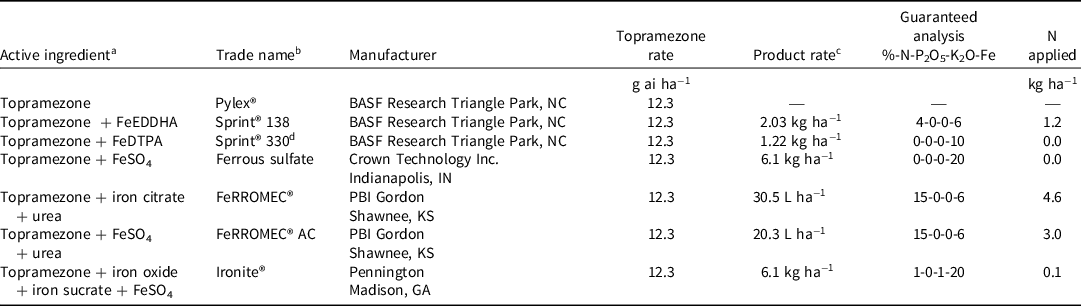
Foliar-applied treatments were made using a handheld four-nozzle boom fit with TeeJet® TP8002VS (TeeJet Spraying Systems, Roswell, GA) nozzles on 30.5-cm spacing and pressurized with a CO2 backpack cylinder calibrated to deliver 280 L ha−1. Topramezone was applied in combination with six different iron sources whose rates and vendor information are listed in Table 1. One of the products, iron oxide/sucrate/sulfate, is a granular source and was applied using a shaker can method over each designated plot in three to four directions. All treatments included methylated seed oil (MSO; Alligare, Opelika, AL) at 0.5% v/v. These treatments were compared with topramezone (12.3 g ai ha−1) applied alone and an untreated check. All treatments were applied once on the initial start date, and no additional applications of herbicide, fertilizer, or fungicide were made during the course of the trial.
List of treatments and rates used for topramezone + iron sources on bermudagrass in Auburn, AL, from 2016 to 2018.

a FeEDDHA, sodium ferric ethylenediamine di-o-hydroxyphenyl-acetate; FeDTPA, ferrous diethylenetriamine pentaacetic acid; FeSO4, ferrous sulfate.
b All treatments were mixed with methylated seed oil (Alligare, Opelika, AL) at 0.5% v/v in 1-L bottles.
c Product rates based on the Fe application rate of 1.2 kg ai ha−1.
d An earlier formulation of this product was used for experiments. This product has recently been reformulated to include 7% N.
Visually estimated bermudagrass symptoms of bleaching and necrosis were assessed at 5, 10, 15, 21, and 28 d after initial treatment (DAT). Bleaching was measured on a 0% to 100% scale, where 0% was defined as no observed bleaching and 100% as complete whitening of plant tissue. Necrosis was measured on a 0% to 100% scale, where 0% was defined as no observed tissue death and 100% was total death and browning of the plant tissue. Measures of clipping yield and normalized difference vegetation index (NDVI) were added in 2018 to further quantify treatment effects. Clipping yield was determined by mowing a swath down the center of each plot at 7 and 21 DAT. A Tru-Cut (Dolphin Outdoor Power Equipment, Pompano Beach, FL) reel mower that measured 50.8 cm in width was used at a height of 2.5 cm. Collected clippings were stored in paper bags and dried for a 48-h period at 60 C in a drying oven. Any debris determined to not be turf clippings (twigs, leaves, etc.) was discarded before weighing. Plots were mowed with a Toro Reelmaster® 3100 (The Toro Company, Bloomington, MN) set at 2.5cm between the collection periods, with all clippings being returned to the surface.
Spectral NDVI analysis was measured using a handheld multispectral radiometer (model ACS-430 Crop Circle, Holland Scientific, Lincoln, NE), which was attached to a three-wheeled golf push cart and mounted at a stationary height of 46 cm parallel to the ground. Reflectance measurements were collected at 0, 5, 11, 21, 28, and 35 DAT throughout 2018. The NDVI measurements were calculated using the following formula
 $${\rm{NDVI}} = {{{{\rm{R}}_{780}} - {{\rm{R}}_{670}}} \over {{{\rm{R}}_{780}} + {{\rm{R}}_{670}}}}$$
where R780 and R670 are designated as the measured reflectance of near-infrared (NIR) radiation (780 nm) and visible red radiation (670 nm), respectively (Bremer et al. Reference Bremer, Lee, Su and Keeley2011; Trenholm et al. Reference Trenholm, Carrow and Duncan1999). Reflectance readings were initiated at the center edge of each plot with approximately 50 readings being collected over the 1.5-m distance of linear travel.
The trial area measured 6 by 12 m, with individual 1.5 by 1.5 m experimental units. All trials had treatments arranged in a randomized complete block design with four replications. Data were subjected to ANOVA within PROC GLM, and means were separated using Tukey’s honestly significant difference test (P < 0.05) in SAS v. 9.4 (SAS Institute, Cary, NC).
Results and Discussion
Bleaching
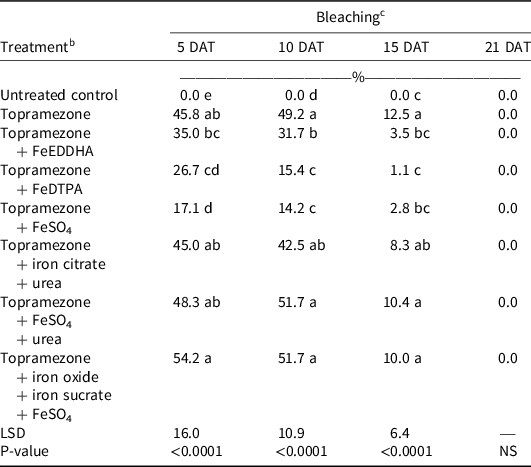
The treatment-by-run interaction (P = 0.98) and main effect of run (P = 0.45) were found to not be significant, while the main effect of treatment was highly significant (P < 0.0001). Data were pooled across all runs (Table 2).
Visual percentage of bleaching injury to ‘Tifway’ bermudagrass based on single applications of various iron + topramezone treatments. a

a Abbreviations: DAT, days after initial treatment; FeEDDHA, sodium ferric ethylenediamine di-o-hydroxyphenyl-acetate; FeDTPA, ferrous diethylenetriamine pentaacetic acid; FeSO4, ferrous sulfate.
b All treatments were mixed with methylated seed oil (Alligare, Opelika, AL) at 0.5% v/v in 1-L bottles.
c Results shown are pooled over six experiments conducted in Auburn, AL (2016–2018). Means with the same letter in the same column are not statistically different based on Tukey’s honestly significant difference test (α = 0.05).
Bleaching symptoms occurred at 5, 10, and 15 DAT and dissipated completely by the 21 DAT rating date for all treatments (Table 2). At 5 DAT, the treatments of FeDTPA or FeSO4 were the only applications that reduced the bleaching percentage below that of topramezone applied alone. The addition of FeDTPA reduced bleaching by 41%, while FeSO4 reduced it by 63% when compared with topramezone alone. At 10 and 15 DAT, applications of FeDTPA, FeEDDHA, and FeSO4 were the only treatments that reduced bleaching, when compared with topramezone applied alone (Table 2). At 10 DAT, additions of FeDTPA, FeSO4, and FeEDDHA reduced bleaching by 69%, 71%, and 36%, respectively. At 15 DAT, these three treatments were comparable to the untreated control, with no bleaching. Highest levels of bleaching at 5, 10, and 15 DAT occurred with the iron sucrate/oxide/sulfate, topramezone-only, Fe citrate/urea, and FeSO4/urea treatments. The iron oxide/sucrate/sulfate product (Ironite®, Pennington, Madison, GA) is predominantly made up of iron oxide, which has been shown to be insoluble within 24 h of soil application (Shaddox et al. Reference Shaddox, Fu, Gardner, Goss, Guertal, Kreuser, Miller, Stewart, Tang and Unruh2019) and thus would not be available for plant uptake. Due to soil application of this granular material, it is understandable why the bleaching ratings were so similar between topramezone applied alone and in combination with iron oxide/sucrate/sulfate.
Four of the sources contained nitrogen, which supplied 1.2, 4.6, 3.0, and 0.1 kg N ha−1, respectively, when the FeEDDHA (Sprint® 138, BASF, Research Triangle Park, NC), iron citrate (FeRROMEC®, PBI Gordon, Shawnee, KS), iron sulfate (FeRROMEC® AC, PBI Gordon, Shawnee, KS), and iron oxide/sucrate/sulfate (Ironite®) commercial sources were applied (Table 1). For summer application of N to bermudagrass these would be low rates of N compared with a typical application to a fairway of 24 to 49 kg N ha−1 (intended to last about 8 wk).
Although no increase in plant bleaching was observed when N was included, as compared with topramezone alone, the decrease in bleaching typically seen with FeSO4 was not observed in products that mixed FeSO4 and other iron sources (Ironite®) or FeSO4 and N (FeRROMEC® AC). When N was part of the FeSO4 (FeRROMEC® AC), bleaching was never reduced compared with the topramezone-only treatment, at any rating date. It appears that the inclusion of N at 3.0 kg ha−1 did inhibit the ability of FeSO4 to reduce bleaching. The only treatments that consistently reduced bleaching were the Fe chelates FeDTPA (all rating dates), FeEDDHA (10, 15 DAT), and FeSO4 without N (all rating dates).
The only treatment that maintained an average bleaching percentage below the acceptable injury threshold of 20% for the entirety of all trials was FeSO4 (Table 2). The FeDTPA treatment had bleaching above the threshold at 5 DAT, which decreased below 20% at 10 and 15 DAT, and was then equal to bleaching observed in the FeSO4 treatment. In this study, both of these products repeatedly showed safening when used in conjunction with topramezone on bermudagrass. Other researchers have shown similar results using mixtures of chelated iron and other herbicides (not topramezone) to suppress or conceal injury of grasses (Flessner et al. Reference Flessner, McElroy and McCurdy2017; Johnson and Carrow Reference Johnson and Carrow1995; Massey et al. Reference Massey, Taylor, Chambers, Coats and Henry2006; McCullough and Hart Reference McCullough and Hart2009).
Necrosis
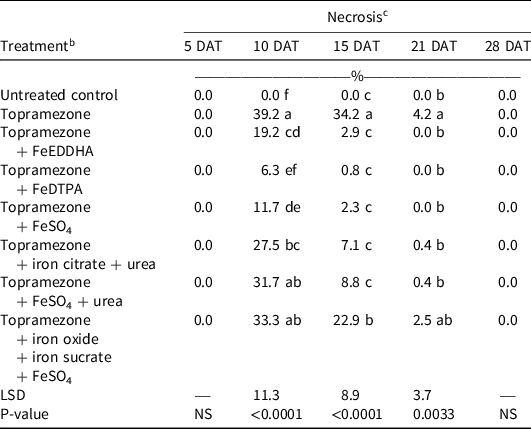
The treatment-by-run interaction (P = 0.827) and main effect of run (P = 0.343) were found to not be significant, while the main effect of treatment was found to be highly significant (P < 0.0001). Data were pooled across all runs (Table 3).
Visual percentage of necrosis injury to ‘Tifway’ bermudagrass based on single applications of various iron + topramezone treatments. a

a Abbreviations: DAT, days after initial treatment; FeEDDHA, sodium ferric ethylenediamine di-o-hydroxyphenyl-acetate; FeDTPA, ferrous diethylenetriamine pentaacetic acid; FeSO4, ferrous sulfate.
b All treatments were mixed with methylated seed oil (Alligare, Opelika, AL) at 0.5% v/v in 1-L bottles.
c Results shown are pooled over six experiments conducted in Auburn, AL (2016–2018). Means with the same letter in the same column are not statistically different based on Tukey’s honestly significant difference test (α = 0.05).
The first symptoms of necrosis were observed at the 10 DAT rating date across all trials (Table 4). At 10 DAT, only the bermudagrass treated with FeDTPA had necrosis comparable to necrosis measured in the untreated control. Most other bermudagrass had tissue damage greater than that observed in the untreated control. All the treatments, except for FeSO4/urea or iron oxide/sucrate/sulfate, reduced overall necrosis at 10 DAT when compared with topramezone applied alone (Table 3). At 15 DAT, all bermudagrass to which iron had been applied had reduced necrosis when compared with bermudagrass treated with topramezone applied alone. The topramezone-only and iron oxide/sucrate/sulfate treatments were the only ones that produced bermudagrass with injury above the 20% threshold (15 DAT). By 21 DAT, all treatments, excluding topramezone alone and iron oxide/sucrate/sulfate, had bermudagrass necrosis equal to that of the untreated control. All signs of necrosis had fully dissipated by 28 DAT (Table 3).
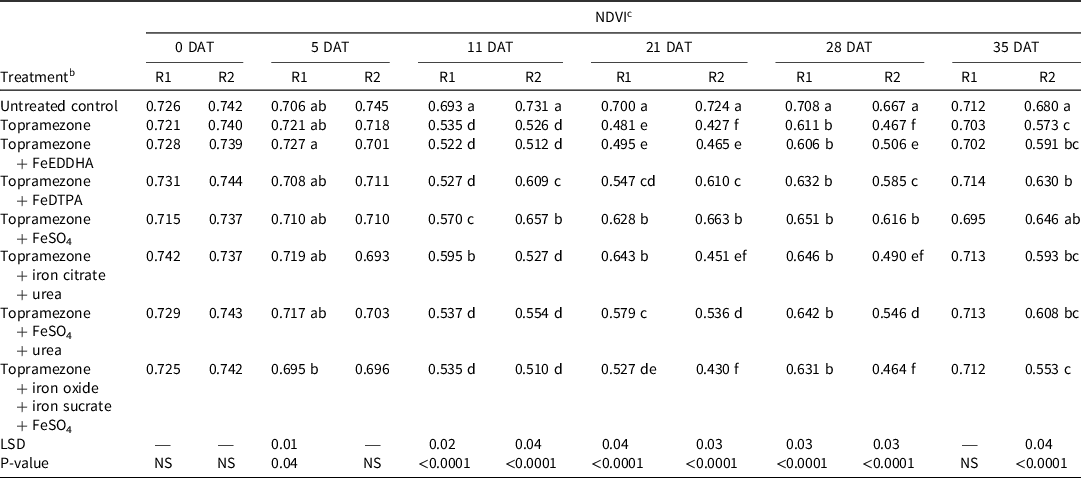
Spectral normalized difference vegetative index (NDVI) measurements of ‘Tifway’ bermudagrass based on iron + topramezone treatments. a

a Abbreviations: DAT, days after initial treatment; FeEDDHA, ferrous sodium ferric ethylenediamine di-o-hydroxyphenyl-acetate; FeDTPA, ferrous diethylenetriamine pentaacetic acid; FeSO4, ferrous sulfate.
b All treatments were mixed with methylated seed oil (Alligare, Opelika, AL) at 0.5% v/v in 1-L bottles.
c Results evaluated the treatment by run interaction for two experiments conducted during the months of August to September of 2018 in Auburn, AL. Means with the same letter in the same column are not statistically different based on Tukey’s honestly significant difference test (α = 0.05).
As for reduced bleaching, the most effective treatments for reduced necrosis in bermudagrass were the Fe chelates (both FeEDDHA and FeDTPA) and FeSO4 (Table 3). While the addition of iron citrate/urea also significantly reduced necrosis, the reduction was not as great as found with the FeDTPA or FeSO4 treatments.
As with the bleaching data, the addition of N to FeSO4 appears to negate the effectiveness of FeSO4 to safen topramezone. For example, at 10 DAT, the FeSO4/urea product (FeRROMEC® AC) produced necrosis equal to that observed in the topramezone-only treatment. Previous trial work reported that the addition of N increased overall injury when mixed with herbicides (Jordan et al. Reference Jordan, York and Corbain1989; Maschhoff et al. Reference Maschhoff, Hart and Baldwin2000), but additional necrosis was not observed in our study. The bermudagrass to which FeSO4 (no N) was applied had significantly less necrosis. It is likely that the applied N, at 3.0 kg N ha−1, was just enough to antagonize the safening ability of the FeSO4. This effect was short-lived. At 15 and 21 DAT, any product that had FeSO4 included was equally effective at reducing necrosis.
Normalized Difference Vegetation Index
The interaction of treatment by run and main effects of treatment and run were found to be significant (P = 0.0124, P < 0.0001, and P < 0.0001, respectively). Corresponding data are shown in Table 4. Because NDVI results were statistically different for Runs 1 and 2 of the 2018 trial periods, results will be discussed separately (Table 4).
For Run 1, minor differences in NDVI appeared at 5 DAT. The greatest differences in NDVI response appeared at 11, 21, and 28 DAT, when all treatments receiving topramezone (with or without an iron additive) provided lower NDVI readings than those measured in the untreated control (Table 4). At 11 DAT, higher NDVI measurements were recorded on bermudagrass receiving either iron citrate/urea or FeSO4 when compared with topramezone applied alone. The iron citrate/urea treatment had the highest N rate (4.6 kg N ha−1) applied with that product, and a slight and short-term darkening in turf color would be expected. At 21 DAT, FeDTPA, iron citrate/urea, FeSO4/urea, and FeSO4 all resulted in higher NDVI readings than observed in bermudagrass treated with topramezone alone. Bermudagrass treated with FeSO4, or iron citrate/urea had the highest NDVI readings. By 28 DAT, all bermudagrass receiving topramezone had lower NDVI readings than those measured in the untreated control, regardless of iron or N inclusion. By 35 DAT, no differences due to treatment were found (Table 4).
For Run 2, no differences were observed until 11 DAT (Table 4). All bermudagrass receiving topramezone, with or without an iron additive, had lower NDVI readings at 11, 21, and 28 DAT when compared with the untreated control. By 11 DAT, bermudagrass that received topramezone combinations that included FeDTPA or FeSO4 had higher NDVI readings than those found in the topramezone-only treatments. At 21 and 28 DAT, topramezone combinations with FeEDDHA, FeDTPA, FeSO4/urea, and FeSO4 all produced higher NDVI readings in bermudagrass than those measured when topramezone was applied alone (Table 4). By 35 DAT, the FeSO4 or FeDTPA applications were the only treatments that produced bermudagrass with higher NDVI readings. These two treatments produced bermudagrass with higher NDVI readings than those measured in the topramezone-only treatments on 5 of 8 rating dates (FeDTPA) and 6 of 8 rating dates (FeSO4) across both runs (Table 4).
To better understand what these NDVI readings convey, it is important to discuss what the device is measuring. The spectral radiometer measures radiative and spectral differences associated with the red and NIR wavelengths, and it produces a number from −1 to +1 (Bremer et al. Reference Bremer, Lee, Su and Keeley2011). When measuring an area of turfgrass, values often range from 0.2 to 0.5 for bare ground, varying stages of dormancy, moisture content, and injury or necrosis, while values of 0.5 to 0.9 indicate turfgrass with varying levels of plant health and chlorophyll content (Bell et al. Reference Bell, Howell, Johnson, Raun, Solie and Stone2004; Bremer et al. Reference Bremer, Lee, Su and Keeley2011; Goodin and Henebry Reference Goodin and Henebry1998; Stiegler et al. Reference Stiegler, Bell, Maness and Smith2005). The red wavelength is part of the visible light spectrum and is influenced by the presence of chlorophyll (Gausman Reference Gausman1977). High chlorophyll content in the plant tissue translates to a lower reflectance value of the red wavelength and a higher reflectance value of NIR, which results in a higher NDVI value. Because more of the red-light spectrum is absorbed, the plant tissue appears green to the human eye. Alternatively, low chlorophyll content will reflect higher levels of the red-light spectrum and lower levels of NIR, which results in a lower NDVI value and a brown or yellowish appearance (Bremer et al. Reference Bremer, Lee, Su and Keeley2011; Karcher and Richardson Reference Karcher and Richardson2003; Trenholm et al. Reference Trenholm, Carrow and Duncan1999).
Previous research has determined that topramezone application to bermudagrass results in visually unacceptable injury due to the destruction of carotenoid and chlorophyll pigments within the leaf tissue (Brosnan et al. Reference Brosnan, Kopsell, Elmore, Breeden and Armel2011; Cox Reference Cox2013; Cox et al. Reference Cox, Rana, Brewer and Askew2017; Elmore et al. Reference Elmore, Brosnan, Kopsell and Breeden2011a, 2011b). These findings corroborate the results of our trial and help to explain the differences observed in our work. Previous trials have all reported that the symptoms associated with topramezone are transient and short-lived, which our findings also substantiate.
Overall, our results indicated that inclusion of FeSO4 or FeDTPA offered superior safening when applied in combination with topramezone on bermudagrass. The iron citrate/urea and FeSO4/urea products both aided in recovery, but higher initial injury should be expected. The iron oxide/sucrate/sulfate product was ineffective in reducing injury associated with topramezone application when applied concurrently with the herbicide.
Acknowledgments
The authors would like to thank Kathie Kalmowitz and her team at BASF for the donation of topramezone and Sprint®138 and 330 products. Without their continued support this research would not have been possible. David Lawrence and his crew at the Auburn University Turfgrass Research Unit in Auburn supplied the turfgrass areas needed for multiple years of research. Also, thanks go to Jeff Buckner at Crown Industries and Alan Estes and Scott Wanzor at PBI Gordon for their donation of products for this research. No conflicts of interest have been declared.