Introduction
Impaired social functioning is a prominent characteristic of schizophrenia, which not only affects the patient's quality of life (as well as that of the family), but also may impede psychosocial and psychoeducational interventions. Social deficits may precede the first psychotic episode and worsen over the course of the disease (Bellack, Morrison, Wixted, & Mueser, Reference Bellack, Morrison, Wixted and Mueser1990). In addition, problems in social functioning have been found in persons who have a biological relative with this disorder (Dworkin et al., Reference Dworkin, Cornblatt, Friedmann, Kaplansky, Lewis, Rinaldi and Erlenmeyer-Kimling1993), suggesting that it reflects a trait, rather than a state characteristic of schizophrenia.
Given the importance of social functioning in schizophrenia, it is critical to understand the factors that may underlie deficits in this area. The isolation of these factors may direct effective therapeutic interventions, improving treatment outcome. While several studies have suggested that cognitive deficits in schizophrenia may account—at least partially—for patients’ impaired social functioning (Addington & Addington, Reference Addington and Addington2000; Green, Reference Green1996; Penn, Mueser, Spaulding, et al., Reference Penn, Mueser, Doonan and Nishith1995), others have failed to establish a robust relationship between neurocognition and social or community functioning in patients with schizophrenia (Bâ, Zanello, Varnier, Koellner, & Merlo, Reference Bâ, Zanello, Varnier, Koellner and Merlo2008; Bozikas, Kosmidis, Kafantari, et al., Reference Bozikas, Kosmidis, Kafantari, Gamvrula, Vasiliadou, Petrikis and Karavatos2006; Dickinson & Coursey, Reference Dickinson and Coursey2002). The failure to explain adequately impaired social functioning in light of neurocognitive deficits has led researchers to expand their explorations into the domain of Theory of Mind (ToM) as a potential factor influencing social interactions.
ToM is considered a component of social cognition and refers to our ability to attribute mental states such as desires, beliefs, and intentions to others, allowing us to predict, explain and potentially influence others’ behavior (Leslie, Reference Leslie1987). Its development in healthy children shows a trajectory of step-wise attainment, with the understanding of others’ intentions and desires as different from one's own manifesting earliest, followed by the ability to distinguish between real and pretend situations, then awareness of the difference between one's own beliefs and those of others, and culminating in the ability to recognize another's intention for giving (apparently) false information (e.g., jokes, irony, lies) (for a review, see Brüne & Brüne-Cohrs, Reference Brüne and Brüne-Cohrs2006). It follows logically, then, that intact ToM should play a role in appropriate adult social behavior, that is, adjusting behavior to match the social context based on social cues. In contrast, impaired ToM in an adult would be expected to lead to a breakdown in communication, causing misperceptions and misinterpretations, with adverse effects in a variety of adult social domains, such as interactions with family, friends or co-workers.
Numerous studies have supported the hypothesis of impaired ToM in patients with schizophrenia (Harrington, Langton, Siegert, & McClure, Reference Harrington, Langton, Siegert and McClure2005; Sarfati & Hardy-Bayle, Reference Sarfati and Hardy-Bayle1999; Shamay-Tsoory, Shur, Harari, & Levkovitz, Reference Shamay-Tsoory, Shur, Harari and Levkovitz2007). Some also investigated the relationship between ToM deficits and clinical characteristics proposing an association of ToM deficits with positive symptoms (Frith, Reference Frith1992; Harrington et al., Reference Harrington, Langton, Siegert and McClure2005). In contrast, subsequent studies reported contradictory findings, suggesting either no clinical associations with psychotic symptoms (Drury, Birchwood, & Robinson, Reference Drury, Birchwood and Robinson1998), or a relationship between ToM deficits and negative symptoms (Langdon, Coltheart, Ward, & Catts, Reference Langdon, Coltheart, Ward and Catts2001). Similarly, several studies have explored the relationship between ToM and cognitive functions (Greig, Bryson, & Bell, Reference Greig, Bryson and Bell2004; Janssen et al., Reference Janssen, Krabbendam, Jolles and van Os2003), yielding contradictory findings: some studies reported a relationship between ToM deficits and deficient performance on measures of executive functioning (Brüne, Reference Brüne2005), or on measures of memory and attention (Drury et al., Reference Drury, Birchwood and Robinson1998; Greig et al., Reference Greig, Bryson and Bell2004), while others failed to find any associations between ToM and particular cognitive functions (Janssen et al., Reference Janssen, Krabbendam, Jolles and van Os2003; Langdon, Coltheart, Ward, & Catts, Reference Langdon, Coltheart, Ward and Catts2001, Reference Langdon, Coltheart, Ward and Catts2002).
More recently, several investigators explored the relationship between impaired ToM and the social difficulties often demonstrated by patients with schizophrenia. The majority of these studies reported a significant relationship between ToM abilities and measures of social competence or community functioning (Brüne, Reference Brüne2005; Mazza, De Risio, Tozzini, Roncone, & Casacchia, Reference Mazza, De Risio, Tozzini, Roncone and Casacchia2003; Pijnenborg et al., Reference Pijnenborg, Withaar, Evans, van den Bosch, Timmerman and Brouwer2009; Schenkel, Spaulding, & Silverstein, Reference Schenkel, Spaulding and Silverstein2005). It is not yet clear, however, how these factors interact with each other or what other factors (such as clinical symptoms and cognitive functions), if any, mediate this relationship. At least one investigation reported the predictive ability of ToM impairment with respect to poor social competence above and beyond neuropsychological dysfunction and illness related factors (Brüne, Abdel-Hamid, Lehmkämper, & Sonntag, Reference Brüne, Abdel-Hamid, Lehmkämper and Sonntag2007). Similarly, other investigators found that patients’ capacity to understand the mental states of others was a good predictor of their level of social competence, in combination with clinical characteristics and certain cognitive functions, such as working memory and verbal fluency (Bora, Eryavuz, Kayahan, Sungu, & Veznedaroglu, Reference Bora, Eryavuz, Kayahan, Sungu and Veznedaroglu2006; Pollice et al., Reference Pollice, Roncone, Falloon, Mazza, DeRisio, Necozione and Casacchia2002), or even a better predictor than cognitive status (Pinkham & Penn, Reference Pinkham and Penn2006). Only in one study did the investigators endorse a model showing a greater influence of neurocognitive dysfunction than of social cognition on social discomfort related to functional outcome (Bell, Tsang, Greig, & Bryson, Reference Bell, Tsang, Greig and Bryson2009), suggesting that neurocognitive functioning was a better predictor of job outcome than ToM. Finally, another study (Bâ et al., Reference Bâ, Zanello, Varnier, Koellner and Merlo2008) suggested that ToM measures were not related to impaired social interactions at all; instead, psychotic symptoms and performance on a verbal memory task predicted impaired social interactions in their patients with schizophrenia.
Potential differences in the assessment tools used in each of the aforementioned studies to measure social competence and ToM may account for some of the discrepancies in the literature, as well as the limited scope of some of the reported findings. In many studies, social abilities were measured through social behavior scales rated by nursing staff or relatives (Bâ et al., Reference Bâ, Zanello, Varnier, Koellner and Merlo2008; Brüne et al., Reference Brüne, Abdel-Hamid, Lehmkämper and Sonntag2007; Pollice et al., Reference Pollice, Roncone, Falloon, Mazza, DeRisio, Necozione and Casacchia2002), while in others, more interactive tasks were used, such as role plays (Pinkham & Penn, Reference Pinkham and Penn2006). Similarly, different ToM tests were administered in each study, often limited to a particular aspect of ToM, further reducing the comparability of the studies. Divergent findings may also be attributed to intervening variables, such as neuropsychological dysfunction and clinical pathology, as well as to the way in which these were assessed.
Given the aforementioned inconsistencies in the literature, our primary aim in undertaking the present study was to explore the impact of potential ToM deficits on social competence in a group of patients with schizophrenia. In contrast to most previous studies, we explored several components or subcategories of ToM, so as to determine which of these might account for patients’ interpersonal difficulties and which might not. In particular, we explored the attribution of intentions and desires, as well as the comprehension of hinting, of 1st and 2nd order false beliefs and of 1st and 2nd order deception. Based on the order of development of the subcomponents of ToM, we expected differential impairment in ToM in adult patients with schizophrenia, reflecting increased difficulties in those abilities typically acquired last in healthy individuals and which are more complicated (e.g., comprehension of deception and of false belief), while leaving intact those abilities typically acquired first in healthy individuals and which are more straightforward (e.g., comprehension of intention and desire). We also included performance on neuropsychological tasks that we presumed to be relevant to ToM in general—and to our ToM tasks specifically (executive functioning, working memory, language, visuospatial tracking, and attention), clinical variables (duration of illness, positive and negative psychotic symptoms) and demographic characteristics (age and level of education) to broaden the scope of the investigation and explore potential relationships between each of these factors and social competence. As for our assessment of social competence, we chose to use role plays as a more ecologically valid measure of social interactions than behavior rating scales. Role-play tests—both standardized (Donahoe et al., Reference Donahoe, Carter, Bloem, Hirsch, Laasi and Wallace1990; Patterson, Moscona, McKibbin, Davidson, & Jeste, Reference Patterson, Moscona, McKibbin, Davidson and Jeste2001; Sayers, Bellack, Wade, Bennett, & Fong, Reference Sayers, Bellack, Wade, Bennett and Fong1995) and not—have been used widely in studying social competence in schizophrenia (Mueser et al., Reference Mueser, Doonan, Penn, Blanchard, Bellack, Nishith and DeLeon1996; Penn, Mueser, Doonan, et al., Reference Penn, Mueser, Doonan and Nishith1995; Penn, Mueser, Spaulding, et al., Reference Penn, Mueser, Spaulding, Hope and Reed1995), as they offer an opportunity for systematic observation and scoring of social behaviors, including nonverbal and paralinguistic responses, in several social domains. We expected ToM abilities would contribute to patients’ social interactions to a greater extent than other neuropsychological and clinical factors.
Methods
Participants
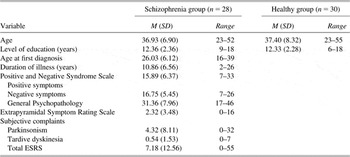
We assessed 28 patients with schizophrenia (22 men) and 30 healthy participants (24 men). The two groups did not differ in terms of age [t(56) = .234; p = .816], level of education [t(56) = –.039; p = .696] and sex ratio [χ 2(1) = 0.018; p = .893]. The patients were recruited from the acute ward of two university psychiatric departments, shortly before discharge. Healthy controls were recruited from the community (and were included in the present study for the purpose of confirming that our patient group is indeed representative of most patients in that they have the expected cognitive impairment on neuropsychological tests, as well as on ToM measures). All participants gave their consent to participate in the study and were treated in accordance with the Helsinki Declaration as well as the Code of Ethics in the Conduct of Research of the Aristotle University of Thessaloniki.
All patients met DSM-IV criteria (American Psychiatric Association, 1994). Diagnosis was confirmed with the Greek version (translation-adaptation to the Greek language by S. Beratis) of the Mini-International Neuropsychiatric Interview (4.4) (MINI) (Sheehan et al., Reference Sheehan, Lecrubier, Sheeman, Amorim, Javans, Weiller and Dunbar1998). Patients were being treated with antipsychotic medication at the time of the study: 20 with atypical antipsychotics, five with a combination of two atypical antipsychotics, two with typical antipsychotics and one with a combination of atypical and typical antipsychotics. Anticholinergic drugs were administered to 10 patients and benzodiazepines to nine patients.
Exclusion criteria for the patient group were the following: non-native speakers of the Greek language, a history of neurological or developmental disorders, head injury with a loss of consciousness for more than 10 min, recent substance abuse (in the last 6 months), as well as a co-morbid psychiatric disorder, or a medical disorder which might compromise cognitive performance. For the healthy control group, an additional exclusion criterion was a history of a psychiatric disorder.
We assessed symptom severity (positive symptoms, negative symptoms, and symptoms of general psychopathology) of the patients with schizophrenia with the Greek version (Lykouras, Botsis, & Oulis, Reference Lykouras, Botsis and Oulis1994) of the Positive and Negative Syndrome Scale (PANSS) (Kay, Fiszbein, & Opler, Reference Kay, Fiszbein and Opler1987). Rating of the PANSS was based on the Greek version (Lykouras et al., Reference Lykouras, Botsis and Oulis1994) of the Structured Clinical Interview for PANSS (SCI-PANSS) and while blind to neuropsychological performance. Extrapyramidal symptoms were assessed with the Extrapyramidal Symptom Rating Scale (ESRS) (Chouinard, Ross-Chouinard, Annable, & Jones, Reference Chouinard, Ross-Chouinard, Annable and Jones1980). Demographic characteristics of the two groups and patients’ clinical data are presented in Table 1.
Demographic and clinical characteristics of the two groups

Procedure
Role plays
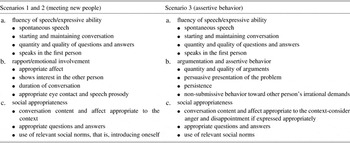
We assessed patients’ social competence through a series of role plays (healthy controls were not given role plays, as we expected minimal variability in their performance and a ceiling effect on such a task). We used three role play scenarios adjusted from Bellack, Mueser, Douglas, and Bennett (Reference Bellack, Mueser, Douglas and Bennett1981) and Patterson et al. (Reference Patterson, Moscona, McKibbin, Davidson and Jeste2001): in the first scenario, the participant was instructed to meet a new neighbor who just moved in next to his/her apartment. In the second scenario, the participant was asked to meet with his/her landlord and persuade him/her to fix a plumbing problem. In the last scenario, the participant was supposed to be in a new job, trying to get to know one of his/her coworkers (i.e., 3rd role play scenario: “You started a new job last week, but haven't met all your coworkers yet. Today, at the coffee shop at work, you see one of your coworkers coming in to buy coffee. You have decided to introduce yourself to him/her.”).
After receiving a thorough explanation of the procedure, patients watched a videotaped sample role play on a computer screen. Once this was over, they were asked to give their consent to be videotaped during their own role plays. Patients were informed that only two other persons would watch the videotaped scenarios for scoring reasons. They were also informed that they could stop the procedure at any point, if they did not feel comfortable with it.
The standard role play procedure was the following: participants were instructed to get involved in each scenario as actively as possible, until the examiner ended the scenario. The duration for each scenario was approximately three minutes; the experimenter was responsible for starting and ending each role play. The experimenter used a standard list of questions and answers for all participants to ensure the consistency of the procedure across patients and enable an objective scoring scheme.
Each scenario was scored according to three criteria on a three-point scale as follows: zero points for a completely absent behavior/utterance, one point if the behavior was apparent in some way, but inadequate/inappropriate and two points if the participant's behavior was appropriate for the criterion, thus yielding a maximum score of 2 for each criterion × 3 scenarios, or a total maximum score of 6 for each patient. The scoring criteria for each scenario were based on a pilot study including the role plays of twenty healthy volunteers; the specific criteria are presented in Table 2. The videotaped role plays were scored independently by two raters and their scores were added to each other, yielding one score for each criterion. Shapiro-Wilk tests of normality indicated that each rater's total score, as well as the sum of the two raters’ scores, were normally distributed (1st rater: p = .329, 2nd rater: p = .122, total score: p = .332). Intraclass correlation coefficients revealed a very high level of inter-rater reliability (alpha = .937). Therefore, we used one score for each patient in subsequent analyses, the sum of the three criteria (e.g., 2 + 2 + 2 = 6) summed across the two raters (e.g., 6 + 6 = 12) for the three scenarios (e.g., 12 + 12 + 12 = 36). The internal reliability of the criteria/items was very high (Cronbach's alpha = 0.90).
Scoring criteria for the three role play scenarios

Theory of Mind
We developed new ToM paradigms (cartoon and verbal stories) that were appropriate for the Greek population and language.
Cartoon stories
This cartoon test comprised 22 cards depicting short stories. Participants had to choose which of the alternative cards for each story provided a logical ending.
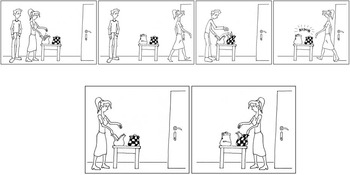
– 1st order false belief: four stories required 1st order ToM (i.e., indicating how the protagonist will act, based on the fact that he/she had a false belief regarding the situation). Figure 1 depicts an example of an item on this task.
Fig. 1Example of an item on the Cartoon “Theory of Mind” (ToM) task: In which bag will the woman look for her mobile phone?

– Attribution of intention: six stories required attribution of intention (i.e., indicating what the protagonist is thinking of doing).
– Attribution of desire: six stories required attribution of desire (i.e., indicating what the protagonist is going to do after perceiving another person's desire).

The remaining six stories depicted simple stories requiring participants to choose the final event in the sequence without the need for mentalizing on their part. These stories were included as control items, to ensure story comprehension. Scores reflect the percentage of correct responses. The internal reliability of the items was moderately high (Cronbach's alpha = 0.66).
Verbal stories
Comprehension of hinting: This task comprised six short stories involving two characters, in each of which the scenario ended with one character dropping a very obvious hint (Corcoran, Mercer, & Frith, Reference Corcoran, Mercer and Frith1995). Participants were asked what the character really meant by what he or she said. An appropriate response was given a score of 2. If the participant failed, the examiner gave a more obvious hint; after this, a correct answer was given a score of 1. The internal reliability of the items of this test was moderately high (Cronbach's alpha = 0.75). An example follows:
Example 1 Mary opened the door to leave home. Helen yelled: “Someone has forgotten to take out the garbage.” Q: What did Mary mean?
Comprehension of false belief
○ 1st order: Four stories tested participants’ ability to infer that the protagonist holds a mistaken belief, despite the participants’ knowledge of the true situation (Frith & Corcoran, Reference Frith and Corcoran1996). The participant was asked questions relating to the beliefs of the protagonist in the scenario. These included a “reality” question and a “belief” question. The reality question ensured that the participant had comprehended the story correctly, while the belief question required an understanding of the protagonist's mental state. If the participant answered the reality question incorrectly, we skipped the belief question and proceeded to the next story. Scores were converted to percentage of correct responses to enable a direct comparison of the “belief question” and the 2nd order condition. The internal reliability of the items of this task was moderately high (Cronbach's alpha = 0.70).
○ 2nd order: Four stories tested participants’ ability to understand what one of the protagonists thinks about what the second protagonist thinks (Frith & Corcoran, Reference Frith and Corcoran1996). The participant is then required to report not only each person's belief about a situation, but also the second protagonist's mistaken belief about the first protagonist's belief state. As in the 1st order false belief task, participants were asked a question regarding the reality of the situation and a question regarding belief. If the participant answered the reality question incorrectly, we skipped the belief question and proceeded to the next story. Scores on the “belief question” were transformed into a percentage of correct responses only from those scenarios on which the participants answered the reality questions correctly. The internal reliability of the items of this task was moderately high (Cronbach's alpha = 0.63). An example follows:
Example 2 Chris sets his phone on the coffee table and leaves the living room. Rena wants to set her coffee on the table, so she takes the phone and places it on the couch. Chris sees this from the next room. A few minutes later, he returns to the living room to find his phone.
• Where will Chris look for his phone?
• Where does Rena believe that Chris will look for his phone?
Comprehension of deception
○ 1st order: One story assessed participants’ ability to realize that a character in the story was giving false information to another character to achieve a particular goal.
○ 2nd order: One story assessed participants’ ability to realize that a character was ignoring false information because he knew that the other character, who was giving the false information, was trying to deceive him (Frith & Corcoran, Reference Frith and Corcoran1996). For both stories, participants were required to infer how the person being deceived will respond and justify this person's thoughts. A score of 1 was given for a correct answer. An example follows:
Example 3 Steve has just robbed a bank and he is fleeing from the police when he runs into his brother, Van. Steve says to Van: “Don't let the police find me” and he runs and hides in a church. The police have searched everywhere for Steve, except the church and the park. When they see Van, they ask him: “Is Steve in the park or in the church?” But they recognize Van and suspect that he will try to protect his brother. They expect him to lie to them, so they intend to search the place other than the one he indicates. But Van is smart and determined to save his brother, and he knows that the police will not trust him.
• Where is Steve really hiding?
• Where will Van tell the police to look for Steve, in the church or in the park and why?
Neuropsychological functioning
We administered a battery of neuropsychological tests to assess the following cognitive domains, which we considered potentially related to ToM abilities in general and which we presumed would play a role in responding to our particular ToM tasks:
• Executive functioning: Wisconsin Card Sorting Test (WCST-64 cards) (Heaton et al., Reference Heaton, Gur, Mandal, Salloum, Gur and Scheider1993), percent of perseverative responses; Trail Making Test-Part B (Armitage, Reference Armitage1946; Vlahou & Kosmidis, Reference Vlahou and Kosmidis2002), time to completion; Stroop Test (word-color condition) (Stroop, Reference Stroop1935; Zafiri & Kosmidis, Reference Zafiri and Kosmidis2008), number of responses.
• Working memory: Digit Span (backward) (WAIS-III; Wechsler, Reference Wechsler1997), number of items correct
• Attention: Digit Span (forward), number of items correct; Stroop Test (word and color conditions), number of responses
• Visual scanning and psychomotor speed: Trail Making Test-Part A, time to completion
• Language: Vocabulary (WAIS-III), total raw score
To decrease the number of neuropsychological variables in subsequent analyses, we first conducted a factor analysis. This analysis yielded only one factor, with an eigenvalue of 5.309, which explained 59% of the variance. Instead of simply adding standardized scores for these variables, however, we opted to derive a factor score for neuropsychological test performance (NP) to provide a weighted estimate of overall neuropsychological functioning. The NP was then used in the group comparisons, as well as in the correlation and regression analyses.
Results
Correlations
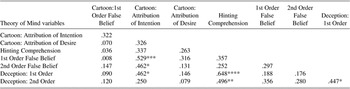
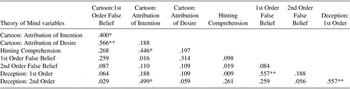
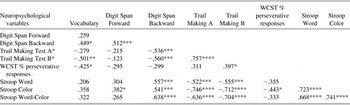
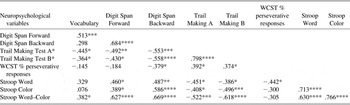
We conducted zero order correlations among the ToM variables separately for the two groups (Tables 3 and 4) as well as among the neuropsychological variables separately for the two groups (Tables 5 and 6) to examine the potential relationships among the variables. Most of the ToM variables appear to be relatively independent of the others in both patient and control groups, as indicated by the predominantly low correlations observed. In contrast, most of the neuropsychological test variables were highly correlated with many others for both patient and control groups, suggesting a strong relationship among these variables.
Zero order correlations among theory of mind variables for the patient group

*p < .05, **p < .01, ***p < .005, ****p < .001.
Zero order correlations among theory of mind variables for the healthy control group

*p < .05, **p < .001.
Zero order correlations among neuropsychological variables for the patient group

*p < .05, **p < .01, ***p < .005, ****p < .001.
Zero order correlations among neuropsychological variables for the healthy control group

*p < .05, **p < .01, ***p < .005, ****p < .001.
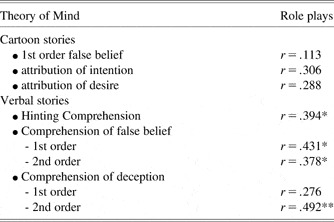
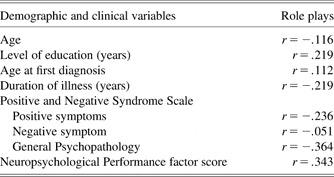
We investigated Pearson's correlations between role plays and each of the following: individual measures of ToM, NP factor score, demographic characteristics and clinical variables. Role play scores correlated with several components of ToM: comprehension of hinting (r = .394; p = .038), 1st and 2nd order false belief-verbal stories (r = .431; p = .022 and r = .378; p = .047, respectively), 2nd order deception-verbal stories (r = .492; p = .008) (Table 7), and the NP factor score (r = .377; p = .048), but not with any of the demographic characteristics or clinical variables (Table 8).
Correlations of patients’ ToM performance and role play ratings

*p < .05, **p < .01.
Correlations of patients’ demographic and clinical characteristics, as well as overall neuropsychological performance, and role play ratings

Group Comparisons
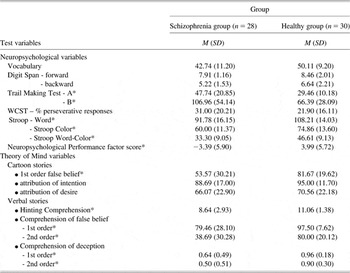
Table 9 lists the mean performance of each group on all ToM and neuropsychological variables, as well as the NP factor score. Multivariate analysis of variance revealed poorer performance on some, but not all, individual neuropsychological tests in the patient group as compared with the control group [Pillai's Trace: Value = .434; F(9,48) = 4.085; p = .001]. Because of the large number of variables included in the paired contrasts, we applied a Bonferroni correction to the level of statistical significance (0.05/9 = 0.0056). Patients with schizophrenia performed more poorly than the healthy group on both parts of the Trail Making Test [A: F(1,56) = 19.059; p < .001 and B: F(1,56) = 15.157; p < .001] and all three conditions of the Stroop [word: F(1,56) = 17.605; p < .001, color: F(1,56) = 23.649; p < .001 and word-color: F(1,56) = 31.077; p < .001]. Group differences did not reach the level of statistical significance for the remaining variables [Vocabulary: F(1,56) = 7.344; p = .009, Digit Span forward: F(1,56) = 0.913; p = .344, Digit Span backward: F(1,56) = 6.820; p = .012, and percent of perseverative responses: F(1,56) = 2.586; p = .113]. The patient group also achieved a significantly lower NP factor score than the control group [F(1, 56) = 24.641; p < .001).
Mean (SD) performance of patients and healthy controls on individual neuropsychological (including neuropsychological factor score) and Theory of Mind tasks

* p < .001.
Another multivariate analysis of variance also revealed poorer performance of the patient group relative to the control group on the individual ToM variables [Pillai's Trace: Value = .583; F(8,49) = 8.566; p < .001]. A separate Bonferroni correction yielded a conservative level of statistical significance (0.05/8 = 0.006) for the paired contrasts, revealing poorer performance of the patient group relative to that of the healthy participants on the following tests: 1st order false belief-cartoon stories [F(1,56) = 17.887; p < .001], comprehension of hinting [F(1,56) = 16.527; p < .001], 1st and 2nd order false belief-verbal stories [F(1,56) = 11.468; p = .001; F(1,56) = 37.917; p < .001], and 1st and 2nd order deception-verbal stories [F(1,56) = 11.499; p = .001; F(1,56) = 13.378; p = .001]. The two groups did not differ on the attribution of intention [F(1,56) = 2.741; p = .103] or desire [F(1,56) = 0.574; p = .452].
Regression Analysis
We conducted four separate hierarchical regression analyses to examine the assumed relationships, with clinical data (duration of illness, positive and negative symptom ratings), demographic characteristics (age and level of education), the NP and ToM scores as independent variables, and role play rating as the criterion variable. Clinical data, demographic characteristics and the NP were entered in the first block serving as control variables and only those ToM variables, which we found to correlate with RP performance (namely, comprehension of hinting, 1st and 2nd order false belief-verbal stories and 2nd order deception) were entered individually in the second block in separate regressions, so as to explore the pure contribution of each of the latter scores to role play performance after removing the influence of all control variables. Table 10 lists R 2, R 2change, F change, significance and beta values for each ToM variable from each regression analysis. The comprehension of 2nd order deception had a significant influence (p = .027) on role play performance beyond that of demographic, clinical and neuropsychological variables, while the influence of 2nd order false belief beyond the other control variables was marginally significant (p = .052). Neither comprehension of hinting (p = .090) nor 1st order false belief (p = .242) had a significant influence on role play performance over and above that of the control variables, although the former showed a trend.
Hierarchical regression analyses of the influence of individual Theory of Mind variables beyond those of control variables on role play performance

Note. Model 1 contains the control variables, while Model 2 contains the control variables plus the corresponding ToM variable.
Discussion
The present data confirmed our hypothesis that ToM is related to social interactions in patients with schizophrenia. Moreover, this relationship was independent of patients’ clinical symptoms, duration of illness, age and level of education, as well as of patients’ neuropsychological status in cognitive domains relevant to ToM.
Our findings replicated, but also extended those of previous studies (Bozikas, Kosmidis, Kiosseoglou, & Karavatos, Reference Bozikas, Kosmidis, Kiosseoglou and Karavatos2006; Harrington et al., Reference Harrington, Langton, Siegert and McClure2005; Sarfati et al., Reference Sarfati and Hardy-Bayle1999; Shamay-Tsoory et al., Reference Shamay-Tsoory, Shur, Harari and Levkovitz2007). The patients in the present study were impaired on most, but not all, of the components of ToM examined, as well as on neuropsychological functioning. With respect to ToM, our patients were impaired on comprehension of hinting, false 1st and 2nd order false beliefs and 1st and 2nd order deception, yet they showed relatively intact comprehension and attribution of intention and desire, which is contradictory to previous reports (Brunet, Sarfati, Hardy-Bayle, & Decety, Reference Brunet, Sarfati, Hardy-Bayle and Decety2003). We should note that our tasks included either a control condition comprising stories to test comprehension without requiring ToM or “reality” testing questions regarding the understanding of the actual scenario. The patients generally responded correctly to these non-ToM scenarios and ‘reality’ testing questions, demonstrating adequate comprehension, yet specifically had trouble with the conditions, scenarios and questions requiring ToM to respond correctly. While clearly dependent on the ability to infer another person's mental state, the ability to attribute either intention or desire to another person may be more straightforward than other types of ToM. In fact, research exploring the order in which ToM abilities develop in children has demonstrated awareness of others’ desires and intentions at a younger age than comprehension of beliefs (see Brüne & Brüne-Cohrs, Reference Brüne and Brüne-Cohrs2006). Instead, perception of hinting, false beliefs and deception, are presumably more complicated processes in that they involve interpretation of indirect—or seemingly contradictory—verbal messages via the social context in which they were presented. In any event, the fact that our patient group was not impaired on all aspects of ToM attests to the fact that the observed deficits were specific and could not be attributed to generalized cognitive dysfunction.
Most aspects of ToM, but neither neuropsychological performance nor clinical or demographic characteristics, were related to measures of social competence. More specifically, comprehension of hinting, 1st and 2nd order false beliefs and 2nd order deception were related to role play performance, but attribution of intention and desire were not.
The results of the present study are consistent with those of previous studies, which found that ToM abilities alone predicted social functioning (Brüne et al., Reference Brüne, Abdel-Hamid, Lehmkämper and Sonntag2007; Pinkham & Penn, Reference Pinkham and Penn2006; Pollice et al., Reference Pollice, Roncone, Falloon, Mazza, DeRisio, Necozione and Casacchia2002), but extends those findings by including neuropsychological functioning in cognitive domains relevant to ToM and clinical/demographic variables in the same analyses to explore the relative contribution of each to social interactions. This exploration highlighted the singular contribution of particular aspects of ToM (namely, comprehension of 2nd order deception and false belief, and, to a much lesser extent, hinting) to social interactions in schizophrenia above and beyond the potential influence of other variables.
Limitations to the generalizability of our findings relate to the method of assessing social competence. Although we consider role plays more ecologically valid than behavior checklists or rating scales, and more amenable to measurement and scoring than real-life interpersonal interactions, we believe that future studies might benefit from a multi-modal approach (i.e., self-report questionnaires, in vivo observation, information from family members). Nevertheless, we consider the current assessment a valid reflection of the patients’ potential interactions in common everyday situations. A related limitation is the fact that we chose not to include the healthy control group in the role plays, due to the potential for obtaining a ceiling effect, removing the possibility, however, of including this group in the regression analyses.
In conclusion, impaired ToM in patients with schizophrenia may impact how they interact and communicate with others in their everyday social life. Many aspects of ToM, but neither neuropsychological functioning nor clinical and demographic characteristics, were related to or accounted for patients’ difficulties in social interactions. Elucidating the actual aspects of ToM that are most closely related to social interactions may not only enhance our understanding of patients’ difficulties in social situations, but also provide guidance in the design of effective and targeted psychotherapy programs. Furthermore, given the potential impact of patients’ difficulties in social interactions, we propose that clinical assessments should include not only traditional neuropsychological measures, but also those evaluating ToM abilities. Along the same lines, we believe that psychotherapy should include interventions such as training in aspects of ToM with the goal of improving patients’ social functional outcome.
Acknowledgments
We thank Amaryllis Malegiannaki for her assistance rating role play performance and Dr. Pagona Roussi and the anonymous reviewers for their suggestions regarding the paper. There was no conflict of interest in the conduction of this study. We received no financial support for this project.