1. Introduction
The Pontides are an E–W-trending orogenic belt stretching about 1400 km, from SE Bulgaria to the Lesser Caucasus (Fig. 1). They repeatedly underwent deformation during the Pan-African (Neoproterozoic), Variscan (Carboniferous), Cimmeride (Triassic–mid-Jurassic) and Alpide (Late Cretaceous–Palaeogene) orogenies (Yılmaz et al. Reference Yılmaz, Tüysüz, Yiğitbas, Genc, Şengör and Robinson1997; Tüysüz, Reference Tüysüz1999), with widespread reactivation of older structures and creation of complex tectonostratigraphic relationships. Although presently constituting a discrete and continuous orographic element, the Pontides result from the amalgamation of three tectonostratigraphic terranes (Fig. 1): the Strandja massif, the İstanbul terrane (İT) and the Sakarya terrane (ST). There are various often conflicting views on the age and formation of the Intra-Pontide suture, the tectonic boundary between the İT and ST (e.g. Şengör & Yılmaz, Reference Şengör and Yılmaz1981; Yılmaz et al. Reference Yılmaz, Genç, Yigitbaş, Bozcu and Yılmaz1994; Okay & Tüysüz, Reference Okay, Tüysüz, Durand, Jolivet, Horvát and Sérrane1999; Yiğitbaş, Elmas & Yılmaz, Reference Yiğitbaş, Elmas and Yılmaz1999; Elmas & Yiğitbaş, Reference Elmas and Yiğitbaş2001, Reference Elmas and Yiğitbaş2005; Robertson & Ustaömer, Reference Robertson and Ustaömer2004). It is considered by Okay & Tüysüz (Reference Okay, Tüysüz, Durand, Jolivet, Horvát and Sérrane1999) to be the result of the progressive closure of an Intra-Pontide ocean during Senonian time. In contrast, according to Şengör & Yılmaz (Reference Şengör and Yılmaz1981), the Intra-Pontide suture formed in early Eocene time after an orthogonal opening between the İT and ST during the Liassic. Stampfli & Hochard (Reference Stampfli, Hochard, Murphy, Keppie and Hynes2009) support a middle Jurassic collision between the İT and ST. Akbayram et al. (Reference Akbayram, Okay, Satir and Topuz2009) favour a Cenomanian collision.
Geologic map of the Western–Central Pontides with apatite fission-track ages from the İstanbul and Sakarya Zones. Base map modified from Okay et al. (Reference Okay, Satir, Zattin, Cavazza and Topuz2008b). Inset: simplified tectonic map of Asia Minor and the surrounding regions showing the major terranes and sutures. Base map modified from Okay & Tüysüz (Reference Okay, Tüysüz, Durand, Jolivet, Horvát and Sérrane1999).

In this paper, we present the first low-temperature thermochronological dataset on the Western Pontides. Apatite fission-track (AFT) age frequency maxima can be correlated with independently determined phases of deformation related to (i) the closure of the İzmir–Ankara ocean and the ensuing tectonism and (ii) northern Aegean extension. AFT ages obtained from rock units cropping out north and south of the Intra-Pontide suture cluster identically, thus suggesting that İT and ST were mechanically coupled at least since Paleocene time. This result has significant bearing on palaeogeographic–palaeotectonic reconstructions of the eastern Mediterranean region.
2. Geological overview
The three distinct tectonostratigraphic terranes composing the Pontides have markedly different geological characteristics (Fig. 1). The Strandja massif constitutes the easternmost part of the vast crystalline basement massif that includes the Rhodope and Serbo-Macedonian massifs. It consists of a Variscan crystalline basement nonconformably overlain by a Triassic–Jurassic sedimentary succession (Y. Aydın, unpub. Ph.D. thesis, Univ. de Nancy, 1974; Okay, Satir & Siebel, Reference Okay, Satir, Siebel, Gee and Stephenson2006; Sunal et al. Reference Sunal, Natal'in, Satır and Toraman2006). Senonian andesites and associated granodiorites are widespread (Moore, McKee & Akinci, Reference Moore, McKee and Akinci1980), and form a Late Cretaceous magmatic belt that can be followed all along the Pontides.
The İT is a fragment of continental lithosphere about 400 km long (Fig. 1). It is made of a late Precambrian basement complex overlain by a continuous Ordovician-to-Carboniferous sedimentary succession, which was deformed during the Variscan orogeny (Dean et al. Reference Dean, Martin, Monod, Demir, Rickards, Bultynck, Bozdogan, Göncüoğlu and Derman1997; Görür et al. Reference Görür, Monod, Okay, Şengör, Tüysüz, Yiğitbas, Sakinç and Akkök1997; Okay et al. Reference Okay, Bozkurt, Satir, Yiğitbaş, Crowley and Shang2008a). The upper Palaeozoic–Mesozoic stratigraphy is similar to that of the Moesian platform and, according to Okay, Şengör & Görür (Reference Okay, Şengör and Görür1994), prior to the Late Cretaceous opening of the western Black Sea the İT was situated south of the Odessa shelf (Fig. 1).
The ST is an elongate lithospheric ribbon stretching >1500 km from the Aegean Sea to the Lesser Caucasus (Fig. 1). It is characterized by the absence of in situ Palaeozoic sedimentary rocks and by the presence of a characteristic Permo-Triassic subduction–accretion complex (Karakaya–Küre Complex) unconformably overlain by ubiquitous Jurassic shallow-marine deposits (Okay & Göncüoğlu, Reference Okay and Göncüoğlu2004).
3. Sample preparation and analytical methods
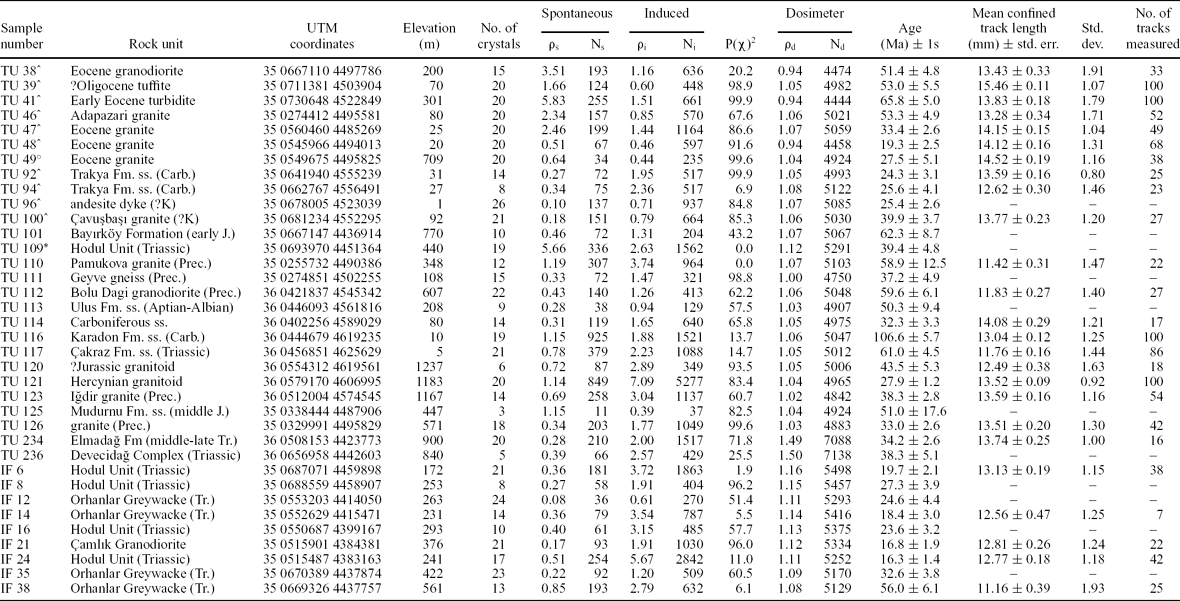
Apatite grains were separated using standard heavy liquids and magnetic separation techniques. Mounts of apatite in epoxy were ground and polished to expose planar surfaces within the grains and then etched with 5N HNO3 at 20°C for 20 seconds to reveal spontaneous fission tracks. Samples then were irradiated with thermal neutrons in the reactor at the Radiation Centre of Oregon State University with a nominal neutron fluence of 9 × 10¹⁵ n cm−2. The CN-5 dosimeter was used to measure neutron fluence. After irradiation, induced fission tracks in the low-U muscovite that covered apatite grain mounts and glass dosimeter were revealed by etching in 40% HF at 20°C for 45 minutes. The track counts and measurements were carried out in transmitted light at a magnification of ×1250 with a Zeiss Axioscope microscope equipped with an automatic stage and a graphic tablet connected to a computer. Apatite FT ages were calculated using the external-detector and the zeta-calibration methods (Hurford & Green, Reference Hurford and Green1983) with IUGS age standards (Durango, Fish Canyon and Mount Dromedary apatites for a total of 14 analyses; Hurford, Reference Hurford1990) and a value of 0.5 for the 4π/2π geometry correction factor. Predicted AFT data were calculated according to the Ketcham et al. (Reference Ketcham, Carter, Donelick, Barbarand and Hurford2007) annealing model and the Donelick, Ketcham & Carlson (Reference Donelick, Ketcham and Carlson1999) c-axis projection using the Dpar kinetic parameter. The apatites of 24 samples were analysed during this study. Twelve additional samples from previous studies (Okay et al. Reference Okay, Satir, Zattin, Cavazza and Topuz2008b; Zattin et al. Reference Zattin, Cavazza, Okay, Federici, Fellin, Pignalosa and Reiners2010) were also incorporated in the dataset. The entire dataset of 36 samples is included in Table 1 and Figure 2. Modelling of t–T paths was performed with the HeFTy program (Ehlers et al. Reference Ehlers, Chaudhri, Kumar, Fuller, Willett, Ketcham, Brandon, Belton, Kohn, Gleadow, Dunai and Fu2005). The program calculates by a Monte Carlo algorithm the range of thermal histories which are consistent with the measured age and with the measured frequency distribution of confined track lengths.
Apatite fission-track analyses

See Figure 1 for location of samples.
Central ages calculated using dosimeter glass CN-5 and ζ-CN-5 = 332.54 ± 5.55. ρs – spontaneous track densities (× 105 cm−2) measured in internal mineral surfaces; Ns – total number of spontaneous tracks; ρi and ρd – induced and dosimeter track densities (× 106 cm−2) on external mica detectors (g = 0.5); Ni and Nd – total numbers of tracks; P(χ2) – probability of obtaining χ2-value for ν degrees of freedom (where ν = number of crystals − 1); a probability >5% is indicative of an homogenous population.
Predicted AFT data were calculated according to the Ketcham et al. (Reference Ketcham, Donelick and Carlson1999) annealing model and the Donelick, Ketcham & Carlson (1999) c-axis projection.
* Published in Okay et al. (2008b). ^Published in Zattin et al. (Reference Zattin, Cavazza, Okay, Federici, Fellin, Pignalosa and Reiners2010). °Corresponds to sample TU 50 of Zattin et al. (Reference Zattin, Cavazza, Okay, Federici, Fellin, Pignalosa and Reiners2010).
The analyses were subjected to the χ2 test (Gailbraith, Reference Gailbraith1981) to detect whether the data sets contained any extra-Poissonian error. A χ2 probability of less than 5% denotes a significant spread of single grain ages.
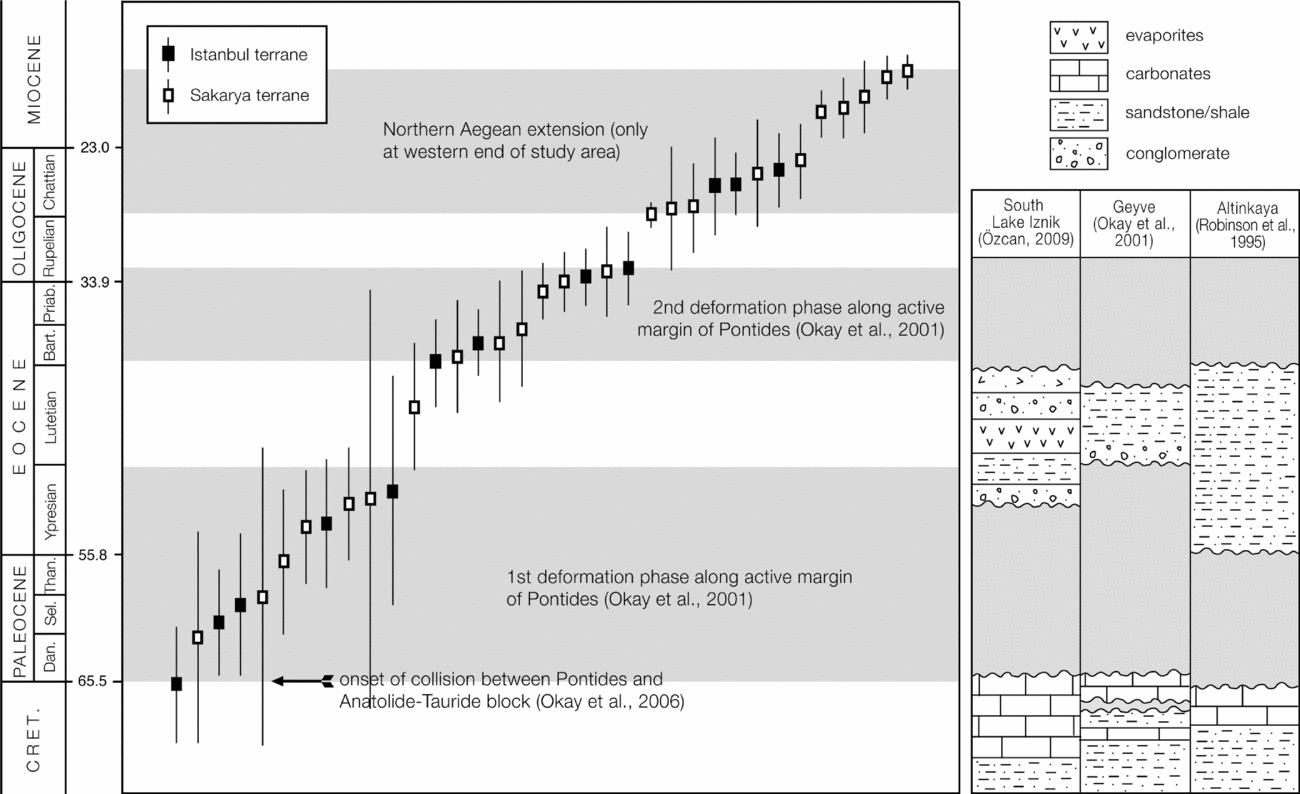
Graphic representation of apatite fission-track age data (mean ± one standard deviation) from the İstanbul (solid squares) and Sakarya (open squares) terranes. See Figure 1 and Table 1 for location of samples. To the right, simplified lithochronostratigraphic sections for selected localities in the Sakarya terrane (see Fig. 1 for locations). Timing of major hiatuses correspond to deformation phases (shaded time spans; Okay, Tansel & Tüysüz, Reference Okay, Tansel and Tüysüz2001) and exhumation episodes defined by AFT age clusters. Time scale from Gradstein et al. (Reference Gradstein, Ogg and Smith2004); age scale in Ma. Sample TU 116 (106.6 ± 5.7 Ma) not reported. Reference to Özcan (2009) is Z. Özcan (unpub. Ph.D. thesis, Istanbul Technical Univ., 2009).

4. Discussion of results
Our dataset includes most of the stratigraphic units suitable for AFT dating over a large area of the İT and the ST (Fig. 1), and represents the first low-temperature thermochronological study of the Western Pontides. Rock samples collected in the western portion of the study area around the Marmara Sea yielded Chattian to early Miocene AFT ages (Fig. 1). In the central-eastern portion of the study area, there is no consistent geographic distribution of ages. Similarly, there is no relationship between AFT ages and sample elevations (Table 1).
AFT ages from the western portion of our study area confirm the results of Zattin et al. (Reference Zattin, Cavazza, Okay, Federici, Fellin, Pignalosa and Reiners2010) and Hejl et al. (Reference Hejl, Bernroider, Parlak and Weingartner2010) that most exhumation in the peri-Marmara region occurred in latest Oligocene–early Miocene times, when the northern Aegean domain was beginning to form by extension (Gautier & Brun, Reference Gautier and Brun1994; Dinter, Reference Dinter1998; Burchfiel et al. Reference Burchfiel, Nakov, Tzankov, Royden, Bozkurt, Winchester and Piper2000). For example, the two youngest AFT ages (16.8 ± 1.9 and 16.3 ± 1.4 Ma) of our dataset were yielded by samples taken from pre-Jurassic units a few kilometres east of the Kazdağ core complex (Table 1, Fig. 1), a major Aegean-related extensional feature exposing mid-crustal level rocks (Okay & Satır, Reference Okay and Satir2000; Cavazza, Okay & Zattin, Reference Cavazza, Okay and Zattin2009). In addition, Zattin et al. (Reference Zattin, Cavazza, Okay, Federici, Fellin, Pignalosa and Reiners2010), Zattin, Okay & Cavazza (Reference Zattin, Okay and Cavazza2005), Okay et al. (Reference Okay, Satir, Zattin, Cavazza and Topuz2008b) and Hejl et al. (Reference Hejl, Bernroider, Parlak and Weingartner2010) provide evidence that the present-day western portion of the North Anatolian Fault system is superposed on older, generally E–W-trending, tectonic structures with a significant vertical component, thus capable of inducing exhumation.
The oldest AFT age of our entire dataset (106.6 ± 5.7 Ma) was yielded by a sandstone sample (TU 116, Table 1) from the Carboniferous fluvio-deltaic Karadon Formation along the coast of the Black Sea (Fig. 1). The age of this sample must be considered with caution as its track-length distribution indicates a complex thermal evolution (see below). Nevertheless, the overall evolution of this sample (and of the nearby sample TU 117) fits well with the time span covered by the western Black Sea break-up unconformity between the Cağlayan Fm (Aptian–Albian) and the Kapanboğazi Fm (Cenomanian) in the area of Sinop and the correlative hiatuses to the west (Tüysüz, Reference Tüysüz1999, Fig. 3). Such a distinctive thermotectonic event was likely registered by other rock units but then erased by younger thermochronological events. Interestingly, this age is also very similar to the age of blueschist/eclogite facies metamorphism in the Central Pontides (Okay et al. Reference Okay, Tüysüz, Satır, Özkan-Altıner, Altıner, Sherlock and Eren2006). However, the location of this sample on the Black Sea coast suggests that this age is related to erosional exhumation due to shoulder uplift during back-arc rifting rather than to events in the subduction zone.
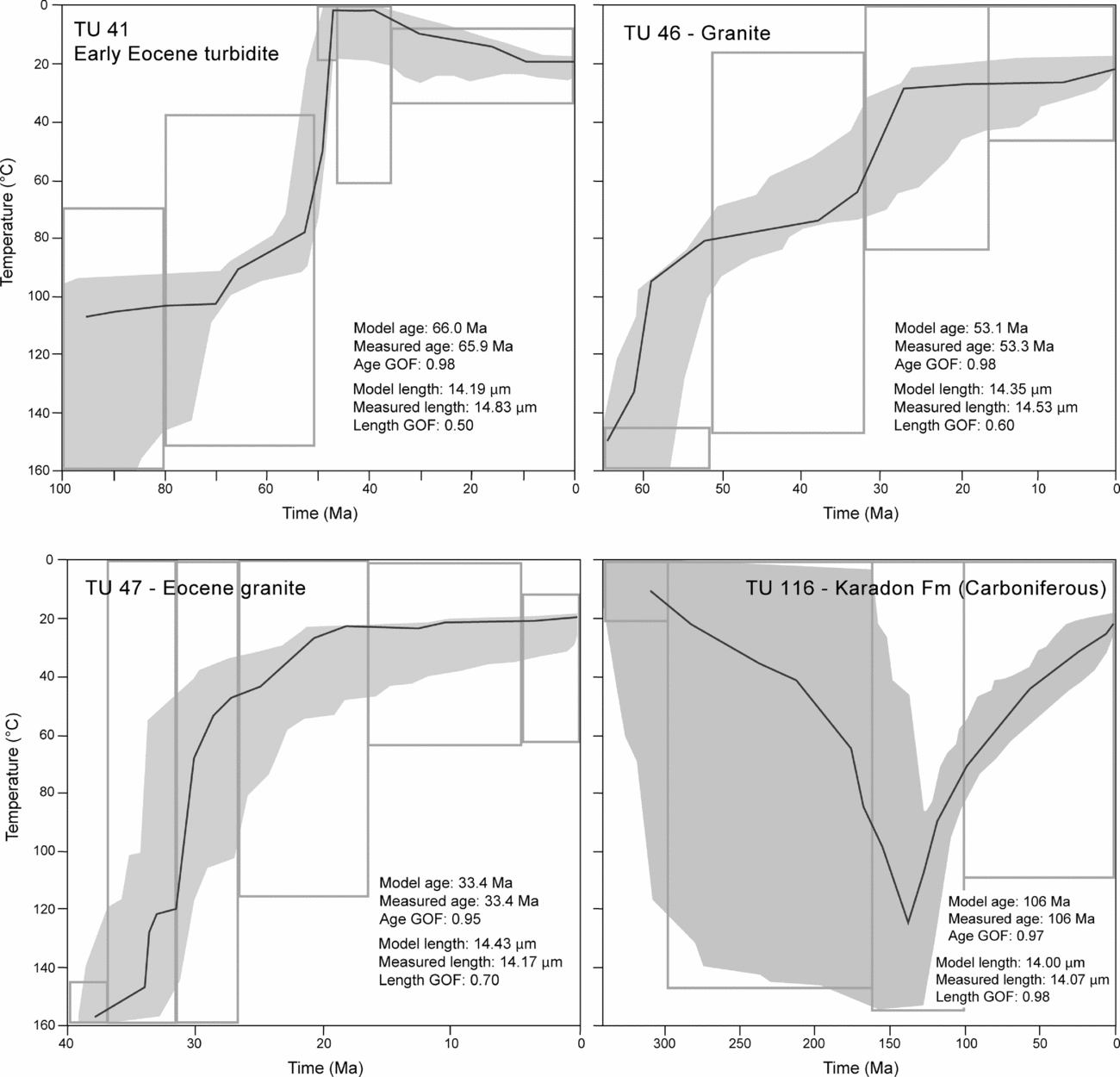
Time–temperature paths obtained from inverse modelling of apatite fission-track data. GOF (goodness-of-fit) values give an indication about the fit between observed and predicted data (with values close to 1 showing a high degree of agreement). Shaded areas mark envelopes of good results (GOF > 0.5) and the thick lines correspond to the most probable thermal histories. Grey boxes indicate time–temperature constraints. (Time–temperature constraints are the depositional age of sedimentary samples (TU41 and TU116) and the intrusion age of granites (TU46 and TU47). The other time–temperature boxes are very large in order to avoid any forcing during the modelling.) Thermal paths out of the partial annealing zone are largely inferential as fission-track data cannot give reliable information out of this temperature range. In each diagram, parameters (model and measured age, model and measured mean length) related to inverse modelling are reported.

Excluding the younger ages from the peri-Aegean region (i.e. the westernmost portion of our study area), AFT ages of the Western Pontides range from the latest Cretaceous to the earliest Oligocene (Fig. 1; Table 1), reflecting the time span of the Alpide orogeny in the region. Within this broad range two clusters might be recognized (Fig. 2) which are neither geographically nor geologically defined, as samples from both the İT and the ST contain ages of each group. The first cluster comprises latest Maastrichtian–Ypresian AFT ages (65.8–50.3 Ma). The second cluster comprises ten samples ranging in age between 39.9 (early Bartonian) and 32.3 Ma (early Rupelian). Excluding sample TU 120, no AFT ages are found from the late Ypresian to the early Bartonian (>10 Ma) and from the early Rupelian to the early Chattian (Fig. 2).
The AFT age distribution along the Western Pontides, with three discrete clusters of ages alternating with two periods of little or no exhumation, reflects the complex tectonic history of the Pontides. The absence of any regular spatial pattern in the geographic distribution of the older AFT ages derives from the multiple, superposed deformation episodes, including Plio-Quaternary strike-slip deformation with large horizontal offset, which have generated complex tectonostratigraphic relationships and jumbled any previous spatially coherent exhumation trend(s). (For an example of how strike-slip deformation can generate seemingly incoherent fission-track age areal patterns, see Okay et al. (Reference Okay, Satir, Zattin, Cavazza and Topuz2008b).) The only areally defined exhumation trend is determined by the youngest cluster of ages in the westernmost portion of the study area (Fig. 1). In fact, such a cluster (late Oligocene–early Miocene) relates to northern Aegean regional extension, i.e. the latest tectonic event capable of generating significant vertical separation.
The older age cluster (Paleocene–late Ypresian; Fig. 2) can be explained as the result of deformation induced by the closure of the İzmir–Ankara oceanic domain and the ensuing collision in Paleocene–early Eocene time between the ST to the north and the Anatolide–Tauride block to the south (Okay & Tüysüz, Reference Okay, Tüysüz, Durand, Jolivet, Horvát and Sérrane1999; Okay, Tansel & Tüysüz, Reference Okay, Tansel and Tüysüz2001). All our samples are from within 120 km of the trace of the İzmir–Ankara suture (Fig. 1) and the entire study area provides ample evidence of deformation related to its development (e.g. Okay, Tansel & Tüysüz, Reference Okay, Tansel and Tüysüz2001). Our data are supported by similar Paleocene–early Eocene AFT ages (i) from the Dereli–Şebinkarahisar granitoids in the Eastern Pontides (Boztuğ et al. Reference Boztuğ, Jonckheere, Wagner and Yeğingil2004), also interpreted as the result of fast exhumation related to the collision, and (ii) from the hanging wall of the Simav detachment (Thomson & Ring, Reference Thomson and Ring2006).
The Bartonian–early Rupelian age cluster (Fig. 2) corresponds to a second phase of deformation along the Pontides characterized by the termination of deposition and deformation in the sedimentary basins located closer to the İzmir–Ankara suture (Okay, Tansel & Tüysüz, Reference Okay, Tansel and Tüysüz2001, fig. 13).
Modelling of fission-track data was performed on four samples with a single-age grain population and high numbers of measured tracks (Table 1) and provided more quantitative constraints on their cooling paths (Fig. 3). Sample TU 41 from lower Eocene turbidites north of İzmit Bay yielded an AFT age of 65.8 Ma, i.e. older than its depositional age. This age, compounded by the modelled thermochronologic history, implies that (i) we dated fast cooling and exhumation in the sediment source area, and (ii) the flysch has never been buried since deposition to temperatures >60°C (>c. 2 km), sufficient to partially anneal fission tracks in apatite. Sample TU 46 from a granitoid within the ST points to an early Paleocene episode of exhumation. Cooling occurred over a wide time span until the late Oligocene, with no exhumation during the middle Eocene, in line with the overall absence of AFT ages in this period throughout the study area (Fig. 2). Sample TU 47 is from a middle Eocene granite (38–36 Ma; Delaloye & Bingöl, Reference Delaloye and Bingöl2000) exposed along the coast of the Kapidaği peninsula. Its modelled thermochronological evolution shows rapid cooling during late Eocene/early Oligocene time to temperatures close to the surface, again in agreement with the second frequency maximum of the measured AFT ages (Fig. 2). TU 116 was taken from the fluvio-deltaic Karadon Formation (Westphalian) along the coast of the Black Sea and yielded an Albian AFT age. In spite of relatively scarce constraints for the pre-Cretaceous history, thermochronological modelling hints at a long phase of early-middle Mesozoic subsidence (Black Sea rifting?) followed by steady exhumation since Cretaceous times.
The clustering of AFT data from both the İT and ST into two groups (Paleocene–Ypresian and late Lutetian–early Rupelian) suggests that the two terranes were amalgamated by earliest Paleocene time and then underwent the same tectonic history. Both exhumation episodes correlate well with phases of deformation along the İzmir–Ankara suture, as discussed above. The overall Cenozoic chronostratigraphy of sedimentary successions in the Pontides within a relatively short distance from the İzmir–Ankara suture (< 50 km) agrees with our thermochronologic data, as major supraregional hiatuses correspond to the two older clusters of AFT ages (Fig. 2). Other independent data substantiate the hypothesis of a pre-Cenozoic amalgamation of the İT and ST: (1) within the Pontides, the Turonian–Campanian magmatic arc related to northward subduction of the İzmir–Ankara ocean stretches continuously some 1500 km from Bulgaria to the Lesser Caucasus, crossing the tectonic boundaries between the Strandja massif, the İT and the ST without any significant interruption or offset (Yılmaz et al. Reference Yılmaz, Tüysüz, Yiğitbas, Genc, Şengör and Robinson1997); (2) Tüysüz (Reference Tüysüz1999) showed that the İT and the ST in the Central Pontides share a common Senonian stratigraphy while they differ in their pre-Senonian stratigraphy and evolution, thus indicating that amalgamation must be Cenomanian or older. The question remains open if amalgamation took place during the Cenomanian, i.e. concomitant with the opening of the western Black Sea (Okay, Tansel & Tüysüz, Reference Okay, Tansel and Tüysüz2001; Akbayram et al. Reference Akbayram, Okay, Satir and Topuz2009), or earlier (e.g. in the middle Jurassic, as shown in the palaeotectonic reconstructions by Stampfli & Hochard, Reference Stampfli, Hochard, Murphy, Keppie and Hynes2009).
5. Conclusions
The areal distribution of exhumation ages in the Western and Central Pontides results from the superposition of discrete tectonic events. The western portion of the study area is dominated by late Oligocene–early Miocene AFT ages, which obliterated any previous thermotectonic event. We suggest that extension affecting the Aegean region (e.g. Jolivet et al. Reference Jolivet, Famin, Mehl, Parra, Aubourg, Hébert, Phillippot, Whitney, Teyssier and Siddoway2004) gave rise to exhumation at a regional scale. These exhumation ages are in agreement with the thermochronologic and structural data of Zattin et al. (Reference Zattin, Cavazza, Okay, Federici, Fellin, Pignalosa and Reiners2010), Zattin, Okay & Cavazza (Reference Zattin, Okay and Cavazza2005) and Okay et al. (Reference Okay, Satir, Zattin, Cavazza and Topuz2008b) for the southern and western Marmara region, indicating that the present-day North Anatolian Fault, which branches into a c. 100 km wide fault system in the Marmara–Biga region, is superposed on older, generally E–W-trending, tectonic structures capable of inducing significant exhumation.
All older exhumation ages in the study area do not show an ordered geographic distribution yet they cluster coherently into two discrete groups: late Danian–late Ypresian (62.3–50.3 Ma) and late Lutetian–early Rupelian (43.5–32.3 Ma). Both exhumation episodes correlate well with phases of deformation along the İzmir–Ankara suture. Since the thermochronological effects of the two exhumation episodes are widespread in both the İstanbul and Sakarya terranes, our data indicate that their amalgamation occurred in pre-Cenozoic times.
Acknowledgements
The authors would like to thank L. Barbero, R. Jonckheere and M. Rahn for their insightful comments on an earlier draft. We also thank S. N. Thomson and an anonymous referee for careful reviews of the final manuscript. This research was sponsored by MIUR (Italian Dept. of Public Education, University and Research) and by TÜBA (The Turkish Academy of Sciences). Field assistance by Selvihan Goktak is gratefully acknowledged.