INTRODUCTION
Infertility is one of the most common long-term problems reported by childhood cancer survivors (CCSs), particularly among female survivors (Byrne et al., Reference Byrne, Mulvihill and Myers1987). Such cancer treatments as radiation and chemotherapy can affect ovarian germ cell survival, which can cause a range of future scenarios, including sterilization, diminished fertility, or no problems at all (Cvancarova et al., Reference Cvancarova, Samuelsen and Magelssen2009; Sklar & Constine, Reference Sklar and Constine1995; Hamre et al., Reference Hamre, Kiserud and Ruud2012). Female CCSs are less likely to report a pregnancy than their siblings or population control subjects (Green et al., Reference Green, Kawashima and Stovall2009; Winther et al., Reference Winther, Boice and Svendsen2008; Barton et al., Reference Barton, Najita and Ginsburg2013). A recent study reported that the risk of clinical infertility (>1 year of attempts at conception without success) is 48% greater in CCSs compared to their female siblings (Barton et al., Reference Barton, Najita and Ginsburg2013). There are also studies reporting a higher risk of premature ovarian failure in CCSs compared to their female siblings (Hamre et al., Reference Hamre, Kiserud and Ruud2012; Chemaitilly et al., Reference Chemaitilly, Mertens and Mitby2006). Reproductive problems can have a significant impact on a woman's life after cancer, affecting her personal relationships, future family planning, and concerns about pregnancy and birth (Zebrack et al., Reference Zebrack, Casillas and Nohr2004; Schover, Reference Schover2005). Considering the high survival rate in childhood cancer patients (Howlader et al., Reference Howlader, Noone and Krapcho2012), reproductive concerns resulting from cancer treatment are an important quality-of-life issue among female CCSs.
Although fertility is usually not their primary concern at the time of cancer diagnosis (Howlader et al., Reference Howlader, Noone and Krapcho2012), the majority of adult CCSs endorse the importance of considering fertility (Howlader et al., Reference Howlader, Noone and Krapcho2012; Nieman et al., Reference Nieman, Kinahan and Yount2007), and most CCSs place a high value on future parenthood (Zebrack et al., Reference Zebrack, Casillas and Nohr2004). However, many CCSs deny having received adequate discussions about reproductive health before or after cancer treatment (Zebrack et al., Reference Zebrack, Casillas and Nohr2004; Quinn et al., Reference Quinn, Vadaparampil and Gwede2007; Hohmann et al., Reference Hohmann, Borgmann-Staudt and Rendtorff2011). Pediatric patients who were diagnosed before the published guidelines about fertility preservation (FP), such as the American Academy of Pediatrics guidelines in 2008 and the American Society of Clinical Oncology (ASCO) guidelines in 2006 (Fallat & Hutter, Reference Fallat and Hutter2008; Lee et al., Reference Lee, Schover and Partridge2006), may be less likely to have received reproductive health information prior to treatment. However, to date, there is no study evaluating CCSs' exposure to high-quality information regarding reproductive health after cancer treatments.
CCSs can experience various endocrine effects, including abnormal puberty, premature menopause, and hypopituitarism (Patterson et al., 2013). For that reason, the Children's Oncology Group recommends that young people with cancer be referred to reproductive consultation (RC) with a fertility specialist to discuss and monitor their current and future reproductive health prior to and after cancer treatment (Metzger et al., Reference Metzger, Meacham and Patterson2012). Moreover, recent advances in FP technologies widen the opportunity of various fertility options (such as egg and sperm banking) for cancer patients (Ethics Committee of American Society of Reproductive Medicine, 2013). While the options are more limited in prepubertal childhood cancer patients (egg or sperm banking is not generally feasible), a recent study reported patients' or their guardians' strong desire to learn more about their risk of infertility (Hohmann et al., Reference Hohmann, Borgmann-Staudt and Rendtorff2011), which can be covered during RC. However, no study has investigated how well CCSs are informed about their reproductive health after cancer treatment and possible fertility treatment options.
This paper reports the results of a single-center pilot study that aimed to measure female CCSs' knowledge about their reproductive health as well as their exposure to and views about RC.
PATIENTS AND METHODS
Study Design and Survey Development and Validation
We conducted a cross-sectional web-based survey using the University of North Carolina (UNC) Cancer Registry. The inclusion criteria were women: (1) who were diagnosed with cancer before 21 years of age between 1994 and 2010 (below this age, individuals are usually managed by pediatric oncologists in the United States); (2) whose current age was between 18 and 45 years; (3) who completed cancer treatments; (4) who currently had no evidence of disease; and (5) who could read English. Eligible women were mailed letters introducing the study and the weblink (URL) for the survey. One follow-up letter was sent three weeks later for candidates who did not respond. Participants were offered a cash incentive ($5.00) for completion of the survey. The study was approved by the UNC institutional review board.
The questionnaire was developed by fertility specialists familiar with FP. The questions were reviewed by physicians and survey experts for content. In addition, nonphysician staff reviewed the survey for clarity. In addition to the main outcomes (listed below), the questionnaire asked subjects to provide demographic information (age, ethnicity, education level, marital status), reproductive and cancer history, and important cancer-related complications.
Primary Outcome: Knowledge About the Reproductive Health and Options After Cancer Treatment
The primary outcome of the study was the participants' knowledge score about their reproductive health as it related to cancer treatments.
To develop a knowledge instrument that had content validity, fertility specialists (JK and JEM) first identified important content regarding posttreatment reproductive health issues. Items of varying difficulty were subsequently generated, and each item was written in the form of a true/false question, with a “don't know” option to eliminate guessing. Members of our research team and an additional fertility specialist reviewed the questions for content validity. In addition, nonphysician staff (secretaries) commented on the preliminary draft of the questionnaire for clarity and face validity.
One point was allotted for each correct answer. Any incorrect or “don't know” response received zero points. The “knowledge score” was generated with the percentage of correct answers from each subject. While all subjects answered all questions, we expected that some patients would not know about treatments they had not received. Therefore, for some questions, we only present the results for the subset of applicable subjects (e.g., knowledge about the reproductive effects of chemotherapy are only reported for those who received chemotherapy) (see Table 2).
Secondary Outcome: Subjects' Experience Regarding Discussions About Reproductive Concerns and Their Views About the Experience
Participants were asked if they or their guardian had had a discussion about reproductive issues and options with their healthcare providers (the oncology team and/or a fertility specialist) at the time of cancer diagnosis and if they or their guardian had had follow-up discussions after cancer treatments. While a young cancer patient may not be aware of discussions that their guardians had at the time of their diagnosis, they ideally would have had subsequent conversations with their guardians to update them about reproductive concerns. Participants were asked to report their views about the content and quality of information that was provided and the frequency of follow-up discussions. Women were considered to have pursued RC if they and/or their guardian had pursued RC.
A positive view about reproductive counseling with a fertility specialist was defined as having pursued RC or as being willing to have pursued RC if an opportunity had arisen. A negative view of RC was defined as not being interested in pursuing RC.
Statistical Analysis
Descriptive statistics were calculated as frequency and percentage for categorical data, and mean and standard deviation for continuous data. Univariate analysis was performed to determine prognostic variables for the positive views toward RC or treatments, using t tests and Fisher's exact test when appropriate. A value of p less than 0.05 was considered statistically significant. Statistical analyses were conducted using SAS statistical software (v. 9.2, Cary, North Carolina).
RESULTS
Invitation letters were sent to 173 eligible women. Of those, 57 were returned due to an incorrect address. A total of 56 women completed the survey (response rate = 56/116, 48%). There was no difference between responders and nonresponders with respect to current age, age at diagnosis, or type of cancer (data not shown).
Participants' Demographics and Cancer and Reproductive History
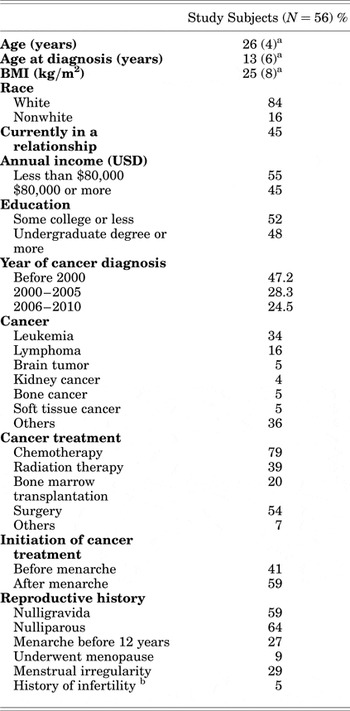
The participants' mean age was 26 ± 4 years, and the mean age at cancer diagnosis was 13 ± 6 years. A quarter of participants were diagnosed between 2006 and 2010, and the rest were diagnosed before 2006 (Table 1). Some 47 women (84%) were white, and the annual income was more than $80,000 for 26 women (45%). Some 91% of participants had attended at least some college, and the majority (52%) had completed college. Some 25 women (45%) were currently in a committed relationship.
Demographic factors and medical and reproductive history of the 2013 web-based survey of childhood cancer survivors, UNC Cancer Registry, 1972–2010

aMean (SD).
bEver tried to become pregnant for at least a year without becoming pregnant.
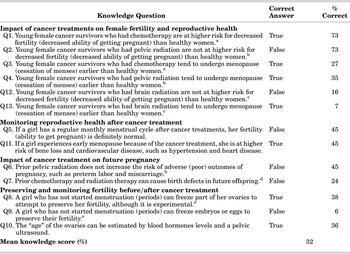
Knowledge items and the percentage of correct responses among 56 childhood cancer survivors at the time of the 2013 web-based survey, UNC Cancer Registry, 1972–2010

aAmong subjects who received chemotherapy.
bAmong subjects who received pelvic radiation.
cAmong subjects who received brain radiation.
dAmong subjects who received chemotherapy or radiation therapy.
eAmong subjects who were diagnosed after 2005.
Some 40% of subjects were diagnosed with leukemia or lymphoma, and 5% were diagnosed with a brain tumor (Table 1). A total of 44 women (79%) had been treated with chemotherapy, and 22 (39%) had a history of radiation therapy (4 had pelvic radiation and 4 brain radiation). Some 23 subjects (41%) initiated cancer treatment(s) before they had menarche.
A total of 33 subjects (59%) had never been pregnant, and 20 (36%) had at least one child (Table 1); 5 women (9%) had undergone premature menopause, and the mean age at menopause was 22 ± 3 years old; and 16 women (29%) reported having irregular periods.
Risk of Various Reproductive Problems Related to Cancer Treatments
The 33 CCSs who received cancer treatment after menarche were at significantly higher risk of premature menopause compared to the 23 CCSs who received cancer treatment before menarche (15 vs. 0%, p = 0.05). CCSs who had received bone marrow transplantation (BMT) were nearly seven times more likely to undergo premature menopause than CCSs who had not received BMT (RR = 6.9, CI 95% = 1.3, 36.6); however, the confidence interval was wide.
Participants' Knowledge About Reproductive Health and Options After Cancer Treatments
The mean knowledge score was 32%. Questions focusing on fertility preservation treatment options (Q8, Q9) and the reproductive sequelae related to brain radiation (Q12, Q13) were answered correctly by less than 40% of the appropriate cohort (Table 2). Some 73% of the cohort who had chemotherapy did not know that CCSs who had chemotherapy tend to undergo menopause earlier than healthy women (Q3), and 76% were not aware that prior cancer treatments did not cause birth defects in future offspring (Q7). The mean knowledge score in women who pursued RC was not different from that in women who did not pursue RC (p = 0.25) (note that only five women, or their guardians, had pursued RC). The subjects' age, age at diagnosis, parity, cancer type, or level of education did not significantly influence the knowledge score.
Childhood Cancer Survivors' Experience Regarding Formal Discussions with Healthcare Providers About Reproductive Issues at the Time of Cancer Diagnosis and After Completion of Cancer Treatment
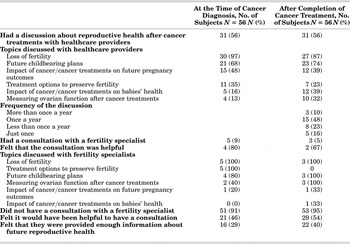
At the time of cancer diagnosis, 31 subjects (or their guardians) (55%) had a discussion about reproductive issues with their healthcare providers (Table 3). Only 5 (9%) had a formal RC with a fertility specialist at the time of diagnosis, and 4 of 5 thought that the RC was helpful. Of the 51 women who did not have a consultation with a fertility specialist at the time of cancer diagnosis, 21 (46%) felt that RC would have been helpful. The most common reason why women did not think that RC would have been helpful was that they were too young to have a discussion about reproductive issues. Some 16 women (29%) believed they were provided enough information about reproductive health at the time of cancer diagnosis.
Discussion about reproductive health after cancer treatments at the time of cancer diagnosis and after completion of cancer treatment

After completion of cancer treatment, 31 women (56%) reported having at least one follow-up discussion about their reproductive health with their healthcare providers (Table 3). Among those, 48% had a discussion once a year, 23% less than once a year, and 16% just once. The most frequently discussed topic was loss of fertility, followed by future childbearing plans, and the impact of cancer/cancer treatment on future pregnancy outcomes and babies' health. Only three women (5%) had a formal RC with a fertility specialist after completion of cancer treatment, and two of three deemed the consultation to be helpful. No women who had irregular periods or who had undergone menopause after cancer treatment had RC with a fertility specialist. A total of 29 women (54%) answered that they would pursue RC if an opportunity arose during the survivorship phase. The topics that the participants most wanted to discuss were: loss of fertility, future childbearing plans, and impact of cancer/cancer treatment on future pregnancy outcome. Only 22 women (40%) thought they were provided enough information about reproductive health after cancer treatment.
When we divided the cohort into subjects diagnosed before and after 2006 when the ASCO guideline for FP was released, the number of women (or their guardians) who had RC with a fertility specialist at cancer diagnosis was slightly higher after 2006 compared to before (4 (29%) vs. 1 (2%), p = 0.06).
Childhood Cancer Survivors' View About Parenthood After Survival and Reproductive Consultation
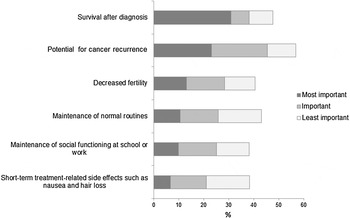
Some 52 participants (93%) answered that they would want to carry a pregnancy at some time in the future, if it were possible. After survival and risk of cancer recurrence, decreased fertility was the next most important cancer-related concern that participants harbored (see Figure 1).
Important cancer-related concerns of the 2013 web-based survey of childhood cancer survivors, UNC Cancer Registry, 1972–2013.

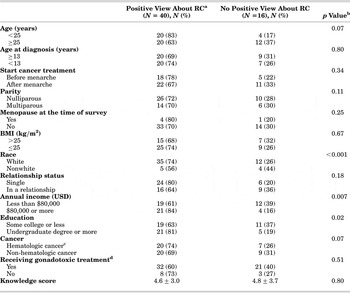
A total of 40 women (71%) had a positive view about RC. White women were more likely to have positive views on RC or treatments compared to nonwhites (p < 0.001) (Table 4). Women whose annual income was $80,000 or more (p = 0.007) and who had an education level of undergraduate degree or more (p = 0.02) tended to have a positive opinion about RC. Menopausal status, BMI, race, parity, relationship status, cancer type, having received gonadotoxic cancer treatments (chemotherapy, brain or pelvic irradiation, or bone marrow transplantation), and knowledge score were not related to views about RC.
Factors associated with a positive view of a reproductive consultation (RC) among childhood cancer survivors at the time of the 2013 web-based survey, UNC Cancer Registry, 1972–2010

aWomen who had received RC or would have pursued RC if the opportunity had arisen.
bFisher's exact test.
cLeukemia, non-Hodgkin's lymphoma, or Hodgkin's lymphoma.
dChemotherapy, pelvic or brain irradiation, or bone marrow transplantation.
DISCUSSION
The importance of fertility and reproductive health in childhood cancer patients is rapidly growing as the long-term survival rate in this population has escalated sharply (Howlader et al., Reference Howlader, Noone and Krapcho2012). This pilot study is the first to quantitatively investigate CCSs' knowledge about the intersection between reproductive health and cancer treatments, and to delve into their experiences and views regarding RC and reproductive opportunities. CCSs' knowledge about reproductive health related to cancer treatment was significantly limited. Some 44% of women did not recall ever having a discussion about reproductive health with healthcare providers, and only a very limited number of women or their guardian pursued RC with a fertility specialist before and/or after cancer treatment. Most significantly, the majority of study participants were not satisfied with the information they had been provided with and were willing to pursue formal RC with a fertility specialist if they were afforded the opportunity.
The general health outcomes literature suggests that a patient's comprehension of his or her disease and treatment closely relates to outcome, satisfaction, and overall quality of life (Peate et al., Reference Peate, Meiser and Hickey2009; Street et al., Reference Street, Voigt and Geyer1995). Studies of women with cancer have revealed that patient education can improve overall comprehension of complex medical concepts and patient satisfaction with difficult medical decisions (Street et al., Reference Street, Voigt and Geyer1995; Balthazar et al., Reference Balthazar, Fritz and Mersereau2011). Our study demonstrates that CCSs' knowledge about cancer-related reproductive health was severely limited, which might prevent them from making the best possible decision about their reproductive options. For example, most women did not know that having been exposed to prior cancer treatments (such as chemotherapy) would not cause birth defects for their future offspring—hypothetically, women may opt not to conceive based on their lack of accurate information (Zebrack et al., Reference Zebrack, Casillas and Nohr2004). While it is not surprising that children tackling a cancer diagnosis would not have a high level of comprehension about reproductive concerns, our study focused on older, well-educated survivors. The fact that these women (mean age 26) had low knowledge scores possibly suggests a significant gap of educational opportunities about reproductive health issues related to cancer treatment among CCSs. It is also surprising that RC has no impact on knowledge scores. However, because the number of participants who received RC was small in this study, further studies are needed to draw interpretable conclusions.
It can be challenging to discuss reproductive issues with childhood cancer patients or guardians because of the understandable focus on such short-term concerns as survival and immediate treatment side effects (Nieman et al., Reference Nieman, Kinahan and Yount2007). At the University of North Carolina, it is discussed at the time of diagnosis and is included in the written consents; however, the more substantial discussions about reproductive issues are usually held at survivorship clinics where CCSs are transitioned after a recurrence-free period of at least two years. Moreover, reproductive issues can be a relatively difficult and unfamiliar concern for young patients and even their parents (Hohmann et al., Reference Hohmann, Borgmann-Staudt and Rendtorff2011). Even if CCSs or their guardians had discussed reproductive issues with healthcare providers at the time of diagnosis, it may be hard for CCSs to remember this discussion in any meaningful way, depending on their age and level of maturity (Hohmann et al., Reference Hohmann, Borgmann-Staudt and Rendtorff2011). However, we feel that that there is significant value in follow-up RCs as these young cancer survivors become older. It is essential that providers recognize that the meaning and potential impact of late effects like infertility can change dramatically over time (Nieman et al., Reference Nieman, Kinahan and Yount2007). Importantly, our finding of CCSs' severely limited knowledge about reproductive health suggests the clinical importance of follow-up counseling when CCSs are interested in and ready to discuss this issue. Clinicians should be aware of reproductive issues during follow-up and be ready to refer CCSs who need more specialized care to a reproductive specialist. Prior studies show that some patients and parents wish they had known more about the possibility of their child's future infertility and preservation opportunities before the first treatment was initiated (Nieman et al., Reference Nieman, Kinahan and Yount2007; Kelly & Porock, Reference Kelly and Porock2005). This is consistent with our finding that the majority of participants were interested in having RC with a fertility specialist to discuss their reproductive health related to cancer or cancer treatments. Surprisingly, none of the women in our study who underwent early menopause or who had an irregular menstrual period after cancer treatment had had a follow-up RC with a fertility specialist in spite of the current guidelines, which recommend referring CCSs to a fertility specialist if they are at risk of early menopause, abnormal pubertal development, or infertility, or for discussions about contraception, bone health, or hormonal replacement therapy (Metzger et al., Reference Metzger, Meacham and Patterson2012).
The impact of pubertal status (pre- or post-menarche) at the time of cancer treatment on future fertility has not been investigated thoroughly. We found that patients who initiated cancer treatment after menarche were more likely to undergo early menopause compared to the patients who initiated cancer treatment before menarche. This is consistent with a recent study reporting a higher risk ratio of nonsurgical menopause in CCSs who had been treated after the onset of puberty (vs. before) with alkylating agents or radiation to the ovaries (Thomas-Teinturier et al., Reference Thomas-Teinturier, El Fayech and Oberlin2013). Also, this finding is supported biologically: quiescent ovarian follicles initiate folliculogenesis and begin to actively divide at menarche (Wallace & Kelsey, Reference Wallace and Kelsey2010), so that postmenarcheal ovaries may be more prone to the damage of gonadotoxic treatments. However, because of the small number of patients, larger studies are needed to validate our finding about the association between menarcheal status at the time of cancer treatment and prevalence of subsequent early menopause after cancer treatment in CCSs.
We found that several variables are related to positive views about RC. First, a higher annual income correlates with positive views about RC, possibly because RC and potential following treatments to preserve fertility may be cost-prohibitive for low-income patients without insurance coverage. Other variables, such as higher education and white ethnicity, were associated with positive views about RC; however, further exploration is needed to validate these findings because of the small number of subjects in our pilot study.
Our study has several limitations. First, the small number of participants and the relatively low response rate weakened its power. Subgroup analysis by the factors directly related to future reproduction such as age at cancer treatment and type/dose of cancer treatments could not be done. However, considering that this is a pilot study that included only a single institution, we believe it has significance as a preliminary report despite the small number of participants. Second, the knowledge instrument is not a validated questionnaire, which may limit the reliability of knowledge assessment. Third, CCSs may not know about or remember discussions that their guardian had had with healthcare providers; this may underestimate the number of families who had the conversation about reproductive issues. However, we believe that the CCSs' comments about their dissatisfaction with the amount and quality of information is a notable strength of the study. Providing appropriate patients with the chance for a discussion in a way that they feel they have mastered the information would truly allow these women to make sound decisions about their reproductive health.
Reproductive consultation with a fertility specialist may improve quality of life after cancer treatments for childhood cancer survivors. Our findings demonstrate that CCSs have severely limited knowledge about their reproductive health, and that current medical practice failed to meet their needs for information about their reproductive health related to cancer or cancer treatments. Most CCSs felt they would benefit from a consultation with a fertility specialist. The results of our pilot study could be used as preliminary data for healthcare providers to discuss reproductive health (or refer to an appropriate specialist) with childhood cancer patients at or after the time of cancer diagnosis. Future studies should focus on expanding to larger study populations and tailoring RC or educational material to meet CCSs' informational needs. Studies about setting up RC as a part of routine follow-up in CCSs may be helpful to meet their informational needs. In addition, studies investigating CCSs' future satisfaction or regret about their decisions about reproductive choices are warranted.
COMPETING INTERESTS
JEM was a consultant at Ferring Pharmaceuticals in 2013. There are no competing interests to disclose about JK.
AUTHORS' CONTRIBUTIONS
JK participated in the design and conduct of the study and data collection, performed the statistical analyses, and drafted the manuscript. JEM participated in the design and conduct of the study and helped draft the manuscript.
FINANCIAL SUPPORT
This work was supported by a T90 grant from the Oncofertility Consortium (National Institutes of Health, 5TL1CA133837-05), Division of Reproductive Endocrinology and Infertility, University of North Carolina, and the Hettinger Foundation.
ACKNOWLEDGMENT
We wish to thank Julie Blatt, m.d., for her helpful comments.