

Vocational rehabilitation research has emphasised job acquisition post-tSCI but has somewhat overlooked job retention (Roessler, Reference Roessler2001). However, withdrawal from employment gained post-tSCI represents a substantial — albeit less-visible — employment outcome. In Australia, for example, 47% of people living with tSCI reported being currently employed; however, 63% also reported that they had worked at some time post-injury (see Young & Murphy, Reference Young and Murphy2009). These figures imply a relatively high incidence of job loss following the initial return-to-work. A similar pattern has been reported in the United States: 27%–48% were currently employed; however, 44%–75% stated that they had worked at some time post-injury (Ghatit & Hanson, Reference Ghatit and Hanson1978; Krause, Reference Krause1992a; Krause & Broderick, Reference Krause and Broderick2006; Krause, Sternberg, Maides, & Lottes, Reference Krause, Sternberg, Maides and Lottes1998). Unfortunately, many of the intrinsic and extrinsic benefits derived from employment are lost when individuals transition to unemployment (Krause, Reference Krause1992b, Reference Krause1996). While re-employment reversed the negative effects of unemployment (Kessler, Turner, & House, Reference Kessler, Turner and House1988; Morrell, Taylor, Quine, Kerr, & Western, Reference Morrell, Taylor, Quine and Western1994), the recovery period increased with longer unemployment duration (Liem & Liem, Reference Liem and Liem1988).
A considerable body of research has identified core demographic and injury-related factors associated with job acquisition post-tSCI (Krause & Anson, Reference Krause and Anson1996; Krause & Terza, Reference Krause and Terza2006; Murphy, Middleton, Quirk, De Wolf, & Cameron, Reference Murphy, Middleton, Quirk, De Wolf and Cameron2011). More recently, an expanded battery of psychological, secondary health, social and environmental factors have been examined (Escorpizo, Miller, Trenaman, & Smith, Reference Escorpizo, Miller, Trenaman, Smith, Eng, Teasell, Miller, Wolfe, Townson, Hsieh, Connolly, Noonan, Loh and McIntyre2014; Krause & Pickelsimer, Reference Krause and Pickelsimer2008; Krause & Terza, Reference Krause and Terza2006; Lidal, Huynh, & Biering-Sørensen, Reference Lidal, Huynh and Biering-Sørensen2007; Murphy, Young, Brown, & King, Reference Murphy, Young, Brown and King2003), which have contributed additional explained variance to the prediction of job acquisition post-tSCI (Murphy et al., Reference Murphy, Middleton, Quirk, De Wolf and Cameron2011). However, considerably fewer studies have comprehensively — or exclusively — examined the factors associated with sustained employment. Some studies have compared the factors that predicted ‘ever worked post-injury’ with those that predicted ‘current employment’ and reported few differences between the two groups (Krause et al., Reference Krause, Sternberg, Maides and Lottes1998; Meade, Forchheimer, Krause, & Charlifue, Reference Meade, Forchheimer, Krause and Charlifue2011). These results may be partly methodological as the ‘currently employed’ subsample may variously contain people who have recently acquired a job, been continuously employed, or withdrew from employment but subsequently re-entered the workforce. Therefore, it is important to separate these two employment outcomes (Krause & Reed, Reference Krause and Reed2009).
Implicit in studies that assess the influence of an extended range of factors on employment outcomes is the notion that the person and the environment ‘exist only as part of nested inseparability or connectedness’ (Bloch, Reference Bloch2005, p. 198). This notion is fully consistent with general systems theory. General systems theory posits that behaviour (or phenomena) is best viewed in its environment and, thus, focuses attention on the whole system (or entity or organisation) (Laszlo & Krippner, Reference Laszlo, Krippner and Jordan1998). In contrast, specialisation has eroded communication among disciplines and obscured understanding of the whole (Boulding, Reference Boulding1956), which is frequently greater than the sum of its parts (Mele, Pels, & Polese, Reference Mele, Pels and Polese2010). However, a general systems theory approach — which also includes interactions within systems and between systems — ‘implies a dialogue between holism and reductionism’ (Mele et al., Reference Mele, Pels and Polese2010, p. 127). Thus, general systems theory provides a coherent framework for unifying the ‘empirical universe’ (Boulding, Reference Boulding1956) and, as such, offers both a conceptual and operational framework for better identifying and classifying the factors that precipitate withdrawal from employment gained post-tSCI.
Despite the acknowledged importance of the environment in labour force participation post-tSCI (Chan & Man, Reference Chan and Man2005; Jongbloed, Backman, Forwell, & Carpenter, Reference Jongbloed, Backman, Forwell and Carpenter2007; Whiteneck, Harrison-Felix, Mellick, Brooks, Charlifue & Gerhart, Reference Whiteneck, Harrison-Felix, Mellick, Brooks, Charlifue and Gerhart2004), few studies have applied general systems theory to tSCI vocational rehabilitation research. One notable exception segmented the work/social environment into three separate systems: (i) immediate physical and social work environment (e.g., workstation), (ii) wider physical and social work environment (e.g., factory) and (iii) socio-economic environment (e.g., labour market/legislation) (Fougeyrollas, Noreau, & Boschen, Reference Fougeyrollas, Noreau and Boschen2002). However, due to its complexity, the work environment may be best viewed as a complete system to more effectively capture the ‘complex interrelationships among its constituent parts’. (Laszlo & Krippner, Reference Laszlo, Krippner and Jordan1998, p. 11). Therefore, the present study proposed a classification system-based upon three hierarchical, interconnected and reciprocal systems: micro-system (person-centred) factors; meso-system (job-related) factors and macro-level (socio-economic) factors. Thus, within the context of general systems theory, the aim of the present research was to identify and classify the factors that precipitated withdrawal from employment gained post-tSCI.
Method
Purposive sampling was used to recruit participants. The Australian Quadriplegic Association (AQA) Victoria e-mailed its members with a brief overview of the study and its aims. Interested participants completed an online pre-screening survey accessed through the AQA website to gather general demographic, injury and employment data and to establish study-eligibility. To be eligible for the study, participants had to have (1) sustained a tSCI, (2) obtained employment post-tSCI and (3) subsequently withdrawn from that job. Eligible participants then completed an in-depth telephone survey. Participation was voluntary, confidential and independent of AQA membership and access to its services. Participants could also elect to go into a draw for one of three nano ipods, to be drawn at the completion of the study. This project was approved by the La Trobe Human Ethics Committee.
Sample
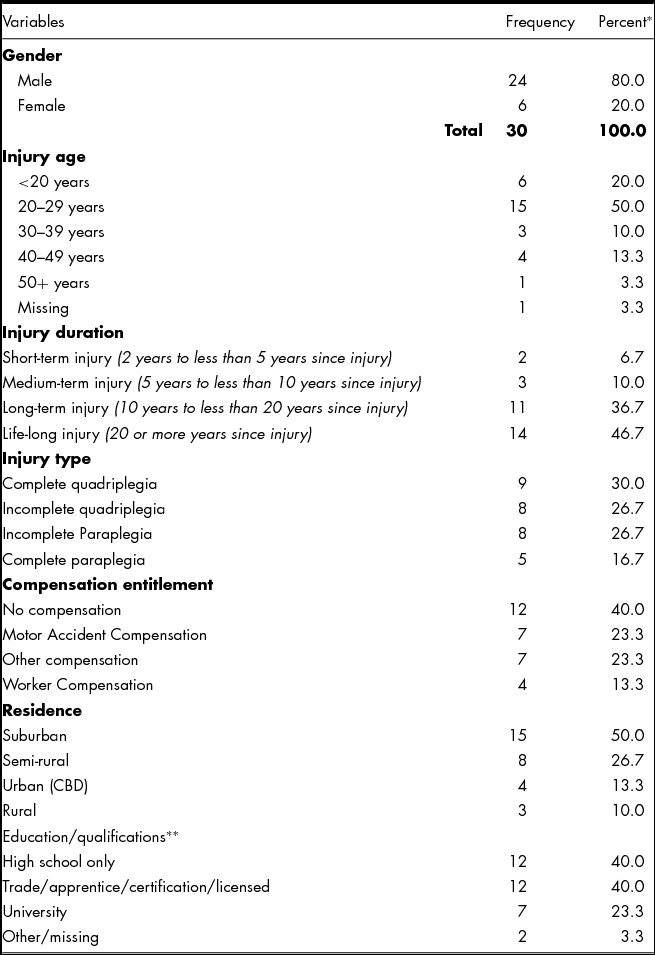
The sample comprised 30 participants with tSCI who had obtained employment post-tSCI but had subsequently withdrawn from that job. The majority of the sample was male (80%), aged from 20–29 years when injured (50%) and received some form of compensation (60%). Quadriplegias were more prevalent than paraplegias (58% vs. 42%) (see Table 1). Thus, the sample was broadly representative of the Australian SCI population in terms of gender, injury age and injury level (Cripps, Reference Cripps2008).
Sample Demographics and SCI Injury Variables

*calculated as % of n = 30 for each option (i.e. as a % of the total sample).
**This category does not equal 100% as some participants hold multiple qualifications.
Measures
Employment cessation survey
Participants completed an in-depth, structured telephone survey about their post-injury job withdrawal experiences. The survey included both coded and free response items on three broad groups of factors hypothesised as critical to job withdrawal: person-centred, job-related and socio-economic. Detailed demographic and employment history information was also collected. The survey took approximately 60 minutes to complete.
Employment history
Participants provided information on their employment at three time-points: pre-injury, post-injury and current. Two indices of employment were collected: (i) work intensity (full-time, part-time etc.) and (ii) occupational status. Occupations were classified according to the Australian Standard Classification of Occupations (ASCO) (Australian Bureau of Statistics, 2013). ASCO is a skills-based classification system designed to capture all occupations in the Australian workforce. According to ASCO, ‘an occupation is a set of jobs with similar sets of tasks’ (McLennan, Reference McLennan1997, p. 5), with the proviso that ‘jobs’ are performed for a wage or salary. Based on skill level and skill specialisation, occupations are classified into eight major groups: (1) manager, (2) professional, (3) technicians and trade-workers, (4) community and personal service workers, (5) clerical and admin workers, (6) sales workers, (7) machinery operators and (8) drivers and labourers. Using the hierarchical groupings of Najman and Bampton (Reference Najman and Bampton1991), ASCO categories were then classified into upper, middle and lower status jobs. Upper status jobs encompassed ASCO categories 1–3, middle status jobs were defined as ASCO category 4 and lower status jobs comprised ASCO categories 5–8.
Statistical Analyses
For the quantitative data, simple proportions were calculated to identify (i) the proportion of the total sample that reported individual job withdrawal factors and (ii) the relative contribution made by each of the broad categories of factors within each of the three systems. For the qualitative data, content analyses techniques were used to identify job withdrawal factors and to provide relevant background information.
Results
Employment — Participants’ Career Trajectory
Work intensity
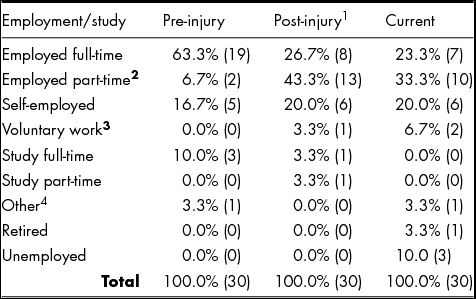
Work intensity declined abruptly post-tSCI (see Table 2). Participants’ career trajectory was characterised by a continual decrease in full-time employment (63% pre-injury; 27% post-injury; 23% currently) and an upsurge in part-time employment (7% pre-injury; 43% post-injury; 33% currently). In contrast, self-employed levels remained comparatively stable at all three measurement points (17–20%).
Work Intensity (Pre-Injury, Post-Injury and Current Employment)
Notes: 1Many participants undertook multiple jobs post-injury, however, the job listed in the post-injury category is the first one they secured following their SCI injury.
2Part-time work varied from 2 to 4 days per week.
3Many participants were involved in voluntary work but few listed it as their main occupation.
4Other category included GAP year and homemaker.
Occupational status
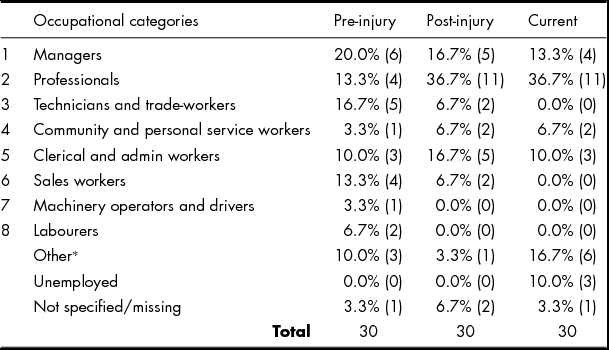
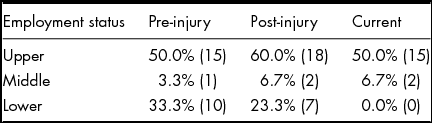
There was a continual decline in engagement in the majority (5/8) of ASCO's occupational categories over the three measurement points (see Table 3). However, there was a striking increase in professional occupations (ASCO category 2) which jumped from 13% pre-injury to 37% post-injury and remained at this level for current employment. Engagement in upper status jobs was the highest at all three measurement points (50%–60% of participants) whereas engagement in lower status occupations declined steadily (30%–0%) (see Table 4). These results argue for a process-oriented versus state-based approach to employment post-tSCI (Chapin & Kewman, Reference Chapin and Kewman2001; Wasiak, Young, Roessler, McPherson, van Poppel, & Anema, Reference Wasiak, Young, Roessler, McPherson, van Poppel and Anema2007).
ASCO Groupings of Pre-Injury, Post-Injury and Current Employment
Notes. Three extra categories were included for the present study. The ‘other’ category includes unpaid jobs (e.g., homemaker, voluntary work), GAP year job, study, retired.
Occupational Status* (Pre-Injury, Post-Injury and Current)
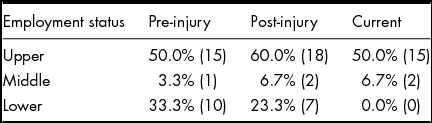
Note. *Occupational status was determined using the hierarchical classification system of Najman and Bampton (Reference Najman and Bampton1991).
Person-Centred (Micro-Level) Factors
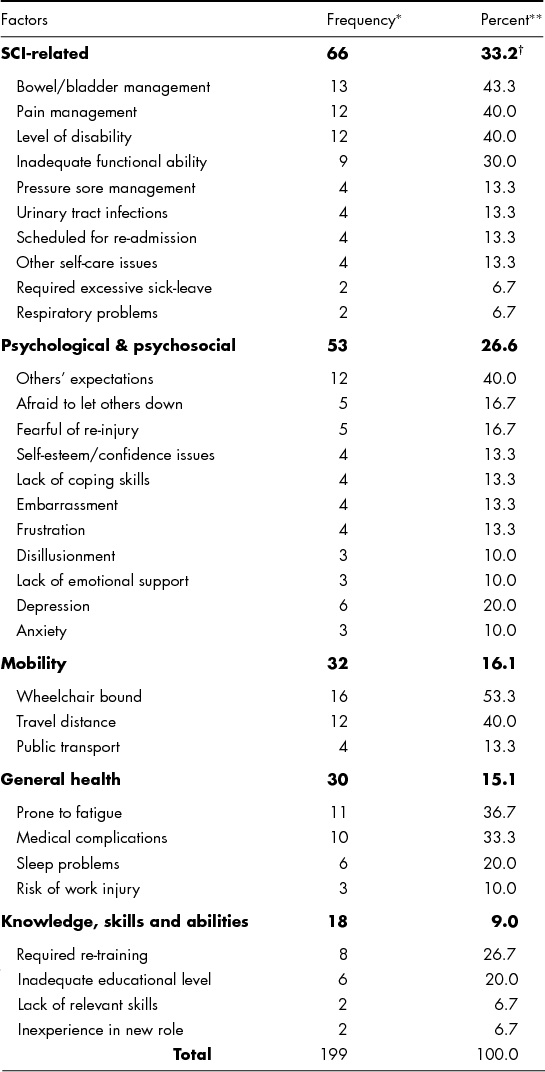
Person-centred job withdrawal factors encompassed physical, psychological and cognitive functioning. In descending order of frequency, five groups of person-centred job withdrawal factors were identified: (i) SCI-related (33%), (ii) psychological and psychosocial (27%), (iii) mobility (16%), (iv) general health (15%) and (v) knowledge/skills/abilities (9%) (see Table 5). Among the individual job withdrawal factors, qualitative analyses revealed that a critical sequelae of ‘inadequate functional ability’ — a key SCI-related factor cited by 30% of the sample — was perceived slowness in the execution of tasks, which often necessitated working extra (unpaid) hours.
Person-Centred (Micro-System) Factors that Precipitated Job Withdrawal
*The frequency with which the item was cited. ** Calculated as a % of the total sample (n = 30) to indicate the proportion of the sample that cited each factor. Ϯ Subtotals (bolded) are calculated as a % of the total number of items (199) to indicate the relative contribution of each broad group of factors to micro-level factors.
‘I had a hard time trying to keep jobs because someone would rock up who was younger and faster and I would lose the job’
‘I used to arrive at the right time but worked an extra hour to compensate for perceived speed’.
Being ‘wheelchair bound’ was the most frequently cited individual factor (53% of the sample). Predominant issues were impeded mobility (e.g., rugged pavements surrounding the workplace, carpeted floors), accessibility (e.g., stairs from car parks, inaccessible hotel rooms) and heightened risk of injury (e.g., tipping over) in some occupations such as, primary school teaching and journalism.
Job-Related (Meso-Level) Factors
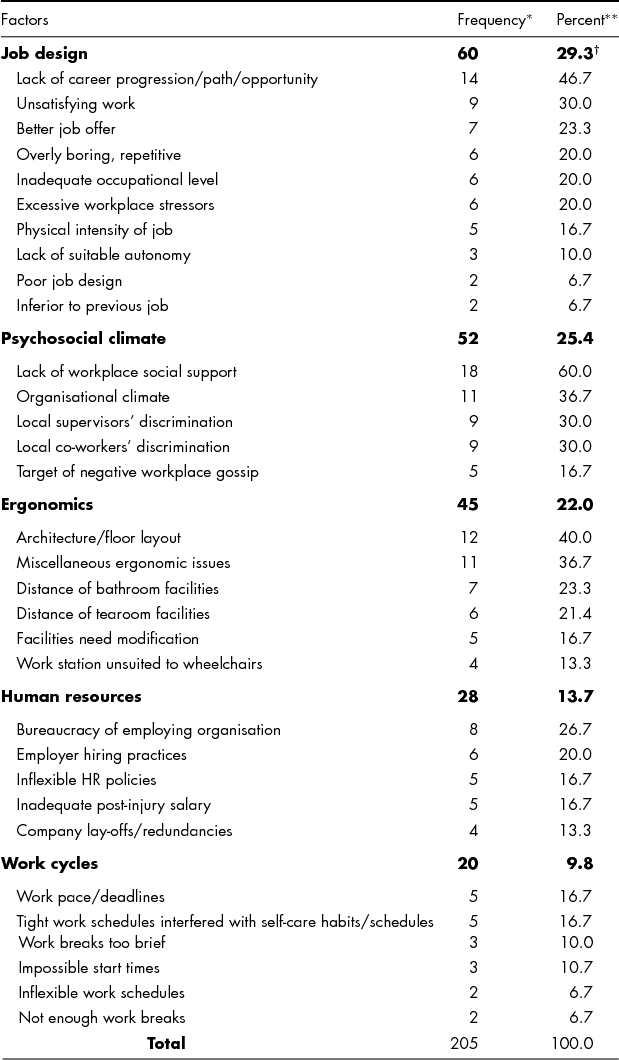
The range and type of job-related withdrawal factors demonstrated the importance of viewing the workplace as a fully-integrated and functioning system. In descending order of frequency, five groups of job-related factors were found to precipitate job withdrawal: (i) job design (29%), (ii) psyhosocial climate (25%), (iii) ergonomics (22%), (iv) human resources (14%) and (v) work cycles (10%) (see Table 6). Qualitative analyses revealed that the psychosocial climate acted as a negative stimulus for job withdrawal whereas job design sometimes also acted as a positive stimulus for job withdrawal. Specifically, exploitation figured in employees’ decision to withdraw from employment and was related to (a) inadequate salary, (b) lack of recognition or undervaluation of work roles, responsibilities and knowledge/skills/abilities and (3) younger age.
Job-Related (Meso-System) Factors that Precipitated Job Withdrawal
*The frequency with which the item was cited. ** Calculated as a % of the total sample (n = 30) to indicate the proportion of the sample that cited each factor. Ϯ Subtotals (bolded) are calculated as a % of the total number of items (202) to indicate the relative contribution of each broad group of factors to meso-level factors.
‘I was cheap labour’
Amongst the self-employed, discrimination — which emanated from clients and staff — resulted in a loss of business, a lack of stable work and lower income. Similarly, exploitation by business partners (e.g., the partner took all of the clients and/or lucrative clients) and staff (who took advantage of the disability) substantially altered post-injury workplace dynamics.
‘Discrimination is a daily thing — it's a constant thing that interferes with business’
‘Being in a wheelchair affects the ability to get clients’
In contrast, accepting another position that promised greater job satisfaction/responsibilities/challenges as well as job security/stable income prompted the decision to withdraw from a (comparatively lesser) job.
Socio-Economic (Macro-Level) Factors
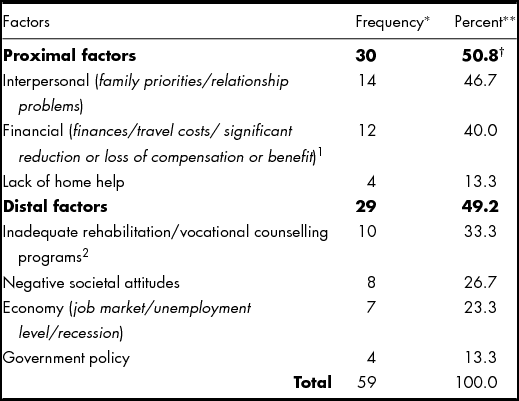
Two groups of macro-level factors were identified: distal (49%) and proximal (51%) (see Table 7). Distal factors focused on the wider socio-economic environment (e.g., economy, societal attitudes and government policies) while proximal factors focused on the immediate socio-economic environment (e.g., financial and interpersonal). Qualitative analyses revealed that macro-level factors (i.e., government policy) directly impacted meso-level factors (i.e., workplace hiring practices) via an implicit relationship with micro-level factors (i.e., SCI-related issues). Specifically, government-level policies and issues were viewed as exerting a negative influence on employment durability post-SCI due to ‘new public management’ in recent years which resulted in a shift to employment-based on merit and, unfortunately, the definition of merit clashes with diversity policy.
Socio-Economic (Macro-System) Factors that Precipitated Job Withdrawal
*The frequency with which the item was cited. **Calculated as a % of the total sample (n = 30) to indicate the proportion of the sample that cited each factor. ϮSubtotals (bolded) are calculated as a % of the total number of items (61) to indicate the relative contribution of each broad group of factors to macro-level factors. 1The compensation/benefit factor was cited twice. 2Rehabilitation and vocational counselling programs are included in the distal factors as they are community-based programs.
Discussion
Within the context of general systems theory, the aim of the present study was to identify and classify the factors that precipitated withdrawal from employment gained post-tSCI. Job withdrawal factors fit into three hierarchical, interconnected and reciprocal systems: micro-system (person-centred) factors, meso-system (job-related) factors and macro-system (socio-economic) factors. At the micro-system level, physical factors precipitated job withdrawal much more frequently than psychological variables (25% of factors) or cognitive functioning variables (~10%). At the meso-system level, five groups of job withdrawal factors were identified: job design, psychosocial climate, ergonomics, human resources and work cycles. Although the macro-system provides the overarching environment within which other systems operate, these factors were the least cited. No participant cited only one factor or, indeed, one system of factors as precipitating job withdrawal — typically a constellation of factors were involved. However, some factors were critical catalysts while others were only mildly influential. Overall, environmental factors (i.e., meso- and macro-level factors) were cited more frequently than personal factors (i.e., micro-level factors).
Micro-System (Person-Centred) Factors
Micro-system factors are among the most studied influences on employment outcomes post-tSCI (e.g., injury and training/education). Nevertheless, when focusing on job withdrawal post-tSCI, the range of micro-system (person-centred) factors identified in the present study — physical, psychological and cognitive — argues for a whole-person approach. As reported elsewhere (Engel, Murphy, Athanasou, & Hickey, Reference Engel, Murphy, Athanasou and Hickey1998), the most frequently cited job withdrawal reason in the present study was health-related. Participant-identified SCI-related factors primarily focused on the secondary complications of SCI (e.g., bowel/bladder management, pressure sores) versus the primary SCI lesion (i.e., level/completeness of injury), which may more accurately reflect participants’ perspectives and lived experience. As found in job retention studies that have included secondary complications Ghatit & Hanson, Reference Ghatit and Hanson1978; Meade et al., Reference Meade, Forchheimer, Krause and Charlifue2011), pressure ulcers and hospitalisations were associated with job withdrawal post-tSCI. Although bowel and bladder management was the most frequently cited SCI-related job withdrawal factor (identified by 43% of the sample) — and is associated with job acquisition — evidence for its role in job retention is conflicting (Chan & Man, Reference Chan and Man2005; Ghatit & Hanson, Reference Ghatit and Hanson1978). Among the psychological/psychosocial job withdrawal factors, which collectively accounted for approximately 25% of micro-system factors, ‘others’ expectations’ were the most frequently cited (40% of the sample). This variable may reflect an external locus of control, which has been associated with poor return-to-work outcomes (Murphy et al., Reference Murphy, Young, Brown and King2003, Reference Murphy, Middleton, Quirk, De Wolf and Cameron2011). However, the multiple variables identified in the present study argue for the inclusion of an extended range of psychological/psychosocial factors (Murphy et al., Reference Murphy, Young, Brown and King2003). Consistent with other research that found employment was terminated partly due to a perceived lack of skills to adequately complete the job (Conroy & McKenna, Reference Conroy and McKenna1999), approximately 10% of micro-system job withdrawal factors were related to knowledge/skills/abilities. Skill acquisition may also reduce or buffer the detrimental impact of meso-system (job-related) factors, such as low occupational level.
Meso-System (Job-Related) Factors
Job design factors were the most frequently cited reason for job withdrawal and point to the reduced satisfactoriness of work attained post-tSCI (e.g., ‘overly boring and repetitive’, ‘lack of suitable autonomy’). Decrements in job satisfactoriness decrease job satisfaction, and decreased job satisfaction is negatively related to job tenure (see Roessler, Reference Roessler2001). In fact, role dissatisfaction has been ranked among the five top most stressful situations faced by employees post-SCI (see Chan & Man, Reference Chan and Man2005). The prominence of job design factors may also reflect employers’ ‘archetypal’ beliefs that people with disabilities were ‘unable to do the work or were somehow less qualified’ (Fraser, Johnson, Hebert, Azjen, Copeland, Brown, & Chan,. Reference Fraser, Johnson, Hebert, Azjen, Copeland, Brown and Chan2010, p. 420). Nevertheless, 23% of the sample reported a positive separation as they left to take up a better job offer. Psychosocial issues were the second most frequently reported cluster of job withdrawal factors: discrimination drove employees out of jobs and resulted in a loss of business among the self-employed. Similarly, other research has reported that workplace discrimination impeded sustained employment (Conroy & McKenna, Reference Conroy and McKenna1999) while workplace gossip, which was identified as very stressful, also led to job withdrawal (Chan & Man, Reference Chan and Man2005). Likewise, employers in medium-sized companies were cognizant of co-worker resentment towards (qualified) workers with disabilities — particularly in relation to workplace accommodations — which adversely influenced their hiring decisions (Fraser et al., Reference Fraser, Johnson, Hebert, Azjen, Copeland, Brown and Chan2010). Managers’ resistance to diversity was also a significant predictor of hiring decisions in medium and larger-sized companies (Fraser, Azjen, Johnson, Hebert, & Chan, Reference Fraser, Azjen, Johnson, Hebert and Chan2011). Among small companies, financial concerns (e.g., decreased profit margins due to slower work pace and cost of accommodations) and risk aversion (e.g., avoidance of litigation) were identified as barriers to hiring qualified people with disabilities (Fraser et al., Reference Fraser, Johnson, Hebert, Azjen, Copeland, Brown and Chan2010). Although ‘lack of workplace social support’ was the most cited individual psychosocial factor in the present study, it has not been widely researched (Murphy & O'Hare, Reference Murphy, O'Hare, Giessen and Harder2011).
Macro-System (Socio-Economic) Factors
Although macro-system factors shape the overarching cultural and socio-economic context within which other systems operate (Brofenbrenner, Reference Brofenbrenner, Gauvain and Cole1994), they were the least cited influence on job withdrawal. Consistent with research that closer referent groups exert a stronger influence on behaviour than do distant referent groups (Levin, Reference Levin1999), proximal social factors (i.e., interpersonal) were cited almost twice as frequently as distal social factors (i.e., negative societal attitudes). Similarly, proximal economic factors (finances) were cited more frequently than distal economic factors (economy) — 40% of the sample reported that finances precipitated job withdrawal. Although less studied than the intrinsic benefits of employment (Krause & Terza, Reference Krause and Terza2006; Krause, Terza & Dismuke, Reference Krause, Terza and Dismuke2008), earnings determine standard of living (Lachowska & Woodbury, Reference Lachowska and Woodbury2012), aid independent living (Lidal et al., Reference Lidal, Huynh and Biering-Sørensen2007), predict extended longevity (Strauss, De Vivo, Shavelle, Brooks, & Paculdo, Reference Strauss, Vivo, Shavelle, Brooks and Paculdo2008) and also influence the intrinsic benefits of employment (i.e., subjective well-being, quality of life and satisfaction) (Hampton, Reference Hampton2004, see also Krause & Terza, Reference Krause and Terza2006). The primacy of ‘inadequate rehabilitation and vocational programs’ among the distal factors may be partly historical as the majority of the sample (83%) was injured more than 10 years ago when rehabilitation programs and vocational expectations were narrower in focus (O'Hare & Murphy, Reference O'Hare and Murphy2012). As 40% of the sample did not receive any form of compensation, it is also likely that they had to rely on a ‘patchwork’ of services which may have fallen short of their needs (Mpofu, Craig, Millington, Murphy, & Dorstyn, Reference Mpofu, Craig, Millington, Murphy and Dorstyn2015). As 28% of job-related (meso-system) factors were job design issues (e.g., unsatisfying work, lack of career progression, inadequate occupational level), specialised vocational programs that include skill acquisition and development may facilitate job retention (Conroy & McKenna, Reference Conroy and McKenna1999). Unlike a Canadian study that identified legislation as one of three critical factors that impacted employment post-SCI (Jongbloed et al., Reference Jongbloed, Backman, Forwell and Carpenter2007), only 13% of the present sample cited government policies as contributing to job withdrawal. Although this disparity may reflect jurisdictional differences between Canada and Australia (Mpofu et al., Reference Mpofu, Craig, Millington, Murphy and Dorstyn2015), it may be partly related to the stronger influence of discrimination by local supervisors and co-workers on job withdrawal decisions (each of these meso-level factors was cited by 30% of the sample). Similarly, normative influences within a company (e.g., beliefs held by managers/HR personnel) were stronger predictors of hiring qualified workers with disabilities than the influence of State/federal agencies (Fraser et al., Reference Fraser, Azjen, Johnson, Hebert and Chan2011).
System-Level Interactions
General systems theory posits interactions and inter-relationships between systems (Laszlo & Krippner, Reference Laszlo, Krippner and Jordan1998; Mele et al., Reference Mele, Pels and Polese2010). Interaction between systems is implicit in much of the research into workplace accommodations. For example, the aim of assistive technology is to reduce the level of workplace disability (Fougeyrollas et al., Reference Fougeyrollas, Noreau and Boschen2002) which implies an interaction between micro-level (person-centred) factors and meso-level (job-related) factors. Similarly, the job withdrawal factors identified in the present research also suggest multiple reciprocal interactions between and among systems. For example, ‘functional ability’ (micro-level factor) and ‘work cycles’ (meso-level factor); job design issues (meso-level factor) and knowledge/skills/abilities (micro-level factor); government policy (macro-level factor) and hiring practices (meso-level factor). Due to its focus on interconnectedness (Laszlo & Krippner, Reference Laszlo, Krippner and Jordan1998), general system theory also provides an integrated framework for intervention development as it endorses interventions at different levels of the system — not just those directed at the individual — to produce change (Patton & McMahon, Reference Patton and McMahon2006). Specifically, a systems approach can provide decision-makers with guidance as to whether a top-down or bottom-up approach would be more feasible or beneficial when implementing interventions. For example, policy-level interventions could address transport-related job withdrawal factors (e.g., legislating a fully accessible transport system) or home care reliability issues (e.g., direct funding to SCI survivors to manage attendant care themselves). Conversely, individual-directed interventions could usefully address the job design issue, ‘a lack of career progression and opportunities’ (e.g., workshops on interview techniques and accessing the hidden job market).
Strengths and Limitations
Two major strengths of the present study are that it identified a broad range of factors that precipitated job withdrawal following the initial return-to-work post-tSCI and applied general systems theory as a conceptual framework to identify, classify and interpret the job withdrawal factors. This approach contributes to an understanding of the factors that hinder job retention (vs. job acquisition) and assists with the identification of potential interventions. Two limitations of the present study are that it reported the frequency of job withdrawal factors, not the salience of each job withdrawal factor. As employment post-tSCI depends on a balance among multiple factors (Fougeyrollas et al., Reference Fougeyrollas, Noreau and Boschen2002), this aspect could be usefully addressed in future research because some factors were critical determinants of job withdrawal while others were only mildly influential. Although broadly representative of the Australian SCI population across gender, injury age and injury level (Cripps, Reference Cripps2008), the sample size was comparatively small.
Conclusion
The foregoing analysis indicates that job withdrawal results from a complex reciprocal interaction between the person — an ‘active, evolving bio-psychological’ system — and the job-related environment (meso-system), all of which operate within the overarching socio-economic and political context of the macro-system (a.k.a Brofenbrenner, Reference Brofenbrenner, Gauvain and Cole1994, p. 38). Furthermore, inclusion of micro-system (person-centred) factors, meso-system (job-related) and macro-system (socio-economic) factors encompasses the medical, economic and (the less-studied) socio-political models of disability (Jongbloed et al., Reference Jongbloed, Backman, Forwell and Carpenter2007). Thus, general systems theory provides a coherent and integrated framework for classifying and interpreting job withdrawal factors, identifying potential interventions and unifying theoretical and empirical research.