Introduction
Sudden sensorineural hearing loss (SNHL) is acute hearing loss that develops within 72 hours.Reference Rauch 1 – Reference Stachler, Chandrasekhar, Archer, Rosenfeld, Schwartz and Barrs 3 It is defined as hearing loss of at least 30 dB affecting three or more contiguous frequencies.Reference Rauch 1 – Reference Stachler, Chandrasekhar, Archer, Rosenfeld, Schwartz and Barrs 3 Physical examination of the external auditory canal and tympanic membrane shows no abnormalities.Reference Rauch 1 , Reference Stachler, Chandrasekhar, Archer, Rosenfeld, Schwartz and Barrs 3 The incidence rate of sudden SNHL is 2–20 cases per 100 000 people per year,Reference Bennett, Kertesz and Yeung 2 – Reference Muzzi, Zennaro, Visentin, Soldano and Sacilotto 5 but no aetiological explanation can be found in 90 per cent of cases.Reference Rauch 1 , Reference Muzzi, Zennaro, Visentin, Soldano and Sacilotto 5 Hypotheses on the aetiology of sudden SNHL in the general population include viral, (micro)vascular and autoimmune causes, as well as Ménière's disease.Reference Muzzi, Zennaro, Visentin, Soldano and Sacilotto 5 – Reference Goodhill 8 Sudden SNHL amongst divers is believed to have a different pathophysiological origin: two frequently reported mechanisms are inner-ear barotrauma and inner-ear decompression sickness.
Boyle's Law states that volume of an airspace is inversely proportional to ambient pressure, and inner-ear barotrauma is a consequence of this relationship.Reference Elliott and Smart 9 , Reference Boyle 10 Ambient pressure rises during diving, resulting in a decreased air volume in the middle-ear cavity. To equalise pressure in the middle ear, additional volume needs to be added through the Eustachian tube by middle-ear clearing techniques (such as the Valsalva manoeuvre).Reference Shupak, Doweck, Greenberg, Gordon, Spitzer and Melamed 11 Middle-ear clearing can result in sudden pressure changes which displace the tympanic membrane and ossicular chain.Reference Goodhill 8 , Reference Elliott and Smart 9 Since the perilymph and endolymph are incompressible, the pressure change is transmitted to other structures such as the labyrinthine membranes and windows.Reference Goodhill 8 , Reference Elliott and Smart 9 , Reference Brubakk and Neuman 12 This is thought to result in rupture of the round or oval window, intralabyrinthine membrane tears or cochlear haemorrhage.Reference Elliott and Smart 9 , Reference Shupak, Doweck, Greenberg, Gordon, Spitzer and Melamed 11 – Reference Parell and Becker 14 Middle-ear clearing techniques can also cause a sudden rise in cerebrospinal fluid pressure, which can be transmitted through the cochlear aqueduct and/or vestibular aqueduct to the perilymph of the cochlea.Reference Goodhill 8 , Reference Elliott and Smart 9 , Reference Shupak 15
Inner-ear decompression sickness results from bubble formation from dissolved inert gas during or after a dive.Reference Klingmann 7 , Reference Edmonds, Bennett, Lippmann and Mitchell 16 – Reference Mitchell and Doolette 19 During a descent, inert gases dissolve in the blood according to Henry's Law, which states that the amount of dissolved gas is directly proportional to ambient pressure.Reference Edmonds, Bennett, Lippmann and Mitchell 16 , Reference Talmi, Finkelstein and Zohar 20 , Reference Henry 21 During ascent, a reverse reaction takes place and inert gas can form bubbles.Reference Edmonds, Bennett, Lippmann and Mitchell 16 , Reference Talmi, Finkelstein and Zohar 20 Bubbles travelling to the labyrinthine or cochlear artery can result in sudden SNHL by blocking arterial vessels, resulting in ischaemia.Reference Mitchell and Doolette 19 It is hypothesised that nitrogen bubbles can result in more damage to the inner ear by stimulating inflammation and activating the coagulation cascade.Reference Gempp and Louge 22 Inner-ear barotrauma and inner-ear decompression sickness can present with isolated sudden SNHL, but can also be accompanied by tinnitus, vertigo, nausea, vomiting and nystagmus.Reference Farmer, Bachrach and Matzen 6 , Reference Shupak, Doweck, Greenberg, Gordon, Spitzer and Melamed 11 , Reference Klingmann, Praetorius, Baumann and Plinkert 23 , Reference Edmonds 24
There is no consensus on the best treatment option for sudden SNHL in either the general population or in divers. Some of the most frequently used treatments are corticosteroids, antivirals, vasodilators and vasoactive substances.Reference Bennett, Kertesz and Yeung 2 , Reference Agarwal and Pothier 25 – Reference Awad, Huins and Pothier 27 These treatment options have all been assessed by Cochrane Reviews; however, none had additional therapeutic value compared with either placebo or no treatment.Reference Agarwal and Pothier 25 – Reference Awad, Huins and Pothier 27 Hyperbaric oxygen therapy could provide an alternative treatment option. Hyperbaric oxygen therapy involves administering 100 per cent oxygen at pressures greater than 100 kPa to increase oxygen levels within hypoxic inner-ear structures and decrease both nitrogen levels and bubble diameter in the blood.Reference Bennett, Kertesz and Yeung 2 , Reference Muzzi, Zennaro, Visentin, Soldano and Sacilotto 5 , Reference Aslan, Oysu, Veyseller and Baserer 28 Hyperbaric oxygen therapy increases the partial pressure of oxygen within blood and capillaries,Reference Bennett, Kertesz and Yeung 2 which stimulates oxygen diffusion from the capillaries into the surrounding tissue, including hypoxic parts of the cochlea.Reference Muzzi, Zennaro, Visentin, Soldano and Sacilotto 5 Secondly, it causes nitrogen bubble dissolution in the labyrinthine and cochlear artery, in accordance with Henry's Law.Reference Mitchell and Doolette 19 , Reference Henry 21 As a result, increased perfusion to the inner ear stimulates cell repair.Reference Bennett, Kertesz and Yeung 2 , Reference Muzzi, Zennaro, Visentin, Soldano and Sacilotto 5 In addition, research shows that hyperbaric oxygen therapy inhibits blood coagulation and pro-inflammatory cytokine production.Reference Muzzi, Zennaro, Visentin, Soldano and Sacilotto 5 Hyperbaric oxygen therapy may therefore stimulate hearing recovery in divers with sudden SNHL due to inner-ear barotrauma or inner-ear decompression sickness. This study aimed to evaluate the therapeutic value of hyperbaric oxygen therapy in divers with sudden SNHL.
Materials and methods
Data selection
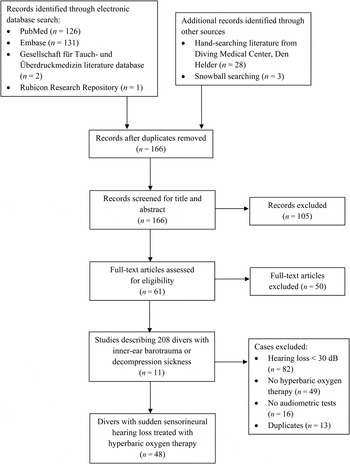
A retrospective analysis was undertaken of three divers with sudden SNHL who were treated with hyperbaric oxygen therapy in two hyperbaric oxygen treatment facilities (Den Helder and Sneek, the Netherlands). These patients were treated between January 2013 and October 2015, and all gave written, informed consent. In addition, all published case reports of divers with sudden SNHL and treated with hyperbaric oxygen therapy were assessed and incorporated into a database. An electronic search of the PubMed, Embase, Cochrane Library, Rubicon Research Repository and Gesellschaft für Tauch-und Überdruckmedizin databases was performed on 10 October 2015 (Figure 1). Hand-searching of literature in the Diving Medical Center library was also conducted. Cases were included if the following three criteria were met: (1) sudden SNHL developed during, or within 72 hours, of a dive (defined as submerging oneself under water for recreational or professional purpose using self-contained underwater breathing apparatus or surface-supplied diving gear; breath-hold and free diving were not included); (2) the patient was treated with hyperbaric oxygen therapy; and (3) outcome was evaluated by audiological testing after the last therapy session. Duplicate case reports were removed by comparing diver and dive characteristics. The following data were collected for all patients: age, sex, maximum diving depth, diving time, diving gas, extent of hearing loss, presence of vestibular symptoms, time between dive and symptom onset, time between symptom onset and hyperbaric oxygen therapy, hyperbaric oxygen treatment table, number of hyperbaric oxygen therapy sessions, additional corticosteroid treatment, follow up, diagnosis, and outcome. Hearing loss was reported as the high Fletcher index (mean hearing loss at 1, 2 and 4 kHz), if available, or as hearing loss determined by the case report.
Flow diagram showing the study selection process.

Statistical analysis
Statistical analysis was performed using IBM SPSS Statistics for Windows software version 21.0 (Armonk, New York, USA) and GraphPad Quickcalcs (http://www.graphpad.com/quickcalcs/). Nominal data were analysed using two-tailed Fisher's exact tests and continuous, non-parametric data were analysed using two-tailed Mann–Whitney U-test. For nominal data, statistical significance was set at a p value of less than 0.05. Owing to the large sample size (n > 20) z scores were used for Mann–Whitney U-tests and statistical significance was set at a z score of less than −1.96 or more than 1.96. The statistical significance of differences in specific characteristics between responders and non-responders was evaluated if the proportion of missing data was smaller than 20 per cent.
Results
Case study 1
A 43-year-old Navy diver attended a 5-day diving course and developed a sensation of fullness of the left ear. On the fifth day of the course, he noticed hearing loss affecting the left ear after a deep dive. During the dive, no clearing difficulties were encountered. He did not suffer from tinnitus, dizziness or nausea. Pure tone audiometry 3 days later showed left-sided perceptive hearing loss with a mean loss of 70 dB at all frequencies (low Fletcher index = 72 dB, high Fletcher index = 72 dB). Magnetic resonance imaging showed no abnormalities of the middle and inner ear. The patient was treated with prednisone for 4 days (80, 60, 40 and 20 mg) and 10 daily hyperbaric oxygen therapy sessions (250 kPa × 75 minutes) on weekdays. Pure tone audiometry five days after the last hyperbaric oxygen session revealed full hearing recovery. Audiometric analysis 11 months later showed similar results.
Case study 2
A 29-year-old Navy diver developed sudden hearing loss 15 minutes after a helium–oxygen dive. The diving profile was a maximum diving depth of 81 m, a diving time of 125 minutes and a bottom time of 20 minutes. Standard decompression schedules were used. He suffered no middle-ear clearing difficulties or pain during diving but did experience fullness of the right ear. There was no tinnitus, dizziness or nausea. Computed tomography showed no middle- and inner-ear abnormalities, in particular, no air in the cochlea. Pure tone audiometry revealed right-sided hearing loss affecting the low frequencies (low Fletcher index = 68 dB, high Fletcher index = 53 dB) and 50 per cent speech discrimination at 80–100 dB. The patient was treated with 50 mg prednisone for 7 days and 10 daily hyperbaric oxygen therapy sessions (250 kPa × 75 minutes) on weekdays. Two days after the last hyperbaric oxygen session, pure tone audiometry showed persistent hearing loss in the low frequencies (low Fletcher index = 27 dB, high Fletcher index = 13 dB). Speech discrimination had improved to 100 per cent at 75 dB. Audiometric analysis one month later showed similar results.
Case study 3
A 29-year-old Navy diver woke up with right-sided hearing loss 2 days after a dive and developed tinnitus later that day. The diving profile was a maximum diving depth of 9 m and a diving time of 20 minutes; the dive finished with rapid ascent from 9 m. During the dive, no pain or middle-ear clearing difficulties were experienced. Pure tone audiometry showed right-sided hearing loss mainly affecting the low frequencies (low Fletcher index = 73 dB, high Fletcher index = 57 dB). Magnetic resonance imaging showed no abnormalities and serological tests were normal. The patient was treated with prednisone for 8 days on a tapering schedule (80, 80, 60, 60, 40, 40, 20 and 20 mg) and 10 daily hyperbaric oxygen therapy sessions on weekdays. After six hyperbaric oxygen therapy sessions, pure tone audiometry showed a marked improvement (maximum hearing loss at 4 kHz of 30 dB). Four days after the last hyperbaric oxygen therapy session, pure tone audiometry showed complete recovery of hearing. Audiometric analysis 9 months later showed similar results.
Published case reports
In addition to the 3 case reports described above, 48 case reports of divers with sudden SNHL and treated with hyperbaric oxygen therapy were retrieved from a literature search (Figure 1).Reference Klingmann 7 , Reference Klingmann, Praetorius, Baumann and Plinkert 23 , Reference Brink 29 – Reference Smerz 37
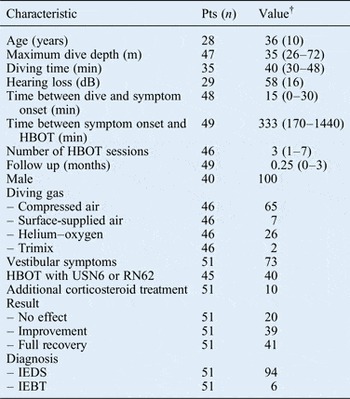
All divers were male, with a mean age of 36 years. The median maximum diving depth was 35 m and the median diving time was 40 minutes. Most divers (65 per cent) used compressed air as the diving gas. The mean hearing loss was 58 dB, and 73 per cent of divers experienced vestibular symptoms that developed after a median of 15 minutes after diving. Divers were treated after a median time of 333 minutes with a median of 3 hyperbaric oxygen sessions. In 10 per cent of cases, divers were additionally treated with corticosteroids. Hearing improved in response to hyperbaric oxygen therapy in 80 per cent of cases: 39 per cent had some improvement and 41 per cent had a full recovery. In 20 per cent of cases, no hearing improvement was detected (Table I). There were no reports of hearing deterioration in response to hyperbaric oxygen therapy.
Baseline characteristics of divers with sudden SNHL treated with HBOT*

* N = 51. †Non-parametric continuous data are reported as medians (Q1–Q3); parametric continuous data are reported as means (SD); non-continuous data are presented as percentages. SNHL = sensorineural hearing loss; HBOT = hyperbaric oxygen therapy; Pts = patients; Q1 = first quartile; Q3 = third quartile; SD = standard deviation; min = minutes; trimix = oxygen, nitrogen, helium; USN6 = United States Navy Treatment Table 6; RN62 = Royal Navy Table 62; IEDS = inner-ear decompression sickness; IEBT = inner-ear barotrauma
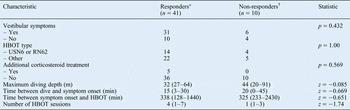
There were no statistical differences in vestibular symptoms, use of hyperbaric oxygen US Navy Treatment Table 6 or corticosteroid use between responders and non-responders to hyperbaric oxygen therapy. Further, there were no differences in maximum diving depth, time between dive and symptom onset, and time between symptom onset and start of hyperbaric oxygen therapy in divers who responded to hyperbaric oxygen therapy and those who did not. Responding divers had received more hyperbaric oxygen sessions than non-responding divers, although this difference was not statistically significant (z score = −1.74; Table II).
Statistical analysis of divers with sudden SNHL treated with HBOT

Non-parametric continuous data are reported as medians (Q1–Q3), parametric continuous data are reported as means (standard deviation), non-continuous data are reported as percentages. *Divers whose hearing improved or recovered completely in response to HBOT. †Divers whose hearing did not improve in response to HBOT. SNHL = sensorineural hearing loss; HBOT = hyperbaric oxygen therapy; USN6 = US Navy Treatment Table 6; RN62 = Royal Navy Table 62; min = minutes; Q1 = first quartile; Q3 = third quartile
Discussion
An analysis of 51 divers with sudden SNHL showed that hyperbaric oxygen therapy resulted in at least some reversal of hearing loss in 80 per cent of cases. The therapeutic effect of hyperbaric oxygen therapy appeared to be greater for divers who received more therapy sessions. The clinical relevance of hyperbaric oxygen therapy, however, is difficult to assess because spontaneous improvement in sudden SNHL of up to 65 percent has been reported in the general population.Reference Rauch 1 , Reference Mattox and Simmons 38
Published case series
Smerz studied hearing loss in 10 divers who presented with isolated inner-ear decompression sickness and were treated with hyperbaric oxygen therapy.Reference Smerz 37 The hearing of all divers showed a clinical improvement: half made a full recovery and half retained some hearing deficit after the last treatment session. Shupak et al. studied inner-ear decompression sickness in 11 recreational divers treated with hyperbaric oxygen therapy, of whom 8 experienced hearing loss: 3 of these (38 per cent) made a full recovery and 5 (62 per cent) suffered residual hearing loss.Reference Shupak, Gil, Nachum, Miller, Gordon and Tal 35 Nachum et al. reported inner-ear decompression sickness with cochlear involvement in 21 sport compressed air divers treated with hyperbaric oxygen therapy: 6 (29 per cent) made a full recovery, 8 (38 per cent) had improved audiological test findings and 7 (33 per cent) had no hearing improvement after therapy.Reference Nachum, Shupak, Spitzer, Sharoni, Doweck and Gordon 32 Farmer et al. reported the cases of 11 divers suffering from inner-ear decompression sickness with hearing loss, who were treated with hyperbaric oxygen therapy.Reference Farmer, Thomas, Youngblood and Bennett 31 Eight divers (73 per cent) made a good recovery and three (27 per cent) experienced no hearing improvement. Klingman et al. reported hearing loss in 10 divers with inner-ear decompression sickness that was treated with hyperbaric oxygen therapy and corticosteroids.Reference Klingmann 7 , Reference Klingmann, Praetorius, Baumann and Plinkert 23 , Reference Klingmann, Benton, Ringleb and Knauth 33 Five divers (50 per cent) made a full recovery and five (50 per cent) had residual hearing loss after treatment. One diver with inner-ear barotrauma and hearing loss also underwent hyperbaric oxygen therapy: this patient experienced a remarkable hearing improvement from 80 dB to 15 dB after treatment.
Studies into the effectiveness of hyperbaric oxygen therapy in non-divers with sudden SNHL have reported mixed results. In 2012, the value of hyperbaric oxygen therapy for idiopathic sudden SNHL and tinnitus in non-divers was assessed in a Cochrane Review.Reference Bennett, Kertesz, Perleth, Yeung and Lehm 39 A pooled analysis revealed that hyperbaric oxygen therapy significantly increased the proportion of patients gaining a 25 per cent hearing improvement (p = 0.02). Five patients had to be treated to obtain one good outcome. Bennett et al. concluded that although hyperbaric oxygen therapy had a beneficial effect, it was difficult to assess its clinical relevance because of the ‘modest number of patients, methodological shortcomings and poor reporting’. In addition, Aslan et al. reported significant hearing improvement in 25 non-divers with idiopathic sudden SNHL treated with hyperbaric oxygen therapy (in addition to conventional therapy) compared with a control group receiving conventional therapy only.Reference Aslan, Oysu, Veyseller and Baserer 28 In two separate studies, Çekin et al. and Satar et al. compared hyperbaric oxygen therapy with conventional therapy, but reported no significant difference in the beneficial effects of both therapies.Reference Çekin, Cincik, Ulubil and Gungor 40 , Reference Satar, Hidir and Yetiser 41 In a retrospective analysis, Kestler et al. investigated the effect of hyperbaric oxygen therapy in 49 sudden SNHL patients and found it to be comparable to spontaneous recovery rates.Reference Kestler, Strutz and Heiden 42 They concluded that hyperbaric oxygen therapy had no additional value as a primary treatment option for sudden SNHL. Comparing these results to our own data suggests that hyperbaric oxygen therapy may be more effective in divers than in the general population. This difference might be caused by the different pathophysiological mechanisms for sudden SNHL in divers (inner-ear barotrauma and inner-ear decompression sickness) and the general population (viral, vascular and autoimmune causes).
US Navy Treatment Table 6 is the most frequently used hyperbaric oxygen treatment table.Reference Shupak, Doweck, Greenberg, Gordon, Spitzer and Melamed 11 , Reference Gempp and Louge 22 , Reference Edmonds 24 , Reference Brink 29 , Reference Nachum, Shupak, Spitzer, Sharoni, Doweck and Gordon 32 , Reference Leverment, Wolfers and Kertesz 34 – Reference Wong and Walker 36 The present study showed a similar level of usage of US Navy Treatment Table 6 between responders and non-responders (Table II), suggesting that this treatment table is not superior to others. Several other studies also reported no difference in therapeutic outcome between different treatment tables.Reference Gempp and Louge 22 , Reference Smerz 37
There are no published recommendations on the optimal number of hyperbaric oxygen treatments for sudden SNHL in divers. The Undersea and Hyperbaric Medical Society recommends 10–20 hyperbaric oxygen treatments for sudden SNHL in non-divers.Reference Muzzi, Zennaro, Visentin, Soldano and Sacilotto 5 , Reference Weaver 43 The present study found that responding divers received more hyperbaric oxygen treatment sessions than non-responding divers (four versus one, z score = −1.74). Although the difference was not statistically significant, it suggests that a higher number of hyperbaric oxygen treatments is associated with a better treatment outcome. This has also been suggested by previous studies reporting a beneficial effect of hyperbaric oxygen therapy after 10–20 sessions.Reference Muzzi, Zennaro, Visentin, Soldano and Sacilotto 5 , Reference Aslan, Oysu, Veyseller and Baserer 28 , Reference Çekin, Cincik, Ulubil and Gungor 40 , Reference Fattori, Berrettine, Casani, Nacci, De Vito and De Iaco 44 It is therefore possible that the non-responding divers from our analysis could have benefited from more hyperbaric oxygen therapy sessions.
Strengths and limitations
The present analysis of 51 divers with sudden SNHL and treated with hyperbaric oxygen therapy is the largest of its kind. Unfortunately, the analysis was hindered by several different kinds of bias. First of all, publication bias might have a major effect on the results. Reports of divers with a good response to hyperbaric oxygen therapy are more likely to be published than studies in which no positive effect of hyperbaric oxygen therapy was found. As a result, the beneficial effect of hyperbaric oxygen therapy might be overestimated in the present analysis.
Another limiting factor is that the cases included in this analysis were not extracted from clinical trials and patients consequently had different diagnostic tests, additional treatments and lengths of follow up. The most important difference was the variation in audiological testing.Reference Klingmann 7 , Reference Klingmann, Praetorius, Baumann and Plinkert 23 , Reference Brink 29 – Reference Smerz 37 Some divers were not subjected to pure tone audiometry before the start of hyperbaric oxygen therapy. Instead, audiological evaluation took place either between therapy sessions or after the last treatment. This might have led to underestimation of the beneficial effect of hyperbaric oxygen therapy as the effect of the first session(s) was excluded from the analysis.
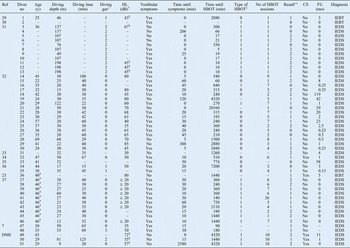
Another factor that may have led to underestimation of the therapeutic effect of hyperbaric oxygen is the inclusion of some cases with a long treatment delay. Limited research suggests that the best therapeutic effect is achieved with a shorter treatment delay.Reference Gempp and Louge 22 , Reference Klingmann, Praetorius, Baumann and Plinkert 23 , Reference Farmer, Thomas, Youngblood and Bennett 31 , Reference Nachum, Shupak, Spitzer, Sharoni, Doweck and Gordon 32 , Reference Shupak, Gil, Nachum, Miller, Gordon and Tal 35 The present analysis included two cases with a considerable delay between symptom onset and the start of hyperbaric oxygen therapy (Table III): these divers commenced treatment after 5 and 14 days, respectively, after symptom onset and experienced no hearing improvement. The therapeutic effect of hyperbaric oxygen is likely to be greatest in the first hours or days after symptom onset. The inner ear is a delicate structure, and diving-related damage to the cochlea can progress to permanent damage within a short period.Reference Freeman and Edmonds 45 Consequently, therapy should be initiated as soon as possible.Reference Gempp and Louge 22 , Reference Klingmann, Praetorius, Baumann and Plinkert 23 , Reference Farmer, Thomas, Youngblood and Bennett 31 , Reference Nachum, Shupak, Spitzer, Sharoni, Doweck and Gordon 32 , Reference Shupak, Gil, Nachum, Miller, Gordon and Tal 35 These conclusions are based on clinical experience, pathophysiology and published reports. However, they are not supported by the statistical analysis in this report since there was no significant difference in the length of time between symptom start and hyperbaric oxygen therapy between responders and non-responders (z score = −0.651). Excluding the two cases with long treatment delays from the analysis had no effect (z score = −0.539). However, this may be the result of the small study populations included in the present analysis.
Characteristics of divers with sudden SNHL treated with HBOT

*0 = compressed air; 1 = surface-supplied air; 2 = trimix (oxygen, nitrogen, helium); 3 = helium–oxygen. †Reported as hearing loss defined by article describing the case. ‡HBO treatment table: 0 = US Navy Treatment Table 6 or Royal Navy Table 62, 1 = other. **0 = no effect; 1 = improvement in pure tone audiometry and/or speech discrimination test; 2 = full recovery of hearing. §Reported as high Fletcher index. #Mean values reported in article describing the case; these values were not used in the statistical analysis. SNHL = sensorineural hearing loss; HBOT = hyperbaric oxygen therapy; Ref = reference; – = unknown or not reported; No = number; y = years; min = minutes; CS = corticosteroids; FU = follow up; HL = hearing loss; mo = months; IEBT = inner-ear barotrauma; IEDS = inner-ear decompression sickness; DMS = Dive Medical Center, Royal Netherlands Navy, Den Helder
The median follow up of cases included in the present study was only 0.25 months (Table I), which made it impossible to draw conclusions on the long-term effects of hyperbaric oxygen therapy. The absence of long-term follow up for divers with sudden SNHL has been noted in previous studies.Reference Klingmann, Praetorius, Baumann and Plinkert 23 , Reference Shupak, Gil, Nachum, Miller, Gordon and Tal 35 However, this is unlikely to represent a weakness of the present study because most of the therapeutic effects of hyperbaric oxygen are expected to take place directly after the initial damage. If no hearing improvement is found shortly after therapy, then spontaneous recovery is not expected to occur later. The three divers treated in our hyperbaric oxygen therapy facility showed no change in hearing loss at 1, 9 and 11 months, respectively, following hyperbaric oxygen therapy (Table III). Furthermore, deterioration is seldom seen in the late recovery phase.
Safety
Hyperbaric oxygen therapy appears to be a safe therapy since no side effects or adverse events were published in the case reports. Only one adverse event occurred during treatment in our own hyperbaric oxygen therapy facility: a diver experienced nausea during one therapy session, which resolved spontaneously during the session. Furthermore, none of the divers included in this analysis experienced hearing deterioration during hyperbaric oxygen therapy.
Three divers with hearing loss due to inner-ear barotrauma were included in the analysis. These cases were of special interest because some experts believe that hyperbaric oxygen therapy can increase cochlea damage in patients with inner-ear barotrauma.Reference Farmer, Thomas, Youngblood and Bennett 31 The hyperbaric conditions that patients experience during hyperbaric oxygen therapy may simulate the conditions that initially caused the inner-ear barotrauma. However, the present results do not support this theory since no adverse events or deterioration of hearing loss were reported for the divers with inner-ear barotrauma, although the small sample size (n = 3) means that this finding should be interpreted with caution. Future research is necessary to confirm these results.
-
• Sudden sensorineural hearing loss in divers is caused by inner-ear barotrauma or inner-ear decompression sickness
-
• There is no consensus on the best treatment options for sudden sensorineural hearing loss in divers and general population
-
• This study evaluated the therapeutic effect of hyperbaric oxygen therapy in 51 divers with sudden sensorineural hearing loss
-
• Hyperbaric oxygen therapy resulted in hearing improvement in 80 per cent of divers
-
• Responding divers had received more hyperbaric oxygen therapy sessions
Clinical implications
This analysis confirmed that hyperbaric oxygen therapy can improve hearing when applied as a primary treatment for sudden SNHL in divers. Since diving is increasing in popularity, more cases of sudden SNHL in divers are likely to be encountered in the future. In addition, the number of hyperbaric oxygen therapy facilities is increasing and more divers receive this therapy for diving-related injuries. The proportion of divers undergoing hyperbaric oxygen therapy for inner-ear decompression sickness rose from 45 per cent in 2003 to 89 per cent in 2005.Reference Klingmann, Praetorius, Baumann and Plinkert 23 All of these developments can drive research efforts. Future clinical trials into the therapeutic effects of hyperbaric oxygen therapy for sudden SNHL in divers are anticipated to support the present findings.
Conclusion
Hyperbaric oxygen therapy resulted in hearing improvement in 80 per cent of divers with sudden SNHL. This type of therapy is more effective if more therapy sessions are received.