Introduction
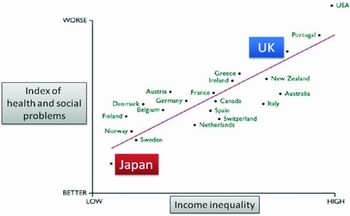
This article revisits some of the evidence presented in The Spirit Level, the highly successful book by Richard Wilkinson and Kate Pickett (Reference Wilkinson and Pickett2009). This book, building on several decades of academic research, has popularised the ‘income inequality hypothesis’ (also known as the ‘relative income hypothesis’), drawing public and political attention to the theory that more equal societies have greater health and social well-being. Analysis within The Spirit Level is based upon international comparisons of industrialised countries and has brought to wide notice the perception that Japan is an exemplar of the value of greater equality, with better health and fewer social problems than other industrialised nations (see Figure 1). In contrast, the UK is highlighted in this book as an example of an industrialised country with relatively poor health, high income inequality and marked social divisions (Wilkinson and Pickett, Reference Wilkinson and Pickett2009).Footnote 1
Japan and the UK in The Spirit Level
Source: After Wilkinson and Pickett, Reference Wilkinson and Pickett2009; http://www.equalitytrust.org.uk.

The research presented in this article aims to revisit these debates and, in particular, The Spirit Level evidence according to which Japan is a more equitable and hence harmonious society than is any other industrialised country, but especially contrasts with a country such as the UK. It is particularly interesting to revisit this evidence now, as the Organisation for Economic Co-operation and Development (OECD) has recently published three reports according to which income inequality in Japan is higher than suggested in The Spirit Level, as well as above the OECD average (OECD, 2011a, b and c). Specifically, according to the most recent of these reports (OECD, 2011c: 45, table sub-section presenting levels in the late 2000s) Japan has the eleventh highest Gini co-efficient out of thirty-four countries, whereas the UK has the eighth highest value. When we look at the inter-quintile share ratio (S80/S20), Japan has the eighth highest value out of thirty-four countries and is ranked just above the UK which has the ninth highest value. In addition, a recent special report was published in the New Scientist magazine on what is described as ‘the age of inequality’. One of the articles in this report (Else, Reference Else2012) uses statistics according to which income inequality in Japan is higher than that of Denmark, Germany and Greece and only slightly lower than the UK. But when we look at the most recent income data presented in the 2011 United Nations (UN) development report (United Nations, 2011), Japan has the lowest quintile income ratio of all when compared to the same set of countries presented in the OECD (2011c) report (but with no data for Iceland and Luxemburg), whereas the UK has the seventh highest value. The UN Human Development Report does not include any data on Gini coefficients for either Japan or the UK. These discrepancies indicate the case for a thorough and systematic review of the quality of income microdata used to calculate official statistics, as the use of the wrong measures will lead to erroneous conclusions.
It is also interesting to note that within Japan, perceptions of the country's socio-economic structure have changed over time. A self-image of the country as a highly egalitarian ‘90 per cent middle-class society’ has been commonly held among the population in the post-war era and, especially, from the mid-1960s onwards (Tachibanaki, Reference Tachibanaki1998; Brinckmann, Reference Brinckmann2008; Chiavacci, Reference Chiavacci2008, Reference Chiavacci2010). However, in recent years, since Japanese economist Toshiaki Tachibanaki published the ground breaking book Confronting Income Inequality in Japan in 1998, this characterisation has been challenged significantly. While some analysis of data in Japan has suggested that income inequality has grown in recent decades and is now relatively high compared to other industrialised countries (Tachibanaki, Reference Tachibanaki2006), it has also been argued that ‘empirical studies on income distribution and social mobility do not support a fundamental transformation of Japan from a general middle-class society to a divided society’ (Chiavacci, Reference Chiavacci2008: 18). Japanese social researchers have, however, increasingly focussed upon the problem of poverty and social exclusion in Japan (for example, see Abe, Reference Abe2011).
Paradoxically, therefore, increasing attention in the UK, and internationally, has recently become focussed upon Japan's socio-economic equality following a period in which many Japanese researchers have decisively rejected this characterisation of their country's social structure and some international data have indicated that the country may now have relatively high levels of inequality.
It is also noteworthy that in the UK, several critics of The Spirit Level have produced publications attacking the income inequality hypothesis and questioning the international comparisons contained in the book (Sanandaji et al., Reference Sanandaji, Malm and Sanandaji2010; Saunders, Reference Saunders2010; Snowdon, Reference Snowdon2010). They too have focussed upon Japan because of its significance as an exemplar of the income inequality hypothesis, and have questioned the role of income inequality in explaining high life expectancy in Japan. These critics have suggested instead that Japan's good health is explained by the genes, diet or racial and cultural homogeneity of its population.
Japan and the UK therefore have, in different ways, been at the centre of recent international academic and political debates regarding health and social equality and well-being in industrialised countries. Nevertheless, no studies have compared recent trends in income distribution in the two countries, despite concern among some Japanese researchers that the growth in income inequality in Japan means that Japan is no longer the exemplar of social equality it has been widely perceived to be. The publication of The Spirit Level and the recent contrasting international comparisons suggest that further investigation is required.
The aim of this article is to build upon previous comparative studies by conducting further analysis of income microdata in the UK and Japan and in particular to estimate the levels of inequality using the best and most suitable available data sets in both countries.
Data and methods
The data used in The Spirit Level work came from high quality, reputable sources such as the World Bank, the World Health Organisation, the United Nations (UN) and the Organisation for Economic Cooperation and Development (OECD). All international comparisons of income inequality in the book were based on data from the United Nations Development Programme Human Development Indicators.
The income data upon which the recent OECD reports are based come from the ‘OECD database on income distribution and poverty’ (OECD, 2011a, b, c). According to the metadata of this database (OECD, 2011d), the data on the UK come from the Family Expenditure Survey (FES) and Family Resources Survey (FRS), whereas the data on Japan come from the Comprehensive Survey of Living Conditions (CSLC). The FRS has a sample size of approximately 24,000 per annum making it suitable for the collection of comprehensive statistical data on the benefit uptake and financial status of specific groups (Department for Work and Pensions, 2011). The income component of the CSLC records comprehensive information on the living conditions and quality of life of Japanese households (Ministry of Health, Labour and Welfare, 2011). The sample size of the income component of the survey varies, but the OECD data are based on a larger survey taken every three years with a sample of around 32,000 households (Mira d'Ercole, Reference Mira d'Ercole2006). It is also important to note that in the past the OECD studies relied on a different source of data for Japan (see Burniaux et al., Reference Burniaux, Dang, Fore, Förster, Mira d'Ercole and Oxley1998): the National Survey of Family Income and Expenditure (NSFIE). They only more recently switched to the CSLC (Förster and Mira d'Ercole, Reference Förster and Mira d'Ercole2005; Mira d'Ercole, Reference Mira d'Ercole2006).
It has been suggested that understanding variations between different sources of Japanese income data may be a key part of resolving disputes regarding Japanese income distribution. For example, when discussing the controversy around income inequality statistics for Japan, Chiavacci (Reference Chiavacci2008) highlighted that organisations such as the World Bank use the NSFIE, whereas other studies (including the more recent work of the OECD and that of Tachibanaki, Reference Tachibanaki1998) are based on the CLCS. There have long been debates on the most suitable data sets for the analysis of income inequality in Japan, and it can be argued that there is a need for a thorough review. The last comprehensive attempt to provide such a review was twenty years ago by Bauer and Mason (Reference Bauer and Mason1992), who identified and reviewed suitable income and wealth data in Japan and highlighted the substantial variation in income inequality measures between studies based on different Japanese data sets, arguing that ‘given these data problems, the country's relative ranking in international comparisons of income equality is a matter of some dispute’ (Bauer and Mason, Reference Bauer and Mason1992: 426). Also, of relevance is the work of Mira d'Ercole (Reference Mira d'Ercole2006) comparing income inequality in Japan to other OECD countries using the CSLC, and pointing to the work of Bauer and Mason (Reference Bauer and Mason1992) and suggesting that the ‘data from the National Survey of Family Income and Expenditure were less suitable for cross-county comparisons than those provided by the Comprehensive Survey, because of the exclusion of households primarily engaged in agriculture and of significant under-reporting of social security and property income’ (Mira d'Ercole, Reference Mira d'Ercole2006: 12). It should be noted, however, that the claim regarding the exclusion of households primarily engaged in agriculture in the NFIES made by Bauer and Mason (Reference Bauer and Mason1992) and cited by Mira D'Ercole is not correct. This was only the case, at the time, for the Family Income and Expenditure Survey (FIES), a different survey from the NFIES which, contrary to this assertion, always included households primarily engaged in agriculture. In contrast, it has also been suggested that the CLSC may be biased due to over-sampling of low income households (Yonezawa and Kaneko, Reference Yonezawa and Kaneko2007; also see Funaoka, Reference Funaoka2001Footnote 2) resulting in over-estimates of income inequality and overall bias compared to the NSFIE (Jacobs, Reference Jacobs2000; Nishizaki et al., Reference Nishizaki and Yamada1997). The CSLC also includes student households, leading to additional potential bias issues due to under-reporting of income (Funaoka, Reference Funaoka2001), whereas the NSFIE does not. Further, it has also been argued that there is over-reporting of elderly households and under-reporting of younger households in the CSLC (Yonezawa and Kaneko, Reference Yonezawa and Kaneko2007; Cabinet Office, 2007). It is also noteworthy that Moriguchi and Saez, in a study of the evolution of income concentration in Japan, used tax statistics and found that the ‘estimated average incomes from the NSFIE coincide well with those from the official tax statistics up to the top 1% income group’ (2008: 724). However, Yamada et al. (Reference Yamada, Shikata, Tanaka and Komamura2010) suggests that the proportion of low income households may be relatively small in NSFIE, in comparison with other nationally representative data collected by the Statistics Bureau.
Against this background, we conducted a review of all currently available data sets in both Japan and the UK that include sources of income that could be potentially used to compare inequality between the two countries (see Ballas et al., Reference Ballas, Dorling, Nakaya, Tunstall and Hanaoka2011). We found that there were far fewer data sets containing individual and household income in Japan than in the UK. In particular, we identified only one data set in Japan that was potentially available to us in microdata form and has information on income measured in absolute terms (not banded) and this was the NSFIE. Until recently, NSFIE data were only available to government officials and a small number of researchers, subject to successful application, but in 2009 the Japanese Statistics Bureau made it possible to apply for resampled anonymised data for use in academic research. Digital survey microdata sets for the years since (and including) 1989 are available subject to successful application to the Bureau. On the other hand, MHLW has begun to provide the anonymised CSLC data sets for the years 2001 and 2004 since April 2011, subject to successful application, but only two survey periods are potentially available at present and the periods are less suitable for comparisons with UK data sets.
In the context of the research presented in this article, we successfully applied to the Japanese Statistics Bureau for access to NSFIE. The NSFIE has been the basis for various studies, including the work of the World Bank. It has a sample size of over 50,000 households (excluding student households and non-Japanese citizens) and it includes information on sources of gross income as well as tax, national social insurance contributions and other deductions. The income recorded is released in absolute values (rather than banded) but extremely high incomes are top-coded. The data set also includes a set of weights that can be used to deal with sample bias by adjusting by known population totals. Given the controversy surrounding the use of Japanese data sets to study income inequality which is discussed above, we decided to perform (as an additional quality control) a comparison between the most recent NSFIE data that we had at our disposal and the Census of Japanese population, which is the most authoritative social accounting of people and housing in the country. These comparisons largely suggest that the NSFIE data are quite robust and representative of the Japanese population (for more details, see Ballas et al., Reference Ballas, Dorling, Nakaya, Tunstall and Hanaoka2011).
Looking at the UK data, the survey data set with the largest sample size is the FRS, which we have already briefly described above, and its refined Households Below Average Income (HBAI) version. The latter data set builds on the data produced by the FRS in order to ensure that household income data are properly comparable between households (Adams et al., Reference Adams, Barton, Bray, Johnson and Matejic2010). In addition, the survey includes record weights that were calculated to reflect revised population estimates from the 2001 Census.Footnote 3
Considering all the issues and points discussed above, we concluded that the HBAI/FRS and the NSFIE were the most suitable to conduct a comparative study between the UK and Japan. The next step was to ensure that the variables that we were going to analyse were appropriate and comparable. The HBAI data set included adjustment to the income values to allow for household size and composition, a process known as equivilisation. The HBAI data include calculated equivalence figures for each household using the McClements and OECD methods (before and after housing costs; for more details see Adams et al., Reference Adams, Barton, Bray, Johnson and Matejic2010: 213). For the purposes of the research presented here, we used the OECD equivalence scales. In particular, we used the existing figures in the HBAI and we calculated the scales for the NSFIE data set, using the household size and composition information.
In addition, the HBAI contained data on gross as well as disposable income. The NSFIE had information on gross incomes as well as tax and national social insurance payments for every individual, which we deducted from the gross income in order to produce an estimate of disposable income. Nevertheless, we observed that this estimate was very problematic as there were several high income households with zero tax values, due to the survey recording tax paid in the current month instead of the average figure for the whole year (and some of the higher income households paid all of their taxes towards the end of the year rather than similar amounts monthly). In order to tackle this problem, we decided to attempt to estimate the tax paid by Japanese households.
We focused on two major types of tax to be estimated: income tax and local government resident tax. It should be noted that the data set did not have any information on the earnings of each individual household member, so we had to assume that the household is taxed as if there is only one earner in each household and they receive all the paid income. Nevertheless, it should be noted that given that the overall difference in tax rates in Japan is smaller than that in the UK, and that Japan tends to have more one-income households than the UK, the overall effect of this assumption would be very slight, mainly affecting the incomes of high income dual earner households which may be very few in number.
Another assumption that we made was that the source of all household income is employment, as there was no information in the data on the actual income source. Again, it could be reasonably expected that this assumption would have a relatively slight effect, given that most income is from employment.
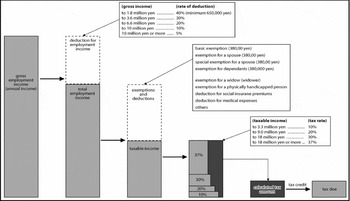
Based on these assumptions, we estimated employment income tax by using relevant official information published by the government of Japan and which is summarised in Figure 2. We also estimated social insurance payments for each household by applying a fixed ratio of 10 per cent on household income. This may have resulted in a slight under-estimate of the income share of high income earners, as the rules used to calculate the social insurance contributions are much more complex than our approach to estimation and also include a de facto upper limit. There are more sophisticated methods of estimating such figures in Japan (such as the work of Yamada et al., Reference Yamada, Komamura, Shikata and Tanaka2011) which we considered but could not have applied here, due to the lack of data availability on earnings for every individual member of each household. Nevertheless, it should be noted that, as discussed in the next section, our calculated aggregate estimated indices were not greatly different from official statistics.
Calculation of income tax for employment income earners in Japan
Source: adapted from: http://www.mof.go.jp/english/tax_policy/tax_system/japanese_tax_system_1999/zc001c05.htm.

In order to directly compare the income distributions between Japan and the UK, we converted the UK income data from HBAI 2004/05 (which was the latest year for which we had income data for both countries) using the OECD power purchasing parity for 2005 (1 British Pound = 203.64 Japanese Yen; OECD, 2011d).
Once we had collected and calculated income data for Japan and the UK that were suitable for comparison, we calculated the following measures of inequality:
• The median quintile ratio: this is the median income of the richest 20 per cent of the population divided by the median income of the poorest 20 per cent. This ratio is also known as the ratio of top to bottom quintile medians and is widely used in the analyses of HBAI data sets conducted by the Department for Work and Pensions (for example, see Adams et al., Reference Adams, Barton, Bray, Johnson and Matejic2010);
• The mean quintile ratio: this is the mean income of the richest 20 per cent of the population divided by the mean income of the poorest 20 per cent. This is also known as the ratio of top quintile share to bottom quintile share and it was the key measure used in The Spirit Level (Wilkinson and Pickett, Reference Wilkinson and Pickett2009).
We have chosen to use the above measures to ensure that our results are directly comparable to those presented and discussed in The Spirit Level.
The next sections present a comparison of the above measures based on the gross income data that we had at our disposal for both countries over the past two decades. We also present comparisons of inequality measures based on the estimated disposable income for Japan and disposable income data for the UK in 2004, which was the latest year for which we had data available for both countries.
Comparing income inequality measures in Japan and the UK, 1989–2009
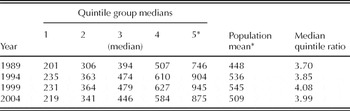
Table 1 presents the quintile group household income medians in Japan for all the years for which we had income data from the NSFIE.
Quintile group gross annual income medians and median quintile ratios, Japan 1989 to 2004 (10,000s of Japanese Yen)

Notes: *Incomes over 1,000 for single person households and over 2,500 for all other households were top-coded.
Source: National Survey of Family Income and Expenditure.
As can be seen, the median quintile ratio increases throughout the 1990s from 3.7 in 1989 to 4.08 in 1999 before dropping to 3.99 in 2004. It is interesting to note that the year 1989 marked the end of the Showa period in Japan and what is seen by many as Japan's post-war golden age (Brinckmann, Reference Brinckmann2008). This is also the year that Japan's asset bubble burst (Brinckmann, Reference Brinckmann2008), marking the start of what was described by many as Japan's lost decade (Saxonhouse and Stern, Reference Saxonhouse and Stern2004). It is also notable that the distribution of wealth has become more equal during the 1990s (Jones, Reference Jones2007), following the crash of the property market and stock markets.
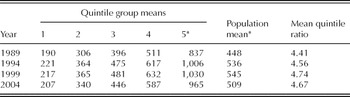
Table 2 shows the quintile group means (annual income) and mean quintile ratios for Japan from 1989 to 2004. A similar pattern is observed: an increase from 4.41 in 1989 to 4.74 in 1999 before dropping to 4.67 in 2004. It is also interesting to note that the mean income of the bottom quintile decreased in nominal terms between 1994 and 1999 and dropped even further by 2004. The mean income of all the other quintiles (and the overall population mean) also dropped between 1999 and 2004. These patterns are consistent with the deflation that Japan experienced shortly after the property and stock market crash of the early 1990s (Hamada et al., Reference Hamada, Kashyap and Weinstein2011).
Quintile group gross annual income means and mean quintile ratios, Japan 1989 to 2004 (10,000s of Japanese Yen)

Notes: *Incomes over 1,000 for single person households and over 2,500 for all other households were top-coded.
Source: National Survey of Family Income and Expenditure.
It should be noted that the income variable in the version of NSFIE data that we had at our disposal was top-coded and this could lead to an under-estimate of income inequalities. In order to evaluate whether that could be the case, we compared our income inequality measures with official summary measures for 2004, which were based on a non-top-coded full version of the dataFootnote 4 and found that the difference is very small (for instance the mean quintile ratio for 2004 using the official non-top-coded data is 4.64, whereas our calculated respective measure is 4.67). Therefore top-coding had a very small impact on the inequality measures.
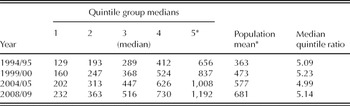
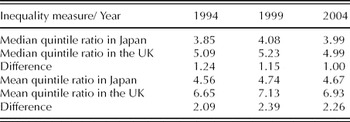
Table 3 shows the quintile group gross income medians (household weekly income) and median quintile ratios for the UK for the years for which we had available data from the FRS that matched the respective years for which we also had similar data for Japan, as well as the most recent median quintile ratio calculated using the most recently released data (2008/09). As can be seen, the ratio is much higher than its Japanese counterpart in all years. Looking at the trends through time, there is an increase in the ratio between 1994 and 2000 from 5.09 to 5.23. The ratio then drops to 4.99 in 2004/05 before rising again to 5.14 in 2008/09. In the most recent year for which we have available data for both countries, 2004, the UK median quintile ratio is higher by 1, whereas the highest difference is recorded in 1994 (1.24).
Quintile group gross weekly income (in GBP) medians and median quintile ratios, UK 1994 to 2009

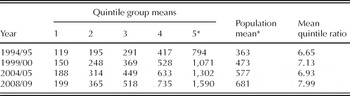
Table 4 shows the quintile group means of gross income and the mean quintile ratios. Comparing it to the respective Japanese figures (Table 2), we can see that the ratios are much higher in the UK (and the gap is even larger than the difference in the quintile group medians). The highest difference in the mean quintile ratio between the two countries is recorded in 1999 (7.13 in the UK and 4.74 in Japan). Table 5 summarises the mean and median quintile ratios and their differences for the years for which we had data for both the UK and Japan. It is also worth taking a closer examination of the most up-to-date data for both countries (2004). Figure 3 depicts both income distributions as well as the differences between them.
Quintile group gross weekly income (in GBP) means and mean quintile ratios, UK 1994 to 2009

Comparing quintile ratios between the UK and Japan

Income distributions in UK and Japan, gross income data from the FRS/HBAI and NSFIE, 2004

It can be argued that the patterns shown confirm the picture painted above. The proportions of individuals in high income households in the UK are consistently higher than the respective proportions in Japan (especially in the very high income groups earning over 25,000,000 Japanese Yen in 2004). This is consistent with relevant research suggesting that the very top income share in Japan is much lower than other OECD countries and especially than the USA and the UK (Pikkety and Saez, Reference Picketty and Saez2006; Moriguchi and Saez, Reference Moriguchi and Saez2008; Alvaredo et al., Reference Alvaredo, Atkinson, Piketty and Saez2011). Nevertheless, it is also interesting to note that the proportions in the very low income bands in Japan are higher than the respective proportions in the UK. This is to some extent consistent with recent analysis of poverty in Japan (Abe, Reference Abe2011).
Comparing disposable household income inequality
As noted above, we only had access to survey data on net disposable household income for the UK. In this section, we present the outputs of our disposable income estimates for Japan for 2004 which were produced by applying the appropriate tax rates on each household in the National Survey of Family Income and Expenditure, assuming that all household income is earned by one household member as discussed in the Data and Methods section. We then compare these estimated data to actual survey data on disposable household income for the UK.
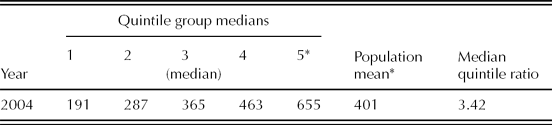
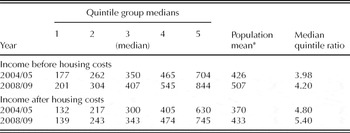
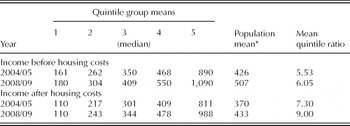
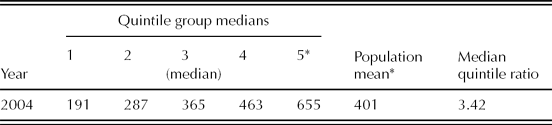
Tables 6 and 7 present the quintile group medians and quintile group means respectively. As expected, both ratios are lower than the respective gross income ratios presented in Tables 1 and 2. It is also interesting to compare these figures with the respective survey UK data presented in Tables 8 and 9, which present quintile means and medians as well as median and mean quintile ratios using income data before and after housing costs. As it was the case with the gross ratios, the estimated net income ratios for Japan are much lower than the respective ratios in the UK.
Estimated quintile group annual disposable income (in 10,000s Japanese Yen) medians and median quintile ratios, Japan, 2004
Notes: *Gross incomes over 2,500 were top-coded.
Quintile group annual disposable income (in 10,000s Japanese Yen) means and mean quintile ratios, Japan, 2004

Note: *Gross incomes over 2,500 were top-coded.
Quintile group weekly net income (in GBP) medians and median quintile ratios, UK 1994 to 2009

Quintile group weekly net income (in GBP) means and mean quintile ratios, UK 1994 to 2009

Conclusions
The analysis presented in this article has built on The Spirit Level work by identifying the best sources of income data and by calculating income inequality measures for Japan, one of the most equitable and harmonious societies, and the UK, one of the most unequal countries, in The Spirit Level. The findings suggest that the UK is much more unequal than Japan in terms of income distributions. In addition, the findings appear to be consistent with The Spirit Level work, as well as with past empirical studies of income distribution and social mobility which do not support the notion of a ‘divided society’ in Japan (Chiavacci, Reference Chiavacci2008). The mean quintile ratio for Japan using our estimated disposable income in 2004 is 3.97 (see Table 7), which although higher than the respective figure of 3.4 used in The Spirit Level work, still puts Japan in the top three most equal countries, with only Finland and Norway being slightly more equal. This means that if Figure 1 was redrawn on the basis of this estimate, then Japan would move slightly to the right of Finland and Norway. On the other hand, the respective mean quintile ratio for the UK in 2004/05 (Table 9) is 6.05 before housing costs and 7.3 after housing costs, whereas the figure used in The Spirit Level work was 7.2. This suggests that the UK would remain in the top most unequal countries in The Spirit Level study.
It is also worth emphasising that our findings paint a different picture from that described by the recent OECD studies which were based on the CSLC data and were also based on a Gini Coefficient approach to analysing income inequalities. In addition to the issues pertaining to data quality and comparability already discussed, it should also be noted that given the relatively small number of extremely high income households in Japan (especially when compared to countries such as the UK) the mean quintile ratio index that was used in this study as well as in The Spirit Level work is much more suitable as it better captures income distribution polarisation, the levels of which have very important implications for overall societal well-being and cohesion (for an extensive argumentation and relevant examples, in addition to The Spirit Level work, also see Frank, Reference Frank2007). Nevertheless, there is an urgent need for better quality disposable income data on both countries (instead of the estimates produced for Japan in the context of this project based on the assumption of a single earner in each household).
Although our data analysis indicates that Japanese society is still characterised by smaller inequalities compared to the UK, it is important to carefully trace the future trajectories of the two countries in order to consolidate The Spirit Level hypothesis by examining how changing social inequalities may psycho-socially affect people's trust, compassion, optimism, lives and health, also taking into account time lags. In addition, a direction of further work could be to extend our comparison by using disposal income and/or assessing regional gaps in wealth, building on recent work regarding urban and rural divides (Chiavacci, Reference Chiavacci2010). Also, considering the difficulties of international comparisons and especially the suggestions that such comparisons between Japan and other countries represent an ‘inherently difficult task because of the difference in survey practices between countries’ (Rebick, Reference Rebick2007: 152), it can be argued that there is a strong need for a more careful consideration of the similarities and differences of survey methods, sampling biases, and their adjustments between the statistical sources in both Japan and the UK.
Given the controversy regarding the suitability and quality of Japanese income microdata as well as the on-going developments in relation to data availability, there is a strong case for closer comparison to be made between the two main Japanese surveys CSLC and NSFIE and further quality checks, such as those we have completed in the context of our research, by comparing them to suitable data from the census of population. The research presented in this article suggested that the NSFIE was very suitable for comparison to the FRS/HBAI. We hope that our research findings can be used to stimulate further informed debates on which is the best income survey microdata set to be used for Japan and also for other countries for international comparisons by organisations such as the OECD, the World Bank and the United Nations.
Acknowledgements
We are grateful to the Daiwa Anglo-Japanese Foundation, the University of Sheffield and Ritsumeikan University for funding, supporting and hosting the research visits of project team members between Japan and Britain, which made the research reported in this document possible. We are also grateful to the themed section's Editor and two anonymous reviewers for their very constructive comments.