Introduction
On 12 January 2010 at 16:53 local time, a magnitude 7.0 Mw earthquake struck near the city of Port-au-Prince, Haiti. More than 200,000 persons were killed and countless others injured.Reference Zarocostas1 Most Haitians in the city either were injured or had loved ones who either were killed or severely injured. The combination of these factors resulted in an overwhelmed healthcare system that could not provide medical care on the scale needed, and the Haitian government quickly requested international assistance.
Partners in Health (PIH) is a non-profit, non-governmental organization which, in partnership with the Ministry of Health in Haiti, has been providing medical care for greater than 20 years. Working with the Haitians, PIH has established hospitals throughout the country with the primary focus of treating infectious diseases and establishing social support networks for indigent families. Their founder, Dr. Paul Farmer, was named the United Nations Deputy Special Envoy to Haiti. These factors positioned PIH to serve a critical role in coordinating the international medical community response to the 2010 earthquake.
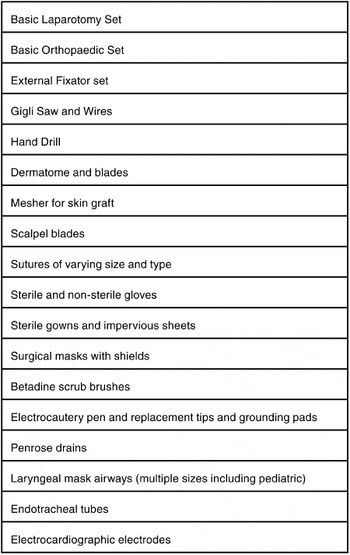
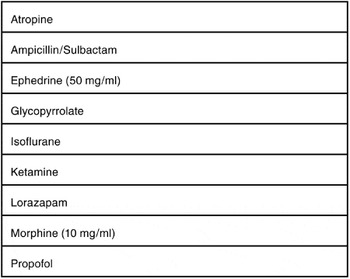
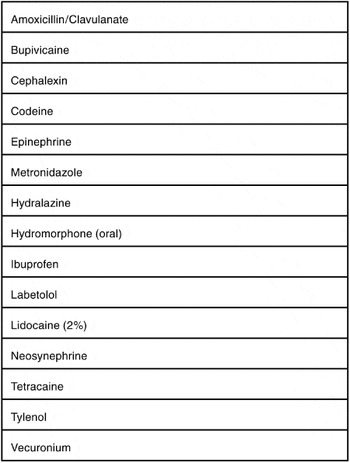
Dartmouth College and its medical center have a long-standing relationship with PIH and quickly answered the call for assistance. Likewise, members of the University of Pennsylvania (Penn) leadership made contact with PIH to offer assistance. Each hospital assembled a surgical team consisting of anesthesiologists, trauma surgeons, orthopedic surgeons, and nurses. In addition, each hospital amassed medical supplies, limited by the weight capacity of the smaller airplanes used to travel to Haiti (Tables 1A–1C). The Dartmouth team was sent to Hinche from 16 January to 25 January, while the Penn team was sent to Cange from 25 January to 06 February 2010.
Key non-pharmaceutical supplies used by each team (EKG = electrocardiogram)

Key pharmaceutical agents used by each team

Pharmaceutical supplies taken, but not commonly used

The villages of Cange and Hinche are located in the Central Plateau of Haiti, an area that is 30 and 60 miles northeast of Port-au-Prince. This region was not in the earthquake zone. The Clinique Bon Sauveur Hospital at Cange can accommodate approximately 100 patients and the St. Therese Hospital in Hinche is a 200-bed facility. Both hospitals have two operating rooms, adult, pediatric, and obstetrical wards, an infectious disease center, outpatient clinics, basic laboratories for routine tests, a small blood bank, and limited plain x-ray radiology capabilities. Due to its proximity to a hydroelectric power plant, Cange has a reliable source of electricity and water, whereas electricity is supplied by generator and water must be transported from a nearby river to the hospital in Hinche.
Because it quickly became apparent that Port-au-Prince did not have the facilities or infrastructure required to care for the thousands of severely injured patients, PIH facilitated the transfer of patients from Port-au-Prince to Cange and Hinche. In addition, many patients or their families knew about the hospitals in the Central Plateau, and used whatever means necessary to transport the injured to these villages. This resulted in each hospital greatly exceeding its bed capacity with injured patients in the initial days to weeks following the earthquake. Simultaneously, PIH coordinated the deployment of international medical teams to the hospitals in these remote villages. The decision to augment regional health facilities at the rim of the disaster zone by well-staffed, highly experienced interdisciplinary teams added a successful dimension to the overall disaster response that previously has not been well described.
The purpose of this report is to describe the injuries seen and evolution of treatments rendered by two university-based trauma teams at these two outlying regional hospitals during the first month following the earthquake. This experience may differ from other reports in that the teams were deployed to zones outside of the immediate disaster area. The goal of this report is to assist future teams in preparing for deployment following a similar disaster.
Methods
Each team maintained a list of equipment taken to Haiti, daily operative log, and patient list while in Haiti. In addition to operations performed, the teams also recorded: age, American Society of Anesthesiology (ASA) physical status, injuries sustained, time to initial evaluation, time to initial operation, whether or not the wound was closed at the end of operation, antibiotic therapy, and early outcomes of operative intervention. After obtaining institutional review board (IRB) approval from each respective university and the Zanmi Lasante Ethics Committee (which serves as the IRB for PIH activities in Haiti), the database was de-identified and analyzed. Where needed, information not available in the operative logs was supplemented by interviewing the members of each team. Procedures performed for reasons not related to the earthquake are excluded from this report.
Results
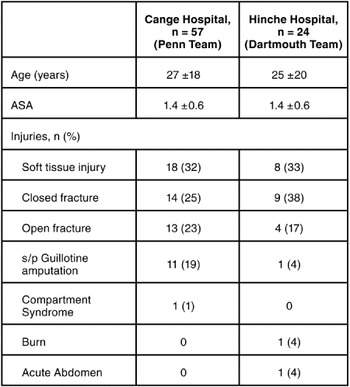
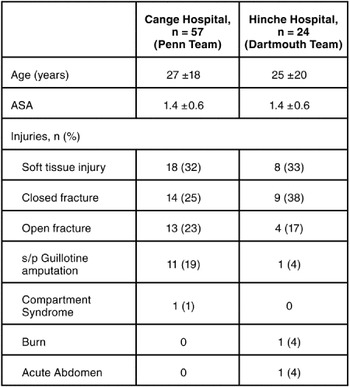
Upon arrival to Hinche five days after the earthquake, the Dartmouth team estimated that the hospital contained >100 injured patients (in addition to those hospitalized prior to the earthquake), 24 of whom required urgent surgical interventions. The demographics of the surgical patients are outlined in Table 2. The average age was 25 ±20 years, nine patients (38%) were <18 years old, and seven (29%) were <10 years old. Injuries noted included: large soft tissue wounds (n = 8), closed fractures (n = 9), open fractures (n = 4), traumatic amputation (n = 1), burn injury encompassing 50% body surface area (n = 1), and an acute abdomen which was concerning for solid organ injury in an acutely anemic patient (n = 1).
Characteristics of the injured population (ASA = American Society of Anesthesiology; s/p = status post)
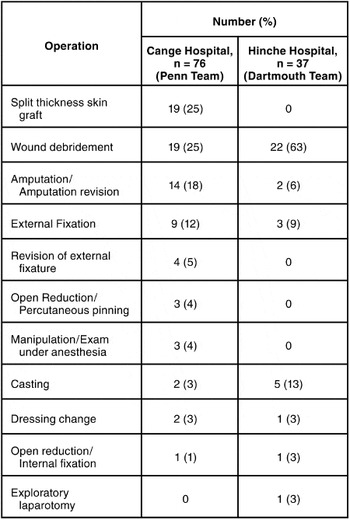
Over the course of six operating days, the Dartmouth team performed 37 operations (Table 3). The most common procedures performed were wound debridement (n = 22), cast placement (n = 5), and external fixation of fractures (n = 3). Seven patients required operations on more than one occasion, most commonly for repeat soft tissue debridements to control infection.
Operations performed on earthquake victims

Upon arrival to Cange two weeks after the earthquake, the Penn team estimated that the hospital contained 125 injured patients (in addition to approximately 100 patients who had been hospitalized for other reasons) and that at least 57 patients required ongoing operative intervention. The demographic characteristics of the patients resemble that noted by the Dartmouth team at Hinche (Table 2). The average age of the injured patients was 27 ±18 years. Twenty patients (35%) were <18 years old, and 11 (19%) were <10 years old. Injuries that required operative intervention included: open extremity fractures (n = 16), closed extremity fractures (n = 16), amputations requiring revision (n = 11), complications of compartment syndrome (n = 1), and soft tissue injuries requiring skin grafting (n = 21).
Over nine days, the Penn team performed a total of 76 operative procedures (Table 3). A total of 65 anesthetic episodes were used for the 76 operations because eleven patients had more than one procedure performed under a single anesthetic. Fifteen patients required operation on more than one occasion. The most common operations performed were split thickness skin grafting (n = 19), wound debridement (n = 19), and amputation revision (n = 14). As in Hinche, the most common reason for repeated operation was debridement of soft tissue to control infection.
Of the 102 anesthetics administered to the earthquake victims in both locations, 36 (35%) were given via a laryngeal mask airway (all at Cange), 39 (38%) via general endotracheal anesthesia, and 24 (24%) patients received monitored anesthesia care. Although each team had the capability to administer regional anesthetic blocks, very few procedures were performed in this way at the request of the patients. At Cange, no procedures were performed using regional anesthesia, whereas two operations were performed using this technique at Hinche. In instances in which either a laryngeal mask airway or endotracheal tube were used, propofol served as an induction agent and sevoflurane as a maintenance agent. The ASA physical status of the patients at each site is listed in Table 2. All patients who underwent operation were recovered without any anesthesia-related adverse events. Additionally, 42 patients with extensive wounds in Cange received bedside conscious sedation for dressing changes. Ketamine delivered intravenously or as an intramuscular injection (when intravenous access was not available) was the preferred medication, although some patients received intravenous midazolam and morphine.
Neither team was able to determine with certainty the long-term outcomes following the operations performed due to lack of reliable follow-up information after this departure. However, the Penn team was able to evaluate eight of the skin grafts performed five days after surgery. In six cases, the graft was implanted successfully, onto the recipient bed, but in two cases infection had recurred with a resultant loss of 30–50% of the graft. The two skin grafts that became infected were located on children's feet, whereas the other grafts were located higher on the extremities in adults. Seven other skin grafts that were placed on a foot in children were not evaluated at time of departure.
Discussion
The earthquake in Haiti resulted in the immediate death of >200,000 people and severely injured thousands more. Viewed in the context of the poorest nation in the Western hemisphere, it is not surprising that the country was immediately overwhelmed due to complete destruction of all medical and social infrastructures in the Port-au-Prince region. Haiti only had a few full-service hospitals before the earthquake, and nearly all of those were located in the central zone of destruction. Therefore, hundreds of hospitals were needed immediately.Reference Pape, Johnson and Fitzgerald2 Consequently, the government placed an official international call for medical assistance. This call was answered by several nations and numerous medical centers. The University of Pennsylvania and Dartmouth College coordinated their response via Partners in Health. Dartmouth was the first team to deploy and was sent to Hinche while Penn's team followed two weeks later and was sent to Cange.
The Central Plateau is a region of Haiti that is located 30 miles northeast of Port-au-Prince and is situated over a mountain range. Due to its location, it was completely spared from the direct impact of the earthquake. However, travel to this region from Port-au-Prince involves travel over dirt roads and through dry river beds. Many Haitians were aware of the PIH sponsored hospitals in Cange and Hinche that provide free medical care and that are known to have excellent outcomes. Realizing that they could not obtain timely care for themselves or loved ones in Port-au-Prince, but may be able to do so in the Central Plateau, large numbers of Haitians travelled to these remote hospitals by minibus, car, horse or mule, or, in a few cases, by organized transportation arranged by PIH. Their condition, slow transportation, and lack of conventional roadways led to significant delays between injury, first aid (if rendered), and hospital arrival. Some patients presented to the hospitals in Cange and Hinche days to weeks after undergoing a life-saving amputation in Port-au-Prince, but most of these amputation stumps had not yet been revised or closed.
Bringing the proper type and quantity of surgical and pharmaceutical supplies to Haiti was a vital factor in the ability to deliver care successfully. While both institutions made an early commitment to provide the teams with the equipment they needed, neither team could take a large amount of equipment due to weight restrictions inherent in air travel by smaller, private aircraft. Therefore, both teams carefully selected the equipment and supplies they would bring based on expected needs and the advice of those already in Haiti. Information and direct communication with Haitian and early volunteer medical personnel was limited. Voice communication via telephone was intermittent, but text and e-mail communication was more reliable. Ultimately, electronic print forms of communication (e-mail and text messaging) allowed teams in the field to respond to questions without interfering with ongoing patient care and became the more preferred and usable format for information exchange.
The Dartmouth team, which arrived in Haiti five days after the earthquake, based its supply list on reports received from PIH. The Penn team was able to obtain initial information from PIH and from Dartmouth via both the leadership group in Hanover and the surgical team in Hinche. This afforded the Penn team information on conditions in outlying regions in addition to equipment and supplies needed to render care. The site-specific information was critical, as the supply chain for each facility was highly variable. Based on these reports, supplies already available on-site and those that would be difficult to transport due to weight restrictions, such as intravenous fluids, were not transported. Instead, the teams took a large number of orthopedic fixation devices and equipment for casting and grafting skin.
Despite attempts to select pharmaceutical supplies based on perceived need, many of the pharmaceutical agents taken were not utilized, but were left behind for general use by the hospital (Tables 1B and 1C). Limitations in communication prior to departure prevented the teams from realizing the supply and types of medications already present at each hospital. Furthermore, there was limited utility for the use of oral agents due to the need for recurrent sedation and administration of anesthetic agents, and the lack of monitors and emergency equipment obviated the need for potent cardiovascular agents, such as epinephrine and hydralazine.
Congruent with reports from Port-au-Prince, the majority of injured patients in Cange and Hinche had extremity injuries consisting of crushing wounds, fractured bones, and extensive soft tissue injuries. Also consistent with reports from Port-au-Prince, nearly one-third of the patients at each site were children.Reference Ginzburg, O'Neil and Goldschmidt-Clermont3 The Dartmouth team did not encounter many amputees because little time had lapsed between the earthquake and the team's arrival to Hinche. Thus, there was insufficient time for patients with mangled extremities to travel from Port-au-Prince to the Central Plateau. Rather, the Dartmouth team found patients with extensive, infected soft tissue wounds that required serial debridement and closed fractures that could be treated with casting. Contrary to this experience, all patients with crush injury seen by the Penn team in Cange either already had undergone a fasciotomy, amputation, or both. Most patients seen at both Hinge and Cange had their initial extremity injury treated in Port-au-Prince. Amputations were performed using a guillotine technique and dressed with simple bandages. Due to the sheer volume of injured patients in Port-au-Prince, medical teams could not provide timely follow-up care, and many of the open wounds could not be revised by the time the patients left Port-au-Prince. Of note, the teams at these outlying hospitals saw very few patients with untreated mangled extremities in need of de novo amputation.
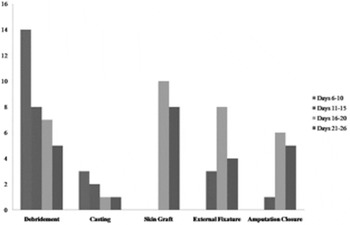
The nature of operations at the two outlying hospitals changed over time (Figure 1). During the initial two weeks following the earthquake, operations involved debridement of infected wounds and closed reduction of fractures. Concurrently, the teams were tasked to triage the large numbers of wounded patients, stabilize fractures, and control infection. Because the flux of new patients decreased as time passed, by the middle of the third week following the earthquake, the Penn team began to concentrate on closing or grafting wounds. The strategy was altered for those with extremity amputation from one focusing on length conservation as the primary goal, to achieving early closure by moving “up” to the next joint space; if the next joint space appeared clean the decision was made to amputate through the joint or just proximal to it and proceed with closure over drains. Another important reason for this change in approach came from the psychological toll of repeat operations on patients, who became frustrated with multiple trips to the operating room for serial debridement and the need for ongoing bedside dressing changes. After several weeks, patients did not want to undergo further painful procedures, and having an anesthesia provider on the team was critical in order to provide conscious sedation and minimize the pain associated with wound care. Ultimately, the new strategy appeared to be successful, given that few patients developed a subsequent wound infection. At the end of the fourth week, most fractures had been stabilized, and wounds had been closed primarily or skin grafted. A few large soft tissue defects in need of further skin grafting or free tissue transfer remained for surgical teams that would follow at the Cange site.
Operations performed as a function of time from the earthquake

Despite attempts to control infection using near-daily dressing changes, appropriate antibiotics, and close inspection by the surgical team, many patients developed recurrent wound infections. Although hospital staff tried to maintain a clean environment, the sheer number of patients with open wounds precluded personal or environmental hygiene that might be expected within a hospital. This was especially difficult in the pediatric population, where a higher rate of skin graft infection and partial graft loss, especially on the lower extremity, was noted. Children received most of their hourly care from family members who lived with them in the hospital ward or space allotted to overflow for patients.
The rehabilitation phase of Haiti's recovery will last many years. Due to the sheer number of new adult and pediatric amputees, combined with the large numbers of individuals who are recovering from serious injuries, the people of Haiti will require significant help from the international medical community for years. This is especially true, considering that the fairly basic healthcare infrastructure that existed before the earthquake nearly was destroyed. This destruction included the obliteration of several key medical education facilities, as well as the death of a large proportion of healthcare students. Academic medical centers are well-positioned to assist in the ongoing medical aid effort due to their large size, multispecialty practice groups, and ability to rotate clinicians for 1–2 week deployments. Orthopedic surgeons will be needed for many months to come to ensure that fractures have healed correctly and to remove the numerous external fixators that were placed. In addition, there will be a need to revise the malunions, non-unions, and infections that will occur in these extremity injuries. Furthermore, general and plastic surgeons are needed to ensure that wounds and amputation stumps heal correctly and revisions are performed as needed. Following prosthetic placement, physical therapists and physiatrists will be needed to ensure the population regains mobility and the ability to be productive. This is especially critical in Haiti due to lack of automation and the need for manual labor.
Although this is one of few articles that reports on the experience of surgical teams outside of the disaster zone following a massive disaster caused by natural hazards, it has limitations. First, the types of injuries noted and therapies rendered may not reflect the injuries seen in the disaster zone in Port-au-Prince. However, previous articles on injuries noted following earthquakes also document that the majority of injuries seen involve extremity fractures, and only a small number of patients are treated for significant head or torso trauma.Reference Yuanfeng, Pan and Yufeng4 Second, due to poor record-keeping before and particularly after the earthquake, the type of interventions given to each patient prior to the arrival of the surgical teams could not be determined. For the same reason, there was no reliable follow-up on the patients treated, and it is possible that their outcomes are not optimal. Therefore, although this experience is described to guide future medical teams responding to a disaster, the authors cannot be certain that this approach to injury management was ideal. Third, the teams worked in established hospitals in the Central Plateau, and therefore, had an established stockpile of medications and supplies. Future teams may need more supplies if they deploy to regions without established hospitals. The list of supplies used and list of supplies taken but not used are provided to guide future teams regardless the location to which they are sent.
Conclusions
The earthquake in Haiti resulted in the death or disability of several hundred thousand people. As with centrally located hospitals, outlying hospitals also were overwhelmed with victims. Responding surgical teams can ameliorate the morbidity and mortality following disasters by being well-prepared and partnering with organizations that already have a presence in the affected region.
Abbreviations:
ASA = American Society of Anesthesiology
PIH = Partners in Health