THE SPHERE OF INFLUENCE OF CLASSIC MAYA CITIES AND THE PROBLEMS OF ORGANIZATION AND LONG-DISTANCE EXCHANGE
Even after more than 100 years of scientific investigations into the Classic Maya world, discovering the boundaries of a city's territory or the degree of influence of any particular city over another is still problematic and unclear (Chase et al. Reference Chase, Chase and Smith2009). While it does appear to be improbable that any Maya city was able to maintain hegemonic control over territories located more than a few days' walk away (Chase et al. Reference Chase, Chase and Smith2009), we know through epigraphy that many cities had established relationships of domination and submission with each other (Marcus Reference Marcus, Vogt and Leventhal1983; Martin Reference Martin and Sabloff2003; Martin and Grube Reference Martin and Grube2000; Schele and Mathews Reference Schele, Mathews and Culbert1996). To date, however, even if we know that tribute was part of this relationship (Stuart Reference Stuart1995:356–358), very few data have enabled us to understand more clearly the economic impact of such relations and the way these interactions between cities actually influenced long-distance exchanges (Arnauld Reference Arnauld1990). In fact, even if it has sometimes been assumed that the location of cities was related to the exchange or the control of specific trade route (Demarest et al. Reference Demarest, Woodfill, Wolf, Barrientos, Bishop, Monterroso, Barrios, Quintanilla, Ivec, Laporte, Arroyo and Mejía2008; Guderjan Reference Guderjan1995; Lee and Navarette, Reference Lee and Navarette1978; Sharer Reference Sharer1994:492) or particular goods (Andrews Reference Andrews1980, Reference Andrews, Clancy and Harrisson1990; Ashmore Reference Ashmore2007; McKillop Reference McKillop1996), archaeologists have not made much headway in examining the privileged relationships among different cities and their actual impact on trade.
This is all the more problematic when taking into account the organization and potential participants of long-distance exchanges in the Maya lowlands, which are still hotly debated (Hammond Reference Hammond and Culbert1996, Masson Reference Masson, Masson and Freidel2002; West Reference West, Masson and Freidel2002). The small quantities of most of the exotic materials in any particular site and their contexts, which have been largely limited to the wealthiest parts of each city, have made many authors propose that much of the exchange of long-distance goods was limited to elite gifting that sealed alliances but did not involve large quantities of material (Potter and King Reference Potter, King, Ehrenreich, Crumley and Levy1995:25–26, 28–29; Rice Reference Rice, Brumfield and Earle1987; Spence Reference Spence1996a; Tourtellot and Sabloff Reference Tourtellot and Sabloff1972).
Some goods do appear to demonstrate a different pattern, however. Obsidian, for example, is commonly found in significant quantities in most, if not all, lowland contexts, even though the highland sources are found at least 80 km away (Tourtellot and Sabloff Reference Tourtellot and Sabloff1972). The organization of obsidian exchange remains unclear, however, and the difference of quantities collected from one site to another have enabled different authors to consider the possibility of a variety of trade mechanisms that might have evolved over time (Aoyama Reference Aoyama2001; Braswell 2004; Braswell and Glascock Reference Braswell, Glascock and Glascock2003; Clark Reference Clark and Hirth2003; Fowler Reference Fowler, Hester and Shafer1991). The discrepancy in quantities found from one site to another also suggested that some cities might have been more involved in the distribution of obsidian than others (Sidrys Reference Sidrys1976). Excavations at Tikal in particular have recovered an unusually high quantity of obsidian, and it has been suggested that it could have been directly involved in the exchange of this material to various other lowland centers during the Classic period (Arnauld Reference Arnauld1990; Dreiss and Brown Reference Dreiss, Brown, McAnany and Isaac1989; Moholy-Nagy Reference Moholy-Nagy and Sabloff2003b:108–109).
THE ROLE OF TIKAL IN MAYA EXCHANGE: TIKAL DURING THE EARLY CLASSIC PERIOD
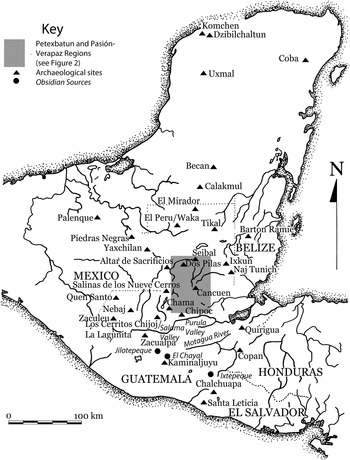
Tikal is one of the most important cities in the Maya lowlands (Figure 1), and its political influence reached its apogee during the Early Classic period (a.d. 250–550). After its victory against Uaxactun in a.d. 373 (Martin and Grube Reference Martin and Grube2000), the site seems to have quickly consolidated its power over much of the central Peten (Martin and Grube Reference Martin and Grube2000), either through domination or alliance. By the latter part of the Early Classic period, Tikal became one of the biggest political centers in the history of Maya civilization, and both epigraphy and iconography document its unique and powerful influence throughout the lowlands and beyond (Bachand Reference Bachand2010; Coggins Reference Coggins1975; Culbert Reference Culbert and Culbert1996a, Reference Culbert and Culbert1996b:314; Jones Reference Jones and Culbert1996:111; Martin Reference Martin and Sabloff2003; Sabloff Reference Sabloff2003; Willey and Mathews Reference Willey and Mathews1985).
Map of the Maya world with sites discussed in this text. Pasión-Verapaz Region shown in shaded grey box (modified by Brent Woodfill from original by Luis Luin).

Although it has not been definitively proven, various scholars (Arnauld Reference Arnauld1990; Dreiss and Brown Reference Dreiss, Brown, McAnany and Isaac1989; Hammond Reference Hammond1972, Reference Hammond and Renfrew1973, Reference Hammond, Hester and Hammond1976; Hammond et al. Reference Hammond, Neivens and Harbottle1984; Nelson, Reference Nelson1985, Reference Nelson, Serra and Olguín1994; Nelson et al. Reference Nelson, Phillips, Rubio, Matheny, Gurr, Forsyth and Hauk1983) have suggested that this influence also played a role in the economy, due to Tikal's political importance as well as its location at the heart of the central lowlands (Marcus Reference Marcus, Vogt and Leventhal1983; Moholy-Nagy Reference Moholy-Nagy1997). Due to the presence of large quantities of jade and obsidian at Tikal, it is typically assumed that the site might have played a central role in the exchange of these two exotics (Becker Reference Becker1973; Dreiss and Brown Reference Dreiss, Brown, McAnany and Isaac1989; Moholy-Nagy Reference Moholy-Nagy1997, Reference Moholy-Nagy and Sabloff2003b).
Since the 1970s, several scholars have also suggested (Coggins Reference Coggins1975) that Early Classic Tikal has been trying to facilitate its access to the highlands by both its relations with Copan (Ashmore 1994; Sharer Reference Sharer and Braswell2003a, Reference Sharer and Sabloff2003b) or Quirigua (Sharer Reference Sharer and Culbert1991) on one side and the Chixoy-Pasión routes on the other (Demarest Reference Demarest2004, Reference Demarest2006; Demarest and Fahsen Reference Demarest and Fahsen2002; Sharer Reference Sharer1994:461; Woodfill Reference Woodfill2007, Reference Woodfill2010). The economic effect of Tikal's political relations with these two regions remains unclear, however.
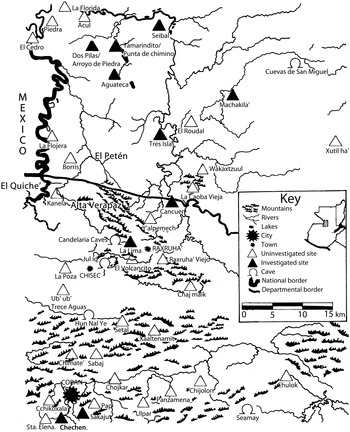
Recent investigations in the Candelaria Caves and other nearby shrines and settlements have allowed for the creation of a preliminary history of the Pasión-Verapaz Region (Figure 2) over the 2,000 years before the Classic period collapse, allowing us for the first time to test hypotheses on its residents' relationships with other zones in the Maya world over time. The Pasión-Verapaz Region is important to any discussion of interregional exchange in the Maya world, since it is situated along a well-trafficked corridor connecting the highlands and lowlands.
Map of the Pasión-Verapaz Region, central Guatemala (drawing by Carlos Efraín Tox from original by Walter Burgos).

Large quantities of ceramic material and iconography with clear Tikal influence have been recovered there from the fifth century a.d., a period contemporaneous to Tikal's greatest access to obsidian. The large quantities of nonlocal ceramic styles here would appear to indicate ties between this zone and the central Peten that went beyond elite alliances, suggesting that traffic associated (if not originating in) Tikal was regularly passing through the region.
This article is a comparison of the research undertaken by various subprojects of Proyecto Cancuen in a series of shrines at the base of the Guatemalan highlands to lithic data from Tikal obtained by the Pennsylvania project that were studied and published by Hattula Moholy-Nagy (Reference Moholy-Nagy2003a, Reference Moholy-Nagy2008). While they might initially appear to be unrelated collections, they do appear to be telling the same story, that of an Early Classic expansion of Tikal along the principal trade routes that was eventually foiled by Calakmul and Caracol. Through a comparison of lithic, ceramic, and iconographic data from both regions, we aim to show that Tikal's involvement in this region had a strong economic impact that seems to stop suddenly during Tikal's hiatus. These data enable us to reconsider the relations among politics, war, trade, and economics during the Classic period.
PREVIOUS INVESTIGATIONS IN THE PRECLASSIC PERIOD AND EARLY CLASSIC PERIOD ALONG THE GREAT WESTERN TRADE ROUTE (1000 b.c.–a.d. 600)
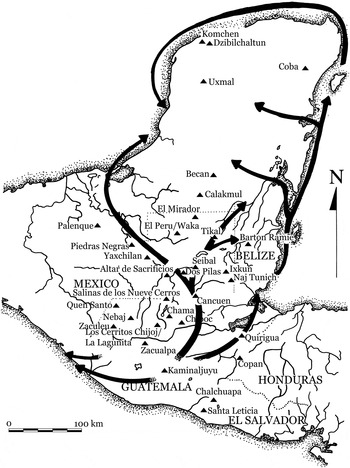
The term “Great Western Trade Route” was coined by Demarest and Fahsen (Reference Demarest and Fahsen2002; see also Demarest Reference Demarest2004, Reference Demarest2006) to refer to the route connecting the Maya highlands and lowlands through the Salama Valley, Coban, and the kingdoms of the Pasión (Figure 3). The highland portion of the route was strictly traversable by foot, but shortly after descending from the highlands it was possible to get to most lowland centers via the Pasión-Usumacinta river network.
The Great Western Trade Route (drawing by Mirza Monterroso from original by Luis Luin).

Interest in this route has an old pedigree. In the seventeenth century, Thomas Gage referred to it as the “Chinaja Trail” (Adams Reference Adams, Lee and Navarrette1978:32). The route was also essential to mid-twentieth-century models of the Classic period collapse, as it was the proposed route for the supposed Putun invasion of the western Maya lowlands (Adams Reference Adams and Culbert1973; Sabloff Reference Sabloff1975; Thompson Reference Thompson1970). Hammond (Reference Hammond1972) and Arnauld (Reference Arnauld1990) returned to the route in recent years, noting its potential for moving lightweight materials, especially El Chayal obsidian, into the lowlands. More recently, Demarest and colleagues (Demarest Reference Demarest1997, Reference Demarest2006; Demarest and Fahsen Reference Demarest and Fahsen2002; Demarest et al. Reference Demarest, Woodfill, Wolf, Barrientos, Bishop, Monterroso, Barrios, Quintanilla, Ivec, Laporte, Arroyo and Mejía2008) have revealed that the route was of central importance in the Late Classic for the transport, production, and exchange of jade throughout the Maya lowlands.
The Northern Highlands
The northern highlands remain woefully under-investigated, although the various segments of the Great Western Trade Route that have been subject to archaeological investigation do show varying degrees of ties to the Peten. The Salama Valley, which would have been an important node along the trade route, was subject to a major study in the 1980s (Sharer and Sedat Reference Sharer and Sedat1987). Although they did recover Classic period materials, the investigation itself focused on the extensive Preclassic occupation of the region, so little can be said about Peten-Salama ties at present.
Arnauld (Reference Arnauld1986a) has conducted the most comprehensive regional survey in the northern highlands, focused on the Purula Valley, a long, narrow corridor that likely served as the principal gateway between the Salama Valley and the rest of the Great Western Trade Route. Her survey uncovered scarce evidence of an Early Classic occupation in the region followed by a pronounced Late Classic boom, although she tempers this by noting that any depositional problems combined with the very conservative rate of ceramic change before the Early Postclassic period could be partially responsible for this apparent pattern. She also notes that the northern part of the region near Coban has stronger ties to the Peten, as evinced through related forms and decoration of the ceramic material. At the same time, there is a paucity of lowland goods, resulting in her supposition that the Chixoy route would have been more important than the Coban-Cancuen land route during the Classic period.
Another site, La Lagunita, was investigated by Alain Ichon and Arnauld (Reference Ichon and Arnauld1985) in the 1980s. Although the site is located in the Guatemalan highlands, a large Early Classic cache found in an artificial cave beneath the site epicenter shows strong links to the central Peten. In his examination of Early Classic iconography in the Maya world, Patrice Bonnafoux (Reference Bonnafoux2008) characterizes the region between La Lagunita and the Candelaria Caves as having a single Early Classic iconographic tradition that is closely connected with the central Peten. He also echoes Ichon and Arnauld (Reference Ichon and Arnauld1985) by suggesting that part of the La Lagunita cache is actually imported into the site from the Maya lowlands. Most of the ceramics recovered from La Lagunita were standard highland types (Arnauld Reference Arnauld, Ichon and Arnauld1986b; Viel Reference Viel and Ichon1982), however, which suggests that its residents were highlanders with some ties to the central Peten.
The Pasión River
Although three large-scale projects were undertaken in the region in the latter part of the twentieth century (Harvard University's Altar de Sacrificios and Seibal projects and the Vanderbilt University Petexbatun project), all three were largely focused on investigating the Classic period collapse, as well as, in the case of the Harvard projects, the development of complex civilization in the Maya lowlands. As a result, the Early Classic period was never fully explored.
The first glimpse into interregional ties here during this period was provided by Graham, who reported three Early Classic stelae in Tres Islas, each of which depicted a Teotihuacano-style warrior (Graham Reference Graham1965; Tomasic and Fahsen Reference Tomasic, Fahsen, Laporte, Arroyo, Escobedo and Mejía2004). The stelae also contained references to the Cancuen kingdom, although the Late Classic city itself had not yet been founded. Tres Islas was too small to have served as anything other than an empty ceremonial center—recent investigations by the Cancuen Regional Archaeological Project (Barrios Reference Barrios2006; Tomasic and Quintanilla Reference Tomasic, Quintanilla, Demarest and Barrientos2004) have revealed that the entire site consisted of the stelae and altar complex and four mounds.
The results of the Seibal and Altar de Sacrificios projects were not able to find much material dating to the Early Classic period, in spite of robust evidence of a healthy Preclassic period occupation. In his conclusions to the Seibal project, Willey (Reference Willey and Willey1990) expressed doubt that the preponderance of Late Preclassic material and the dearth of Early Classic material represented a boom and bust and not just a misunderstanding of the local ceramic sequence. This concern over the possibility of a Late Preclassic-Early Classic overlap was echoed by several other scholars (Gifford Reference Gifford1976; Lincoln Reference Lincoln, Willey and Mathews1985).
The problem of the “invisible” Early Classic was not properly resolved until Juan Pedro Laporte (Reference Laporte, Laporte and Escobedo1995) published his results of investigations in the southeastern Peten, noting that the waxy-slipped ceramic wares that had previously been the principal Preclassic marker in the Maya lowlands actually continued to be the dominant ware in most of the southern lowlands through the Early Classic period. Not only does this mean that there was likely no Late Preclassic boom followed by an Early Classic bust at those two sites, but also that the ceramics need to be reanalyzed with a much more refined modal analysis in order to reconstruct the 800 or so years predating the Late Classic period at these sites.
The Petexbatun material did not necessarily fall into the same chronological pitfalls, since the majority of investigations were limited to the Late and Terminal Classic periods in order to investigate the causes of the Classic Maya collapse. More recent research (Bachand Reference Bachand2006, Reference Bachand2010; Eberl Reference Eberl2007; Escobedo Reference Escobedo1997) in the Petexbatun region has demonstrated the existence of a local dynasty (referred to as the “Scroll Dynasty” by Houston [Reference Houston1993] and Eberl [2007]) that existed at the sites of Tamarindito and Arroyo de Piedra. Petexbatun residents were involved in interregional trade—directly or indirectly—with other areas beyond the Maya world, as evinced by the presence of Mexican obsidian from at least two sources from fill at Punta de Chimino (Aoyama Reference Aoyama, Inomata and Triadan2009; Eberl Reference Eberl2007). While the dynasty appears to have been independent with little influence outside of the region, the region appears to have become so closely related to the central Peten in a.d. 430 that one recent dissertation (Bachand Reference Bachand2006:488, Reference Bachand2010) suggested that it had actually been conquered by Tikal.
NEW INSIGHTS INTO THE EARLY HISTORY OF THE GREAT WESTERN TRADE ROUTE
Settlements predating the Late Classic period have remained elusive in the Pasión-Verapaz region, but investigations in caves and other shrines and associated settlements (Carot Reference Carot1976, Reference Carot1989; Forné et al. Reference Forné, Alvarado and Monterroso2007; Monterroso Reference Monterroso2006; Woodfill Reference Woodfill2007, Reference Woodfill2010; Woodfill et al. Reference Woodfill, Fahsen, Monterroso, Arroyo and Mejía2006, Reference Woodfill, Guenter and Monterroso2012) have uncovered a wealth of ceramic data spanning the 1,500 years before the Late Classic apogee of Cancuen and Dos Pilas. Research has focused primarily on four different shrine areas—the Cave of Hun Nal Ye, the Candelaria Caves, the San Francisco Hills, and Tres Islas. All of them exhibit a similar chronological pattern—ritual activity peaks in the latter part of the Early Classic (ca. a.d. 450–550) and declines at the same time that the majority of known settlements in the region are founded in the Late Classic period. The Early Classic material is stylistically related to far-flung regions on either end of the Great Western Trade Route in contrast to the highly local style of the material recovered from the surrounding settlements. In spite of the exotic styles, this material has proven to be locally produced. Finally, there were major and significant transformations in ritual activity between the Early and Late Classic periods, indicating a changing sociopolitical context surrounding it.
After describing the sites and shrines used in this study, we will summarize the data gleaned from investigations there in two different contexts: (1) the ceramic styles and modes, which allow us to focus on the intended ceramic consumers, and (2) the ceramic technology, which allows for an examination of the producers.
The Pasión-Verapaz Shrines
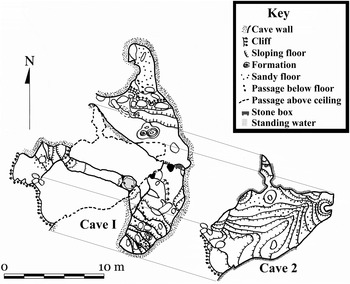
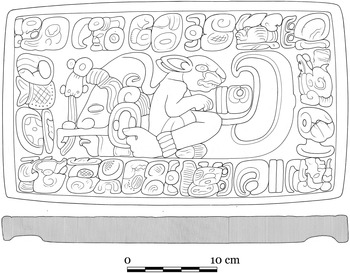
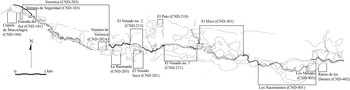
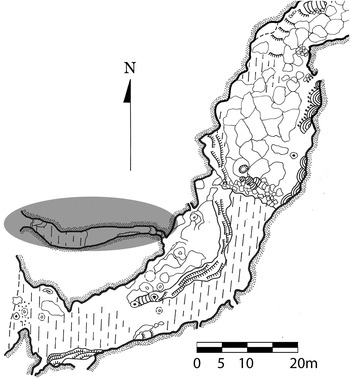
To date, there have been four principal shrines that have been investigated by the Vanderbilt Upper Pasión Archaeological Cave Survey (VUPACS) and the Proyecto Cancuen. Hun Nal Ye (Figure 4), located in the southernmost part of the zone, is a small cave located above an eight-meter waterfall. When it was discovered in 2005 it contained a carved, lowland-style Early Classic stone coffer (Figure 5) and 30 whole vessels from disparate corners of the Maya highlands. The Candelaria Caves (Figure 6), located underneath the last foothills of the northern highlands, compose the second-largest cave system in Central America. Centered around 18 km of the Candelaria River, they were one of the most-visited shrines for the ancient Maya during the Early Classic period (Woodfill Reference Woodfill2010).
The Cave of Hun Nal Ye (drawing by Mirza Monterroso).

The Hun Nal Ye stone coffer lid (drawing by Luis Luin).

The Candelaria Cave system (drawing by Mirza Monterroso. Updated version of inset in Carot [1989], drawn by Carot from the original by Daniel Dreux and Francoise Bagot).

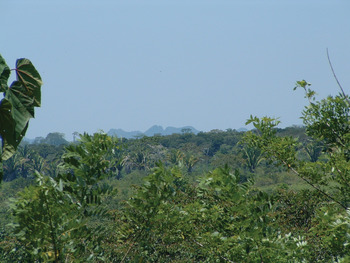
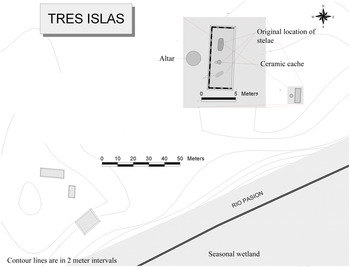
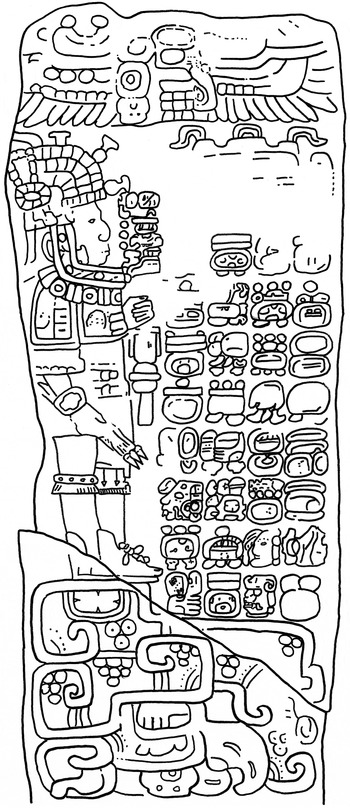
The San Francisco Hills are found in a 35 km2 area northeast of Cancuen and visible on the horizon from most of the region (Figure 7). They were never a principal focus of ritual activity but have evidence of continuous ritual events spanning the nearly 2,000 years between the Early Middle Preclassic period (1000–800 b.c.) and the Maya collapse (ca. a.d. 800). Tres Islas (Figure 8) was originally identified and investigated by Graham (Reference Graham1965) with follow-up work by members of the Cancuen Project (Barrios Reference Barrios2006; Tomasic and Quintanilla Reference Tomasic, Quintanilla, Demarest and Barrientos2004; Woodfill Reference Woodfill2007, Reference Woodfill2010). It is a small site atop a levee that consists of four structures organized in an irregular pattern and a nearby group of three Early Classic stelae fronted by an altar. Each of the stelae (Figure 9) depicts a warrior dressed in Teotihuacano garb and mentions the Early Classic seat of power for the Cancuen kingdom (Graham Reference Graham1965), the location of which is still debated.
Photo of the San Francisco Hills from the Cancuen horizon (photo by Jon Spenard).

Tres Islas (modified by Brent Woodfill from the original by Marc Wolf).

Tres Islas Stela 2 (drawing by Mirza Monterroso from the original by Luis Luin).

In addition to the shrines, there are two associated settlements that were studied as a part of the larger regional investigations—La Lima and La Caoba Vieja. La Lima is a Late Classic community located near the eastern edge of the Candelaria Cave system that appears to have been populated by people from the northern highlands, although as they moved into the lowlands they took on several lowland traits. La Caoba Vieja was a village in the center of the San Francisco Hills that was likely founded in the Preclassic period but reached its zenith in the Late Classic period, at which point it was part of the Cancuen sphere.
Changing Ceramic Styles
Preclassic ceramics show a mixture of highland and lowland modes in the Pasión-Verapaz region. While the limited Middle Preclassic material demonstrates characteristics of both the highlands and the lowlands, during the Late Preclassic period the ceramics are fully developed in either a northern highland or southwestern lowland style with no modal mixing apparent on the same vessel.
The Early Classic period represents the pinnacle of shrine use in the region, in spite of the nearly total lack of identified settlements dating to this time. The material composes the largest part of the shrine ceramic assemblage (71.1%, n = 16,510) and draws from a wide range of traditions from both the highlands and lowlands, although almost all of it appears to have been locally produced. We will break down the material for each of the shrines here, moving from south to north.
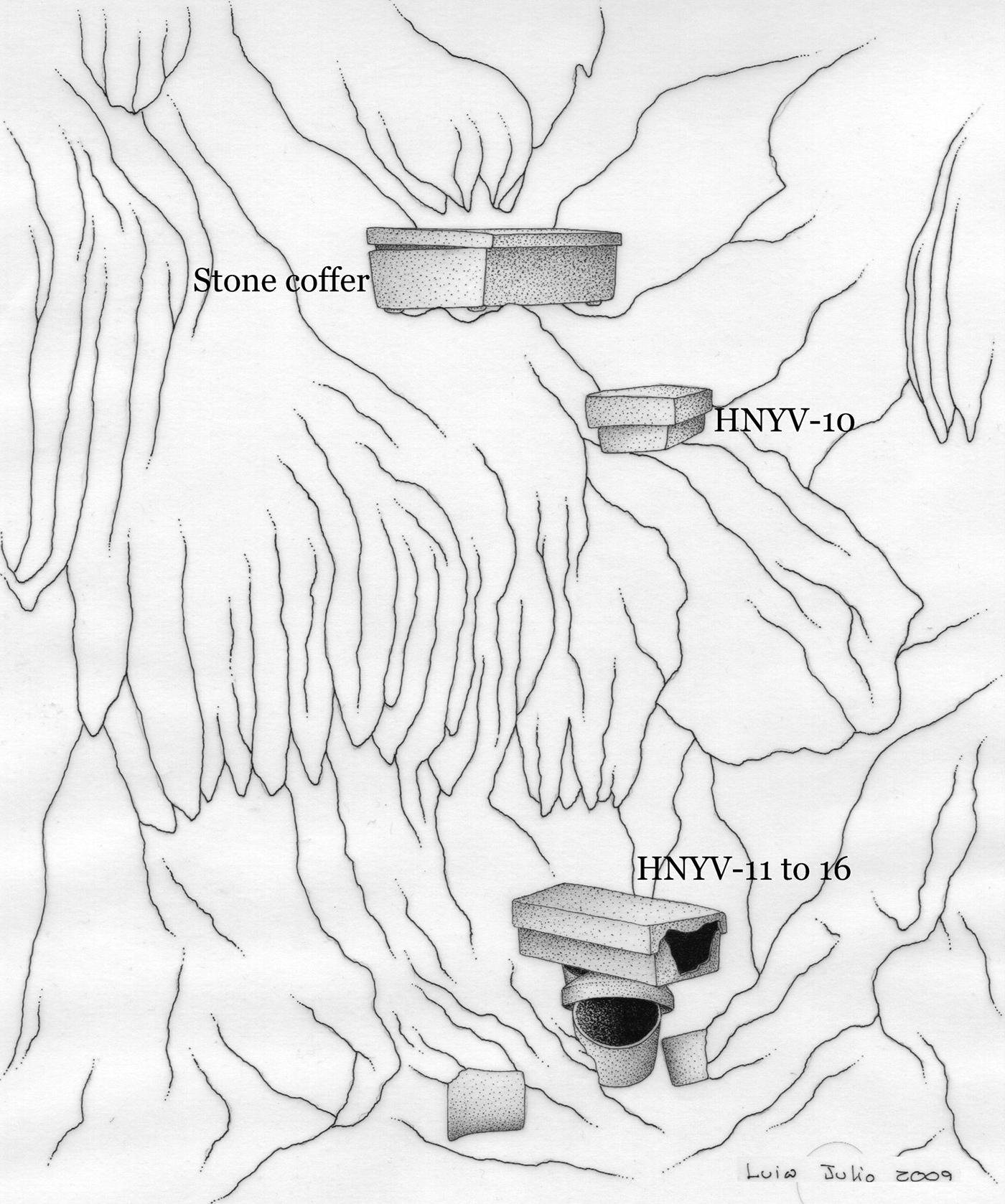
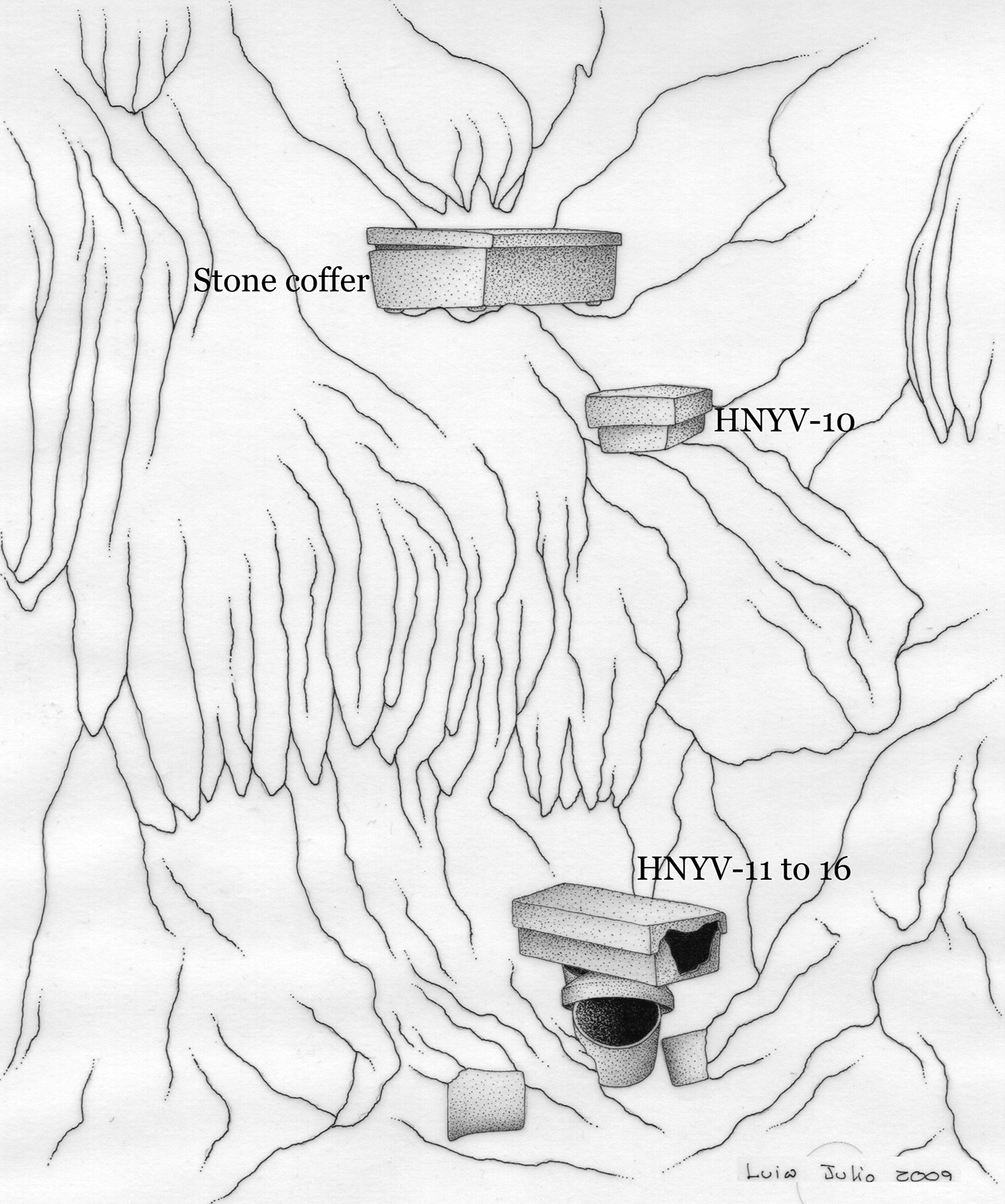
The Hun Nal Ye cave contains 18 whole vessels (Figure 10) that date to the Terminal Preclassic/Early Classic period (Woodfill et al. Reference Woodfill, Fahsen, Monterroso, Arroyo and Mejía2006, Reference Woodfill, Guenter and Monterroso2012; Woodfill Reference Woodfill2007, Reference Woodfill2010).Footnote 1 The vessels are exclusively highland and derive from traditions as far ranging as the Salama and Motagua Valleys, Kaminaljuyu, and perhaps as far as southeastern El Salvador. A carved stone coffer (see Figure 5), dating to the latter part of the Early Classic period, was also found and represents the sole central Peten-style object found in the cave. The iconography and glyphs are strongly representative of the contemporaneous Tikal style, and the box may have originally held a codex, likely removed in the Late Classic period.
Back wall of Hun Nal Ye Chamber II showing location of Early Classic cached vessels and stone coffer (drawing by Luís Luin).
The Candelaria Caves, although located only 20 km to the north, have only a handful of highland sherds (.2%, n = 32) dating to the Early Classic period (Woodfill Reference Woodfill2007, Reference Woodfill2010), while the vast majority of sherds from this time period (99.7%, n = 14,629) belong to typical lowland types, although almost all were locally made (Woodfill Reference Woodfill2007, Reference Woodfill2010; discussed in the following section). The “Peripheral Chicanel,” the continuation of Late Preclassic ceramics into the Early Classic period, is almost entirely absent here (.1%, n = 16), although it is typical in the area around Cancuen and further north.
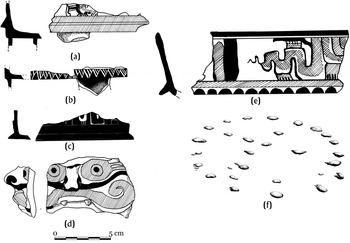
There are strong links to the central Peten (Figure 11)—slab-footed tripod vessels (Figure 11a–c) and other Petenero adaptations of Mexican imagery (Figure 11d and 11f) have been identified in the shrine material, and the polychrome iconography is mostly a variation on the “Serpent Head X” motif identified by Smith (Reference Smith1955) at Uaxactun (Figure 11e). Although the ceramic types are lowland, there are several “exotic” highland flairs that were commonly incorporated into the style. Approximately one-quarter (24.0%, n = 188) of the polychromes have a black-slipped or smudged interior, for example, a typical highland trait absent in the lowlands. The Candelaria Caves vessels also have smaller diameters and thinner walls than typical lowland counterparts.
Central lowland connections in the Candelaria Cave system: (a-c) slab-footed cylindrical tripod vessels (drawings by Luis Luin); (d) appliquéd polychrome Tlaloc mask (drawing by Walter Burgos); (e) Serpent Head X motif on a Dos Arroyos Orange Polychrome vessel (drawing by Walter Burgos); (f) pecked cross (drawing by Luis Luin).

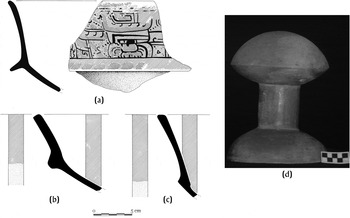
The San Francisco Hills and Tres Islas (Figure 12) are much more typical for the southwestern Peten—they have a mix of Peripheral Chicanel and Tzakol wares with some imports from the lower Pasión and the southeastern Peten. While still somewhat rare, there is a much higher amount of Peripheral Chicanel (3.9%, n = 70). The vessel diameters tend to be larger than their counterparts in the Candelaria Caves—the polychrome basal-flanged bowls in the San Francisco Hills (n = 44) (Figure 12a) have a mean diameter of 30 cm (range of 21–35 cm, while the Candelaria Caves bowls (n = 325) have a diameter of 22.7 cm (range of 12–48 cm). This is statistically significant at a p of .01 according to the Student's T test (bivariate).
Typical southwestern Peten material recovered from Tres Islas and the San Francisco Hills: (a) Dos Arroyos Orange Polychrome (drawing by Luis Luin); (b–c) Águila Red-Orange (drawing by Luis Luin); (d) Baclam Orange mushroom pot (photo by Brent Woodfill).

In addition to the ceramics, there are close iconographic associations with Teotihuacan in the region. The stelae at Tres Islas (see Figure 9) depict warriors dressed as Teotihuacanos, and one of the caves in the Candelaria system has a pecked cross (Carot Reference Carot1989, Figure 11f), also associated with Teotihuacan (Aveni et al. Reference Aveni, Hartung and Buckingham1978). Finally, excavations in the Candelaria Caves in 2004 recovered a Tlaloc mask appliqué from a polychrome vessel (Figure 11d). Since there are no direct associations with Teotihuacan in the region outside of the iconography, however, it is very likely that these were all filtered through Tikal and its allies, who were most closely affiliated with Teotihuacan in the Maya world.
Ties between Tikal and Kaminaljuyu are well established during the Early Classic period, and even if their exact nature is still unclear (Braswell Reference Braswell and Braswell2003; Iglesias Ponce de Leon Reference Iglesias Ponce de Leon and Braswell2003), iconographic evidence from material found in burial 10 and 48 in Tikal (Bonnafoux Reference Bonnafoux2008; Coggins Reference Coggins1975; Culbert Reference Culbert and Culbert1996a; Reents-Budet and Culbert Reference Reents-Budet, Culbert, Laporte and Escobedo1999) as well as isotopic data from Kaminaljuyu burials suggest strong alliances between rulers from both cities at that time (Wright et al. Reference Wright, Valdez, Burton, Price and Schwarcz2010). Since this region was located along one potential route connecting these two cities, the Tlaloc mask as well the Teotihuacan style steles from Tres Islas could potentially relate to this Tikal-Kaminaljuyu connection.
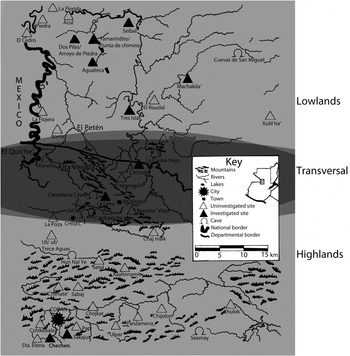
The Early Classic material shows strong outside influences and multiple ties to the central Peten, which corresponds with the close ties noted by Bachand (Reference Bachand2006, Reference Bachand2010) at Punta de Chimino beginning in a.d. 430. The iconographic data in particular show interactions with the Tikal sphere, which corroborates data from Carot (Reference Carot1989) in the Candelaria system and Ichon and Arnauld (Reference Ichon and Arnauld1985) in La Lagunita. All of these patterns contrast with the Late Classic material, where the shrines and settlements have a strongly local character deriving from three traditions—the northern highlands, the southern lowlands, and the “Transversal” at the border between them (Figure 13).
Late Classic regional affiliations in the Pasión-Verapaz Region (modified by Brent Woodfill from the original by Carlos Efraín Tox).

Technological Change along the Great Western Trade Route
While examining ceramic styles allows us to infer aspects of the intended consumers of the vessels, we can study the affiliations of their producers through studying the paste and other technological aspects. These technological choices are to a certain degree limited by the available resources, so it is surprising that the largest changes in temper and paste (both of which were acquired locally) are temporal—not geographical—in the Pasión-Verapaz region.
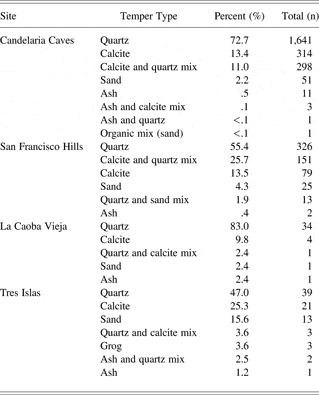
The pastes are all rather standardized in the northern part of the region during the Early Classic period, as can been seen in Tables 1 and 2. Quartz dominates all of the assemblages, followed by calcite. Sand and a mixture of calcite and quartz are the next most common tempers, although there is some variation in ranking between Tres Islas and the assemblages further south. The Early Classic material from Hun Nal Ye was excluded from this study because the material consists of whole vessels and so was not subject to paste analysis.
Early Classic pastes in the Pasión-Verapaz Region

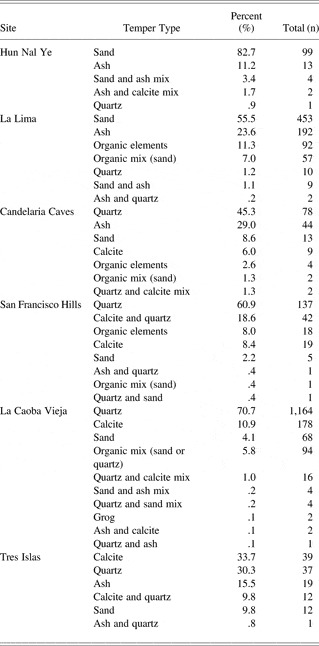
Late Classic pastes in the Pasión-Verapaz Region

There are drastic changes in temper in the Late Classic period, with the assemblage consisting principally of a mixture of highland, lowland, and transversal spheres with little overlap from the previous period. Organic temper becomes common for utilitarian vessels in Tres Islas, the San Francisco Hills, and the Candelaria Caves and is occasionally found in polychrome vessels, which is typical of the northern highlands (Arnauld Reference Arnauld, Ichon and Arnauld1986b) as well as being part of the transversal tradition, where it is a common addition to the Salinas de los Nueve Cerros temper mix (Castillo and Woodfill Reference Castillo, Woodfill, Woodfill, Monterroso, Castillo and Tiul2010; Dillon Reference Dillon1979). The differences in wares that are shown in Table 1 are not simply stylistic but technological—the northern highland slips are much duller and flakier than their lowland counterparts, and the vessels themselves tend to be more fragile. There is some change in the methods used to make color, as well. Black slip is common in the Candelaria Caves in the Early Classic period, for example, but during the Late Classic period, it is typically replaced by smudging, a typical northern highland mode (Arnauld Reference Arnauld, Ichon and Arnauld1986b; Ichon Reference Ichon1992; Smith Reference Smith1952; Woodfill Reference Woodfill2007, Reference Woodfill2010). When black slip is used, it is typically much more uneven than its contemporaneous lowland counterparts, often fading to gray or brown.
Several scholars (Berlin and Slane Reference Berlin and Slane1997; Sanders Reference Sanders, Sanders and Michels1977; Spence Reference Spence, Mastache, Parsons, Santley and Puche1996b) have used utilitarian ceramics with apparent success as a marker for determining what is here termed “ethnic affiliation” (Forné Reference Forné, Becquelin, Breton and Ruz2010; Heinz Reference Heinz1993; Woodfill Reference Woodfill2007), roughly understood as the geographic and cultural origin of the producers and consumers of the ceramic material. This class of ceramics in particular is fruitful for examining the ethnic affiliation, as the technology used to make them, as well as the tasks for which they were made, tend to change very little over time within the same group. Using this model, it is possible to formulate several general patterns in the region at hand.
The complete lack of any highland utilitarian ceramics in the material recovered north of Hun Nal Ye in the Early Classic period is directly contrasted with the Late Classic period, when they compose 40% of the sample (2,392 sherds). This pattern is even more pronounced in the surface settlements in the southern half of the region, where lowland ceramic types have not been identified in the assemblage.
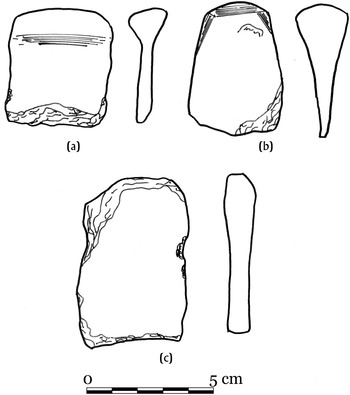
In addition to changes in the ceramics, research in the settlements has also uncovered the presence of groundstone hand axes (Figure 14) in the settlements surrounding the Candelaria Caves and the San Francisco Hills. This is a rare type of artifact that appears to be typical of the northern highlands—while they have not been noted in field reports, a private collector in the Coban area has a large quantity of them, all of which were found on or near his property (Woodfill Reference Woodfill2007, Reference Woodfill2010). It is likely that they were a local replacement for chert tools in the highlands, since chert does not naturally occur in most of the highlands and was not commonly imported there. Taken together, the ceramic and lithic data present compelling evidence for a northern highlander intrusion around the Early-to-Late Classic transition.
Northern highland-style groundstone hand axes (drawing by Mirza Monterroso).

Changes in Settlement Patterns and Ritual Practice and their Implications to Understanding Local Culture-History
One final clue to the understanding the Early-Late Classic transition in the Pasión-Verapaz region is the drastic change in settlement patterns and ritual activity after a.d. 550, which will be briefly described here. Four meaningful and superficially contradictory patterns were revealed at this time: (1) Both of the major settlements in the region (Cancuen and Raxruha Viejo) and most of the known villages were founded in the Late Classic period, and (2) ritual activity virtually came to a halt at all known shrines at the end of the Early Classic period. At the same time, (3) Early Classic ritual is focused on the areas that conform most closely to Mesoamerican ideals of sacred space, while (4) the ritual activity that is present in the Late Classic period shifts principally to natural stages where ritual activity could be observed by a large audience.
The Early Classic shrine material represents nearly three-quarters of all of the recovered material. The actual percentage of this period in the region is likely much higher, however, as a result of a skewed sampling strategy. Virtually all of the ritual assemblage from the caves dates to the Early Classic period, but due to the overwhelming amount of material present, only a very limited sample (typically less than 1% of the surface material) was recovered. Late Classic assemblages, on the other hand, were smaller and more concentrated and were, thus, collected in their entirety on several occasions. We estimate that the Early Classic material likely represents well over 90% of the ritual assemblage from the Pasión-Verapaz region, even though it has remained largely elusive in the settlement record.
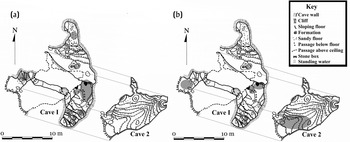
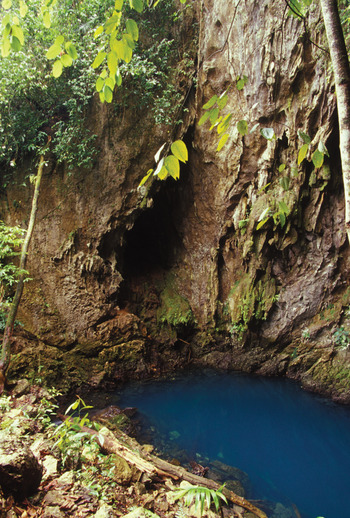
A comparison of Early and Late Classic ritual practice reveals fundamental differences in the function of ritual during the two periods of use. This is most profoundly seen in Hun Nal Ye, where the Early Classic pattern of caching exotic whole vessels in the cave interior is largely replaced during the Late Classic by smashing and caching vessels at the entrance (Woodfill Reference Woodfill2010; Figure 15). In a similar manner, the Early Classic ritual in the Candelaria Caves is found throughout the caves and does involve smashing whole vessels on a massive scale, but most of the activity is focused in the most dramatic contexts and near sources of water, both near the entrance and in the cave interior (Woodfill Reference Woodfill2007, Reference Woodfill2010). The Late Classic material, however, is almost completely limited in both Hun Nal Ye and the Candelaria Caves to high entrances that could have served as natural stages for ritual performance in front of an audience (Woodfill Reference Woodfill2007, Reference Woodfill2010: Figure 16). Late Classic ritual in the Candelaria Caves is also highly restricted spatially, limited to areas in the immediate vicinity of contemporaneous settlements.
(a) Early Classic and (b) Late Classic period ritual foci in the Cave of Hun Nal Ye (modified by Brent Woodfill from the original by Mirza Monterroso).

Cave entrance used as ceremonial stage, Hun Nal Ye (photo by Horacio Martínez).

The underlying rationale for the ritual is almost certainly different for the two time periods. The region was much more densely occupied in the Late Classic period, and much of the ritual would have been done as a part of the standard status-reinforcing ceremonies of the local elite, especially since the region was devoid of pyramids (Barrientos and Demarest Reference Barrientos and Demarest2000; Woodfill Reference Woodfill2002, Reference Woodfill2007, Reference Woodfill2010). These ritual activities would have been performed in contexts that could replicate lowland temple-pyramids: a naturally well-lit stage; a darker, more secluded interior for “off-stage” events; and a place for an audience to sit and observe the ritual events. These are indeed the areas in which most of the Late Classic ritual occurred in Hun Nal Ye and the Candelaria Caves. The upper entrance to Ratón de los Dientes, for example, had a natural stage at the entrance and a dark side chamber that was invisible to the audience below that doubled as a “back door” to the public ritual space (Figure 17).
Ceremonial ledge at entrance to Ratón de los Dientes, in the eastern part of the Candelaria Cave system (drawing by Mirza Monterroso).

Early Classic ritual practitioners, on the other hand, did not typically pick places with an audience in mind. They focused instead on the most dramatic parts of the cave that evoked the “sense of the numinous” (Insoll Reference Insoll2004:150) so common to sacred sites cross-culturally. Since there was typically no place for an audience to observe the ritual event, it appears that the practitioners were either alone or in small groups. To date, the Cancuen Project has recovered no significant evidence of a local population, however, so it is likely that the rituals were undertaken by visitors and people passing through the region, although there would have been enough steady ritual traffic to account for the amount of material deposited and to support large-scale, local production of ritual paraphernalia.
Synthesizing the Pasión-Verapaz Data
By comparing the stylistic, technological, and ritual changes that occurred in the Pasión-Verapaz region between the Early and Late Classic periods, several distinctive patterns emerge: (1) close associations with the central Peten in the Early Classic period through ceramics and iconography; (2) an apparent influx of population into the region in the Late Classic period from the south; and, (3) a high quantity of ritual activity undertaken by nonlocals, strongly influenced by the central Peten region in the Early Classic period that diminishes or stops by the beginning of the Late Classic period.
Given the strategic location of this region at the base of the highlands along what is already well-documented as one of the principal trade routes connecting the central Peten with the highlands during the subsequent Late Classic period (Adams Reference Adams and Culbert1973; Arnauld Reference Arnauld1990; Demarest Reference Demarest1997, Reference Demarest2004, Reference Demarest2006; Demarest and Fahsen Reference Demarest and Fahsen2002; Demarest et al. Reference Demarest, Woodfill, Wolf, Barrientos, Bishop, Monterroso, Barrios, Quintanilla, Ivec, Laporte, Arroyo and Mejía2008; Hammond Reference Hammond1972; Sabloff Reference Sabloff1975; Thompson Reference Thompson1970; Woodfill Reference Woodfill2010), it is reasonable to suspect that the links could be based to a large degree in the same interregional exchange having its roots in the Early Classic period. The iconographic and stylistic links to Tikal and its allies suggest strongly that the initiator, if not the overseer, of much of this trade is to be found in the central Peten, and we will summarize the data from there in the following section.
THE VIEW FROM TIKAL
If the central Peten, in general, and Tikal, specifically, benefited from some special access to this major trade route between the highlands and lowlands in the Early Classic period, and if this influence were somehow motivated by or related to interregional exchange, then we would expect to find significant quantities of highland goods at Tikal at the same time, followed by a drastic reduction of these goods after a.d. 550. In order to test this, we examined the relative frequencies of jade and obsidian over time, since they are the two most significant nonperishable highland exports in the pre-Columbian Maya world.
The complete lithic collection collected by the Tikal Project has been intensively studied and published by Hattula Moholy-Nagy, providing us with invaluable quantitative and chronological data.Footnote 2 The assemblage included material from 10,690 excavated lots from the Tikal Project—2,172 from civic ceremonial structures, 1,952 from range structure groups, 1,248 from intermediate structure groups, and 3,720 from small structure groups (Moholy-Nagy Reference Moholy-Nagy2003a:5), that is to say that 69% of the excavated lots come from residential structures of different sizes and architectural quality. Despite the lack of data coming from the peripheral area of the site (only 23% of the excavated lots), this sample is drawn from a variety of contexts, enabling us to perceive eventual changes in raw material importation through time.
Tikal's Jade during the Early Classic Period
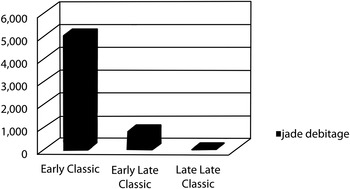
The frequency of finished jade artifacts are relatively stable between the Early and Late Classic periods (Moholy-Nagy Reference Moholy-Nagy2008:Annex 6:Tables 3.43, 3.49, 4.05, 4.12, 4.17, 4.29, 4.23). There are, however, pronounced changes in the frequency of jade debitage—over 79% (n = 5,032 out of 6,391) dates to the Early Classic period (Moholy-Nagy Reference Moholy-Nagy2008:Annex 6:Table 3-057). This indicates that not only did Tikal appear to have much greater access to jade in the Early Classic period, but also that its residents were using and importing it in a different way than during other periods, when access was predominately limited to complete artifacts (Moholy-Nagy Reference Moholy-Nagy2008:32).
While it is possible to say with a high degree of certainty that all of Tikal's jade comes from the Motagua fault in the Guatemalan highlands, none of the material has been sourced through chemical analyses (Moholy-Nagy Reference Moholy-Nagy2008:5). However, most of the potential sources that have been recognized and studied are located in the Motagua Valley (Forshag and Leslie 1955; Hammond et al. Reference Hammond, Aspinall, Feather, Hazelden, Gazard, Agrell, Earle and Ericson1977; Kidder Reference Kidder1935; Rochette Reference Rochette2009; Taube et al. Reference Taube, Hruby and Romero2005), and it is highly unlikely that the Tikal material would derive from an additional source. At Tikal, jade debitage was typically found as a part of structure caches (99%) (Moholy-Nagy Reference Moholy-Nagy1994:89, Reference Moholy-Nagy1997, Reference Moholy-Nagy2008:32), so we can say with a high degree of confidence that this is representative of the whole sample, since high quantities of such caches have been excavated by the Tikal Project that date to every major period of occupation (Coe Reference Coe1990; Maxwell Reference Maxwell1996). While examining the cache data, Maxwell (Reference Maxwell1996:269) notes: “Jade is a rare commodity in post Early Classic deposits at Tikal, and like many others, this change appears abruptly at about the time of the hiatus. . . . The number of exterior deposits containing jade decreases by more than 80% from the preceding period.”
Even if Late Classic chamber burials are, in general, far richer than the earlier tombs and have higher quantities of jade artifacts than their predecessors, access to jade seems to have been more restricted after the Early Classic period (Moholy-Nagy Reference Moholy-Nagy1994:46, Reference Moholy-Nagy and Sabloff2003b:105, Reference Moholy-Nagy2008:39). From this, we can conclude that jade continued to be a central symbol of elite power during the Late Classic period, and the radical decrease of jade debitage from one period to another (Figure 18) likely indicates that Tikal's residents stopped producing jade artifacts, instead becoming primarily consumers.
Comparison between Early and Late Classic period jade debitage (data from Moholy-Nagy Reference Moholy-Nagy2008:Table 3-057).

TIKAL IMPORTATION OF OBSIDIAN DURING THE EARLY CLASSIC PERIOD: AN ATTEMPT TOWARD QUANTITATIVE ESTIMATIONS
Many hypotheses have underlined the fact that Tikal might have had a particular role in the exchange of obsidian. A variety of models of the Classic period obsidian trade consider Tikal as a possible redistribution center for El Chayal obsidian (Arnauld Reference Arnauld1990; Dreiss and Brown Reference Dreiss, Brown, McAnany and Isaac1989; Hammond Reference Hammond1972, Reference Hammond and Renfrew1973, Reference Hammond, Hester and Hammond1976; Hammond et al. Reference Hammond, Neivens and Harbottle1984; Nelson et al. Reference Nelson, Phillips, Rubio, Matheny, Gurr, Forsyth and Hauk1983; Moholy-Nagy Reference Moholy-Nagy and Sabloff2003b:108–109; Nelson Reference Nelson1985, Reference Nelson, Serra and Olguín1994). How Tikal would have managed this is not understood, however, nor is the evolution of this organization through time.
During the Classic period, the great majority of the obsidian imported to the central lowlands came from El Chayal, Guatemala (Nelson Reference Nelson1985). Although instrumental neutron activation analysis (INAA) and x-ray fluorescence (XRF) analyses have shown importation from a variety of Mexican sources, most obsidian at Tikal throughout the Classic period, like the majority of lowland Maya cities (Moholy-Nagy and Nelson Reference Moholy-Nagy and Nelson1990:75), seems to be from El Chayal (Moholy-Nagy Reference Moholy-Nagy2003a:28; Moholy-Nagy and Nelson Reference Moholy-Nagy and Nelson1990). If our hypothesis about the role of Tikal in the Chixoy-Pasión trade route is correct, then Tikal should have had easier access to El Chayal obsidian during the Early Classic period, since it is most easily transported into the lowlands through this route (Arnauld Reference Arnauld1990; Nelson Reference Nelson1985).
Determining Sample Size
Because of the difficulty to distinguish visually among Mexican and Guatemalan gray obsidians (Moholy-Nagy Reference Moholy-Nagy1999, Reference Moholy-Nagy2003c), Moholy-Nagy did not present the obsidian source attribution on a visual basis, and only separated it by color (Moholy-Nagy Reference Moholy-Nagy2003a). Therefore it is not possible to discuss Tikal's importation of obsidian through time on the basis of the entire collection. Most of the obsidian sample (98.7%) is classified as translucent gray (Moholy-Nagy Reference Moholy-Nagy2003a:Tables 3.2; 3.8; 3.14; 3.20; 3.25), which is consistent with an El Chayal attribution. However, some Mexican sources—Otumba, for instance—can be visually confused with El Chayal obsidian (Moholy-Nagy Reference Moholy-Nagy2003c). Given the distance to most Mexican obsidian sources (more than 1,000 km from Tikal), as well as the dominance of El Chayal obsidian at Tikal's neighbors (Dreiss and Brown Reference Dreiss, Brown, McAnany and Isaac1989; Hammond et al. Reference Hammond, Neivens and Harbottle1984; Nelson Reference Nelson1985, Reference Nelson, Serra and Olguín1994; Nelson et al. Reference Nelson, Phillips, Rubio, Matheny, Gurr, Forsyth and Hauk1983), however, it is reasonable to assume that most of the obsidian at Tikal is also from El Chayal.Footnote 3 Therefore, it is safe to consider that the great majority of the gray obsidian probably came from the El Chayal source, as indeed is the case in most lowland sites during the Classic period (Moholy-Nagy and Nelson Reference Moholy-Nagy and Nelson1990:75; Nelson Reference Nelson1985).
If we consider the totality of the obsidian collection in Tikal, without taking into account its provenience, it appears that most of Tikal's obsidian has been found in Early Classic contexts. Indeed, if we consider the published data from 2003, 55% of all obsidian found in Tikal appears to date to the Early Classic period (Moholy-Nagy Reference Moholy-Nagy2003a:Tables 3.5–6, 3.11–12, 3.18, 3.24, 3.29). However, these data are complicated by the collection strategy employed by the Tikal Project. Due to the quantity of materials found in exterior burial special deposits and special deposits, only a portion of the material was removed (Moholy-Nagy Reference Moholy-Nagy1997). As a result, we have no way of knowing the representativeness of each sample. Moholy-Nagy (Reference Moholy-Nagy1997:296, 298) estimates the totality of the obsidian debitage found in special deposits to be approximately 228,243 pieces, although the studied sample only included 65,920 pieces. She notes that most Late Classic exterior burial deposit material was not collected during excavation, so we must be very cautious while interpreting the data.
Although Table 3.29 gives the impression that debitage deposition peaked during the Early Classic period, this is misleading. Early Classic period deposits, in general, were still small enough to be completely excavated, and usually only a small sample of what was recovered was brought into the field laboratory (Moholy-Nagy Reference Moholy-Nagy2003a:35).
In particular, Late Classic chamber burial deposits are described as by far the most important and impressive (Moholy-Nagy Reference Moholy-Nagy1997). Late Classic Burial 116, for instance, is considered to be the biggest artifactual deposit found in Tikal. It was described by Coe (Reference Coe1990:607) as containing “a ton of esoterically distributed flint—perhaps a quarter of a ton of obsidian—may not be far off the mark.” On that weight basis, Moholy-Nagy (Reference Moholy-Nagy1997:306) estimated that this single deposit contained “157,000 pieces of chert and at least 380,000 pieces of obsidian.” Therefore, Burial 116, along with the slightly later Burial 196 and Burial 77 (Moholy-Nagy Reference Moholy-Nagy1997: 305–306), would be the largest obsidian deposits at Tikal. The misrepresentation of the material excavated from exterior chamber deposits from the Late Classic period therefore strongly complicates quantitative comparisons between both periods. The apparent drastic quantitative change observed between Early and Late Classic collections could be due to bias in the excavation and recollection strategies.
Patterns in the Obsidian Assemblage
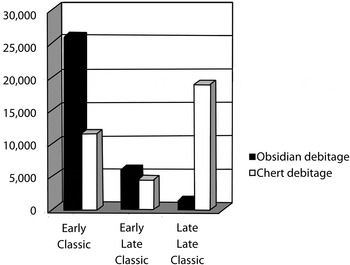
If we compare the obsidian with the chert sample, which was subject to the same sampling problems as the obsidian (Moholy-Nagy Reference Moholy-Nagy1997, Reference Moholy-Nagy2003a:24), it is possible to confirm changes in obsidian importation from one period to another. Interestingly, obsidian and chert quantities present the inverse pattern. While obsidian drastically diminishes after the Early Classic period, chert debitage appears to be much more important for the Late Classic period (Figure 19).
Comparison between Early and Late Classic obsidian and chert debitage quantities (data from Moholy-Nagy 2003:Tables 2.35 and 3.29).

This change has also been noticed by Maxwell's study of Tikal's cache material. While the frequency of deposits containing eccentrics increases slightly (from 32.8% to 38.2%), the number of eccentrics declines by almost sixty percent. This lends support to the notion that obsidian supplies to Tikal had diminished at this time—at least for ceremonial use—especially since 22.5% of that present was deposited under stelae and thus prior to the Caracol event in a.d. 562 (Maxwell Reference Maxwell1996:264).
A CORE/BLADE RATIO APPROACH
The qualitative structure of the Early Classic obsidian collection provides us another way to compensate for the sample discrepancies. When comparing obsidian artifact types, most of the collected cores are Early Classic (n = 1,080). When adding the number of eccentrics made out of cores for that same period (n = 506) (Moholy-Nagy Reference Moholy-Nagy2008:Table 3.006)Footnote 4, the number of cores appears to be even more important. The number of cores for the Early Classic period is 1,586, whereas only 1,300 blades were recovered that date to that same period (Moholy-Nagy Reference Moholy-Nagy2003a:Tables 3.18, 3.24). While it is important to note that blades are smaller and more easily overlooked than cores, they are also more fragile, often breaking into several pieces. As a result, the difference can be presumed to be negligible, and we can assume that blade collection would be consistent among different time periods.
This core-blade ratio is 1.22 for the Early Classic period. There is, therefore, a very strong overrepresentation of cores in comparison with blades during this time period. If we assume a reasonable blade-to-core ratio of 100 (Aoyama Reference Aoyama2001; Clark Reference Clark and Isaac1986; Fowler Reference Fowler1981), there would be 157,300 blades missing from the Early Classic assemblage! During the subsequent period (a.d. 554–692), the ratio is slightly more typical, with 503 cores and 753 blades. During the latter part of the Late Classic period (a.d. 692–869), the blade/core ratio is weaker still, with 122 cores for 514 blades (Moholy-Nagy Reference Moholy-Nagy2003a:Table 3.18, 3.24; 2008:Table 3.006). Thus, the most striking overrepresentation of cores to blades appears to be limited to the Early Classic period.
Interestingly, most of the recovered obsidian blades come from residential structures (62%) (Moholy-Nagy Reference Moholy-Nagy2003a:Table 3.22), which shows that this pattern is not due to a lack of excavation in household context. These residential groups' occupation peaked during the Late Classic period (Haviland Reference Haviland and Sabloff2003), making the number of blades per inhabitant thus even lower during that period and confirming that Tikal's inhabitants probably had access to more obsidian during the Early Classic period than in subsequent periods.
Since this core/blade ratio is so low for the Early Classic period, the question becomes, where did these blades go? One possibility would be that most of them were consumed by households located in the site's periphery outside of the scope of the Pennsylvania Project excavations. Recent work outside the core area of Tikal (Webster Reference Webster2007; Webster et al. Reference Webster, Murtha, Straight, Silverstein, Martinez, Terry and Burnett2007:36–37), however, showed that obsidian was extremely rare in households outside of the site center and that there was a clear correlation between the distance to the core and the quantity of obsidian per excavated lot. This particular pattern could therefore indicate that Tikal was producing and exporting blades outside of the site in massive quantities during the Early Classic period, an industry that withered during later periods.
SYNTHESIZING THE LITHIC DATA
The jade and, to a lesser extent, the obsidian seem to corroborate the idea of a major change in the importation and exportation of highland materials at Tikal at the end of the Early Classic period. Both Early Classic collections are unique in comparison to other lowland sites.
1. The composition of the jade collection clearly shows that local production of jade artifacts took place in Tikal during the Early Classic period (Moholy-Nagy Reference Moholy-Nagy2008:32), something unique in the lowlands. To date, no contemporaneous lowland site shows any evidence of jade production, and all other Early Classic lowland jade or greenstone assemblages are limited to finished objects. All jade debitage, in contrast, was geographically limited to the highland workshops close to known jade sources (Andrieu and Forné Reference Andrieu, Forné, Arroyo, Palma and Aragon2010). The presence of 5,032 pieces of debitage during the Early Classic period in Tikal, therefore, indicates a highly unusual pattern.
2. While the quantitative obsidian data are harder to use because of sampling problems, the obsidian-to-chert data and the blade-core ratio also indicate the importation of large quantities of obsidian and large-scale production at the site during the Early Classic period that has no comparison to contemporaneous sites (Andrieu Reference Andrieu2009:228).
3. Both collections show a drastic change after the Early Classic period: jade debitage largely disappears, and the obsidian core-to-blade ratio approaches patterns found at other Late Classic lowland cities.
These major qualitative changes that occurred between the Early and Late Classic period can be correlated with Tikal's loss of influence in the Passion Verapaz trade route and its political defeats at the end of the sixth century. In fact, this period following Tikal's military defeats has long been considered as a “hiatus,” as manifested by the lack of stelae and inscriptions that continued for over a century (Martin and Grube Reference Martin and Grube2000).
This model has been recently challenged, however: while Tikal clearly faced internal political conflicts (Martin Reference Martin and Sabloff2003), the demographic estimation showed that population peaked in the site and that the numerous constructions were built during that same period (Moholy-Nagy Reference Moholy-Nagy2003d). However, the lack of epigraphic inscription during more than a century would seem to indicate a major change in Tikal's internal politics (Martin Reference Martin and Sabloff2003; Moholy-Nagy Reference Moholy-Nagy2003d) that could have been the consequence of the documented military defeats at the hands of Caracol, Calakmul, Dos Pilas, and others (Martin and Grube Reference Martin and Grube2000). Interestingly, the coincidence between these losses and its loss of influence along this trade route is not as much accompanied by a decrease of highland exotic materials in the site than by a radical change in their import and export. As a matter of fact, Tikal's Late Classic material culture continues to reveal a very wealthy city (Moholy-Nagy Reference Moholy-Nagy and Sabloff2003b, Reference Moholy-Nagy2003d), and the burials from that period are by far the richest of the whole site occupation. So this change does not imply that Tikal has been cut from any kind of long-distance exchanges after its defeat with Caracol and Calakmul. However, the coincidence between the loss of Tikal influence along the western trade route and the drastic change in jade and obsidian importation that we noticed after the end of the Early Classic period could indicate a major economic transformation in that city, which stopped being a producer of jade and obsidian artifacts, becoming instead a wealthy consumer.
The composition of both obsidian and jade Late Classic collections indicates a more “normal” pattern for a major Maya city where hints of large-scale lithic production is usually very scarce (Potter and King Reference Potter, King, Ehrenreich, Crumley and Levy1995; Rice Reference Rice, Brumfield and Earle1987; Speal Reference Speal2009). As a matter of fact, no other Early Classic lowland site to date has any evidence of jade production, and no published collection is composed of more obsidian cores than blades (see, for example, Aoyama Reference Aoyama1999, Reference Aoyama2007; Baudez Reference Baudez, Becquelin and Baudez1982; Brokmann Reference Brokmann2000; Hruby Reference Hruby2006; Kidder Reference Kidder1947; McAnany and Peterson Reference McAnany, Peterson and McAnany2004; Rovner and Lewenstein Reference Rovner and Suzanne1997; Willey Reference Willey1972, Reference Willey1978). The radical qualitative change in Tikal's collection from the Early to the Late Classic period would imply that the loss of direct influence in the western trade route ended what seems to have been an economic specificity of Tikal as a major center of production for jade and obsidian.
TIKAL AND THE PASIÓN-VERAPAZ REGION: A PRELIMINARY CHRONOLOGY
As is apparent in the previous sections, the chronologies from Tikal and the Pasión-Verapaz region are closely correlated. Together, they appear to tell the story of increased traffic through the highlands along the Pasión River in the latter part of the Early Classic period under the auspices of Tikal and its allies, followed by increasing competition along the route after Tikal's defeat in the latter part of the sixth century a.d.
The Early Classic
Tikal's importance during the Early Classic period has been long recognized and discussed (Bachand Reference Bachand2010; Culbert Reference Culbert and Culbert1996a, Reference Culbert and Culbert1996b:314; Jones Reference Jones and Culbert1996:111; Martin Reference Martin and Sabloff2003; Sabloff Reference Sabloff2003). Epigraphic and iconographic data have shown the very aggressive military politic developed by its rulers at that time (see, for example, Martin and Grube Reference Martin and Grube2000) toward its close neighbors, and its associations with the founding of the Copan and Quirigua dynasties have been interpreted as a clear strategy to obtain a privileged access to highlands goods and trade routes (Sharer Reference Sharer and Sabloff2003b).
Data from the Candelaria Caves and the Verapaz indicate that Tikal could have developed similar strategies in order to have access to highland precious goods traveling along the Pasión River and the Great Western Trade Route, although the lack of epigraphic data has led us to other avenues of inquiry detailed above. It is clear, however, that through the importation and production of large quantities of raw jade and obsidian in the central lowlands, Tikal seems to have developed a unique economic system that is still not fully understood.
While there is a significant amount of evidence that much of the Early Classic trade and transit that passed through the Pasión-Verapaz region was under the auspices of Tikal and its allies, there is no evidence that the region was actively conquered. The region was too distant to have made an actual invasion worthwhile (Chase et al. Reference Chase, Chase and Smith2009) and by all accounts, the region had a dispersed local population too small to have allowed for active control. It is more likely that the privileged access Tikal had to obsidian and jade material was enabled through an active strategy of alliances or associations with extant Pasión-Verapaz sites and marking the principal ritual sites along the route through iconography and religious paraphernalia, all of which is evinced by ceramic, ritual, and iconographic data. The actual nature and mechanisms of the alliances or associations are still not understood, given the lack of intensive investigations throughout most of the region, especially in the northern highlands. We can say with a high degree of certainty, however, that any connections forged would have allowed Tikal to have greater ease of access of the obsidian and jade passing along the route.
The Late Classic
This privilege did not last long, however. Beginning with Tikal's defeat in a.d. 562, Calakmul appears to have quickly taken over the Great Western Trade Route through its alliance with Dos Pilas (Demarest Reference Demarest2006; Demarest and Fahsen Reference Demarest and Fahsen2002). Dos Pilas, a major military force since its establishment in a.d. 629 (Demarest Reference Demarest2006; Martin and Grube Reference Martin and Grube2000), was, in fact, the key to both Tikal's and Calakmul's strategies during the Late Classic period. Although Tikal founded the site as an attempt to pull itself out of its “hiatus” and maintain control over the highland raw materials (Demarest and Fahsen Reference Demarest and Fahsen2002), Calakmul managed to gain its fealty and used it to take over much of the route.
After Tikal recovered at the end of the seventh century and successfully defeated Calakmul, its rulers still found their power in other regions greatly circumscribed. This is especially clear in the Pasión-Verapaz region and the southwestern Peten, where an apparent population explosion began around a.d. 600 resulting in the proliferation of cities along the river and into the highlands, making long-distance conquest impossible. Instead, the Late Classic period here is typified by increased decentralization, a sort of political “king of the hill” as a succession of cities took control of the route, only to have the control wrested away—Tikal, then Calakmul, then Dos Pilas, then Cancuen (Demarest Reference Demarest2006; Demarest and Fahsen Reference Demarest and Fahsen2002; Demarest et al. Reference Demarest, Woodfill, Wolf, Barrientos, Bishop, Monterroso, Barrios, Quintanilla, Ivec, Laporte, Arroyo and Mejía2008; Fahsen et al. Reference Fahsen, Barrientos and Demarest2004; Woodfill Reference Woodfill2007, Reference Woodfill2010).
As the route was divided up among more and increasingly local cities, the archaeological evidence strongly suggests that the desperation and stakes became increasingly higher. Eventually, the larger cities were abandoned and the surrounding region was thrust into chaos. All of the major cities—Dos Pilas, Aguateca, Cancuen, Altar de Sacrificios, Seibal, and Punto de Chimino—met violent ends, and the trade route was largely abandoned (Demarest Reference Demarest, Andrews V and Mozzillo1994, Reference Demarest1997, Reference Demarest2006; Demarest et al. Reference Demarest, Houston and Johnston1989; Eberl Reference Eberl2007; Inomata Reference Inomata1995; Martin and Grube Reference Martin and Grube2000; Willey Reference Willey and Willey1990; Willey and Smith Reference Willey and Smith1969; Willey et al. Reference Willey, Smith, Tourtellot and Graham1975; Woodfill Reference Woodfill2007, Reference Woodfill2010). The endemic warfare there, in turn, could have led to an increased dependence on the eastern Caribbean route, which became the primary trade artery in the Terminal Classic and Postclassic periods, as evinced by the overwhelming importance of Ixtepeque obsidian (Arnauld Reference Arnauld1990; Hammond et al. Reference Hammond, Neivens and Harbottle1984; Nelson Reference Nelson1985, Reference Nelson, Serra and Olguín1994; Nelson et al. Reference Nelson, Phillips, Rubio, Matheny, Gurr, Forsyth and Hauk1983).
CONCLUSIONS
We hope that this paper demonstrates the necessity to correlate epigraphic, iconographic, ceramic, and lithic data from multiple sites and regions in order to derive cultural-historical hypotheses to be tested through future research. In particular, the close chronological correlation between these two regions allows us to glean important insights on the Classic Maya economy.
Although this Early Classic economic expansion of Tikal appears convincing, to date we can only describe the patterns, leaving any questions or discussions of the mechanisms involved for future research. How and why were the links between Tikal and the Pasión-Verapaz region formed? How far into the highlands did these associations go? Why was raw jade, which was quite heavy, transported from the highlands all the way to Tikal? Who were the people involved in this transportation? Aside from these questions, we still have to describe and understand the particular economic organization of jade and obsidian production at Tikal during the Early Classic period, and to understand how the apparently radical changes in this production in the Late Classic period is related to Tikal's internal politics (Moholy-Nagy Reference Moholy-Nagy2003d).
This Early Classic expansion appears to have resulted in the ability to take advantage of a large portion of highland-lowland exchange of precious raw materials, at least through the beginning of the Tikal Hiatus. Interestingly, after Calakmul's ascension to power starting in the seventh century, its rulers did not take advantage of their privileged access to highland materials through the route in the same way, but instead “subcontracted” much of the jade production to Cancuen. The economic consequences of this new economic model are still unclear, although the lack of jade production and relatively low frequency of obsidian at Calakmul speaks to significant changes from Tikal's Early Classic economy (Braswell 2004; Andrieu Reference Andrieu2009).
Cancuen continued to be the principal jade production site in the Maya lowlands even after Calakmul lost its hold over the region. Dos Pilas allied itself with Cancuen in order to take advantage of the site's economic importance, and after Dos Pilas' collapse, Cancuen itself seems to have become the head of its own hegemony. It is interesting to note that inhabitants of both Tikal and Cancuen seem to have had a particularly easy access to jade at one point. The thousands of pieces of jade debitage recovered from two Late Classic structures at Cancuen (Demarest and Barrientos Reference Demarest and Barrientos2002; Kovacevich and Pereira Reference Kovacevich, Pereira, Demarest and Barrientos2002) indicate that, like Early Classic Tikal, Cancuen was importing blocks instead of finished objects, which would have had a much more profound economic and political effect. However, Cancuen appears to have occupied a much more specialized economic niche, since it lacks evidence of large-scale obsidian production or exportation (Kovacevich Reference Kovacevich2006).
It seems that Tikal's Early Classic organization of long-distance trade was unique, effective, and never imitated. We suspect that this is largely because of the lack of competition at its Early Classic zenith. Once it developed a clear and easy economic and political innovation and managed to establish a privileged access to the Great Western Trade Route, however, it appears to have opened up a “Pandora's Box,” creating a new strategy for building power relations through privileged access to exotics. As soon as Calakmul started to engage in the same strategy, the competition to control the route became increasingly intense, and this competition is likely one of the principal factors leading to the endemic warfare along the Pasión River during the Terminal Classic period.
ACKNOWLEDGMENTS
We would like to thank the Instituto de Antropología e Historia de Guatemala, Arthur Demarest, and Hattula Moholy-Nagy for their thoughtful remarks and criticisms, the members of Proyecto Arqueológico Cancuen and Proyecto Salinas de los Nueve Cerros, and the anonymous reviewers of earlier drafts of this article.