Introduction
Alzheimer’s Disease (AD) is becoming an increasingly important health problem in modern societies, as life expectancy continues to grow with the improvement in the quality of life, nutrition and health services. In this paper, we utilize the technique of discrete choice experiments (DCE) to study the monetary value of several key policies aimed at improving the health care of patients with AD. The DCE technique has been employed intensively in the valuation of health policies (see for instance Ryan and Hughes, Reference Ryan and Hughes1997; Diener et al., Reference Diener, O’Brien and Gafni1998; Klose, Reference Klose1999; San Miguel et al., Reference San Miguel, Ryan and Mcintosh1999; Ryan and Bate, Reference Ryan and Bate2001; Carlsson and Martinsson, Reference Carlsson and Martinsson2003), allowing researchers to study the intensity of preferences for health care programmes, as well as the relative preferences for their specific attributes.
DCE methodology originated in mathematical psychology and statistics (Luce and Tukey, Reference Luce and Tukey1964), and has been used intensively for policy evaluation in market research (Louviere, Reference Louviere and Bagozzi1994; Adamowicz et al., Reference Adamowicz, Swait, Boxall, Louviere and Williams1997) and transport economics (Hensher, Reference Hensher1994). Although there have been important applications to the evaluation of health care programmes, there is limited evidence with respect to the assessment of the benefits that can be provided by programmes intended to aid those affected by senile dementia; the most noteworthy of these are the contingent valuation studies conducted by Nocera et al. (Reference Nocera, Telser and Bonato2001), Nocera et al. (Reference Nocera, Bonato and Telser2002), and Bonato et al. (Reference Bonato, Nocera and Telser2003).
In this study, we consider the evaluation of three different health care programmes for patients with AD: (i) home care services, (ii) day centre services, and (iii) services provided by medium- and long-stay centres. In each of these resources, patients would receive individualized and specialized care, as well as health-related services.
From a methodological standpoint, we compare the result of three different DCEs with different degrees of complexity from the point of view of the respondent. The simplest approach is the single DC question, which involves the evaluation of a single set of policy measures with particular levels of their attributes against the alternative status quo, and subsequently requests a binary yes/no answer from the respondent. This approach is compared with more complex methods in which three or four alternative policy sets are included in the choice set. The model chosen for modelling the data is the mixed logit model. The analysis is carried out with both classical and Bayesian methods.
The paper is organized as follows: Section 2 presents the discrete choice experiment used for establishing relevant product attributes and estimating WTP for different programmes for treating patients with AD. We provide a brief description of the fieldwork by which the data were obtained and describe the econometric models that were implemented. Section 3 presents the results obtained, and, finally, in Section 4 we discuss the findings and draw some conclusions.
Methods
DCEs present respondents with alternative descriptions of a health care service, differentiated by different combinations of attribute levels. Respondents are asked to choose their preferred alternative. For each choice made, the alternative selected is assumed to yield a higher level of satisfaction than that rejected. This enables the probability of an alternative being chosen to be modelled in terms of the attribute levels used to describe the service. There are two key underlying assumptions: that the service can be separated into distinct attributes (Lancaster, Reference Lancaster1966) and that satisfaction can be modelled as a behavioural response that comprises a systematic and random component (Ben-Akiva and Lerman, Reference Ben-Akiva and Lerman1985; Manski, Reference Manski1977). The DCE comprises four steps: establishing the attributes and levels, selecting alternative scenarios to present (or combinations of attribute levels), measurement, and estimation.
Attributes and levels
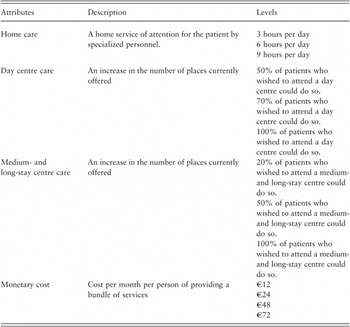
For the present study, aged persons and key stakeholders were interviewed in an open-ended pre-test (N=18), in order to establish the most significant attributes of AD care services. Table 1 shows the four attributes defined: ‘Home care’, ‘Access to day centre care’, ‘Access to medium- and long-stay centres’, and ‘Monetary cost’. Plausible levels for the attributes were identified through a pre-test survey. For a full description of the attributes, see Cards 3–5 in the Appendix.
Attributes and levels included in the study

Selection of scenarios
In order to test the sensitivity of the results to the degree of complexity of the selection experiment, three alternative exercises are examined. In the first exercise, termed Model A, the respondent is asked to consider a combination of home care, day centres, and medium–long-stay centres, and is informed of the total cost of this combination. The respondent is asked to choose between accepting this combination or continuing the present situation of scarce social health services. In Model B, the respondent has to choose between two possible combinations of policies, each of which has an associated cost, or otherwise continue with the status quo. Finally, in Model C, three combinations are presented as alternatives to the status quo.
Since the first three attributes have three levels each, while ‘Monetary cost’ has four, the number of possible scenarios amounts to a total of 108 (=3*3*3*4). Since a single individual might find it extremely difficult to evaluate so many scenarios, we utilized a D-optimal design to generate a set of manageable alternatives. D-optimal design maximizes the information matrix (Huber and Zwerina, Reference Huber and Zwerina1996) and is implemented in the software package SAS (Kuhfeld, Reference Kuhfeld2001). This allowed us to reduce the full factorial design to 20 scenarios. Based on prior discussions with focus groups and pre-test results, we decided to limit the number of choice questions for each respondent to five. Thus, for the single dichotomous choice scenario, each respondent received five sets of alternatives randomly chosen from the 20 optimal scenarios. For the case of two and three alternatives, the optimal scenarios were grouped in five sets of two or three alternatives utilizing appropriate procedures for designing balanced incomplete block designs, also implemented in SAS (Federer and Raghavarao, Reference Federer and Raghavarao1987).
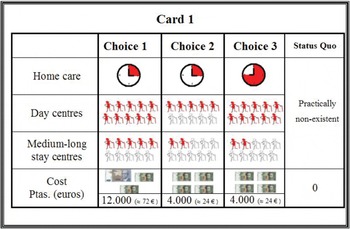
To minimize respondent confusion, the levels of each attribute were represented with images. All images and accompanying texts were tested in pre-test studies, to ensure satisfactory understanding by respondents. Figure 1 shows an example of a card presented for Model C.
Example of a card included within the questionnaire

Measurements
The survey consists of face-to-face interviews (of about 30–40 minutes length on average) with a random sample of 600 individuals selected from the adult population. The total sample was randomized into three groups of 200 for Models A, B, and C, respectively. Only two respondents, for Model B, were rejected because of inconsistencies in the answers. The fieldwork was carried out from 2001 to 2002 on the island of Gran Canaria (Canary Islands, Spain). The survey team had been instructed in the specific requirements of the questionnaires on stated preferences. The questionnaire comprises three sections.
In section 1, participants’ knowledge of and sensitivity to AD were examined, by means of four questions on general knowledge regarding AD and mental disorders. Then, the Alzheimer problem was defined. Information was given about the disease and the policies applied to date. The survey officials explained AD clearly and slowly, and informed respondents of the current supply of resources available in the National Health System (see Cards 1 and 2 in the Appendix).
Section 2 presents the discrete choice experiment, describing the attributes and payment method (see Cards 2–7 in the Appendix). In all three models (A, B, and C), the respondent was shown five cards (see Card 8 in the Appendix and Figure 1) with different combinations, so that a total number of 2,990 choice situations were obtained (=5*200+5*198+5*200).
Finally, Section 3 asked about socio-demographic characteristics. These include gender, age, marital status, health status, education, and average monthly net family income.
Estimation
The mixed logit model is considered to be the most promising discrete choice model currently available (Hensher and Greene, 2003), providing a flexible and computationally practical econometric method for any discrete choice model derived from random utility maximization (McFadden and Train, Reference McFadden and Train2000), while overcoming some limitations of standard multinomial logit by allowing for random taste variation (Train, Reference Train2003).
Choice-based approaches are based on the random utility function, which represents the level of satisfaction perceived from the provision of a good at a social level. As defined in the questionnaire, ‘these policies can benefit you in the future if you suffer any mental disorder, or they can benefit other patients’. The individual is assumed to consider the full set of alternatives offered and to choose the alternative offering the highest utility. The utility is derived from the services associated with this good, and these can be described by the following series of attributes

where U int is the utility that individual n obtains from alternative i at instant t; β n is a vector of parameters of variables for person n representing his/her tastes;x int is a vector of observed attributes; η int is a random term with zero mean whose distribution over individuals and alternatives depends in general on underlying parameters and observed data relating to alternative i; and ɛint is a random term with zero mean that is i.i.d. over the alternatives and is normalized to set the scale of utility (Brownstone and Train, Reference Brownstone and Train1999).
If the βn parameters are fixed  , then the probability of choosing alternative i takes the form of a simple logit model (Domeneich and McFadden, Reference Domeneich and McFadden1975). The mixed logit class of models assumes a general distribution of ηint, which can take various distributional forms, such as normal, log-normal, uniform, or triangular (McFadden and Train, Reference McFadden and Train2000; Hensher et al., Reference Kukull and Higdon2005). In this paper, as in most applications (Layton and Brown, Reference Layton and Brown2000), the random parameters are specified as normal.
We examine two estimation procedures for the mixed logit model. In the first one, the frequentist method, the estimation is based on the simulated maximum likelihood method (Bhat, Reference Bhat2001; Train, Reference Train2003). The second one, the Bayesian method, assumes that the parameters of interest are random variables, with an associated probability distribution. The development of this method applied to mixed logit models is based on articles by Allenby and Ginter (Reference Allenby and Ginter1995) and by Lenk et al. (Reference Lenk, DeSarbo, Green and Young1996).
One premise of Bayesian statistics is that of incorporating prior knowledge, along with a given set of current observations, in order to make statistical inferences. In our analysis, we assume diffuse or non-informative prior information, and in order to estimate the parameters of the model, MCMC simulation methods must be applied (Gilks et al., Reference Gilks, Richardson and Spiegelhalter1996). The software used is WinBUGS, version 1.4. Codes are available from the authors upon request.
The amounts to be paid for single increases or decreases in an attribute, considered on the basis of its utility, are calculated from the marginal rate of substitution between the quantities expressed for the attribute in question, and the variations in income required to compensate for such reductions, such that the level of utility remains constant. The marginal rate of substitution between two goods is expressed as the ratio of the marginal utilities perceived for each one.
Explicative factors
The model proposed above assumes that preferences vary between individuals. An extension of this model could be to analyze the characteristics of the respondent that would explain such differences. Previous studies have revealed that WTP against AD is correlated with a number of sociodemographic variables and other respondent characteristics (Nocera et al., Reference Nocera, Bonato and Telser2002).
A flexible way of studying explicative factors is to suppose that the marginal utilities assigned to each attribute can be explained by covariates. However, we are not interested in the effects of the characteristics of the patient on the marginal utility of attributes, but on the corresponding WTP. To solve the problem, we propose a transformation of the equation that defines the utility

where HCint refers to the level of home care for respondent n in alternative i at instant t; DCint is the equivalent level for day centres; MLSCint that for medium–long-stay centres; Cint for cost; and μint is a random term. As an individual marginal utility is estimated for each attribute, we can divide the members of the equation by minus the marginal utility of costs  . Thus, the utility function becomes

Under the conventional assumption that the marginal utility of costs is always negative, the decision process with utility in Equation (3) remains invariant where an alternative i is preferred to alternative j when  .
Thus, assuming that the same factors influence WTP for each respondent, the coefficients WTP n that allow us to estimate WTP for each attribute of the individual n, would be specified as a linear combination of the covariates.
Results
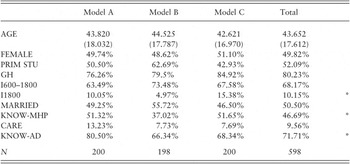
The sample characteristics of the respondents are shown in Table 2. Thus, the mean AGE is 43.65 (SD=17.6), 49.82% are FEMALE and 50.5% are MARRIED. The majority had only primary or no studies (PRIM STU) (52.1%) and they declared themselves to enjoy good mental health (GH) (80.23%). In addition, 68.17% had a level of family income per month of €600–€1800 (I600–1800), while 10.15% of respondents had a corresponding income exceeding €1800 (I1800). It is interesting to note that 46.69% knew of somebody with mental health problems (KNOW-MHP). Furthermore, 71.7% of the sample had a broad knowledge of AD (KNOW-AD), while 9.56% were informal caregivers (CARE) for a mental health patient. Chi-square analysis only revealed significant differences between the sample groups in the percentage of participants with a monthly income higher than €1800, acquaintance with a mental patient and knowledge of AD.
Summary statistics by models. Mean (standard deviation, SD)

Notes: *p-value <0.05. Two-tailed t-test for continuous variables and a chi-squared test for discrete variables
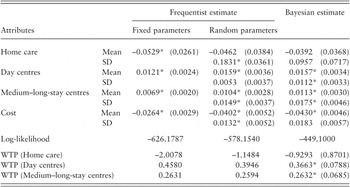
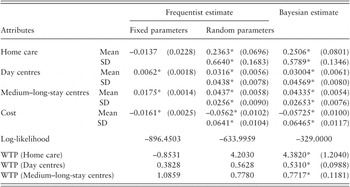
Table 3 shows the results of classical and Bayesian estimation of the first sub-sample, i.e. the one in which the respondents only had to choose between a possible combination of new policies and the current situation (Model A). In addition to the mean and the standard deviation of each parameter, the table also shows the statistical relevance, i.e. the p-value for frequentist analysis and the probability of a parameter having the same sign as that of the mean value for Bayesian analysis.
Utility function for model with two alternatives (Model A). Marginal utilities and willingness to pay. Mean (SD)

Notes: *p-value<0.05 for classical estimates and  or
 for Bayesian estimates.
The results are shown for three alternative methods of estimation. In the first one, fixed parameters were applied, using the classical approach, corresponding to a conventional logit model. The sign of the coefficients shows that the day centres and the medium–long-stay centres are valued positively by the population, but that the same is not true for home care. The model presents a WTP of €0.46 per month to increase access to day centres by 1%. This WTP decreases to €0.26 per month for medium–long-stay centres.
The next two columns show the random parameters estimate (the mixed logit model). The log-likelihood criteria show that the fit of the random parameters model is better than that of the fixed parameters counterpart, and so we conclude that the non-observable heterogeneity in the sample is significant.
The parameter estimates for the attributes are significantly different from zero in every case, except for the policy of improving home care. The estimated WTP for an increase of 1% in the probability of obtaining places at day care centres was €0.39 for the random parameter model. This value fell to €0.26 for the medium–long-stay centres.
The third column shows the results of the Bayesian analysis. The non-informative analysis did not produce very different results from those of the classical method (Huber and Train, Reference Huber and Zwerina2001), but it did offer significant conceptual and interpretative advantages. For example, Bayesian estimation enables us to estimate the βn coefficients for each individual, which is not feasible with classical methods. Moreover, while with classical models the mean WTP is obtained from the coefficient E(WTP)=E(meanattribute)/E(meancost), in the Bayesian counterpart the mean WTP is defined as a new random variable that is obtained as the ratio of the marginal utilities of the two attributes.
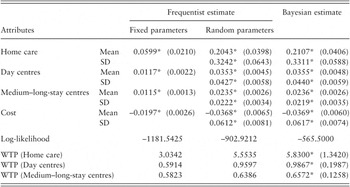
The results obtained with Model A can be compared with those obtained when more alternatives were proposed. Tables 4 and 5 show the results for Models B and C, respectively.
Utility function for model with three alternatives (Model B). Marginal utilities and willingness to pay. Mean (SD)

Notes: *p-value<0.05 for classical estimates and  or
 for Bayesian estimates.
Utility function for model with four alternatives (Model C). Marginal utilities and willingness to pay. Mean (SD)

Notes:*p-value<0.05 for classical estimates and  or
 for Bayesian estimates.
In Model B, the results for the multinomial logit show there is no statistical relevance for the coefficient of the home care policy. However, in the random parameter model, this coefficient is highly relevant and positive. The mean WTP is estimated at €4.20 per month for one additional hour of attention at home by specialized personnel. For the other two policies, higher values are recorded than those achieved with the binary model. These results are confirmed by Bayesian estimation, under which a better fit is achieved.
Estimation of the random parameters with four alternatives (Model C) produces results that are similar to those of Model B. In this case, the WTP for one more hour of home attention is close to €6 per month, while an increase of 1% in access to day centres and medium–long-stay centres is valued at €0.99 and €0.66 per month, respectively.
Two results are clear from this first part of the analysis. Firstly, random parameter Bayesian estimation provides the best representation of the empirical data, according to the log-likelihood statistics. Secondly, the statistical efficiency of the results increases as the number of alternatives in the choice set rises from two to four.
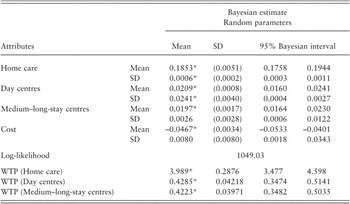
Finally, we estimate a joint model, which takes into account the number of alternatives that each respondent must choose from. Thus, we can obtain a single assessment of the WTP for each policy for the whole sample of respondents. Table 6 shows the results of the assessment of random parameters from the Bayesian standpoint, with the mean, the standard deviation, and the 95% probability interval.
Utility function for joint model. Marginal utilities and willingness to pay. Mean (SD)

Notes: * or
 .
The results can be interpreted as a weighted mean of the three models, in which the models with more alternatives have a higher relative weight. The monthly WTP per hour of home care is estimated as approximately €4, with a 95% Bayesian interval of (3.48, 4.60). The values of mean WTP for access to day centres and to medium–long-stay centres are estimated as €0.43 per month and €0.42 per month, with 95% probability intervals of (0.35, 0.51) and (0.35, 0.50), respectively.
Explicative factors
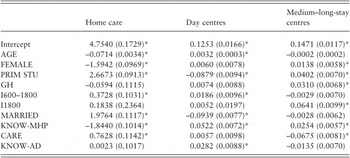
Table 7 shows the results of our analysis of the factors that may explain the differences in the evaluation of the policies proposed to the respondents, using as covariates of the model the variables listed in Table 1.
Explicative model of willingness to pay. Mean (SD)

Notes: * or
 .
Younger people show a higher WTP for the home care programme, while day centres are more highly valued by older respondents. The WTP for home care is lower among women than among men, as found by Nocera et al. (Reference Nocera, Bonato and Telser2002). There are no significant differences between men and women concerning WTP for day centres, but women are willing to pay more for increased access to medium–long-stay centres. People with only primary or with no studies are willing to pay higher amounts for home care programmes and medium–long-stay centres, and lower amounts for day centres. In general, higher levels of income correspond to a higher WTP, although in many cases the differences are not relevant.
Among the factors that are significant in explaining the marginal utility provided by the various programmes proposed, an interesting one is KNOW-MHP. This factor is relevant in explaining the WTP for the three policies considered. It is positive for the access to day centres and medium–long-stay centres, but negative for home care. In other words, people who are acquainted with someone with a mental problem have a preference for a policy of treatment centres rather than one that involves a closer relation with the patient, such as home care. However, those individuals who are actually taking care of someone with AD (CARE) favour a policy with longer hours of home care in preference to an increase in the probability of the patient staying at a medium- or long-term centre (which has a negative sign).
Discussion and policy implications
AD is considered the main cause of dementia and the fourth cause of death in developed countries (Larson et al., Reference Larson and Shadlen2004; Cleusa et al., Reference Ferri, Martin and Carol2005). In Spain, according to data from patients’ associations (CEFA, 2006), there are an estimated 600,000 sufferers, and by the year 2025 this figure is expected to double. AD, together with other dementias, constitutes one of the health problems that most affects the quality of life of the elderly (Hebert et al., Reference Hebert, Scherr and Beckett1995), although its appearance is not limited exclusively to this population group. The population is aging and the disease is appearing more and more frequently among those aged 60 and over. A study by Kukull et al. (Reference Kukull and Higdon2002) showed that the prevalence increases from 3% at the age of 65 to 45% at 85 and older.
This disease imposes a considerable psychological and economic burden on sufferers’ relatives and on society in general. Health care for patients is extremely costly, both in terms of direct costs such as nursing homes, community centres, residential homes and medicines, and in indirect ones arising from the carers’ loss of productivity and time. The direct cost of caring for AD patients for six months has been estimated as $3,129, whereas the indirect cost is $26,080 (Small et al., Reference Small, McDonnell, Brooks and Papadopoulos2002). Most of this expense is borne by the patient’s family in the form of out-of-pocket payments for services and time spent caring for the patient.
Additionally, AD affects not only the patients themselves but also the lives of their families for years, and especially so in the case of the principal carer. In most cases, social health assistance and care is provided by relatives (Fox et al., Reference Fox, Kohatsu, Max and Arnsberger2001). Taking into account the continuing increase in life expectancy in developed societies, it is likely that this kind of dementia will become a very significant health care problem, and that society and governments will have to draw up appropriate plans for the allocation of health care and social resources (Schumock, Reference Schumock1998; Cleusa et al., Reference Ferri, Martin and Carol2005).
Informal caregivers, usually family or friends, contribute greatly for no remuneration to caring for people with AD and related disorders, but this contribution is often viewed, incorrectly, by policymakers as a ‘free resource’, reducing the need for professional carers. Even for those policymakers who recognize the public health benefits of providing treatment for mental illnesses, an important question remains, especially when resources are limited: how should allocations be made? Given the availability of a wide range of treatments, their rising costs and the limited resources available, policymakers often face difficult choices and decisions.
In recent years, new drugs addressing AD have been introduced. However, we are far from knowing the effect of these new drugs on the care needs of AD patients. These drugs delay the progression of the disease but they do not cure it or reduce its incidence (Patterson et al., Reference Patterson, Gauthier, Bergman, Cohen, Feightner, Feldman and Hogan1999).
An appropriate financing system should minimize out-of-pocket payments in favour of prepayment methods that cover mental disorders. In general, the healthy should subsidize the sick, and the well-off subsidize the poor (WHO, 2001). Prepayment policies could be ensured through general taxation, mandatory social insurance, or voluntary private insurance.
In the present study, we have focused on eliciting WTP for a policy proposal aimed at improving the health care offered to patients suffering from AD. This study was undertaken in a context in which there is currently no public or private coverage for these patients apart from a limited network of social assistance. Only 77 respondents in the sample (13.1%) stated that they would not pay anything to improve health care services.
Several policy implications can be drawn from these results. Firstly, it is clear that our respondents placed significant values on the policy programmes being evaluated: home care, day centres, and medium–long term centres. Comparison of the WTP for each policy per hour of service shows that the highest value corresponds to day centres. Assuming that the chances of obtaining a place in a day centre are close to zero (which was the situation when the survey was conducted), respondents are willing to pay a monthly amount of €43 to ensure that 100% of elderly patients who want to attend a day care centre could effectively do so. The second preferred resource was home care, with a monthly WTP of about €24 to ensure six hours’ daily attention (the same time as at day centres) at home. Finally, the participants were only willing to pay €42 to ensure full coverage at a medium–long-stay centre (24 hour/day).
An implication of our study concerning budgetary management polices in health services arises from the observed differences in the WTP for different policies for AD patients. Our results show that day centres are clearly the health care resource that is most highly valued among the sample, and potentially over the population in general. As recommended by the WHO, financial options could be released for the development of community services (such as day centres) by partially closing psychiatric hospitals, while parallel funding could be established to maintain a certain level of institutional care even after community-based care has become established (WHO, 2001).
Therefore, the findings of this study support the feasibility of DCEs as a method for assessing the WTP for health policies devoted to improving the services provided for the mentally ill, including patients with AD. Our response rate of over 99% indicates that respondents are willing and able to answer WTP questions on such policies. This response rate was higher than those reported by other researchers using the same methods (Bostedt and Boman, Reference Bostedt and Boman1996), and may be explained by the relevance of the study for the target population.
Nevertheless, the results and particular limitations of the present study raise a number of questions that should be addressed in further research. Firstly, there might be a need to consider and compare the results of alternative policy measures that could also be useful for improving the health care of patients with AD, but which we have not tackled in this study. For instance, other promising policies and approaches such as pharmaceutical treatment or the early diagnosis of AD could also be elicited using DCEs or other methods, and their values compared with the values obtained in this study in order to derive final policy decisions.
Secondly, from a methodological standpoint, our results point to evidence of the sensitivity of individual-specific WTP estimates to the number of alternatives presented in the choice situations of the DCE technique. Although the results show a certain consistency among the three and four alternatives, it would be of interest to carry out an analysis with five or more alternatives in order to determine the most efficient number of alternatives to be presented to respondents in a discrete choice scenario.
Thirdly, one of the advantages of using DCE and other stated preference methods is the ability to control the data collected in the experiment. In contrast to market analysis, the researcher is able to narrow the focus to the precise issue of interest. However, there is a potential danger in DCE that the results may not be consistent with real-life settings due to possible differences between observed and true preferences (Cookson, Reference Cookson2003).
Fourthly, it should be noted that the programmes evaluated in the present study are not completely interchangeable, and the most appropriate programme for each patient is likely to depend on his/her characteristics and on the state of the illness. We only surveyed the preferences of the adult population about different policies they would favour if they were suffering AD. Our results could be complemented with further inquiries as to the phase of the illness in which the target population would prefer these policy measures to become effective.
Finally, the policies evaluated in this study include specialized personal-care and health-related services designed to relieve and slow down the progress of AD symptoms. Therefore, the results show only evidence concerning the social value of these resources but say nothing about their clinical benefits. Thus, further scrutiny based on the utilization of other evaluation methods such as quality of life analysis or cost-effectiveness analysis could be of interest in order to compile a more qualitative and relative approach to the evaluation of alternative policy measures. In relation to this, our results could be incorporated into a complete cost–benefit analysis that would allow researchers to determine the most efficient policy measures to be undertaken for the benefit of society.
Appendix: Cards used in the discrete choice experiment questionnaire
The University of Las Palmas de Gran Canaria is carrying out a study to discover how high a value the inhabitants of the Canary Islands would place on various health care policies aimed at improving the health care provided to patients suffering senile dementia, for example Alzheimer’s disease.
Your sincere contribution is important to help us increase scientific knowledge about the problem of Alzheimer’s disease. The results will be very important, enabling policymakers to assess the social demand for specific policies for this disease.
THANK YOU FOR YOUR CONTRIBUTION
All the personal information collected in this survey will be kept strictly confidential and will be used only for research purposes. The database obtained from the survey will not include names or any other characteristics that might identify you or the members of your household.
(Card 1) Dementia affects approximately 3% of people at 65 years and approximately 45% of those aged over 85 years. Alzheimer’s disease is considered the main cause of dementia. Problems of memory, particularly recent or short-term memory, are common early in the course of the disease. Alzheimer's disease is presently incurable, and therefore the mainstay of treatment for a person with Alzheimer's disease is good nursing care at home and at day or medium–long-stay centres, providing both physical and emotional support for a person who is gradually able to do less and less for him or herself, and whose behaviour is becoming more and more erratic. Currently only 0.5% of Alzheimer's disease patients in Gran Canaria receive the public health care offered by the National Health System, and there are enormous waiting lists and severe crowding in geriatric clinics and hospitals.
(Card 2) Alzheimer's disease is a progressive, degenerative disease. A person with Alzheimer's disease may forget things more often and not remember them later, especially things that have happened recently. Caring for a relative with Alzheimer’s disease is an extremely challenging experience for families. The best care involves intellectual stimulation through activities organized by specialised and trained personnel, at home or in day or medium–long-stay centres. Please consider the following three types of care.
•Hours of Home Care (Card 3)
Home care attention for the patient by specialised and trained personnel for a given number of hours a day. For example: 3, 6 or 9 hours per day.
•Day Centres (Card 4)
Day centres are designed to offer health care by specialised personnel. These centres would be near home, and ensure transportation facilities.Alzheimer’s patients stay at day centres for a maximum of 8 hours.
The benefits of this policy arise from the patient’s increased chances of obtaining a place in one. For example, assume 100% of patients who wished to attend a day centre could do so, or only 70%, or only 50%.
•Medium–Long-stay Centres (Card 5)
Medium–long-stay centres are for patients with Alzheimer’s disease requiring medical care, such as general psychiatric clinics or geriatrics specialists. Alzheimer’s patients stay for days or only for some hours.
The benefits of this policy arise from the patient’s increased chances of obtaining a place in one. For example, assume new facilities should be capable of satisfying 100% of the demand by patients requesting a place, or 50%, or only 20%.
(Card 6) Improving the attention provided to Alzheimer’s patients requires important economic resources, which cost money. In the following questions, we want to know how much you value these policies, bearing in mind that you may also have other priorities.
(Card 7) Suppose that these policies are only implemented if the benefits for the general population are greater than the costs incurred. To decide whether these policies are worthwhile for you, imagine that you are asked to pay a monthly contribution for them to be implemented. These policies can benefit you in the future if you suffer any mental disorder, or they can benefit other patients.
(Card 8) The next cards show different combinations of the three policies considered earlier, that is, hours of home care, and availability of day centres and medium–long-stay centres, as well as what is actually provided at present. The cards also state the monetary cost involved in providing the whole set of policies in each case. If these were the only options available, which one would you prefer?