INTRODUCTION
Clinical neuropsychologists often relate patients’ cognitive functioning to their ability to function in daily life; however, the literature regarding the cognitive domains that best predict everyday functioning is mixed and results vary widely across studies (see Royall et al., Reference Royall, Lauterbach, Kaufer, Malloy, Coburn and Black2007 for review). Executive functioning, however, has emerged as having the most consistent predictive utility of both self- or informant-reported basic activities of daily living (ADL; e.g., feeding, bathing, toileting) and instrumental ADL (IADL; Cahn-Weiner, Boyle, & Malloy, Reference Cahn-Weiner, Boyle and Malloy2002; Royall et al., Reference Royall, Lauterbach, Kaufer, Malloy, Coburn and Black2007; Tomaszewski Farias et al., Reference Tomaszewski Farias, Cahn-Weiner, Harvey, Reed, Mungas, Kramer and Chui2009; e.g., medication/financial management, cooking, shopping) as well as performance-based measures of everyday cognition (Schmitter-Edgecombe & Parsey, Reference Schmitter-Edgecombe and Parsey2014). There is also support for measures of memory (Tomaszewski Farias et al., Reference Tomaszewski Farias, Cahn-Weiner, Harvey, Reed, Mungas, Kramer and Chui2009; Tuokko, Morris & Ebert, Reference Tuokko, Morris and Ebert2005), processing speed (Tuokko et al., Reference Tuokko, Morris and Ebert2005), and global cognition (Royall et al., Reference Royall, Lauterbach, Kaufer, Malloy, Coburn and Black2007) in predicting self- or informant-reported ADLs/IADLs.
It is now understood that older adults with MCI may evidence mild functional impairment or need to compensate for cognitive difficulty (e.g., use a pill box or calendar, take more time to complete tasks) on complex IADLs (Albert et al., Reference Albert, DeKosky, Dickson, Dubois, Feldman, Fox and Phelps2011). Cross-sectional studies using measures of self- or informant-report have demonstrated that those classified as MCI have more difficulty with IADLs relative to cognitively normal older adults (e.g., Gold, Reference Gold2012; Tuokko et al., Reference Tuokko, Morris and Ebert2005). Furthermore, faster rates of longitudinal functional decline in MCI compared to normal older adults have also been demonstrated using self-report (Wadley et al., Reference Wadley, Crowe, Marsiske, Cook, Unverzagt, Rosenberg and Rexroth2007) and performance-based IADL measures (Thomas & Marsiske, Reference Thomas and Marsiske2014).
There is mixed evidence that MCI subtypes differ in cross-sectional self- or informant-reported IADL functioning. For example, Teng, Becker, Woo, Cumming, and Lu (Reference Teng, Becker, Woo, Cummings and Lu2010a) found that amnestic MCI had more informant-rated IADL impairment than non-amnestic MCI, but did not differ based on whether they had a single-domain or multidomain amnestic MCI. Other work showed multidomain MCI participants had more functional difficulty than single domain MCI participants (Aretouli & Brandt, Reference Aretouli and Brandt2010). Conversely, a recent meta-analysis did not find evidence that specific MCI subtypes (amnestic vs. non-amnestic) nor the number of cognitively impaired domains (single vs. multidomain) significantly differed in the proportion of functional variance explained by cognition (McAlister, Schmitter-Edgecombe, & Lamb, Reference McAlister, Schmitter-Edgecombe and Lamb2016).
Longitudinally, one study found that non-amnestic MCI showed faster decline in self-reported basic ADLs compared to normal controls, and that all MCI subtypes (amnestic, non-amnestic, multidomain) showed faster self-reported IADL decline over time relative to controls (Wadley et al., Reference Wadley, Crowe, Marsiske, Cook, Unverzagt, Rosenberg and Rexroth2007). Few studies, however, have examined the differential trajectories of well-characterized subtypes of MCI in an attempt to understand how these subtypes contribute to our understanding of functional prognosis. Thus, we used MCI subtypes identified via cluster analysis (Edmonds et al., Reference Edmonds, Delano-Wood, Clark, Jak, Nation, McDonald and Bondi2015) to evaluate the rate of change in informant-reported functional difficulty over time.
Given the evidence that executive functioning is an important predictor of everyday functioning (McAlister et al., Reference McAlister, Schmitter-Edgecombe and Lamb2016), we hypothesized that amnestic MCI participants with prominent executive/attention dysfunction would demonstrate faster functional decline trajectories than the single-domain amnestic or amnestic plus language-impaired MCI subtypes. Furthermore, previous work found that a subset of participants classified as MCI by ADNI had normal neuropsychological functioning (“cluster-derived normal”; Edmonds et al., Reference Edmonds, Delano-Wood, Clark, Jak, Nation, McDonald and Bondi2015); thus, we anticipated that the cluster-derived normal group would have a functional trajectory more consistent with normal controls than the MCI subtypes.
METHOD
Participants
Data used in the preparation of this article were obtained from the Alzheimer’s Disease Neuroimaging Initiative (ADNI) database (adni.loni.usc.edu), and were obtained in compliance with our institution. The ADNI was launched in 2003 as a public-private partnership, led by Principal Investigator Michael W. Weiner, MD. For up-to-date information, see www.adni-info.org.
Participants included in ADNI were aged 55–90 years, stable on permitted medications, had a reliable study partner, Geriatric Depression Scale <6, Hachinski Ischemic Score ≤4, adequate visual/auditory acuity, good general health, 6 years of education or work history-equivalent, and fluent in English or Spanish. Exclusion criteria included significant head trauma or neurologic disease. Consistent with Edmonds et al. (Reference Edmonds, Delano-Wood, Clark, Jak, Nation, McDonald and Bondi2015), ADNI MCI participants were included in the current study as well as ADNI normal control participants (“robust” NC) who had at least 1 year of follow-up data and who did not progress to MCI during their participation in ADNI (range of 1–7 years). Participants were excluded from the current study if their baseline Functional Activities Questionnaire (FAQ; Pfeffer, Kurosaki, Harrah, Chance, & Filos, Reference Pfeffer, Kurosaki, Harrah, Chance and Filos1982) score was ≥6. Prior work has shown that this cutoff best distinguishes between MCI and dementia (Teng et al., 2010b). The remaining sample included 938 participants (mean age=73.44 years).
ADNI’s MCI criteria (Petersen et al., Reference Petersen, Aisen, Beckett, Donohue, Gamst, Harvey and Trojanowski2010) included: subjective memory complaint by participant or informant; Mini-Mental State Examination score ≥24; global Clinical Dementia Rating score of 0.5; abnormal memory function based on education-adjusted cutoffs for delayed free recall on story A of the Wechsler Memory Scale-Revised Logical Memory II; and do not qualify for dementia based on cognitive/functional performance. Biomarkers were not used in the diagnosis of MCI.
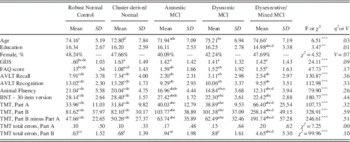
In our previous work (Edmonds et al., Reference Edmonds, Delano-Wood, Clark, Jak, Nation, McDonald and Bondi2015), the ADNI MCI participants’ neuropsychological scores were included in a cluster analysis. Inclusion of neuropsychological scores in the domains of language (Animal Fluency, Boston Naming Test), attention/executive functioning (Trail Making Test, parts A and B), and memory (Rey Auditory Verbal Learning Test, delayed recall and recognition) in the cluster analysis identified several MCI subtypes within ADNI’s MCI participants: Amnestic MCI (n=217), Dysnomic MCI (n=116), and Dysexecutive/Mixed MCI (n=65). Table 1 shows the demographic/cognitive variables by MCI subgroup.
Demographic, clinical characteristics, and cognitive test results by group

Note. arepresents significant difference from Robust Normal Control, brepresents significant difference from Cluster-derived Normal, crepresents significant difference from Amnestic MCI, drepresents significant difference from Dysnomic MCI, erepresents significant difference from Dysexecutive/Mixed MCI. The neuropsychological variables are in raw metric. For Trail Making Test, Parts A and B, higher scores represent lower performance. One-way analyses of variance (omnibus=F-statistic, effect size=η 2 ) were used for continuous variables; Kruskal-Wallis tests (omnibus=χ2-statistic; effect size=η H 2 ) were used for the TMT total error scores (sequencing, set loss, omission); a chi-squared test (omnibus=χ2-statistic; effect size=Cramer’s V) was used for the categorical gender variable.
**p<.01.
***p<.001.
MCI=mild cognitive impairment; GDS=Geriatric Depression Scale; AVLT=Rey Auditory Verbal Learning Test; BNT=Boston Naming Test; TMT=Trail Making Test.
Briefly, Amnestic MCI participants had a primary memory impairment with intact language and attention/executive functioning (i.e., single-domain amnestic MCI); Dysnomic MCI participants had prominent language impairment in the context of mild memory difficulty (i.e., multi-domain amnestic MCI with memory and language impairment); Dysexecutive/Mixed MCI participants had prominent attention/executive dysfunction in the context of memory and language difficulty (i.e., multi-domain amnestic MCI with memory, language, and attention/executive functioning impairment). The cluster analysis also derived a group of individuals who were classified as MCI by ADNI (Petersen et al., Reference Petersen, Aisen, Beckett, Donohue, Gamst, Harvey and Trojanowski2010), but were found to be cognitively normal based on neuropsychological testing (i.e., Cluster-Derived Normal subtype; for further information on the cluster analysis and its resulting MCI subtypes, see Edmonds et al., Reference Edmonds, Delano-Wood, Clark, Jak, Nation, McDonald and Bondi2015).
While biomarkers were not considered in the cluster analysis, participants in this Cluster-Derived Normal (CDN; n=256) group have also been shown to have normal Alzheimer’s disease (AD) biomarkers and rates of progression to dementia that are more consistent with robust normal control participants (NCs; n=284) than the other MCI groups (Bangen et al., Reference Bangen, Clark, Werhane, Edmonds, Nation, Evangelista and Delano-Wood2016; Bondi et al., Reference Bondi, Edmonds, Jak, Clark, Delano-Wood, McDonald and Salmon2014; Edmonds et al., Reference Edmonds, Delano-Wood, Clark, Jak, Nation, McDonald and Bondi2015, Reference Edmonds, Eppig, Bondi, Leyden, Goodwin and Delano-Wood2016), strongly suggesting that the CDN group are likely “false positive” MCI diagnoses based on ADNI’s criteria.
Measures
The FAQ (Pfeffer et al., Reference Pfeffer, Kurosaki, Harrah, Chance and Filos1982) is an informant-rated questionnaire measuring the participant’s level of functional difficulty over the past 4 weeks. The measure includes 10 IADL items: (1) writing checks, paying bills, balancing a checkbook; (2) assembling tax records, business affairs; (3) shopping; (4) playing a game of skill; (5) heating water, making coffee; (6) preparing a balanced meal; (7) keeping track of current events; (8) paying attention and understanding a television program or book; (9) remembering appointments, dates, medications; (10) traveling out of the neighborhood. Difficulty in each category was rated as 0 (normal or never did, but could do now); 1 (has difficulty, but does by self or never did, but would have difficulty now); 2 (requires assistance); 3 (dependent). The FAQ was completed at ADNI’s baseline assessment as well as at follow up visits at 6, 12, 18, 24, 36, and 48 months.
Analyses
Baseline demographic characteristics and neuropsychological scores by group classification were examined using Bonferroni-corrected analyses of variance (for continuous variables), Kruskal-Wallis test (for nonparametric variables), or chi-squared test (for categorical variables). Multilevel modeling was used to examine whether there were differential rates of functional difficulty (FAQ) over time by cognitive group. In the primary model, the CDN group was the reference group. We ran the same model one additional time with the Dysexecutive/Mixed MCI group as the reference group to test our two hypotheses regarding the functional trajectories of the CDN and Dysexecutive/Mixed groups.
The Visit variable included seven time points over 4 years and was modeled as a continuous parameter. Both linear and quadratic effects of visit were examined, but including quadratic visit did not improve model-fit based on −2 log likelihood (−2LL), Akaike information criterion, and Bayesian information criterion. Covariates included baseline variables that significantly differed between groups (age, education, depression [Geriatric Depression Scale; Sheikh & Yesavage, 1986]). The random effect of intercept was included in the model. The model was examined both in the raw-score metric and with normalized variables (resulting in normally distributed residuals); however, the pattern of findings did not differ, so the data are presented in raw-score metric to allow for clearer clinical translation. Full information maximum likelihood method was used to estimate the model, allowing for all available data to be used for parameter estimates (Singer & Willett, Reference Singer and Willett2003), thus producing less biased results than other methods (e.g., listwise deletion of cases; Schafer & Graham, Reference Schafer and Graham2002). Effect sizes (r-values) are interpreted as small=0.10, medium=0.30, and large=0.50 (Cohen, 1992).
RESULTS
At baseline, there were significant differences (p<.05) between groups on age, education, depressive symptoms, and FAQ score, but not gender. As expected, there were significant differences in all neuropsychological performance between groups. Specifically, the three MCI groups were significantly different across measures from the NC and CDN groups, which did not differ from each other. The MCI groups did not differ on memory measures, the Dysnomic and Dysexecutive/Mixed groups performed worse on language, and the Dysexecutive/Mixed group performed the lowest on attention/executive measures.
When executive functioning was examined, after adjusting for processing speed (i.e., TMT Part B minus Part A), the Dysexecutive/Mixed group had the most executive dysfunction and 41.5% had the maximum TMT Part B score of 300 seconds. When examining TMT total errors (sequencing, set loss, omission), there was not a significant effect of group for TMT Part A errors, but for TMT Part B errors, the Dysexecutive/Mixed group had more total errors compared to the other groups. Table 1 shows the baseline demographic/neuropsychological means (SD) and all specific group differences.
Regarding the multilevel model results (complete parameter estimates and effect sizes available in Supplementary Table 1), there were significant main effects for age [F(1,302.55)=7.34; p<.01], such that older age was associated with more functional difficulty as measured by the FAQ. Education and depression did not significantly predict FAQ score (p>.05). The main effect for visit was significant [F(1,2400.49)=1161.02; p<.001], suggesting that on average, participants had higher FAQ scores over time. The main effect of group classification was significant [F(4,255.92)=30.27; p<.001], and Bonferroni-corrected post-hoc analyses found that, on average, MCI groups had greater functional difficulty than the CDN group [Amnestic d=.34; Dysnomic d=.37; Dysexecutive/Mixed d=.92; all p-values<.001], while the NC group had less functional difficulty than the CDN group [NC d=−.31; p<.001].
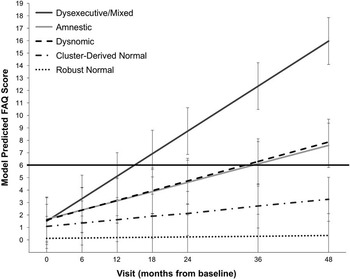
The overall visit×group interaction [F(4,2304.16)=164.21; p<.001] was significant across participants. Figure 1 shows the trajectories of functional difficulty by group over time. Specifically, for the visit × group interaction, when compared to the CDN group, all MCI groups showed a steeper rate of increased functional difficulty over four years (p-values<.001), with effect sizes ranging from small-to-medium [Dysnomic t(2286.19)=8.38; p<.001; r=.173, Amnestic t(2205.47)=9.58; p<.001; r=.200] to medium [Dysexecutive/Mixed t(2464.14)=19.23; p<.001; r=.361).
The trajectories of functional difficulty by group over time. Error bars represent 99% confidence intervals. The horizontal line at a FAQ score of 6 shows a suggested cut-off to distinguish dementia and mild cognitive impairment (Teng et al., 2010b).

Conversely, the NC group had a small, shallower rate of change [t(2114.79)=−5.39; p<.001; r=−.116), suggesting a slower increase in functional difficulty. The Dysexecutive/Mixed group showed a steeper increase in difficulty over time than all other groups (p-values<.001; r-values ranged from −.226 to −.409). While the CDN group showed a faster increase in functional difficulty over time compared to the NCs, only the CDN and NC groups’ mean predicted FAQ scores remained below the cutoff score of ≥6 (shown to distinguish MCI and dementia; Teng, Becker, Woo, Knopman, et al., Reference Teng, Becker, Woo, Knopman, Cummings and Lu2010b) at year 4.
DISCUSSION
We examined the longitudinal trajectories of functional difficulty in participants classified as having amnestic MCI by ADNI, as well as in a robust normal control group. The results showed that the Dysexecutive/Mixed MCI group (memory plus language plus attention/executive impairment) demonstrated the fastest rate of functional decline over the four years of follow-up. This finding is consistent with previous work showing that performance on tests of executive functioning has the strongest relationship with IADLs (McAlister et al., Reference McAlister, Schmitter-Edgecombe and Lamb2016; Royall et al., Reference Royall, Lauterbach, Kaufer, Malloy, Coburn and Black2007).
The Dysexecutive/Mixed group was primarily impaired in attention/executive functioning, but participants in this MCI subgroup also showed memory and language impairments. Thus, since the Dysexecutive/Mixed group showed faster rates of IADL decline than both the Amnestic (single-domain memory impairment) and Dysnomic (memory plus language impairment) groups, this finding suggests that the addition of attention/executive dysfunction over and above memory and/or language impairment may elevate an individual’s risk for a faster rate of future functional decline.
Prior work has also suggested that multidomain MCI puts one at greater risk for functional difficulty (e.g., Gold, Reference Gold2012; Lindbergh, Dishman, & Miller, Reference Lindbergh, Dishman and Miller2016), although our classification method of subtyping the specific domains of impairment allowed for a focal examination of the specific cognitive domains that best predict functional difficulty. Indeed, had we combined the Dysnomic and Dysexecutive/Mixed groups into a “multidomain amnestic MCI” group, we would not have captured the differential trajectories of functional difficulty between these two groups nor been able to conclude that the addition of attention/executive impairment appears particularly important for everyday functioning. This finding suggests that studies that use “multidomain” or “nonamnestic” MCI naming conventions may be missing valuable information related to specific cognitive domain impairments.
The evidence that the Dysexecutive/Mixed group was more neuropsychologically impaired at baseline (both in breadth and depth of cognitive impairment) and showed steeper functional decline over time suggests that the Dysexecutive/Mixed group may be more “severe” or represent a later stage of MCI/underlying pathology relative to the other MCI groups. This conclusion is supported by previous work that demonstrated the Dysexecutive/Mixed group had the fastest rate of progression to dementia compared to the Amnestic and Dysnomic groups (Edmonds et al., Reference Edmonds, Delano-Wood, Clark, Jak, Nation, McDonald and Bondi2015). Interestingly, ADNI characterized MCI participants as “early MCI” and “late MCI” (determined by WMS-R Logical Memory); however, these labels do not appear to improve diagnostic clarity. In a subsample of participants included in a study by Edmonds et al. (Reference Edmonds, Eppig, Bondi, Leyden, Goodwin and Delano-Wood2016), 20% of the Dysexecutive/Mixed group was considered “early MCI” by ADNI and 42% of the CDN group was considered “late MCI” suggesting that further clarity into how to determine the stage (early vs. later) of a progressive disease process such as AD is needed.
By approximately year 3, the three cognitively impaired MCI subtypes’ FAQ score based on the model predicted values were at or above the cutoff of ≥6 that was previously used to distinguish MCI and dementia (Teng, Becker, Woo, Knopman, et al., Reference Teng, Becker, Woo, Knopman, Cummings and Lu2010b), and their FAQ scores continued to worsen through year 4. Conversely, both the CDN and NC groups’ predicted FAQ scores remained below the cutoff at year 4. Additionally, the CDN group showed a slower rate of functional change than the MCI groups. Previous work examining this CDN group has demonstrated that this group’s initial MCI diagnosis in ADNI may have been a “false positive” MCI diagnosis given their rate of progression to AD and their normal cerebrospinal fluid markers (e.g., phosphorylated-tau, β-amyloid; Edmonds et al., Reference Edmonds, Delano-Wood, Clark, Jak, Nation, McDonald and Bondi2015), β-amyloid levels on positron emission tomography imaging (Bangen et al., Reference Bangen, Clark, Werhane, Edmonds, Nation, Evangelista and Delano-Wood2016), and cortical thickness profiles (Edmonds et al., Reference Edmonds, Eppig, Bondi, Leyden, Goodwin and Delano-Wood2016). The current study provides additional evidence that the CDN group’s functional trajectory is not consistent with the faster rate of change observed in the three impaired MCI subtypes.
While the CDN group’s functional trajectory was different from the other MCI groups, their slope was somewhat steeper than the NCs. The reason for the functional difference between the CDN and NC groups is unclear. However, because the CDN group was diagnosed with MCI before their informant completed the FAQ, it is possible that the informant’s expectation of decline may have impacted their ratings. Additionally, the CDN group may be heterogeneous in that it captured a mixture of healthy, normal participants as well as some participants with subtle cognitive changes that might be clinically meaningful.
While the current study has several strengths, a key limitation is that almost all of the ADNI MCI participants had memory impairment since they were diagnosed by ADNI using a memory measure. This limitation prevented the examination of single-domain, non-amnestic MCI subtypes. Although the Dysexecutive/Mixed group performed poorer than the other groups on TMT Part B minus Part A at baseline (reflecting executive/switching difficulty after controlling for attention/processing speed), the ADNI neuropsychological test battery is limited and future work should replicate these findings in a sample with additional measures of executive functioning. An additional limitation is that there are not data available to examine cognitive and emotional characteristics of the informant nor the relationship of the informant (e.g., spouse, adult child) and contact time with the participant. Furthermore, ADNI did not include a standardized measure of overall physical functioning or the extent to which physical limitations may be impacting everyday functioning.
Our results offer further support that a high number of “false positive” MCI diagnoses (i.e., diagnosed as MCI by ADNI but found to have normal neuropsychological performance) can occur when additional neuropsychological data is not used as part of the decision making process (Bondi et al., Reference Bondi, Edmonds, Jak, Clark, Delano-Wood, McDonald and Salmon2014, Edmonds et al., Reference Edmonds, Delano-Wood, Clark, Jak, Nation, McDonald and Bondi2015). This study is unique in that it uses a large biomarker and neuropsychological dataset (ADNI) that allowed for the examination of well-characterized diagnostic groups, including specific domains of impairment, to answer questions about longitudinal functional changes in MCI.
ACKNOWLEDGMENTS
M.W.B. is a consulting editor for the Journal of the International Neuropsychological Society. Other authors report no disclosures. This work was supported by NIH grants R01 AG049810 (M.W.B.) and K24 AG026431 (M.W.B.), and the U.S. Department of Veterans Affairs Clinical Sciences Research and Development Service (Career Development Award-2 1IK2 CX001415-01A1 to E.C.E.). Data collection and sharing for this project was funded by the Alzheimer’s Disease Neuroimaging Initiative (ADNI) (National Institutes of Health Grant U01 AG024904) and DOD ADNI (Department of Defense award number W81XWH-12-2-0012). ADNI is funded by the National Institute on Aging, the National Institute of Biomedical Imaging and Bioengineering, and through generous contributions from the following: AbbVie, Alzheimer’s Association; Alzheimer’s Drug Discovery Foundation; Araclon Biotech; BioClinica, Inc.; Biogen; Bristol-Myers Squibb Company; CereSpir, Inc.; Cogstate; Eisai Inc.; Elan Pharmaceuticals, Inc.; Eli Lilly and Company; EuroImmun; F. Hoffmann-La Roche Ltd and its affiliated company Genentech, Inc.; Fujirebio; GE Healthcare; IXICO Ltd.; Janssen Alzheimer Immunotherapy Research & Development, LLC.; Johnson & Johnson Pharmaceutical Research & Development LLC.; Lumosity; Lundbeck; Merck & Co., Inc.; Meso Scale Diagnostics, LLC.; NeuroRx Research; Neurotrack Technologies; Novartis Pharmaceuticals Corporation; Pfizer Inc.; Piramal Imaging; Servier; Takeda Pharmaceutical Company; and Transition Therapeutics. The Canadian Institutes of Health Research is providing funds to support ADNI clinical sites in Canada. Private sector contributions are facilitated by the Foundation for the National Institutes of Health (www.fnih.org). The grantee organization is the Northern California Institute for Research and Education, and the study is coordinated by the Alzheimer’s Therapeutic Research Institute at the University of Southern California. ADNI data are disseminated by the Laboratory for Neuro Imaging at the University of Southern California.
SUPPLEMENTARY MATERIAL
To view supplementary material for this article, please visit https://doi.org/10.1017/S1355617717000285