

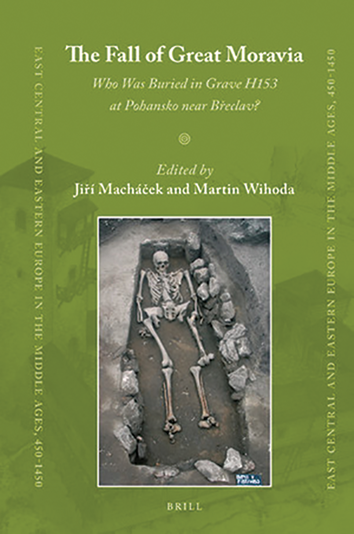
This volume is based on the discovery of a Great Moravian church, a rotunda, excavated in Pohansko near the town of Břeclav in the Czech Republic in 2008–2012. During the excavations, a burial was found in a dominant position in the interior of this building; the grave (H153) was that of a tall man of advanced years. It was the matter of the correct interpretation of this find that led Jiří Macháček (the director of the excavation) and Martin Wihoda to assemble the team of Czech and Austrian researchers behind this book.
Although the primary focus of the volume is the archaeological find, the conclusions drawn from the analysis of written sources also feature heavily. In widening the context of the discovery, the book omits, for example, a chapter devoted to comparative tombs in Great Moravian churches; attention is directed instead at the broader issues relating to the Christianisation of Central European territory west of the Morava River. Working on the assumption that Christianisation was initiated by elites of local (Slavic) origin, there is a focus on the social and cultural expression of elites in the Eastern Alps, the Austrian Danube Region, Bohemia and Moravia.
Ivo Štefan (Chapter 7) provides an explanation of the process of centralisation that led to the creation of the state; this is based on a comparison of early medieval Bohemia and Moravia. Štefan highlights several differences apparent in the archaeological manifestations of social elites in these two historical territories. Yet, these elites had one thing in common, something that also applied to other nascent Central European monarchies: they could not base their power on extensive land ownership. Land had been in collective possession for a long time.
As discussed by Roman Zehetmayer (Chapter 2), the Austrian Danube Region was the contact zone with the Western European world for the emerging Great Moravian elites. Besides the Church, the Frankish nobility itself had a share in the ownership and administration of this territory, while also being active in the area of trade. Martin Wihoda (Chapter 4) explores this still further, identifying the dynasty of the Great Moravian rulers directly with vassals of the Frankish Empire.
The following two chapters consider elite burial to contextualise grave H153. Using written sources from the Latin ecclesiastical milieu, David Kalhous (Chapter 5) presents not only a summary of the issue of so-called proprietary churches of the Carolingian period, but also shows how they reflect the custom of burial inside the church building during that period. Stefan Eichert (Chapter 6) builds on the themes in Kalhous's chapter, but does not limit his scope to churches. His chapter summarises all known graves of prominent individuals from three Eastern Alpine regions (Upper Austria, Styria and Carinthia), where the presence of elites of Slavic origin is assumed. Eichert demonstrates that the emergence of local elites clearly preceded Christianisation, and that it was the fusing of this elite with early Christianity that later led to the building of proprietary churches exclusively.
The detail of grave H153 is presented in the introductory chapter in which Jiří Macháček and anthropologist Vladimír Sládek describe the skeletal remains and the grave itself, but also the broader context of the find. The rotunda in which the grave was dug was not the principal sacred building at Pohansko; its structure was not entirely constructed in masonry, rather it was supported by vertical wooden columns. The rotunda was located in the suburb of a vast stronghold. The latest graves known from the cemetery that gradually formed around the rotunda can be dated to the period soon after the demise of Great Moravia. Jiří Macháček keeps his interpretation of grave H153 until the final chapter, which brings together the evidence to identify it as belonging to the founder, or perhaps owner, of the church. Macháček's conclusion is that although he was undoubtedly a notable person, the deceased was probably not a member of the ruling dynasty.
So, what is the connection, alluded to in the book's title, between the demise of Great Moravia and grave H153 from Pohansko near Břeclav? It is certainly significant that the rotunda at Pohansko where the grave was discovered survived the fall of Great Moravia in the late first millennium AD (albeit for only a brief period). Particularly when considering that Pavel Kouřil (Chapter 3) uses archaeological evidence from Moravian sites to argue that this historical event, which involved the Old Hungarians (Magyars), was destructive in nature. As recent findings suggest, possible evidence of the violent end of multiple hillforts can also be found in the area of south-west Slovakia, the eastern part of Great Moravian territory (see König Reference König, Chudzińska, Wojenka and Wołoszyn2016).
The title of the book is perhaps a little misleading, as the content is thematically quite different. While it may not fully explain ‘the fall of Great Moravia’, or the significance of the occupant of grave H153 in that event, the book does provide an up-to-date overview of the evidence for Central European elites of Slavic origin during the Carolingian period. Despite the omission of discussion of Pannonia, Zalavár, south-west Slovakia and Nitra, the volume presents a new perspective on the emergence of Central Europe in the ninth century AD.


