Homogenization process is widely used in the dairy industry to prevent creaming during storage and to improve functional properties of milk. In recent years, ultra-high pressure homogenization (UHPH) has been investigated for its potential applications in the food industry. Recent studies have demonstrated that cavitation, turbulence, impact and shear forces are physical phenomenon taking place during UHPH treatment (Middelberg, Reference Middelberg1995; Pandolfe & Kinney, Reference Pandolfe and Kinney1999). These mechanisms are responsible for the production of fine and stable emulsions (Floury et al. Reference Floury, Legrand and Desrumaux2003; Thiebaud et al. Reference Thiebaud, Dumay, Picart, Guiraud and Cheftel2003), for the microbial and enzymatic inactivation (Vachon et al. Reference Vachon, Kheadr, Giasson, Paquin and Fliss2001; Hayes & Kelly, Reference Hayes and Kelly2003; Hayes et al. Reference Hayes, Fox and Kelly2004; Datta et al. Reference Datta, Hayes, Deeth and Kelly2005; Briñez et al. Reference Briñez, Roig-Sagués, Herrero and López2006; Pereda et al. Reference Pereda, Ferragut, Guamis and Trujillo2006) and for the modification of coagulation and rheological properties of milk and dairy emulsions (Desrumaux & Marcand, Reference Desrumaux and Marcand2002; Hayes & Kelly, Reference Hayes and Kelly2003; Serra et al. Reference Serra, Trujillo, Quevedo, Guamis and Ferragut2007; Zamora et al. Reference Zamora, Ferragut, Jaramillo, Guamis and Trujillo2007). Few studies (Adapa et al. Reference Adapa, Schmidt and Toledo1997; Sandra & Dalgleish, Reference Sandra and Dalgleish2005) focused on physico-chemical characteristics of milk have been carried out in skim milk treated by UHPH. Sandra & Dalgleish (Reference Sandra and Dalgleish2005) studied the effects of UHPH-pressure magnitude (⩽186 MPa), inlet temperature of milk and number of passes through the UHPH equipment on reconstituted skim milk. These authors concluded that whey protein denaturation did not occur during the UHPH treatment but partial casein micelles desintegration took place. Nevertheless, the milk base, the design of the equipment and the treatment conditions applied were very different from those used in this study. Despite the scarcity of studies based on physico-chemical characteristics of UHPH-treated skim milk, there is some published data related to bacterial inactivation by UHPH depending either on milk fat content or on viscosity of the product (Diels et al. Reference Diels, Callewaert, Wyutack, Masschalck and Michiels2004, Reference Diels, Callewaert, Wyutack, Masschalck and Michiels2005; Briñez et al. Reference Briñez, Roig-Sagués, Herrero and López2006), and all of them conclude that the efficiency of the treatment is ‘viscosity-dependent’. Diels et al. (Reference Diels, Callewaert, Wyutack, Masschalck and Michiels2005) observed that an increase in fluid viscosity reduced cavitation phenomena, causing a shift from turbulent to laminar flow pattern, decreasing the efficiency of the treatment for microbial neutralization.
There is an increasing trend in the dairy industry to develop low fat products with good texture because of the concern of high fat diet in relation to cardiovascular disease and obesity. Currently in yogurt production, fat replacers such as modified starches or proteins with good emulsifying or gel properties are being used to obtain of low-calorie and creamy texture products (Tamine & Robinson, Reference Tamine and Robinson1999). As mentioned before, UHPH is capable of modifying coagulation behaviour, improving gelling properties of whole milk and final characteristics of the obtained gels. Serra et al. (Reference Serra, Trujillo, Quevedo, Guamis and Ferragut2007) studied the suitability of UHPH for full-fat yogurt production, and concluded that yogurts produced from UHPH-treated milk >200 MPa presented better texture and water holding capacity than yogurts produced by the conventional process, in which skim milk powder is added. Considering the differences in the disperse phase composition between whole and skim milk and the encouraging results observed in previous studies carried-out with whole milk, the objective of this work was to evaluate the UHPH-induced changes on skim milk constituents and their influence on the acid coagulation behaviour and on some functional characteristics of the obtained yogurts.
Material and Methods
Milk Supply and UHPH Treatment
Raw whole bovine milk was obtained from a dairy farm (Can Badó, Sta. Agnès de Malanyanes, Spain). Milk was collected from the farm's refrigeration tank and immediately transported to our pilot plant, fat was removed in a disk centrifuge (Seital separatori italia, Santorso, Italy) to <0·1% fat content. The efficiency of the skim process was controlled by a Gerber test (International Dairy Federation (IDF), 1981) in all the experiments. After 24 h in refrigeration, skim milk was subjected to the UHPH treatment using a two-stage Stansted ultra-high-pressure homogenizer with a flow rate of 120 l⋅h−1 (Stansted Fluid Power Ltd., Essex, UK) at 100, 200 and 300 MPa (one stage) or at 100+30, 200+30 and 300+30 MPa (two stages). The inlet temperature of milk was 30°C, which was reached by passing milk through a heat exchanger (Garvia, S.A., Barcelona, Spain) connected to the ultra-high-pressure homogenizer. During the UHPH treatment, the inlet temperature, the temperature after the second homogenization valve (T1) and the outlet temperature (milk temperature after passing through a water cooling system) were monitored. UHPH-treated milk samples were compared with milk heat-treated in a tubular heat-exchanger (ATI, Granollers, Barcelona, Spain) (90°C for 90 s, conditions commonly used in yogurt production) and homogenized (Rannie, Copenhagen, Denmark) in one stage at 15 MPa (HT), or to milk treated under the same thermal conditions but fortified with 30 g skim milk powder/l (Reny Picot, Anleo-Navia, Asturias, Spain) (HT+SMP). For milk fortification, SMP was added to raw skim milk and mixed for several minutes in a mixer (Bachiller, Barcelona, Spain). After UHPH or heat treatment, milk was collected in plastic bottles and kept at 4°C until laboratory analysis throughout the same day or the day after.
Compositional analysis of milk was performed in triplicate after every treatment following the IDF Standard methods for total dry matter (IDF, 1987) and protein content (IDF, 2002).
Study of Physical Characteristics of UHPH-Treated Skim Milk: Particle size, Viscosity and Colour
Particle size distribution was performed by laser light-scattering, supported by the patented multi-wavelength system (PIDS) which provides accurate results in the 0·04 and 0·8 μm regions. An LS™ 13320 Series Particle Size analyser (Beckman Coulter, Fullerton, California, USA) was used for this purpose. Milk samples were diluted until obscuration of 2 or 10%, depending on the sample, and tempered to 37°C. Particle size determinations were carried-out at pump speed of 20% and using a refractive index of 1·50 (Olson et al. Reference Olson, White and Richter2004) corresponding to the dispersing phase, and 1·33, corresponding to water. Particle size distribution was characterized by the Sauter mean diameter, d3·2 (particle diameter that has the same specific surface as that of the full distribution) and by the d4·3 (diameter of the spheres of equivalent volume to measured particles). All measurements were made in duplicate for each sample. Viscosity was assessed in duplicate at 20°C using a rheometer (Haake Rheo Stress 1, Thermo Electron Corporation, Karlsruhe, Germany) in rotational mode. Samples were subjected to an increasing shear rate from 0 to 140 s−1 in 3 min, and the experimental flow curves were fitted to the Newton model, τ=η γ where τ is the shear stress (Pa), η is the viscosity (Pa⋅s) and γ is the shear rate (s−1).
Colour measurments were performed using a Hunter Lab colorimeter (MiniScan XETM, Hunter Associates Laboratory tory Inc., Reston, Virginia, USA). Colour coordinates were measured with an illuminant of D65 and a standard of 10°, and the colorimeter was calibrated against white and black tile standards. CIE (Comission International d'Éclairage) L* values were measured in triplicate. L* represents the lightness from 0 (black) to 100 (white), which indicates a perfect reflecting diffuser.
Study of Whey from Skim Milk Ultracentrifugation: Total nitrogen, Whey proteins denaturation and Determinations of Ca, P and Mg contents
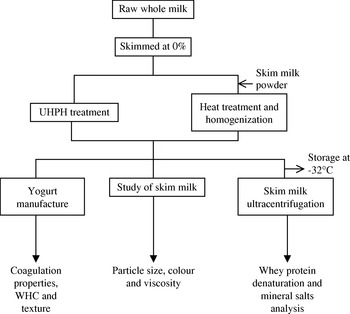
As shown in Fig. 1, one portion of each UHPH treatment and one portion of HT milk were frozen just after the treatment for further analysis. To obtain whey, 50 ml of each type of milk (raw, UHPH and HT) were thawed overnight at 4°C and ultracentrifugated at 80 000 g for 60 min at 20°C (L8-60M Ultracentrifuge, Beckman, California, Fullerton, USA). After ultracentrifugation, whey was carefully removed with a glass Pasteur pipette and frozen in 5 ml tubes at −32°C until the day of analysis. Before each analysis, whey was thawed overnight at 4°C and then warmed to room temperature.
Working Plan followed in the present study.

Total nitrogen determinations were performed in triplicate following the standard Dumas method (IDF, 2002).
Levels of α-lactoalbumin (α-la) and β-lactoglobulin (β-lg) present in whey were determined by reverse-phase HPLC. Samples were prepared by diluting 0·5 ml whey in 5 ml phosphate buffer (IDF, 178A:1999), and were then filtered through 0·45 μm cellulose acetate filters (Tracer PVDF, Teknokroma, Sant Cugast del Vallès, Spain). RP-HPLC was performed using a Waters liquid chromatograph (LCM1, Waters Corporation, Milford, MA, USA) with a 250×4·6 mm column packed with C8-silica gel, 5 μm particle size and 300 Å pore size (Tracer Excel 300, Teknokroma, Sant Cugat del Vallès, Spain). Chromatographic conditions were those described by Resmini et al. (Reference Resmini, Pellegrino, Andreini and Prati1989). Results are expressed as the total area of the obtained peaks×105.
For determinations of Ca, P and Mg, whey was diluted 1:25 (v/v) in 0·2% nitric acid. Mineral concentrations were assessed in triplicate by inductively coupled plasma optical emission spectroscopy (ICP-OES) (Perkin-Elmer 4300, Shelton, CT, USA). Results are expressed as mg of each cation⋅l−1.
Acid Gel Formation and Characteristics of Yogurt
The coagulation process was monitored using an Optigraph® System (Ysebaert, Frepillon, France). The coagulation conditions and parameters analysed were those described by Serra et al. (Reference Serra, Trujillo, Quevedo, Guamis and Ferragut2007).
Evaluation of water holding capacity (WHC) and firmness of yogurts were assessed 24 h after storage in refrigeration. For this purpose, as well as for the study of the coagulation process, frozen commercial cultures of Streptococcus thermophilus and Lactobacillus delbruekii subsp. bulgaricus (DVS YF-3331, Chr. Hansen, Horsholm, Denmark) were inoculated at 0·03% (v/v), and incubated at 43±2°C for 4 h. Determinations of WHC and yogurt firmness were carried out as described by Serra et al. (Reference Serra, Trujillo, Quevedo, Guamis and Ferragut2007).
Statistical Analysis
Analysis of variance (ANOVA) was performed using the general linear modelling procedure of the SAS® System. The Student-Newman-Keuls test was used for comparison of data; evaluations were based on a significance level of P<0·05.
Results and Discussion
Changes in skim milk constituents by UHPH
Compositional analysis results were: 8·9±0·1 and 11·2±0·04% dry matter and 3·5±0·06 and 4·3±0·01% total protein for non-enriched and enriched skim milk with SMP, respectively.
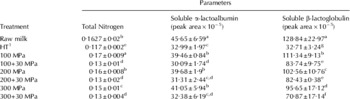
WP denaturation by UHPH>200 MPa in different substrates has already been described by several authors (Desrumaux & Marcand, Reference Desrumaux and Marcand2002; Hayes & Kelly, Reference Hayes and Kelly2003; Hayes et al. Reference Hayes, Fox and Kelly2004; Datta et al. Reference Datta, Hayes, Deeth and Kelly2005; Zamora et al. Reference Zamora, Ferragut, Jaramillo, Guamis and Trujillo2007). Results of this study concerning whey protein (WP) content and total nitrogen in whey (Table 1) showed that both heat and UHPH treatments decreased the amount of native WP, compared with raw skim milk, although the extent of denaturation was higher in heat-treated (≈75% of β-lg and ≈30% of α-la) than in UHPH-treated milk. However, in both heat and UHPH treatments, β-lg was much more sensitive to denaturation than α-la, which could be because α-la denaturation is 80–90% reversible after short-time heating (Ruegg et al. 1977). These results agree with other studies, although all of them were carried out with whole milk (Hayes et al. Reference Hayes, Fox and Kelly2004; Datta et al. Reference Datta, Hayes, Deeth and Kelly2005; Zamora et al. Reference Zamora, Ferragut, Jaramillo, Guamis and Trujillo2007). In UHPH-treated milk β-lg denaturation increased with pressure from 100 to 300 MPa (from 14 to 26% denaturation), probably due to the increase in mechanical forces and temperature, but did not exceed the degree of denaturation of heat-treated milk. It is important to stress the importance of holding time at high temperatures for WP denaturation: despite the high temperatures reached (Table 2) during the UHPH treatments at 300 MPa (close to 90°C), holding time at this temperature was less than 1 s in contrast to 90 s of duration in heat treatment. On the other hand, UHPH treatments at two stages caused more insolubilization of WP than treatments performed at one stage, probably because the pass of proteins through the small gap of the second valve could promote the aggregation of proteins that were already partially denatured in the first stage.
Mean values±standard deviation (n=4) of total nitrogen, α-lactoalbumin and β-lactoglobulin in heat-treated and ultra-high pressure homogenized milk

a–g Means in the same column with different superscripts differ significantly (P<0·05)
1 Heat-treated milk (90°C, 90 s) and homogenized at 15 MPa
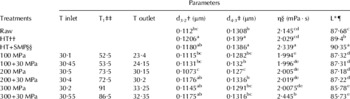
Measured temperatures and mean values±standard deviation (n=4) of particle size, viscosity and luminosity of raw, heat-treated and ultra-high pressure homogenized milk

a–h Means of the same parameter with different superscripts differ significantly (P<0·05)
† d3·2: Particle diameter that has the same specific surface as that of the full distribution
‡ d4·3: Diameter of the spheres of equivalent volume to measured particles
§ Viscosity measured at 20°C
¶ L*: Luminosity measurements measured at 20°C
†† Heat-treated milk (90°C, 90 s) and homogenized at 15 MPa
§§ Heat-treated milk (90°C, 90 s), homogenized at 15 MPa and supplemented 30 g SMP/l
‡‡ Temperature after the second homogenisation valve
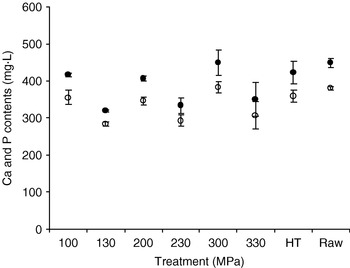
Mineral distribution (Fig. 2) in the soluble phase was different in heat- and UHPH-treated milk. In heat-treated milk, Ca and P concentrations were lower than in raw skim milk (P<0·05), since heating decreases calcium-phosphate solubility (Gaucheron, Reference Gaucheron2005). However, in UHPH-treated milk mineral content (Ca and P) in whey decreased with pressure in treatments at 100 and 200 MPa, probably due to the gradual increase in temperature during the treatment. Zamora et al. (Reference Zamora, Ferragut, Jaramillo, Guamis and Trujillo2007) described the same tendency in whole milk treated at 300 MPa, but these authors did not observe any differences between treatments at one stage or at two stages. On the contrary, in this study Ca and P concentrations in whey were much lower in UHPH treatments at two stages. In the case of 300 MPa, an unexpected increase in Ca and P concentrations in the soluble phase was observed, although temperatures reached during this treatment were higher than those reached in treatments at 100 and 200 MPa. This increase in mineral concentrations in the soluble phase could be related to casein micelles disruption caused by the UHPH treatment, which is reflected in changes of L* values observed in the case of 300 MPa (Table 2). Luminosity or lightness (L*) values are influenced by the number and size of the dispersed particles. In heat-treated skim milk with SMP, L* values were higher than all those treated by UHPH (P<0·05), due to an increase in the number of particles in dispersion. On the other hand, UHPH-treated milk from 100 to 200 MPa presented similar L* values, but those treated at 300 and 300+30 MPa showed the lowest values (P<0·05). Adapa et al. (Reference Adapa, Schmidt and Toledo1997) reported lower L* values when high-pressure throttling at 310 MPa was applied on skim milk, concluding that disruption of non-covalent forces responsible for the casein micelles integrity and further reaggregation could take place.
Calcium (○) and Phosporus (●) concentrations in whey of raw, heat-treated (HT) and and ultra-high pressure homogenized milk. Results expressed as mg⋅L−1.

Results of particle size, viscosity and colour are included in Table 2. It is necessary to point out that differences observed in viscosity and particle size are very subtle, which may be due to the nature of the fluid studied. The total protein content of skim milk was 35 g/l, so the formation of little clusters in such a diluted dispersion could only slightly modify the parameters mentioned above, as observed in this work. Hence, the variations observed in particle size and viscosity, although not always statistical significance, reflected a tendency related to UHPH conditions applied to milk. To study UHPH-induced changes in particle size, d3·2, parameter which is indicative of the mean diameter of particles, and d4·3, parameter which is indicative of the presence of small quantities of big particles or aggregates, were analysed. In heat-treated milk, with or without added SMP, an increase in both d3·2 and d4·3 values was observed compared with raw milk, probably due to the interactions involving β-lg and κ-casein that appeared as appendages or filaments on micelle surface in electron micrographs (Kalab et al. Reference Kalab, Allan-Wojtas and Phipps-Todd1983). In the case of d3·2 values of UHPH-treated milk, no significant differences (P>0·05) were found between UHPH treatments, excepting those at 200 MPa, which exhibited the lowest values. However, the tendency to increase observed in d4·3 values in UHPH treatments applied at two stages should be noted.
Viscosity of heat-treated skim milk enriched with SMP showed the highest values (P<0·05). Of all UHPH-treated milk, those treated at 100+30, 200+30 and 300+30 MPa presented slightly higher values of viscosity than milk UHPH-treated at 100, 200 and 300 MPa, respectively. Thus, despite the fact that no statistical differences (P>0·05) in viscosity were observed between UHPH treatments, apart from those treated at 300+30 MPa, the tendency to increase was observed in both, viscosity and particle size parameters, in treatments applied at two-stage These results agree with Adapa et al. (Reference Adapa, Schmidt and Toledo1997) who observed an increase in viscosity due to the presence of protein aggregates in skim milk treated by high pressure throttling at 310 MPa. This parallelism between particle size and viscosity was also observed by Desrumaux & Marcand (Reference Desrumaux and Marcand2002) in sunflower oil emulsions treated at 350 MPa. It is likely that the formation of aggregates took place in UHPH treatments at two stages as it happened in whole milk. Serra et al. (Reference Serra, Trujillo, Quevedo, Guamis and Ferragut2007) described that the presence of the second homogenization valve just after the high pressure valve (first stage) could act as a bottle neck because of the extremely high velocity of the fluid after the first stage, thus favouring the formation of protein aggregates. The presence of these clusters could explain the arbitrary decrease of soluble WP and minerals salts present in whey observed in treatments at two stages, since they could precipitate during the milk ultracentrifugation (80 000 g) applied to obtain the whey.
Impact of UHPH and Heat-induced Changes on Skim Milk Acid Gels
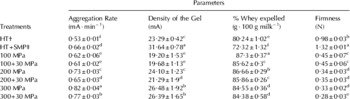
Gelling properties of skim milk were studied in terms of aggregation rate (AR) and density of the gel (DG) (Table 3), which mainly depend on the potential number of interactions between proteins during gel formation. At the same time, those interactions will depend on changes in dispersed particles and molecules induced by treatments applied to skim milk prior to yogurt elaboration. AR in UHPH-treated milk increased with pressure and was generally higher than in heat-treated skim milk. As mentioned in the previous section, UHPH treatment causes disruption of casein micelles to some extent. This effect contributes to an increase in the effective surface susceptible to interaction, thus increasing the AR of UHPH compared with heat-treated milks. The latter presented the highest d4·3 values, thus reflecting the presence of aggregates which could slow the AR. Within UHPH treatments the AR increase could be explained by the increased degree of whey protein denaturation with increasing pressure, so the loss of solubility of some milk protein could enhance the rate of aggregation. However, UHPH treatments at 200+30 and 300+30 MPa presented lower AR values than 200 and 300 MPa, respectively, probably due to the presence of clusters and the subsequent increase in d4·3 values.
Mean values±standard deviation (n=4) of aggregation rate, density of the gel and water holding capacity of heat-treated and ultra-high pressure homogenized milk

a–f Means of the same parameter with different superscripts differ significantly (P<0·05)
† Heat-treated milk (90°C, 90 s) and homogenized at 15 MPa
‡ Heat-treated milk (90°C, 90 s), homogenized at 15 MPa and supplemented 30 g SMP/l
The network density of the obtained gels depends on the number of interactions in the matrix of the gel. In heat-treated milks, there was a great extent of denatured WP that, either associated with the micelles or dispersed in the serum, could act as bridging material by interacting with other denatured WP associated with casein micelles in the network (Lucey et al. Reference Lucey, Teo, Munro and Singh1997). Gels from heat-treated milks supplemented with SMP had the highest DG values (P<0·05), since the concentration of casein particles was increased, which led to an increased matrix density in accordance with Sodini et al. (Reference Sodini, Remeuf, Haddad and Corrieu2004). In UHPH-treated milks, the extent of WP denaturation was lower (Table 1) than in heat-treated milks, which could explain both the lower DG values and the tendency of this parameter to increase with pressure from 100 to 300 MPa. However, it has to be mentioned that the increase in particles in UHPH-treated milks, as a consequence of casein micelles partial disintegration, could contribute to the formation of dense networks which could partially make up for the lower extent of denatured WP in these milks compared with heat-treated milks without added SMP.
Yogurt quality is mainly determined by texture, which can be characterized either by textural analysis or by physical measurements such as WHC (Sodini et al. Reference Sodini, Remeuf, Haddad and Corrieu2004). Whey expelled from the gel by centrifugation (expressed as g of whey per gram of milk) gives an idea of the water retention capacity. In Table 3 it is reflected that in yogurts from heat-treated milk, especially in those supplemented with SMP, the amount of whey expelled was lower than in yogurts made from UHPH-treated milk (P<0·05). It is widely known that heat treatment, and the subsequent WP denaturation, is the most important processing parameter affecting texture of yogurt. Dannenberg & Kessler (Reference Dannenberg and Kessler1998) suggested that denatured β-lg decreased the capacity of casein micelles to coalesce during fermentation, which resulted in the formation of networks capable of immobilising large volumes of water. Within UHPH treatments of milk, yogurts obtained tended to increase the water retention in the network as pressure increased, in accordance with the degree of WP denaturation. In addition, the increased number of dispersed casein fragments could also contribute to the retention of water, especially in treatments at 300 and 300+30 MPa. The second stage of homogenization had a significant effect in increasing the water retention capacity at 100+30 and 200+30 MPa, compared with single stage homogenization, although UHPH did not lead, in any case, to an improvement in water retention compared with heat treatment.
In texture evaluation heat-treated milk enriched with SMP resulted in the formation of the firmest yogurts (P<0·05). Cho et al. (Reference Cho, Lucey and Singh1999) considered that cross-linking of denatured WP with casein micelles was responsible for a marked increase of firmness of the gels, so considering the great extent of β-lg denaturation in yogurts made from heat-treated milks, it seems reasonable that these yogurts presented the highest firmness values compared with yogurts from UHPH-treated milk. Firmness values of yogurts from UHPH-treated milk were in all cases (from 100 to 300 MPa) lower than those produced from heat-treated milk, and decreased when increasing pressure despite the slight increase of β-lg denaturation observed. However, it is likely that the disintegration of casein micelles caused by UHPH at high pressures could contribute to obtain denser but considerably weaker networks than those obtained from heat-treated milk. In addition, it has to be mentioned that, skim milk gels from UHPH-treated milks showed spontaneous syneresis inversely proportional to pressure (results not shown), so higher firmness values observed in yogurts prepared from UHPH-treated milks at 100 MPa could be attributed to the shrinkage of the network and the subsequent expulsion of whey.
The authors acknowledge the Ministerio de Educación y Ciencia (AGL2003-03494) and the Commission of the European Communities (EU project 512626) for the financial support given to this investigation. Mar Serra acknowledges the predoctoral fellowship from the Ministerio de Educación y Ciencia.