By bridging terrorism literature with demography, my study (2021) addresses the important, yet underexplored, question of why Islam is the fastest-growing religion in the contemporary world. Even after controlling for demographic factors such as the comparatively young age and high fertility rate of Muslims, my empirical analysis for the sample period, 1970–2007, reveals that a significant, yet overlooked, potential driver in the growth of the Muslim population worldwide is terrorist campaigns, defined as terrorist attacks and online propaganda. Although my empirical analysis establishes an association rather than causality, it has intrigued many readers. However, after discussing potential theoretical and methodological shortcomings in my study, Egger and Magni-Berton (Reference Egger and Magni-Berton2021) conclude that there is no empirical support for the positive relationship between terror attacks and Muslim populations. Their approach of separating terrorism into Islamist and non-Islamist terrorism is an effort to advance the contemporary research on the nexus between terrorism and Islam.
I argue, however, that Egger and Magni-Berton's conclusion suffers from two limitations: theoretically unfounded and empirically inadequate. First, the conclusion is theoretically unfounded because Egger and Magni-Berton theorize 1991–2007 as ‘the period in which many countries start hearing of – and, for some, experiencing – Islamist terrorism’ (p. 6), despite the fact that previous studies observe more than 535 Islamist terrorist attacks occurred between 1970 and 1990 (Kis-Katos et al., Reference Kis-Katos, Liebert and Schulze2014, 120; see also Hou et al., Reference Hou, Gaibulloev and Sandler2020; Meierrieks and Renner, Reference Meierrieks and Renner2021). It is also worth noting that 535 Islamist terrorist attacks for the period 1970–1990 are greater than ‘372 Islamist attacks’ that Egger and Magni-Berton ‘identified during the period [1991–2007]’ and used for their empirical scrutiny (p. 6). Second, the conclusion is empirically inadequate because Egger and Magni-Berton's main finding of an insignificant effect of Islamic terrorism on Muslim populations is not based on the same model specification as I do. By correcting the model misspecification in the third section, I show how Islamist terrorism emerges as a significant and positive predictor. In the following sections, I demonstrate how to remediate the limitations in their replication step by step, and then provide evidence that the growth of the worldwide Muslim population is a result of a series of terrorist activities.
1. Potential confounders may exist
Egger and Magni-Berton assert that my study ‘is flawed by a failure to account for possible exit trajectories and alternative mechanisms linking violence with the growth of the Muslim population’ (p. 3). On one hand, Egger and Magni-Berton's assertion is on target in the sense that scholars should generally further scientific research by looking at a political phenomenon through diverse theoretical angles. On the other hand, within the context of my empirical models, Egger and Magni-Berton provide no quantitative evidence for how their proposed theories work. For example, although they speculate that ‘discriminatory policies may hence be the hidden factor related to terror attacks and the growth of Muslim population’ (p. 4), they do not engage in empirical analysis. Nonetheless, I acknowledge that there may be omitted variables, and I welcome further research by Egger and Magni-Berton that specifies new channels of influence and produces new evidence. It also may be plausible that a different underlying logic gives rise to a different relationship (i.e., victimization of the Muslim population, migration, or other possibilities). Future studies with micro-level analysis may explore these possibilities. To be on the safe side, I have explored causal directions between terrorism and Muslim populations using the Panel Vector Autoregression-Granger Causality Wald tests (Abrigo and Love, Reference Abrigo and Love2016). I find that terrorism Granger-causes the growth of Muslim populations at the 0.000 level, but the other way around is not the case. This finding is consistent with my theoretical arguments.
2. My research design criticized
In their third subsection, ‘A flawed empirical design,’ Egger and Magni-Berton discuss potential ‘flaws that prevent from drawing any meaningful results from [my] analysis’ (p. 4). The crux of their critical arguments is that ‘to assess whether terror attacks lead to massiveFootnote 1 waves of conversion, it is then necessary to distinguish between Islamist and non-Islamist terror events at a conceptual level’ (p. 5). This is indeed an excellent point. However, I already noted that very point in my original study as follows:
Due to the widespread yet unfounded perception that associates Islam with terrorism, people are likely intrigued by Islam after terrorist attacks. This means that people's perception prevails over the reality of whether terrorist plots are actually executed by Muslims or not, so a majority of terrorist attacks likely contribute to an increase in Muslim converts and populations. This is the conceptual reason I did not differentiate between Islamic and non-Islamic terrorist attacks. There is also an empirical reason for this choice. As Dugan (Reference Dugan2010: 16), one of the original compilers of GTD, points out, ‘nearly half of the attacks in the GTD are unattributed to any terrorist organization.’ The missing data problem discourages me from collecting data on Islamist terrorism since the estimation would be biased due to non-randomness of the terrorist incidents included or excluded (p. 47).
What is new in Egger and Magni-Berton's reply is the separate analysis of Islamist and non-Islamist terrorism data, even though the separation is already done in other studies (see Kis-Katos et al., Reference Kis-Katos, Liebert and Schulze2014; Egger et al., Reference Egger, Magni-Berton and Varaine2020; Hou et al., Reference Hou, Gaibulloev and Sandler2020; Meierrieks and Renner, Reference Meierrieks and Renner2021). Using their compiled data, Egger and Magni-Berton dissect my empirical models. The essence of their replicated results can be found in their Table 1 (p. 7). After perusing the coefficients and standard errors in the table, Egger and Magni-Berton argue that my main findings do not hold. In the next section, I demonstrate how that argument is mistaken.
3. Limitations in Egger and Magni-Berton's replication
In their reply, Egger and Magni-Berton scrutinize whether terrorist activities lead to an increase in the worldwide Muslim population. With a special focus on domestic terrorism, their Table 1 contains six regression models. The first four are OLS and the remaining are Tobit. They conduct tests of statistical significance at the 0.10, 0.05, and 0.01 levels (p. 7).
In Model 1, they successfully replicate my model without any difficulty. The replicated results confirm that during the period from 1970 to 2007, domestic terrorism was a significant predictor of increased Muslim populations. (That model is not reproduced here, since it has already been reported in both my original study and their reply.)
In my original study, I stated that 1970–2007 is the sample period subjected to my empirical testing. I made clear that ‘the study period [1970–2007] is determined by the data availability on domestic and transnational terrorism’ (footnote 9, p. 46). This is a common practice for justifying sample selection in the literature (e.g., Choi and James, Reference Choi and James2007; Piazza, Reference Piazza2008; Choi Reference Choi2021a, Reference Choi2021b).Footnote 2
In Model 2, Egger and Magni-Berton limit the sample data to a shorter period spanning from 1991 to 2007. The rationale is that the smaller sample data better represent ‘the period in which many countries start hearing of – and, for some, experiencing – Islamist terrorism’ (p. 6). Since my theory is more pertinent to Islamist terrorism rather than other types of terrorism, they argue that a more rigorous empirical testing should confine the sample to the shorter period, excluding the first 21 years during which Islamist terrorism was, they assert, non-existent. I initially thought that their rationale was more reasonable than mine until I found studies by Kis-Katos et al. (Reference Kis-Katos, Liebert and Schulze2014) and Meierrieks and Renner (Reference Meierrieks and Renner2021). Kis-Katos et al. demonstrate that different terrorist ideologies have different determinants since not all terrorist groups cater to the same grievance. They compile 4,821 Islamist terrorist incidents by decades. Of 4,821, they find 116 incidents (2.4%) for the decade 1970–1979; 419 incidents (8.7%) for 1980–1989; 1,331 incidents (27.6%) for 1990–1999; and 2,955 incidents (61.3) for 2000–2008 (see Table 1 on p. 120). These statistics undermine the rationale for using the shorter sample period from 1991 to 2007, since more than 535 Islamist terrorist incidents occurred between 1970 and 1990.
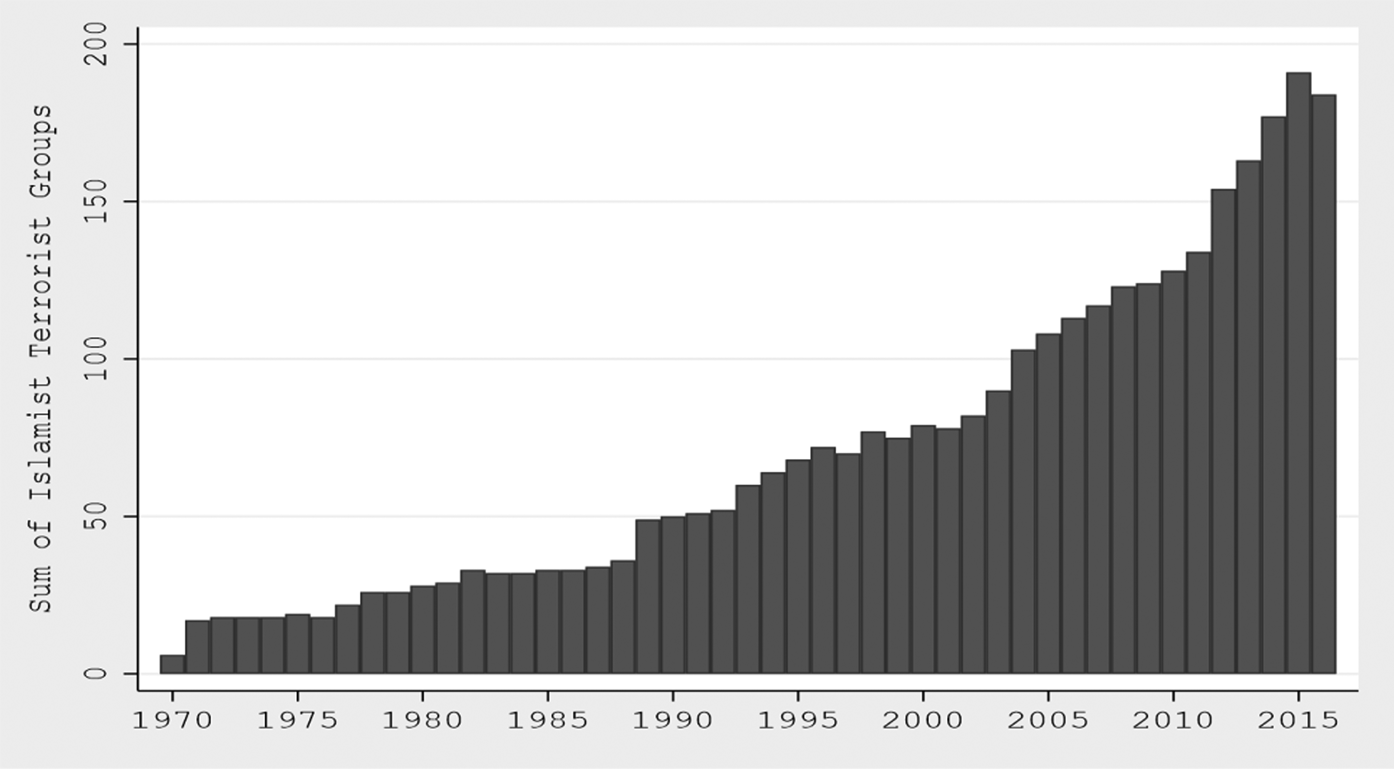
Meierrieks and Renner (Reference Meierrieks and Renner2021, 16) also provide statistics in Figure 1 that well support the findings of Kis-Katos et al.. I reproduce Meierrieks and Renner's figure below for reference purposes.Footnote 3 Meierrieks and Renner aim to examine the effect of Islamist terrorist activity on women's economic, political, and legal positions in society for the years, 1970–2016. They state that ‘between 1970 and 2016, almost 60 countries saw activity by one or more Islamist terrorist groups’ (p. 16). Since Meierrieks and Renner show the data by terrorist group, the number seems small. But when translated into the frequency of Islamist terrorist incidents by year, which is the focus of my original and response studies, it is large (more than 535 times for 1970–1990). Since a sizable number of Islamist terrorist activities occurred between 1970 and 1990, an accurate, complete representation of my work requires that those 21 years be included.Footnote 4
Global sum of active Islamist terrorist groups, 1970–2016.
Source. Meierrieks and Renner (Reference Meierrieks and Renner2021), p. 17.

However, Egger and Magni-Berton's claim that I ‘focus on all terrorist groups over a period where Islamist attacks were rare’ (p. 1) leads me to further scrutinize the validity of the claim. I below demonstrate how the choice of the starting year for a sample data makes a drastic difference. Since I am asked to be brief, I introduce only two examples to make my point.
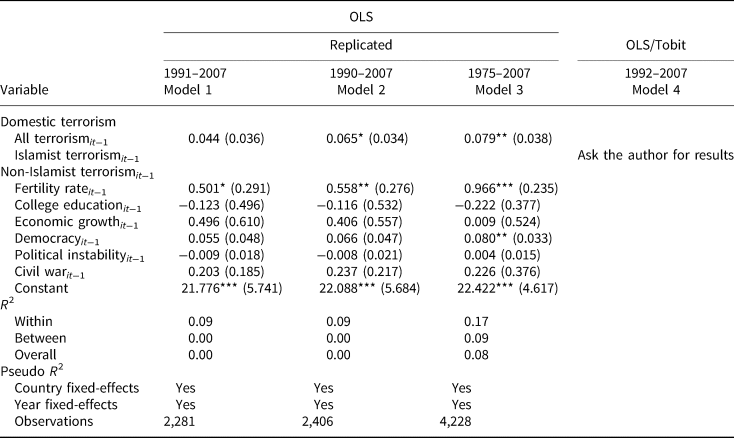
I begin by reproducing Egger and Magni-Berton's Model 2. Thanks to their replication materials,Footnote 5 I have successfully reproduced the model and displayed estimates in Model 1 in Table 1. The reproduced coefficients and standard errors do coincide with those reported by Egger and Magni-Berton. Note that the All Terrorism variable does not achieve significance during the period from 1991 to 2007.
Effect of domestic terrorism on the growth of Muslim populations

Note. Robust standard errors.
*P < 0.10, **P < 0.05, ***P < 0.01, two-tailed tests.
In Model 2, I confine the sample period to the years 1990–2007. I choose 1990 as the first year of the examination since Kis-Katos et al. maintain that ‘Islamist terror has risen in importance very strongly; it occurs mainly from 1990 onwards’ (p. 132, emphasis added). I re-estimate Model 1 using the sample period 1990–2007 and display the re-estimated results in Model 2. The results confirm my theory since the All Terrorism variable is significantly different from zero and in the expected direction.
Interestingly, Kis-Katos et al. present empirical analyses for the period 1975–2008,Footnote 6 which is close to the period studied in my original work. Based on their model, I re-estimate Model 1 for the period 1975–2007. The results, reported in Model 3, verify the significant and positive effect of domestic terrorism.
4. Conclusion
When I was informed that Egger and Magni-Berton wrote a reply to my study, I was thrilled for two reasons. First, Egger and Magni-Berton's reply meant that my research has been read by peers rather than evaporated into thin air right after its birth, which is one of the main reasons I continue to engage in research activities. Second, I considered Egger and Magni-Berton's reply as an attempt to advance our scientific discovery regarding the relationship between terrorism and religious affiliation. Searching for scientific discovery also motivates me to continue to engage in scientific inquiry through scholarly exchanges (Choi, Reference Choi2016). After having finished my response to Egger and Magni-Berton's contribution, I remain excited by their interest, yet less enthralled with their way of engaging empirical scrutiny. Put it another way, their distinction between Islamist and non-Islamist terrorism can be an important contribution, but the reply has revealed limitations in their critique of my research.
Although previous studies have already made the separated data for Islamist and non-Islamist terrorism publicly available for the entire period of my study, 1970–2007 (see Kis-Katos et al., Reference Kis-Katos, Liebert and Schulze2014; Hou et al., Reference Hou, Gaibulloev and Sandler2020; Meierrieks and Renner, Reference Meierrieks and Renner2021), Egger and Magni-Berton choose to confine their analysis to a much shorter period, 1991–2007. Egger and Magni-Berton's logic is that Islamist terrorist incidents were non-existent during the period from 1970 to 1990 so that they must be excluded from the statistical analysis. I find this justification unsupported since 535 Islamist terrorist incidents took place during the first 21 years of my study period, as shown in Kis-Katos et al.'s (Reference Kis-Katos, Liebert and Schulze2014, 120) analysis (for a similar statistical data, see also Hou et al., Reference Hou, Gaibulloev and Sandler2020; Meierrieks and Renner, Reference Meierrieks and Renner2021). More importantly, 535 Islamist attacks for the period 1970-1990 turn out to be larger than 372 Islamist attacks for the period 1991–2007 that Egger and Magni-Berton identified and used for their empirical analysis. Nonetheless, Egger and Magni-Berton treat 535 Islamist terrorist incidents that occurred for the period, 1970–1990, as non-existent, so they choose 1991 as the starting point of their statistical analysis. Egger and Magni-Berton claim that 1991 is the beginning of ‘the period in which many countries start hearing of – and, for some, experiencing – Islamist terrorism’ (p. 6). Let alone this claim is unfounded, Egger and Magni-Berton contradict themselves in their other study (Egger et al., Reference Egger, Magni-Berton and Varaine2020, 30). In it, they define 1992, not 1991, as the year of ‘the first noticeable wave of jihadist terrorism.’
My results do not hold when the starting year is set at 1991 and the sample period is only 17 years (1991–2007). This is because Egger and Magni-Berton's statistical analysis excludes the valuable and available information on Islamist terrorism that took place during the previous 21 years (1970–1990). Be that as it may, I retest models using other starting years that are more theoretically justifiable and referenced in the literature: 1975, 1990, and 1992. The results of those tests support my theoretical argument. In addition, correcting their replications to restore my original model specification yields much different results than they report: while their findings do not hold, mine does. The overall reanalysis suggests that future research can offer additional evidence to understand whether there is a significant and positive relationship between Islamist terrorism and the growth of Muslim populations.Footnote 7
Supplementary material
The supplementary material for this article can be found at https://dataverse.harvard.edu/dataset.xhtml?persistentId=doi:10.7910/DVN/3QFVIB
Acknowledgements
I would like to thank Benjamin Acosta, Alba Alexander, Davis Brown, Rebecca Clendenen, Michael Dirksen, Julian Garcia, Christopher Green, Yasmine Haiti, Abbott Hays, Patrick James, Justin Labonte, Semih Patan, Marco Rossi, Keith Simonds, Tina Tran, Esteban Valtierra, and Daniel Williams for their helpful comments and suggestions.