Introduction
Patients in advanced stages of life-limiting diseases and in end-of-life care are too often suffering from an extensive symptom burden (Kehl & Kowalkowski, Reference Kehl and Kowalkowski2013; Kobewka et al., Reference Kobewka, Ronksley and McIsaac2017). Although pain is a common symptom in patients in palliative care (Romem et al., Reference Romem, Tom and Beauchene2015) and often linked to insufficient treatment (Öhlen et al., Reference Öhlen, Russell and Hakanson2017), many other problems can trouble and worry patients physically as well as socially, psychologically, and spiritually. Early identification and treatment of symptoms is important to promote the best possible quality of life regardless of the disease from which the patient is suffering (Radbruch & Payne, Reference Radbruch and Payne2009). Hence, it is important to integrate palliative care into the treatment of severe chronic diseases (Siouta et al., Reference Siout, van Beek and Preston2016a, Reference Siouta, Van Beek and van der Eerden2016b). Patients with palliative care needs are cared for in a diversity of healthcare settings, not least hospitals, which are common places of death (Broad et al., Reference Broad, Gott and Kim2013; Håkanson et al., Reference Håkanson, Öhlén and Morin2015; Pivodic et al., Reference Pivodic, Pardon and Morin2016; Reich et al., Reference Reich, Signorell and Busato2013). Patient-reported outcome measures (PROM) have an important role in identifying symptoms in patients with palliative care needs (Etkind et al., Reference Etkind, Daveson and Kwok2015).
It has been shown that the use of PROM supports clinical judgment among healthcare professional (HCP), drawing attention to changes in the patient's disease (Boyce et al., Reference Boyce, Browne and Greenhalgh2014) and improving communication between the patient and HCPs (Etkind et al., Reference Etkind, Daveson and Kwok2015). The choice of which PROM to use for the intended group of patients is important (Antunes et al., Reference Antunes, Harding and Higginson2014; Bausewein et al., Reference Bausewein, Simon and Benalia2011; Dawson et al., Reference Dawson, Doll and Fitzpatrick2010). A scale used for patients with palliative care needs is the Integrated Palliative Care Outcome Scale (IPOS). It is a brief assessment tool with questions relating to various symptoms and problems (Beck et al., Reference Beck, Olsson Möller and Malmström2017; Schildmann et al., Reference Schildmann, Groeneveld and Denzel2016). IPOS begins with an open-ended question asking patients about their most distressing problems. This is followed by questions concerning their experience of common symptoms and problems to be answered on a 5-point Likert scale. A proxy version is available when patients are not able to answer IPOS themselves (Beck et al., Reference Beck, Olsson Möller and Malmström2017; Schildmann et al., Reference Schildmann, Groeneveld and Denzel2016). The implementation of PROM for patients with palliative care needs is characterized by both enablers and barriers. The way HCPs experience the use of the assessment tool is of importance. For instance, a user-friendly tool could reduce the sense of increased workload (Boyce et al., Reference Boyce, Browne and Greenhalgh2014), whereas a tool that HCPs perceive as too burdensome for the patient may not be used (Bausewein et al., Reference Bausewein, Simon and Benalia2011). Thus, the aims of this study were to explore (1) factors that contributed to or hindered patients with palliative care needs from having their symptoms assessed using IPOS and (2) HCPs’ experiences of using IPOS in acute care settings.
Methods
Design
The study had an explorative design and a mixed method approach was used (Creswell & Plano Clark, Reference Creswell and Plano Clark2011). It is part of a larger study aiming to explore the feasibility of an implementation strategy to introduce IPOS in different care settings (Lind et al., Reference Lind, Sandberg and Brytting2018).
Settings
The study was performed from March to June 2016. The units were strategically selected because they cared for patients with severe diseases in need of curative as well as general palliative care. Participating units were a pulmonary diseases unit and a neurological diseases unit at an acute care hospital, and a gastro-surgery unit at a university hospital. The latter unit cared for patients receiving acute and planned surgery, often related to severe cancer with limited life expectancy. The implementation strategy included: (1) Six training sessions, performed by the first author (S.L.). The sessions, each lasting 15 minutes, were designed to prepare HCPs for the use of IPOS. The content of the sessions was based on the key element of palliative care (i.e., a holistic approach to improve quality of life for patients with life-threatening diseases). How IPOS should be used and for which patients, and possible actions related to the patients’ assessment of symptoms, for example the treatment of pain and breathlessness were also included. (2) The use of IPOS over 12 weeks. IPOS was to be offered to patients (≥18 years of age) with severe chronic disease affecting their general condition on their third and seventh days of care on the unit (Appendix 1). A proxy version of IPOS could be used for patients unable to self-report. (3) Nurse managers and internal facilitators were assigned to support the HCPs in the use of IPOS. (4) Nurse managers and internal facilitators were supported by an external facilitator (S.L.) (Figure 1). The findings on the feasibility evaluation of the implementation strategy is reported in a separate paper (Lind et al., Reference Lind, Sandberg and Brytting2018).
Description of the implementation strategy. IPOS, Integrated Palliative Care Outcome Scale.

Data collection
The collection of data was performed in conjunction with the evaluation of the feasibility of the implementation strategy. Quantitative data related to the patients were collected through review of patients’ health records that met the criteria for being offered using IPOS at the participating units. Quantitative data related to HCP were collected through notes made during the implementation, whereas qualitative data were collected through semistructured interviews (Brinkmann & Kvale, Reference Brinkmann and Kvale2015).
Quantitative data: Study sample and variables
The study sample for the quantitative data consisted of 309 patients who met the description of patients to be offered the opportunity to complete IPOS (Appendix 1). If patients were admitted to the same unit several times during the study period, each occasion was counted separately. The presence of completed IPOS in the patient's health record was categorized as yes or no. Four variables were related to the patients’ demographic characteristics: gender, age, diagnosis, and death on unit during the study period. The patients’ age on the day of their admission to the unit was categorized into three groups and their diagnoses were categorized as either cancer disease or other chronic disease. A patient's death on the unit was categorized as yes or no. The four variables regarding HCPs related to their participation in the training sessions. Because the number of nurse managers (n = 3) in the study was small, their participation was categorized as: not at all, one through three sessions or four or more sessions. The participation of the remaining groups of HCPs was calculated as the proportion of participants related to available HCPs. Their participation was categorized as: not at all, 1–50% in at least two sessions, or 51–100% in at least two sessions (Table 1).
Description of variables
IPOS, Integrated Palliative Care Outcome Scale; NM, nurse manager; TS, training sessions.

Qualitative data: Participants
Eight interviews, with individuals or in groups, depending on practical conditions at the units, were performed with available assistant/registered nurses (n = 10) and the nurses who had acted as internal facilitators (n = 6) in the implementation of IPOS. Nurse managers (n = 3) at participating units were also interviewed, making a total of 19 participants. The interviews were conducted in a separate room close to the units. An interview guide was used, which included open-ended questions regarding HCPs’ experiences of the use of IPOS (Appendix 2). The interviews were audio recorded, lasted between 24 and 48 minutes, and were performed from June to October 2016 by a coworker in the implementation study. The interviewer had no relationship with the participants before the interviews.
Ethical issues
The study was approved by the Regional Ethical Review Board in Stockholm (2013/875-31/1, 2015/2197-32). Access to the units and patients’ health records was permitted in writing by each department manager. All participants in the interviews received oral and written information and signed consent forms before the interviews.
Analysis
Statistical analysis
Descriptive and analytical statistics were used. Number and percentage were calculated for descriptive statistics. Chi-square test was used for comparison between independent groups and Fisher's exact test was used for groups with cell counts smaller than 5 (Björk, Reference Björk2011). Multivariable logistic regression analyses (forward) were performed with the number of completed IPOS in patient's health records as the dependent variable. Because of the small sample and high correlations (Spearman 1.0) between variables related to HCP participation in the training sessions (TS), two complementary models were performed so as not to violate the data. In model 1, assistant/registered nurses and facilitators participating in TS were included as independent variables. In model 2, facilitators’ participation was replaced with physicians’ participation in TS. Nurse managers were not included because they do not regularly care for patients. Demographic variables were included in both models. The significance level was set at p < 0.05. All statistical computations were performed in IBM SPSS Statistics 22 software.
Qualitative analysis
Qualitative content analysis as described by Elo and Kyngäs (Reference Elo and Kyngäs2008) was performed on interview data. The interviews were transcribed verbatim by an external person. The first author (S.L.) listened to all interviews to verify the transcribed text. The texts were then read through several times to obtain a sense of the whole. Words and phrases relevant to the aim were marked as meaning units and extracted. These meaning units were condensed and labelled with codes. The codes were subsequently sorted into subcategories based on similarities and differences, and finally organized into two categories. The steps were performed by two of the authors (S.L. and I.B.), first independently, and then discussed and agreed upon.
Results
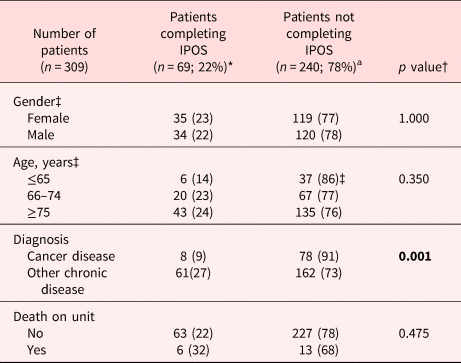
Of the 309 patients included, 126 were cared for on the pulmonary unit, 101 on the neurological unit and 82 on the gastro-surgery unit. There was an even distribution between women and men in the study: 154 women and the same number of men. Just over one-half of the patients were aged ≥75 years (58%), whereas 28% were aged 66–74 years and 14% of the patients were 65 years or younger of age. Approximately 72% of the patients received care for chronic diseases compared with 28% for cancer diseases. About 6% of the patients died on the units during the study period. In total, almost a quarter of the patients (22%) had completed IPOS. Overall, there was a similar distribution of women and men who had or had not completed IPOS. The distribution of patients with completed IPOS corresponded to the age distribution of included patients. The share of patients with chronic diseases other than cancer who had completed IPOS was significantly higher (p = 0.001) than for those with cancer diseases (Table 2).
Distribution of patients completing and not completing IPOS in relation to patient demographics

Data presented as n (%).
IPOS, Integrated Palliative Care Outcome Scale.
Bold values indicates p value < 0.05.
*Percentages are row percentages.
†Chi-square test.
‡Gender and age of one patient at the gastro-surgery unit are missing.
A significant association was found for all four variables regarding HCPs’ participation in TS and patients having completed IPOS (p ≤ 0.001). A higher degree of participation in TS by managers, HCPs, and facilitators was associated with a higher degree of completed IPOS (Table 3).
Associations between staff's participation in training sessions and patients’ completion of IPOS

Data presented as n (%).
IPOS, Integrated Palliative Care Outcome Scale; TS, training sessions.
Bold values indicates p value < 0.05.
*Percentages are row percentages.
†Fisher's exact test.
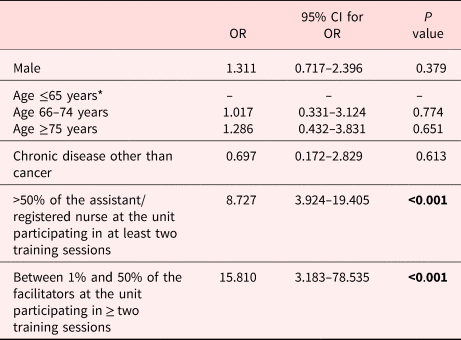
The first model tested in the logistic regression analyses explained between 17.0% (Cox and Snell R 2) and 25.9% (Nagelkerke R 2) of the variance of completed IPOS, and correctly classified 77.3% of the cases. Two of the independent variables made a unique statistically significant contribution to the model. The strongest determinant for completion of IPOS was internal facilitators participation in TS (odds ratio = 15.8) (Table 4).
Logistic regression analysis on completion of IPOS – model I

Hosmer and Lemeshow goodness-of-fit test; chi-square 5.673; degrees of freedom 8; P = 0.684. All variables entered in the logistic regression contributed to the model.
CI, confidence interval; IPOS, Integrated Palliative Care Outcome Scale; OR, odds ratio.
Bold values indicates p value < 0.05.
*Reference category.
When facilitators’ participation in TS was replaced with physicians’ participation (model 2), the analysis indicated that patients were about 15 times (odds ratio = 15.8) more likely to have completed IPOS if physicians at the unit had participated in TS (Table 5). Although the same result was found in both models, the importance of the participation of HCPs in TS, regardless of profession, is indicated for the patients’ completion of IPOS.
Logistic regression analysis on completion of IPOS, model 2

Hosmer and Lemeshow goodness-of-fit test; chi-square 5.673; degrees of freedom 8; P = 0.684. All variables entered in the logistic regression contributed to the model.
CI, confidence interval; IPOS, Integrated Palliative Care Outcome Scale; OR, odds ratio.
Bold values indicates p value < 0.05.
*Reference category.
HCPs’ experiences of using IPOS
The analysis of the interviews with HCP, generated seven subcategories distributed across two categories: “IPOS acting as a facilitator” and “barriers to the use of IPOS” (Table 6).
Staff's experiences of use of IPOS in acute care settings

IPOS, Integrated Palliative Care Outcome Scale.
IPOS acting as a facilitator
The use of IPOS was described as contributing to person-centered care of patients with palliative care needs. HCPs experienced IPOS as being a simple tool that was easy to use. The questions in IPOS were easy to understand and the content was not perceived to be harmful to the patients. That all kinds of symptoms/problems were covered in the tool facilitated patients being offered IPOS. The simplicity of IPOS, as described by HCPs, made it possible for them to use IPOS as a routine tool for identifying patients with palliative care needs regardless of whether the intention of care was curative or palliative.
The use of IPOS was experienced as contributing to increased communication between HCPs and patients. The questions in IPOS were described as preparing HCPs for how to talk with patients and ask them about their issues. Talking about the scorings deepened the content of the conversations. The use of IPOS increased the insight into palliative care as being holistic care. The significance of other symptoms, not only pain and breathlessness, was regarded as being easier to identify and the patients’ own experiences of the situation were captured. Further, the use of IPOS made it easier to include family members into such conversations, who HCPs sometimes described as being forgotten. IPOS was experienced as being helpful in identifying those patients in need of palliative care and thereby acted as a support mechanism for decision-making. Discussions about which patients should be offered IPOS and consideration of how the patients scored on IPOS contributed to decision-making regarding the goal of care, i.e. being curative or palliative.
“It [IPOS] makes you realize, so that you start thinking in terms of it being palliative and what could this be due to, is it anxiety, is it pain, is it….” (HCP)
Further, HCPs experienced that IPOS contributed to the improvement of quality of care and an increased level of teamwork. Discussions at morning sessions about which patients should be offered IPOS, especially among nurses and assistant nurses, was referred to as almost becoming a routine. Assistant nurses were described as supporting the registered nurses in obtaining a comprehensive picture of the patient's situation. Moreover, the use of IPOS supported the HCPs in developing a greater awareness concerning integrated palliative care. An increased awareness of the need for improved care of patients with palliative care needs in acute care settings was described. The use of IPOS made it easier for the HCPs to initiate treatment of pain and other symptoms.
“…what I reacted to was that many [patients] had such problems with dry mouth…we really ought to have thought about that but…” (facilitator)
IPOS was experienced as providing a contribution to and inspiration for the improvement of routines. The structure of IPOS facilitated the documentation of the patient's condition and the improvement of HCPs’ routines. The content in IPOS made it easier to articulate and describe the patient's situation when completing the patient's health record. In this way, documentation was described as becoming more specific. IPOS also acted as a reminder to ask patients regularly about their symptoms. In addition, IPOS provided possibilities for the future quality improvement of current issues, such as insufficient teamwork and routines. The regular use of IPOS and clearer description of the patients’ condition in their health record supported information transfer and acted as a standing item in medical meetings among HCPs. This was felt to contribute to improved teamwork and thereby improved the care of patients affected by severe diseases.
“All of them have eating problems and nausea but I think that this led to there being a bit more structure …” (nurse manager)
Barriers to the use of IPOS
HCPs described feelings of insecurity regarding the use of IPOS. They experienced the combination of options to write both freely and give answers on a 5-point Likert scale as difficult to understand. The free listed answers were felt to be difficult to interpret and to distinguish between symptoms, such as pain and anxiety. Further, HCPs were concerned that the assessment of patients’ symptoms completed by proxy, when patients were unable to self-report, was subjective and chose not to use IPOS for such patients.
“Because there were a lot of symptoms listed that you could put a cross by, and then you were also supposed to list any other symptoms, you could write freely, and this is hard for me to really understand, what could these possibly be…” (HCP)
Lack of knowledge regarding palliative care and limited clinical experience of caring for patients with palliative care needs were described. We interpreted this as uncertainty in how to integrate palliative care for patients affected by severe diseases.
The mix of patients with curative and/or palliative care needs sometimes made the HCPs confused about how to act. HCPs expressed that they felt frustration due to the different approaches of nurses and physicians concerning the goal of care for patients affected by severe diseases. Palliative care as a concept was perceived as unclear; in the context of acute care settings, it was equated with end-of-life care. Consequently, HCPs experienced that decision-making occurred late in the disease trajectory, which meant that the patient was not receiving the optimal possible care.
“Many may have difficulties in being able to make the decision …the difference when you talk about palliative care in palliative care units, …there the care can be palliative for quite a long time, … whilst in acute care settings palliative care is considered to be care at the end of life.” (facilitator)
HCPs described uncertainty concerning how to approach severely ill patients and their family members. They expressed difficulties in explaining to the patients why IPOS should be completed, which made them feel apprehensive. This was especially true for questions relating to psychosocial and emotional issues, which were perceived by HCPs as being difficult to discuss. HCPs reported that they were affected by patients’ anxiety, particularly when they felt that they did not know how to respond to the them. Further, they were afraid of causing distress when communicating with the patient, especially when they were not sure about how much information the patient had been given concerning the prognosis of their disease. When patients responded to IPOS themselves, HCPs were worried that this could cause anxiety. HCPs also experienced difficulties in talking with family members. They felt uncertain, particularly when they had not met the family members previously and did not know anything about their relationship with the patient.
“It was maybe a bit more the psychosocial questions, as a nurse I didn't really know if I ought to go in, how are things at home, …how is your relationship with NN, I thought this was quite difficult…” (HCP)
Difficulties in finding new routines for the use of IPOS were mentioned as a barrier to its use. IPOS was distributed to the units in paper format. Integration of IPOS into the digital health record was requested by HCPs to support documentation and information transfer. They also experienced that a high workload made it difficult to perform all tasks and contributed to feelings of time pressure. Constant changes of duties, with several ongoing projects and introduction of new routines, further contributed to such feelings. For this reason, the use of IPOS was omitted, especially in the follow-up care. Lack of continuity in the HCPs’ work schedule contributed to insufficient teamwork, which was experienced as a barrier to using IPOS. The work was organized in teams, but HCP members did not necessarily work in the same team for a series of days, which resulted in poor continuity for the patients. Physicians’ schedules often meant that they only worked a couple of weeks on each unit. This was perceived as reducing opportunities for good teamwork.
“There is such a high turnover of staff the whole time and we have agency nurses who are not at all up to date with and trained in the different routines and guidelines that we have.” (HCP)
Discussion
We found an association between HCPs’ participation in palliative care training sessions and patients completing IPOS. We also found that HCPs experienced the use of IPOS to contribute to person-centered care of patients with palliative care needs, improved routines, and enhanced teamwork. However, HCPs’ feelings of uncertainty about how to approach severely ill patients and their family members hindered them from using IPOS. Further, HCPs’ feelings of high workload and time pressure hindered them in using IPOS. Neither the regression analyses nor the HCPs’ experiences of the use of IPOS suggest that patient related factors (gender, age, or type of disease) were associated with completion of IPOS. However, consistent results regarding HCPs’ participation in training sessions, regardless of profession, were found using both Fisher's exact tests and regression models, indicating its significance for patients’ completion of IPOS. Several practical issues concerning the use of PROMs, such as insufficient training and guidance on the use of the intended PROM, are well-known barriers for getting such tools into practice (Antunes et al., Reference Antunes, Harding and Higginson2014; Bausewein et al., Reference Bausewein, Simon and Benalia2011; Boyce et al., Reference Boyce, Browne and Greenhalgh2014). In addition, lack of education in palliative care has been highlighted as a barrier to the provision of palliative care in acute care settings (Bloomer, et al., Reference Bloomer, Moss and Cross2011; Frey et al., Reference Frey, Gott and Raphael2014; Reid et al., Reference Reid, Gibbins and Bloor2015). Our findings underline the importance of having a relatively large proportion of all professions participating in the training sessions, which might also impact. The lack of knowledge in palliative care experienced by HCPs.
HCPs in our study highlighted the contribution of IPOS to person-centered care and communication, thereby providing opportunities for improved palliative care in acute care settings. They also described an improvement in their teamwork as a result of using IPOS. Because a palliative care approach emphasizes the quality of life for the patients and their family members, the assessment and treatment of distressing symptoms using an interdisciplinary perspective are important (Radbruch & Payne, Reference Radbruch and Payne2009).
Furthermore, our results indicate that some HCPs experienced the use of IPOS as difficult, especially questions relating to anxiety and psychosocial issues. These findings are in line with results in a study by McIlfatrick and Hasson (Reference McIlfatrick and Hasson2014) in which a holistic assessment tool for palliative practice was evaluated. HCPs in that study experienced the tool used as being comprehensive and useful; however, it was primarily physical issues that were assessed. It is possible that gatekeeping influenced the prevalence of completion of IPOS in our study because of HCPs’ concerns about harming the patient by asking questions related to psychosocial issues and their uncertainty regarding proxy estimation. The use of PROM in palliative care has also previously been associated with gatekeeping because these patients are viewed as highly vulnerable (Bausewein et al., Reference Bausewein, Simon and Benalia2011).
Strengths and limitations
The use of a combination of quantitative and qualitative data contributed to the identification of elements associated with the use of IPOS. The variation in the interviewees’ professions strengthens the findings and biases were avoided given that the interviews were performed by a coworker who was not involved in the implementation process. A limitation is that only three acute care units participated in the study. This contributed to a correlation between variables related to HCPs’ participation in the training sessions, so that two regression models had to be used. Further, the confidence intervals for the variables relating to HCPs’ participation in training sessions were large, indicating uncertainty of the true odds ratio, which is important to consider when interpreting the results.
Conclusions
We found an association between HCPs’ participation in trainings sessions and patients who completed IPOS. This indicates the need for a high degree of participation in training to achieve successful implementation. The use of IPOS was perceived to enhance teamwork and contributed to improving the quality of care for patients with palliative care needs. The feelings expressed by the HCPs concerning their insecurity in the use of IPOS and how to approach severely ill patients and their family members indicate a need for further education and clinical support in the use of IPOS. Moreover, education in the integration of palliative care for patients with life-limiting diseases and training in communication seem to be of importance for improved palliative care in acute care settings.
Author ORCIDs
Ingela Beck, 0000-0002-7790-6906
Acknowledgments
The authors sincerely thank the study participants for generously sharing their time and experiences, the Erling-Persson Family Foundation, and the Swedish Society of Nursing for funding the project.
Conflicts of interest
The authors declare that there are no conflicts of interest.
Supplementary Materials
The supplementary material for this article can be found at https://doi.org/10.1017/S1478951518001104.