Implications
The present work shows that substituting corn stalk silage with corn silage in a finishing ration could not improve the growth performance, carcass trait, oxidative stability and meat quality of beef cattle except for better intramuscular fat deposition, which might improve marbling score of beef muscle. Inoculated silage showed no advantage on the production performance of beef cattle relative to non-inoculated silage. The results suggest that it is not economical to substitute high-quality forage for relative low-quality forage in a high-concentrate finishing ration and silage inoculant addition could not exert a direct effect on animal performance.
Introduction
As a high-quality forage, corn silage (CS) has been popularized in dairy cattle production around the world and beef cattle production in Europe and North America (Adesogan, Reference Adesogan2009; Millen et al., Reference Millen, Pacheco, Arrigoni, Galyean and Vasconcelos2009), whereas corn stalk silage (SS) is still a preference to beef cattle production in the districts short in feed resources like China. In the past few years, with grain production achieving consecutive increases, corn supply has been in a relative surplus, whereas the import of high-quality forage is becoming larger and larger (National Bureau of Statistics of China, 2016). As a result, Chinese government would implement ‘food to feed’ transformation policy, that is, transferring the production mode of cereal planting (mainly corn, wheat and sorghum) from grain-objective production to feed production used as whole plant silage (Chinese Communist Party Central Committee, 2015), contributing to CS popularization in ruminant production over the country. There is scarce literature that has compared the performance of finishing cattle offered CS or SS, whereas there are lots of reports comparing the inclusion effects of other silages such as grass silage and whole-crop cereal silage to CS. Improvements in cattle’s feed intake with inclusion of CS in grass silage-based diets have been demonstrated in previous studies (O’Mara et al., Reference Pesonen, Joki-Tokola and Huuskonen1998; O’Kiely and Moloney, Reference O’Mara, Fitzgerald, Murphy and Rath2002). Studies examining the effect of including whole-crop wheat in grass silage-based diets have observed increased intake in beef cattle relative to grass silage (Keady et al., Reference Keady, Lively, Kilpatrick and Moss2007). These results imply that inclusion of a relatively higher-quality roughage could promote feed intake. It is hypothesized that finishing beef cattle offered CS would have a higher feed intake and better production performance than those offered SS because CS is apparently higher in nutrient values than SS.
Ensiling is an easy preservation method for moist forages based on lactic acid bacteria (LAB) converting water soluble carbohydrates into organic acids under anaerobic condition (Weinberg et al., Reference Wilkinson, Bolsen and Lin2003). In theory, inoculating silage with LAB ensures the presence of enough number of bacteria to cause a rapid reduction in pH, preventing undesirable fermentation and proteolysis (Limin et al., Reference Limin, Stokes and Lin2003). In practice, the effect of LAB inoculant inclusion has been variable, with most research reporting positive effects on chemical or microbiological compositions of the silage (Wilkinson et al., Reference Wilkinson, Bolsen and Lin2003) but rarely on animal performance (Contreras-Govea et al., Reference Contreras-Govea, Muck, Mertens and Weimer2011). Interestingly, there are some studies revealing that the addition of silage inoculant not only decreases the pH value of silage with increased lactic acid content, but also improves animal performance such as increased dry matter (DM) intake, digestibility and more daily gain (Khuntia and Chaudhary, Reference Khuntia and Chaudhary2002) likely acting as probiotics in rumen (Weinberg et al., Reference Wilkinson, Bolsen and Lin2003). Based on these studies and inference of in vitro study data (unpublished), it is hypothesized that the cattle fed inoculated silage would show advantages on growth performance than those fed non-inoculated silage. Thus, this study was conducted to compare the growth performance, carcass trait, meat quality and oxidative stability of beef cattle offered alternative silages (CS v. SS; inoculated silage v. non-inoculated silage) in a finishing ration.
Material and methods
Silage preparation
Whole corn plant was harvested at its maturation stage of 1/2 milk line with a theoretical particle length of 2 cm using a JAGUAR 830 forage harvester (CLAAS KGaA mbH, Harsewinkel, German) and ensiled into two semi-underground silos, one of which was sprayed with Sila-max (LAB (Lactobacillus Plantarum, Pediococcus Acidilactici, Enterococcus Faecium)⩾5×10¹⁰ CFU/g; 5 g/ton fresh silage; Ralco Nutrition Inc., Marshall, MN, USA). On the other hand, SS was produced with the fresh corn stalk (corn plant removed ears) bought from the surrounding farmers and subjected to the following processes the same as whole CS done. All the silages were opened for use after 60 days fermentation.
Experimental design and animal management
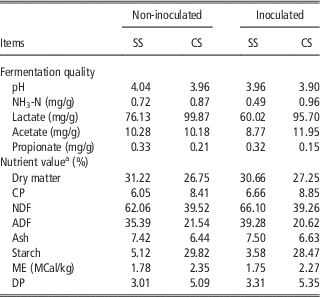
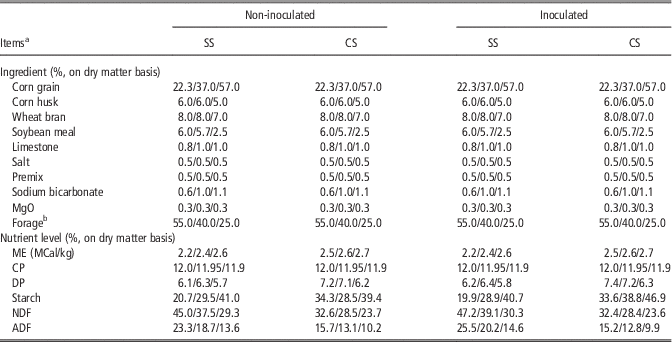
This study was performed at the cooperative farm of China Agricultural University and all the procedures were approved by the Animal Care and Use Committee of China Agricultural University. In all, 60 crossbred Bohai Black steers (18 months old) were selected and allocated randomly to four dietary treatments that were isonitrogenous diets (balanced with urea) and formulated to meet the National Research Council (2000) recommendations based on CS, inoculated CS, SS and inoculated SS, respectively (Table 1). In order to go smoothly through adaptation, cattle were fattened in a step-wise (4, 4 and 16 weeks) finishing system, where the proportions of dietary concentrate levels (on a DM basis) were 45%, 60% and 75%, respectively. The total mixed rations (Table 2) were mixed with the well-mixed concentrates and fresh silage using a fixed mixer (Ruiting Equipment Ltd, Zhengzhou, China), and then manually delivered to the animals with the consideration of 10% feed intake residue. All the cattle were reared with free access to feed and clean water in individual pens (2×4 m), which were separated by iron fence and fixed with individual trough and drinking bowl. The daily amount of offered feed and residual was manually recorded in consecutive 7 days every 4 weeks and feed sample was taken for moisture determination. Live BW was measured on the last day of each fattening phase. By the end of the 24-week finishing period, all the cattle were bled by jugular vein puncture for oxidative stability analysis on the morning after a 12-h fast. On the afternoon (1800 h) of the day before slaughter, the animals were transported about half an hour for 10 km to the waiting lairage of abattoir by trucks (10×3 m; 12 cattle/truck). Following a 12-h fast, the slaughter was conducted in halal slaughter method on the following morning (0600 h) and the slaughter procedure lasted around 3 h. Following a 48-h aging at 4°C, the carcass traits of all the cattle including carcass weight, loin eye area, the individual weight of chuckeye, ribeye, striploin and tenderloin were measured and meat sample of striploin (a depth of 10 cm) was collected on the left carcass. The steaks were measured for color and pH on the spot after 1 h of blooming at 4°C, and then vacuum packaged and transported to lab in ice box. At almost 60 h postmortem, the samples were analyzed for other physical traits and partially lyophilized and powdered for nutrient value analysis. In addition, another sample of striploin (5 g) was collected in sterile tube and stored in liquid nitrogen designated for oxidative stability analysis.
Fermentation parameters and nutrient values of alternative silages fed to beef cattle

SS=corn stalk silage; CS=corn silage; ME=metabolizable energy; DP=digestible protein.
a ME and DP are referred to Chinese Feeding Standard of Beef Cattle (NY/T 815, 2004) and the other nutrient values are measured.
Dietary formulas of beef cattle in different treatments with 45%, 60% and 75% of concentrate level used in different fattening phases

SS=corn stalk silage; CS=corn silage; ME=metabolizable energy; DP=digestible protein.
a SS, CS, ME, CP, DP, calculated based on the individual digestible protein value of each ingredient referred to Chinese Feeding Standard of Beef Cattle (NY/T 815, 2004). All the nutrient levels are calculated values. The total mixed ration was balanced to isonitrogenous level with urea. The three values in the same cell separately represent the individual level of the three finishing phases.
b Forage: corn stalk silage, inoculated corn stalk silage, corn silage and inoculated corn silage, respectively.
Chemical analysis
In order to analyze the fermentation quality of silage, a sample was prepared by soaking and shaking fresh silage (25 g) in distilled water (225 ml) at 4°C overnight and centrifugating it at 8000×g and 4°C for 15 min. The supernatant was collected, and then its pH value was measured with a portable pH meter (Testo 205; Testo AG, Schwarzwald Germany), ammonia nitrogen concentration was colorimetrically measured based on the method described by Broderick and Kang (Reference Broderick and Kang1980), volatile fatty acids profile was determined with gas chromatography (GC) 3420 gas chromatograph (Agilent Technology Inc., Dionex, FTC, Palo Alto, USA) as stated by Erwin et al. (Reference Erwin, Marco and Emery1961) and lactic acid was determined with DIONEX-2500 ion chromatograph (Dionex, USA) using sodium hydroxide solution as mobile phase. In addition, silage was dried, powdered and analyzed for DM, CP, NDF, ADF and ash according to Association of Official Analytical Chemists (AOAC) (2000) methods.
Beef muscle was also analyzed for DM, CP, fat and ash according to AOAC (2000). Cholesterol was extracted by petroleum ether and determined by capillary gas chromatograph as the method of GB/T (2008). Freeze-dried sample (0.50 g) was placed into a 50 ml stopper-cap tube, to which 10 ml of 1N KOH and 10 ml of ethanol were added. The tube was incubated in a 95°C water bath for 1.5 h capped with condenser pipe, and then the liquid was transferred into a separating funnel. Petroleum ether (10 ml ) was added to extract the cholesterol by shaking mixing and discarding water-phase, then distilled water (30 ml) was added and discarded to clean the organic-phase, and then 10 g of anhydrous sodium sulfate was added to clear water. Finally, the organic-phase was filled in a tube and dried away with nitrogen gas, and then 3 ml ethanol was added into the tube to collect cholesterol and placed into a GC vial. The vial was capped and placed at −20°C until GC analysis. Cholesterol was determined by capillary GC on a HP-5, 30 m×0.32 mm×0.25 µm capillary column (Supelco, Agilent Technology Inc., Dionex, FTC, Palo Alto, USA) installed on a Agilent Technologies 6890N gas chromatograph equipped with a 16-hole-automatic sampler and a flame ionization detector (Agilent Technologies Inc.). The initial oven temperature was 200°C, held for 1 min, subsequently increased to 280°C at a rate of 30°C/min, held for 8 min. Nitrogen was used as the carrier gas at a flow rate of 2.4 ml/min and the gas flow rates of hydrogen and air were set 30 and 350 ml/min, respectively. The injector and detector were set at 280°C and 290°C, respectively. Splitless injestion was selected. Cholesterol was identified by comparing its retention time with the standard solution and calculated with peak area.
For fatty acids profile analysis, intramuscular fat was extracted using the direct fatty acid methyl ester (FAME) synthesis method described by O’Fallon et al. (Reference O’Kiely and Moloney2007). Freeze-dried sample (0.50 g) was placed into a 16×125 mm screw-cap Pyrex culture tube, to which 1.0 ml of C13 : 0 internal standard (0.5 mg of C13 : 0/ml of MeOH), 0.7 ml of 10 N KOH in water, and 5.3 ml of MeOH were added. The tube was incubated in a 55°C water bath for 1.5 h with vigorous hand-shaking for 5 s every 20 min to properly permeate, dissolve and hydrolyze the sample. After cooling below room temperature in a cold tap water bath, 0.58 ml of 24 N H2SO4 in water was added. The tube was mixed by inversion and with precipitated K2SO4 present it was incubated again in a 55°C water bath for 1.5 h with hand-shaking for 5 s every 20 min. After FAME synthesis, the tube was cooled in a cold tap water bath. A quantity of 3 ml of hexane was added, and the tube was vortex-mixed for 5 min. The tube was centrifuged at 2500×g and 4°C for 10 min, and the hexane layer, containing the FAME, was placed into a GC vial. The vial was capped and placed at −20°C until GC analysis. The fatty acids profile of the FAME was determined by capillary GC on a HP-88, 100 m×0.25 mm×0.20 μm capillary column (Supelco) installed on a Agilent Technologies 6890N gas chromatograph equipped with a 16-hole-automatic sampler, a flame ionization detector and split injection. The initial oven temperature was 120°C, held for 1 min, subsequently increased to 175°C at a rate of 10°C/min, held for 10 min, and then increased to 230°C at a rate of 5°C/min, held for 20 min. Nitrogen was used as the carrier gas at a flow rate of 1 ml/min and the gas flow rates of hydrogen and air were set 40 and 450 ml/min, respectively. The injector and detector were set at 250°C and 280°C, respectively. The split ratio was 30 : 1. Fatty acids were identified by comparing their retention times with the fatty acids methyl standards.
Meat quality analysis
Beef muscle was analyzed for pH, color (L*, a* and b*), tenderness (shear force), water holding capacity (drip loss and cooking loss) and texture profile analysis (including hardness, cohesiveness, springiness, gumminess, chewiness and adhesiveness). In brief, pH value at 48 h postmortem was determined by inserting probe directly into muscle with a portable pH meter (Testo 205). Color measurement (lightness, L*; redness, a*; yellowness, b*) was performed at 48 h postmortem on a flat cut using a CR 400/410 Minolta chromameter (Minolta, Osaka, Japan) after 1 h of blooming at 4°C. With subsamples from one steak, cooking loss was measured by immersing the beef cut (6×4×4 cm) in retortable pack bags in a water bath at 80°C to an internal temperature of 70°C, which was measured with a Hanna Foodcare digital thermometer (HI 9041; Hanna Instruments Ltd, Bedfordshire, UK), then cooling at room temperature, surface water was removed with paper towel and the sample was weighed again, and the weight difference before and after cooking was regarded as cooking loss, expressed as the ratio of initial weight (%); meanwhile, meat cores (1.25 cm diameter) were sampled on the cooked steak parallel to the direction of muscle fibers and sheared by a texture analyzer (TMS-PRO; FTC, USA) for tenderness; drip loss was determined as the weight loss after suspending meat samples (5×2×3 cm) at 4°C for 24 h, and texture profile of beef muscle was also analyzed using the texture analyzer (TMS-PRO), for which samples (1×1×1 cm) were compressed up to compression ratio of 25% of the initial depth with a 1000 N tension/compression load cell. All the measurements were performed in triplicate for each steak except that cooking loss measured one time and shear force measured six times.
Oxidative stability analysis
The blood samples were centrifuged at 2500×g and 4°C for 15 min to prepare serum used for superoxide dismutase (SOD), malondialdehyde (MDA), cortisol (Cor), creatine kinase (CK) and total antioxidative capacity (T-AOC) analysis. The meat sample was homogenized with saline to prepare extract liquid for the determination of SOD, MDA, T-AOC and carbonyl (Car). All the parameters were examined with commercial test kits in a service corporation (Beijing Sino-UK Institute of Biological Technology, Beijing, China) by a Hitachi-7160 Auto-Biochemical Analyzer (Hitachi, Tokyo, Japan) except that Cor was measured by an r-911 Auto-Radio-immuno Counter (Science and Technology Industrial Company of University of Science and Technology of China, Hefei, Anhui, China).
Statistical analysis
The experiment was a 2×2 factorial design, considering silage material (S) and inoculant treatment (T) as fixed factors in the linear model. The statistical model was:
 $$Y_{{ijk}} \,{\equals}\,\mu {\plus}S_{i} {\plus}T_{j} {\plus}(S{\times}T)_{{ij}} {\plus}e_{{ijk}} $$
where Y ijk is the every observation of the ith silage (S i , silage material) when processed by the jth method (T j , treatment); µ the general mean; S i (i=1, 2) the effect of silage material; T j the inoculant effect (j=1,2); (S×T) ij the interaction between silage material and inoculant treatment; and e ijk the experimental random residual error. In order to examine the response of silage material to inoculant treatment, data were subjected to the Mixed procedure of SAS (version 9.0; SAS Institute Inc., Cary, NC, USA), and Duncan’s test was used to determine the differences among the means with difference declared significant at P<0.05.
Results
Growth performance of beef cattle
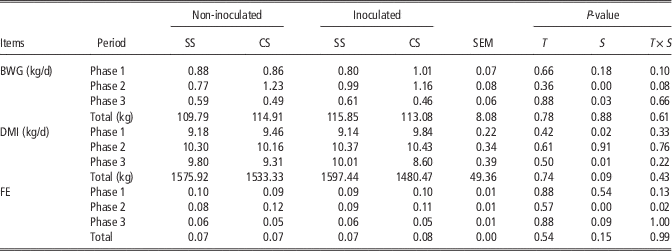
The periodical BW gain, DM intake and feed efficiency of beef cattle offered alternative silages in a finishing ration are summarized in Table 3. The average daily weight gain of cattle fed CS was higher (P<0.01) than that of cattle fed SS in phase 2, and reverse in phase 3 (P<0.05) . The cattle fed CS had a higher (P<0.05) daily feed intake than those fed SS during phase 1, and reverse in phase 3 (P<0.05). The cattle offered CS showed a higher feed efficiency (P<0.01) in phase 2 than those offered SS. The full-period growth performance of cattle offered CS or SS was similar (P>0.05) and silage inoculant exerted no significant effect (P>0.05) on all the monitored parameters of growth performance with little interaction (P>0.05) between inoculated treatment and silage material. In addition, calculating with the data of growth performance, the cattle fed CS had higher metabolizable energy (ME) and protein (MP) intake than those fed SS in phases 1 and 2, the cattle fed inoculated CS had the lowest intake of ME and MP relative to the other three groups in phase 3, and non-inoculated CS group showed the most intake of energy and protein in the whole period.
Growth performance of beef cattle offered alternative silages in finishing rations

SS=corn stalk silage; CS=corn silage; T=inoculated treatment; S=silage type; T×S=interaction between inoculated treatment and silage type; BWG=BW gain; DMI=dry matter intake; FE=feed efficiency (BWG/DMI).
Carcass performance of beef cattle
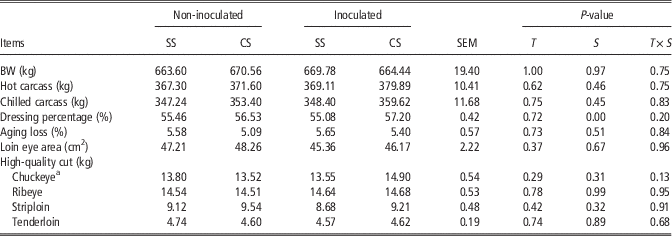
The final BW, hot carcass weight, chilled carcass weight, dressing percentage, aging loss, loin eye area and high-quality cuts weight (chuckeye, ribeye, striploin and tenderloin) are showed in Table 4. No significant differences were found in different inoculated treatments or silage materials (P>0.05) except that the cattle fed CS showed a higher (P<0.01) dressing percentage than those fed SS.
Carcass traits of beef cattle offered alternative silages in finishing rations

SS=corn stalk silage; CS=corn silage; T=inoculated treatment; S=silage type; T×S=interaction between inoculated treatment and silage type.
a Chuckeye: the 1st to 5th rib longissimus muscle, followed with ribeye at 5th to 6th rib.
Nutrient values of beef muscle
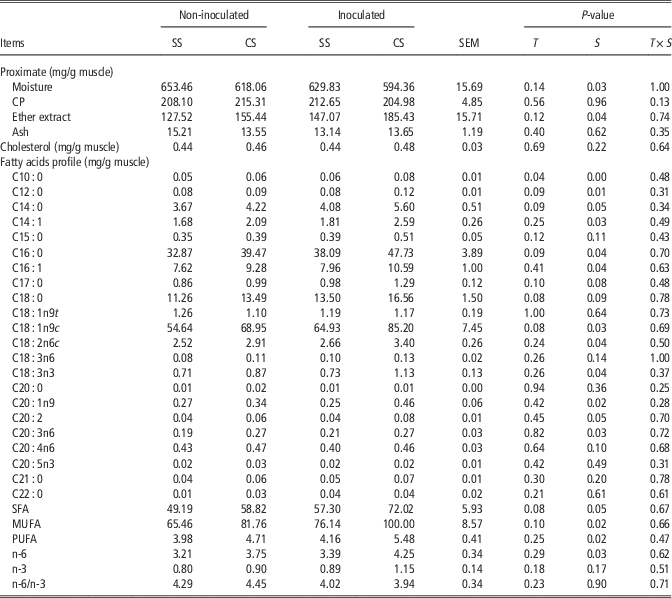
The proximates (moisture, CP, ether extract (EE) and ash), cholesterol content and fatty acids profile of the muscle in animals offered alternative silages in finishing rations are covered in Table 5. Moisture content was found to be lower (P<0.05) in the beef muscle of animals offered CS relative to those offered SS, whereas it was inverse as for EE content (P<0.05). Inoculated treatment made no difference (P>0.05) on the proximate components of beef muscle, neither was there an interaction (P>0.05) between inoculated treatment and silage material. There was no difference (P>0.05) in cholesterol content among different treatments. As to fatty acids profile, the contents (mg/g muscle) of C10 : 0, C12 : 0, C14 : 1, C16 : 0, C16 : 1, C18 : 1n9c, C18 : 2n6c, C18 : 3n3, C20 : 1n9, C20 : 2, C20 : 3n6, saturated fatty acids (SFA), monounsaturated fatty acids (MUFA), polyunsaturated fatty acids (PUFA) and n-6 fatty acids were higher (P<0.05) in the beef muscle of animals offered CS than those offered SS, whereas fatty acids profile was not affected (P>0.05) by the inoculated treatment.
Proximates, cholesterol content and fatty acids profile of beef muscle from cattle offered alternative silages in finishing rations

SS=corn stalk silage; CS=corn silage; T=inoculated treatment; S=silage type; T×S=interaction between inoculated treatment and silage type; SFA=saturated fatty acids; MUFA=monounsaturated fatty acids; PUFA=polyunsaturated fatty acids.
Meat quality traits of beef muscle
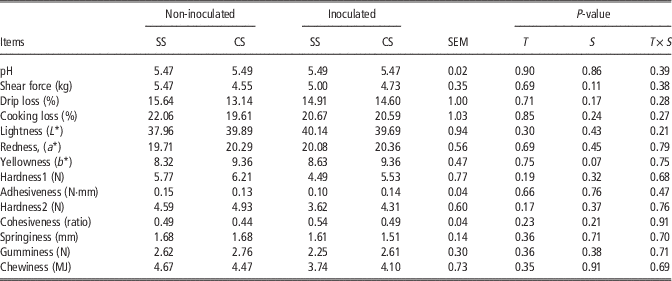
The pH, shear force, drip loss and cooking loss, color (L*, a* and b*) and texture profile (hardness, adhesiveness, cohesiveness, springiness, gumminess and chewiness) are measured to evaluate beef quality (Table 6). Neither inoculated treatment nor silage material exerted a significant effect on the measured parameters concerning meat quality of beef muscle (P>0.05).
Meat quality of beef muscle from cattle offered alternative silages in finishing rations

SS=corn stalk silage; CS=corn silage; T=inoculated treatment; S=silage type; T×S=interaction between inoculated treatment and silage type.
Oxidative stability
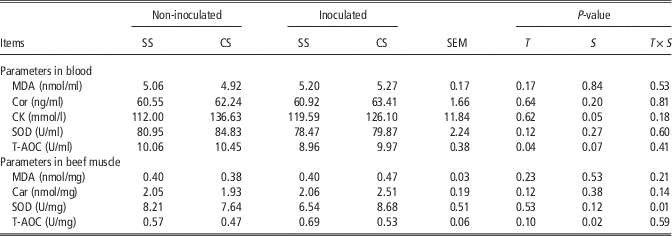
The parameters including MDA, Cor, CK, SOD, T-AOC and Car in blood/muscle that indicate oxidative status are presented in Table 7. The cattle fed CS developed higher blood CK (P=0.05) and T-AOC (P=0.07) concentrations along with a lower (P<0.05) muscular T-AOC concentration than those fed SS; inoculated treatment of silage decreased (P<0.05) the blood T-AOC concentration of beef cattle, and the interaction between inoculated treatment and silage material showed a significant effect (P<0.05) on muscular SOD concentration, where the cattle fed SS had a higher muscular SOD concentration than those fed CS for non-inoculated silage, and it was reverse for inoculated silage.
Oxidative stability of beef cattle offered alternative silages in finishing rations

SS=corn stalk silage; CS=corn silage; T=inoculated treatment; S=silage type; T×S=interaction between inoculated treatment and silage type; MDA=malondialdehyde; Cor=cortisol; CK=creatine kinase; SOD=superoxide dismutase; T-AOC=total antioxidative capacity; Car=carbonyl.
Discussion
Growth performance of beef cattle
Generally, it is believed that increasing dietary concentrate level would contribute to improved animal performance and substituting SS with CS in a ration would increase dietary energy level because of the additional corn. But note that there should be a break-point that concentrate increase would not anymore exert a positive effect on animal performance as high concentrate level would have a disappointing effect on the dietary digestibility, especially fiber digestibility. Russell et al. (Reference Waghorn, Shelton and Thomas2016) reported that supplementing soybean hulls diets with corn can increase dietary energy concentration, but corn inclusion in fiber-based diets negatively affected fiber digestibility (Faulkner et al., Reference Faulkner, Hummel, Buskirk, Berger, Parrett and Cmarik1994; Garcés Yépez et al., Reference Garcés Yépez, Kunkle, Bates, Moore, Thatcher and Sollenberger1997), the optimal corn inclusion for growth and diet utilization of beef cattle fell between 0.4% and 0.2% BW corn supplementation. In the present study, compared with SS, cattle fed CS showed no advantage on growth performance over the feeding trial despite the higher ME and MP intake of the cattle fed CS. Similarly, Dawson (Reference Dawson2012) reported that forage type (lupins/triticale silage and grass silage) had no effect on live weight gain, carcass gain or feed efficiency. Kirkland and Patterson (Reference Kirkland and Patterson2006) observed that including CS along with grass silage increased feed intake, whereas there was no effect on live weight gain. Dewhurst et al. (Reference Dewhurst, Delaby, Moloney, Boland and Lewis2009) reported that ruminants consuming legumes had higher intakes relative to those consuming grass forage and attributed this to faster rates of fermentation and more rapid particle breakdown and clearance from the rumen (Waghorn et al., Reference Walsh, O’Kiely, Moloney and Boland1989; Beever and Thorp, Reference Beever and Thorp1996). Moreover, there is evidence to suggest that there is a synergistic effect when a mixture of grass silage and whole-crop cereal silage are offered together relative to either of the silages offered alone (O’Kiely and Moloney, Reference O’Mara, Fitzgerald, Murphy and Rath2002; Keady et al., Reference Keady, Lively, Kilpatrick and Moss2007; Rondahl et al., Reference Rule, MacNeil and Short2007). Benton et al. (Reference Benton, Watson, Erickson, Klopfenstein, Pol, Meyer and Greenquist2015) reported that corn stalk resulted in better performance than alfalfa or CS when included in a low level in beef finishing diets with 30% wet distillers’ grains with solubles, which was owed to the stimulation of physically effective NDF. Proper physical stimulation plays an important role in dietary nutrition. The different rates of fermentation and clearance from rumen might cancel out the effect of different nutrient values of silages, consequently leading to similar animal performance.
In the current study, LAB inoculant in silage did not show an improved effect on animal performance as hypothesized. Bayatkouhsar et al. (Reference Bayatkouhsar, Tahmasebi and Naserian2011) reported that microbial inoculation of CS had no significant effect on milk compositions, milk yield and 4% fat corrected milk production. Inconsistently, Nkosi et al. (Reference Nkosi, Meeske, Palic, Langa, Leeuw and Groenewald2009) showed that improved lamb performance occurred when inoculated whole-crop CS was fed. The discrepancy in different studies might be attributed to the differences of microbial inoculants, silage materials and animals, etc.
Carcass performance of beef cattle
In the present study, no significant difference was found on the carcass traits of beef cattle fed alternative silages except that a higher dressing percentage was found in the cattle fed CS relative to those fed SS, that is, different nutrient intakes (e.g. ME, MP) could not show an effect on the carcass performance yet, well coinciding with the growth performance. The difference in dressing percentage should be primarily attributed to the higher feed intake and greater gut fill in phase 3 of the cattle fed SS relative to those fed CS, which resulted in a higher percentage of rumen content relative to live BW. There are scarce reports available where the effects of CS compared with SS on the carcass traits of finishing cattle have been examined. Similarly, Pesonen et al. (Reference Rondahl, Bertilsson and Martinsson2014) observed no difference in carcass weight, dressing proportion and carcass conformation for growing and finishing bulls fed either pure timothy or mixed timothy and red clover silage. Lee et al. (Reference Lee, Evans, Nute, Richardson and Scollan2009) reported no difference between feeding treatments in slaughter weight or carcass conformation when dairy cull cows were offered either grass or red clover silage. The study of Walsh et al. (Reference Weinberg, Muck and Weimer2008) showed that no major differences were observed in carcass conformation of cattle consuming maize silage, whole-crop cereals or concentrates.
Nutrient values of beef muscle
Generally, moisture, protein, fat, mineral and vitamin are the most commonly mentioned nutritional components of beef muscle, and the contents of moisture, protein and fat in muscle are closely correlated and determine the sensory quality of beef. Moreover, owing to their implications in human health, fatty acids profile and cholesterol in meat have received increasing attention over the last decades and have been regarded as important indicators of meat quality. Much research indicates that cholesterol is a risk factor for the development of heart problems (Bartoň et al., Reference Bartoň, Marounek, Kudrna, Bureš and Zahradkova2007) and consumption of more n-3 fatty acids and fewer SFA can reduce the risk of developing cardiovascular diseases (Hu et al., Reference Hu, Manson and Willett2001). World Health Organization (2003) reported that maximizing the PUFA proportion, particularly n-3 PUFA proportion of beef lipids would enhance the nutritional value of beef. In the current study, the cattle offered CS had a higher intramuscular fat proportion and a lower moisture content of beef muscle than those offered SS along with higher contents of C10 : 0, C12 : 0, C14 : 1, C16 : 0, C16 : 1, C18 : 1n9c, C18 : 2n6c, C18 : 3n3, C20 : 1n9, C20 : 2, C20 : 3n6, SFA, MUFA, PUFA and n-6 fatty acids. The difference should be ascribed to the different intakes of ME and MP as more energy intake would contribute to lipid deposition, which would contribute to better marbling score and more tender beef. Higher intramuscular fat content resulted in lower moisture proportion because of the hydrophobicity of lipids as well as higher contents of most individual fatty acids. Similarly, Moloney et al. (Reference Moloney, Mooney, Kerry, Stanton and O’Kiely2013) reported that the alternative forages (CS and whole-crop wheat silage) to grass silage decreased the n-3 PUFA proportion and increased the linoleic/α-linolenic acid ratio in intramuscular lipid, and owed the difference to the lower intake of n-3 fatty acids. Barton et al. (Reference Barton, Bures and Kudrna2010) reported that the alternative forages to grass silage increased the n-6/n-3 PUFA ratio of intramuscular lipid. It is reported that beef from cattle fed on a grass-based ration had a higher proportion of n-3 PUFA and CLA in intramuscular lipids relative to those fed on concentrates (French et al., Reference French, Stanton, Lawless, O’Riordan, Monahan, Caffrey and Moloney2000). CS was usually considered as partial concentrate and expected to exert a concentrate-like effect on the fatty acids profile of beef muscle, whereas there was no marked detrimental effect found in the present study. The discrepancy between different studies could partially owe to the difference of expression basis for fatty acids contents and the rations. By the way, the different percentage of muscle fat could explain why the weight gain and carcass weight of beef cattle showed no difference under the condition of different intakes of ME and MP as the synthetic efficiencies of fat and protein are quite different. It is noteworthy that nutritional background was not the only factor dictating cholesterol concentration in muscle (Miller et al., Reference Miller, Masor and Riley1981) and altering the cholesterol concentration of muscle may require a marked redistribution of phospholipids in cells as well as marked changes in unsaturation of the membrane fatty acids (Rule et al., Reference Russell, Sexten and Kerley1997). In addition, inoculated treatment had little effect on the nutritional components of beef muscle.
Meat quality traits of beef muscle
In general, sensory quality in meat science is mainly referred to the aspects of meat color, tenderness, flavor and juiciness, which would greatly dictate consumers’ purchasing desires and eating feelings. Meat color is an important factor impacting on consumer purchase, constituting the main criterion for the choice of meat. In the present study, there were no differences found on the meat color of cattle offered alternative silages except that CS tended to increase the yellowness of beef muscle relative to SS. The yellowness probably resulted from the differences in carotenoid concentrations of CS and SS, which was potentially negative to ‘white’ fat carcass production. Similarly, Juniper et al. (Reference Juniper, Browne, Fisher, Bryant, Nute and Beever2005) reported no difference in muscle color when grass silage was replaced by increasing amounts of maize silage in the diet of beef steers. Dawson (Reference Dawson2012) and Keady et al. (Reference Keady, Gordon and Moss2013) detected no difference in muscle color or aspect of palatability when grass silage was replaced with maize silage. Given that moisture and intramuscular fat contents were significantly different between the treatments and generally intramuscular fat was positively correlated to the tenderness and water holding capacity of beef muscle, it was expected that shear force and water holding capacity of beef muscle would be dissimilar. Consistently, Dewhurst et al. (Reference Dewhurst, Delaby, Moloney, Boland and Lewis2009) reported that there was little evidence that forage type influenced muscle tenderness. Texture profile analysis is created as an imitative test, resembling what goes on in human mouth, which can be an excellent substitution for taste panel test, giving an overview of muscle texture profile. The present results showed that the dietary treatments made no difference in meat texture profile. In addition, inoculated treatment hardly improved the beef quality. Moloney et al. (Reference Moloney, Mooney, Kerry, Stanton and O’Kiely2013) concluded that there was little different between types of silage in terms of the color, tenderness, juiciness and acceptability of beef muscle as well as its nutritional quality, and the effects on the fatty acids composition of intramuscular lipids were too small to be of commercial significance.
Oxidative stability of beef cattle
Oxidative stability is one of the most important determinants in shelf life of meat food (Kochhar and Henry, Reference Kochhar and Henry2009), well reflecting the extent of potential harvest stress, which could be affected by breed, dietary factors and pre-slaughter procedures. Generally, there are several parameters such as SOD, T-AOC, CK and Cor in blood/muscle selected to detect the antioxidant capacity and stress status. It is well known that MDA is an end-product of lipids peroxidation, generally used as an indicator of lipids peroxidation (Jain, Reference Jain1984) and protein Car is a marker of protein that has suffered from oxidative modification by free radicals. Measuring the extent of lipids oxidation and protein oxidative modification is a common way to evaluate the body oxidation damage. In the present study, compared with SS, the cattle fed CS developed a higher blood T-AOC concentration, which indicated a better potential to scavenge free radicals and recover the impaired tissue, and its lower muscular T-AOC concentration inferred weaker stress suffering. In addition, inoculated silage decreased the blood T-AOC concentration. The ingestion of different rations may be the cause as it is reported that deficiency of antioxidative nutrients such as vitamin E, vitamin C, Se, Cu could result in a low SOD level.
Conclusions
Over a 24-week fattening period, substituting SS with CS in a finishing ration could not improve the growth performance, carcass trait and antioxidant capacity of beef cattle and beef quality but only contribute to better intramuscular fat deposition and higher composition of many individual fatty acids, which might improve marbling score of beef muscle. In addition, inoculated silage showed no advantage on the performance of beef cattle relative to non-inoculated silage. The collective findings suggest that it is not economical to substitute high-quality forage for relative low-quality forage in a high-concentrate finishing ration, and silage inoculant could not exert a direct effect on animal performance.
Acknowledgments
This work was supported by grants from the Special Fund for Agro-scientific Research in the Public Interest (201503134), the China Agricultural Research System (CARS-38), Integration of Technology in Corn Silage Processing & Feeding (21175052), and supported by State Key Laboratory of Animal Nutrition, China Agricultural University.