Introduction
Previous research on the grammar of English has led to the development of a number of useful reference books (e.g. Quirk et al., Reference Quirk, Greenbaum, Leech and Svartvik1985; Biber et al., Reference Biber, Johansson, Leech, Conrad and Finegan1999; Huddleston & Pullum, Reference Huddleston and Pullum2002; Berry, Reference Berry2012), which have substantially contributed to the teaching and learning of English language in EFL contexts. However, I found that from an (advanced) EFL learner's perspective, EFL learners are often left to our own choices when we want to express a specific meaning in spoken and/or written communication, such as acknowledgement-making for example (Hyland & Tse, Reference Hyland and Tse2004). One major reason for this is that these reference books have mainly focused on discussing issues such as word classes, types of clauses, tense and aspects, etc. They have not attempted to document systematically the lexicogrammatical means by which specific meanings can be expressed, though they do have selectively described some. This stimulated me to think whether it is possible to develop, what I tentatively call, a meaning -based grammar of English, i.e. a grammar which is primarily concerned with meanings and their typical lexicogrammatical realisations.
This paper reports on an ongoing projectFootnote 1 which explores the possibility of developing such a grammar, aiming to address the issue raised above. For clarity's sake, meaning here is used as an equivalent to function, referring to discoursal or pragmatic functions, such as apology or evaluation, that language fulfills in social contexts. As Dickins and Woods (Reference Dickins and Woods1988: 630) note, ‘[w]ith grammar, we are concerned with how we make up the message we are communicating, not simply in terms of forms and structures, but in terms of meaning’. Therefore, grammar in this study is defined not as prescriptive structural or organising principles governing how words are combined to produce grammatically well-formed phrases or sentences, but as a repertoire of lexicogrammatical resources which can be used to inform language users, EFL learners in particular, of the ways to express and convey meanings in communication.
The project draws on insights from pattern grammar and the burgeoning local grammar research. Specifically, it uses a pattern-based approach to develop local grammars and argues that the local grammars developed in turn contribute to a meaning-based grammar of English.
Pattern grammar and local grammar
Pattern grammar is an approach to the description of the English language which prioritises the behaviour of individual words (Hunston & Francis, Reference Hunston and Francis2000). Two major observations drawn from pattern grammar research are that lexis and grammar are inseparable and that patterns and meanings are associated. A good example to illustrate the first observation is the phrase want to. While the word want often co-occurs with a to-infinitive clause, an agreement can hardly be reached about ‘whether this is a fact about lexis (the collocation of want and to) or a fact about grammar (the distribution of to-infinitive clauses)’ (Hunston & Francis, Reference Hunston and Francis2000: 251). Evidence supporting the second observation has been presented in many studies (e.g. Sinclair, Reference Sinclair1991; Hunston & Francis, Reference Hunston and Francis2000). One representative study is Francis, Hunston and Manning (Reference Francis, Hunston and Manning1996, Reference Francis, Hunston and Manning1998) in which the authors show that lexis occurring in each pattern can be divided into a (limited) set of meaning groups. Furthermore, in some cases it is even possible to argue that it is the pattern itself, not the words it has in it, which has the meaning. For example,
(1) It was big of you to take the risk.
(2) There is something almost American about the minister's informality.
Both big and American are normally not associated with evaluation. However, they can acquire evaluative meanings when used in specific patterns, as shown in examples (1) and (2). The two patterns, it v-link ADJ of n to-inf and there v-link something ADJ about, have been shown to be inherently evaluative (Hunston & Francis, Reference Hunston and Francis2000). In consequence, words co-occurring with them become evaluative because they have to keep in line with the meaning of the pattern. This clearly shows that patterns and meanings are associated. A further implication is that searching grammar patterns helps to identify meanings (see Hunston and Francis [2000] for more discussion).
The above discussion may remind some readers of construction grammar (Goldberg, Reference Goldberg1995, Reference Goldberg2006). While pattern grammar shares similar views with construction grammar (e.g. both reject the demarcation between syntax and lexis; both emphasise the association between form/pattern and function/meaning), they are quite different (cf. Hunston, Reference Hunston, Herbst, Schmid and Faulhaber2014). I discuss three differences here. First, pattern grammar is wholly descriptive and mainly aims to account for language patternings that are observable in actual language use. In other words, patterns are about language output only. By contrast, being a usage-based and a more theoretical approach, construction grammar is concerned with both the output and the mental representation or processing of such patternings. Second, constructions do not necessarily correspond to grammar patterns and each pattern may contribute to one or more constructions, as discussed in Hunston and Su (Reference Hunston and Su2017). Third, compared with grammar patterns, constructions are defined rather broadly – they can be general as well as specific, ranging from morphemes, words, to partially lexically filled and fully general phrasal patterns, and to grammatical structures such as ditransitive construction (Ellis, Reference Ellis, Hoffmann and Trousdale2013). Hunston and Su (Reference Hunston and Su2017) have noted that this multi-level approach of construction grammar is both a benefit and a disadvantage. Specifically, while construction grammar allows us to describe both lexis and grammar in a single model, ‘the number of potential constructions is vast, and a listing of them all seems an impossible task’ (Hunston & Su, Reference Hunston and Su2017: 4). In this paper I suggest that this makes it challenging to take a construction-based approach to develop local grammars and, further, the kind of meaning-based grammar proposed in the project.
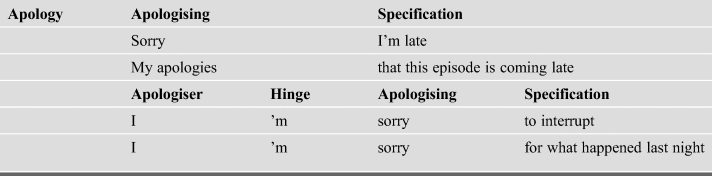
Turning now to local grammar. Briefly, local grammar is an alternative approach, as opposed to general grammars, to linguistic analysis and explanation. The object of local grammar research is not the whole of a language, but one meaning only (Hunston, Reference Hunston, Reppen, Fitzmaurice and Biber2002). It has been widely applied to deal with meanings, inter alia, evaluation (Hunston & Sinclair, Reference Hunston, Sinclair, Hunston and Thompson2000; Hunston & Su, Reference Hunston and Su2017), definition (Barnbrook, Reference Barnbrook2002), and request and thanking (Su, Reference Su2017, Reference Su2018). The defining feature of local grammar research, as shown in these studies, is that local grammars are primarily concerned with the pragmatic aspects of language in use and use functional labels, i.e. local grammar terminologies, to analyse corresponding formal elements. For the purpose of illustration, Table 1 provides examples of local grammar analyses of apology expressions.
Local grammar analyses of apology expressions (Su & Wei, Reference Su and Wei2018)

Table 1 shows that each syntactic unit which has a pragmatic meaning has been analysed using a term that is directly related to its discourse function (e.g. sorry is analysed as Apologising, I as Apologiser), which contributes to the delicacy of the description. It is also evident that the terms used in the analyses are context-specific and explicitly reflect the function of the element being analysed, thereby contributing to the transparency of the description. Furthermore, Su (Reference Su2017, Reference Su2018) and Hunston and Su (Reference Hunston and Su2017) have shown that each meaning can be adequately accounted for with a limited set of local grammar terminologies (e.g. Su [2017] shows that seven terminologies are adequate for the description of requests), which suggests that local grammar description also has the feature of adequacy. The observation that local grammar descriptions are delicate, transparent and adequate indicates that local grammars can be a valid alternative approach for describing English.
As noted above, local grammars use transparent and context-specific terms to analyse corresponding formal elements. Therefore, an essential step of local grammar research is the identification of appropriate terminologies. With regard to the identification of such terminologies, I tentatively propose two principles. One is termed the Principle of Transparency, which means that the terminologies used for a local grammar analysis should, first, be proposed within the specific context of the targeted meaning or function and, second, explicitly reflect the discoursal or pragmatic function of the element being analysed. In most cases, the selection of the terminologies can be justified by the meaning or function being examined (cf. Hunston & Su, Reference Hunston and Su2017: 6). The other principle is that of Economy, which is defined as the tendency to use a limited number of local grammar terminologies to achieve a relatively comprehensive description of language in use. An example to illustrate this is the label ‘Specification’ used in the local grammar analyses of apology (Su & Wei, Reference Su and Wei2018). ‘Specification’ was employed to analyse those elements which specify the offence for an apology. Types of offences, as discussed in Deutschmann (Reference Deutschmann2003: 64), can be related to accidents, talk/hearing offences, etc. One may of course give each of them a terminology in the analysis. However, the problem is that it would unnecessarily result in a large number of such terminologies and complicate the analysis. Conforming to the Principle of Economy allows the researcher to avoid this problem. Arguably, the two principles can usefully guide the identification of terminologies for local grammar analyses.
Because each local grammar is concerned with one meaning or function, previous studies on local grammars normally take one particular semantic or functional phenomenon as the starting point (e.g. Barnbrook, Reference Barnbrook2002; Cheng & Ching, Reference Cheng and Ching2018; Su, Reference Su2017, Reference Su2018). While these studies have been shown to be useful and valuable, especially in that they offer a systematic and specialised account of the targeted meaning/function, such studies have one major drawback, relating to systematicity and consistency. That is, because each of the aforementioned studies centres on one particular semantic or functional phenomenon, they only provide a local grammar of ‘this’ or ‘that’. This then raises the question as to how local grammars can be developed in a more systematic and principled manner. This paper, corroborating with Hunston's (Reference Hunston, Reppen, Fitzmaurice and Biber2002: 181) argument that grammar patterns ‘are an essential component of Local Grammars’, presents a pattern-based approach to developing local grammars.
A prerequisite for this approach to be successful is that a comprehensive list of language patternings is available. This excludes the option of taking constructions as the starting point to do so because there is as of yet no such list of constructions, as noted earlier. Grammar patterns, on the other hand, would be one candidate. The two volumes of the Grammar Pattern series (Francis et al., Reference Francis, Hunston and Manning1996, Reference Francis, Hunston and Manning1998) list approximately 90 verb patterns, 70 noun patterns, and 40 adjective patterns that are observed in the Bank of English (BoE). Given that language use is highly patterned (Sinclair, Reference Sinclair1991; Hunston & Francis, Reference Hunston and Francis2000) and pattern grammar is one effective approach to describing language patternings, it is arguable that these patterns have a broad coverage of language used in real contexts. Thus, the argument can be made that analysing all the grammar patterns identified in Francis et al. (Reference Francis, Hunston and Manning1996, Reference Francis, Hunston and Manning1998) from a local grammar perspective facilitates the development of local grammars.
The local grammars developed in turn contribute to the proposed meaning-based grammar of English. In other words, the meaning-based grammar of English proposed in this project comprises a set of local grammars. In addition to the practical justification mentioned at the very beginning of this paper, the rationale for doing this further relates to Butler's (Reference Butler2004: 158) argument that ‘rather than a single general grammar, we might end up with a set of local grammars for particular areas defined by their communicative functions in the discourse’.
Patterns, local grammars, and a meaning-based grammar of English
In this section I demonstrate the pattern-based approach to local grammars and further discuss how this can contribute to a meaning-based grammar for communication in English. Because of space constraints and the fact that the analytic procedure is replicable, only one verb pattern is analysed below: V n on n (Francis et al., Reference Francis, Hunston and Manning1996: 403–10). Before moving further on, it is necessary to note briefly the data and the selection of terminologies for the subsequent analysis. Although examples used in this paper are either taken from Francis et al. (Reference Francis, Hunston and Manning1996) or BoE, I also consider examples from more modern language corpora in the project. The selection of local grammar terminologies for the analyses is justified by the meaning or function being analysed, as discussed in the Pattern grammar and local grammar section. Therefore, I do not explain the terminologies used in each analysis unless it is necessary.
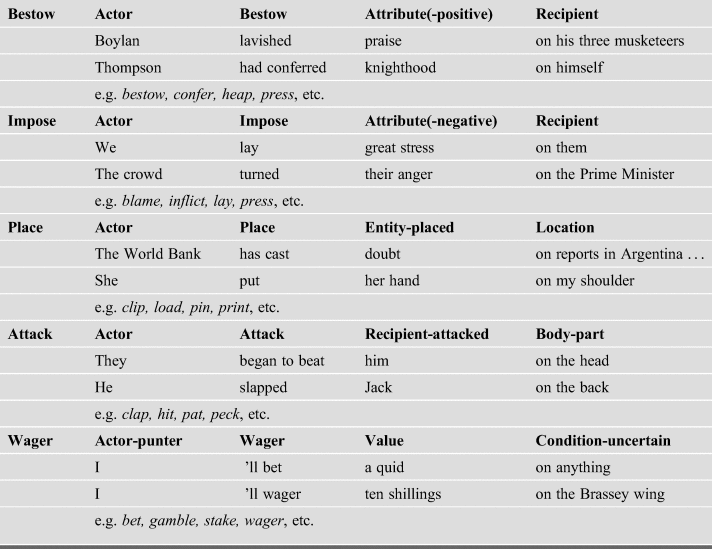
Concordance analyses suggest that verbs occurring in the pattern V n on n can be generally divided into those which construe actions (e.g. ‘Give’, ‘Place’) and those which construe communication (e.g. ‘Inform’, ‘Information-seeking’), which are discussed in turn. For verbs construing actions, I tentatively used Actor to label the ‘doer’. These verbs are used to construe several meanings, i.e. 1) an Actor bestows an Attribute to the Recipient; 2) an Actor imposes something, usually unpleasant, on the Recipient; 3) an Actor places an entity, either material or abstract, on a Location; 4) an Actor attacks someone on a particular part of her/his body; and 5) an Actor wagers something valuable on an uncertain condition. Table 2 presents examples of the analyses. A point worth noting here is that verbs are selectively, rather than exhaustively, listed to illustrate each meaning group.
Local grammar analyses of instances with the meaning ‘action’
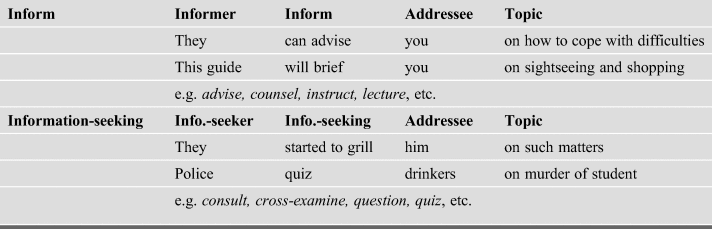
Verbs associated with the meaning of communication can be further divided into three groups. These include: 1) verbs which indicate an Informer informs the Addressee something on a particular topic or subject, and 2) verbs which are concerned with seeking information from the Addressee, as shown in Table 3.
Local grammar analyses of instances with the meaning ‘communication’

The other group of verbs, though also concerned with communication, conveys evaluative meanings. These verbs indicate an evaluator makes an evaluation (usually positive) about the Target. The prepositional phrase following the pronoun often specifies the ‘things’ based on which the evaluation is made (Table 4).
Local grammar analyses of instances with the meaning ‘Evaluation’

The analyses presented above, though preliminary, should have demonstrated the possibility and feasibility of using grammar patterns as the input to develop local grammars. The analyses of the pattern V n on n suggest eight meaning groups, contributing to eight local grammars. While this might indicate that the proposed approach would result in a very large number of local grammars, the reality may not be so. It is very likely that a number of overlapping meaning groups across patterns would have been found if more patterns had been analysed. Adjective complementation patterns, for example, have been shown to be predominantly associated with evaluation (Hunston & Su, Reference Hunston and Su2017). This suggests that the analyses of grammar patterns listed in Francis et al. (Reference Francis, Hunston and Manning1996, Reference Francis, Hunston and Manning1998) would result in a manageable number of local grammars. These local grammars, each defined by a specific meaning, are the main components of the kind of meaning-based grammar to be developed in the project.
While this is clearly a different way of doing grammar, it is these differences that make it arguable that the resulting meaning-based grammar can be supplementary to traditional approaches to the grammar of English language. It is supplementary in the sense that, while traditional approaches to English grammar help learners develop their grammatical competence, acquiring necessary grammatical rules, the proposed meaning-based grammar contributes substantially to learners’ communicative competence, so that they know how to express specific meanings in an appropriate and native-like way.
Furthermore, the analyses have also shown that local grammars allow the researcher to analyse each syntactic unit using a term that is directly related to its discursive or pragmatic meaning and as such go much further than the form-meaning mapping suggested in construction grammar (see also Hunston and Su [2017] for further discussion). The kind of analysis proposed might instead appear to be more reminiscent of FrameNet (Fillmore & Atkins, Reference Fillmore, Atkins, Lehrer and Kittay1992; Baker, Reference Baker2012). However, the difference is that FrameNet starts with the analyses of individual words and then groups together words which have similar meaning or share the same frame whereas the proposed approach starts with patterns identified in Francis et al. (Reference Francis, Hunston and Manning1996, Reference Francis, Hunston and Manning1998). Since there is a really large number of individual words, it would be extremely challenging to analyse them all. In contrast, since a relatively limited number of grammar patterns have been identified so far (approximately 200), analysing all the patterns and then developing a meaning-based inventory for communication in English appears to be a more practical approach.
The kind of grammar proposed in this project has two noteworthy features. First, the grammar built upon local grammars is more systematic and transparent than other approaches are. This is because each local grammar offers a specialised description of the targeted meaning or function, thereby contributing to the systematicity and transparency of linguistic analysis and explanation. To be specific, local grammar descriptions are systematic because each local grammar accounts for only the targeted meaning or function within its specific context, and they are transparent because each utterance unit is analysed using a term that is directly related to its discursive or communicative function (Hunston & Sinclair, Reference Hunston, Sinclair, Hunston and Thompson2000; Butler, Reference Butler2004).
Second, the proposed meaning-based grammar captures both the lexicogrammatical realisations and the corresponding semantico-pragmatic patterns of each meaning, as shown in the analyses above. This further has pedagogical applications, especially given that such a grammar contributes substantially to developing and expanding EFL learners’ repertoire of linguistic choices available to express specific meanings in communication (Su, Reference Su2017, Reference Su2018). Furthermore, because the elements used in local grammar descriptions are (more) transparent and context-specific, they can be more useful than elements of a general grammar, especially in the context of EFL teaching (Hunston, Reference Hunston, Reppen, Fitzmaurice and Biber2002). In the case of ‘Inform’, it is more practical to know, for example, an element whose function is to indicate the source of a message as ‘Informer’ than as ‘Subject’.
At this point, a more general issue might be worth further discussing, relating to the balance between the generality and specificity of grammar. A grammar is supposed to be a generalised description that is able to account for language used in different contexts. However, as indicated above, local grammars resist this kind of generalisation, but prioritise specificity, i.e. each local grammar deals with language used in one particular semantic or pragmatic domain. Nevertheless, as Hunston and Thompson (Reference Hunston and Thompson2000: 74) note, ‘the loss of generalizability is compensated for by the gains in qualities such as accuracy, transparency, and cumulative coverage’. Thus, developing local grammars, with each accounting for one meaning or function, is a valuable enterprise.
Conclusion
In this paper I report on a project which adopts a rather different approach to the grammar of the English language. The proposed approach brings together pattern grammar and local grammar research to develop a meaning-based grammar for communication in English, i.e. a grammar which is primarily concerned with the ways meanings can be expressed in social contexts. I have shown that taking grammar patterns as the starting point allows us to develop local grammars in a more systematic and principled manner and that the local grammars developed in turn contribute to a meaning-based grammar of English.
The kind of grammar to be developed in the project could have significant pedagogical applications, because it provides language users with a repertoire of lexicogrammatical resources by which meanings are typically expressed in English, as noted above. In the English as lingua franca context, a large population are learning English and most of them have, more or less, difficulties expressing and conveying meanings in English in an appropriate and native-like way. In consequence, it is necessary and important to equip EFL learners with resources that can help to improve their communicative competence. The kind of research reported in this paper is one possible candidate, which alone would suffice to indicate the significance and desirability to continue with and disseminate this research.
 HANG SU is a professorial research fellow at Sichuan International Studies University, Chongqing, China. His research interests include corpus linguistics, systemic functional linguistics, and discourse analysis. His recent publications have appeared in, for example, Applied Linguistics, Journal of Pragmatics, Pragmatics, and Language Resources and Evaluation. Email: suhangunique@hotmail.com