I. INTRODUCTION
In recent years, the high-temperature self-lubricating metal matrix composite coatings have a wide and promising applications in several fields, such as auto-motive, nuclear power industries and aerospace. Reference Gallo and Berto1–Reference Li, Gao, Jia, Han, Guo and Wang6 NiAl intermetallic compounds are considered to be the promising materials for high temperature applications due to the high melting point (T m = 1638 °C), high thermal conductivity, as well as excellent oxidation and corrosion resistence at high temperature. Reference Shi, Wang, Zhai, Zhu, Xu, Zhang, Song, Yao and Din7–Reference Shi, Zhai, Wang, Xu, Yao, Song, Qamarud Din and Zhang11 Graphite and molybdenum disulfide usually act as solid lubricants to improve the tribological properties of the composities. Reference Liu, Wang, Gao and Jia2,Reference Aouadi, Paudel, Simonson, Ge, Kohli, Muratore and Voevodin12–Reference Voevodin, Muratore and Aouadi15 However, these solid lubricants would be oxidized or decomposed in air and lose their lubricating effects above 500 °C. Reference Liu, Wang, Gao and Jia2 It is essential to search efficient lubricants for high-temperature self-lubricating coating in wide temperature range. Reference Liu, Wang, Gao and Jia2 Silver could decrease the friction coefficients and wear rates of composites and provide the excellent lubrication below 400 °C due to a large diffusion coefficient and low shear strength on the worn surface in the process of sliding. Reference An, Chen, Hou, Zhao, Zhou, Chen and Yan16–Reference Akbi, Bouchou and Zouache20 H. Zhou et al. Reference An, Chen, Hou, Zhao, Zhou, Chen and Yan16 prepared the NiMoAl–Cr3C2–Ag composite coatings by high velocity oxy-fuel (HVOF) spraying and demonstrated that the incorporation of silver could effectively improve the tribological properties of composite coatings. In recent years, due to the excellent lubrication performance in wide temperature range, Ag–Mo dual-lubricant has been investigated by several researchers. Reference Kong, Zhu, Qiao, Yang, Bi and Liu21–Reference Chen, An, Yang, Zhao, Yan, Zhou and Chen24 J. Chen et al. Reference Chen, An, Yang, Zhao, Yan, Zhou and Chen24 fabricated the adaptive NiCrAlY–Ag–Mo composite coatings using atmospheric plasma spraying technique, which presented prominent lubricating properties at the wide range of temperature. But three components of composite coatings were great disadvantages to the adhesive strength of the coating and the coating had bad cohesion with the substrate. The adhesive strength is an important performance for plasma-sprayed coatings. To insure the adhesive strength of the coatings, several researchers applied the bond coating between the coating and substrate and also investigated the effect of bond coating on the adhesion of composite coatings. Reference Zhang, Wang, Xu and Zhang25–Reference Daroonparvar, Hussain and Yajid30 F. Ghadami et al. Reference Ghadami, Sohi and Ghadami29 researched the effect of bond coating on the adhesive strength of atmospheric plasma spraying WC–Co coatings. The results manifested that applying bond coating could effectively improve the adhesive strength of WC–Co coatings, which could be due to the decreasing interfacial porosities. In recent years, several methods are used to fabricate the composite coatings such as mechanical alloying, Reference Canakci, Erdemir, Varol, Dalmıs and Ozkaya31 plasma spraying, Reference Chen, An, Yang, Zhao, Yan, Zhou and Chen24,Reference Zhang, Wang, Xu and Zhang25 cladding, Reference Yu, Zhou, Ren, Wang, Xin and Cao32 CVD and PVD. Reference Thakur and Gangopadhyay33,Reference Śliwa, Mikuła, Golombek, Tański, Kwaśny, Bonek and Brytan34 In contrast with other methods, plasma spraying shows several distinguished advantages, such as low heat input, reduced cost and high processing speed. Reference Chen, An, Yang, Zhao, Yan, Zhou and Chen24,Reference Yang, Chen, Wang, Chu, Liu, Dong, Yan, Zhang, He and Wang35
In present work, we investigate the mechanical properties and tribological properties of NiAl matrix composite coatings containing silver and molybdenum for wide temperature range application. The NiAl powder is applied as bond coating. The atmospheric plasma spraying technique was used to fabricate the composite coatings. The tribological properties of composite coatings are researched against Al2O3 ceramic ball at all test temperatures. In this composite coating, Cr2O3 acts as a reinforced phase which has the high hardness and excellent wear resistance at high temperature.
II. MATERIALS AND METHODS
A. Material preparation
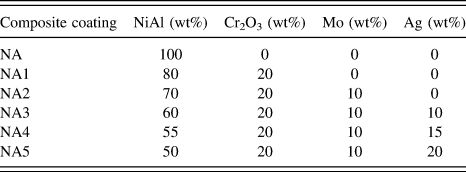
The NiAl matrix seif-lubricating composite coatings were fabricated by atmospheric plasma spraying (Sulzer Metco 9M, Winterthur, Switzerland). The feedstock powders of NiAl, Cr2O3 and Mo were gained from Sulzer Metco. The Ag powder was obtained from Beijing Research Institute of Mining & Metallurgy (Beijing, China). The morphologies of powders of NiAl, Cr2O3, Ag and Mo were presented in Fig. S1. The NiAl, Mo and Ag powders were the spherical shape and the size were about 50–100 μm. The Cr2O3 was prepared by sintering and crushing. The powder was angular shape with the size of 20–90 μm. All feedstock powders were mixed mechanically using three-dimensional mixing apparatus before spraying. The duration time was 10 min and all powders mixed uniformity (Fig. S2). The substrate (Inconel 718 alloys) was sand blasted with corundum grits and then cleaned by ultrasonic cleaner with acetone. The compositions of each composite coating were shown in Table I. The thickness of coating was about 0.3 mm. The spray parameters useded were: H2 flow rate was 5 L/min; Ar flow rate was 40 L/min; power feed rate was 40 g/min; current was 500 A and voltage was 60 V.
Composition of composite coatings.

B. Characterization
The microhardness of the coatings were measured by microhardness tester (MH-5-VM) and load was 300 g and dwell time was 5 s. The measure was repeated at least ten times for all samples and the average value was carried out and listed in Table II. The adhesive strength of composite coatings were tested corresponding with the standard of ASTM C633. The diameter was 25.4 mm (1 inch) for samples. The speed was 0.5 mm/min. Each kind of specimen was gauged at least five times and the average value was worked out. The porosity of the coating was measured with an image analyser. The microstructures of the composite coatings were characterized using field emission scanning electron microscopy (FE-SEM; Tescan Mira 3, Tescan, Brno, Czech Republic) and high resolution transmission electron microscope (HRTEM; FEI Tecnai G2 F30, FEI Company, Hillsboro, Oregon). The composition and structures of composite coatings were confirmed by X-ray diffractometer (Philips X’Pert-MRD, PANalytical B.V., Almelo, The Netherlands) with Cu-Kα radiation and the angular range was 20–90°. The operating voltage was 40 kV and the scan speed was 10° min−1. The micro-Raman (Czemy-Turner Labram HR800, Horiba Jobin Yvon, Paris, France) was used to study the phase compositions of worn surface and the wave length of laser light was 532 nm. The processes of friction and wear tests have been described in details elsewhere. Reference Li, Gao, Jia, Han, Guo and Wang6
Vickers hardness of composite coatings.

III. RESULTS AND DISCUSSION
A. Mechanical properties and microstructure of composite coatings
Table II presents the microhardness of NiAl matrix composite coatings. It can be seen that the Vickers hardness of composite coatings are improved by the addition of Cr2O3 and Mo phases and then deteriorated with the increasing of silver contents. This result is due to the soft metal of silver decreases the Vickers hardness of composite coatings.
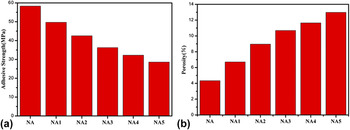
The adhesive strength is an important performance for plasma-sprayed coatings. To improve the adhesive strength of composite coatings, NiAl is used to the bond coating. Figure 1 displays the adhesive strength and porosity of composite coatings. The adhesive strength of composite coatings are deteriorated with the addition of Cr2O3, Ag and Mo [Fig. 1(a)]. The adhesive strength of composite coating often lowers the bond of substrate-coating. Reference Dellacorte and Edmonds36 The detachment occurs in the coating for all coatings. It is probably due to the four components of NiAl, Cr2O3, Mo and Ag in the composite coatings, which is a great disadvantage to the adhesive strength of composite coatings. The porosity of composite coatings are increased with the addition of Cr2O3, Ag and Mo [Fig. 1(b)]. The NA coating holds the lowest porosity of 4.3%. The reason may be that the addition of Cr2O3, Ag and Mo increase the pores of composite coatings.
Adhesive strength and porosity of composite coatings.

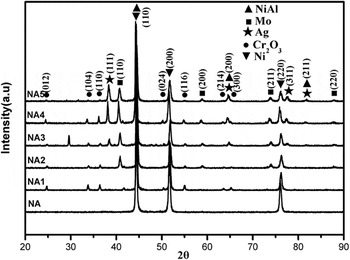
The XRD patterns of NiAl matrix composite coatings are shown in Fig. 2. It is obvious that the NiAl phase (JCPDS file no. 20-0019) is the main component in all composite coatings. The diffraction peaks of Cr2O3 (JCPDS file no. 38-1479) and single-phase Mo (JCPDS file no. 42-1120) and Ag (JCPDS file no. 04-0783) are exist in the XRD spectrum, which indicate that spray powders have been successfully deposited in the composite coatings and the Mo and Ag can’t be alloyed in NiAl through spraying process. The diffraction peaks of Ag phase become more evident from coating NA3 to NA5, which indicates that the components of spray powders and the as-sprayed coatings have a good coincidence.
XRD patterns of composite coatings.

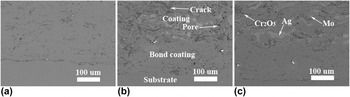
Before tribological tests, the surfaces of samples are polished by 100, 400, 600, 800 and 1000 grit emery paper and burnished by flannel. The surfaces of composite coatings are smooth and have no scratches (Fig. S3). It can be obviously seen that the composite coatings have the homogeneous microstructure. Figure 3 gives the micrographs of polished cross-section of composite coatings. It can be observed that the coatings contain many cracks and pores [Fig. 3(b)], which shows the existence of typical lamellar structure. The NiAl bond coating adheres well with substrate and coating, which could be effectively improved the adhesive strength of composite coatings. It is clearly seen that the composite coatings are mainly consist of white Ag phase, gray Mo phase, black Cr2O3 phase and deep gray NiAl phase from Fig. 3(c). It can also be obviously seen that the four components distribute uniformly and combine with each other tightly. Reference An, Chen, Hou, Zhao, Zhou, Chen and Yan16
Micrographs of polished cross-section of NA (a), NA3 (b) and NA5 (c) coatings.

B. Friction and wear performances of the composite coatings
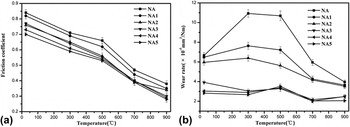
Figure 4 presents the average friction coefficients and wear rates of NiAl matrix composite coatings at different temperatures. The friction coefficients of all composite coatings reduce continuously with the increasing of temperature [Fig. 4(a)]. The NA coating has high friction coefficient at the wide range of temperature. Subsequently, the addition of Cr2O3 and Mo compound have a remarkable role in improving the tribological properties of composite coating. The soft metal Ag acts as the solid lubricant which could reduce the friction coefficient of composite coating at low temperature. However, the friction coefficient of NA3 composite coating is higher than NA2 composite coating at room temperature. It is possibly due to the melt of Ag during the spraying process, that makes the residual Ag not enough to play the lubricating role. Reference Liu, Wang, Gao and Jia2 The wear rates of NA, NA1 and NA2 composite coatings increase firstly and then decrease from room temperature to 500 °C [Fig. 4(b)]. When above 500 °C, the wear rates of composite coatings decrease sharply. However, the wear rates of NA3, NA4 and NA5 composite coatings decrease firstly and then increase from room temperature to 500 °C. It is probably due to that the NA, NA1 and NA2 composite coatings have no effective lubrication below 500 °C. The wear rates of NA3, NA4 and NA5 composite coatings increase from 700 to 900 °C. It is possibly due to the worn surfaces of composite coatings have severe plastic deformation at 900 °C. Reference Li, Gao, Jia, Han, Guo and Wang6 It is distinctly seen that the NA5 composite coating exhibits lower friction coefficient and wear rate than other coatings at all temperatures except 500 °C.
Friction coefficients and wear rates of composite coatings at different temperatures.

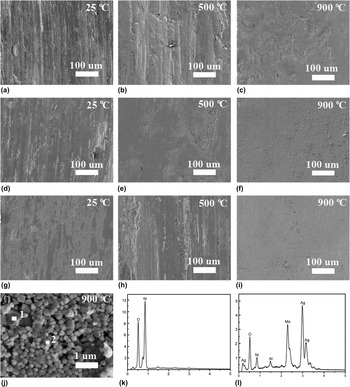
The SEM micrographs and corresponding EDS analysis of worn surfaces of NiAl matrix composite coatings at different temperatures are shown in Fig. 5. At 25 °C, for the NA coating, the worn surface is covered with terrible brittle fracture [Fig. 5(a)] compared with that in NA3 [Fig. 5(d)] and NA5 [Fig. 5(g)], corresponding to the highest friction coefficient and wear rate (Fig. 4). Therefore, the wear mechanism is dominated by delamination and abrasive wear. When addition of silver, the worn surface of NA5 has no obvious delamination [Fig. 5(g)]. On account of the smoothest worn surface at room temperature, the friction coefficient and wear rate of NA5 composite coating are the lowest. The Cr2O3 particles are embedded on the worn surface, which act as a reinforced phase and effectively improve the wear rate of composite coatings. Reference An, Chen, Hou, Zhao, Zhou, Chen and Yan16 At 500 °C, the worn surfaces of NA3 [Fig. 5(e)] and NA5 [Fig. 5(h)] composite coatings show continuous glaze films with some detachment smears. Reference Liu, Wang, Gao and Jia2 The composite coatings alleviate the abrasive wear and show a sign of adhesive wear. It clearly reveals that the NA5 composite coating with a higher content of silver has the severe wear with some microploughings and surface deformation on the worn surface, which lead to higher wear rate [Fig. 4(b)] than NA3. However, the worn surface of NA coating has the microcutting and microploughing [Fig. 5(b)]. So the coating has the highest wear rate [Fig. 4(b)]. At 900 °C, the worn surfaces of NA3 [Fig. 5(f)] and NA5 [Fig. 5(i)] composite coatings become smooth and cause some high-temperature lubricants, which consist of many small flat particles [Fig. 5(j)]. These particles are NiO, silver molybdates and nickel molybdates, which is confirmed by XRD (Fig. 6) and EDS analysis [Figs. 5(k) and 5(l)].
Worn surfaces of composite coatings: (a–c) SEM of NA, (d–f) SEM of NA3, (g–i) SEM of NA5, (j) is the high magnification of (i); (k) and (l) are the EDS of 1 and 2 in (j).

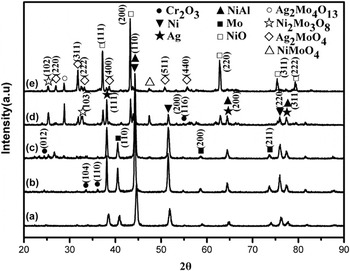
XRD patterns of worn surfaces of NA5 composite coatings at different temperatures: (a) 25 °C, (b) 300 °C, (c) 500 °C, (d) 700 °C and (e) 900 °C.

Figure 6 shows the XRD patterns of the worn surfaces of NA5 composite coating at different temperatures. The diffraction peaks of composite coating after friction test at 300 °C are nearly the same as that at 25 °C. It clearly illustrates that the components of the composite coating have no obvious change at 300 °C. Interestingly, the new peaks of silver molybdates and nickel molybdates can be detected when test was run at 700 °C. At the same time, the diffraction peaks of Mo disappear and Ag peaks weaken. During 700 °C sliding test, silver, nickel and molybdenum can react and form silver molybdates and nickel molybdates lubricating films which are responsible for the improved tribological properties of composite coatings at high temperature. Reference Liu, Gao, Wang, Zhang, Wang, Yi and Jia5 Except the nickel molybdates and silver molybdates, the NiO diffraction peaks (JCPDS file no. 47-1049) appear on the worn surface at 700 °C. It has been approved that the NiO could also improve tribological properties of composite coatings at high temperature. Reference Liu, Wang, Gao and Jia3 So the composite coating has lower friction coefficient and wear rate. It can also be found that the diffraction peaks of NiO become more evident at 900 °C.
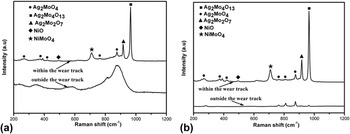
To further identify the tribo-chemical changes of the composite coating at high temperature, the Raman spectra obtains the worn surfaces of NA5 composite coatings at 700 and 900 °C test temperatures in Fig. 7. It can be clearly seen that the silver molybdates and nickel molybdate peaks have been detected in the area of wear track after 700 and 900 °C tests, which are ascribed to the Ag2MoO4, Ag2Mo4O13, Ag2Mo2O7 and NiMoO4 peaks. In contrast, only weak silver molybdates peaks are detected outside the wear track area. The NiO peak also has been detected within the wear track area. The Raman spectra of silver molybdates peaks within the wear track area are more evident than that outside the wear track area at high temperature. In fact, the Ag2MoO4 peak has been detected in the rubbing surface from 25 to 500 °C (Fig. S4). The peaks of Ag2MoO4, Ag2Mo4O13, Ag2Mo2O7 and NiMoO4 appeared at 700 and 900 °C, which illustrated the occurrence of tribo-chemical reaction and the formation of lubricating composite layer with silver molybdates and nickel molybdate during the sliding process at high temperature. The Ag2MoO4 could act as a thermal chemically stable solid lubricant at mid-to high-temperatures. Reference Liu, Wang, Gao and Jia3 At the same time, the silver molybdates and nickel molybdate tribo-layer have been formed on the worn surface, which have the synergistic lubricating effect and are attributed to the improved tribological properties of composite coating. The tribo-layer acts as the protective cover which could effectively reduce ball and disk direct contact. So the NA5 coating possesses the excellent tribological properties at the wide range temperature.
Raman spectra of worn surfaces of NA5 composite coatings tested at (a) 700 °C and (b) 900 °C.

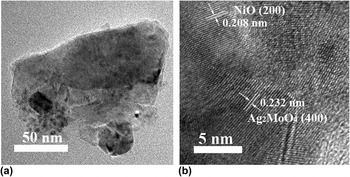
After tested at 900 °C, there are many particles on the surfaces of NA3, NA4 and NA5 composite coatings. This particles consist of Ag2MoO4, NiMoO4 and NiO (Fig. S5). The TEM analysis of particles on the surfaces of NA5 composite coating is shown in Fig. 8. The particles are determined to be approximate 150 nm coarsen. The corresponding HRTEM image of composite particles are shown in Fig. 8(b). The distance of lattice fringes is 0.208 nm in the HRTEM image [Fig. 8(b)]. It is corresponding with NiO (JCPDS file no. 47-1049) of the (200) plane. The 0.232 nm distance of lattice fringes is consistent with the (400) plane of Ag2MoO4 (JCPDS file no. 08-0473), which are corresponding to the XRD analysis in Fig. S5.
TEM image (a) and HRTEM image (b) of products on the surfaces of NA5 composite coatings tested at 900 °C.

IV. CONCLUSIONS
In this work, the tribological properties of NiAl matrix self-lubricating composite coatings from 25 to 900 °C were studied. The main conclusions are as follows:
-
(1) The addition of Cr2O3, Mo and Ag could effectively improve the tribological properties of composite coatings at the wide range temperature.
-
(2) The silver, nickel and molybdenum could occur tribo-chemical reaction and form silver molybdates and nickel molybdates lubricating films inside the wear track of composite coatings at high temperature. The friction process promoted the formation of the silver molybdates.
-
(3) The molybdenum reacted with silver firstly and then reacted with nickel when the content of silver decreased on the surface of composite coatings.
-
(4) The silver molybdates, nickel molybdates and NiO were the main components in composite coatings at high temperature, which could effectively improve tribological properties of composite coatings.
Supplementary Material
To view supplementary material for this article, please visit https://doi.org/10.1557/jmr.2017.136.
ACKNOWLEDGMENTS
The authors thankfully acknowledge the financial supports by the National Natural Science Foundation of China (Grant No. 51471181, 51575505, 51675508).