




No CrossRef data available.
Teaching Politics Using Antigone
Published online by Cambridge University Press: 25 April 2006
Extract
Antigone, Sophocles' 5th century take onthe Oedipus story, dramatizes war, fratricide, attempted patricide,suicide, the loss of young love, civil disobedience, and capitalpunishment. These elements make for great theatre butAntigone is also an immensely useful tool toengage undergraduate students from many disciplines in learningabout politics. I use Antigone as a “motivatingtext” in political theory courses to engage students in the study ofpolitics and persuade them of the importance of this field of study(Turner 2005).
Information
- Type
- THE TEACHER
- Information
- Copyright
- © 2006 The American Political Science Association
Antigone, Sophocles' 5th century take on the Oedipus story, dramatizes war, fratricide, attempted patricide, suicide, the loss of young love, civil disobedience, and capital punishment. These elements make for great theatre but Antigone is also an immensely useful tool to engage undergraduate students from many disciplines in learning about politics. I use Antigone as a “motivating text” in political theory courses to engage students in the study of politics and persuade them of the importance of this field of study (Turner 2005).
Introductory theory courses typically rely on either original or excerpted versions of texts to speak to students. Yet, because many programs use such courses as introductions to their political science programs, it is imperative that instructors consider ways to draw students into thinking politically. I use Antigone alongside of classical texts for five reasons. First, Antigone has rich commentary on the nature of leadership and legitimacy, what good law looks like, how citizens should behave, and how they ought to live together. While faculty in the arts might make much of its dramaturgical aspects, political scientists can use Antigone as a study of political power—how you get it, how you maintain it, what it entails. In this way, it is a good text for teaching about political subjects.
Second, the societal problems illustrated in Antigone—gender roles, the push and pull of family, the tension between freedom and authority, the role of religion in law and in our personal lives, the absolutist nature of patriotism, our duties “to God and country,” and the difficulties of reconciliation and forgiveness—challenge us even today. This realization, that the societal problems of ancient Greece mirror those of our own society, opens students to the possibility of universal themes in political experience that transcend temporal and geographic boundaries.
Third, in my experience, teaching politics using Antigone motivates today's disengaged students to care about the political world by bringing such drama and tragedy to fundamental political questions. Antigone connects political forces and issues to individual lives in ways that move students. And, analyzing Antigone encourages students to develop their own positions on classic issues in our discipline.
Fourth, using literature in political science courses underscores the interconnectivity of knowledge that is the hallmark of a liberal arts curriculum (Walke 1991). Finally, Antigone offers a link between the theory of the Western canon and the praxis of political leadership (Whitebrook 1993). It can help students do one of the most challenging parts of social science—connect theory to practice.
Better Named Creon?
Though named Antigone, Sophocles' third play in the Oedipus trilogy is as much a story about Creon, Oedipus' brother-in-law and the newly crowned king of Thebes, as it is about Antigone, Oedipus' daughter. Creon, having declared himself king after the mutual murders of Oedipus' two sons, Polyneices and Eteocles, must learn how to exercise the powers of his office. He issues an edict that no one is to bury Polyneices who left Thebes (after being denied his rightful turn at the throne) to raise an army and sack the city. Creon aims to assure his people, who have suffered terribly from the misbehaviors of the royal family, that he will protect them. Since Polyneices betrayed the city, his body will be left to rot on the battlefield and his soul to wander the earth forever without the means to move onto the Underworld where souls rightfully go after death.
Antigone, Polyneices' sister, as a female is one of the proper administrators of the funereal rites, and defies Creon's explicit edict and buries her brother. Creon sentences Antigone to death. Antigone's fiancée, Creon's son Haimon, pleads with him but Creon is unmoved. Finally, Teiresias, the blind seer, tells Creon that his offering to the gods has been rejected and that the gods are angry with Creon. Creon denounces Teiresias as he does all his other detractors but eventually capitulates when Teiresias prophesies great catastrophes. The Chorus persuades Creon to free Antigone, whom Creon has exiled to a cave with food and water rather than executing her outright, and to bury Polyneices. Creon hurries to bury Polyneices first and arrives at Antigone's tomb only to find that she has hung herself. Haimon, overcome with grief, swings his sword at his father but misses and turns it on himself. A messenger carries the news back to the palace where Creon's wife, Eurydice, kills herself upon hearing it. The play concludes with Creon returning to the city, having lost his son, niece, wife, and, presumably, his kingdom.
Thinking Politically about Antigone: Power vs. Legitimacy
As an instruction book for leaders, Antigone is more a study of what not to do. Creon, the most powerful person in the city, finds he is not omnipotent and botches his job of leading the city. One of the key political lessons of Antigone is about how to obtain power. Creon comes to office through the rather dubious claim of being the only male in the family who has not either killed his father and slept with his mother or killed (or been killed by) his brother recently. Creon appears sensitive at the outset of the play that it is not just the office that needs to be gained but rather the right to hold the office, meaning that Creon must earn the respect of the people. He must, in Weberian terms, earn the monopoly of legitimate authority over the instruments of the state (i.e., force). But where does legitimacy come from? Creon is desperate to prove himself above the past failures in leadership by his own family that had led Thebes to plague, famine, civil war, and siege. Kings, says Creon, must be tested in order to command the people's loyalty and he immediately sets a test for himself in his opening speech to the Chorus, or more broadly, to the people of Thebes.
Nevertheless, I say to you at the very outset that I have nothing but contempt for the kind of Governor who is afraid, for whatever reason, to follow the course that he knows is best for the State; and as for the man who sets private friendship above the public welfare—I have no use for him, either. I call God to witness that if I saw my country headed for ruin, I should not be afraid to speak out plainly; and I need hardly remind you that I would never have any dealings with an enemy of the people. No one values friendship more highly than I, but we must remember that friends made at the risk of wrecking our Ship [of State] are not real friends at all. (Oedipus Cycle 1977, 192–3)
His test is thus to serve the public welfare over private interest, the trademark of Plato's philosopher-kings, Rousseau's citizens, and the distinguishing feature of Aristotle's pure forms of government. Though Creon strives to frame his leadership as one serving the public good in contrast to the private and selfish orientations of his detractors (Antigone, he accuses of acting for her family, Haimon of being seduced by Antigone, Teiresisas of taking bribes), it quickly becomes apparent that Creon's test is really a straw man and that he is hardly capable of transcending the pull of the private realm himself. The conflict between public and private goods that Creon attempts to establish is dispelled by the realization that where the laws of the gods (e.g., that bodies should be buried) are ignored, the whole city suffers. Because whatever punishment Creon will suffer for thwarting the will of the gods would be shared collectively by the city, what Creon would like to frame as a conflict between public and private goods really is no more than a conflict between his version of the public good and Antigone's. Plus, in denying Polyneices his due, Creon plays god, taking the gods' laws into his own hands; his desire for power betrays his avowed commitment to placing the city's interests above his own. In making his edict that Polyneices will not be buried, Creon oversteps what little authority he commands as incumbent to a bankrupt office and seems to fall victim to his own public relations. Plato's point that power is best exercised by those who do not want it makes a charade of Creon's assertions that his actions are designed to serve the public welfare. In his quest for the legitimacy to rule, Creon sets a test for himself to prove he is worthy of the city's allegiance and fails it almost within the same breath.
This framing of political struggle as the conflict of public versus private interests tends to grip students; it helps them reflect on the discourse of contemporary politics and the character of today's political leaders, find a language to talk about themselves as individuals and the authority of the state (and society), and provides a segue for discussing what the social contract theorists understand as the sacrifices we make to be part of a political community.
Thinking Politically about Antigone: Power vs. Justice
Were Creon able to convince the city that he is dedicated to serving their interests instead of his own (and passing the first test), he would still have the problem of maintaining their allegiance. The second political lesson in Antigone is about how you keep your power once you have acquired it. Antigone offers a study of the relationship between leaders and their followers. To be a leader, people have to follow you. Though people, in Creon's understanding, need kings, kings also need people and Creon forgets this. He does not open himself to the concerns of the people of Thebes and conflates issuing orders with political leadership. When his son Haimon attempts to explain to him the public perception of Antigone's death sentence, Creon denies the right of those in the city to have opinions and claims the absolute power to determine justice.

Haimon is here cautioning his father that he is out of touch with his people. Creon's understanding of leadership (L'etat, c'est moi), Haimon argues, would be appropriate only to a kingdom of one, a desert. To Haimon, leadership derives from good judgment and this is found not in the declarations of a single person (even a king) but from the collective process of discussion, persuasion, and the taking of counsel. It is important to note, that there is room for compromise on Creon's part: whereas Eteocles received a full state funeral with all the attendant honors, Antigone seeks only to give Polyneices a minimal ritual burial. Creon could meet his obligations to the gods, thereby giving Antigone (and arguably the city) what she (they) sought, while still distinguishing between the brothers if he saw his leadership in a different light. Instead, Creon's arrogance prevents him from relating to his people as their servant and causes him to claim rights inherent in the office that he has not yet earned.
The interaction of Haimon and his father in this scene also airs critical arguments about what justice is, one of the key themes of political theory:
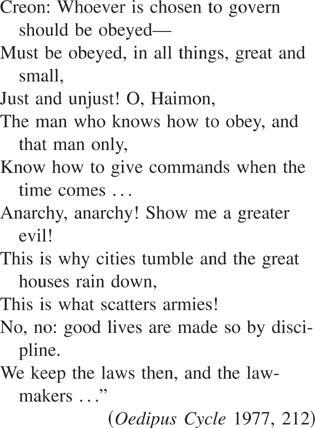
For Creon, the stakes are as for Hobbes: the difference between ultimate chaos and lawful order and for both disobedience to the law is the destroyer of cities. But Creon, who has become sovereign through his own declaration of right rather than the consent of the governed, overlooks the fact that law must be properly constituted in order to be considered just by the people. Creon's legal positivism is juxtaposed nicely with Haimon's argument that reason is a collective process:

When teaching Antigone I often refer to Aristotle's comments on law and sovereign power because they fit into this discussion so tidily. Aristotle echoes Creon's arguments that good rulers learn how to rule well by first obeying (quoted in Ebenstein and Ebenstein 1992, 88) but he also points out that “passion perverts the minds of rulers, even when they are the best of men” (101). Law, continues Aristotle, is best understood as “reason unaffected by desire” and this kind of principled neutrality is best derived from the decisions of “many judges.” Kings commonly make it a practice “to make to themselves many eyes and ears and hands and feet” so as to see and hear and act better than one can with only two of each (102). He also warns that law must derive from the customs, traditions, religion, and beliefs of the people and that the law means nothing if the people are not inclined to follow it.
To the people of Thebes, Creon comes across as arbitrary, being against the religion and cultural traditions of the people, which require a burial for all the fallen. Early in the play, Creon is even willing to punish Ismene, Polyneices' other sister, for the crime though it is clear she had no role in its commission. As Creon struggles to establish his authority through its exercise, he neglects the all-important lesson from Rousseau's Social Contract: might is right only so long as you are able to force people to obey you. I use this lesson from Antigone to talk with students about what justice is and whether and under what conditions they believe we must obey the law.
The Character of Leaders: What Power Entails
Finally, Antigone demonstrates another critical lesson: leadership entails flexibility, humility, perspective, and nuance. The play would not have resulted in such tragedy had Creon responded to his advisors or been willing to give ground. Instead, over the course of the play Creon becomes increasingly entrenched and invested in his decisions to ban Polyneices' burial and punish the guilty with death. Haimon uses the following analogy in speaking to Creon:

But Creon loses all humility, developing excessive pride, the ancient Greek character flaw of hubris. As a leader, Creon conflates the personal and the public, the self with the abstract, and takes every act of political objection as personal confrontation. Unable or unwilling to separate the office from the individual holding it, he loses his kingdom rather than lose face.
Conclusions
While it is true that Creon is the figure who seems to have the most opportunity to make choices (and to pay their consequences), the play does invite conflicting emotions and controversy. Many students sympathize with Creon at the outset of the play. Certainly, Creon seems to have the best intentions as the play begins. He gives a great speech to the people of Thebes (“Gentlemen: I have the honor to inform you that our Ship of State, which recent storms have threatened to destroy, has come safely to harbor at last.” (Oedipus Cycle 1977, 192)) that is unassailably noble in its sentiment. He is thus more complicated and more interesting than anything but a close read of the text would suggest. And, though students are quick to recognize Creon's limitations as the play unfolds, there are almost always some who are willing to argue that Antigone is as much to blame as Creon; Antigone, after all, pursues (private) glory through her actions at the expense of the public well-being as much as does Creon. Ultimately, it is not Creon who kills Antigone, but Antigone. What if Antigone had waited just another few minutes before taking matters into her own hands? Three lives might have been spared: hers, Haimon's, and Eurydice's. In short, both antagonists act with inflexibility, selfishness, and hubris. While some students connect with Creon and defend his attempts to lead in difficult times and others are truly moved by Antigone, seeing in her a person of conscience and courage, almost all get hooked by the clash between them. The conflict between these two characters, both noble, both flawed, is part of what makes this story so inspiring and compelling.
It is telling that Sophocles chose to name the play not Creon but Antigone. I always ask students to ponder this decision. Doing so opens the door to discussing gender roles and constructions of gender in Western political thought. In fact, again and again, Antigone is chastised by Creon for acting outside of her assigned and accepted role as a private individual in this public struggle and Creon repeatedly states that he will not let Antigone turn him into a woman. In a canon dominated by not just dead White men but by dead White men who exclude women from their discourse, Antigone provides a welcome opportunity to contextualize discussions of gender and ways that the Western tradition subordinates and even oppresses women.
Antigone should be considered by teachers of political science as a tool to bring political lessons to life. Because we can live vicariously through the characters, as the ancient Greeks watching Sophocles' plays would have, reading or viewing Antigone engages the mind in puzzling through these lessons. It can help us consider the distinction between power and legitimacy, between leadership and self-importance, and between power and justice. It sets the stage to raise key themes in political science and can help students consider the qualities of leaders. And, it can teach us fundamental lessons about how we should live together.
Biography
Kimberly Cowell-Meyers is assistant professor in the government department at American University in Washington, D.C. She is author of Religion and Politics: The Party Faithful in Ireland and Germany (Greenwood, 2002) and articles published in Women & Politics, Nationalism and Ethnic Politics, and Irish Political Studies. She has worked in the British Parliament and the United States Institute of Peace.
References
Ebenstein, William, and
Alan
Ebenstein, eds. 1992.
“Aristotle, ‘From Politics.’” In
Introduction to Political Thinkers. New
York: Harcourt Brace.Google Scholar
Sophocles. 1977.
The Oedipus Cycle. Trans. Dudley Fitts and
Robert Fitzgerald. New York: Harcourt
Brace Jovanovich.Google Scholar
Turner, Charles C.
2005. “The
Motivating Text: Assigning Hannah Arendt's Eichmann in
Jerusalem.” PS: Political Science and
Politics
38 (January):
67–69.Google Scholar
Walke, John C.
1991. “Liberal
Learning and the Political Science Major: A Report to the
Profession.” PS: Political Science and Politics
24 (March):
48–60.Google Scholar
Whitebrook, Margaret. 1993. “Only Connect:
Politics and Literature 10 Years Later, 1982–92.” PS:
Political Science and Politics
26 (June):
257–262.Google Scholar
 You have Access