Introduction
Over the last several decades, genebanks worldwide have collected large numbers of samples. Simultaneously, they strive to obtain reliable information about the collected samples, conserve viable genetic resource stocks, and distribute healthy samples to researchers and other interested users upon request (Engels and Fassil, Reference Engels, Fassil and Squires2009). The value of conserving genetic resources for biotechnology R&D depends crucially on whether they can provide relevant solutions to the problems plaguing the human society. This means that the utilization of genetic resources is ultimately the most important activity of genebanks, and, therefore, it is crucial to promote the utilization of conserved resources. The general interest in genetic resources stems from the opportunities offered by their present and future utilization for R&D and commercialization (Khoury et al., Reference Khoury, Laliberté and Guarino2010). The early 21st century ushered in an era of more efficient use of genetic resources (Cohen et al., Reference Cohen, Williams, Plucknett and Shands1991). They were collected, studied, described, catalogued and properly conserved, thus making both the information and the samples available to interested users. Today, these activities continue to be the most vital and challenging activities for genebanks. McCouch et al. (Reference McCouch, McNally, Wang and Hamilton2012) presented a case study in rice to promote the utilization of plant genetic resources in genebanks. Their results suggest that perhaps the biggest challenge faced by genebank managers is identifying the most appropriate set of accessions that meet the needs of users. In this context, a few studies have emphasized that genebanks need to actively respond to users' specific needs to promote the utilization of their genetic resources, by performing descriptive analysis (Smale and Day-Rubenstein, Reference Smale and Day-Rubenstein2002), regression analysis (Day-Rubenstein and Smale, Reference Day-Rubenstein and Smale2004) and principal component analysis (Ukalska and Kociuba, Reference Ukalska and Kociuba2013) (for the results of the literature, refer to the Supplementary material, available online).
Although the literature has contributed to the discussion on and understanding of the utilization of genetic resources in genebanks, the general observation emerging from the studies is that they rarely try to identify genetic resource attributes suitable to users' needs. Hence, we can contribute to the existing literature by examining the question ‘How can the most appropriate set of accessions for a given genebank collection be identified to address the stated research objectives of various interested users?’ Economic methodologies can provide tools and insights to help understand how genebanks should cope with this challenge. This study employs econometric techniques to estimate the relative importance of plant, animal, and microbial genetic resource attributes among researchers using three Korean genebanks, namely the Plant Extract Bank (PEB), the Korean Collection for Type Cultures (KCTC) and the Laboratory Animal Resource Center (LARC), to obtain genetic resources for R&D. In doing so, the study provides genebank managers possible strategic orientations covering creative and adaptive decision-making, which is tailored to specific and continuously changing operating conditions such as users' preferences.
Pressing management issues at Korean genebanks
Modern genebanks for ex situ genetic resource conservation and use in developed countries emerged nearly a century ago. Modern genebanks in Korea were established and designated by the government as late as 1988.
By the mid-2000s, the relevant authorities had enacted and implemented their own laws and regulations on genetic resources according to the scope and purpose of the operations. However, there was no coordination among them (Shin et al., Reference Shin, Bae and Yoon2011). The mid-2000s witnessed mounting pressures, such as fierce international competition to secure useful and valuable genetic resources in the field, the realization of the importance of genetic resources in biotechnology and, more recently, the necessity to provide a proactive response to the Nagoya Protocol on Access to Genetic Resources and the Fair and Equitable Sharing of Benefits Arising from their Utilization, on the country's genetic resource management system. The pressures spurred the government to devise an integrated management system for securing, conserving and using genetic resources for R&D in biotechnology (KOBIC, 2011). The Ministry of Science, ICT and Future Planning (MSIP) created the Office of Science and Technology Innovation in 2004 and the General Council for the Management of Biological and Genetic Resources (for the integrated management of biological and genetic resources) in 2006. In December 2007, the MSIP devised the National Master Plan for Securement, Management, and Use of Biological and Genetic Resources for R&D in biotechnology (hereafter referred to as ‘the National Master Plan’), which included the establishment of a basic plan for and the readjustment of the legal and institutional systems governing the management of biological and genetic resources for R&D in biotechnology at the national level (BPRC, 2008). Korea enacted the Law on Securing, Management, and Use of Genetic Resources for Biotechnology R&D (hereafter referred to as ‘the Law’) in May 2009 and established the implementing ordinance of the Law in November 2009 as part of the follow-up effort to implement the National Master Plan (MSIP et al., 2013). Thus, Korea established a coordination framework among the relevant authorities for the efficient management of its genetic resources for R&D in biotechnology at the national level. After the Law went into effect in November 2009, the relevant authorities established the Basic Plan for the Management of Genetic Resources for Biotechnology R&D (2011–2020) (hereafter referred to as ‘the Basic Plan 2011–2020’) in May 2011 (MSIP et al., 2011), and they also enacted their own rules and regulations to implement the Law (for more details on these, see Supplementary Table S1, available online). Since 2011, each relevant authority has published its annual plan for implementing the Basic Plan 2011–2020 (MSIP et al., 2013).
By 2020, the Basic Plan 2011–2020 aims to (1) secure twice as many genetic resources conserved by Korean genebanks in 2011 from around the world, (2) acquire world-class expertise in conserving and managing these genetic resources and (3) enhance their utilization for R&D in biotechnology by over 20 times the corresponding 2011 levels (MSIP et al., 2011). All these activities are increasingly important and challenging for Korean genebanks. Most importantly, the government has noted the lack of systematic support towards elevating the value of genetic resources; Korean genebanks have only focused on securing and maintaining genetic resources for R&D in biotechnology, thus compelling Korean researchers to increasingly resort to using the genebanks of other countries (Kim et al., Reference Kim, Kim and Cho2013). In this context, the government has devised a strategy for maximizing the utilization of Korea's genetic resources for R&D in biotechnology in user-oriented ways. This strategy includes three action points: (1) identifying the value of Korea's genetic resources; (2) strengthening analytical information systems; (3) intensifying the degree of their utilization. These interventions clearly underscore the government's recognition that the identification of the most appropriate set of accessions to meet users' needs is a strategic reference point for the survival of the country's genebanks.
Contribution of economics to tracking pressing management issues at genebanks
How can genebanks increase the utility value of their genetic resources by ensuring that their information and samples meet the needs of various interested users? We must pay heed to this pressing issue by recognizing the necessity of economic evaluation of genetic resource use. It is difficult to measure the economic value generated by genetic resources across multiple dimensions. Nonetheless, economic research can help estimate the value of the genebanks' resources in terms of their utility value to users and answer the above-mentioned question (Mendelsohn, Reference Mendelsohn2003). Economics is a utilitarian discipline focusing on human society rather than biological systems. The economic value of genetic resources, therefore, derives from their human uses (Brown, Reference Brown, Orians, Brown, Kunin and Swierbinski1991). Within the utilitarian framework, there are different ways to classify the value of genetic resources. The total value derived from genetic resources is divided into two categories: use and non-use values (Gollin and Evenson, Reference Gollin and Evenson2003; Ahtiainen and Pouta, Reference Ahtiainen and Pouta2011).
Unlike an endangered species or a scenic wonder, most of the value associated with plant genetic resources in a genebank collection relates to their use rather than their existence (Smale and Koo, Reference Smale and Koo2003). Thus, in this paper, we focus primarily on the direct use values of genetic resources, namely benefits obtained from the direct use of genetic resources for R&D in biotechnology. In this context, in order to identify the most appropriate set of accessions to meet the needs or demands based on users' preferences, we employ approaches of economic valuation based on the utility function. In light of the findings of Chee (Reference Chee2004), Pascual et al. (Reference Pascual, Muradian, Brander, Gómez-Baggethun, Martín-López, Verma and Kumar2010) and Roosen et al. (Reference Roosen, Fadlaoui and Bertaglia2003), approaches based on the utility function are classified into two techniques, namely revealed preference and stated preference.
As the direct use values of genetic resources for R&D in biotechnology can be estimated by conducting the economic valuation of genetic resources (products) with certain embedded attributes, the econometric demand and supply estimation, hedonic pricing method, contingent valuation method (CVM) and conjoint analysis (CA) can be employed. However, revealed preference approaches are not appropriate for economic valuation, because no revealed preference data are available. Hence, we need to use one of the stated preference techniques, the CVM or the CA, for this study. The CVM contrasts with CA in terms of options presented to the respondents. The CVM usually presents one option to the respondents. In the CA, survey respondents are given a choice between several options, each consisting of various attributes. Although the CVM is less complicated to design and implement, the CA is more capable of providing value estimates for specific attributes of genetic resources (Adamowicz et al., Reference Adamowicz, Boxall, Williams and Louviere1998) as well as changes in these attributes (Adamowicz et al., Reference Adamowicz, Boxall, Williams and Louviere1998; Pascual et al., Reference Pascual, Muradian, Brander, Gómez-Baggethun, Martín-López, Verma and Kumar2010). This is because the CA measures buyers' trade-offs among multi-attributed products simultaneously (Green and Srinivasan, Reference Green and Srinivasan1990). Therefore, the CA is suited for our study, which aims to (1) estimate the relative importance of genetic resource attributes among researchers currently using genebanks to obtain genetic resources for R&D and (2) provide genebanks strategic orientation so that their management can take creative and adaptive decisions tailored to specific and ever-changing operating conditions such as interested users' preferences.
Materials and methods
We employ the CA and cluster analysis for our estimation. In the CA, a user's utility for an attribute is estimated based on a part-worth function (Cattin and Punj, Reference Cattin and Punj1984). We estimate the part-worth utilities (an additive utility to a user's total utility for an attribute) using the ordinary least-squares regression analysis. It is the most extensively used method in such cases, and allows us to establish the relative importance of the attributes and the part-worth utilities of attribute levels. We use the rating-based conjoint model instead of the choice-based model, because of its simplicity (Karniouchina et al., Reference Karniouchina, Moore, Van der Rhee and Verma2009) and its appropriateness considering the main objective of the study. To grasp user segmentation with different patterns in terms of the part-worth utility of attribute levels and the relative importance of attributes, we also perform Ward's hierarchical cluster analysis with Euclidean distance.
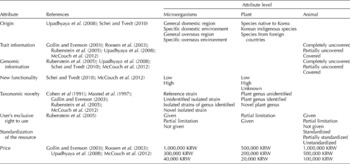
First, the study identifies the appropriate attributes and specifies their levels, in order to reflect the characteristics of genetic resources and dimensions that are valuable for the users. In order to determine the most appropriate attributes, feedback from key stakeholders was sought through focus group discussions. Focus group discussions are appropriate for situations requiring understanding of a specific topic (Malhotra et al., Reference Malhotra, Hall, Shaw and Crisp1999). The attributes and levels to be chosen for each attribute must be identified in a way that is meaningful to the users (respondents), in order to ensure that the attributes are measured objectively and can be controlled (CIE, 2001). This means that only realistic and practical attributes and levels should be considered. Focus group discussions are based on realistic and practical situations. For this reason, they are the mainstay in studies employing the CA. Focus group discussions for this study were conducted during March–April 2012 for microbial genetic resources and during March–April 2013 for plant and animal genetic resources. Each focus group on microbial, plant and animal genetic resources consisted of researchers using three genebanks: the KCTC (which has a wide and systematic collection of materials comprising bacteria, actinomycetes, yeasts, moulds, microalgae, genetically modified microorganisms, and virus and patent strains from domestic and international sources); the PEB (which stores a variety of plant extract samples; about 800 species of medicinal plants, about 2900 species of wild plants from Korea, and about 1000 species of wild plants from foreign countries); the LARC (which houses mice and rats, transgenic and otherwise, for animal experimentation purposes). These banks belong to the Korea Research Institute of Bioscience and Biotechnology (KRIBB) that has been playing an important role in establishing national R&D capacity and infrastructure, thus driving progress in the field of biotechnology since its establishment in 1985. There were six to eight participants in each group. Each focus group worked by analysing the literature concerning ex situ genetic resource conservation and use (e.g. Cohen et al., Reference Cohen, Williams, Plucknett and Shands1991; Gollin and Evenson, Reference Gollin and Evenson2003; Roosen et al., Reference Roosen, Fadlaoui and Bertaglia2003; Upadhyaya et al., Reference Upadhyaya, Gowda and Sastry2008; Antofie, Reference Antofie2011; McCouch et al., Reference McCouch, McNally, Wang and Hamilton2012), identifying the most appropriate attributes, specifying their levels and performing preliminary tests on the conjoint design. The most important and appropriate attributes and levels for each genetic resource were identified and selected, which constitute the basis for the conjoint study design (see Table 1).
Attributes and levels selected for the conjoint analysis

The definitions of attributes and levels for each genetic resource presented in Table 1 are as follows. In the case of the microbial and plant genetic resources, the origin indicates the location where the culture was separated for the first time (general domestic region, specific domestic environment, general overseas region and specific overseas environment); the taxonomic novelty indicates whether the separated culture is a previously reported strain or not in the taxonomic perspective (reference strain, unclassified strain and completely classified strain); and new functionality indicates the extent to which the genus can be used for the development of a useful resource such as a new enzyme or antibiotic, or for functionalities such as bioenergy production or the purification of new polluting agents. For animal genetic resources, the trait information indicates the extent to which the trait information possessed by the animal genetic resource (gene expression, disease-causing and the characteristic of industrial use) has been revealed; genomic information indicates the extent to which the genomic functional information including mutation, transformation and pathways is known; and the standardization of the resource indicates the extent to which the quality of the animal genetic resource is standardized based on factors such as genetic analysis and disease monitoring. In all of the microbial, plant and animal genetic resources, the price indicates the cost of acquiring an accession, and the user's exclusive right to use indicates the extent to which the researcher granted access to the resource is able to monopolize the resource.
We generated the profiles of each genetic resource to be used in the CA based on the attributes and levels presented in Table 1. A large number of possible different combinations were possible and presented to the respondents in the questionnaire (4 × 2 × 4 × 3 × 3 = 288 for microbial genetic resources, 3 × 3 × 3 × 2 × 3 = 162 for plant genetic resources and 3 × 3 × 3 × 3 × 3 = 243 for animal genetic resources). In this case, fractional factorial design is the best way to test the effects of the attributes on users' preferences (Halbrendt et al., Reference Halbrendt, Wirth and Vaughn1991; Harrison et al., Reference Harrison, Ozayan and Meyers1998), missing the least of information. We apply an orthogonal main-effects design to construct the fractional factorial plan, so that the independent contributions of all the main effects are balanced, assuming negligible interactions (Green and Wind, Reference Green and Wind1975), and conduct the design using SPSS 21. The numbers of the hypothetical profiles generated for the microbial, plant and animal genetic resources are 16 each (for the hypothetical profiles of each genetic resource, see Supplementary Tables S2–S4, available online). Data for the CA were collected through questionnaire-based surveys. The survey for microbial genetic resources was conducted in June 2012. The questionnaire was delivered to 700 researchers who use the KCTC. The surveys for plant and animal genetic resources were conducted in June 2013. We delivered 635 and 650 questionnaires to the researchers using the PEB and the LARC, respectively. According to our calculation based on MSIP et al. (2013), the KCTC, PEB and LARC accounted for 40.43, 88.19 and 38.96% of the total microbial, plant and animal genetic resources, respectively, provided by all of Korea's state-run genebanks to researchers across the nation in 2012. The surveys collected 100, 77 and 79 usable microorganism, plant and animal researcher responses for a response rate of 14.28, 12.12 and 12.15%, respectively (for sample characteristics, see Supplementary Table S5, available online). The response rates appeared to be low. A widely cited source on survey research indicates that ‘surveys with response rates over 30% are rare, and those with response rates between 5 and 10% are more common’ (Alreck and Settle, Reference Alreck and Settle2004, p. 3). In this context, the response rates for this study may be considered as commonly acceptable.
Results
Importance of genetic resource attributes
The part-worth utility and relative importance of each attribute are estimated for the researchers using genetic resources (microbial, plant and animal) (for the estimation results, see Supplementary Table S6, available online). For the researchers using microbial genetic resources, goodness-of-fit is indicated by Pearson's R ( = 0.996), based upon the correlation of actual and predicted preference scores. Considering the mean relative importance of each attribute, the researchers consider price (cost of acquiring an accession) as the most important attribute in selecting a microbial genetic resource. The second-most important attribute is taxonomy-based novelty (21%), followed by the origin (18.8%), scope of a user's exclusive right to use (17.9%) and new functionality (17.7%). The most relevant attribute for the researchers using plant genetic resources is new functionality (relative importance of 27.4%), followed by price (21.4%), taxonomy-based novelty (20.7%), origin (17.5%) and scope of a user's exclusive rights to use (13%). Our analysis of the researchers who use animal genetic resources indicates that they consider genomic information as the most important attribute while selecting animal genetic resources (22.6%), followed by trait information (20.7%), resource standardization (20.1%), scope of a user's exclusive rights to use (20.0%) and price (16.5%).
User segmentation
To grasp user segmentation with different patterns in terms of the part-worth utility of attribute levels and the relative importance of attributes, we also perform Ward's hierarchical cluster analysis with Euclidean distance. Scheffé post hoc tests were then performed to identify significant differences between the clusters.
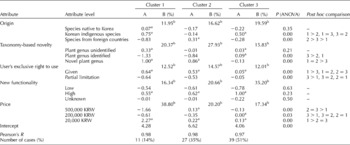
Table 2 summarizes the results of the cluster analysis of the researchers using plant genetic resources (for the graphic version of the results, see Supplementary Figure S1, available online). Cluster 1 includes 11 researchers and indicates that a competitive price is the most appealing, and that novel plant genetic resources, user's exclusive rights to use, and Korean indigenous species are highly valued. Cluster 2 includes 27 researchers who consider taxonomy-based novelty, new functionality and price (listed in order of decreasing importance) as the most favoured attributes. Novel plant genetic resources, high new functionality and user's exclusive rights to use appeal highly to the researchers of cluster 2. Cluster 3 comprises 39 researchers (51%) and lists high new functionality as the most appealing, while plant genetic resources originating in Korea and Korean indigenous species are highly valued.
Cluster analysis based on the pattern of individual utilities (plant genetic resources)

a Positive utility values.
b Mean relative importance values.
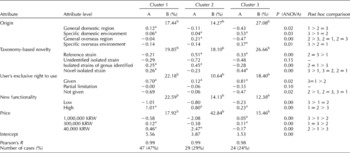
Table 3 presents the results of the cluster analysis of the researchers using microbial genetic resources (for the graphic version of the results, see Supplementary Figure S2, available online). ANOVA shows that most segments differed significantly (P< 0.050) from each other with respect to the utility variables generated by the CA and used to determine the segmentation. As reported in Table 3, cluster 1 includes 47% of the total respondents (47 researchers) and indicates that microbial genetic resources with high new functionality are the most appealing, and user's exclusive rights to use and a competitive price are highly valued. Cluster 2, comprising 29 researchers (29%), strongly prefers a competitive price compared with the other two clusters. In contrast, the other attributes, except taxonomy-based novelty, are less appealing to the researchers in cluster 2. Cluster 3 includes 24 researchers (24%), who consider origin, taxonomy-based novelty, user's exclusive right to use the resource and new functionality (listed in order of decreasing importance) as the most favoured attributes. These subjects assign less importance to low price compared with the other two clusters. For cluster 3, microbial genetic resources originating from specific domestic or overseas environments, with reference and novel strains, are highly valued.
Cluster analysis based on the pattern of individual utilities (microbial genetic resources)

a Positive utility values.
b Mean relative importance values.
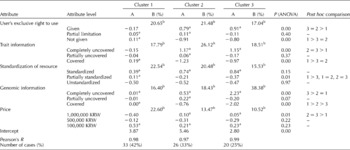
Table 4 reports the results of the cluster analysis of the researchers using animal genetic resources (for the graphic version of the results, see Supplementary Figure S3, available online). Cluster 1 comprising 42% (44 researchers) of the total respondents shows a strong preference for 100,000 KRW as the price, while a standardized resource is highly valued. Cluster 2 comprises researchers who strongly prefer trait information compared with the other two clusters. Cluster 2 (20 researchers) shows that animal genetic resources with completely uncovered trait information appeal the most to these researchers and that resources for which users are granted exclusive user rights and standardized resources are also highly valued. Cluster 3 consists of 20 researchers (25% of the total respondents), who strongly prefer animal genetic resources with completely uncovered genomic information compared with the other two clusters. The researchers of cluster 3 also assign a higher mean relative importance to the other two attribute levels: resources with completely uncovered trait information and those for which exclusive user rights to use are granted. Scheffé's test results presented in Tables 2–4 also suggest that differences in the part-worth utility of attribute levels between two clusters (e.g. 1 and 2/3, 2 and 1/3, or 3 and 1/2) generally exist and are significant.
Cluster analysis based on the pattern of individual utilities (animal genetic resources)

a Positive utility values.
b Mean relative importance values.
Discussion
The current study conducted conjoint and cluster analyses to estimate the relative importance of genetic resource attributes among researchers using three genebanks administered by the KRIBB to obtain genetic resources for R&D. In doing so, the study intended to classify user segmentation with different patterns, employing survey data for Korean researchers using microbial, plant and animal genetic resources, respectively, during 2012–2013.
We suggest four key implications for genebank managers and policy makers. First, the study shows that the relative importance of the attributes and the part-worth utilities of attribute levels, including the number of attributes and their related levels, evaluated by the researchers, vary across genetic resource sectors. The results indicate that even as the government places increasing emphasis on promoting the present and future utilization of genetic resources for R&D, in order to enhance policy effectiveness and efficiency, policy makers should understand these differences. Nonetheless, the government has been implementing its policy pertaining to genebanks in Korea without any consideration for the difference across the genetic resource sectors. Thus, it is not possible to incur any feedback on government policy implementation in this context. This suggests that the government should expend greater effort to enhance the dynamic efficiency of its policy. In particular, Korea's budget is relatively small compared with those of other developed countries. There are also many other future challenges to consider, such as continuously applying new technologies to improve efficiency, promoting sustainable use of genebank materials, and efficient operation of genebanks. More importantly, the future of genebanks ultimately rests on providing high-quality service to their users. This suggests that the government needs to implement differentiated policy strategies aiming for the maximum utilization of genetic resources for R&D in biotechnology, in user-oriented ways that are specific and match users' needs.
Second, policy makers need to understand the necessity of investments in related technologies and R&D to promote genetic resource utilization and generate new opportunities in the area. This study finds strong evidence that the researchers conducting R&D in the three genetic resource sectors view high new functionality and completely uncovered trait and genomic information as far more important in their decision-making about R&D use than other attributes. Thus, it is necessary for the genebanks to conduct various R&D activities at the inter- and intra-organizational levels (including cooperation and outsourcing), such as generating and analysing genomics and functionality data, to provide genetic resources suitable for researchers' needs. Such R&D activities require major investments in technology and bioinformatics infrastructure. They give impetus to the government to establish and implement an effective policy for technology development and infrastructure use. The most important thing, as McCouch et al. (Reference McCouch, McNally, Wang and Hamilton2012) noted, is that the government needs to implement policies encouraging genebanks to take advantage of economies of scale. Regardless of the organism types, the technology platforms and analytical skills applicable to the generation and analysis of genomics and functionality data are common. This favours centralization, because it would allow genebanks to take advantage of economies of scale and to leverage access to the necessary (but scarce) computational and analytical expertise needed to decipher the data. Smaller genebanks may develop consortia to promote technology sharing and computational expertise, thus mobilizing resources and creating economies of scale that will provide them the opportunity to sequence their collections. Besides, the government needs to expand its expertise to help the genebanks capture the value of the analysed data, by involving larger numbers of scientists from varied backgrounds such as computational biologists, population geneticists and statisticians.
Third, the study shows that users conducting R&D in the microbial and plant genetic resource sectors especially prefer resources from specific domestic environments and Korean indigenous species, respectively (for the results, see Supplementary Table S6, available online). This result implies that such genetic resources, particularly microorganism and plant genetic resources, are particularly attractive to the researchers for R&D and commercial exploration. Knowledge of genetic and economic parameters is crucial for the design and execution of programmes aimed at utilizing and conserving these genetic resources (Bosso, Reference Bosso2006; Ajani et al., Reference Ajani, Mgbenka and Okeke2013). Lack of knowledge is a major limitation to effective genetic improvements of local resources, and limits the decision-making capability of national agencies implementing programmes. The results of this study indicate that researchers focus on exploring the vital and valuable roles that many of these local species play in the ecology and economy of their native country, Korea. Therefore, the government should direct its policy towards creating a reliable knowledge pool of genetic and economic parameters related to Korean indigenous plant and microbial genetic resources from specific domestic environments of Korea.
Fourth, the study reveals Korean researchers' preferences for various attributes of microbial, plant and animal genetic resources for R&D purposes. This means that the most appropriate sets of accessions to meet the needs of users conducting R&D using microbial, plant and animal genetic resources can be identified, which is essential in enabling the genebanks to understand their value. The results, in turn, provide incentives to conserve and use genetic resources sustainably, as well as to ensure that the potential benefits that may result from their use are equitable. It is vital for genebanks to understand and evaluate users' needs to promote the present and future utilization of their genetic resources (Khoury et al., Reference Khoury, Laliberté and Guarino2010; McCouch et al., Reference McCouch, McNally, Wang and Hamilton2012). The results of this study, hence, can help Korean genebank managers and their policy makers to arrive at better decisions or take actions to promote the utilization of genetic resources for R&D in biotechnology, which is the most important function of genebanks, and currently also their biggest challenge. Better information about the use of plant genetic resources can guide efficient resource allocation in genebanks (Day-Rubenstein and Smale, Reference Day-Rubenstein and Smale2004). Genebanks are responsible for registering, studying, describing and documenting their collections, and making information and plant material available to researchers and other interested users (Rasmussen, Reference Rasmussen2008). These activities require sufficient funds. However, most genebanks lack sufficient funds, facilities and staff to maintain their germplasm collections (Rubenstein et al., Reference Rubenstein, Heisey, Shoemaker, Sullivan and Frisvold2005). Fixed budget allocations in many genebanks constrict the banks from conserving all the material they would ideally like to, and, thus, there are trade-offs associated with their choices (Smale and Koo, Reference Smale and Koo2003). It implies that genebank managers should expend greater effort and input to maximize efficiency and utility for a given budget. Data on researchers' preferences for various attributes of plant genetic resources for R&D purposes can contribute towards increasing the efficiency and cost-effectiveness of genebank management, as such information would reduce the difficulty in decision-making regarding fund allocation towards specific activities. Overall, the results pertaining to plant genetic resources (see Table 2 as the text table and Supplementary Table S6 as the supplementary table, available online) indicate that, in order of decreasing importance, genebank managers can enhance their management efficiency by allocating their budgets to listed activities, based on the consideration of the relative importance of attributes and part-worth utilities of attribute levels, R&D on detecting functional properties of germplasms for specific applications and uses, cost-saving efforts, collection of novel plants, collection of Korean indigenous species, and the intellectual property rights policy. In addition, the results of cluster analysis based on subgroups of researchers who have common needs (i.e. researcher segments) for plant genetic resources (see Table 2) suggest that genebank managers need to improve customization of plant genetic resources to the needs of specific researchers and focus their management resources more efficiently to meet the bank's own future strategic targets.
This study contributed to a better understanding of the needs of users of genetic resources, namely Korean researchers, and the possible mechanisms for promoting their utilization in R&D. However, it has a few limitations. First, the results of the study may not necessarily apply across periods and regions/countries. Users' preferences regarding the attributes of genetic resources differ across regions/countries (Roosen et al., Reference Roosen, Fadlaoui and Bertaglia2003) and are continuously changing (Roosen et al., Reference Roosen, Fadlaoui and Bertaglia2003; Ukalska and Kociuba, Reference Ukalska and Kociuba2013); there is no single answer to the question that motivates this study. This study was Korea-specific and employed a cross-sectional research design using one-time (and not yearly follow-up) survey data for the same respondents over a long period. We could not shed light on changes in researchers' preferences towards attributes or the attribute levels of genetic resources, and, thus, the findings may not be generalized to other regions/countries. Future research, hence, should address these issues. Second, the study limits our ability to draw implications for efficient and effective implementation of researcher segmentation strategies. Genebanks want to increase the probability of researchers becoming members of segments with the greatest utility potential. This means that our results should ideally offer some insights into the effects of changes in the structure of segment membership on segmentation strategy. This information would necessitate an analysis (e.g. a multinomial logistic regression) of the relative change in researchers' behavioural variables on the probability of membership in a particular segment, as well as the change in that probability given a specific change in the behavioural variable of interest. Because this study used a small sample size and did not survey researchers' behavioural variables that are likely to affect the extent of changes in the structure of segment membership, we could not offer recommendations for making and implementing effective and efficient segmentation strategies. According to a widely cited source on survey research, while the response rates of the researchers in the microbial, plant and animal sectors (14.28, 12.12 and 12.15%, respectively) are commonly acceptable (Alreck and Settle, Reference Alreck and Settle2004, p. 3), they, nevertheless, appear to be relatively low compared with the size of each sample frame. Given a small sample frame size, such as the one seen in this study, increasing questionnaire response rates, to ensure an adequate number of samples, is important to allow us to undertake various tests pertaining to researcher segments. Therefore, future research should address this issue. Third, this study did not focus on specific species or groups of species within a sector. Thus, we only contributed to management and policy strategies for these three genetic resource sectors at the overall level, and could not provide policy and strategy implications for specific species or groups of species within each genetic resource sector. Further research, therefore, should address this issue. Last, but not least, this study focused on a narrow view, namely the utilization of genetic resources for R&D in biotechnology, which limited our ability to find effective and efficient ways to use these resources in an environmentally sound and sustainable manner. The low utilization of materials from genebanks does not imply that they have low value. It means that from the perspective of the environment, all genetic resources have value when one considers their sustainable use. This is a vital consideration not only because genebanks are responsible for taking a long-term view, but also because they need to implement dual (long- and short-term) strategies. In terms of sustainable development, the role of genebanks is to take a long-term perspective, which would include considerations for securing and conserving biodiversity. Additionally, the concept of economic value has its foundations in welfare economics (Nijkamp et al., Reference Nijkamp, Vindigni and Nunes2008). Analysing the utilization of genetic resources in terms of an integrated approach for sustainable use or human welfare is an important topic for future research.
Supplementary material
To view supplementary material for this article, please visit http://dx.doi.org/10.1017/S1479262115000520
Acknowledgements
This paper was financially supported by the National Research Foundation of Korea Grant funded by the Korean Government (NRF-2012S1A3A2033712).