I. INTRODUCTION
In situ particulate reinforced Al composite materials as the potential structural materials have been obtaining much more attention in aerospace and automobile industries due to their light weight and high mechanical properties.Reference Sun, Lyu, Jiang and Zhao1,Reference Sheibani and Najafabadi2 TiC as a reinforcement is particularly attractive due to its high hardness, high elastic modulus, low density, good wettability with Al melt, and low chemical reactivity.Reference Kaftelen, Ünlü, Göller, Öveçoğlu and Henein3 Among different fabricating methods, in situ casting method is the most of simplicity and cost-effectiveness for producing in situ TiC/Al composites, in which Al–Ti–C system is used commonly as the reactant.Reference Li, Kandalova and Nikitin4,Reference Yu, Zhao, Liu, Shi, Du and Wang5
In the conventional in situ casting methods, the melting temperature of aluminum matrix is always higher than 900 °C, for lower temperature is unable to lead to the thermal explosion of Al–Ti–C in a short time, resulting in the formation of large blocky Al3Ti particles instead of small TiC particles. Thereby, high melting temperature of the molten aluminum is necessary for synthesizing TiC particles. However, some issues associate with the high melting temperature, such as the high manufacturing cost and the burning loss of some alloying elements in aluminum alloys. Also, higher temperature can lead to the formation of TiC particles with larger size. Li et al. added Al–Ti–C mixed powders into the pure aluminum melt at 1000 °C, and the size of in situ formed TiC particles was in the range of 1–5 µm.Reference Li, Kandalova and Nikitin6 Liang et al. fabricated in situ TiC/Al–4.5Cu composites by adding Al–Ti–C pellets into the Al–4.5Cu alloy melt at 1000 °C, and the size of in situ formed TiC particles was about 2–3 µm.Reference Liang, Zhou and Dong7 Anandakrishnan et al. found that when the synthesizing temperature was 900 °C, the size of TiC particles was in the range of 1–2 µm.Reference Anandakrishnan, Baskaran and Sathish8
Generally, the formation of TiC phase undergoes the processes of nucleation and growth after the thermal explosion reaction in the aluminum matrix. In the limited synthesizing time of TiC particles, the temperature of the growth environment influences the size of TiC particles directly: lower temperature can lead to smaller size of in situ formed TiC particles. Although this principle contradicts the formation of TiC particles, how to synthesize smaller size TiC particles at low temperature has become an interesting research topic for us.
In the present research, the conventional Al–Ti–C system was used as the reaction system. A novel preheating treatment of Al–Ti–C pellets was designed by means of heating the pellets in the furnace in which the pure Al was melted as well. The aim of this research is to explore an approach to synthesize TiC particles with smaller size at low melting temperature.
II. EXPERIMENTAL
Pure aluminum (99.7% purity) was used as the matrix. Titanium powder (99.7% purity, average size 40 µm), aluminum powder (99.9% purity, average size 40 µm), and graphite powder (99.9% purity, average size 20 µm) were used as the reactants. Powder blends with a molar ratio of Ti/C = 1.0 mixed with 40 wt% aluminum powder were prepared by ball milling for 6 h and then were pressed into cylindrical pellets (1.5cm × 1.5 cm) with a pressure of 130 MPa. The weight of each pellet was about 5 g.
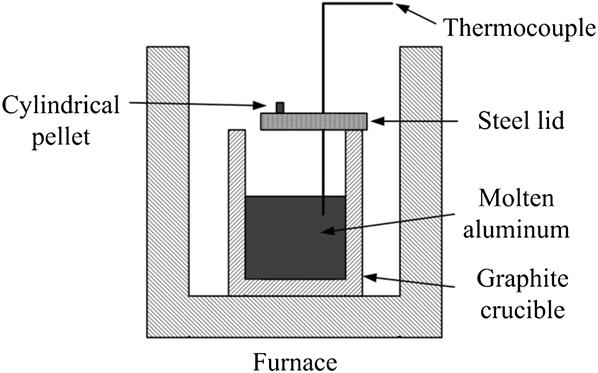
A 500 g pure Al ingot was melted in a graphite crucible in an electrical resistance furnace and superheated at 750 °C. A thermocouple was immersed into the melt to measure the temperature change during the experiment. An Al–Ti–C pellet was preheated in the furnace by putting on the steel lid coated with a boron nitride layer, as shown in Fig. 1. The preheated pellet was pushed into the molten aluminum immediately as soon as it turned red. After the thermal explosion of Al–Ti–C took place in the molten aluminum, mechanical stirring was introduced into the melt for 5 min to disperse in situ formed particles. The melt was then cast into a metal mold to form an ingot.
High temperature preheating treatment of the Al–Ti–C pellet.

The phases formed during the fabrication were examined by x-ray diffraction (XRD, Bruker D8, Karlsruhe, Germany) using Cu Kα radiation at 40 kV and 40 mA and a scan rate of 0.015°/s. The microstructural features of the sample were examined by scanning electron microscopy (SEM, JEOL* 6400, Tokyo, Japan) equipped with energy dispersive spectroscopy (EDS).
III. RESULTS AND DISCUSSION
After adding the preheated Al–Ti–C pellet into the pure aluminum melt, the thermal explosion reaction took place with strong sparks in the melt in a few seconds. The temperature of the melt increased a few degrees due to the heat released from the thermal explosion reaction of Al–Ti–C.
Some research showed that when the melting temperature was lower than 730 °C, the thermal explosion of Al–Ti–C pellet was unable to occur due to the slow heating rate.Reference Hou, Xia and Zhao9 In our research, the thermal explosion reaction of the preheated Al–Ti–C pellet was able to take place in a few seconds in the pure aluminum melt at 750 °C, suggesting that the heat accumulated in the preheating process played an important key for igniting the final thermal explosion reaction.
A. Phases of in situ TiC/Al composites
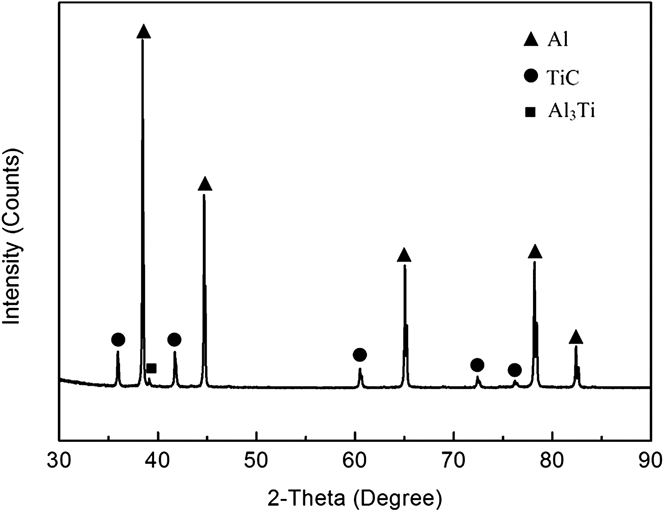
Figure 2 is the XRD pattern of in situ TiC/Al composites fabricated in our research. It is clear that TiC was the main in situ formed phase due to its strong diffraction peaks, and the amount of Al3Ti phase was rather low due to its weak diffraction peak. The result of XRD analysis indicated that the thermal explosion reaction of the preheated Al–Ti–C pellet was completed in the molten Al.
XRD pattern of in situ TiC/Al composites.

B. Microstructure of in situ TiC/Al composites
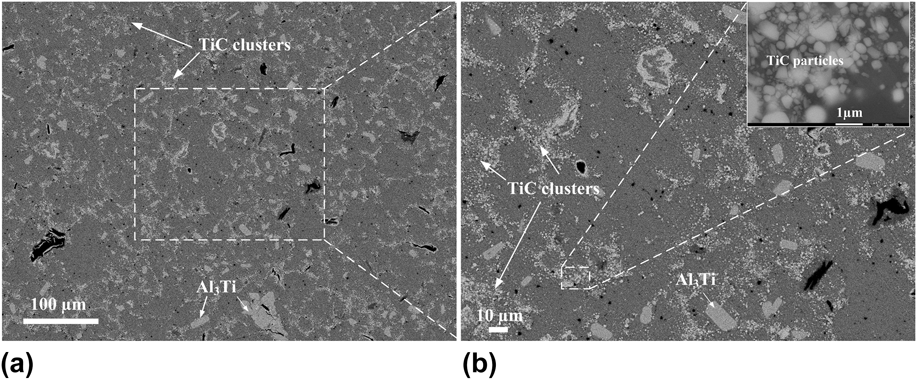
Figure 3(a) shows the typical microstructure of in situ TiC/Al composites. Overall, a relatively homogeneous microstructure was obtained. Most of the small in situ formed TiC particles identified by EDS were pushed by dendrites to the grain boundaries during the solidification. A small amount of Al3Ti particles identified by EDS existed in the matrix, which was in good agreement with the result of the XRD in Fig. 2. Some important features of in situ formed TiC and Al3Ti particles, such as their shapes and sizes can be observed in Fig. 3(b), respectively. Most of the Al3Ti particles were blocky in shape, with the average size of 10 µm. Actually the blocky Al3Ti particles can be used as the nuclei of α-Al crystals during the solidification, which are beneficial for decreasing the grain size of Al matrix.Reference Liu, Wang, Han and Li10 In situ formed TiC particles were spherical in shape and smaller than 1 µm in size. It should be mentioned that due to the formation of a little amount of Al3Ti phase, the weight percent of TiC phase should be less than 10% in the final Al composites.
(a) Typical microstructure of the mechanical stirring sample, and (b) higher magnification of the area marked in image (a).

The smaller size of in situ formed TiC particles was attributed to the low melting temperature of the pure aluminum. The related discussion will be conducted in the following section.
C. Effect of high temperature preheating treatment of Al–Ti–C pellets
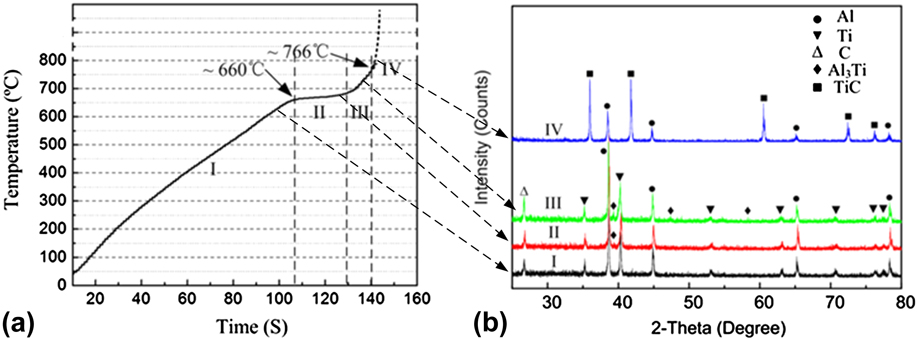
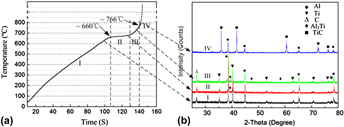
To investigate the effect of preheating treatment of Al–Ti–C pellet in the fabricating process of composites, the temperature change of the pellet in the furnace was recorded by a thermocouple. It is clear that the temperature change curve underwent for around 140 s from the placement of the pellet to the occurrence of the final thermal explosion. The temperature curve can be divided into four stages, as shown in Fig. 4(a). In Stage I, the temperature of the pellet increased to the melting point of aluminum due to the high temperature of the furnace in around 110 s. In Stage II, the temperature almost kept the same (about 660 °C) corresponding to the melting of aluminum powders in the pellet, which lasted about 20 s. In Stage III, the temperature increased obviously, 100 °C in 10 s. In addition, the whole pellet turned red, indicating that plenty of heat was released in this stage. In Stage IV, the temperature of the pellet exceeded 766 °C, and a strong exothermic reaction took place with dazzling light. Some important information about the high temperature preheating treatment of Al–Ti–C pellet can be obtained from the temperature curve. It is known that the characteristics of powders, such as the size and the ratio of each component, affect the thermal explosion reaction. By using this method, the preheating time can be decided simply. In our experiment, when the pellet turned red, the related preheating time was around 130 s, and the temperature of the pellet was in the range of 700–800 °C.
(a) Temperature change with time of the pellet preheated in the furnace, and (b) XRD pattern of the pellets preheated for different time in the high temperature preheating treatment: (I) 100 s, (II) 120 s, (III) 135 s, and (IV) occurrence of the final thermal explosion.

Furthermore, the evolution of composition of the Al–Ti–C pellet during the high temperature preheating treatment was investigated by using the XRD test of three pellets, which were heated for 100 s (Stage I), 120 s (Stage II), and 130 s (Stage III), respectively. In addition, one more pellet after the final thermal explosion (Stage IV) was examined by XRD. The results of XRD analysis of the four pellets are shown in Fig. 4(b). In our research, based on the XRD analysis, no new phase was found in the pellet in Stage I, for the diffusion reactions among solid phases were unable to take place due to the limited time. In Stage II, a small amount of Al3Ti phase was formed during the melting process of aluminum powers, for the occurrence of liquid aluminum accelerated the diffusion reaction in Al–Ti system. In Stage III, more Al3Ti phase was formed due to further reaction. The related reaction taking place in Stages II and III was given below.
 $$3{\rm{Al}}\left( {\rm{l}} \right) + {\rm{Ti}}\left( {\rm{s}} \right) \to {\rm{A}}{{\rm{l}}_3}{\rm{Ti}}\left( {\rm{s}} \right)\quad .$$
In the preheating process, only Al3Ti phase was obtained, which was in agreement with the reported work.Reference Wang, Jiang, Li and Wang12
After the final thermal explosion, only TiC phase was obtained in Al–Ti–C system. Owing to the high temperature in Stage IV, Al3Ti and Ti were melted to form Al–Ti melt. And then the solid graphite dissolved into the Al–Ti melt, leading to the formation of the thermodynamic stable TiC phase with decreasing the temperature. The main reactions were as follows.
 $${\rm{A}}{{\rm{l}}_3}{\rm{Ti}}\left( {\rm{l}} \right) + {\rm{C}} \to {\rm{TiC}}\left( {\rm{s}} \right) + 3{\rm{Al}}\left( {\rm{l}} \right)\quad .$$
 $${\rm{Ti}}\left( {\rm{l}} \right) + {\rm{C}}\left( {\rm{s}} \right) \to {\rm{TiC}}\left( {\rm{s}} \right)\quad .$$
And the overall reaction can also be as follows.
 $$\left[ {{\rm{Al}} - {\rm{Ti}}} \right]\left( {\rm{l}} \right) + {\rm{C}}\left( {\rm{s}} \right) \to {\rm{TiC}}\left( {\rm{s}} \right) + {\rm{Al}}\left( {\rm{l}} \right)\quad .$$
In our research, the melting temperature of the pure aluminum was 750 °C, which was much lower than those of conventional methods. Owing to the huge temperature difference between the molten aluminum and the reaction location of Al–Ti–C pellet, the heat generated from the thermal explosion reaction could be transferred fast into the pure aluminum melt. In situ formed TiC particles had limited time to grow up, leading to submicrometer size.
D. Thermodynamic analysis of Al–Ti–C system
Heating Al–Ti–C system, the possible reactions among each component are given below.
 $$3{\rm{Al}} + {\rm{Ti}} \to {\rm{A}}{{\rm{l}}_3}{\rm{Ti}}\quad ,$$
 $${\rm{Al}} + {\rm{Ti}} \to {\rm{AlTi}}\quad ,$$
 $$4{\rm{Al}} + 3{\rm{C}} \to {\rm{A}}{{\rm{l}}_4}{{\rm{C}}_3}\quad ,$$
 $${\rm{Ti}} + {\rm{C}} \to {\rm{TiC}}\quad .$$
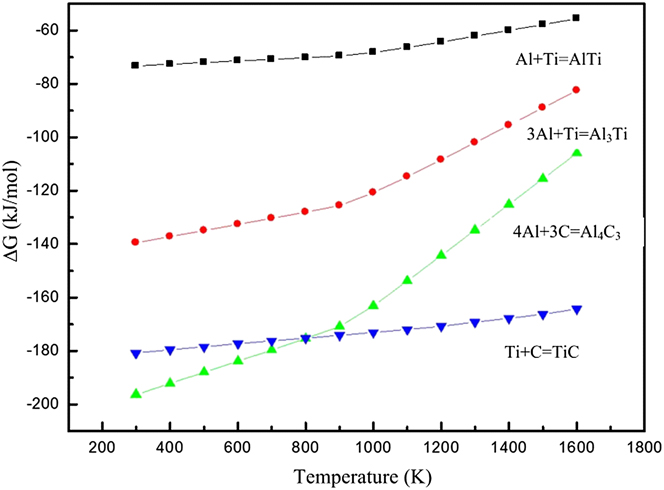
According to the thermodynamic dataReference Ye and Hu11, the relationship between the change of Gibbs free energy and the temperature of the above reactions in Al–Ti–C system is as follows (Fig. 5).
The relationship between the change of Gibbs free energy and temperature of each reaction in Al–Ti–C system.

It is clear that TiC phase is the most stable phase in the products in Al–Ti–C system. The other three phases AlTi, Al3Ti, and Al4C3 might exist as the metastable phases during the heating process. The formation of products is influenced not only by the thermodynamic factor, but also by the kinetic factor at a certain temperature range within a certain reaction time. In our research, only Al3Ti phase can be formed in the Al–Ti–C pellet during the high temperature preheating treatment, which was in good agreement with some previous reports.Reference Wang, Jiang, Li and Wang12,Reference Xu, Cui, Hao and Yang13 On the one hand, in the reactive diffusion of Al–Ti, the Al3Ti compound can be formed preferentially due to its lowest free energy formation in the titanium aluminides. On the other hand, Al–Ti system has much higher reactivity than Al–C and Ti–C system when the temperature is lower than 1000 °C, thereby the Al3Ti compound can be formed much faster than Al4C3 and TiC, yet these two compounds are more stable than Al3Ti.
In addition, since the TiC phase has the lowest ∆G, which can exist stably as the only product after the final thermal explosion reaction in the Al–Ti–C pellet [Fig. 4(b)IV].
E. DTA test of Al–Ti–C system
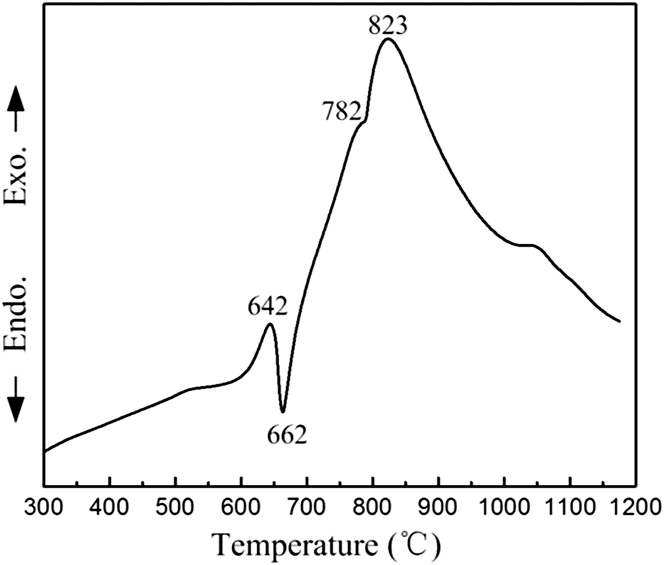
Generally, for Al–Ti–C system, the size and ratio of powders can affect the reactivity and influence the final reaction further. To investigate the thermal behavior of Al–Ti–C system in the heating process, 30 mg mixed Al–Ti–C powders were heated at 20°C/min to 1200° under Ar atmosphere in the DTA apparatus (SDT 2960, New Castle, DE). The related DTA curve is shown in Fig. 6. When the temperature heated to 600 °C, the mixed powders started to release heat. By increasing the temperature, one exothermic peak occurred at 642 °C. The heat generated in this stage resulted from the solid phase reaction in Al(s)–Ti(s) system. And then an endothermic peak occurred at 662 °C due to the melt of Al powders. After the solid aluminum powders melted, more heat can be generated due to the reaction of Al(l)–Ti(s) system. As the temperature increased, one huge exothermic peak occurred at 823 °C, suggesting the final thermal explosion reaction occurred. Due to the final exothermic reaction in the mixed Al–Ti–C powders, the new phase generated at this stage should be TiC. The other exothermic reactions belonged to intermediate reactions, thereby the main newly formed phase might be Al3Ti.
DTA curve of Al–Ti–C mixed powders.

It is obvious that the emergence of liquid aluminum in the Al–Ti–C pellet can accelerate effectively the generation of heat from the reaction of Al–Ti. The exothermic behavior of Al–Ti–C system displayed by the DTA was in good agreement with the temperature curve of the Al–Ti–C pellet during the quick preheating treatment. The DTA test showed directly that much more heat can be released in Al(l)–Ti(s) than Al(s)–Ti(s) system.
The emergence of the liquid aluminum phase in the Al–Ti–C pellet is the key of synthesizing submicrometer-sized TiC particles in the molten aluminum matrix at low temperature. The above analyses were mainly conducted from qualitative aspect in terms of the change of Gibbs free energy and the DTA test of Al–Ti–C system. The related quantitative analysis will be discussed as below briefly.
F. Reaction enthalpy of Al–Ti system
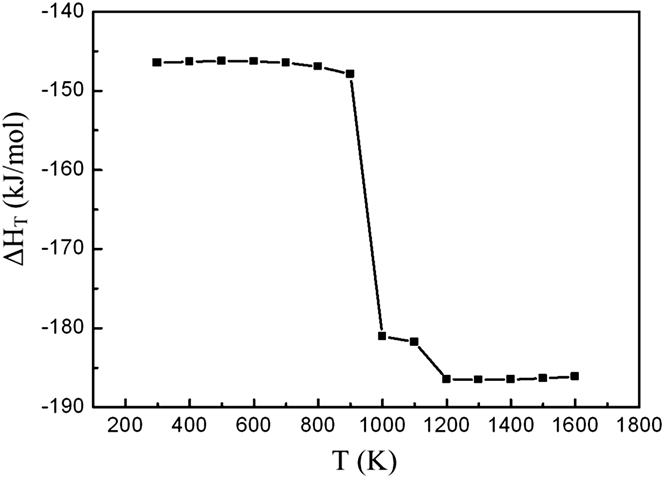
In the high temperature preheating process, the solid aluminum powders were melted due to the high temperature in the furnace. Al(s)–Ti(s) system in the Al–Ti–C pellet was changed to Al(l)–Ti(s) system, which resulted in the generation of more heat due to the reaction between liquid Al and Ti. Based on the thermodynamic data of Al–Ti systemReference Ye and Hu11, the relationship between reaction enthalpy and temperature of Al–Ti system is shown in Fig. 7. It is an exothermic reaction due to the negative values of ∆H T. In Al(s)–Ti(s), it is clear that 145 kJ of heat is produced when 1 mol of Al3Ti is obtained. For Al(l)–Ti(s), the value of heat increases to 185 kJ.
The relationship between reaction enthalpy and temperature in Al–Ti system.

Actually, Al(l)–Ti(s) system can produce much more heat than Al(s)–Ti(s) system in the same time. On the one hand, the reactive diffusion between aluminum and titanium can be accelerated greatly. In the Al–Ti system, the reaction rate for the formation of Al3Ti phase can be evaluated by diffusion coefficients for the species. It is known that the impurity diffusion coefficient in two species is usually described by the Arrhenius equationReference Liu, Rakita, Han and Li14:
 $$D = {D_0}\exp \left( {{{ - {E_{\rm{A}}}} \mathord{\left/ {\vphantom {{ - {E_{\rm{A}}}} {RT}}} \right. \kern-\nulldelimiterspace} {RT}}} \right)\quad ,$$
where D 0 is a temperature-independent pre-exponential (m2/s), E A is the activation energy for diffusion (J/mol), R is the gas constant and its value is 8.31 J/mol, and T is the absolute temperature (K).
For Al–Ti system, the related data of D 0 and E A in different temperature scales can be obtained through other researchers' work.Reference Krafcsik, Gyulai, Palmstrom and Mayer15–Reference Du, Chang, Huang, Gong, Jin, Xu, Yuan, Liu, He and Xie17 Based on our former workReference Liu, Rakita, Han and Li14, it was found that the diffusion coefficient for aluminum (D Al/Ti) in titanium and the diffusion coefficient for titanium (D Ti/Al) in aluminum in the Al(l)–Ti(s) system in the temperature range of 700–850 °C were much larger than those in the Al(s)–Ti(s) system in the temperature range of 300–600 °C. The values of D Al/Ti and D Ti/Al in the Al(l)–Ti(s) system were around 105 and 108 times than those in the Al(s)–Ti(s) system, respectively. As a result, more Al3Ti phase can be formed in the Al(l)–Ti(s) system compared to the Al(s)–Ti(s) system within the same preheating time. On the other hand, it should be mentioned that liquid Al can be spread on the surface of solid Ti powders easily in Al–Ti–C pellet due to the capillary force, leading to the increase of contact area between aluminum and titanium. Thereby, more Al3Ti phase can be obtained. Based on the above reasons, more heat can be generated and accumulated in Al(l)–Ti(s)–C(s) pellet in a very short time, and the heat can ignite the final thermal explosion of the Al–Ti–C pellet in the molten aluminum.
In addition, the high temperature preheating treatment is simple to be carried out, for the pellets are heated in the same furnace in which the pure aluminum was melted. This method can be extended to the mass production of in situ particulate reinforced Al composite materials due to its simplicity and low cost.
IV. CONCLUSIONS
In this research, a simple method for fabricating submicrometer-sized TiC particles reinforced Al composite materials at 750 °C was proposed by using the high temperature preheating treatment of Al–Ti–C pellets. In situ formed TiC particles were spherical in shape and smaller than 1 µm in size. By comparing with the conventional methods, the synthesizing temperature was reduced significantly and the size of in situ TiC particles was decreased obviously as well. Also this approach could be extended in the mass production of in situ particulate reinforced Al composites.
ACKNOWLEDGMENTS
This research was supported by the US Department of Energy under Award Number DE-EE0001100, the North American Die Casting Association, and the China Scholarship Council of the Chinese Ministry of Education.