When Seth Parker Woods unwrapped his ice cello from its casings, the room turned cold. 26 April 2018: the Black Family Visual Arts Center Atrium at Dartmouth College.Footnote 1 Dressed in a full-length wetsuit, the cellist knelt on a raised, stark white platform as a technician helped ease the 120-pound obsidian ice instrument into position. In the lull, the audience read their programme notes: ‘The inherent vulnerability of a melting ice sculpture – with its eventual destruction – serves as a commentary to overlooked and undocumented cases of mental disability within underrepresented populations. This work serves as an ode to these struggling minds, and bruised, tattered, and broken bodies on display.’Footnote 2
The performance began. I heard the sound of fabric on ice as Parker Woods stroked his cello, running his hands over its curves. I heard the tap of metal rings on the icy surface, the bite of a chisel chipping away at the instrument, computer-generated processing of the sounds produced onstage, a heavily vocoded sample of what I later learned was poetry. The audience's attention converged on Parker Woods's performative movements and the sounds they produced, all framed by the revelations of the programme notes.
Iced Bodies comprises one layer of an artistic genealogy that takes into account the aesthetic and reception histories of two previous versions of this piece. In London 1972, mixed media artist Charlotte Moorman walked onto a concert hall stage – nude – and played a cello made out of ice cubes until the instrument melted to nothing. According to composer and collaborator Jim McWilliams, Ice Music for London was a piece about time.Footnote 3 Within the context of the 1970s, the piece also became a commentary on the female body in art and life, as well as on the literal and metaphorical dangers of the avant-garde.Footnote 4 In 2001, cellist Joan Jeanrenaud reimagined Ice Music to include a sleeveless wetsuit and the addition of electronic sound. Ice Cello, Jeanrenaud maintained, was a piece about transformation.Footnote 5 It can also be read as a meditation on the nexus of femininity, illness, and aging in the early twenty-first century. Parker Woods's reworking of Ice Music/Cello into Iced Bodies reframed the hermeneutic possibilities yet again – now explicitly positioning the piece as an exploration of the relationship between race and the treatment of mental illness. Through the creation and distribution of lengthy, detailed programme notes, documentaries, and interviews, Parker Woods took a more active role than either of his predecessors in guiding the audience's interpretation of his performance and its past.
I argue that Ice(d) Music/Cello/Bodies has become a musico-political palimpsest, a measure of the way Moorman and her art have been incrementally recuperated through a performative historiography. The notion of a palimpsest implies a writing surface that has been scraped or washed in order to be reused; if paleographers were once limited to examining what could be seen by the naked eye, increasingly sophisticated technologies and methods now make legible traces of even the oldest layers. The palimpsest as a theoretical lens, then, insists on texts as simultaneously overwritable and recoverable. In the case of Moorman, a polarizing figure who was all but erased from the literature and has been only recently acknowledged as integral to the history of the 1960s performative avant-garde, this duality offers the opportunity to recognize and mitigate the myths and memories that have shaped her reception. The palimpsest metaphor serves as a means of bringing together disparate primary and secondary sources, acknowledging their availability or absence at any given moment in time, and accounting for disagreement between them. As each further iteration of Ice Music is produced and Moorman's star is brought back into focus, the previous versions – and the histories and biography on which they rely – are partially obscured, imperfectly overwritten in the service of constructing the new, the modern, or the relevant.Footnote 6 In this article, I reconstruct the historical circumstances and assumptions under which Moorman, Jeanrenaud, and Parker Woods realized their performances; in the process, I explore how a piece initially representative of an artist so closely linked to her social and cultural time has been performed and interpreted out of its time.Footnote 7 Thick descriptions of the sensory material of Ice Music, Ice Cello, and Iced Bodies are interleaved with archive- and interview-driven analyses that make visible traces of the palimpsest as it existed in 1972, 2001, and 2018.
The resulting histories and historiographies of Ice Music are inextricably tied to the intellectual and social history of bodies, as well as to emerging conversations about vulnerability and risk within the context of performance. More specifically, I show how contemporary discourses of gender and race are materialized through the physical and metaphorical resonances of these performers’ individual bodies in proximity to their unusual musical instrument. Drawing on work by Elizabeth LeGuin, Kirsten Hoving Powell, Alexander Weheliye, and Simone Browne, I reassess this relationship to include instruments as bodies (in addition to bodies as instruments, and instruments and bodies) in order to address how these performances have both positioned themselves and been positioned as ‘political’.Footnote 8
Ice Music, 1972
Charlotte Moorman – Juilliard-trained cellist, mixed media artist, impresario of the well-known Annual New York Avant Garde Festivals – performed artist and composer Jim McWilliams's Ice Music for London for the first time at the London-based International Carnival of Experimental Sound (ICES) organized by Harvey Matusow and Annea Lockwood in August, 1972.Footnote 9 A photo from Moorman's concert included in a Saturday Review article by American journalist Carman Moore began the process of myth-making: ‘Charlotte Moorman, wounded and nude, plays her melting ice cello’, the caption read.Footnote 10 The photo is a dramatic side-profile shot, the barely shaped lump of ice almost glowing while most of Moorman's naked body stays in shadow. Her face is serious; her body in perfect ‘traditional’ cellist position, clear plexiglass bow poised above her instrument. Two other photos from the premiere further illuminate the scene. One shows the ice cello balanced on a wire cage placed inside a shallow basin. Incongruously, Moorman appears to be wearing sensible shoes.Footnote 11 The other is a close up – close enough to see that the ice instrument was made of many individual ice cubes fused together.Footnote 12 Close enough to capture the bandages wrapped around Moorman's knees and left breast; these are the points of contact skin to ice. Close enough to make visible the ‘wound’ mentioned in Moore's caption: an impressive, by no means fully healed scar running from sternum to belly.Footnote 13
‘Miss Moorman came to the stage, threw aside her cape, grandly ripped the hospital bandages from her healing side, and snuggled up to her accustomed spot where the cello's back and finger board meet’, according to Saturday Review.Footnote 14 Drama, dedication, danger: these three attributes may as well have served as Moorman's signature. Their collective effect bridged the distance between expectations for a cellist playing a cello and those for an artist performing at an experimental festival. ‘Sound there was’, Moore assured his readers. ‘The sound of water dripping … from time to time the sound of ice falling off in a chunk … subthreshold sounds of bow on ice. She shuddered without showing it for the hour or so that elapsed before the instrument finally fell away into water and cubes – it was a virtuoso performance, legendary in proportion’.Footnote 15
Moore's sonic analysis is borne out by a single extant recording. Though Moorman did not obtain a copy for her archive, the University of Kansas Sound Archive holds the master reels of all recordings made at ICES ’72 – including the last five minutes of Ice Music, when we must imagine the cellist's body wracked with cold.Footnote 16 We hear the sounds of Moorman hitting the cello, dragging her bow across its body to make the ice crack and groan. The audience laughed and talked quietly; ice chips slid across the floor. At one point, Moorman repeatedly hit her instrument: a rhythmic event. At the last, a final series of targeted bowings produced a sound louder than anything that had come before – a sound like fireworks – before the audience erupted into cheers.
Moorman performed Ice Music a total of seven times between 1972 and 1978 (see Appendix). The extant archival documents and photographs serve as both a significant point of access to the sensory experience of these lesser-known versions of Ice Music, and as a map of Moorman's evolving understanding of the piece's identity. Collectively, they suggest a trajectory that simultaneously grew more spectacular with the addition of costumes, props, sets, and sonification; and more streamlined through the compilation of detailed lists and diagrams sent ahead to venue organizers. The palimpsest metaphor accounts for each variation in logistics, aesthetics, and potential semantics: Moorman's approach – far from upholding a “definitive underwriting” – embraced mutability. Non-negotiably, however, the cellist appeared onstage naked to play her instrument made of ice.
Moorman debuted Ice Music in the United States as an invited guest to New York University's ‘Art Speakers Series’ on 7 March 1973.Footnote 17 After some disappointment in the physical appearance of the cello body at the premiere, Moorman sent a letter to Jack Demyan (owner of the catering service Demyan's Hofbrau, Inc.) that included a ‘pattern outline’, a photo of her wooden cello, and another showing her playing posture.Footnote 18 Moorman and McWilliams also added a white feather boa around the cellist's neck and in her hair (‘cinderella feathers’, she called them in her Daybook), and the addition of a bank of heaters at the edge of the stage to curtail the overall run time.Footnote 19 One last adjustment based on the experience of the premiere: Moorman began taking an oral antihistamine prescribed by a doctor to counter the effects of the cold and the possibility of frostbite.Footnote 20
New York University's student newspaper, the Washington Square Journal, published a review of Moorman's performance on 13 March 1973. ‘Celloist [sic] Figuratively Cracks the Ice’, the title read.Footnote 21 No byline is given for the article that follows, but it seems to have been written by someone unfamiliar with the avant-garde. If so, it offers a rare glimpse into the thoughts and rationales of an outsider processing the sights and sounds of a Moorman performance. ‘To the avant-garde, she was of course Charlotte Moorman and playing her ice cello was expected. But to the man off the street, it was a naked woman scraping a piece of ice with a piece of plexiglass. … The trouble was, it made no discernable sound’, the article continued.Footnote 22 Nonetheless, the author took pains to pigeonhole the piece into a standard musical vocabulary: she looked like she was ‘playing’ a cello, the writer noted, and clearly she was a ‘virtuoso’ since she had no need of ‘sheet music’.
During what seemed to be crescendos, Moorman struck the cello with her bow quite severely, causing pieces of ice to fling onto the floor and into the audience. Occasionally the audience heard the sounds of performance – water dripping, and pieces of ice falling. Also heard was an annoying studio feedback from the Loeb Student Center South Lobby's sound amplification equipment; maybe the feedback was supposed to ‘happen’.Footnote 23
‘After all’, the article concluded, ‘it was art’.
Moorman's next invitation to perform Ice Music for New Jersey was scheduled for 13 April 1973 at William Patterson College's ‘Salon de Refusés (anti festival)’ (Figure 1).Footnote 24 In the snapshots from the archive, the ice cello is clear and bright, and Moorman wore pink orchid corsages at her wrist, her left breast, and her groin. Once again, Moorman asked for and received heat lamps.Footnote 25 By the third performance, then, Moorman had a quickly reifying sense of what worked, as well as a wish list of what could be improved. To that end, two new, significant words appear in her Daybook – ‘speaker’ and ‘throat mike’ [sic]. These requests not only uphold the centrality of sound to Moorman's conception of Ice Music, but also acknowledge an evolving sonic profile.Footnote 26 As for choreography, a photographic time-lapse taken near the end of the night clarifies the gradual deterioration of the melting instrument: the neck falls off the body of the cello first, and Moorman's own body – specifically, her knees – takes the full brunt of the remaining ice. She adjusts her posture, hunching forward to accommodate the new weight distribution, and continues to perform until the moment the cello is so small, so slippery, she can no longer hold it in her arms.Footnote 27
Charlotte Moorman performing Ice Music, New Jersey 1973. Charlotte Moorman Archive, Charles Deering McCormick Library of Special Collections, Northwestern University Libraries.

The third and final stop on Moorman's 1973 tour of Ice Music was artist Marta Minujín's show ‘Soft Gallery (200 Mattresses)’ at the Harold Rivkin Gallery in Washington DC.Footnote 28 Titled Yellow Ice Music for Washington D.C., the 24 April performance claimed the distinction of colour: the sculptors dyed the cello yellow at the behest of McWilliams, and thanks to the largesse of David Bourdon, a music critic and art world friend, who contributed $50 to underwrite an instrument. (‘I think that's a pretty small price to pay for bringing culture to Washington’, Bourdon wrote in a letter to Moorman. ‘The whole town belongs under yellow ice’.Footnote 29) The distinctive colour of the cello paired well with the distinctive venue: images captured by Hal Christian Walker show a performance space padded on every side with old mattresses Minujín rented from squatters around the city. In Walker's photographs, Moorman sat on a chair anchored to a wall mattress, the entire rickety-looking contraption tilting forward just so with gravity nestling her nude body against the ice instrument. Audience members sat cross-legged mere inches away from the cello; others packed in around the edges of the gallery, or pushed in at the door.Footnote 30 ‘The performances staged in this space shared a common interest in creating a more visceral and intensified embodied experience for the viewer’, Nadja Rottner writes in her article ‘Marta Minujín and the Performance of Softness’.Footnote 31 Like Ice Music for London audiences one year earlier, the attendees at Yellow Ice Music for Washington D.C. would have listened to the ice melt over the course of the piece and seen a corresponding erosion of the cello's form. In this case, however, the water droplets falling (softly) from the melting instrument would have made their mark visible through presence as well as absence – each drop another spreading stain for the mattresses’ collection. In that insulated room, Moorman's bowing would have sounded even more muffled, even more desperate. And the shivers rippling up and down Moorman's naked body may have signified something different in the context of Minujín's feminist art commentary on ‘the city's best known flophouse’, as the Washington Post called the building from which she collected most of her mattresses, and the dangers its residents faced.Footnote 32 Even within Moorman's oeuvre, not all Ice Music performances were created equal; this version's juxtaposition with Minujín's 1970s-era social commentary may have opened up new possibilities for audience members and scholars to overwrite their own meanings onto the palimpsest.
After those concentrated performances of 1973, the piece temporarily receded into Moorman's back catalogue. It re-emerged, however, when Moorman met Australian John Kaldor, a fabric maker whose company periodically sponsored ‘Art Projects’. With the support of the Visual Arts Board of the Australia Council, Kaldor organized an all-expenses paid tour to Australia for Moorman and her frequent collaborator, Nam June Paik, in spring 1976.Footnote 33
When Frank Pileggi, Moorman's husband and manager, reminisced about Ice Music for Adelaide (22 March), he first remembered Moorman's objections to being asked to perform at the same time as John Cage, who had also been brought to the city. According to Pileggi, Moorman's loyalty was such that she would not agree. ‘No, I'm sorry, I just won't go against John Cage’, he reported her saying. In the end, she performed Ice Music on the mall outside Cage's venue; the audience could walk by on the way in, check back at intermission, and see the finale after Cage's show. ‘They built an amphitheater’, Pileggi recounted. ‘They wired it for sound, they got the best speakers – because the whole idea of the ice cello is: as the ice drips, sometimes it just drips, sometimes it comes off in huge chunks, and you get all these different sound effects. And sometimes it sounds like a war.’Footnote 34 Pileggi's comment, once again, opens up semantic space for reading new meaning into the sonic properties of this version of Ice Music – perhaps now in the context of an American abroad in 1976, less than a year after the US government evacuated its troops from Vietnam.
Moorman's 3 April performance in Sydney is represented in the archive by a small number of snapshots scattered through multiple folders.Footnote 35 After a pre-performance ritual consisting of two assistants painting antihistamine cream onto her thighs, Moorman took to the stage. She sat with her ice cello on a wooden stool in front of a blue backdrop, an enormous lei around her neck, flowers covering her groin, and the usual practical black shoes on her feet.Footnote 36 Someone had placed a barrier in front of the stage, and Moorman appeared alone and untouchable from her dais.
A gap in time, then, which brings us to Moorman's seventh and final performance of Ice Music. There are no photographs, no reviews, no recordings – all that remains in the archive are a few letters and its inclusion on Moorman's CV. In autumn 1976, not so long after Moorman returned from her Australian success, the cellist received an invitation from Hans Otte to appear in the May 1978 Pro Music Nova Festival in Bremen, Germany.Footnote 37 True to Moorman's usual form, Otte spent the next year and a half hounding her for confirmation of her participation. She finally replied sometime after November 1977: ‘As I promised you’, she wrote, ‘I am enclosing two drawings (actual size) of the outline of my cello (front and side views). If your ice factory would use these drawings, we will have a perfect ice sculpture of my cello.’Footnote 38 As usual, she also requested microphones and amplifiers, a stool, heaters, metal sheets, and ‘one sympathetic physician who will not laugh at my frostbite after the performance’.Footnote 39 Brief, efficient: the sign of a piece often-performed, albeit for the last time.
The photographs and reviews that document the seven performances of Ice Music raise a constellation of themes as pertinent for audience members then as for those of us revisiting the piece fifty years later: nudity in art, politics via art, the spectacle of danger, and the danger of the avant-garde. The ‘official’ subject of Ice Music – the subject flagged by the man who conceptualized the piece, Jim McWilliams, and the subject that Moorman's biographer Joan Rothfuss inscribed in her book Topless Cellist many years after the fact – is time: ‘With the passage of time ice melts’, Rothfuss writes, ‘flesh shrivels, flowers wilt, and music is made.’Footnote 40 ‘Time’ is a timeless interpretation of Ice Music; Rothfuss's prose is reminiscent of Romantic poetry speaking Great Human Truths: ‘The flowers fade and wanton fields/To wayward winter reckoning yields’, Raleigh's nymph replies to Marlowe's shepherd. It is also a remarkably generic interpretation in the context of the surprise, elation, or horror that contemporary audiences must have experienced when a naked woman took the stage with a cello made of ice (the Washington Square Journal article serves as evidence), not to mention a remarkably apolitical interpretation in the context of an experimental art world often deemed inherently leftist by virtue of its status outside the mainstream.Footnote 41 ‘Always, eventually’, Rothfuss continues, ‘both performer and audience are left with nothing.’Footnote 42 Except, at the end of Ice Music for London, both Moorman and her audience are left with something: Moorman's physical, visceral, shuddering, shivering, naked, female body. Regardless of composer/performer intent, the incongruity of a classically trained cellist playing in the nude was bound to provoke reactions and encourage interpretations.
This was not the first time that Moorman put her body on display in the service of her art. Notably, five years earlier in 1967, Moorman's topless performance of the Second Aria of Nam June Paik's Opera Sextronique resulted in her arrest on charges of indecent exposure.Footnote 43 Moorman built her career on spectacle – ‘provocation’ according to art historian Kristine Stiles – and she relied on nudity as a cornerstone of her strategy.Footnote 44 The notoriety that ensued in the wake of the Opera Sextronique scandal was a burden to Moorman in theory, but a boon in practice: the ‘topless cellist’ moniker made her a known quantity, and opened as many doors as it closed in her efforts to secure performances and leverage influence.
Whether Moorman conceived of or engaged with her performances – nude or otherwise – as political statements, however, remains an open question.Footnote 45 Though a number of her pieces refer to national politics (Paik's ‘Guadalcanal Requiem’ and Giuseppe Chiari's ‘Per Arco’, for example), and others can be read in light of sociocultural norms (her performance bowing Paik's bare back in ‘Human Cello’, as one among many), Moorman's tendency to ‘merge denial and consent’ – to claim or abdicate responsibility for her provocations as it suited her purposes – complicates her status as a political artist.Footnote 46 In her own time, Moorman's disinclination to align her nudity with the goals of so-called second wave feminism earned her a cadre of harsh critics.Footnote 47 In an often-quoted pronouncement by feminist Andrea Dworkin, Moorman was a ‘harlot’, and her career ‘a process of extended rape’.Footnote 48
Despite Dworkin's disapproval, in the context of 1972, Moorman's naked body would inevitably have been read (and, I would argue, still is read) in light of the contemporary women artists who put their nude or semi-nude bodies on provocative display precisely to ‘bring an awareness of feminist concerns to the practice of art making, thus explicitly proposing the idea that art could be a form of political practice’, in the words of art historian Jayne Wark.Footnote 49 Scholars including Rebecca Schneider, Kathy O'Dell, and Amelia Jones have all explored early 1970s body art's performative critique of object/agent dissonance within the Western patriarchy via works by (to name only a few) Carolee Schneemann, Yvonne Rainer, Yoko Ono – artists, dancers, and musicians who were also Moorman's friends and colleagues.Footnote 50 Moorman and McWilliams may not have conceived of Ice Music as ‘feminist art’, but their creation does trade on a number of parallel histories rooted in contemporary social mores related to women in art and life.Footnote 51
If the possibility of political and artistic intertextuality fuelled the spectacle of Ice Music, so too did Moorman's body in simple proximity to the material substance of ice. Ice Music accrues meaning in the face of real and present danger. Indeed, for experimental composer, poet, and theorist Dick Higgins, danger – whether spiritual, psychological, or physical – was one hallmark of the 1960s performative avant-garde:Footnote 52
[A] work which is without [the possibility of danger] only decorates life and so is merely a commodity; the most intense art is necessarily involved with these things … because they are implicit in the new mentality of our time. This mentality is one in which total success is impossible, total victory inconceivable, and relativism axiomatic.Footnote 53
Performance scholar Alice O'Grady expands the theoretical reach of Higgins's argument; while she notes that a certain amount of ‘risk’ is inherent to all performance, she also offers the concept of risk (physical, social, emotional, cultural, or cognitive) as a means of examining the ‘tensions between vulnerability and agency’.Footnote 54 When Moorman placed her body in contact with a block of ice for hours at a time, she ran the risk of failure in the form of permanent damage to that body. Frostbite, after all, is the death of skin tissue. The introduction of the space heaters as early as her second performance may have shortened the run time in an attempt to keep the audience's attention, but it also ensured that Moorman was relieved of physical contact with a block of ice as quickly as possible.
Ice Music also engages with a second, metaphorical – or, in Higgins's terms, ‘psychological’ – danger. Moorman called into question traditions related to music, and to women in music, by superficially adhering to the conventions of her craft – via techniques ranging from bowing posture to command of the stage – even as she performed not in concert dress, but naked, with a cello not made of wood, but of ice. An agonizing incongruity imbues those hushed bow strokes standing in for Bach or Saint-Saëns while Moorman shivers her way past death and dismemberment. Moorman ‘corrupted’ cultural inheritance by playing the kind of music she did, by linking ‘high art’ to spectacle, and by displaying her female body in the face of a male lineage of composers and performers. The avant-garde was its own kind of danger.
Within O'Grady's framework of risk, Moorman's body and its relation to feminist art, and Moorman's body in relation to physical and generic danger are intimately connected. Ice Music may have been dangerous, but Moorman sought out that danger. She collaborated with McWilliams willingly and often – when he composed a piece that involved covering her body with melted chocolate (suffocating her pores), or when he asked her to play her cello from a harness attached to forty helium balloons (one faulty strap away from a steep fall).Footnote 55 ‘Jim McWilliams says he didn't intend this composition to be dangerous or difficult’, Rothfuss wrote. ‘As he got to know Moorman better, however, he came to believe that she enjoyed “suffering for her art”.’Footnote 56
In the early 1970s at the naissance of the feminist movement in art, a male composer asking a female performer to hold ice against her bare skin for the many hours it takes to melt – despite her consent – reflects the tension between vulnerability and agency that shaped Moorman's career and would come to make her an uneasy fit for histories of either avant-gardism or feminist practice. The gesture of collapsing the meaning of this request and this act into ‘Time’, such that ‘both performer and audience are left with nothing’, is an erasure of physical, female endurance (and the dangers that entailed) that is not consistent with the extant documentation. At the end of Ice Music for London, after the last stroke had been bowed, after the last ice chunk had melted, Moorman's body took centre stage.
Ice Cello, 2001
As a young girl first learning to play the cello in the 1960s, Joan Jeanrenaud remembers watching Charlotte Moorman on the Johnny Carson Show at the height of her notoriety post-Opera Sextronique.Footnote 57 That image of Moorman stayed in the back of Jeanrenaud's mind as the younger cellist made her career playing new music of all stripes in the renowned Kronos Quartet. But Moorman was brought to the forefront, so the story goes, with the onset of illness, the breakdown of Jeanrenaud's body. Jeanrenaud was diagnosed with multiple sclerosis in 1998, retired from Kronos and its punishing touring schedule, and (her classical bona fides secured) struck out on her own to play even newer new music.Footnote 58Ice Music-turned-Ice Cello was among her first solo productions; in 2001, the Walker Art Center invited her to perform her ‘re-staging’ on their campus in Minneapolis.
Jeanrenaud's renewed interest in Moorman and her avant-garde was catalysed by a chance encounter with an exhibit featuring the Moorman–Paik collaboration TV Bra for Living Sculpture.Footnote 59 In 1999, she began by contacting a number of Moorman's friends and colleagues including Jim McWilliams and Barbara Moore, the executor of Moorman's estate and temporary keeper of her archive. ‘The piece that stuck out to me the most [during my encounter with the archive] was Ice Music for London’, Jeanrenaud told me in 2018, ‘and I decided I was going to try to read through that piece’.Footnote 60 According to an essay she wrote for The Strad magazine in 2006, however, Jeanrenaud never saw images of Moorman's performance.Footnote 61 Nor could she have relied on scholarly descriptions, analyses, or theories of Moorman's life and work: her preliminary research took place two years before Northwestern bought Moorman's archive in 2001 and began the long process of cataloguing the materials and making them available to the public; more than a decade before Benjamin Piekut included Moorman in Experimentalism Otherwise (2011), his meticulously researched history of New York's experimental music scene in the year 1964; fifteen years before Joan Rothfuss published the first Moorman biography, Topless Cellist (2014). This gap in historiography provided Jeanrenaud with an unchallenged, unfettered opportunity to begin the process of recuperating Moorman's legacy through the act of performance. Her method was the equivalent of the ‘naked eye’ in paleographic studies; she mined the most visible traces of the recently scraped palimpsest, and overwrote her own details where the record was less than forthcoming.
With help from McWilliams and Moore, Jeanrenaud envisioned an Ice Cello for the new millennium that took advantage of the latest technologies to shape both image and sound. She began by contacting the Canadian company Ice Culture to measure her cello, a 1750 Deconet, for a mould in two parts. For each performance, the company filled the moulds and shipped the resulting ice instrument – still in two pieces – to a freezer close to the performance site. A technician would then fuse together the cello's main body and its neck, and set it on a specially made stand complete with spikes to keep the ice in place during performance. Jeanrenaud also hoped to add electronic sound to her version of the piece in order to create what she called a ‘total environment’.Footnote 62 She contacted Greg Kuhn, a sound engineer, to bring his expertise to the table.
A dry run in her hometown of San Francisco helped Jeanrenaud discover and work through the last of the logistics. Hoping to fit the performance into a more-or-less standard run time (somewhere between two and four hours) without resorting to heat, the cellist consulted with an audience consisting of her friends: musicians, artists, fabricators. ‘One of the things we told them was if you have some kind of implement that you think would help destroy the cello, please bring it’, she told me.Footnote 63 Her friends responded with brio; the saws, picks, and pitchforks rescued from their gardens and shops became the bows that Jeanrenaud brought with her whenever she performed Ice Cello – including the performance at the Walker Art Center, scheduled at 12–4pm on 20 May in Gallery A/B as part of the exhibit Yes Yoko Ono.Footnote 64 ‘My idea is that it is an installation where people come and go or pass by … not that they necessary [sic] sit and watch/listen for a long time’, Jeanrenaud wrote in an email to Philip Bither, the Walker's Senior Curator of Performing Arts.Footnote 65 The instinct that led the Walker and Jeanrenaud to agree on a free and free-form performance paid perfect homage to Moorman and her ethos.Footnote 66
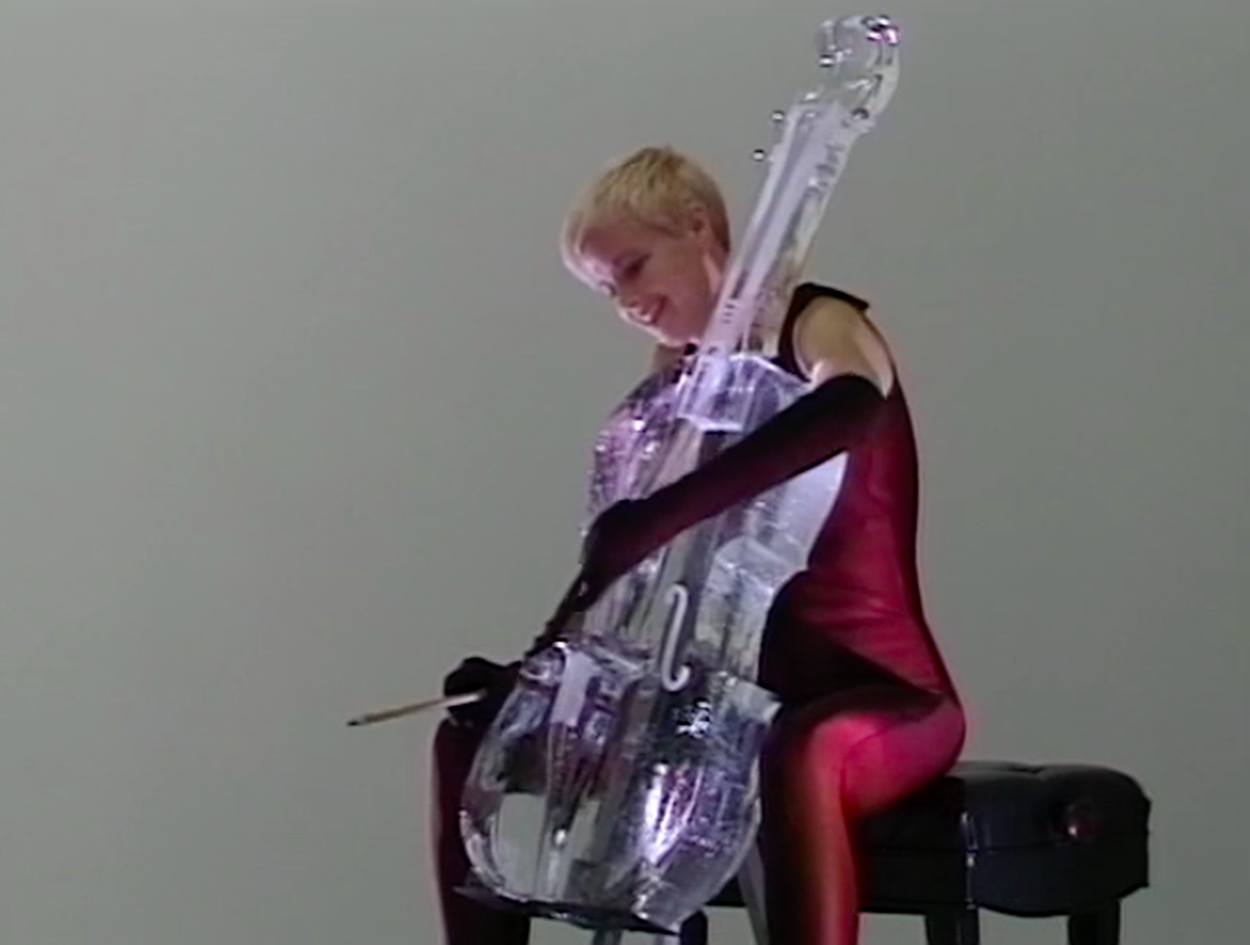
The video documentation of Jeanrenaud's Walker performance of Ice Cello opens with a shot of the stage. A museum employee removes a tarp to reveal the ice cello bound to a tripod stand set on an elevated platform.Footnote 67 The cello is exquisite: the icy replica of Jeanrenaud's pedigreed instrument does not include strings, but exhibits precise edgework, a scroll complete with pegs, and a cut-out bridge. Snow packs the fingerboard and f-holes in clear contrast to the transparency of the rest of the body. It's a far cry from Moorman's ad hoc ice cube instrument. Even at this early stage, I can both see and hear the cello dripping onto small metal plates positioned strategically below the cello stand. Jeanrenaud appears in a sleeveless neoprene wetsuit, rubber boots, and elbow-length black gloves (Figure 2). The spotlights shining up at the platform throw her body–cello silhouette into stark relief on two walls.
Video still of Joan Jeanrenaud: performance of Ice Cello, Walker Art Center, 2001. Courtesy of Walker Art Center, Minneapolis.

Adjusting her seating, Jeanrenaud assumes the position of a cellist – though, thanks to the tripod, no part of her body touches the ice directly. She picks up a bow and places it on the instrument; I expect to hear sound, but – nothing. Instead, I watch as she runs her left hand up and down the fingerboard in the pattern of a glissando. I watch the drips fall from the bottom edge of the cello and try to match them to the ambient ‘dripping’ emerging from the strategically positioned speakers. From the very beginning of the performance, sound frames the experience of Ice Cello: the sounds the audience believes it hears, the sounds it wants to hear, the sounds it never hears, and the experience of constantly questioning hearing.
Of course, real sounds as well as imagined structure the performance. As the piece goes on, Jeanrenaud periodically picks up new bows, all of which are recognizably bow-shaped and each of which constitutes both an event and a sound profile: thin tubes of plexiglass, barbed wire, something that looks and sounds like a giant toothbrush. This last is particularly noisy both sonically and visually, a multisensory tornado of brushstrokes and ice shavings. Though wetsuit-clad Jeanrenaud never obviously shivers as the newspapers report naked Moorman did, she does now and again squeeze her left hand into a fist – wringing out her waterlogged glove and in the process creating a concentrated sound event that is then re-incorporated into the electronic material piped back into the performance gallery. At times, the cello becomes a percussion instrument: Jeanrenaud strikes its body with the front and back of her bow. Attention to the ambient sound ebbs and flows as both Jeanrenaud's analogue sound events – bristle brushes, barbed wire catches, plexiglass thumps – and Kuhn's electronic additions – cello-timbred pitches, feedback – take turns occupying centre stage.
After easing the audience into the sound and feel of the piece, Jeanrenaud produces another class of bows: saws that spray ice pellets into the crowd, rasps that shave flecks of ice off the cello. These objects are violent (in fact, Joan Rothfuss, who saw Jeanrenaud perform this piece live in 2001, described her playing as a ‘violent attack’Footnote 68), and they do the practical work of breaking the ice into smaller pieces. Fifty minutes into the performance, the first big chunk of ice falls to the ground. Jeanrenaud visibly startles; viewing the recording seventeen years later, so do I. By the halfway point, Jeanrenaud's technique results in an instrument diminished: pockmarked, textured (especially where she focuses her bow strokes near the ‘bridge’ of the instrument), edges no longer clearly defined.
Throughout the piece, Jeanrenaud takes great care to play with the image of a ‘classical cellist’, a human body at work. In Boccherini's Body, musicologist Elizabeth LeGuin probes the potential of this image – the ‘framing of the cellist-body’ – as the foundation of a carnal musicology that re-stages the physical presence of musicians in order to access the historical circumstances of composition.Footnote 69 Jeanrenaud's opening gestures correlate exactly with LeGuin's ‘basic position’: she sits on a bench with the cello between her legs, she moves her left hand up and down the fingerboard, and she uses her right hand to bow. Drawing on the photographs of Moorman's Ice Music for London as well as documentation of her general performance style in the early 1970s, it is not farfetched to argue that Jeanrenaud's performative gestures would not have looked so different from Moorman's thirty years earlier.
But ‘[i]t is in the act of playing the instrument, the engagement of that cellist-body in movement and doing, that the enterprise becomes fraught with complexity’, LeGuin argues.Footnote 70 LeGuin's resulting taxonomy moves towards the particular – muscular extension, motion of limbs, release of friction – and although these apply to a study of Ice Cello, the act of playing an ice instrument also gains complexity through something much simpler: the piece ignores basic physical terms and re-frames the cellist-body. As the ice breaks down, so too do Jeanrenaud's allusions to the physical movements associated with playing the classical cello, and to the photographic and sonic evidence of Moorman's performance practice. She hits the cello all over its body with the barbed wire, ignoring the cellist's mandate to stay where the sound is purest. Instead, she creates sound everywhere, and where that sound is made, the instrument is physically changed, cracked, broken. One particularly vigorous movement, and the neck detaches. (Jeanrenaud raises her hands in victory!) With the instrument in pieces, cello posture no longer applies. She takes a saw to her instrument and the bottom right quadrant of the cello falls off in one large piece. Her bowing picks up again, becomes almost frenetic as ‘a climax’ looms on the horizon. She deliberately searches for cracks, she looks for weak spots – and then she pulls out a short-handled pitchfork and goes to work on the middle of the instrument. An instrument that no longer looks like a cello, that no longer looks like an instrument. She grins as she works – the end is near – one more thrust and she shatters what is left of the ice into hundreds of large and small pieces, and the audience cheers as one.
If McWilliams and Rothfuss have claimed that Ice Music's subject is ‘time’, Jeanrenaud champions ‘transformation’. ‘Ice is all about change, it's all about the process of being transformed from one thing into another’, she said in 2004.Footnote 71 ‘Same kind of thing with the sound’, she told me in 2018: the drips of ice create sound as they hit the metal plates waiting below before being transformed into an electrical signal that Kuhn samples, remixes, and filters back to the audience as ‘the sound of dripping’.Footnote 72 The resonances with Jeanrenaud's own personal transformations in 2001 – a woman recently diagnosed with multiple sclerosis, a cellist recently separated from the ensemble that made her career – loom large.
Over the course of my conversation with her, Jeanrenaud made several other allusions to ways of understanding her performance of Ice Cello. ‘It's really a fun piece’, she told me, proceeding to advocate for accessibility as a means of promoting Moorman and her experimental art world.Footnote 73 Indeed, a press release preserved in the Walker Art Center Archive encouraged potential audiences to consider Jeanrenaud's project as one that ‘re-stages the work in collaboration with McWilliams and Kuhn’.Footnote 74 Jeanrenaud's Ice Cello and LeGuin's carnal musicology are both kinds of re-stagings, acts of recovery through physical performance laced with imagination. And yet, Jeanrenaud's recovery of Moorman's Ice Music is less an attempt to access the historical past and more a form of homage, a plea for the recognition of an underappreciated artist. In crafting ‘a visual and sonic experience’ via the juxtaposition of the 1970s avant-garde and early twenty-first century conventions of spectacle – the spotlight's creation of a larger-than-life silhouette, the addition of technological magnifications of sight and sound, her destructive violence alluding to smashed guitars and the aesthetic trappings of rock and metal – Jeanrenaud hoped to disseminate the spirit of the avant-garde.Footnote 75
The re-staging was not, she said explicitly when I asked, a statement about danger or art traditions or feminism-writ-large. Nor, it seemed, had Jeanrenaud read Moorman's version as such. ‘I was interested to read a lot of what Rothfuss said [in Topless Cellist], because she talked about it as a very political piece’, Jeanrenaud told me.Footnote 76 ‘And I was not necessarily doing that. … For me, it was this whole idea of trying to create this enveloping environment. So for me, the political aspect was not at the forefront of my thinking. … I'm not opposed to anyone having whatever their idea of it is!’ she added.Footnote 77
Please indulge me, Joan.
In the same way that Ice Music may be read in relation to art that embodied 1970s feminist thought, Ice Cello's featured bodies – Jeanrenaud (physically) and her ice instrument (through visual and sonic metaphor) – encourage interpretations that resonate with the changing values of feminism at the turn of the century. One of the most obvious changes to Ice Music-turned-Ice Cello revolves around Jeanrenaud's wetsuit – a woman's clothing choice in the spotlight yet again. ‘[M]y outfit will be an important part’, Jeanrenaud wrote to the Walker's Philip Bither in July 2000. ‘I believe Charlotte was nude or at least topless … but, hey, not me! She also got frostbite’.Footnote 78 My interview confirmed that Jeanrenaud considered her wetsuit and gloves practical precautions – not a commentary on Moorman's feminism, not a statement on the nature of politics or political action. Her choice was also a means to an end: for one thing, by covering her body Jeanrenaud secured the opportunity to align her re-staging with an established art museum, simultaneously nudging Moorman into an emerging canon of avant-gardists and positioning herself as an arbiter of that canon one step removed from then-current discourses and politics of the contemporary avant-garde. (After all, the night before Jeanrenaud performed Ice Cello, she played a concert in the Walker's auditorium featuring arrangements by mainstays of new music including Zoltán Kodály and Philip Glass.Footnote 79) If I begin by taking Jeanrenaud's rebuff of the ‘political aspects’ of Ice Music/Cello at face value, her decision may speak to the moment in time at which she mounted her performance, as well as to Jeanrenaud's own identity. In early 2001, before the dot-com bubble burst, before 9/11 had cast its shadow on the United States, as a white woman earning her living through an art music tradition, Jeanrenaud felt comfortable performing a piece that was both ‘fun’ and ‘apolitical’.
For Moorman, however, nudity was not simply a feature of Ice Music; she conceived of the nude body as a cornerstone of the piece's otherwise fluid identity. For an audience member with any knowledge of Ice Music's performance history, to understand Ice Cello as the latest inscription on the palimpsest is to grapple with the difference in kind between the presence of Moorman's nude body and that of Jeanrenaud's clothed body. Without nudity, Ice Cello's potential for intertextuality keyed to feminist art – not to mention the question of danger – takes on a new valence. In one reading, Jeanrenaud's performance fits neatly into the third-wave embrace of individuality and the ideal of the ‘new girl’: ‘assertive, dynamic, and unbound from the constraints of femininity’, according to scholar Marnina Gornick.Footnote 80 No longer does the performer risk life and limb for the avant-garde; instead, Jeanrenaud, with her insulated suit and her saws and axes, positions herself as a danger to the ice cello – and, by extension, the generic expectations it represents. The image of a woman daring to take a pitchfork to an icon of classical music is striking.Footnote 81 The notion of a woman rejecting what was theretofore considered a key part of the piece – the risk of bare skin against ice – to ensure her own health and safety is nothing short of radical.
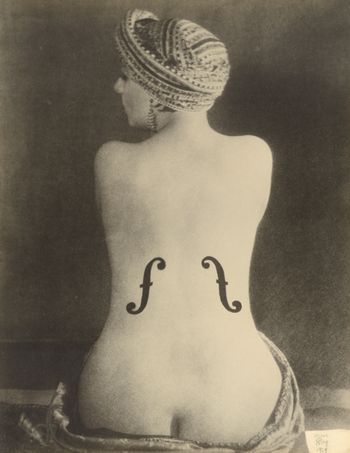
In another reading, however, the obscuration of Jeanrenaud's body serves to re-inscribe the importance of bodies to the re-staging of a piece in which nudity was once front and centre. The excess meaning, then, is transferred to the ice cello as a body – an instrument-body in pain. In Jeanrenaud's performance, the moment the neck of the cello melted off the ice instrument, the cello took on the form of a human woman's body. The shape of her shoulders, her waist, and her hips; the f-holes inscribed on her lower back: it is an uncanny inversion of Man Ray's surrealist Le Violon d'Ingres (Figure 3).Footnote 82
The J. Paul Getty Museum, Los Angeles. Man Ray, Le Violon d'Ingres, 1924. Gelatin silver print, 29.6 x 22.7 cm. © 2000 Man Ray Trust ARS-ADAGP.

In the Man Ray photograph, the transformation of a woman into a stringed instrument objectifies her, enacts ‘metaphoric mutilation’, according to art historian Kirsten Hoving Powell, in the service of ‘challenging the inviolability of tradition by violating the sanctity of Ingres's form’.Footnote 83 The violence done to the female figure in order to render her into a violin (in the process alluding to the ‘Cubo-Primitivist analogies between the shape of a woman's body and a musical instrument’, Powell points out) echoes the violence done to genre (in the process aligning Man Ray's artwork with the Dadaist impulse to parody).Footnote 84 If this well-known art artefact serves as one referent for understanding the ice cello as a woman, then violence and its correlate, vulnerability, are also primed for semantic consideration.
In Ice Cello, the transformation of a stringed instrument into a woman humanizes it, enacts ‘metaphoric materialization’. In its noun form, ‘materialization’ is the process of taking bodily form, but also the thing that has taken form; as a verb, ‘materialize’ may be coded transitive or intransitive, coerced or agential. ‘Metaphoric materialization’ acknowledges the ties between the material presence of ice, cello, and the body that emerges over the course of the piece. After making the initial art historical connection, the impossibility of un-seeing the cello as a female body encourages a reading of the piece that foregrounds the physical changes to the ice instrument heralded by the ever-present sonic drips, thunks, chips, and thwacks. Jeanrenaud's physical attack on the ice instrument in the service of sound becomes a metaphor for the way illness, pain, or aging efface women over time in a patriarchal society. The metaphor was timely: the 1990s birthed a subfield of feminist scholarship concerned with women's bodies, pain, chronic illness, and aging as a redress to the consumerist focus on a particular kind of youthful, white, idealized – impossible – female beauty.Footnote 85 Jeanrenaud's performative movements feminize the ice cello only to dehumanize her, reduce her to vulnerability, define her by the places she breaks into pieces.
Jeanrenaud's ability to claim that her performance is apolitical and to prioritize her body's safety by wearing her wetsuit can be situated within the context of a millennial feminism that measured progress in relation to and against the goals of its 1970s predecessors. The first of these conceptual–performative decisions may be – counter-intuitively – attributed to the success of the second wave. As Jennifer Baumgardner and Amy Richards memorably argue in Manifesta: Young Women, Feminism, and the Future: ‘[F]eminism is out there, tucked into our daily acts of righteousness and self-respect … . For our generation, feminism is like fluoride. We scarcely notice that we have it – it's simply in the water.’Footnote 86 So-called third-wave feminism worked to resist the idea that the women of the 1970s had achieved ‘enough equality’ to make the need for feminist activism a moot point. At the same historical moment, interventions by women of colour and queer individuals – from Kimberlé Williams Crenshaw's coining of the term ‘intersectionality’, to Leslie Feinberg's writings on sexual and gender identity – constituted critical reminders that marginalized and vulnerable women were being left behind by mainstream feminism's insistence on the ‘individuality’ and ‘empowerment’ available to white, cisgender, able women.Footnote 87 Regardless of Jeanrenaud's stated vision for the piece – or Moorman's and McWilliams's before her – the 2001 realization of Ice Cello not only re-stages Ice Music via concept and gesture, but also via interrelated ideas about performance, music, bodies, feminism, risk, and vulnerability.
Iced Bodies, 2017–2018
Seth Parker Woods, a cellist who describes himself as a ‘fierce advocate for contemporary arts’, first saw a photograph of Ice Music on his Facebook page in 2009.Footnote 88 ‘I had no idea who Charlotte was at the time’, Parker Woods told me.Footnote 89 When the photo popped up on his social media again, however, he began to think about what it might mean to recreate Ice Music as a young, African-American man representing a new generation. Several years later, Parker Woods moved to Chicago and was re-re-introduced to Ice Music through the Block Museums’ A Feast of Astonishments exhibit (2016). Iced Bodies began to take shape.Footnote 90
Parker Woods started by contacting both Jeanrenaud and the Charlotte Moorman Archive at Northwestern University, which, in turn, put him in touch with Jim McWilliams for a multi-hour phone conversation. During our interview in 2018, Parker Woods drew on all these public and private sources, conversations, and documents to paint the picture of Moorman and Ice Music that he used as a template for Iced Bodies. Some of what he told me I have not been able to corroborate through other sources, but these statements are nonetheless worth considering if for no other reason than that this was the state of the palimpsest when Parker Woods encountered it. To put it another way, archival documents, scholarship, memories, and myth equally influenced the aesthetics, logistics, and semantics of the next generation's take on the piece. According to Parker Woods, McWilliams never saw Moorman perform Ice Music.Footnote 91 In the pre-performance talk he gave before Iced Bodies for Dartmouth, the cellist told the crowd that the 1972 version of Ice Music for London had been a rush job; Moorman had been scheduled to play another piece – TV Bra, Parker Woods thought – when her equipment malfunctioned and she called upon McWilliams to conceive a new work for the imminent concert date.Footnote 92 McWilliams wrote what became Ice Music. Though he was never present in the audience for any of its iterations, he nonetheless remained a critical collaborator and advisor as the piece took root in Moorman's core repertoire. One of their joint innovations included the yellow cello in DC. Parker Woods told me that was only the beginning; many of the cellos contained dye in all colours of the rainbow: blue, pink, purple. Moorman's various props – suggested by McWilliams for each individual city – also frequently corresponded to the colour scheme of the moment, although neither artist ever explained their reasoning behind tying a particular colour or flower to a particular place.Footnote 93
McWilliams's memories combined with documentation from the Moorman Archive constituted precedent, the rules-to-be-broken that shaped Parker Woods's initial thoughts about Iced Bodies. ‘How can I bring this piece into 2017 while paying tribute to it?’ he asked in an interview during a short documentary about the project.Footnote 94 The idea of ‘modernizing’ Ice Music runs through every aspect of Parker Woods's process, from the technology he used to create the ice cello, to the addition of electronics both within and outside of the ice instrument, to the explicit motivation for and meaning of Iced Bodies as expressed in programme notes and interviews.
Parker Woods roots his interpretation of Ice Music – his ode to ‘struggling minds and … broken bodies on display’, as he writes in the Iced Bodies programme notes – in his own lived experience: a move to a new city, his family history, a stated commitment to social consciousness.Footnote 95 The invisibility of mental illness in the homeless population of Chicago inspired him to research the historical connections between asylums, prisons, and the weaponization of mental illness towards the incarceration of black men.Footnote 96 ‘I have to say something, do something’, Parker Woods said. ‘I can't just play – yes, I can play my concerts as a normal cellist, but I've got to do something bigger. And that was the impetus for starting this piece.’Footnote 97 His solution – to invoke Moorman's Ice Music rather than repertoire from his career as a ‘normal’ classical cellist – speaks to the politics of risk that may be read into her body's interaction with an instrument made of ice. Parker Woods, however, disagrees: ‘There was no political undercurrent when Jim thought [Ice Music] up. If there was, he didn't voice it. I don't know how Charlotte thought about it … but I guess she felt strongly enough about it that she did it as many times as she did.’Footnote 98 His assertion reads as an attempt to set his work apart from its historical precedents, even as it claims a stake in its ‘authorship’. Unlike both Moorman and Jeanrenaud, Parker Woods explicitly foregrounds an interpretation of Iced Bodies that calls upon current events. By highlighting the experience of raced, male, mentally ill bodies in the twenty-first century, he aims to encourage both reflection and action from the audience on behalf of those bodies:
It's really a protest song, a protest piece. My aim is to get people, to wake them up at least. To get people to take action, to be aware and maybe learn about mental illness, maybe learn more about schizophrenia, maybe investigate more about privilege and more about the racialization and politicization of governmental and state and local infrastructures. [Get the audience] to where they see themselves as helping to better. That is really my aim and goal. Not to just say: I went out and I cultured today.Footnote 99
Though Parker Woods never mentioned the Black Lives Matter movement by name during our interview, its presence is felt in many of his statements about the conception and realization of Iced Bodies – so much so that The Dartmouth (Dartmouth's campus newspaper) published an article situating Iced Bodies as ‘a piece about the Black Lives Matter movement’.Footnote 100
To enact his social critique, Parker Woods and his collaborators turned to the ice instrument, its symbolic affordances, and the sonic possibilities raised by its interaction with technology. In the beginning, Parker Woods imagined a cello in homage to Moorman's very first ice cello: something decidedly rougher than the smooth polish of Jeanrenaud's instrument. After a series of trials and errors involving a frame made out of chicken wire, Parker Woods took to YouTube: an instructional video on how to make lightsabers by 3D casting a two-part mould in resin led him to research silicone, gassing, degassing. Eventually, Parker Woods was introduced by mutual friends to sound artist Spencer Topel, who agreed to work with Parker Woods specifically on what would become Iced Bodies. The two formed a partnership with Kevin Baron and the Thayer School of Engineering at Dartmouth College, where Topel was an assistant professor in the Digital Musics Program.Footnote 101 The first 3D print of a mould produced a prototype cello the size of Parker Woods's palm. The second mould prototype was the size of a violin and cast in a brittle rubber with a tendency to break into pieces. A better option, Baron thought, would be a pliable, industrial grade silicone conducive to cold temperatures. In the end, the team created not a ‘natural’ replica of a cello, but one highly designed in both form and function.
Logistics under control, Parker Woods and his collaborators turned to another symbolic facet of the instrument's aesthetics: the colour of the ice. ‘Obsidian’, the cellist calls it.Footnote 102 ‘It's imagery, because when bodies do become frozen or frostbitten, they do turn this dark black colour, but [it's] also [imagery] to do with, historically, black people’, Parker Woods noted.Footnote 103 The metaphor of cello-as-racialized-body is further assembled through its relationship to sound as a means of shaping lived and imagined experience. Thanks to the construction of the mould, the team building the ice cello was able to implant both water transducers and hydrophones – microphones and speakers – into the instrument itself.Footnote 104 As Parker Woods excavates the embedded hydrophone, the fragments of muffled sound it emits become clearer and clearer, eventually resolving into words. ‘Over the course of the entire performance, the act is to unearth these voices, unearth these narratives, unearth these stories’, he argues.Footnote 105
Parker Woods's own interpretation of and aspirations for Iced Bodies heavily influenced my experience of the piece as it unfolded in the moment. He and Topel made this body of knowledge easily accessible to the audience ahead of time in the form of event teasers and published interviews; on the night of the event through a pre-concert talk and written programme notes available in hard copy or digitally; and, in my case, after the fact during an extended interview. Dartmouth College: 26 April 2018.
The front of the ‘stage’ – a large, white, wooden platform – features a crevice that opens out into a shallow pool close to the audience. (‘It's this very vaginal thing’, Parker Woods said later, ‘it serves very much as an ode to the matriarchy, so this goes back to Charlotte’.Footnote 106) Topel's sound equipment station sits at the back of the performance space between two almost-sculptural sheets of glass hanging from supported rods and serving as sound conduits. On a table to one side, the cello lies in a long, thin box with dry ice steaming on top. Parker Woods moves into position – kneeling on the platform, his arms ready to receive his instrument – as a group of technicians hoists the heavy ice form replete with tangled cords.
‘It looks like a body’, an older woman whispers behind me.
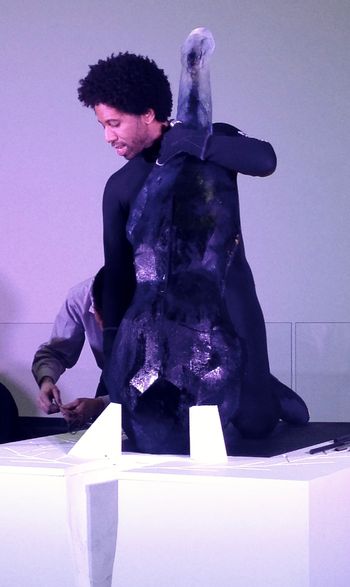
Parker Woods, like Jeanrenaud, wears a black neoprene wetsuit, now with the addition of sleeves, short gloves, and boots – a swath of rubber covering every bit of his skin from the neck down. The left hand glove is adorned with metal rings and cuffs: sensors to send sound back to Topel. Parker Woods, like Moorman, leans the cello against his person. Unlike both women, Parker Woods breaks the illusion of perfect cello posture – smashes LeGuin's basic physical taxonomy of the cellist-body and carnal musicology's production of knowledge through re-staged gesture – by kneeling rather than sitting, by beginning his performance with taps of his fingers rather than strokes of his bow (Figure 4).
Seth Parker Woods performing Iced Bodies, Dartmouth College, 26 April 2018 (photo by author).

A few minutes into the piece, the cellist picks up a clear plexiglass rod, an explicit allusion to Moorman's bowing implement. At one point, he wields the bow with both hands. At another, he exchanges it for a black plexiglass rod. ‘We have a time-based score that we work with’, Parker Woods told me after the performance. ‘I have my own choreographic, gestural cells that I implement.’Footnote 107 He holds his left hand still so as not to create excess sound. He avoids the neck of the cello (where Jeanrenaud's left hand kept up a near constant dance) and focuses his attention on the body of the instrument. One kinaesthetic pattern recurs over and over again: his hands circle above the cello's body, then dive over the side before swishing out. (‘It's almost a shamanistic thing in my head’, he said of this movement. ‘It's connected to a washing away … to the neglect of those who have mental disability.’Footnote 108) He uses the bow to achieve specific sounds, rhythms, and textures that are further varied in a complex collaborative improvisation with Topel's manipulations of those sounds and rhythms. ‘We end up creating this kind of sound environment that is meant to be wedded or mixed with visual experience’, Topel noted in the Iced Bodies documentary.Footnote 109
A technician appears to help Parker Woods shift the cello to a table-top position. Parker Woods looms over his instrument with a dangerous-looking Japanese chisel in hand. Flecks of ice fly into the audience as he drags his tool across the cello's surface; he could be writing words, I think.Footnote 110 All the while, I hear the sounds I see Parker Woods produce in front of me, as well as the sounds I cannot see but know Topel manipulates and reintroduces through the glass speakers behind my chair. It is a testament to Parker Woods's framing of Iced Bodies that metaphorical resonance can be such low-hanging fruit: what we can see is the tip of the iceberg, the piece claims, but the fact and effects of suppressed voices are all around us.
Though Parker Woods raises and lowers the cello to and from its upright position once more over the course of the performance, the ice instrument lies flat on the platform for most of the duration. Certainly a practical decision, it gives Parker Woods a respite from holding the weight of the 120lb block of ice without anything to support his body.Footnote 111 Simultaneously, it frees both of the cellist's hands, provides sightlines, and opens up angles with which to chisel away at the instrument. It is also decidedly different from both Moorman's and Jeanrenaud's adherence to an unstated rule that the piece's identity is tied to a play on expectations of ‘cello and cellist’. In fact, Parker Woods and Topel embrace the disruption of this mandate: ‘When you see a person playing a cello’, Topel said in the Iced Bodies documentary, ‘it evokes this kind of auditory imagination. It's a balancing act how to create … that kind of warping of perception.’Footnote 112 In other words, Topel acknowledges the potential of Iced Bodies to configure meaning through sounds (real and imagined) by subverting carnal knowledge.
At several points, I hear what sounds like a voice, heavily vocoded, speaking words, heavily distorted. I lean forwards at the edge of my seat, and I notice the surrounding audience mirror my actions. ‘Son? Skin? Selves?’ I write in my notes with an obvious question mark. The sentences are difficult to understand, but surely what I hear is in keeping with the grief-stricken, unearthly character of the voice. Both the instrument and the timbre encourage me to force meaning onto individual words.Footnote 113 Parker Woods lays down his tools as the voice speaks, and he waits for it to say its piece. He slowly, slowly strokes the cello with his hands, creating a sonic climax out of silence.
There are also sonic events more in line with an imagining of Moorman's performance and the reality of Jeanrenaud's. With one well-thrust chisel, the entire neck of the ice cello falls off the instrument and thunks to the floor. Parker Woods dismounts the platform, picks up the fallen part, and throws it back (clunk) before tossing it into the discard pool (slosh). These discards, too, are sound events that organize perception.
I watch as the left side of the instrument is torn up and the electronic insides poke through. Parker Woods plucks them, bows them. As more of the ice chips away, a fin running down the middle of the cello emerges; it serves as a structural component keeping the two halves connected and as an ode to a cello string. The fin provides additional sonic content different in kind from that created by the chisel or the rods – lyrical, expressive sounds. Through it all, Parker Woods taps and wedges, chips and stabs. Larger and larger ice chunks fall to the platform, and he scoops them into the discard pool as the instrument shrinks.
What more can possibly be done to this ice-cello-body? How does this end?
As the cello deteriorates, it stains the white platform on which it sits. The drips of obsidian-coloured water making their way down the sides look like nothing so much as blood. At the same time, the sound physically changes. Given that the ice functions as a ‘meta-membrane’, both the hydrophones and the water transducer simply work better the closer they are to the surface. The sounds grow louder and the words grow clearer; Topel and Parker Woods increase the volume and velocity of the sound events for which they are responsible. Just as in Jeanrenaud's performance, the excitement in the audience is palpable as the end – made clear both visibly and sonically – draws near after so much time.
All at once the electronic sound cuts out. Parker Woods continues to chisel, mutilating the ice chunks that remain on the platform. At first, his actions seem gratuitous; it is hard to watch the last gasp of what was once so clearly a body. And then I realize that he is chiselling towards the embedded transducers: the voices still to be excavated, freed. The electronics serve as the heart of the cello, the point of the performance, and it all becomes clear as the words the audience has been straining to understand since the beginning finally resolve:
‘Do you feel like you're holding a body at times?’ a woman asked Parker Woods in his pre-performance talk. ‘I do’, he replied instantly. ‘There are moments.’ And then backtracked: ‘It's not always about the idea of a corpus. Sometimes it's an instrument! Don't look at it that way, like it's a body on a butchering block. That's hard and I don't want to put that on anyone.’Footnote 115 But hard though it was to watch the cellist dismember his ice instrument body, it was even harder to suspend my belief in that body.
Alexander Weheliye's discussion of Hortense Spillers's work on pornotroping – the ‘enactment of black suffering for a shocked and titillated audience’ – complicates this seemingly clear-cut example of metaphoric materialization à la Ice Cello.Footnote 116 Perhaps the ice cello does not represent a body after all, but rather flesh. For Spillers, the ‘distinction … between “body” and “flesh” … [is] the central one between captive and liberated subject-positions’.Footnote 117 Her work maintains that the institution of slavery continues to produce ideas about bodies, gender, and sexuality. ‘Flesh’, Weheliye argues after Spillers, ‘works in tandem with the body within the regimes of liberal democracy as they are traversed by sovereignty and slavery, since the (white) body – full life – functions as the abstract norm against which (black) flesh – mere life – is measured, and it also serves as an exception due to its unattainability for the black subject’.Footnote 118 Parker Woods's mutilation of the obsidian-dyed ice instrument performs Spillers's ‘grammar of the pornotrope – the cross-fertilization of [racialized] violence and sexuality’.Footnote 119 Elucidated by the explicit nature of the title (Iced Bodies), programme notes, and choreography, the fleshly ice cello signifies both an instrument and a corpus; a thing to be chiselled and a figure to be caressed; a lump of dyed ice and the suppression of black men's suffering. At the same time, the sonic properties of the ice flesh – the voices that rise to the surface speaking the words of a black poet – allow Parker Woods to frame his act of dismemberment as one of unearthing, excavation, and even freedom. In his article ‘Pornotropes’ for the Journal of Visual Culture, Weheliye makes clear the potential for pornotroping to transform both body to flesh and, in certain contexts, flesh to body: ‘What the pornotrope contributes to the theorization of modern sociopolitical subjectivity is its freeing and setting in motion the deviances that lay dormant in bare life and social death … deviances that repudiate by their very pornotropic existence the equation of domination and violence with the complete absence of subjectivity, sexuality, life, enjoyment, etc.’Footnote 120 If Parker Woods can succeed in realizing his goal to ‘get people to take action’ as a result of his performance, Spillers's ‘potential for pornotroping’ remains in play.
Parker Woods's own young, black, male body performing a piece previously claimed by white women – one naked, and one clothed – underscores the simultaneous process of humanizing/dehumanizing and sexualizing/desexualizing enacted by the ice instrument. ‘Can we talk about the wetsuit?’ I ask, and he laughs. ‘Why not do it nude?’ he continues for me. ‘You know, the body – especially the female body – has been put on display so much and objectivized so many times. Charlotte, of course, did it because it was part of her personality and it was spectacle. But … [she] got frostbite. It was a conscious choice to go with the wetsuit to protect myself.’Footnote 121 The boots protect his feet from shards of shaved ice. The gloves protect his hands – his cellist's hands, his livelihood – from the cold and from the (less obvious, but still very real) danger of the tools. He continued:
The other side of it, from a personal and social side, is: I didn't feel that there needed to be another black body on display. So I chose not to sexualize and not to politicize my body in that way. I'm still a body on display, still an artist on display. But I do it on my own terms. It's almost a reclaiming of an imagery that has historically bad connotations – you've seen Eric Garner and Ferguson. There didn't need to be another brown body laid out, so I wore the wetsuit as a protector and a cover, a shield.Footnote 122
His statement resonates productively with Simone Browne's concept of ‘racializing surveillance’, a ‘technology of social control where surveillance practices, policies, and performances concern the production of norms pertaining to race and exercise “a power to define what is in or out of place” … . [T]he outcome is often discriminatory treatment of those who are negatively racialized by such surveillance.’Footnote 123 Parker Woods specifies exactly how much of his body he is willing to expose, how much pain he is willing to perform – and, in the process, he provides another model for O'Grady's understanding of risk as the tension between vulnerability and agency. In Parker Woods's telling of the piece, his clothed body is the overtly political statement that Moorman's naked body allegedly was not.
Parker Woods's Iced Bodies – his rendering of Ice Music laced with his knowledge of Ice Cello – is persuasive because it relies on archival evidence and oral histories as the foundation over which he made his choices. His reading – intentional, precise, leaving little to chance – lays bare its relationship to the historical avant-garde and to twenty-first century racial politics using words, and these are easily mapped onto the sonic and visual materials of his performance. Parker Woods's overwriting presents as clean and whole; the audience's interpretive work is bound to it, and bound by it.
Then again, the performance history of Ice Music is a refutation of easily accessed meaning, a negotiation of authorship and interpretation informed by sociocultural context. At no other point in my Ice Music research have I been as willing to let the artist speak on behalf of my experience; at no other point has an artist been so willing to define the boundaries of that experience. Parker Woods's choice to exercise tight control over his narrative at first seems to dampen risk, to eliminate much of the danger that Dick Higgins understood as crucial to the avant-garde. Parker Woods's body is covered, his narrative unambiguous, and the first performance of the piece that inspired him took place more than forty-five years ago – hardly the cutting-edge vehicle for reaction it might once have been. And yet, the cellist's uncompromising and extensive auto-explanation also nods to the stakes of his performance. In forging connections between a black male body, an obsidian ice instrument-turned-flesh, mental illness, police brutality, and the incarceration of black men, the audience can locate a challenge to the contemporary classical music world – Parker Woods's, Jeanrenaud's, and even to some extent Moorman's musical home. This challenge is not so different from that issued by Ice Music read through the lens of 1970s feminist art, or by Ice Cello read through early millennial critiques of the feminism that came before. Modernize, the Ice(d) Music/Cello/Bodies palimpsest now reads; become relevant in a world defined by vulnerable bodies and the webs of power through which they manoeuvre.Footnote 124
* * *
If the palimpsest metaphor holds true, the writing, overwriting, and acts of recovery do not end there. Parker Woods's interpretation does not preclude the possibility of a future version of Ice Music that must reckon with the historiographic and hermeneutic trails of both Ice Cello and Iced Bodies. Rooted in an ethics of narration focused on process and change, erasure and recuperation, this future probability encourages an understanding of the palimpsest not simply as theory, but as methodology. A consideration of both implicit and explicit layers of meaning at moments of rupture (in the form of performative re-stagings or significant scholarship) acknowledges that every iteration of Ice Music will inherit both ethical complexity and a larger, more sophisticated collection of tools with which to encounter it. Already, I have shown how each successive version's engagement with activist subject matter intensifies the ethical project embedded in the process of recovering a female avant-gardist erased from her own history. Future performers and scholars of Ice Music will have the option to begin the practice of decipherment where my study leaves off – but so too will future performers and scholars of Yoko Ono's Cut Piece (1964) or Carolee Schneemann's Meat Joy (1964) or Benjamin Patterson's Lick Piece (1964), each of which has similarly positioned itself and been positioned as ‘political’. The intellectual and sociocultural currents that run through the Ice(d) Music/Cello/Bodies palimpsest provide an analytic framework for broader study of twenty-first century re-enactment of the historical avant-garde.
Appendix: Chronology of Performances (1972–2019)
Moorman, Ice Music
1972, 19 August: ICES ’72 Festival, London, UK
1973, 7 March: New York University, NYC, NY, ‘Art Speakers Series’
1973, 13 April: William Patterson College, Wayne, NJ, ‘Salon de Refusés’
1973, 24 April: Harold Rivkin Gallery, Washington DC, ‘The Soft Gallery Show’
1976, 22 March: Adelaide Arts Festival, Australia, Art Gallery of South Australia, ‘Moorman/Paik’ exhibit
1976, 3 April: Art Gallery of New South Wales, Sydney, Australia, ‘Moorman/Paik’ exhibit
1978, 6 May: Pro Musica Nova Festival, Radio Bremen Sponsor, Bremen, Germany
Jeanrenaud, Ice Cello
2001, [April]: San Francisco
2001, 3 May: San Francisco, Yerba Buena Center for the Arts
2001, 20 May: The Walker Art Museum, Minneapolis, MN, Yes Yoko Ono exhibit
2001, 21 September: Lafayette College, Williams Center for the Arts
Parker Woods, Iced Bodies
2017, 12 August: The Arts Club Chicago, Illinois
2018, 26 April: Dartmouth College, Hanover, NH
2019, 16 November: Huddersfield Contemporary Music Festival, Bates Mill Blending Shed, Huddersfield, West Yorkshire, UK