Introduction
“Political organizations are formed to keep the powerful in power. Their first rule is “don't rock the boat.” If someone makes trouble and you can get him, do it. If you can't get him, bring him in. Give him some of the action, let him have a taste of power. Power is all anyone wants, and if he has a promise of it as a reward for being good, he'll be good. Anyone who does not play by those rules is incomprehensible to most politicians.”
– Rep. Shirley Chisholm (D-NY) in Unbought and Unbossed, 1970In their canonical study, Protest is Not Enough, Browning, Marshall, and Tabb (Reference Browning, Marshall and Tabb1986) originally argued that incorporation—the inclusion of racial minorities in decision making and influential positions in dominant governing coalitions—leads to responsiveness to minority policy demands in political institutions. Their findings, however, were limited to small group settings, including such as city councils and school boards. Since then, scholars have chronicled the challenges associated with inclusion in larger, more formalized settings (Gamble Reference Gamble2007; Reference Gamble2011; Guinier Reference Guinier1991; Hawkesworth Reference Hawkesworth2003; Tate Reference Tate2014). Ultimately, across these studies, they find increased influence for Black lawmakers is often shaped by, or the product of, trade-offs and sacrifice. Noticeable proportional gains in minority membership in Congress and increases of legislative influence have yet to produce sizable policy gains for the communities they represent. I find, Black lawmakers and the policies that they promote are often perceived as ideologically radical and are typically met with resistance that inhibits their ability to progress bills beyond the committee phase and onto the floor.
Robert Smith's (Reference Smith1996) foundational study, We Have No Leaders, highlights the challenges of Black representatives seeking to remedy problems in their community through issue advocacy within American political systems. His typology distinguishes between the demands and methods that groups employ in an attempt to gain leverage on agendas and outcomes. Smith (Reference Smith1996, 5–6) argues:
“Theoretically, demands may be categorized as either systemic or nonsystemic. Systemic demands are those that do not challenge or threaten or appear to challenge or threaten the basic values or essential characteristics of the system, while nonsystemic demands are those that do challenge basic system values or characteristics. […] In addition to the substantive character of the demands, the method or methods employed to pursue them may be categorized as systemic or nonsystemic, depending on the nature of the political system. […] Systems, or more precisely the elites or authorities that manage systems, respond to demands on the basis of their substantive content and the methods employed in pursuit of them.”
Smith also considers how systems respond to such demands and methods. Drawing on frameworks from Easton (Reference Easton1965) and Scoble (Reference Scoble1971), he points to five outputs likely to emerge: substantive policy change, symbolism, cooptation, neglect, and repression. In the modern Congress, scholars suggest proportional gains in the chamber have yet to translate into substantive policy wins. Instead, members settle for largely-symbolic legislative gestures when their substantive goals cannot be achieved (Cameron, Epstein, and O'Halloran Reference Cameron, Epstein and O'Halloran1996; Lublin Reference Lublin1999; Swain Reference Swain1993). It may be that the institution's efforts to coopt, neglect, or repress Black members and their efforts is what largely shapes their effectiveness in representing Black interests in a more substantive manner. Those in power routinely establish and reify rules and procedures designed to mitigate challenges to long-standing cultural and racialized orders and the resulting asymmetric power structures in political institutions (King and Smith Reference King and Smith2005; Polsby Reference Polsby1968).
As Black lawmakers accrue influence, it is important to understand if and how these dynamics shape the legislative processes. The most recent iterations of Congress are more diverse than ever before. With its 55 members—five of whom chair full committees and 28 sit atop subcommittees—the Congressional Black Caucus (CBC) is in a place to wield a significant leverage over the legislative agenda in the 116th Congress. Katherine Tate (Reference Tate2014, 15) argues Black lawmakers' “effectiveness will always be limited by the institutional constraints of the political system.” Black members and the issues that they seek to promote onto the institutional agenda are perceived to be direct challenges the status quo and, thus, have the potential to induce institutional and intra-party conflict. Given this, the CBC finds itself in a peculiar dilemma of relying on systemic methods to make nonsystemic demands.
Can traditional—or systemic—modes of access and influence in congressional committees be parlayed into a greater degree of influence over the legislative agenda for Black lawmakers? Or, do forces such as negative agenda setting and institutional marginalization prove insurmountable for those seeking substantive policy change in Black interest areas? Incorporation into decision-making systems—such as congressional committees—certainly provides distinct advantages to those who ascend to power (see Cox and McCubbins Reference Cox and McCubbins2007; Deering and Smith Reference Deering and Smith1997; Hall and Evans Reference Hall and Lawrence Evans1990, among others; Krutz Reference Krutz2005; Schiller Reference Schiller1995). However, incorporation may require members to shed some or all of the entrepreneurial ambitions needed to disrupt centuries of racial inequality in America (Tate Reference Tate2014). Similarly, lower levels of incorporation leave systemic checks, overseen by those invested in the status quo, to stand in the way of substantive agenda or policy change. This paper seeks to determine if a systemic approach to lawmaking can lead to an increased degree of success in pursuing a nonsystemic agenda in congressional committees.
To answer this question, I explore the process of legislative winnowing—the process of sifting through a multitude of proposals to determine which should receive the attention of the full institution. In some instances, winnowing is thought of as an essential function of decision-making bodies designed to “decide what to decide on” (Krutz Reference Krutz2005). Winnowing could also be one of many institutionalized gatekeeping practices designed to induce agenda and institutional stability (Carson, Finocchiaro, and Rohde Reference Carson, Finocchiaro and Rohde2010; Cox and McCubbins Reference Cox and McCubbins2007; Polsby Reference Polsby1968). In measuring the impact of committee influence on the prospects of nearly 57,000 individual bills sponsored from the 103rd through the 112th Congress, I find evidence that supports the latter proposition: winnowing does not appear to be merely a color-blind function of the decision-making process. A pattern of gate-keeping appears to be prevalent despite favorable committee assignment and appointments to leadership positions on policy-relevant committees. Proposals by Black members in the House of Representatives and issues that are at the core of struggles in the Black community are systematically and disproportionately winnowed at the committee level. In addition, legislative gate-keeping means most Black lawmakers do not (or cannot) see a distinct advantage from incorporation at the committee level.
Legislative Agenda Setting and Racial Identity
Black lawmakers are said to have a distinct connection to the unique constituencies they represent (Broockman Reference Broockman2013), and translate that into legislative activity. Scholars of race and representation argue members of marginalized groups draw on lived experiences that shapes their priorities, and it is their responsibility to communicate “uncrystallized” concerns to an institution that has historically shown a general unwillingness to address Black interests (Mansbridge Reference Mansbridge1999, see also Frymer Reference Frymer2010; Tate Reference Tate2014). Once embedded into the representative body, minority members have a duty to translate the perspectives and insights that are of concerns of their identity group into legislative action (Fenno Reference Fenno1978; Mansbridge Reference Mansbridge1999; Pitkin Reference Pitkin1967). Individually and collectively, members of color sponsor group-specific issue bills (Barrett Reference Barrett1995; Bratton Reference Bratton2006; Bratton and Haynie Reference Bratton and Haynie1999; Wilson Reference Wilson2010) and serve as vessels to increase debate and deliberation surrounding problems that plague the unique constituencies that they represent (Ellis and Wilson Reference Ellis and Wilson2013; Gamble Reference Gamble2011; Minta and Sinclair-Chapman Reference Minta and Sinclair-Chapman2013). These efforts serve as “inputs” or “signals” for which the institution must decide on the appropriate response (Jones Reference Jones1994; Jones and Baumgartner Reference Jones and Baumgartner2005; Simon Reference Simon1985; Smith Reference Smith1996).
Political institutions have a natural tendency to neglect, or under-respond, to most signals that they are presented with (Baumgartner et al. Reference Baumgartner2009; Jones and Baumgartner Reference Jones and Baumgartner2005). At any given point in time, Congress processes hundreds of unique, context-driven problems that are often poorly structured and contain a number of attributes that could all, justifiably, be considered for attention. However, policymaking institutions are ill-equipped to handle, simultaneously, every single signal that is relayed by both actors within the institution as well as external events. Krutz (Reference Krutz2005, 314) argues that winnowing, “the process by which the House and Senate determine which small proportion of bills will receive committee attention among thousands introduced,” is a necessary function of legislative committees that are designed to reduce the amount of time and resources necessary to attend to a number of issues. Winnowing has tremendous implications on later phases of the legislative process. The prioritization of issues at the committee stage shapes institutional discourse around particular policy problems, determines how and from whom information is gathered to define those problems, and drives considerations of which solutions should be employed (Jones Reference Jones1994; Jones and Baumgartner Reference Jones and Baumgartner2005; Workman, Jones, and Jochim Reference Workman, Jones and Jochim2009; Workman, Shafran, and Bark Reference Workman, Shafran and Bark2017).
As a function of this process, a vast majority of proposed bills will never reach the floor. This is by design. On the one hand, the “boundedly-rational” nature of political institutions makes it necessary to prioritize certain issues over others. In an institution with limited time, resources, and agenda space, mechanisms must be in place to streamline legislative processes and organize institutional attention (Jones Reference Jones1994; Jones and Baumgartner Reference Jones and Baumgartner2005). On the other hand, the inattention to legislation has been found to be rooted in a desire on parties to maintain stability (Cox and McCubbins Reference Cox and McCubbins2005; Reference Cox and McCubbins2007). What the literature fails to highlight is: (1) the possibility that certain groups other than the opposing political party are disproportionately disadvantaged by the winnowing process, and (2) if traditional avenues to advance bills through the legislative process are availed to all. The first two hypotheses presented in this analysis are designed to determine if winnowing is less of an indiscriminate function of an institution needing to sift through a mountain of issues placed on its doorstep or if there are underlying factors that point to a more systematic neglect of particular groups or issues.
Racialized Neglect and Winnowing
Minority representation has increased in Congress, both in the number of elected officials and in their formal and informal activity within their respective chambers. Unfortunately, once there, Black lawmakers are met with layers of structural and interpersonal hurdles, rooted in racialized resentment, marginalization and ordering, that inhibit group-specific policy change. American politics have long been plagued with racialized ordering that shapes preferences, processes, and outcomes (Dawson and Cohen Reference Dawson and Cohen2002; Holt Reference Holt2009; King and Smith Reference King and Smith2005). Political conditions that exist in minority communities are the product of consistent and resilient political structures that create and reinforce those conditions. Therefore, inclusion in the House of Representatives is met with—and shaped by—a centuries-long rigidity toward the advancement of racial communities, a propensity to mitigate conflict, and the development of cartelized decision-making.
As Vanessa C. Tyson (Reference Tyson2016, 33) points out, “Congress, like its counterparts, is not immune to the insidious nature of prejudice. These institutions were not built with the express intent to provide for the equal representation of racial minorities, women, the poor, or other groups that have suffered systematic exclusion from their ranks.” “That exclusion,” she continues, “and the subsequent discrimination, remain deeply entrenched in contemporary American society.” The effects of racial marginalization in Congress are evident throughout the lawmaking process. For instance, there is evidence that Black members in the House of Representatives find themselves funneled to less prestigious committees (Frisch and Kelly Reference Frisch and Kelly2004; Griffin and Keane Reference Griffin and Keane2011; Rocca, Sanchez, and Morin Reference Rocca, Sanchez and Morin2011). In her interviews of Black women in Congress, Hawkesworth (Reference Hawkesworth2003, 546) finds, once in committees of interest:
“Through tactics such as silencing, stereotyping, enforced invisibility, exclusion, marginalization, challenges to epistemic authority, refusals to hear, legislative topic extinction, and pendejo games, Congresswomen of color are constituted as “other.” In committee operations, floor debates, and interpersonal interactions, they are treated as less than equal in various ways that carry palpable consequences for their identities and their policy priorities.”
Once one group is shut out of the institution's problem-solving process it complicates their ability to achieve substantive change. Silencing, othering, and exclusion routinely manifest themselves in various points of the legislative process and create tangible hurdles for those seeking to drive attention toward Black interests. As long as Black lawmakers “are forced to deal with institutional dynamics and interpersonal relations that constitute them as subordinate” (Hawkesworth Reference Hawkesworth2003, 546), conditions that plague the communities that they represent are reinforced and a status quo of racial inequality is preserved. Previous studies of winnowing fail to address if the process is truly racially color-blind or if it is used as a mechanism of systematic marginalization of Black lawmakers within the chamber. The presumptions of Hawkesworth and others would be supported if:
Hypothesis 1: Bills sponsored by CBC lawmakers have a lower probability of navigating the committee phase than those sponsored by their non-Black counterparts.
Issue Neglect and Winnowing
American institutions are designed to be sturdy, change-resistant bodies. Congress is no different. Committees are often called upon to serve as the mechanism to instill, maintain, and reinforce power structures. Institutions also have a vested interest in assuring that problems that are attended to remain relatively consistent, thus, maintaining the status quo (Dawson and Cohen Reference Dawson and Cohen2002; Holt Reference Holt2009; Polsby Reference Polsby1968; Schattschneider Reference Schattschneider1975). This role results in the routine and deliberate under-responsiveness to certain issues (Cox and McCubbins Reference Cox and McCubbins2005; Reference Cox and McCubbins2007). One such example of this stubbornness is the routine resistance to racial advancement, especially those efforts initiated from within the institution, by members of marginalized groups.
Black lawmakers routinely work to sponsor group-specific legislation that challenge generational problems of inequality in education, economic advancement, and the free exercise of citizenship in America (Bratton and Haynie Reference Bratton and Haynie1999; Canon Reference Canon1999; Miller Reference Miller1989; Tate Reference Tate2014). The nature of the policy areas that have been identified as central to the CBC has the potential to expose and capitalize on cleavages within the system and realign power at both the institutional and party levels (Lowi Reference Lowi, Bauer, Dexter and de Sola Pool1964; Schattschneider Reference Schattschneider1975).
These issues are naturally disruptive to political systems that have, thus far, done little to dismantle racial inequalities in the representation and implementation of black interests; they routinely draw on partisan, ideological, regional, and social differences. Black interests are perceived to be ideologically radical and narrow (Singh Reference Singh1998; Swain Reference Swain1993; Tate Reference Tate2001; Reference Tate2014). For decades, the battle against racial inequality and discrimination placed the CBC's legislative focus on what Canon (Reference Canon1995) calls the “politics of difference.” These perceptions remain despite efforts on the part of the caucus to moderate their positions and move toward a more pragmatic agenda (see also Tate Reference Tate2014). There is also the fear of “white-voter backlash” that may come as a result of taking on a more racially progressive agenda. As a result, the Democratic Party and the institution as a whole shy away from adopting their agenda.
Black interests are perceived to be highly contentious. Many issues on a Black legislative agenda come in the form of a long-held grievance, and along with each grievance comes the potential for a new conflict to be introduced into the system with a unique challenge to power structures and the stability of those structures. In some instances, racial orders, institutionalized barriers to citizenry and participation, as well as open hostility toward the advancement racial minorities and their communities have made it necessary for policies that seek to reinforce those core values. However, solutions to those problems often take on qualities of more contentious policy types (King and Smith Reference King and Smith2005; Peterson Reference Peterson2012). Seeking policy change in areas like voting rights, low-income housing, disease prevention, healthcare reform, and community development often play on “haves and have-nots” dynamics that result in a certain degree of contentiousness. These policies often require a great deal of bargaining, thus, leading to a dynamics that come with heightened potential for conflict (Lowi Reference Lowi, Bauer, Dexter and de Sola Pool1964).
Compounding this reality is the fact that Black-interest policies often take on characteristics that further reduce the likelihood of substantive action in those areas. Minority issues are often complex. If many of the issues facing Congress are “poorly structured,” the issues facing minority populations are as complex as they come. As a result, attending to minority issues is costly. Attention to new issues bring upon new search costs, especially after lengthy periods of inattention. When institutions lack a particular degree of motivation toward an issue, they may choose to ignore the issue and all relevant signals. This makes shifting institutional attention toward those issues a costly endeavor.
Cobb and Ross (Reference Cobb and Ross1997) argue, the longer issues remain on the agenda, the more costly they are to deny attention to. Therefore, it may be considered advantageous to deny access to minority issues early and often. This makes minority issue marginalization more convenient option for racialized institutions. Suppressing a subset of issues from the offset clears at least a bit of room in the congested bottleneck of institutional attention. Doing so decreases costs on the overall institution and, as a result, reduces the overall degree of friction on more pressing and less costly issues on the legislative agenda. Given these realities, one would expect an institution invested in self-preservation would also be invested in limiting agenda access in areas that directly threaten the stability of the institution. There could be a disproportionate winnowing of minority issues in the committee stage resulting in a systematic and routine de-prioritization of minority issues, pushing group-specific bills out of the attention of the larger body of lawmakers. It could be the case that the issues are perceived as the largest threats to the institution, not necessarily the presence of non-white members. Therefore, I forward:
Hypothesis 2: Bills sponsored in issue areas that have been prioritized by the Congressional Black Caucus will have a lower probability of navigating the committee phase than other bills.
Mechanisms for Driving Legislative Attention
A number of scholars have devoted a great deal of effort into explaining the processes and motivations driving how committee membership and leadership appointments take place (see Bullock Reference Bullock1973; Frisch and Kelly Reference Frisch and Kelly2006; Leighton and Lopez Reference Leighton and Lopez2002; Masters Reference Masters1961; Matthews Reference Matthews1960; Shepsle and Weingast Reference Shepsle and Weingast1987). Party leadership considers a number of factors in deciding on the strategic placement of members in particular posts within the institution, of which include electoral needs, geography, party loyalty, policy preferences, and seniority of a particular member. In institutions with limited attention spans, “decision makers must have some mechanism for shifting attention and effort among multiple problems” (Jones and Baumgartner Reference Jones and Baumgartner2005, 44). Access is seen as one of those potential mechanisms for policy change (Baumgartner and Jones Reference Baumgartner and Jones2002; Schattschneider Reference Schattschneider1975).
The incorporation of minorities in racialized political institutions is most typically conceptualized as the moment when members of color gain influence over decision-making in that institution (Tate Reference Tate2014). However, should the ascension of Black lawmakers to influential positions in the institution be considered political incorporation? Or, does it actually resemble what Smith and others political call cooptation—another response to nonsystemic demands in political systems? Cooptation—or “the process of absorbing new elements into the leadership-determining structure of an organization as a means of avoiding threats to its stability” (Selznick Reference Selznick1949, 13)—is a preventative measure. As Smith notes and Chisholm (Reference Chisholm1970) reinforces, congressional leadership is willing to make highly visible appointments in an effort to dampen potential challenges to the status quo.
As new members gain access to the policymaking process or decision-making positions, it is expected to reshape the discourse surrounding policies and invoke change to the status quo. However, it may be the case that inclusion is result of further litmus tests for Black lawmakers given the nature of their perceived demands (Mixon and Ressler Reference Mixon and Ressler2001; Tate Reference Tate2014). Access and influence, then, come at an expense—perhaps to their targeted agenda. Does an increase in access and influence empower Black lawmakers in a manner that allows them to forward key interests onto the legislative agenda? I examine two of these mechanisms that are commonly considered to be valuable resources for promoting policy change.
Increasing Agenda Influence through Committee Access
Committee placement is often seen a means to pursue substantive change in policy areas of concern (see Bullock Reference Bullock1973; Frisch and Kelly Reference Frisch and Kelly2006; Leighton and Lopez Reference Leighton and Lopez2002; Masters Reference Masters1961; Matthews Reference Matthews1960; Shepsle Reference Shepsle1978; Shepsle and Weingast Reference Shepsle and Weingast1987). Lawmakers jockey for position on “clearly stratified” committees to take advantage of prestige offered by placement on a committee, take advantage of one's personal expertise, or to leverage placement on committees to satisfy constituency demands and improve their prospects for re-election (Grimmer and Powell Reference Grimmer and Powell2013; Matthews Reference Matthews1960). Ideally, members of color will be placed on an equal footing with their white counterparts. Although some progress has been made from periods of overt suppression of minority members in the institution (Canon Reference Canon1995; Friedman Reference Friedman1996; Mixon and Pagels Reference Mixon and Pagels2007; Mixon and Ressler Reference Mixon and Ressler2001), Griffin and Keane (Reference Griffin and Keane2011, 152) argue that “there is still some distance to go before assignments are race neutral.” These differences are even more noticeable when Democrats are in the minority. Even though minority members do not request placements on lower committees (Frisch and Kelly Reference Frisch and Kelly2006), Griffin and Keane (Reference Griffin and Keane2011) found that minority MC's consistently receive less valuable committee assignments (supported by Rocca, Sanchez, and Morin Reference Rocca, Sanchez and Morin2011) despite lobbying on the part of the CBC in hopes to advance members to more prestigious or policy-relevant committees (Congressional Black Caucus 2018).Footnote 1
Even when Black Caucus members do receive favorable committee assignments, it is likely the result of Democratic leadership using party loyalty as a measuring stick (Mixon and Ressler Reference Mixon and Ressler2001); member uniformity in voting behavior and other representative functions pay off. Although the ideas of political “cartels” is not new, especially when speaking of committee and leadership assignments (Cox and McCubbins Reference Cox and McCubbins2007), Mixon finds that party loyalty serves as a pre-screening device for committee placements and is reinforced by rewarding the behavior of old members by placing incoming members in more favorable positions. Inversely, “boat-rockers” are not rewarded with influence. Conformity and roll-call vote cohesion means, for minority members, substantive policy change often takes the shape of “color-blind” or satisficing solutions.
As members gain access to committees of interest, they also gain influence over the committee agenda by drawing attention to particular problems, offering solutions for those problems, and capitalize on ever-evolving, ever-expanding policy jurisdiction within committees (Baumgartner, Jones, and MacLeod Reference Baumgartner, Jones and MacLeod2000). In fact, in his study of winnowing, Glenn Krutz (Reference Krutz2005) finds a positive effect across five policy issues—agriculture, healthcare, education, environmental policy, and telecommunications—of committee membership on the likelihood of receiving attention at the committee level. To test if similar effect present for Black members, I offer the following hypothesis:
Hypothesis 3: The probability of a CBC-interest bill receiving a committee report will increase when the bill's sponsor is a member of a committee with jurisdiction over that policy area.
Increasing Agenda Influence through Committee Leadership
Committee leadership has long been determined to have positive impacts on the prospects of a bill's survival. Ideally, a rise to a leadership means that one has successfully showcased a level of success and quality necessary to gain such a consensus. However, power may dampen the entrepreneurial pursuits of Black lawmakers seeking to advance legislation designed to improve lives in the Black community. Incorporation may leave Black lawmakers hamstrung by the larger party apparatus that has an interest in preserving order by adhering a leadership-sanctioned agenda. Pursuing Black interest may directly impede their ability to toe the party line, especially if their party is resistant to addressing minority issues (Frymer Reference Frymer2010).
For members of color, a promotion to leadership may introduce a certain degree of personal conflict into the legislative process. The intrinsic desire to secure re-election, accumulate power within the institution, and achieve their policy goals is a constant driver of member behavior (Fenno Reference Fenno1973; Reference Fenno1978; Mayhew Reference Mayhew1974). This is not to say that these motivations do not clash with one another, especially for members of color. Black lawmakers occupy relatively safe seats, so the electoral threat is typically marginal (Singh Reference Singh1998; Swain Reference Swain1993; Whitby Reference Whitby2000). However, the pursuit of power may directly influence their efforts to shape policy outcomes. There is the notion that it is the responsibility of committee leadership to try their hardest to carry out the agenda of party leadership whereas preventing bills from reaching the floor that may divide the party along different cleavages (Cox and McCubbins Reference Cox and McCubbins2005; Reference Cox and McCubbins2007).
Incorporation is also the product of an ideological evolution of Black lawmakers. Although early studies paint Black congressmen as racially and ideologically radical, modern studies reveal generational and political differences have transformed the Black Caucus into an increasingly moderate organization (Canon Reference Canon1999; Gillespie Reference Gillespie2010; Tate Reference Tate2014). The old guards of CBC members were raised in the civil rights era, ran explicitly racialized campaigns, and dedicated much of their legislative activity to solving problems of inequality in America. Those currently in line for committees leadership are products of a second generation of Caucus members whose backgrounds may not be fully engulfed in racial turmoil and who may have run deracialized campaigns (Gillespie Reference Gillespie2010). Tate (Reference Tate2014) argues, this ideological moderation could further decrease the likelihood that committee leadership will pursue radical change in Black-issue areas.
Nevertheless, empowering minority members means exposing more traditionally marginalized members to all of the luxuries afforded to congressional leadership, including increased staff resources and funding. This often translates into active and effective representatives (Gamble Reference Gamble2007; Volden and Wiseman Reference Volden and Wiseman2014). Leadership is also a means to maximize the level of influence a member can have on the legislative agenda and committee functionality through positive or negative agenda control (Cox and McCubbins Reference Cox and McCubbins2005; Reference Cox and McCubbins2007). Further, leadership results in increased productivity when it comes to bill sponsorship (Schiller Reference Schiller1995; Sinclair Reference Sinclair1986). Pivotal to this study, Krutz (Reference Krutz2005) found, committee leadership has a positive impact on the likelihood of a bill progressing through the committee stage. This study seeks to determine if the luxuries afforded to those appointed to leadership positions are extended to members of color as well, particularly when they are in pursuit of minority-issue policies.
Ellis and Wilson argue, “descriptive representatives with the power to bring attention to minority issues may shape a substantially more favorable policy environment for the representation of minority interests” and identified a direct link between increased minority representation and an increased likelihood that committee hearings will be devoted to groups specific issues (Ellis and Wilson Reference Ellis and Wilson2013, 1219). However, hearings do not necessarily lead to legislation. If legislators await moments of opportunity to capitalize on, one would think there would be no better time to seek out and realize policy gains in key issues than when members ascend to positions of leadership. These appointments allow for members to leverage broad policy jurisdictions to make headway in issue areas that would otherwise struggle to gain attention. If this is indeed the case, one would expect the following hypothesis to be confirmed:
Hypothesis 4: The probability of a CBC-interest bill receiving a committee report will increase when the bill's sponsor is a chairperson of a committee or subcommittee with jurisdiction over that policy area.
Design and Methodology
Krutz (Reference Krutz2005) argues that winnowing is an effective means of sifting through a multitude of signals to cope with limitations of boundedly-rational individuals and institutions comprised of them. What has yet to be determined is if the winnowing process unfairly disadvantages members seeking change in specific policy areas. To examine this phenomenon, I draw on bill sponsorship data from the 103rd to 112th Congresses provided by the comprehensive Congressional Bills Project—a subsection of the larger Comparative Agendas Project (Adler and Wilkerson Reference Adler and Wilkerson2018). The primary unit of analysis, therefore, is the individual bill. Sponsor, committee, and institutional-level characteristics are used to support the bill-level analysis and hypothesis testing.
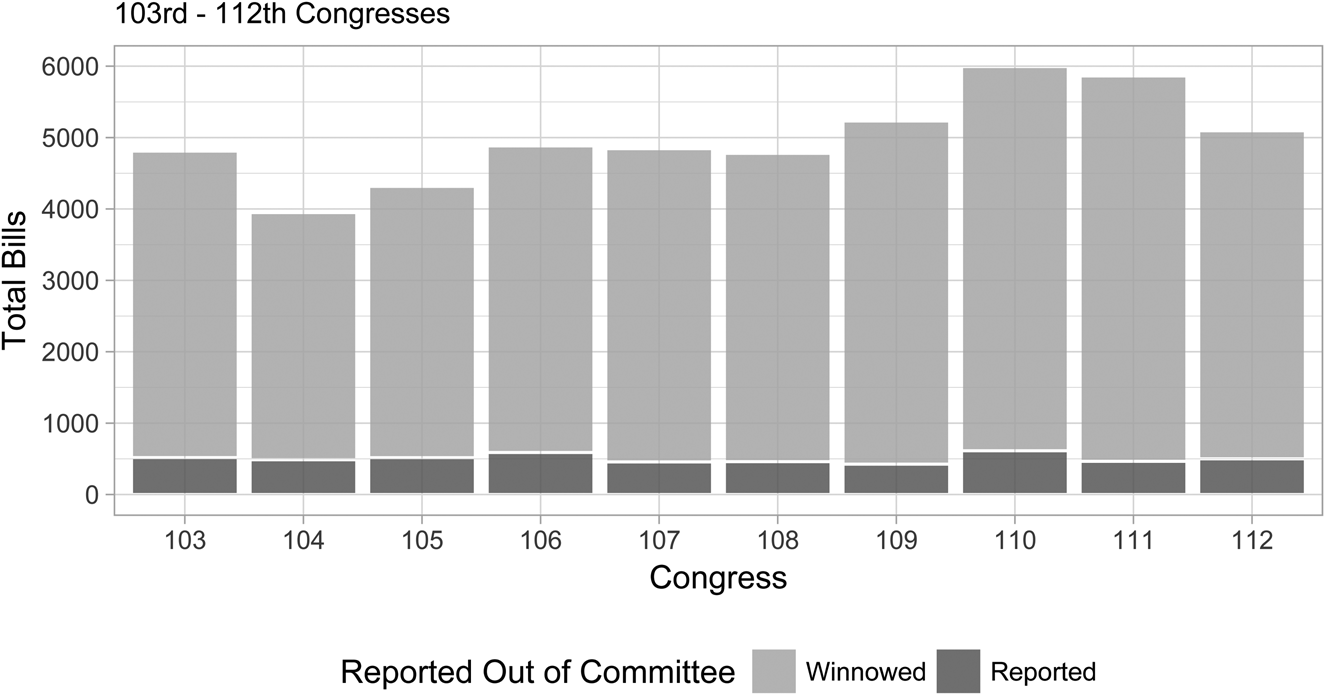
The dependent variable of interest is a dichotomous indicator that a bill has received a committee report. On average, only 10% of sponsored bills are reported out of committee (see Figure 1). This number is relatively consistent across congressional terms and partisan majorities. As Schneider (Reference Schneider2013, 1) notes, “most committee reports explain a bill's purpose and the need for the legislation, its cost, the committee votes on amendments and the measure itself, the position of the executive branch, and the specific changes the bill would make in existing law.” It is often accompanied by the history of the bill, signals that the bill has been thoroughly considered and rewritten, and can also recommend action to the floor. Therefore, committee reports are one of the better identifiers that an individual bill has fully navigated a committee that it was referred to. The nature of the dependent variable calls for a statistical model designed to binary outcomes. I opt for the tighter fit of the Probit model with fixed effects to account for variation between congressional terms.
Winnowing of Bills in the U.S. House of Representatives. This figure represents the number of bills sponsored from the 103rd–112th Congress. Coloring delineates those bills that received a committee report and those that were winnowed.

Independent Variables
Krutz (Reference Krutz2005) paints a winnowing process that is dependent on three aspects of a policy: sponsor-level factors, leadership, and policy area context. In the mold of Krutz, this is a bill-level analysis that considers all three factors. The racialized institution hypotheses propose that winnowing may be a process that magnifies institutional marginalization of Black lawmakers and the issues that they seek to promote. To capture this, I, first, include a dichotomous indicator that identifies if a bill's sponsor is a member of the CBC. To examine the possibility that disproportionate winnowing may be used to limit agenda access of contentious issues, I also include a binary indicator that a bill falls squarely within the expressed legislative domestic agenda of the CBC—a significant divergence from traditional studies in Black representation.Footnote 2
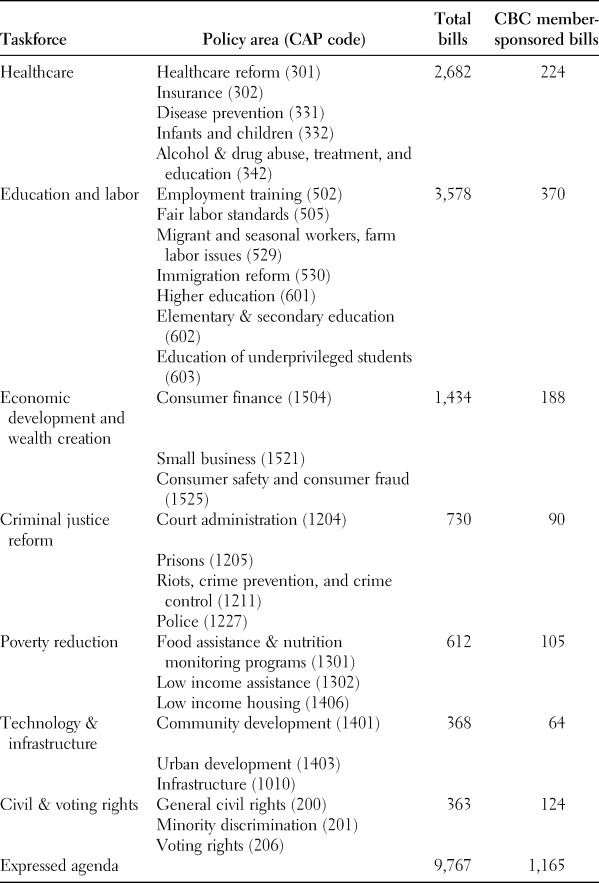
To accomplish this, I consider a combination of factors. First, I use seven standing working groups and task forces organized by the caucus as a baseline indication of interest areas. I, then, consider official, public commitments that speak directly to agenda areas and specific policy goals made by the Caucus (see Appendix A for examples). The CBC releases a public agenda at the beginning of each congressional term and routinely issue public releases on their official website and through social media that offer insight into their legislative goals. This approach reveals a multifaceted agenda that spans a diverse set of issues. From these statements, I extrapolate 28 distinct minor policy areas that fall within the jurisdiction of these particular working groups (see Table 1). Each of the specific jurisdictions have varying degrees of attention through bill sponsorship—from 3,578 in Education and Labor to 363 in Civil and Voting Rights (see Table 1).Footnote 3 This treatment identifies 9,767 bills were sponsored in key areas identified by the Caucus by all members of the House. CBC members were the primary sponsor of 1,165 of such bills. In all, bills sponsored in these seven policy areas targeted by the CBC constitute 17% of the all-inclusive 56,981-bill sample and 25% of the Caucus members' total sponsorship activity.
This table identifies seven policy taskforces and their corresponding issues of interest for the CBC

Policy areas were identified through analysis of official materials. Comparative Agendas Project (CAP) minor topics codes are included for reference. This table also includes counts of the total number of bills sponsored across each policy taskforce jurisdiction from the 103rd–112th Congress.
Assessing the Effects Access and Influence on the Pursuit of Minority Issues
One question that is central to this study asks if traditional mechanisms for forwarding issues onto the legislative agenda are equally robust and effective for those pursuing minority-interest bills. Membership on a particular committee provides, or indicates a degree of expertise or knowledge in that particular policy area. It also allows for the mediation of institutional, friction-inducing costs that are often necessary for a bill to gain traction including acquiring co-sponsors and bargaining with fellow committee members. Thus, I include a dichotomous measure of membership on the committee of referral. In addition to the variable designed to gage the impact of committee access on their ability to forward bills through committees, I include dichotomous indicators of leadership in the form of Chairmanships at the Committee and Sub-Committee levels.Footnote 4
Conceptually, results of incorporation in congressional committees can be thought of as the product of an interaction between three factors: race, issue, and degree of influence. As Black lawmakers improve on their positioning in decision-making bodies, it is expected that it will improve on their ability to advance Black-interest legislation. To assess this presumption, I present a series of three-way interactions (Table 2 in the online appendix) where race is operationalized through the dichotomous indicator that a bill's sponsor is a member of the CBC, issue area is captured by the indicator that a bill falls within the CBC agenda, and access and influence is determined by their position on and within particular committees using the benchmarks mentioned above. Scholars have argued that Black lawmakers have been funneled to less prestigious or narrow committees and may not have access to policy relevant committees (Griffin and Keane Reference Griffin and Keane2011; Rocca, Sanchez, and Morin Reference Rocca, Sanchez and Morin2011). If the incorporation hypotheses prove true, one would expect interactions to yield significant increases in the likelihood of a bill clearing the committee stage for Black members seeking change in targeted issue areas.
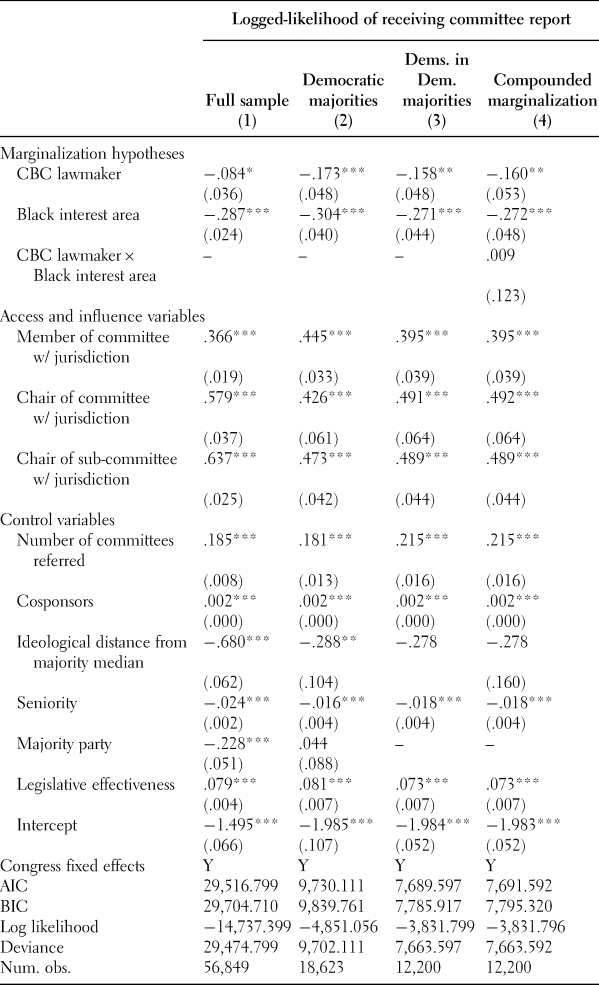
This table presents the logged-odds coefficients of four Probit models measuring the impacts on the likelihood that a bill receives a committee report from the 103rd to the 112th Congress

***p < .001, **p < .01, *p < .05.
Additional Considerations
I incorporate a number of control variables that have been found to contribute to the progress of a bill in the House of representatives. I identify sponsor-level characteristics that have the potential to greatly shape the progress of a bill through the committee level. I account for if the primary sponsor of the bill is in the majority party. Coalitional support is vital for a bill's prospects in the House of Representatives. Significant literature has been contributed to the impact of co-sponsorship on the legislative process (Koger Reference Koger2003; Krehbiel Reference Krehbiel1995). I include a count of the number of cosponsors a particular bill has garnered. There is also a dichotomous indicator to account for bills with multiple committee referrals. There are three individual characteristics that could shape the bill's likelihood of passing out of committee. I include a measure of seniority, and a measure of the member's overall effectiveness using Volden and Wiseman's (Reference Volden and Wiseman2014) measure. Additionally, negative agenda-setting literature suggests committees are a means to filter legislation that would deviate from the will of the party and its leadership (Aldrich Reference Aldrich1995; Aldrich and Rohde Reference Aldrich and Rohde2005; Cox and McCubbins Reference Cox and McCubbins2005; Reference Cox and McCubbins2007). Therefore, included in the model is a variable that captures the ideological distance of the primary sponsor from the median of the majority party using Poole and Rosenthal's DW-Nominate score (Poole and Rosenthal Reference Poole and Rosenthal2000). Finally, I include congressional fixed-effects to account for variation over time.
Results
Scholars and critics of Black representation point to a general lack of large-scale success in the promotion and passage of legislation that would result in the substantive improvement of Black Americans (see Singh Reference Singh1998; Swain Reference Swain1993; Tate Reference Tate2003; Reference Tate2014, among others). What role does the congressional committee system play in the perceived lack of legislative productivity? The racialized institution hypotheses argue Black lawmakers are subject to institutional and interpersonal forces that inhibit their success (Griffin and Keane Reference Griffin and Keane2011; Hawkesworth Reference Hawkesworth2003; Tate Reference Tate2014; Tyson Reference Tyson2016). I test the impacts of race and issue promotion on the likelihood of navigating the committee phase across the full sample of bills (Model 1) and in Democratic majorities (Model 2). I also include a subset of bills sponsored by Democrats in Democratic Majorities in an effort to simplify in-group comparisons. Findings in all three models—presented in Table 2—support the notion that the racial identity of a bill's sponsor and policy interest of the bill diminish the likelihood that a bill receives full attention in congressional committees. The findings presented allow for the confident rejection of the null hypotheses in both H1 and H2.
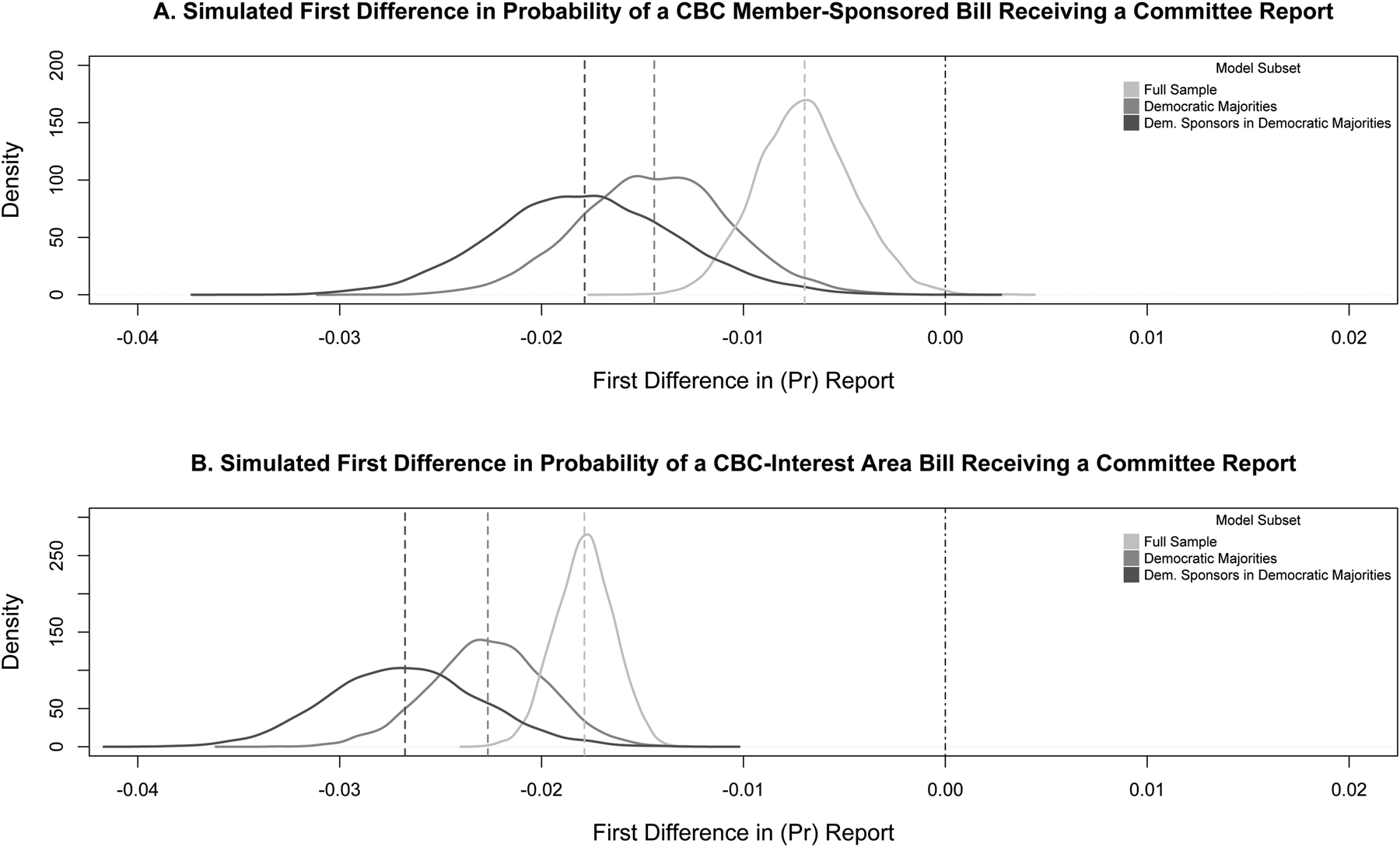
First, coefficients in Table 2 suggest the experiences of “othering” captured in Hawkesworth's (Reference Hawkesworth2003) interviews are evident beyond interpersonal interactions in congressional committees. Controlling for individual, institutional, and bill level variables, bills sponsored by members of the CBC are less likely to receive a report from the full committee. Figure 2 presents the simulated first differences of the effects of (A) a bill sponsor's race and (B) a bills issue concentration on the likelihood that the bill receives a committee report. Estimates are arrived at by using a Gibbs sampler with a sample size of 10,000 Markov Chain Monte Carlo iterations following a burn-in of 1,000 iterations.Footnote 5 The distributions represent the results of those simulations, and the mean point estimate of those simulations is captured by the corresponding vertical line.
Winnowing of Bills in the U.S. House of Representatives. This figure represents the prospects of bills sponsored from the 103rd–112th Congress conditioned upon the race of primary sponsor (panel A) and issue area (panel B). Distributions are the result of 10,000 simulations holding all other variables constant at their proper measure of central tendency. The dashed lines indicate the mean point estimate of a given distribution in each of the corresponding models. (A) Simulated first difference in probability of a CBC member-sponsored bill receiving a Committee report. (B) Simulated first difference in probability of a CBC-interest area bill receiving a Committee report.

As Figure 2A reveals, these findings are supported across the full sample of bills sponsored from the 103rd through the 112th Congress (coef. = −.084, p < .05) and in Democratic majorities, where the impact of racial identity equates to a decrease in predicted probability of 1.4% (coef. = −.173, p < .001). Model 3 finds that Black lawmakers are at a distinct disadvantage even when compared to their in-party counterparts (coef. = −.158, p < .001). Bills sponsored by non-Black members of the Democratic Party whereas in the majority have a 6.1% probability of receiving full attention of the committee. CBC members, on the other hand, see only a 4.3% chance of receiving a committee report. In an agenda space where only 10% of all bills receive committee reports in a given term, the substantive impact of a near 2% decline in opportunity that is attributed solely to the racial identity of a bill's primary sponsor is clear and non-trivial. Put differently and simply, when considering the ability (or inability) of particular lawmakers to navigate the legislative process, race certainly matters.
Similarly, institutional theories suggest that Congress is invested in limiting agenda access to issues that threaten to destabilize certain power structures in the institution. The issue marginalization hypothesis argues that racialized policy areas present such a threat to partisan and institutional orders of power and are, therefore, subject to a greater degree of agenda denial than less contentious, complex issues. Results from Table 2 suggest that issue areas that are prioritized by the CBC are, indeed, significantly less likely to navigate the committee phase of the legislative process. This finding is significant in the full sample of bills (coef = .287, p < .001) as well as in Democratic majorities (coef = .287, p < .001)—where party leadership would be presumably open to a more progressive agenda. Figure 2B reveals the substantive impact of issue preference on the prospects of receiving attention at the committee phase of the legislative process. Holding all other variables at their appropriate measure of central tendencies, there is a 1.8% difference in the predicted probability of receiving a committee report. That difference increases to 2.8% when considering bills sponsored by Democrats in Democratic majorities (Model 3).
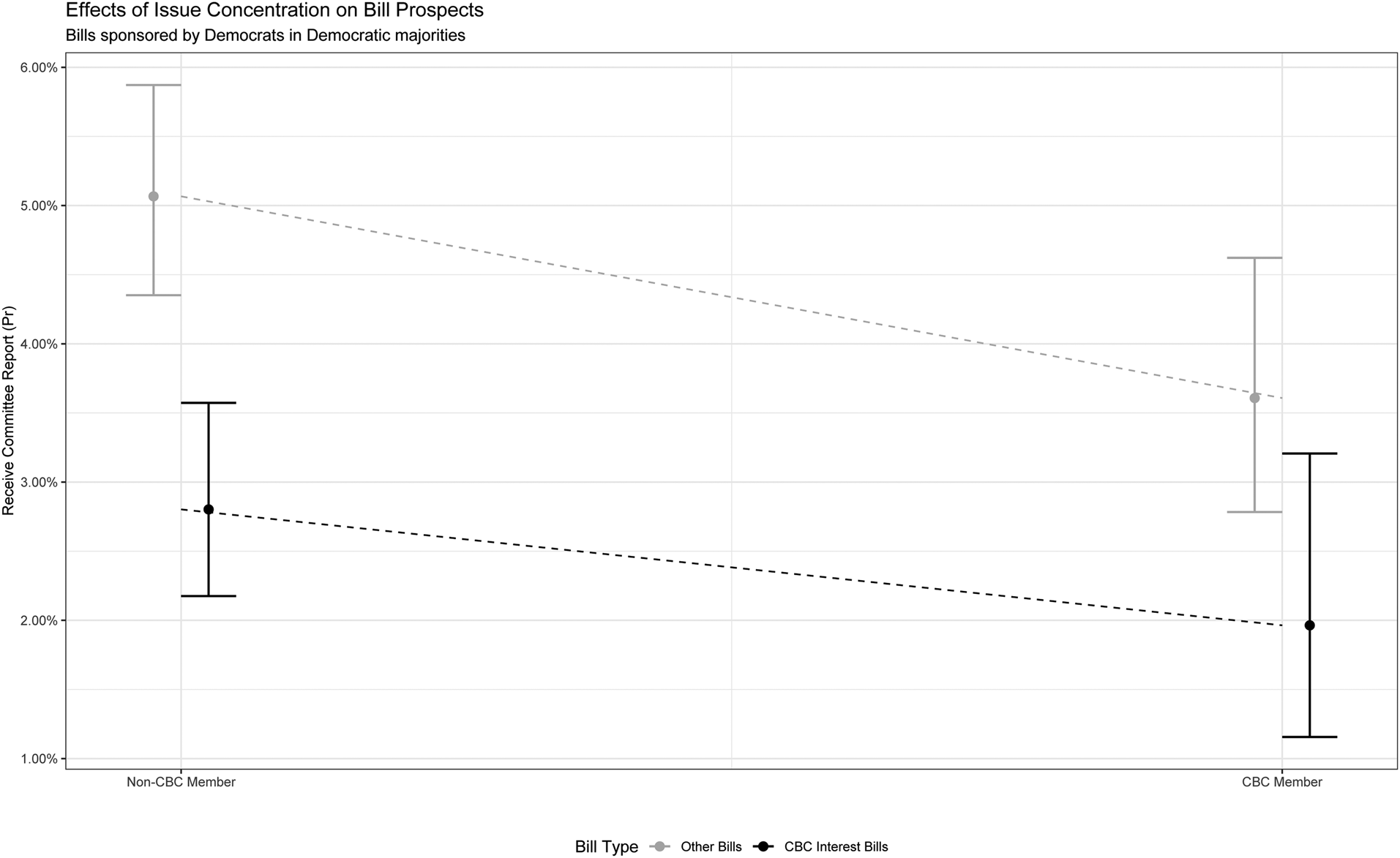
These two factors raise the question as to what happens when Black members sponsor Black-interest bills. Model 4 explores the possibility that there are interacting dynamics at play that may further constrict the effectiveness of Black members of Congress. Although the interaction in the model does not indicate a significant influence on bill prospects, the resulting visualization does further exemplify the burden of representing Black interests in the House of Representatives. Taken together, the findings from Figure 3 suggest that Black lawmakers are doubly disadvantaged—they face both marginalization rooted in their racial identity as well as in the issues that dominate their own legislative agenda. There is a significant difference in the prospects of bills sponsored by Black lawmakers that is a function of the issues they concentrate on. There is a significant decline in the probability of receiving a committee report when CBC members sponsor Black interest bills than when they adopt an agenda driven by potentially deracialized areas. Table 1 provides ample evidence that Black members face layers of structural barriers even from what one would imagine to be a friendlier legislative environment—Democratic majorities. This would be consistent with study from Frymer (Reference Frymer2010) and others who point to a hesitance on the part of Democratic leadership to embrace the advancement of racialized policy issues.
The effects of issue concentration on bill prospects. This figure represents the prospects of bills sponsored by members of the Democratic Party in Democratic majorities. Presented are interaction effects of the racial identity of the bill's sponsor and the nature of the bill's policy focus, captured in Model 4.

Access, Influence, and the Promotion of Black Interests in Committees
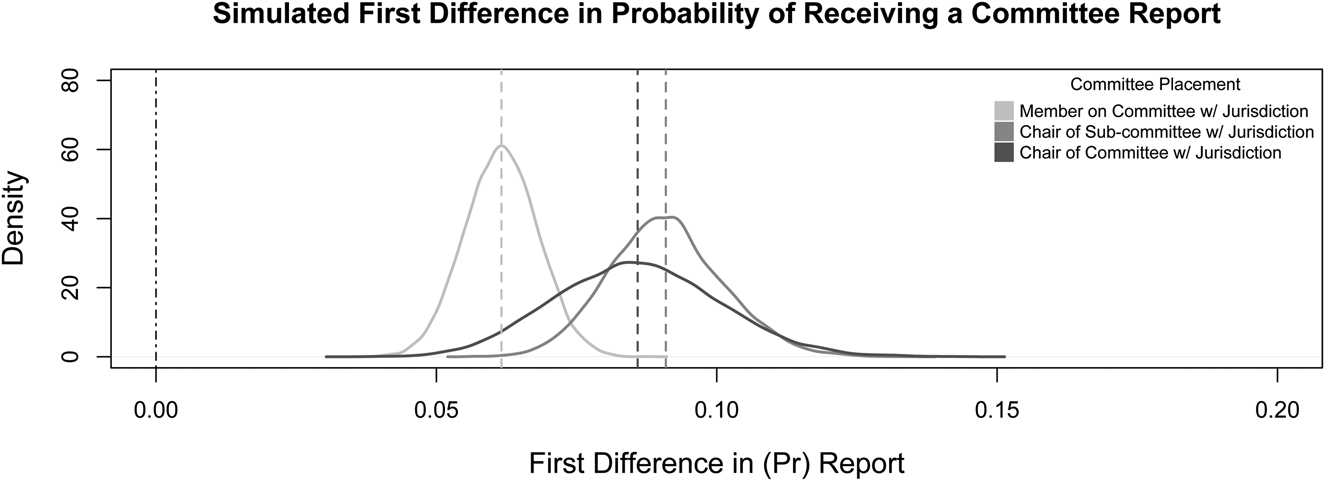
Does an increased influence at the committee level translate into an increased effectiveness for Black lawmakers? Setting racial elements aside for the moment, the models in Table 2 are consistent with Krutz's (Reference Krutz2005) study on winnowing regarding factors that could improve the prospects of a bill receiving attention in committee—at least among the general membership. As expected, the key measures of sponsorship from committees with jurisdiction or when appointed to a chairmanship on a committee or subcommittee with jurisdiction all result in a sizeable increase the likelihood of success at the committee level (Figure 4).Footnote 6 In Democratic majorities, membership on a committee increases the likelihood of receiving a committee report by 6.2%. The effects of committee leadership nearly double other Democrats: sub-committee chairs enjoy a 9.1% advantage, whereas full committee chairs hold an 8.6% advantage over the general membership and committee outsiders in the party. However, similar to the Krutz study, these findings are color-blind in both policy area and in consideration of the political actors' racial identity.
Simulated first differences in probability of receiving a report. This figure reveals the distribution of first difference estimates of the effects of access on the probability of a bill sponsored by a member of the Democratic Party receiving a committee report in Democratic majorities (Model 3). Distributions are the result of 10,000 simulations holding all other variables constant at their proper measure of central tendency.

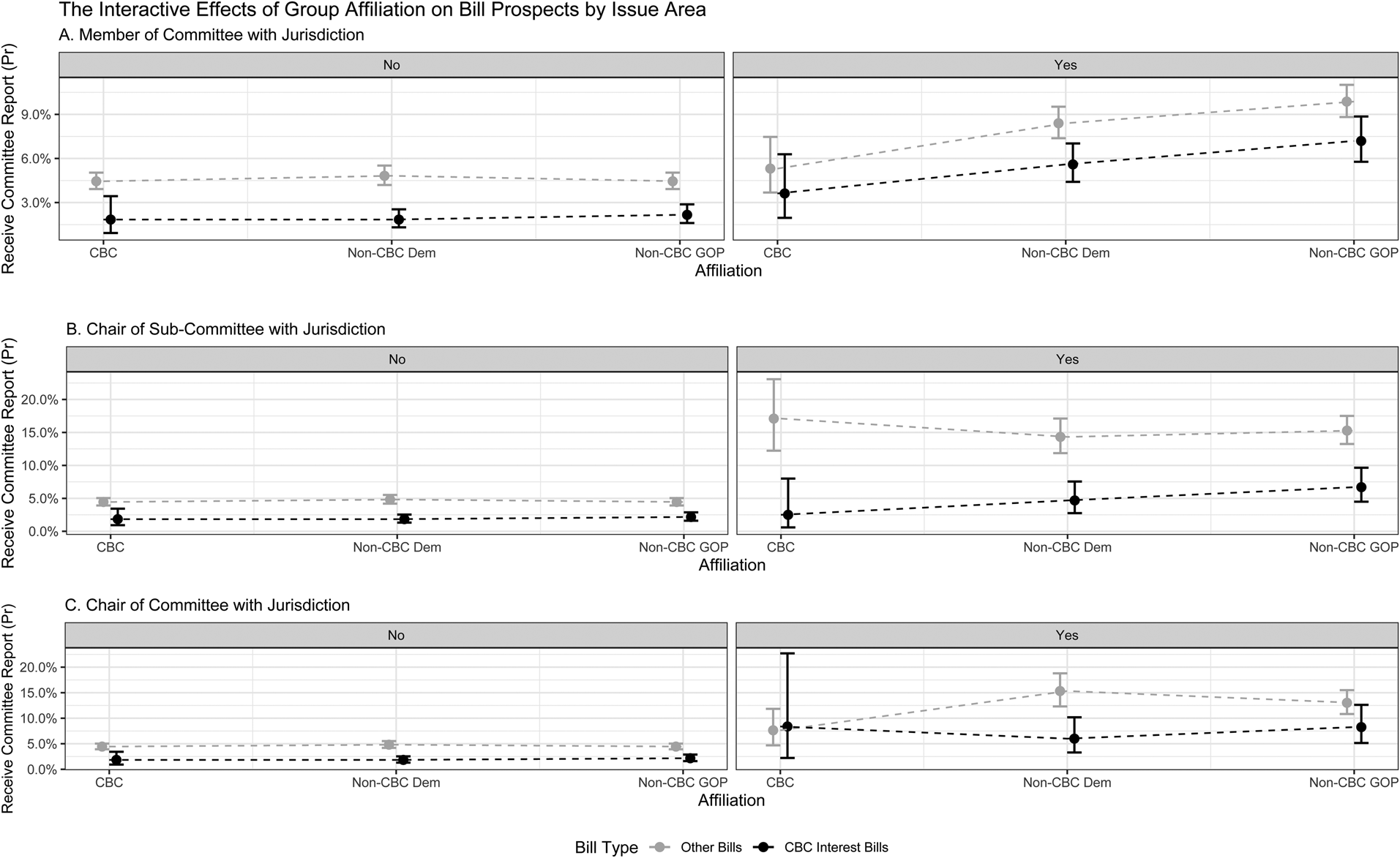
Are these benefits conditioned upon the race of the sponsor and topical interests of their legislative pursuits? Figure 5 reveals three-way interaction effects that consider if group affiliation improves the prospects of bills depending on one's position within the committee.Footnote 7 To explore this possibility, I separate House members into three groups—CBC members, non-CBC members of the Democratic Party, and non-CBC Republicans. From the 103rd through the 112th Congress, committee influence the treatment of non-CBC-interest areas is relatively consistent across groups. There are two distinct exceptions. First, mere access to committees with jurisdiction over a sponsored bill tends to benefit Republican House members slightly more than their counterparts in the CBC. Second, CBC-member committee chairs are less likely to see their non-CBC-interest bills progress through the committee phase. The disproportionate winnowing seen in CBC-interest areas is consistent across groups and positions, with the one exception remaining with those that chair larger committees. However, in policy areas targeted by the Black Caucus, CBC members experience less of a benefit from access than their Republican counterparts.
The interactive effects of group affiliation on bill prospects by issue area. This figure reports the predicted probability of receiving a committee report for bills sponsored from the 103rd–112th Congress. These findings are conditioned upon access and influence of the primary sponsor, the affiliation of the primary sponsor and the topical focus of the bill. (A) Member of Committee with Jurisdiction. (B) Chair of Sub-Committee with Jurisdiction. (C) Chair of Committee with Jurisdiction.

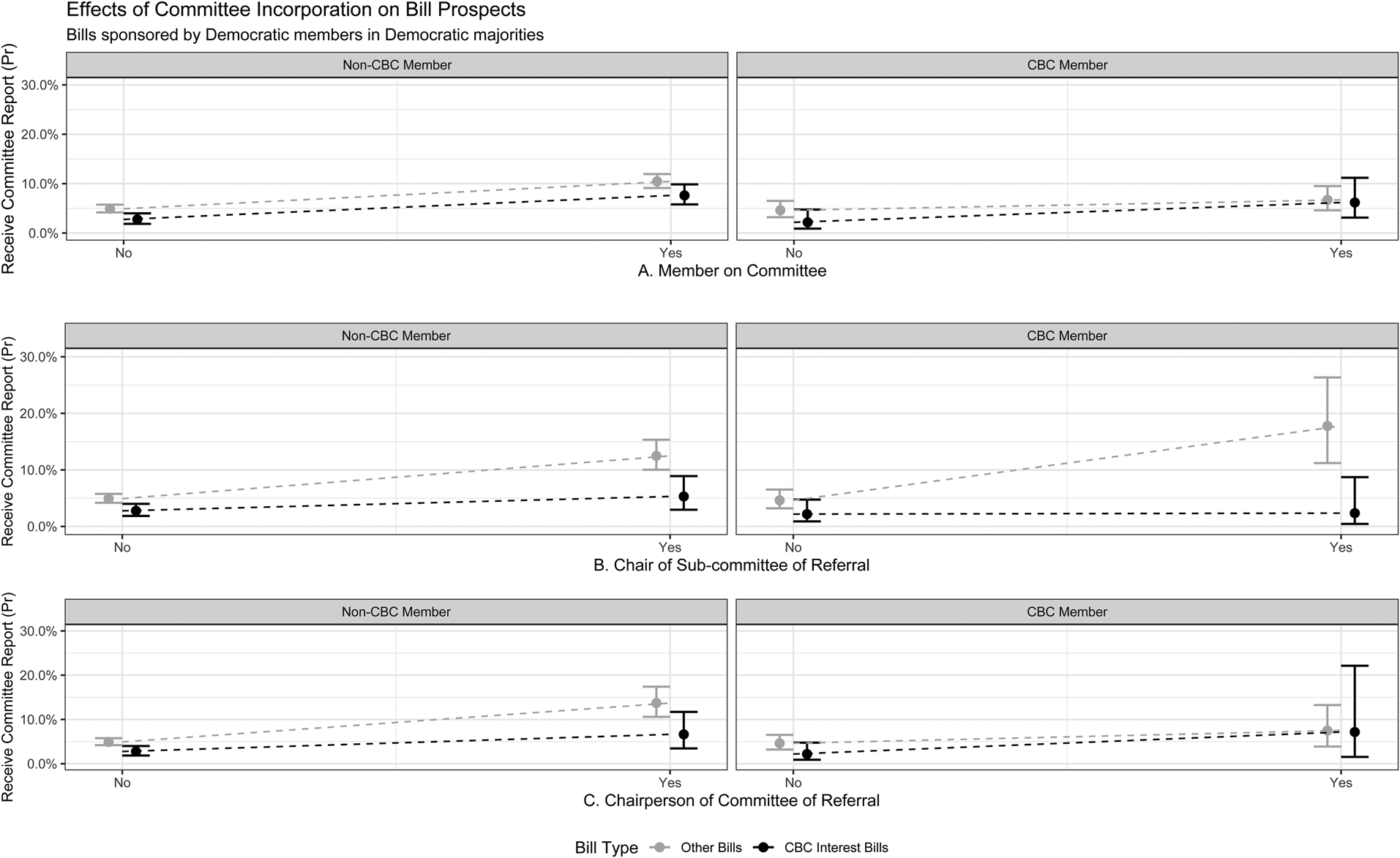
Figure 6 extends a similar treatment to only those bills sponsored by Democratic lawmakers under Democratic majorities. This is an effort to examine how party dynamics may impact a particular bill's trajectory. Ultimately, none of these interactions presented produce evidence that incorporation leads to substantive improvements in the ability of Black lawmakers to promote Black interests. Figure 6 suggests that Black-interest proposals are treated similarly in congressional committees regardless of who sponsors them and from where in the committee structure the proposals are sponsored. These interactions also reveal the underlying forces commonly discussed in the congressional literature that better explain the likelihood of success for Black-interest legislation and highlight the problematic reality for the current state of Black representation in the House of Representatives.
Winnowing of bills in the U.S. House of Representatives. This figure reports the predicted probability of receiving a committee report for bills sponsored by Democratic members during Democratic majorities. These findings are conditioned upon access and influence of the primary sponsor, the CBC Membership, and the topical focus of the bill. (A) Member on Committee. (B) Chair of Sub-committee of Referral. (C) Chairperson of Committee of Referral.

Committee Access and Black-Interest Promotion
First, although the general models in Table 2 find convincing evidence that the chances of bill success at the committee level is increased when a bill is sponsored by a member of a committee with jurisdiction over that specific policy area, this is not the case for all lawmakers. Black lawmakers receive no real advantage from positioning on committees of interest, regardless of the nature of the proposal. In fact, the marginal increase Black members experiences when sponsoring bills from within a committee merely puts them on par with the prospects of bills sponsored by non-Black lawmakers from outside of a relevant committee. These findings are consistent with arguments from Hawkesworth (Reference Hawkesworth2003) suggestion that even when minority members of congress—in her study, Black women—happen to gain access to committees of interest, they face marginalization, silencing, and additional forms of othering that impede their legislative pursuits.
The cross-racial comparison (Figure 6) reveals the second reality: the marginalization of Black members is compounded by the fact that when non-Black members sponsor bills that fall within the topic areas of interest, they experience a slight, but significant, increase in probability of navigating the committee phase. Bills sponsored by non-CBC lawmakers experience slightly more than 10% predicted probability of receiving a committee report. This may indicate that, in a political environment where factions are at constant competition in the game problem identification and attribute definition, minority members remain disadvantaged.
Committee Leadership and the Promotion of Black-Interest Bills
These findings in Figures 5 and 6 suggest two interrelated ideas. First, the burden of advancing Black issues in House committees is real and prevalent, regardless of the influence of individual member. This would be consistent with previous arguments that institutions—regardless of who is in control—shy away from contentious, racialized policy issues. Second, the mechanisms to preserve order within the larger party structure seem to prevail over individual pursuits of the member. At no place is this more evident than in results at the sub-committee level. Scholars have examined the influence of sub-committees and come to varied conclusions (Deering and Smith Reference Deering and Smith1997; Hall and Evans Reference Hall and Lawrence Evans1990). Among them, Hall and Evans (Reference Hall and Lawrence Evans1990, 350) find, “influence varies considerably from bill to bill, even among bills reported from a single subcommittee, suggesting that there are conditions specific to the issue and legislative context that explain the distribution of power within House committees.”
The interactions in Figures 5 and 6 point to negative agenda-setting playing a major role in a subcommittee chairs ability to forward legislation. Sub-committee chairs—Black or otherwise—see a tremendous advantage over rank-and-file members when sponsoring bills in more mainstream policy areas within their jurisdiction. However, that benefit disappears when sub-committee leaders stray away from traditional legislation—those issues likely endorsed by party leadership (Cox and McCubbins Reference Cox and McCubbins2005; Reference Cox and McCubbins2007)—and venture into what may be perceived as radical, racialized policy areas. In the case of sub-committee chairs, efforts to shape the legislative agenda and drive attention toward these policy areas are met with noticeable opposition. Whether this is a function of non-Black committee leadership thwarting efforts for racial advancement or Black committee chairs dampening attempts by activist sub-committee chairs cannot be discerned from the data.
Rules at the committee and caucus levels create a situation where, “in their attempts to usher legislation through their parent committee, subcommittees are guaranteed none of the procedural advantages that recent institutionalist theory would lead us to expect,” and thus, their role as legislative floor manager is one that is likely conditional on their ability to toe the committee or party line (Hall and Evans Reference Hall and Lawrence Evans1990, 351). The similarities in the comparison across races suggest that leadership at the committee level and in the broader party may understand these issues to be political landmines. If credit claiming is at the core of members' legislative behavior (Fenno Reference Fenno1978), Black sub-committee chairs are faced with the dilemma of choosing between building a portfolio of legislative wins in areas sanctioned by the larger party apparatus or being stonewalled in their pursuits of Black interests. Figure 6B reveals 15% difference in the probability of advancing legislation driven by the topical focus of the proposal—a difference that may be enough to de-incentivize pursuing policies targeted by the CBC. The interactions in Figure 6C tell a different story for Blacks that sit atop full committees. Not only do Black committee chairs struggle to receive an advantage from their positioning in their pursuit of Black-interest legislation, it appears that there is no statistical difference in the performance of bills sponsored by Black committee chairs and the average rank-and-file member of the Democratic party. Non-black committee chairs, however, do experience a significant boost in issue areas that fall outside of the Black Caucus agenda space.
Discussion
The winnowing process is an unforgiving one, and these findings suggest that it is not a color-blind phenomenon. Instead, it is a process that doubly-disadvantages those charged with and interested in the representation of Black Americans. First, there is a significant degree of deprioritization and filtering of bills at the committee stage that can be attributed, simply, to the racial identity of the bill's sponsor. Second, policy areas targeted by the CBC are subject to a disproportionate degree of winnowing. These differences may be a result of the highly competitive policy environment in Congress; it could also be a product of the contentious nature that surrounds many of those issues as well. Either way, Black members and their non-systemic demands face distinct disadvantages.
Even more troubling for Black lawmakers, the mechanisms that are generally effective for members to promote these issues appear to be relatively ineffective for CBC members. Incorporation would presume that those that rise to power would also assume much of the benefits that are associated with the new rank. These finding suggest this is not the case. The results of this analysis tell a rather bleak story for Black lawmakers. Access to key committees provides no real advantage for Black representatives; they are ultimately treated, statistically speaking, as outsiders. Those that ascend to leadership in committees a disincentivized from sponsoring legislation that deviates from a more mainstream agenda.
Blacks in committee leadership positions routinely struggle with the pursuit of Black interests and often set aside big policy change for “smaller, quieter” impact on the legislative agenda (Gamble Reference Gamble2011; Tate Reference Tate2014). Tate (Reference Tate2014) contends this tension is the result of the ideological moderation necessary to ascend to influential positions within the institution. Conversely, Chisholm (Reference Chisholm1970) argues that leadership dangles power as a means to tamp down the ambitions of activist “boat rockers.” This analysis provides further support for both Tate's and Chisholm's findings. Although an increase of Black lawmakers may directly translate to increased attention to minority issues in committee hearings (Ellis and Wilson Reference Ellis and Wilson2013; Minta Reference Minta2011), they do not use their perch to serve as champions of legislation in Black interest areas. This study provides clear evidence that, as a result of an institutional culture that promotes legislative gatekeeping as well as structural and interpersonal marginalization rooted in racial identity, Black lawmakers do not—or cannot—leverage leadership positions to advance Black-issue bills.
There are notable exceptions that contribute to the variation found in these models. These findings are likely influenced by productivity of Charlie Rangle who occupied the chairman's seat in one of the most influential committees in the chamber—Ways and Means. From that position, he authored more than 90 bills in his 2 years as chair. In that time, his proposals saw a unique level of success; two-thirds of the substantive bills sponsored in the 110th Congress cleared the committee stage and half of those sponsored in the 111th Congress saw similar results. John Conyers saw similar success as Chairman of the House Judiciary Committee. Although his productivity did not match his colleague Rangel's output, he was able to author several bills that progressed beyond the committee stage (Volden and Wiseman Reference Volden and Wiseman2014). These finding, however, suggest that Conyers and Rangel were exceptions, not the rule.
Conclusion
Minority members have made tremendous strides in closing the gap in committee portfolios and in their upward mobility in the chamber. Access and promotion appears to benefit some members of the institution in some ways. However, for Black representatives, occupying agenda-influencing positions does not appear to translate into increased success in forwarding their more racialized agenda. The conditional nature of power and agenda influence in congressional committees lends more support to Smith's (Reference Smith1996) concept of cooptation as a response to a group's non-systemic demands. The authoritative allocation of power in its political institutions comes with an expectation of stability. Those invested in preserving power are deliberate in their allocation of such power, especially when that power is bestowed to members of groups who have traditionally been subject to marginalization within that institution. Thus, as others have argued, those that are selected to lead committees are expected not to “rock the boat.”
As Chisholm points out, systems are willing to give members a taste of power because “[p]ower is all anyone wants, and if he has a promise of it as a reward for being good, he'll be good.” Influence, then, becomes a means to suppress the ambitions of a particular group or individual members when the institution feels stresses from signals rooted in nonsystemic demands. Cooptation is an especially viable option when, for example, the electoral security of a particular member prevents the party from replacing her with a less contentious person more willing to acquiesce to the wishes of the larger system. Black lawmakers occupy uniquely safe seats with constituencies that are unlikely to shift to more traditional or non-white representation. Therefore, the House of Representatives—and its leadership—quickly realize that if they cannot “get him,” then they are best served to bring him in (Chisholm Reference Chisholm1970).
These findings could prove problematic for those looking to improve on the conditions of Black America. When committees do decide to forward those issues through to the larger stage, the findings suggest the bills considered may come from a different or even counter-perspective from the agenda of Black Caucus members. CBC members may be at the mercy of members seeking to implement more regressive policies or be heavily reliant on allies within the committee to forward bills in the areas Caucus members pursue. Unfortunately, non-CBC members of the Democratic Party have proven themselves to be reliably unreliable in attending to Black interests. The biggest loss may be suffered by those who hope that the election and incorporation of Black representatives will increase the likelihood of favorable policy outcomes. These findings suggest that there remain major institutional hurdles in the path of legislative liberation for the Black community.
These findings emphasize that a more comprehensive approach to agenda influence is necessary—incorporation, alone, is not enough. It is important to remind—and to an extent reassure—readers that bill sponsorship in those targeted policy areas is not wasted effort on behalf of the Black Caucus despite the institution's overall inattentiveness. Congress is “sticky” by design and requires surges of information—or “signals”—in order to invoke a response. Policymaking institutions have a tendency to behave in two fashions: they under-respond to environmental signals until those signals become unavoidable, then, they over-respond (Jones Reference Jones1994; Jones and Baumgartner Reference Jones and Baumgartner2005; Workman, Jones, and Jochim Reference Workman, Jones and Jochim2009). As Kingdon (Reference Kingdon2011) argues, it is often necessary to “soften up” decision making institutions in order for policy change to occur. Thus, persistence may not reap immediate rewards, however, this effort is not futile.
It is also important to understand the hurdles that these lawmakers must overcome in order to bring about change in an institution that has yet to shake its history of racialized institutionalism despite significant gains in minority representation (King and Smith Reference King and Smith2005). Minority members of Congress are forced to challenge not one but two power structures in order to achieve their substantive policy goals. On one front, they must navigate the larger institution and its interests that have historically been at least resistant to minority advancement or, in many instances, a causal force in their marginalization. On the second front, they operate, almost uniformly, within a party that avoids addressing minority issues and reinforces conformity with the larger “color-blind” agenda. Absent a realignment in power—either through the rearrangement of priorities or an upheaval of the power structure itself—in one of the two systems, a constant imposition of friction may inhibit their ability to gain traction on many of the issues that they have prioritized.
If traditional mechanisms fail Black lawmakers seeking to advance key issues onto the legislative agenda, it is important to expand our queries into uncharted territory. As a discipline concerned with the representation of minority interests, it is important to move beyond individual measures of member activity and to take on the challenge of examining nontraditional strategies that may be unique to lawmakers of color. It would also be advantageous to expand on the efforts to study the intersections of marginalized-group interest and understand how different groups collaborate to achieve policy wins in shared priorities (Minta and Sinclair-Chapman Reference Minta and Sinclair-Chapman2013; Tyson Reference Tyson2016). Finally, it is essential to update our understanding of the policy pursuits of the CBC as the group reshapes its legislative agenda to meet modern demands. A modern, pragmatic agenda may improve member's ability to drive attention toward those issues. Increased influence within the chamber may be a tool for collective advancement rather than personal gain. It may be fruitful to expand our scope of inquiry beyond traditional measures of influence and adopt an approach that could unearth more nuanced trends in the collective behavior of Black lawmakers.
SUPPLEMENTARY MATERIAL
The supplementary material for this article can be found at https://doi.org/10.1017/rep.2020.18.