Dissatisfied with the dearth of roles for actresses of colour in Canada, Maxine Bailey and Sharon M. Lewis decided in 1992 to start a theatre company in Toronto that they called Sugar n’ Spice Productions as a resistant, tongue-in-cheek response to those who thought a women-initiated theatre project ‘so cute’.Footnote 1 Later, in rehearsals of a script written by an African American, they became frustrated with that playwright's attempt to represent black Canada and decided to write a play themselves. The result was Sistahs, which premiered in 1994 at the Poor Alex Theatre in Toronto. Coincidentally, during the writing, workshopping and finally performing of Sistahs, sustained controversy erupted around Harold Prince and Livent's revival of the American musical Show Boat as the inaugural production for the North York Performing Arts Centre, located in a nearby Toronto suburb.
The genesis of this play points to a multifaceted issue of particular importance within diaspora relations, namely how to negotiate difference within identity.Footnote 2 This article analyses that play as an instance of African diaspora feminism. Having been written initially for presentation at a conference on women's performance as ‘act[ion]s of transfer’ in the Americas, it crosses that hemispheric frame to gesture towards the old world of Europe and Africa, always already present in the new, whose legacy is not spoken in Sistahs but is made manifest in bodily repertoires of disease. Indeed, none of the women in this play even mentions Africa, suggesting that older formulations of diaspora as expulsion from an originary site of belonging are being superseded by postcolonial histories of migration and circulation in which individuals recognize themselves and others as members of the African diaspora by virtue of the racialized experiences that they endure in host countries. The play's focus on five women in a Canadian kitchen displaces the hegemony enjoyed by African Americans as signifiers of blackness in the Americas, challenging spectators as well as readers to remember instead the long history of blacks in Canada and the existence of multiple African diasporas in the Americas. Dramatizing the labour of fostering an African diasporic sensibility, this Canadian play anticipates some of the challenges that African US Americans have begun to confront, as members of a contemporary diaspora produced by neocolonial economic policies, poor governance and genocidal wars that outnumbers the historic diaspora produced by slavery.Footnote 3 Further, through its focus on black women, some of whom are lesbians, Sistahs not only rewrites a 1970's cultural feminism, but, more importantly, it also subverts diaspora's conventional emphasis on heteronormativity, positing home and family instead as fragile, fabricated networks of shared histories, love, struggle and reciprocal responsibilities.
The sociocultural context in which the Bailey–Lewis play emerged is itself instructive of tensions between the local and the transnational and of risks of misrecognition inherent in diaspora projects. That context seemingly reinforced the playwrights’ determination to dramatize a story of black Canada, and undoubtedly became part of the interpretive environment in which audiences received the production. As noted above, during the time Maxine Bailey and Sharon M. Lewis began working and preparing the play for production, Harold Prince and Garth Drabinsky of Livent opened Show Boat in Toronto. The musical's plotline, in which the singer Julie must be expelled from a Mississippi riverboat once her mixed-race background becomes known, and a young white woman benefits from Julie's musical tutelage, provoked protests and ultimately boycotts by African Canadians who argued that the representations of blacks were racist.Footnote 4 Though dismissing community concerns as ‘intellectual travesty’,Footnote 5 the creative team, nonetheless, revised the script in an attempt to lessen stereotypical representations, resulting for some in a confused modernization that reaffirmed the black subservience on display in the original.Footnote 6 Additionally, producers employed well-known African Americans to advertise and generate educational materials,Footnote 7 and the Toronto Globe and Mail newspaperFootnote 8 seemingly deployed news of black US American media's subsequent positive reception of Show Boat as a rebuke to the African Canadian community's concerns. Missing from its coverage was consideration of the local contexts of Toronto and New York City that might account for such discrepant readings. During this controversy Sharon M. Lewis wrote an essay, ‘Rocking the Show Boat’, in which she proposed several responses that artists of colour might pursue while still trying to advance their professional careers. Among her recommendations were that actors present audition pieces written by playwrights of colour, inquire about play selection policies, seek seats on funding agencies and protest demeaning representations.Footnote 9 That the play emerges in a context of struggle for visibility and authority is not immediately apparent some fifteen years later, but this theatre history illustrates the always rooted quality of diaspora – that is, people create communities of identity in relation to particular, material realities; given asymmetrical power relations particularly as the latter operate in global routes, diaspora subjects risk misrecognition by, or pose harm to, those considered like themselves, if all parties are not vigilantly self-reflexive in their attention to local histories.Footnote 10
My crafting this article is itself an exercise in diaspora practice. As an African American woman and scholar, I recognize in Sistahs much that looks like African American experiences. Indeed, black Canadian scholars and creative writers alike have remarked upon the significant role that black American popular culture plays in shaping their imaginary, and scholarship about black Canada seemingly frequently draws upon that of black America for its support.Footnote 11 But as the beneficiary of the unearned privilege of hegemonic location, how do I avoid repeating a repertoire of dominance? I have attempted to decentre my sense of familiarity in order to appreciate how African Canadians are speaking their experiences. In some instances, such decentring involves a politics of citation, prompting me to respond to questions such as who gets to speak first (or last) in providing authoritative analysis? Who is assigned to the footnotes? In deciding such concerns, how am I balancing recognition of the dynamic circulation and interplay of cultures against knowledge of the cultural theft that hegemonic actors have historically enacted?
Briefly stated, Sistahs revolves around five middle-class black women, in their thirties, who have gathered in a Canadian kitchen to confront the cancer that is ravaging one of the group. Sandra is a history professor who has decided to stop conventional medical therapies against cervical cancer. Her partner is Dehlia, who has also parented Sandra's child, Assata, from the time the girl was young. Rea is Sandra's sister; she is also a married, government bureaucrat hostile to her sister's lesbian relationship. Rounding out the group is filmmaker Cerise, whose mother died from breast cancer. Sandra has invited these women to her home to make a soup that she hopes will ease her journey towards death and institute a parenting circle for her teenaged daughter. Structured in eighteen episodes, the play also utilizes three different representational modalities, namely an ‘ancestral time’ in which everyone moves slowly and repetitively; a lecture style in which Sandra addresses the audience as though it were her class; and the ‘real’ time of the play's present in which the women chop ingredients, reminisce about varied coming-of-age experiences, grieve and rage about the impending loss of a mother/sister/lover/friend, and finally eat a soup that is unlike any they remember from ‘back home’.
Recognizable even in this brief plot synopsis are elements characteristic of second-wave cultural feminism: an emphasis upon and validation of women's culture, as signified by the act of cooking–nurturing; deployment of the kitchen as the locus of women's agency; use of folklore surrounding menstruation and (hetero)sexual pleasure; and the intergenerational transfer of bodily knowledge, particularly between mothers and daughters. Yet this appearance of a transcultural, female essence is rendered particular by the fact of black women's bodies, for as Andrea Davis observes in the introduction to the play, ‘The kitchen has always provided an important space for black women within the African diaspora. During slavery, some of the boldest acts of covert resistance were initiated by women who worked in the kitchens of plantation Great Houses’.Footnote 12 Even though after slavery the kitchen became a space in which black women could build and sustain their own communities, the symbolic potential of this Canadian kitchen is inflected and at times destabilized by the different national, diasporic and sexual identities that have been externally imposed, embraced and creatively re-performed – and contested – by the five women. Stuart Hall's discussion of diaspora identity as both a being and a becoming is instructive here, for at virtually each moment in the play one sees the bases upon which these women enjoy a shared, group identity and those factors that simultaneously distinguish them from each other and push them into the process of renegotiating their sense of self in relation to another. That is, in their sometimes joking exchanges about the most desirable ingredients and the proper sequence of their additions to the soup they are collectively cooking, each woman operates from a clear definition of what constitutes home. Each initially projects what Hall terms ‘one true self’, having learned in her mother's kitchen a history that is held in common with others and cultural codes that mark the group as a distinct entity and provide a stable framework in which to understand the world. As black and brown women, they are the same – that is, other to Canada's presumed whiteness. For two years after the play's premiere, ‘visible minorities’ constituted only 11.2 per cent of the total population.Footnote 13 Furthermore, hailing mainly from the Caribbean, they are, as Hall argues, positioned monolithically as peripheral vis-à-vis the West, they are viewed as ‘always “South” to someone else's El Norte’.Footnote 14 Yet as Hall also notes, each island does not ‘stand in the same relation of “otherness” to the metropolitan centres. Each has negotiated its economic, political and cultural dependency differently’.Footnote 15 Thus, in accepting Sandra's invitation to cook together at a point of crisis, they are challenged to dismantle their intimately felt notions of home, negotiate their differences, and attempt to create a new recipe that may or may not prove palatable.
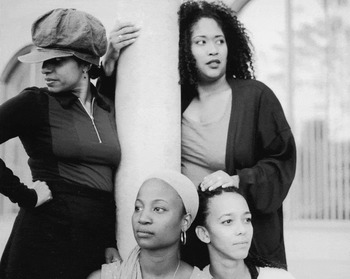
Production photo of Sistahs by Maxine Bailey and Sharon M. Lewis. Photographer: Dawn Stephenson.
From left standing: Sharon M. Lewis, Kim Roberts
From left, seated: Melanie Nicholls-King, Lisa Richardson

Indeed, in this play, the women make shorthand references to the different island histories that have brought them to Canada: Dehlia is from Jamaica, where, as she caustically observes, the former socialist-oriented prime minister, Michael Manley, was forced in the late 1980s to become ‘a Reaganite’ in order to meet the severe conditionalities imposed by the International Monetary Fund. Sandra and Rea are from Trinidad and Tobago, which during the same period used the sudden expansion of petrodollars not only to improve general standards of living for all but the very poorest, but also, more troublingly, shifted from being an exporter nation to an importer.Footnote 16 Though sisters and daughters of a black woman, Sandra and Rea have different fathers: Sandra's father was black, while Rea's was Indian, descended in all likelihood from those forced from the Indian subcontinent to the Caribbean as indentured, agricultural workers after the abolition of slavery in the British Empire in the mid-1800s. Given her mixed parentage, Rea belongs to that tenth of the Trini population known as dougla hated or mistrusted by both Indian- and African-descended communities because of colonial governing policies that positioned Indians as a buffer class between the white upper classes and the black masses. Furthermore, though neither Sandra nor Dehlia mentions this fact, Trinidad and Tobago in the mid-1980s passed the Sexual Offences Act that consolidated existing laws criminalizing homosexual behaviours as well as prostitution.Footnote 17 Thus, in emigrating to Canada, Sandra has found a sexual freedom denied her at home, but that benefit has come at the cost of marginalized status in a nation where true citizens are presumed to be white and all others are regarded as immigrants, despite the fact that approximately 45 per cent of blacks in Canada are native-born.Footnote 18 Playing with that nationalist construction, the women tease Cerise several times about having been born in Canada, implying thereby that as a black woman she, too, is out of place because she has not emigrated from the Caribbean. Their histories of immigration and centuries-old residency mirror the histories of African Canada, which must be acknowledged as a ‘fragmented collective, one fissured by religious, ethnic, class, and length-of-residency differences’.Footnote 19 In consciously addressing the women's relationships with each other, the play thereby performs a project that is simultaneously diasporic and national, revealing thereby a confluence in two categories most often considered oppositional. One might also think of this double move – negotiating difference within similarity and insisting upon visibility within the nationalist imaginary – in terms of what Rustom Bharucha terms ‘intracultural theatre’ devoted to exploring internal diversity within the boundaries of a presumably homogenized region, group or nation.Footnote 20
Similarly, though the women may joke about what distinguishes them from each other, though their lost homeland is a particular Caribbean island rather than the African continent itself, they are all haunted by the transatlantic slave trade. Not only did that trade transform some humans into commodities and conscript others into hegemonic whiteness, but it also enabled imperial projects that forced many into diaspora and made them colonial subjects whether at home or abroad. Gendered practices of that trade produced in women's bodies an inheritance that is obvious in some respects and yet subtle in others, having been internalized and passed along to younger black women as a desirable model of womanhood. Sandra recuperates aspects of that legacy when she lectures her class:
The middle passage . . . the surgical removal of female reproductive organs . . . Women were kept at the bottom of the ship, as they fetched less of a price than a stud; a few were kept on-deck to cook for the captain, and some were used for . . .Footnote 21
Not only is she alluding to the sexual violation that many enslaved women experienced, but she is also making reference to the forgotten history that ‘slavery enabled the foundation of gynecology and in the process helped define the proper objective of medical experimentation’, for J. Marion Sims, the father of gynaecology, experimented on enslaved black women in order to develop the speculum and the treatment of vesicovaginal fistulas or tears in vaginal walls that allow urine or fecal matter to leak.Footnote 22 And as scholars like Terri Kapsalis and Dorothy Roberts note, poor women of colour, resident in the global South as well as in North American cities, have continued to be used as suitable experimental subjects for reproductive technologies like Norplant.Footnote 23
Relatedly, Sandra announces in another university lecture that her department will no longer allow her to present oral ‘stories . . . as a valid historical document’.Footnote 24 Barely represented in official history as objects of servitude and thus lacking in subjectivity or agency, black people and their experiences are to become further invalidated by the proscription against oral history. Lost to younger generations is knowledge of the long history of blacks in Canada that calls into question the construction of the nation as a liberal, welcoming haven unlike its racist neighbour to the south.Footnote 25 Lost also is understanding of the impact of a history of misrepresentation and erasure on the body – particularly on the bodies of black women. Though many of the students in Sandra's classroom – and spectators or readers – will have encountered what black feminists call the Strong Black Woman (SBW) as service worker, domestic servant, office mate, mother or aunt, few will know the historical motivations for, and costs endured in the development of, this persona.Footnote 26 Historian Darlene Clark Hine has theorized that African American women, in response to systematic rape and discursive violence, developed behaviours by which they ‘created the appearance of openness and disclosure but actually shielded the truth of their inner lives and selves from their oppressors’.Footnote 27 In her study of the employment history of black nurses in Canada, Karen Flynn suggests that this behaviour obtains in Canada too, when she identifies silence, frequent changing of jobs, acceptance of skill devaluation and the creation of informal, safe networks for women as strategies they deployed to deal with racism.Footnote 28 Introducing Sistahs, Andrea Davis remarks,
Black women, after all, have been socialized to believe that strength – psychological and emotional – is their particular inheritance that they should wear with pride because only white women have the luxury of weakness. These women, then, learn how to internalize their pain and find innumerable ways to camouflage and mask their suffering until it's too late.Footnote 29
This model of tireless, indomitable womanhood, in service to everyone other than herself, the SBW passes along to her younger, female relatives.Footnote 30
Not surprisingly, this practice of repressed response to racialized violence, masked as accommodation and openness to all, comes at great cost to the SBW herself. Though research on black women's health in Canada is relatively sparse, and the relationship between emotions and health is not necessarily direct, it is nonetheless sobering that given lower economic status and racism, ‘African women from the continent, the Caribbean, and Canadian born Blacks are over represented in terms of HIV/AIDS, diabetes, asthma, hypertension, sexually transmitted diseases, sickle cell anemia, breast cancer, high blood pressure, and uterine fibroids’.Footnote 31 And, if black women in Canada have a profile similar to their counterparts in the United States, then we may also suspect that the frequency of premenopausal breast cancer is twice as high among black women as among white, and that their mortality rates may be ‘higher than any other racial/ethnic group for nearly every major cause of death including heart disease, lung cancer, cerebrovascular disease, breast cancer, and chronic obstructive pulmonary disease’.Footnote 32 Playwrights Maxine Bailey and Sharon M. Lewis posit a similar situation in Canada. It is no accident that the history professor is suffering from cervical cancer, for under slavery the womb and reproduction were ‘not an elaboration of the life-principle in its cultural overlap, but an extension of the boundaries of proliferating properties’.Footnote 33 As scholar Hortense Spillers argues, in a slave system where black children had no legally recognized parents and were simply the property of the master,
even though the enslaved female reproduced other enslaved persons, we do not read ‘birth’ in this instance as a reproduction of mothering precisely because the female, like the male, has been robbed of the parental right, the parental function. One treads dangerous ground in suggesting an equation between female gender and mothering . . .Footnote 34
In suckling the baby girl, teaching her how to care for her menstruating body, and generally modelling a possible womanhood, this diseased black female has given her girl-child a deeply ambivalent legacy that has been archived in the body and reproduced across generations. As Cerise reflects, her mother buried all the dissatisfaction of long hours and low pay, the painful insults of working in racist environments. But even though she hated her government job, she advised her filmmaker daughter to opt for employment security by obtaining a similar position. The older woman learned to expect no happiness in life and was distant even to family members closest to her; she said little until the cancer ‘ate away both her breasts and started to feed on . . . she died a bag of bones, screaming at me’.Footnote 35 Prompted by Cerise's memories, both Rea and Sandra recall similar encounters with racist coworkers. Disguising their emotional reactions at work so as to avoid enacting the Sapphire or angry-black-woman stereotype, both women release some of that rage in this kitchen: Rea in the manner in which she attacks the chopping and peeling of the soup ingredients while speaking of her work environment, Sandra in her insistence that Assata join them in the preparations. Ironically, Sandra's attempt to fix the outcome of this bonding ritual threatens to further destabilize her relationship with her daughter, for she does not recognize in Assata's refusal a gesture of love, as the teen decides to prepare her mother's favourite dish by herself.
But even though these women, whether born in the Caribbean or in Canada, have learned repertoires of repressed rage, diminished intimacy and occasional, seemingly unmotivated, emotional outbursts, they also imbue with love rituals from ‘home’, such as dissolving sugar in a Dutch pot before adding the soup ingredients or rubbing a young girl's belly to ease menstrual cramps. They have in fact assumed the culturally conservative role typically allotted women of maintaining tradition and teaching the young. The deployment of a sometimes overlapping ‘ancestral time’, with its gestural language of slowed, repetitive movement, pushes these five individual characters towards the iconic. This stylization transforms pedestrian movements like chopping vegetables, mopping floors, massaging another woman's head, mother and daughter putting away household staples in a complementary fashion, or holding one's stomach with a rocking motion. Though many of these gestures are familiar cross-culturally, not to be forgotten is the particular history of black women that renders these tasks extraordinary. That is, enslaved women had few resources or control over their domestic space. Furthermore, labour demands have historically meant that Caribbean women are forced to leave their families and find work overseas in order to ensure familial survival; often, they have purchased material sustenance at the cost of alienation from their children left behind. Thus the gestures of ancestral time make remarkable the exhausting, daily labour of homemaking. Equally importantly, they point towards a history of self-comfort and female intimacy that function as counterpoints to the SBW's masked anger and pain. In sharing these practices with each other in this Canadian kitchen, in embellishing their characters with culturally specific gestures and sounds in performance, these women also labour to innovate. They strive to make a(nother) ‘home’ that, like the soup they finally eat, is different from anything that can be found in the Caribbean. The ‘home’ that may eventually emerge is elsewhere to both the Caribbean and Canada; it has no fixed, geographical location, because it is an internalized idealization of community or solidarity that individuals are continually challenged to materially (re-)enact.
Sandra says of the collective or group she wants to create for this home: ‘When I say family, I mean it in the biggest sense. A complex, extended non-traditional family, with its own secret language, a recipe to survive genocide. Nourish the good cells. Prepare the baby cell.’Footnote 36 The two sisters especially must work to produce this new meaning of family, for at the outset Rea's hostility towards her sister's partner is palpable. She is dismissive of the parenting that Dehlia has done for Assata and insists instead upon a biological definition of family. She insinuates that should the worst happen, she and her husband – rather than Dehlia – should be appointed Assata's guardians, for, as she blurts out, ‘I want Assata to be raised like I was in a proper Trini home’.Footnote 37 But in her dedication to middle-class respectability, she has forgotten two things: her lesbian sister was raised, as was she, in ‘a proper Trini home’, and, in fact, their mother was husbandless. Through the ebb and flow of memories, flashes of interpersonal tensions, the handling of history-laden cooking utensils, and challenges to create a soup they all can enjoy, Rea, Sandra, and Dehlia make peace, rewriting dominant definitions into an equivalence whereby a dougla or mixed African–Indian ancestry and a lesbian identity are not genetic deviations but simply ‘variations’ within a range of identities available to humans.
Conceptualized in opposition to the nation, diaspora, with its etymological root meaning seed and sperm, has, nonetheless, shared assumptions of the primacy of the heteronormative family that reproduces not only biological life but also the cultural consciousness of itself as a displaced community. As Hall observes, the painful experience of displacement ‘gives rise to a certain imaginary plenitude’, fuelling that conservative imaginary's desires to regain the lost Eden by becoming one again with the Mother.Footnote 38 As dramatized in Sistahs, this mother is not entirely healthy. Furthermore, queer desire reorients ‘th[is] traditionally backward-looking glance of diaspora’ towards a future, where the bonds of human affection and affiliation are potentially more inclusive.Footnote 39 Fashioned from multiple diasporas, constructed from varied historical, geographical, racial and sexual factors, ‘sistahs’ becomes a name given to the labour and love of negotiating difference within similarity. That this unity or name is always fragile and contingent is signalled by the final moment of the play. Using terms emanating from different cultural traditions but signifying the same process, the women celebrate the ‘alchemy’, ‘voodoo’ or ‘obeah’ that has worked to produce their satisfying soup. But in the midst of this rejoicing, Sandra doubles over in pain.
Lighting, sound, the actress's demeanor, as well as varied spectatorial desire, palpable at any given performance, will determine whether Sistahs is finally more triumphant or ambivalent in its evocation of family. Though some may see the play's vision of diasporic possibility as ultimately unrealistic in its optimism, I argue that the theorizations of Jill Dolan and D. Soyini Madison concerning, respectively, the utopian performative and the performance of possibility are critical here.Footnote 40 In rehearsing and performing, in watching the play performed, or in reading and writing about the text, we practise the possibility of change along with the reality of competing agendas and different histories that frustrate solidarity. Imagining and trying on for size a world of greater inclusivity, we may just move ourselves one step closer to the realization of our dreams. Counter to the ‘showboat’ that dominant paradigms seduce us to enjoy, this rehearsal of diaspora pushes us beyond the biology of family and the mythology of nation towards explorations of those histories and struggles for social justice that render us different and united in the Americas, the originating locus for this essay. ‘Home, in the diaspora framework, is an ethical place, not a narrative of containment,’ posits Rinaldo Walcott.Footnote 41 The kitchen is a place of continual labour, where meal after meal is prepared and consumed – some of them are comfortingly familiar, others uninspiring in their blandness, some remarkable in their (re)combination of different ingredients, and still others simply disastrous. As Bailey and Lewis's Sistahs dramatizes, we may be invited in to participate in cooking a meal, provided we accept the challenge of working to ‘nourish the good cells’ and set the table for a better future.