INTRODUCTION
Every tourist venue in Sri Lanka teems with tusked elephants: carved of wood, formed from brass, in relief on silver trays, etched in lace on centerpieces, outlined in batik, emblazoned on t-shirts, and adorning the covers of tea boxes. Carved and bejeweled ivory elephants were once at the top of this heap. Items of this sort were displayed even at the 1904 St. Louis Worlds Fair.Footnote 1 But they have disappeared, due to Sri Lankan conservation efforts and the passage in 1989 of CITES (Convention on International Trade in Endangered Species). Elephants are a prime focus of modern conservation efforts, and as such have been studied and documented extensively. But the same cannot be said of ivory in Ceylon. Existing scholarship either has dismissed ivory as scarce and irrelevant, or lumped it together, without distinction, with that of Southern India. Ceylon, successively a pivotal outpost for the Portuguese, Dutch and English, was a significant source for ivory, but the specifics about this trade appear in trade documents only rarely. Shall we then conclude that ivory trade did not occur?
SRI LANKAN ELEPHANTS – A SOURCE OF IVORY?
The spotlight on elephants in Sri Lanka is by no means the creation of a modern commercialized economy. From as early as the sixth century BCE, elephants were used for royal transportation and as beasts of burden. They were pitted against each other in battle or for the amusement of kings.Footnote 2 Elephants even served as executioners in gruesome events which, supposedly, they were trained to prolong by stomping on the extremities of the victim before delivering a final merciful foot to the head.Footnote 3 When Buddhism was introduced to the island sometime in the third century BCE, the symbolic importance of the elephant, as a possessor of strong character and wisdom, as one of the seven jewels of royal power, and even as Buddha himself, found ready acceptance in local practices. Some even believed that the souls of kings inhabited the bodies of elephants.Footnote 4 Thus elephants are depicted in Sri Lankan art of all periods.
Some scientists regard the Sri Lankan elephant (elephas maximus zeylanica) as a distinct subspecies of the Asian Elephant (elephas maximus maximus). Characteristic of the elephants of Sri Lanka is a large, bony forehead. These elephants were valued not only domestically, but also abroad. As difficult as the logistics must have been, even in ancient times they were exported to India, a practice mentioned, for example, in the Travels of Ibn Battuta, the reminiscences of a Moroccan traveler of the early fourteenth century.Footnote 5 Nearly every European observer, from Diogo do Couto (1542–1616)Footnote 6 through English dispatches of the nineteenth century, note the quality of Ceylonese elephants. What made Ceylonese elephants desirable was their temperament rather than their size, which was on the small side.Footnote 7 As Europeans arrived, elephants were exported by each of the colonial powers in turn: the Portuguese, the Dutch and the English. In the early years of Dutch rule, elephants were considered second only to cinnamon as a significant export.Footnote 8 The Dutch East India Company obtained elephants “as tribute, by payment, and by having them captured on its account.”Footnote 9 By the time the English took over in 1795, however, “the taking of elephants was no longer considered by the Ceylon Government an important branch of revenue.”Footnote 10 Nevertheless exports continued throughout the nineteenth century, some of which were intended for zoological gardens and circuses.Footnote 11
Just as the presence of oysters means that there are pearls, the presence of elephants indicates ivory. Not all oysters contain pearls, but all species are capable of producing them; likewise, not all elephants have tusks, but tuskers exist in all species of elephants. The percentage of Sri Lankan elephants bearing tusks is unusually small. Modern estimates put tuskers at 3–7% of the population, with tusks appearing exclusively in males. There has been much speculation as to why this is the case. Samuel W. Baker, a mid-nineteenth-century resident in Ceylon, postulated, “there are elements wanting in the Ceylon pasturage (which is generally poor) for the formation of … ivory.”Footnote 12 His contemporary James Emerson Tennent (1804–1869) disparaged a then commonly held belief that African elephants required tusks to dig out water in the sand or in plants, whereas in tropic Ceylon the abundance of water and vegetation made tusks less necessary.Footnote 13 Among modern theories, one suggests that Sri Lankan elephants originally were tuskless, their tusks appearing only after they crossbred with imported elephants.Footnote 14 What seems more likely is that the selective culling of elephants with tusks has led to the predominance of the tuskless gene.
The Ceylonese placed higher value on elephants with tusks. Kandyan kings, for example, usually retained only elephants with tusks because tuskers were required for state and religious processions. It is perhaps for this reason that elephants in art, even tourist art, are always depicted with tusks. Robert Knox, an Englishman held captive by the king of Kandy for twenty years during the third quarter of the seventeenth century, claimed never to have seen the Kandyans take any elephants from the wild but “Choice ones with teeth.”Footnote 15 Because the Portuguese, Dutch, and English traders received a higher price for tusked elephants, they also attempted to obtain as many tusked elephants as possible.Footnote 16 Later, when sport hunting became widespread, a tusker was a desired trophy. Samuel Baker noted:
What a sight for a Ceylon elephant-hunter would be the first view of a herd of African elephants – all tuskers! In Ceylon, a “tusker” is a kind of spectre, to be talked of by a few who have had the good luck to see one. And when he is seen by a good sportsman, it is an evil hour for him – he is followed till he gives up his tusks.Footnote 17
This constant pressure on tusked elephants may have led to their decline. Recent studies have noted that in areas of heavy poaching, tusklessness has appeared even in normally tusked male Asian and African elephants.Footnote 18
Even tuskless elephants usually have at least a set of smaller protruding teeth called tushes. In females they are small, but males can have tushes half the length of a tusk but only a couple inches in diameter. Though less valuable, tushes are still sufficient for many carving applications.Footnote 19 In Europe, for example, they were used for billiard balls because of their lower cost and fine grain. In Ceylon, most of the raw material for carving came from tushes, because the larger tusks were highly valued and often mounted intact.Footnote 20 The technical term for tushes and tusks of less than 20 lb (as opposed to about 30–70 lb for a full-sized Asian tusk) was scrivello.Footnote 21
Indigenous Ivory Traditions
In Sri Lanka ivory was valued for its use in carving from at least as early as the second century CE, but probably much earlier. Descriptions of Lanka in the Ramayama make references to ivory-embellished chariots and ivory panels. King Jethatissa II (c. 332) was even known as the “ivory carver king”, and reputedly taught these arts to his subjects. By at least the fifteenth century, ivory working had become important enough to result in the evolution of castes that placed ivory workers fairly high on the social scale, just below farmers. François Valentijn, writing in the early eighteenth century, mentions two distinct castes of ivory artisans, the carvers (Atdatkatayankarayo), who ranked high among artisan castes, and the turners (Liyana vaduvo), who were lower on the social scale. Turners used lathes to produce round boxes, fan handles and the like.Footnote 22 In Kandy, gold and silversmiths, painters, and ivory carvers were among the so-called Four Workshops (Pattal-hatara) allowed only to work for the king unless granted explicit permission to do otherwise.Footnote 23
Although by the early modern period there were several ethnic groups in Ceylon, including Tamils, and the so-called Moors (Muslims) – some of whom were craftsman – ivory carving in Ceylon seems to have been generally restricted to the Sinhalese castes.Footnote 24 As Ernest Haeckel, a German naturalist who went to Ceylon in Reference Haeckel and Bell1881, observed:
[The Tamils] bring precious stones, shells, silver filigree, and other ornaments on board to sell; while the Cinghalese deal in cocoa-nuts, bananas, pine-apples, fish and crabs, or in the characteristic products of their own industry such as images of elephants, or of Buddha carved in ivory or ebony …Footnote 25
Sinhalese ivory carvers produced ivory elephants, known as Perahera (after the Buddhist festivals that include parades of costumed elephants), and jewelers, who were predominantly Muslim, applied the gems to these items.Footnote 26 Tourist shops in Colombo in the nineteenth century also seem to have been generally run by Muslims or Tamil traders, who played a historically significant role as international traders to Sri Lanka.Footnote 27
Ivory was carved with a high degree of skill, using only simple tools such as saws, chisels and rasps.Footnote 28 Ivory artisans often were accomplished at other arts as well, such as wood carving or painting.Footnote 29 The products created by these artisans included ivory knife handles, which were a part of male attire,Footnote 30 combs, bangles, boxes, book covers, compasses and even architectural elements, such as ornamentation around door frames. While ivory tended to be more of a luxury item than not, possession appears to have been common across the social spectrum: ivory combs were a traditional wedding gift, while ivory betel boxes and ivory jewelry have survived in great quantities.Footnote 31
Ivory was also used extensively in Buddhist settings, as covers for texts, fan handles (which were one of the few items Buddhists monks could personally own and were received upon papillary succession) and scent sprayers (siviliya). This last item was a masterpiece of ivory turning that consisted of a hollow cylindrical base and a long neck. A secret method, now lost, was used to turn a bottom piece of such thinness it could be compressed by hand to convey the scent up the neck.Footnote 32 Buddhist images carved of ivory also were produced in some quantity. Although many tourist trinkets with Buddhist images have been created from ivory both in and outside of Sri Lanka, the use of ivory for proper religious images apparently was unique to Sri Lanka, because, being an animal substance, other cultures regarded it as either inappropriate or, more prosaically, simply too difficult and expensive to obtain. Buddhist temples in Ceylon were often repositories for ivory donated by individuals or the king of Kandy himself.Footnote 33 Temple craftsmen at times used donated materials to create the images, often leaving them in tusk form.Footnote 34 Even today, it is still common practice to place mounted elephant tusks on each side of temple doorways. Ivory confiscated from poachers or from elephants that die is generally given to Buddhist temples.Footnote 35
Ivory was worked in several parts of the island. Father Fernão de Queyroz noted that there were skilled workmen in Matura.Footnote 36 Similarly, Dutch missionary Philippus Baldeaus noted “excellent workmen in ivory” in Jaffna, and Joan Maetsuyker, the Governor General from 1646 to 1650 wrote that, “In Candia [Kandy] and other prominent places there are many artful workmen who make all kinds of splendid things from ivory.”Footnote 37 Tusks from the central province of Badulla, and other more southern areas were brought on bullock carts (tavalams) to Galle, a significant harbor on the southern tip of the island. Velassa was especially renowned for providing ivory.Footnote 38 These sources suggest the existence of active local demand, developed distribution routes, and highly sophisticated production techniques even during times predating colonialism.
Ceylonese Ivory Abroad
As with Ceylonese elephants, there was a strong external demand for Ceylonese ivory. Even under the Portuguese, the kingdom of Kotte was entitled to sixty elephant tusks annually. The kings of Kandy customarily sent gifts of ivory to other countries.Footnote 39 According to J. W. Bennett, an officer in the British colonial government, “Ceylon ivory is considered the most valuable for all the purposes of the manufacturer, being whiter, of finer grain, and retaining its whiteness much longer, than any other.”Footnote 40 This opinion was apparently widely held in Europe, which made ivory from Ceylon “much dearer” than other kinds.Footnote 41 Art historian Ananda Coomaraswamy argues that this assessment was equally true in Asia: “Ceylon ivory is valued in the East above African on account of its density of texture and delicacy of tint.”Footnote 42 One nineteenth-century writer even claimed that the Ceylonese elephants were priced above others “on account of the superior quality of the ivory.”Footnote 43 This ranking held until the twentieth century, when, as it was said, “For some unaccountable reason, Ceylon ivory has been for years past becoming shorter and less valuable than the Indian.”Footnote 44
Not only were tusks from Ceylon valued, worked Ceylonese ivory was prized as well. For example, Linschoten judged the Sinhalese to be “very cunning workmen” in ivory.Footnote 45 Baldaeus called Sinhalese ivory carvers “naturally active and ingenious.”Footnote 46 Similar sentiments were echoed by many other Westerners, including Company soldiers Albrecht Herport and François Valentijn, the latter of whom noted, “there are many among them those who are skilled in engraving beautifully in … ivory … carving it artistically, as I have seen entire cabinets covered with ivory and very ingeniously carved.”Footnote 47 Like these seventeenth- and eighteenth-century writers, in the nineteenth century Joseph Campbell also described these craftsmen as “neat and ingenious workmen, who can imitate anything given them as a pattern.”Footnote 48
Galle was especially famous for producing handicrafts for the export market. The ivory carvers there were reputed to have “quite remarkable skill,” but, in Tennent's opinion, “owing to their deficiency in design, and the want of proper models, their unaided productions are by no means in accordance with European tastes.”Footnote 49 A generation later, however, George Kunz felt that, “The finest Cinghalese ivory carving is done at … Galle.”Footnote 50 For the European (or Europeanized) community things such as bible covers and fans were carved,Footnote 51 while for tourists, ivory carved or inlaid boxes were “so well known that the crews and passengers of vessels touching at Galle always purchase them as presents for their friends at home.”Footnote 52 Galle was also a center for furniture production, both for export and for European residents, and some of the furniture made there was inlaid with ivory. For example, Tennent owned a pair of carved ebony, ivory and porcupine quill book troughs made in Galle or the vicinity.Footnote 53
Jan Huyghen van Linschoten, who worked for the Portuguese in Goa, mentions a Ceylonese ivory cross of fine workmanship brought to Goa in the late sixteenth century:
My master the Archbishop had a crucifixe of Ivorie of an elle long, presented unto him, by one of the inhabitants of the Isle, and by him so cunningly and workmanly wrought, that in the hayre, beard, and face, it seemed to be alive, and in all other parts so neatly wrought and proportioned in lines, that the like can not be done in Europe.Footnote 54
The cross was sent back to the king of Spain, who kept it among his jewels. This high regard for Ceylonese ivory must have been widely held, because carved ivory caskets in particular appear to have been used frequently as diplomatic gifts both by the Sinhalese and Portuguese with connections in Asia during the mid-sixteenth century. These items were produced in the kingdom of Kotte, but show stylistic links to Afro-Portuguese ivories from the Atlantic coast.Footnote 55 Caskets of this sort can be found in museums all over Europe, including one in the Schatzkammer Residenz in Munich, one in the Kunsthistorisches Museum in Vienna, one in the British Museum, nine in the Victoria and Albert and one in the Ashmolean. Several examples remain in Sri Lanka as well. Among them are caskets with abstract floral or geometric patterns, but more commonly they were carved with biblical scenes. For the latter type, prints such as those by Albrecht Dürer provided inspiration. These caskets were not related to indigenous tradition, but more probably made in order to please foreign dignitaries, at times at their behest.
Another product created in Ceylon and traded in Europe was the ivory fan. Like caskets, these functioned as a diplomatic gift. Between 1541 and 1549, Catherine of Austria (of the House of Hapsburg), queen of Portugal, received five ivory fans from Bhuvaneka Bahu VI, king of Kotte. These fans used in diplomacy are rendered in the same style as fans Buddhist monks used, with flat leaves that unfold into a full circle. Apparently they were much in favor with the Queen, who had them placed on display at state occasions. The only other such fans identified in Europe belonged to Maria of Parma, the Queen's niece.Footnote 56 The establishment of Goa as an ivory producer and diminishing Portuguese influence in Ceylon may explain why ivory objects exported to Europe by the Portuguese declined by the mid-seventeenth century.Footnote 57
Under the Dutch, ivory pipe cases were exported (though not as gifts of diplomacy). From the sixteenth to the twentieth century there was a widely held custom among Dutch men of smoking tobacco in long-stemmed clay pipes. The stems made the pipes very fragile. In Asia, where replacing a pipe or its parts must have been relatively difficult and expensive, cases were made to protect them. Several of these cases, made in Ceylon in a composition of carved ivory panels over a wood base, can be found in present-day European collections.Footnote 58 These and the above examples of Ceylonese ivory found in European collections indicate both a demand for existing items and the ability of Ceylonese craftsmen to create products intended to meet European tastes and desires.
DUTCH IVORY TRADE – OFFICIAL AND UNOFFICIAL
For all periods of colonial rule, trade records about ivory are scant. Just why this should be the case is somewhat of a mystery, as there is little doubt that ivory was an article of trade throughout much of the island's history. The Portuguese began trading relations with Ceylon in 1512, trading in both elephants and ivory.Footnote 59 With regard at least to importation to Europe, many ivory objects were considered miudezas (trifles), which could be sent without tax or duty; thus they left little record.Footnote 60 According to Jan Huygen van Linschoten, who served as bookkeeper to the archbishop of Goa from 1583 to 1589 and had access to Portuguese records, Ceylon was the source for “many ivorie bones, and divers Elephantes, which are accounted for the best in all India.”Footnote 61 Similarly, Tomé Pires noted that the Portuguese acquired an “abundance” of ivory in Ceylon and then traded it to Bengal, Coromandal and Pulicat for things such as rice and white sandalwood.Footnote 62
As the Dutch East India Company (VOC) moved into Ceylon in the seventeenth century, they naturally assumed that they would be able to export ivory. There is no doubt they did, as did the British when they seized control of the island in 1796. Robert Knox mentions elephants' teeth among the important products of the country.Footnote 63 In 1722, François Valentijn listed “elephants and their tusks” as among the “most important goods found here.”Footnote 64 The same can be said for the first fifty years of British rule, when, for example, in the mid-nineteenth century, H. C. Ridder Huyssen van Kattendyke, a Captain-Lieutenant in the Dutch navy, noted that, “the principle products of Ceylon are now: coffee, sugar, coconut oil and elephants' teeth.”Footnote 65
Dutch exports of ivory, however, fell short of expectations. In 1661, for example, the former Governor of Ceylon, Joan Maetsuyker, wrote to the Heeren XVII, directors of the Dutch East India Company in the Netherlands, “It is indubitable that there are many elephants on the island Ceylon, and that elephants' teeth must be discoverable here and there in the forests, but we have never heard of a sufficient quantity to trade. It requires further investigation.” Maetsuyker thought that perhaps Sinhalese carvers were using up most of the ivory.Footnote 66 Pieter van Dam, in his history of the Dutch East India Company, said that tusked elephants were sold with their tusks still attached, which reduced the amount of available ivory. Such would indicate that the demand for tusked elephants trumped that for ivory.Footnote 67 Yet the VOC did not give up on the idea of ivory as a trade good. In 1670 the Company declared a monopoly on ivory. While ivory was but one item on a list of trade commodities to be monopolized as a part of Company efforts to tighten control of Ceylon trade, its inclusion on this list shows the belief that it was a profitable commodity.Footnote 68 In 1724, the Governor of Ceylon informed the council in Batavia that though existence of tusks was limited, they were much better than could be obtained from Africa or in Siam.Footnote 69 For a number of years, the Heren XVII tried to increase the amount, but the Governor of Ceylon never seemed to be able to obtain enough despite “the great numbers of elephants on Ceylon.”Footnote 70
Although the evidence detailing Dutch trade in ivory is sparse, there is no doubt it existed. When Anthonij Paviljoen left a memoir for his successor in 1665, he wrote, “Some profit is also derived from elephant tusks, ebony, wax, honey, indigo, black branch coral, tortoise shell margosa oil, &c. but these do not amount to much and are not of great importance.”Footnote 71 Similarly, in 1762, the English sent an unsuccessful embassy led by John Pybus to the king of Kandy in order to obtain trading privileges. In his report to George Pigot, Governor at Madras, Pybus discussed exports under the Dutch: “Wax, Elephants Teeth, Wild Cardamums are likewise sometimes to be procured, but in such small quantities as scarcely deserve being noticed here.”Footnote 72 The amount of trade cannot account for the scant documentation, because there is better documentation on many of the other commodities listed such as ebony, indigo and cardamom. In 1703, moreover, the Heeren XVII specifically put in a request for ivory. And in 1738 the Governor General of the East Indies cautioned against substituting ivory from the Cape or Ceylon for Siamese ivory, implying that such practices had occurred in the past and that supplies were available.Footnote 73
There are a number of possible explanations as to why the documentary trail is so indistinct. One is that the Dutch factory records in Sri Lanka have suffered considerably over the years, both from climate and from initial negligence by the English. Most notably, at the end of the eighteenth century the records of the dessave burned. The dessave was an office unique to Ceylon, based on a traditional Sinhalese post but filled by a European. The dessave was responsible for local affairs, which included the administration of matters related to elephants. Because profits from the sale of elephants were in fact considered “revenues derived from the country”,Footnote 74 it is quite possible that much of the information on ivory was kept in dessave records. In fact, the dessave was supposed to receive a tribute of eight tusks a year from the Vanniars.Footnote 75 Revenues for cinnamon did not appear in local records, but only in the profits from the Netherlands.Footnote 76 While cinnamon was an exception to the rule of local profitability reportage, it is possible that ivory was another such exception.
A further possibility is that much of the trade in ivory was illegal, conducted clandestinely as deceptive bookkeeping, private trade, or smuggling by either notoriously underpaid Company employees or independent traders. Private trade was when Company servants traded on their own account in absolute violation of Company rules. Company servants could be, and sometimes were, bribed. A relatively low-volume, high-profit item like ivory, carved or uncarved, was ideal for private trade. In other VOC factories, there is evidence of misrepresentation of ivory sales prices, and it is possible that similar practices were carried out in Ceylon, which would facilitate private trade.Footnote 77
Smuggling was an ongoing nuisance to all the colonial powers. While the island of Ceylon, from ancient times, had been connected with numerous trading networks of Asia, with the arrival of the Europeans trading patterns were altered considerably. The Europeans (especially the Dutch) generally attempted to restrict the number of ports and to reduce the number of foreign traders. Neither Portuguese nor Dutch attempts to monopolize trade in Ceylon were ever very effective; rather, they essentially were ignored. The Dutch attempted to clamp down on smuggling by reissuing restrictive measures in 1734 but these seemed to have had little effect. Although ships were dispatched to cruise the area in the straits, this tactic was equally ineffective because smugglers used smaller ships and operated at river mouths. Spy networks and increasingly harsh penalties did little to deter smuggling.Footnote 78
Ships from all the European nations traded in Colombo and Galle throughout the eighteenth century. Despite various attempts by the Dutch to place strict limitations on foreign ships, there was never any time when the vessels of other nations did not call. Portuguese merchants traveling from Goa would stop at Galle on their way to Macao to purchase goods for the Chinese market, including ivory.Footnote 79 While some of this trade was legal or at least tacitly permitted, some was willfully illegal. Galle was a notorious stopping point for smugglers.Footnote 80 Local traders also docked there, and when they were caught smuggling ivory it was impounded and shipped to Europe.Footnote 81 In the early eighteenth century, the Dutch colonial government established control posts off the Jaffna peninsula (such as that at Mullaititivu) in order to combat the smuggling of elephant tusks, among other things, to South India.Footnote 82 In 1716, Governor Hendrick Becker specifically cautioned his successor about ivory smuggling from Jaffna, suggesting the area be closely guarded to maintain the Company monopoly.Footnote 83 Both Dutch officials and modern scholars suspected that the king of Kandy was actively involved in smuggling as a means to subvert Dutch authority.Footnote 84
Dutch relations with the kingdom of Kandy were always problematic. When looking at the history of Sri Lanka under the Dutch, it is important to remember that the island was not entirely under their control. After the Portuguese arrived in 1518 “warfare was almost continual.”Footnote 85 Summarized broadly, three main kingdoms existed: Kotte, Kandy and Jaffna. Torn by factionalism and succession disputes, Kotte was subjugated by the Portuguese at the end of the sixteenth century; Jaffna came under Dutch control when the Portuguese were expelled in 1658; and Kandy remained a separate kingdom until the British crushed it in 1815. Relations between Kandy and the Dutch never stabilized, in part because Kandy was not interested in cooperating with Dutch ideals of monopoly. In 1751, Governor Julius Stein van Gollenesse outlined Dutch-Kandyan relations as follows: “I am of the opinion that they prefer the Dutch Company above all European nations … but it appears clear to me that they would much rather have us leave the island entirely to have a free trade carried on in their land.” Gollenesse blamed the Kandyans for protecting Muslim smugglers who undermined Company trade.Footnote 86
Kandy was significant both as a source of tusks and for ivory carving. The king of Kandy valued tusks, and received them each year as tribute from those not under his direct rule, as well as from the Dutch. Tusks not put to use were stored in his treasure house.Footnote 87 Little information exists regarding how many of the tusks were stockpiled and how many were used, but when the British captured Kandy in 1815, they confiscated 289 tusks from this site, weighing a total of 5,951½ lb.Footnote 88 A “curious” ebony cabinet inlaid with ivory was also found among his possessions.Footnote 89 In order to access royal ivory supplies, the Dutch first signed a treaty with Rajasinha, king of Kandy, in May of 1638. In Article Nine of this treaty, the Dutch requested that the king sell ivory only to them.Footnote 90 In August of that same year, Dutch colonial officials, in a gesture that perhaps indicates an awareness that elephants were traditionally the domain of the king, successfully submitted a petition to Rajasinha that allowed Rajasinha to maintain the monopoly on ivory. It requested that the king provide a purchasing price.Footnote 91 The negotiations ultimately resulted in an agreement to sell, but it did not establish a fixed price.Footnote 92 In later negotiations the Dutch tried to monopolize ivory but the Kandyans would have none of it. Finally, a revolt in 1761 allowed the Dutch colonial government to extract a treaty from the Kandyans in which Kandyan export ivory would be sold exclusively to the Company at pre-determined prices.Footnote 93
Very few specific, quantitative records of ivory have been discovered in the National Archives in Sri Lanka. Perhaps the most significant was in the annex of the Annual Compendium of 1752, which contained a cargo list that specified the following ivory exports:
January Westhoren to Batavia 16/8 lb and two pieces
April Cornelia “ 25½ lb
Mij Schellege “ 25½ lb and four piecesFootnote 94
While it may seem odd that ivory appears once, only one other similar document, dating from 1758, was found in these annexes.Footnote 95 If supplies were irregular, it would not be unusual to miss a year. A mention of 244 tusks was also found in an account book of 1788.Footnote 96 Dutch East India Company archives outside of Sri Lanka might bear more fruit, but the official sources in Sri Lanka are sparse enough to suggest that with regard to ivory unofficial trade was more significant than the official trade channels.
Obtaining Ivory
Just how ivory was obtained in Sri Lanka is not entirely clear. J. W. Bennett, a civil servant in the English government, wrote that, “Elephant tusks have been occasionally found in the jungle, but whether it be done by the animals themselves, or, for concealment, by the natives, is hitherto hypothetical.”Footnote 97 Traveler Jacob Haafner also tells of passing “the entire carcass of an elephant, which lay near the path,” adding that, “The animal must have been long dead; it had however, beautiful teeth …”.Footnote 98 Another raconteur asserts that elephants “in flight will fall upon their tusks, their own impetus and weight snapping them off close to the sockets.”Footnote 99 It was believed by the Sinhalese that the pain from caries (a bacteria-driven bone disorder) caused elephants to break off their own tusks in order to ease their anguish.Footnote 100 Another strong possibility was periodic epizootics.Footnote 101
Because elephants were so highly valued as draft animals and in contexts of religious ceremonies, they generally were not hunted for sport. In Kandy elephants were the king's monopoly, so hunting was expressly forbidden. The slaughter of tusked elephants was considered to be among “the most heinous offenses.”Footnote 102 Such strict prohibition does not mean, of course, that hunting never occurred. In 1683, for example, Christopher Schwitzer, a German employee of the Company, went elephant hunting in Kandy. Although he shot an elephant, it escaped. The next morning, however, the elephant was found dead, and he was forced to lie that the elephant had pursued him because, he explained, “it is strictly forbidden to shoot any elephants unless a man is in danger of his Life.” Significantly, Schwitzer did not get in trouble, but the Company took possession of the tusks.Footnote 103 Other indications of poaching can be found in the memoirs of Governor Hendrik Brower who noted, “it would be impossible to obtain so many of these animals [elephants] in our land, because they … are perhaps killed for the sake of the tusks.Footnote 104
An exception to the no-hunting rule appears to have been the Veddah (Vadda) people of the Batticaloa region in the eastern provinces of the island. The Veddah are a non-Sinhalese, non-Tamil group who comprised only a small portion of the population.Footnote 105 Later anthropologists classified them into groups such as “rock”, “village” and “coastal”, referring in part to their level of assimilation, but even very early observers such as Robert Knox noted that some groups had assimilated into Sinhalese culture more than others.Footnote 106 The so-called rock Veddah, who resided in the jungle, were known to have hunted elephants, “both for their own protection and on account of the ivory, so valuable to them as an article of barter.”Footnote 107 In more distant areas the practice does not appear to have been restricted to Veddah. For example, in Nurwerakalawe, if a stranger killed an elephant, they were given the right to one tusk, but the other had to be given to the local village. Within the village the chief would appropriate the ivory, usually for his own use.Footnote 108
Among the Vedda, archery was the most widely observed method of hunting; one of the most coveted articles ivory was traded for was the arrowhead.Footnote 109 The bow was drawn either by hand or the feet, and armed with broad, iron-tipped arrows fletched with red peacock wing feathers.Footnote 110 The hunters would aim for the fleshy part under the front leg in order first to disable the elephant.Footnote 111 Another traditional method for capturing elephants used in Sri Lanka until comparatively recent times was noosing. Evidence that the Veddah employed this technique is that one important Veddah spirit, Rerangala Yaka, was famed for this ability. Still, the technique generally is associated with the Tamils and Muslims.Footnote 112 There were two variations. In one version of noosing, the hunter would chase after the elephant, and after slipping the leather noose (atmaddoo, or hand snare) around a hind leg, would immediately tie it around a tree. Once ensnared, the elephant would crash to the ground. In the second, (called gasmaddoo, or tree snare) the noose was left on the ground, and pulled when the elephant stepped into it.Footnote 113 Noosing was more widely practiced in the north.Footnote 114 Sinhalese practice utilized nooses that were made as a form of taxation by the Rodiya, a low caste.Footnote 115 In fact, in the eighteenth century the Dutch outlawed noosing because it often resulted in severe injuries to the elephant. The ban did not put an end to the practice, however.
The Veddah traded ivory, along with other products of the forest such as deer meat, honey and beeswax to other residents of Ceylon for cloth and arrowheads. Trade did not occur in the marketplace. Rather, the Veddah paid in kind outside the smith or merchant's house with “a leaf cut in the form they will have their Arrows made,” or other notation.Footnote 116 Although not subjects of the king of Kandy, the Veddah were required to supply elephant tusks as part of their tribute to him.Footnote 117 As a result, Knox wrote, in order to initiate trade “they will acknowledg his Officers and will bring to them Elephants-Teeth”.Footnote 118 The Veddah thus were responsible for a steady stream of ivory into the marketplace.
The most common method used to obtain elephants was a sort of roundup known as an elephant “hunt” (in Dutch, jacht). Although the primary purpose of this elephant hunt was not to obtain ivory, it would certainly have provided another source of ivory due to the inevitable deaths it caused. The practice supposedly originated in India, but had been carried out in Ceylon long before the Dutch arrived. It was sometimes organized by the king of Kandy, and sometimes by the colonial powers, usually in the central and south parts of the island. The elephants were chased into a large, fenced-in enclosure, a kraal. Kraals were considered better than noosing because, in the latter practice, elephants often become crippled as they fought against the restraints.Footnote 119 These hunts were organized by the dessave. The particulars varied according to time and place, but elephants so captured would then be led out one-by-one to be tamed for work and trade. Tuskers were always desirable because they obtained higher prices, so every effort would have been made to capture and retain them. When captured, pipes and drums accompanied them as they were led to the stables.Footnote 120 According to one observer, it was at this point that the tuskers had the ends of their tusks cut off, a process known as tipping.Footnote 121 It is unlikely these tips were discarded.
By the end of the eighteenth century the elephant trade dwindled, due in part to declining demand for war elephants, but the British revived the roundups. Initially they tried to trade them, sending shipments of elephants to Madras, but the majority of their business was providing tame elephants for public works projects such as road building and railway construction. One hunt was even organized in 1881 for the pleasure of a visiting Edward VII. The last elephant hunt was held in 1950 at Panamura. By this time, the events had become a matter of public spectacle. So-called “kraal towns” would mushroom around the site. Thus, when the necessity of shooting a recalcitrant elephant arose, there were many witnesses. Public outcry finally led to the end of this practice in Sri Lanka.
Kraals were seen as more humane than noosing, but inadvertent death in the kraaling and subsequent three-month taming process was high.Footnote 122 Some elephants died in the initial stampede into the kraal, or from insufficient food or water in the enclosure, where they would sometimes wait for weeks until they could be led out between two tame elephants. Of those driven into the kraal, estimates put the number of survivors at only 40–50%.Footnote 123 More elephants died during the taming process. According to British doctor John Davy, “more than half of those caught, die during their confinement: they seem to pine for the lost blessing of liberty: they refuse to eat, and generally die of starvation.”Footnote 124 In one hunt conducted under the British
One Hundred & Twenty Six as the number of those driven in to the great kraal, of whom seventeen died in the stable, thirteen in the water kraal, & three more shot as it was found impossible to make them go into the cage & they delayed the capture of the others. Twenty one were on the road to Tangalle & seventy two kraals, eighty three or nearly that number may therefore be considered as the quantity of elephants gained by government in the present hunt.Footnote 125
These figures were sent in a dispatch from Fredric North to show how effective improvements such as smaller kraals and better water supplies had been. Thirty more died from “bruising & long fasting during the taming process.”Footnote 126 Although these figures represent a mortality rate of about 58%, North bragged of a high survival rate. Even if only 7% of the animals had tusks in early modern times, nearly every hunt must have yielded some tusks. In one report back to the Netherlands in 1729, it was noted that eighty-one tusks had been obtained via the kraal method.Footnote 127
Only one source, penned by Pieter van Dam, discusses the outcome of the tusks taken from elephants that died as a result of kraals:
The teeth of those who die in their stalls in Jaffnapatnam were brought to the warehouses of the Company and put on the account of the inland revenues, but those that die in the forest, the hunters keep for themselves, or give to the WanniasFootnote 128 while some come to the castle with a tooth, saying that they wish to present it to the commander, but also now and then they can be purchased but these are generally so few, that at the most no more than 70 or 80 pounds can be obtained.Footnote 129
The Company was not adverse to the idea of slaughtering elephants for tusks, should that prove more profitable than selling the elephants.Footnote 130
While the British continued many of the practices of the Dutch, one significant new introduction was the hunting of elephants for sport. According to Samuel Baker, there was a “peculiar excitement which attends elephant-shooting beyond all other sports.” He did, however, also note that, “One of the most disgusting sights is a dead elephant … The gas generated in the inside distends the carcass to an enormous size, until at length it bursts and becomes in a few hours afterwards one living heap of maggots.”Footnote 131 This change in the nature and purpose of hunting would have a devastating effect on elephants, and, consequently, the ivory supply. It remained very much the occupation of the colonists. Local sportsmen rarely hunted elephants except when necessary to destroy a rogue or to protect fields, and even that was a last resort.Footnote 132
Sport hunters would either employ beaters to flush out their quarry, or in what was seen as the manlier alternative, track them into the jungle.Footnote 133 In the 1820s there was an Englishman named Farrell who ran a hunting lodge in Hambantota equipped with “several fine horses, upwards of eight greyhounds, besides other dogs of various breeds.”Footnote 134 Perhaps most infamous of all the hunters was Major Thomas William Rogers (1804?–1845) of the Ceylon Regiment, who was credited with killing between 1,300 and 1,600 elephants – he stopped counting after 1,300!Footnote 135 According to one visitor, “His whole house is filled with ivory … At each door of his verandah stand huge tusks, while, in his dining room, every corner is adorned with high piles of similar trophies.”Footnote 136 If the quarry had no tusks, its tail was cut off as a trophy.Footnote 137 In addition, Rogers reputedly used the ivory from his exploits to buy his commission.Footnote 138 So while some hunters kept the tusks, the income Rogers derived suggests that successful hunters also sold some of the tusks they obtained.
Elephants were regarded as trophies because they are not terribly easy to kill. Special brass shot (sometimes zinc) was used because the normal lead balls flattened too easily, and even then had to enter the eye or nose socket, or the ear hole. They had to be fired at a distance of no more than twenty yards.Footnote 139 Rogers used special 5oz shot.Footnote 140 More than one sportsman, frustrated by his inability to bring down an elephant, went to the Colombo Medical Museum to examine elephant skulls in order to figure out how to kill them.Footnote 141 If a tusker was caught, the tusks were usually sawed off, but sometimes the head would be buried or left to decay so that the tusks could be removed intact.Footnote 142 The tusks were certainly a much more attractive trophy than a tail, so the desire for tuskers was high.
BRITISH IVORY TRADE AND THE EFFECTS OF COLONIAL POLICY
After the conquest of Kandy, the British enjoyed a secure hold on the island, and thus using tribute, and trade, could continue trade in ivory. Regarding ivory trade, both Dutch and British documentation is scant; of the two, however, the British have somewhat more. It appears that the main commercial concerns of the British colonial government were with products that could be exploited by way of a plantation system, such as tea, coffee, cinnamon and indigo. Thus they initially dealt with ivory through taxation. In the early years of British rule, a heavy duty was imposed of two-thirds the value of all the ivory collected in Kandy, but this was before they actually had control of the area.Footnote 143 Early in the nineteenth century, an export duty of one rupee per pound was levied.Footnote 144 Ivory ornaments were also one of the items subject to the “joy tax”, a very unpopular levy on personal luxuries instituted by Governor Fredric North in 1800.
In the early years of British rule, it appears not much data was collected on ivory exports.Footnote 145 In 1832, a recommendation came down from the colonial government that the special tax on ivory be repealed, that it be made subject to the same general export duty as everything else, and that revenue of £50 be noted for the crown from the sale of elephant tusks.Footnote 146 In the following year, the commercial monopoly of the East India Company was ended, and Robert Percival of the English 19th Regiment reported that “Moors and Malabars” exported ivory from Colombo, but with a 5% duty.Footnote 147 It is interesting that by this time ivory revenues (£57) almost equaled those from live elephants (£61).Footnote 148
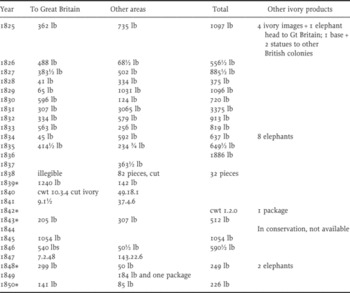
By 1825, the British had begun recording export data. Ivory, the data indicate, was exported every year: As Table 1 shows, Tennent, the Colonial Secretary of Ceylon from 1845 to 1850 who claimed each year “five or six hundred weight”Footnote 149 of tusks were being imported from Ceylon into Great Britain was, at best, providing an average figure.Footnote 150 Because supplies were erratic, sometimes there were significantly more than this and sometimes less; likewise it was probably difficult at times to determine the amount because of irregular counting practices, e.g. quantities were recorded sometimes in weight, sometimes in number of tusks. However, the overall quantity did drop significantly later in the century, a change that directly correlates with a noticeable drop in the number of elephants.Footnote 151
Ivory Exports from Ceylon 1825–1850

* Data from Ceylon Government Gazette 1825–1850.
Destinations
In addition to Europe and India, a significant destination for ivory exported from Ceylon appears to have been China. Travelers from China such as the monk Faxian had visited Ceylon as early as the turn of the fifth century. Large numbers of Chinese ceramics from this period found in Sri Lanka attest to the conduct of trade. During the Song dynasty (960–1279) in particular, there appear to have been regular trading relations.Footnote 152 European involvement in moving ivory to China was documented by Linschoten, who mentions “ivorie bones” as products that sold well for the Portuguese in Macao.Footnote 153 Initially traditional middlemen appear to have been responsible, but as the British established themselves in East Asia, more direct routes were developed.Footnote 154
Tennent blamed China as a reason for the lack of more exports to Europe.Footnote 155 As the British were by this time firmly established in Canton, and later Hong Kong, it would have made sense for them to follow traditional trading patterns. Trading within the Crown Colonies would have cut down on paperwork too. Moreover, for most applications East Asian craftsmen preferred the finer-grained Asian elephant ivory. By the time the British occupied Ceylon, China had developed an enormous appetite for ivory, fueled by both strong internal demand and a thriving export industry.
Dwindling Supplies
In 1859, Tennent suggested that had more Sri Lankan elephants borne tusks, they long since would have been exterminated for their ivory.Footnote 156 Likewise, Samuel W. Baker, one of the best-known sport hunters in ninteenth-century Ceylon, attributes the decline in the Sri Lankan elephant population to the demand for ivory.Footnote 157 Much more significant, however, was the conscious effort to place their habitat under cultivation, which by both accident and design resulted in a drastic reduction in the number of elephants. Even today, crop damage by wild elephants is an ongoing aspect of the strained relations between wild elephants and stationary human agricultural populations. In colonial Ceylon, the elephants destroyed fields, ate crops and killed workers. The reduction of the elephant population was regarded as a necessity. The British, who sought to promote an economy based on plantation labor, found intrusions by elephants especially irksome. The policy of agricultural development was especially strong during the 1830s, under the administration of Governor Robert Wilmont Horton. Initially, the effort to reduce elephants was seen as a success. The government profited through fees for hunting licenses and was able to open up more land for cultivation. However, the decline of the elephant population was precipitous. In the late 1840s Samuel W. Baker noted,
The government reward for the destruction of elephants in Ceylon was formerly ten shillings per tail; it is now reduced to seven shillings in some districts, and is altogether abolished in others, as the number killed was so great that the government imagined they could not afford the annual outlay. Although the number of these animals is still so immense in Ceylon, they must nevertheless have been much reduced within the last twenty years.Footnote 158
Similarly, in 1859 Tennent observed, “They have entirely disappeared from districts in which they were formerly numerous.”Footnote 159
This sharp decline resulted in some of the earliest wildlife legislation anywhere in the world. In 1870 the Elephant Protection Act was passed, in an attempt to reverse the trend. In that same year, an export duty of £20 per head was placed on elephant exports, a measure which effectively halted the trade.Footnote 160 In 1891, Ordinance no. 10 was passed in order “to prevent the wanton destruction of elephants, buffaloes and other game.” Hunting tuskers was expressly prohibited.Footnote 161 By the turn of the twentieth century, licensing fees alone made elephant hunting the sport of “foreign princes and noblemen and millionaire globe-trotters.”Footnote 162 Even in 1907, however, the decline of elephant populations caused by destruction of habitat continued to be noted.Footnote 163 Other measures were passed, such as the 1937 ban of elephant hunting for sport.Footnote 164
Conservation measures led to the end of ivory carving in Sri Lanka, and today it is no longer openly practiced. As early as 1850 Henry Sirr complained, “this art is falling into decay and disuse,” recounting that:
The Kandians formerly used drinking-cups of ivory, which were so extremely thin, as to be rendered perfectly transparent and pliable; a friend having one of these remarkable vessels in his possession, we were most desirous to obtain a similar specimen, but to our dismay were informed by a Kandian chief, that he knew but of one old man living in the interior, who could fabricate these curious cups, and that he was too ill to work. A short time afterwards we heard of the death of the old man in question, and with him the art is said to have died, as he refused to impart his secret to any living being, and we can only hope for the sake of posterity that our informant had been misled in this respect.Footnote 165
While mourning over a lost past is a commonly held sentiment, the definite decline in the craft of ivory carving resulted from a change of demands. Writing in 1908, Ananda Coomaraswamy attributed this phenomenon in great part to British destruction of the traditional system of state-sponsored craftsmen.Footnote 166 As early as 1955, one authority viewed ivory carving as “more or less extinct” for the last twenty years; another authority called the death of artist Utuwankande Swarnatilake in the 1970s the loss of the “last champion”. Blame was placed on the inability of craftsmen to receive proper payment for the time it took to produce quality ivory carvings.Footnote 167 It may very well be that these problems all led to the decline of quality work in ivory, but tourist art in Sri Lanka continued to be produced in large quantities, relying partially on imports of tusk from Africa.Footnote 168
Wildlife protection laws were tightened in 1964, going so far as to prohibit ownership of even a part of a tusk, and from the late 1970s onward serious efforts were made to enforce these laws. As a consequence, even the production of curios for tourists eventually ceased. By 1979, the Sri Lankan ivory industry had become one of the smallest in Asia.Footnote 169 The passage of CITES more or less brought all Sri Lankan ivory carving to a halt. The only use I was able to discern in present-day Sri Lanka was the practice of ornamenting the casket dais at funerals with whole, undecorated tusks mounted in ebony stands. It appears that even some of these are imitation.
CONCLUSION
In literate societies we are inclined to trust paperwork; for a large, bureaucratic institution such as the East India Company, one might conclude that if something is not documented, it may never have happened. At first glance, the documentary history of decline in Sri Lankan ivory over the past 150 years would seem to support the idea that there was no significant ivory trade to be discovered. The scarcity in Sri Lanka of elephants in general, and tusked elephants in particular might even lead one to believe that there never was sufficient ivory to trade.
Any good historian questions his or her sources; in this case there is much to learn because physical, anecdotal and extra-official sources all support different, and at times contradictory, stories. It is apparent that when their populations are not under duress, even tuskless elephants are able to provide a significant amount of ivory. Although later sport-hunting practices were a contributing factor, habitat destruction was equally if not more significant in the reduction of ivory resources. It is unlikely that the Dutch East India Company would have ignored a trading opportunity that they were aware of and, later, was successfully exploited by the British. There was sufficient supply, distribution and demand to make ivory trade both possible and desirable, as well as a high level of indigenous craftsmanship to provide both fine exports and sailor's souvenirs until the twentieth century. The East India Company's archives are vast and scattered; further examination of other archives may reveal more information. But even without accounting books and cargo lists, the abundance of other evidence that remains suggests that ivory trade, based upon carved and uncarved forms, and carried out through official and unofficial channels, was a constant in early modern Ceylon.
To what extent early modern Ceylonese ivory trade was significant on a global scale cannot presently be determined, because so little is known about the trading patterns of ivory for most of the regions of Asia.Footnote 170 Still, as a product, it certainly was known and appreciated in both East Asia and the West. It is not a matter of blind faith to accept that ivory played a significant role in the political, economic and cultural landscape of early modern Ceylon; it is rather a matter of looking beyond Company documents.