Legislatures run on rules. They cannot function in their absence. Arguably the most fundamental of all parliamentary rules are quorum standards, which establish the number of members who must be present for a deliberative body to make formal decisions. On occasion, the strategic exploitation of these standards captures public attention, as the spectacle of broken quorums and fleeing state lawmakers in Indiana, Texas, and Wisconsin has in recent years. Such actions have a long history in American legislatures, and quorum rules have played a central but underappreciated role in the legislative process. These rules matter because broken quorums raise fundamental questions about democratic governance, pitting the ability of a legislative majority to work its will against the right of a minority to protect its interests.
In this article I distinguish between disappearing quorums and bolting quorums and generate several hypotheses about when each kind of quorum exploitation is apt to be employed. I then trace the use of quorum standards in American legislatures from the colonial era to the present. After documenting shifting standards, I offer some basic tests of my hypotheses by examining instances where minorities (and occasionally majorities) have exploited quorum rules. This analysis identifies the conditions under which quorums are more likely to be abused.
HYPOTHESES ABOUT QUORUM EXPLOITATION
Quorum rules potentially allow legislators who anticipate losing on an issue or issues to stop legislative proceedings, thereby preventing legislation they oppose from passing. Breaking quorum is not, of course, the only way that likely losers can attempt to impede the legislative process. Lawmakers have always been willing to seize on rules they can manipulate to their advantage and over time they have enjoyed an impressive menu of obstructive actions from which they can choose.Footnote 1 Indeed, by 1750 the Virginia House of Burgesses, a chamber where political parties did not exist, had at least four different means by which a burgess could delay consideration of a measure: a motion to adjourn during a debate, moving that the orders of the day be read, moving the previous question, and offering amendments.Footnote 2 Each was employed as lawmakers sought a tactical advantage.
Perhaps the most prominent form of legislative obstruction is the filibuster, where one or more lawmakers take command of the floor in an attempt to prevent a measure from coming up for a vote. Filibusters are usually associated with the U.S. Senate but they are also allowed under the rules used in some state legislative chambers.Footnote 3 But concerns over the ability of legislators to obstruct by engaging in filibusters are actually of very long standing and, again, precede the advent of political parties. A procedure to cut off debate first surfaced in 1682 in the newly established Pennsylvania Assembly with the passage of a resolution that allowed the speaker to on his own initiative stop “superfluous and tedious” speeches. By 1703 the cloture rule had evolved to allow four members to demand an end to “tedious” debate and to move the previous question.Footnote 4
Thus, there have long been a variety of means by which members of a legislature could obstruct legislative proceedings. But there are two important differences between other obstructive actions and breaking quorum. The first is their status. The quorum requirements in place during the American national era—the bulk of those examined here—are embedded in constitutions. As such, they are almost impossible for legislators to circumvent because they cannot change them on their own initiative. In contrast, almost every other obstructive procedure is the product of rules adopted by lawmakers and thus susceptible to being changed by a legislative majority, or in some cases a super majority, through the issuance of either new rules or innovative parliamentary rulings.Footnote 5 Second, where other obstructive maneuvers can slow down a legislature or prevent it from considering a specific measure, they usually cannot bring a legislative session to a complete halt. Under most circumstances lawmakers have mechanisms that enable them to set aside the contentious issue and move on to other matters. But breaking quorum can stop a legislature dead in its tracks, leaving it unable to process any legislation or conduct any business. Indeed, examples will be given below where broken quorums have allowed a minority to run out the clock on a legislative session over months and even, in one instance, prevent a chamber from organizing and meeting at all over the course of an entire year.
Given the potential gravity of breaking quorum, one might anticipate that lawmakers would do so only as a last resort, when other available and less drastic obstructive procedures have been exhausted. But it is more likely to be the case that those in the minority will break quorum when the rules make it possible and when they calculate that only doing so will give them the leverage over the majority that they seek. And, once a group of lawmakers breeches any norms against breaking quorum as a parliamentary tactic, it is likely that doing so will become an accepted action in their fellow legislators’ procedural arsenals. This appears to be true of all obstructive actions. Witness, for example, the significant increase in the incidents of filibusters in the U.S. Senate over the last four decades, a time period during which the basic rules governing the action have stayed stable.Footnote 6 The notion that it takes sixty votes to pass most measures has come to be seen by all as the norm. As we will see, it can happen that breaking quorum becomes almost routine.
Lawmakers have always understood the governing implications of breaking quorum. As a Louisiana senator argued during a debate over such behavior in that chamber in 1853, “The rules of a deliberative body are the only means by which the minority can hope for full protection against the attacks of the majority.” In turn, one of his colleagues noted this reasoning meant “a factious minority might at any time break a quorum and prevent the passage of a bill to which they might be opposed. This would be putting the majority completely in the power of the minority.”Footnote 7
While the rationale for exploiting quorum rules is well understood, the ability of lawmakers to actually do so hinges on the particular standard that is in place. The higher the percent of the overall membership that is required to be present for a legislative body to conduct business, the greater the leverage of those in the minority to obstruct the proceedings by withdrawing. Thus, we can hypothesize that the more stringent the quorum standard, the more likely that the minority will exploit the strategic opportunity offered. The expectation that weaker standards operate in the majority's favor, however, rests on two important assumptions: first, that those in the majority maintain cohesion, and second, they attend in sufficient numbers to make a quorum. As will be discussed below, during the nineteenth century the majority often failed to stick together or to muster enough members to prevent the minority from having an opportunity to exploit even weak quorum standards.
There is a second relationship that is more subtle and revolves around the method of quorum exploitation pursued. In the American legislative experience quorum standards have been abused in two distinct ways: disappearing quorums and bolting quorums. A disappearing quorum is when lawmakers who are in the chamber refuse to answer a call to vote, thereby appearing not to be present. If a quorum is deemed only evident when a sufficient number of members actually vote—a proposition on which different chambers reached different answers—lawmakers in the minority can block a quorum by their silence. In contrast, a bolting quorum occurs when a sufficient number of lawmakers physically exit a chamber to prevent a quorum from being present to conduct business. The quorum standard in a state is the same regardless of the approach taken to breaking it, but because a disappearing quorum involves the interpretation of the way the standard gets applied, under some circumstances majorities can pass new rules or issue new interpretations of existing rules to prevent them. But majorities have no procedural mechanisms to overcome bolting quorums short of physically forcing absent members to return.
We can anticipate that there are differences in the circumstances under which each form of quorum breaking is employed. Where the rules are interpreted to allow them, disappearing quorums are low cost to use. Little advance coordination is needed; they require only the silence of a prominent member to signal others to be quiet. Consequently, disappearing quorums can be employed on short notice and on any measure, regardless of its importance. Costs are much higher for bolting quorums because of a need both for highly coordinated action to remove a sufficient number of lawmakers from the floor in a timely fashion—attempted bolts have foundered on the failure to do so—and, in many cases, efforts to locate a place to hide the bolters from those sent to retrieve them. Given this, we should expect bolts to be reserved for weighty measures that matter to a requisite number of legislators.
QUORUM RULES IN THE COLONIAL ERA
The first formal quorum standard in the Americas was established by the 1629 Massachusetts Bay Colony Charter. That document held that seven of the eighteen assistants, along with the governor or deputy governor, was a sufficient number for the “dispatching of all such buysinesses.”Footnote 8 This benchmark is notable because it was put in place before the English House of Commons first established a quorum rule: It was only in 1640 that “It was declared as a constant Rule, that Mr. Speaker is not to go to his Chair till there be at least forty in the House.”Footnote 9 Eventually, Massachusetts followed the House of Commons precedent, and in 1692 it also set forty representatives as the “number sufficient to constitute a house, pass bills, and to transact and do any business proper to be done in that house.”Footnote 10 Because the colony apportioned seats on the basis of towns, the number of members in its assembly varied over time. As it happens, there were roughly eighty members of the House when the quorum rule was adopted, thus requiring half of the membership to be present to conduct business. By the end of the colonial era the body had around 125 members, thereby reducing the required quorum to less than a third.
The House of Commons quorum standard was not adopted elsewhere in the colonies.Footnote 11 In 1683 The Frame of the Government of the Province of Pennsylvania and Territories thereunto annexed, in America established that in its assembly “not less than two thirds shall make a Quorum in the passing of all Bills into Laws.”Footnote 12 In most of the other colonial assemblies quorum rules were actually recalibrated from time to time to fit their attendance patterns.Footnote 13 Virginia in the eighteenth century, for example, frequently changed its quorum for conducting business, from a high of 41 out of 84 members in 1748 (49 percent) to a low of 25 out of 104 members in 1756 (24 percent), with a number of other stops in between.Footnote 14 Some colonies adopted quorum rules that were even looser than those in Virginia. Maryland approved a lax standard in 1642: “Any tenn members of the house at any time assembled at the usuall or appointed time (whereof the Leivtent Generall & Six Burges's to be Seaven) shall be a house unless sickness do hinder that number In which Case only the members present to make the House.”Footnote 15 But nothing was more lenient than the standard established in the 1663 Rhode Island charter: whatever number of deputies attended.Footnote 16
The strategic opportunities offered by quorum rules were well understood by colonial politicians. Perhaps the earliest episode of quorum exploitation occurred in Pennsylvania, shortly after the two-thirds standard was put in place. In 1689, Penn's deputy governor persuaded enough Assembly members to leave the chamber to break quorum in order to prevent the passage of a list of grievances against the proprietor.Footnote 17 The bolters’ response to their colleagues’ actions is instructive. They voted to denounce “that abominable Treachery and Practice of the said absent Members, in wilfully neglecting to appear at the Time, when they understood that this House were going about to call the Violators of the Liberties of the Freemen of this Government to Account.” They went on to seek retribution by declaring “That the said absent Members ought not to receive any Salary for the Service this Assembly; and are not worthy to be chose again, or be intrusted as Delegates.”Footnote 18 It is worth pointing out that in exploiting the quorum rule, Pennsylvania's fledgling lawmakers were precocious; the first example of such behavior in the British House of Commons did not occur until 1729.Footnote 19
Despite the political fury generated by the initial broken quorum, in later years Pennsylvania witnessed other such actions.Footnote 20 Most notably, in June 1776 Assembly members who supported independence withdrew from the body to prevent it from meeting, blocking the pursuit of any conciliatory policies.Footnote 21 Other assemblies also suffered from quorum abuse. In 1748, the South Carolina governor groused that, “A Party of pleasure made by a few of the Members renders it often impossible for the rest to enter upon Business, and sometimes I Have seen a Party made to go out of Town purposely to break the House as they call it (well knowing that nothing could be transacted in their absence).” The absent members’ motivation for leaving was “to prevent the Success of what they could not otherwise oppose.”Footnote 22 The problem was sufficiently troubling that the British authorities contemplated pressuring the Assembly to loosen its standard.Footnote 23 North Carolina's governor also complained about “the conduct of a few designing Men” in his lower house who because they “found their account in Keeping Public Affairs in confusion they have made the Governor and Council, and remaining Members of no weight in the Legislature for they could not so much as meet unless they thought fit to be present and after they were met if they did not like any Bill, they withdrew Privately and then the Majority of Burgesses being absent, no more Business could be done.” The governor went on to note that “This is no Imaginary Consequence, but a real effect which has happened more than once within these four years past.”Footnote 24
During the colonial era, quorum rules became set and two precedents about their use were established. First, under certain circumstances lawmakers could and would exploit the rule to their advantage. Second, those who did not break quorum might seek retribution against those who were seen as abusing the rules.
QUORUMS RULES IN THE STATE CONSTITUTIONS
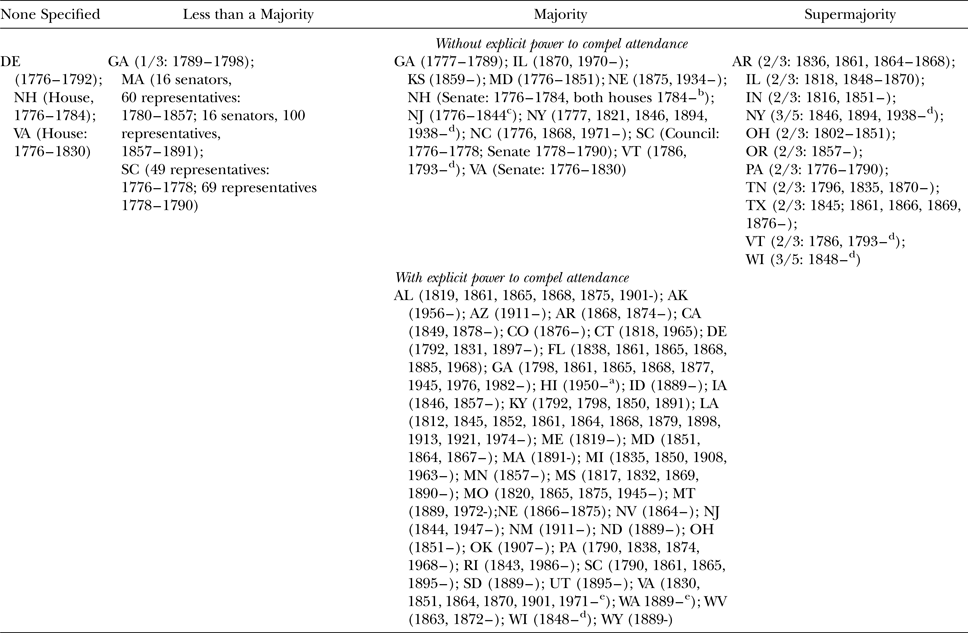
With independence, the new states were given the opportunity to write constitutions to govern them. All of them did so, with the exception of Connecticut and Rhode Island, which continued to be governed under their (only cosmetically changed) charters until 1818 and 1843 respectively. In the constitutions that were written the new states had the chance to adopt quorum requirements, and most did so, as documented in Table 1. A plurality of the states imposed simple majority quorum requirements in both chambers (Maryland, New Jersey, New York, and North Carolina), or in the case of Georgia, the only chamber. Pennsylvania stuck with the two-thirds quorum for its unicameral assembly. Massachusetts also opted for a familiar standard, keeping its less than a majority quorum for both its houses. Over time, the Senate's size was stable at forty members; requiring sixteen members to be present gave it a quorum of 40 percent. The House, however, continued to be apportioned by town, and towns could decide whether or not to send their member or members to a session. Consequently, with the quorum standard set at sixty members, the percentage of the membership required to conduct business fluctuated from a high of 31 percent in 1820 (when 193 members attended) to a low of 8 percent in 1812 (when 749 members appeared). South Carolina adopted a less than a majority quorum for its lower house—a stipulated number that represented 24 percent in its 1776 constitution and 34 percent in its 1778 constitution—but imposed a majority quorum requirement on its upper house. Delaware neglected to impose any quorum standard on either of its chambers. New Hampshire and Virginia put in place majority quorum requirements for their upper houses but, curiously, did not require any quorum for their lower houses. In the chambers without a constitutional quorum standard, one was established in the rules. In 1776, for example, the New Hampshire House's ninth rule held “That the Speaker & Thirty of the members returned, be a House to do Business.”Footnote 25
State Constitutions and Quorum Provisions, 1776 to the Present

Source: State constitutions and amendments. The years in parentheses show when a provision was in effect. Thus Pennsylvania had a two-thirds quorum from 1776 to 1790, and then a majority quorum with each subsequent constitution.
a. Hawaii requires a constitutional majority on all final votes.
b. New Hampshire requires that when less than two-thirds are present, votes on final passage need two-thirds of those present.
c. New Jersey set a majority as a quorum in the upper house, but required a majority of members in both chambers to vote in favor on final passage of any measure.
d. New York (since 1846) and Wisconsin require three-fifths quorums on budget measures. Vermont requires two-thirds to be present to raise a state tax.
e. Explicit lower quorum standard in event of enemy attack.
The decision not to establish a constitutional quorum in the Virginia House and to instead leave the matter for the lawmakers themselves to decide troubled Thomas Jefferson. Writing in Notes on the State of Virginia, he identified “That the assembly exercises a power of determining the quorum of their own body which may legislate for us” as a significant defect. Jefferson observed that “the British parliament fixes its own quorum: our former assemblies fixed their own quorum: and one precedent in favour of power is stronger than an hundred against it. The house of delegates therefore have lately voted that, during the present dangerous invasion, forty members shall be a house to proceed to business.” He understood that, “They have been moved to this by the fear of not being able to collect a house.” Jefferson's dread was “The power however of fixing their own quorum has been avowed, and a precedent [set]. From forty it may be reduced to four, and from four to one: from a house to a committee, from a committee to a chairman or speaker, and thus an oligarchy or monarchy be substituted under forms supposed to be regular.”Footnote 26 Despite such slippery slope concerns, the Virginia House survived without a constitutional quorum requirement until 1830. But when the state replaced its original constitution that year it fell in line with the other states by mandating a quorum requirement, something that Delaware and New Hampshire had also done years earlier when they replaced their original constitutions.
Thus, since 1830 every state constitution has mandated a quorum standard for its state legislature. Only rarely has that rule been less than a majority. South Carolina's lower house had a less than majority rule from 1776 until the imposition of a majority standard in the state's 1790 constitution. Georgia imposed a one-third requirement during the brief period its second constitution was in force, but switched back to a majority quorum in 1798 with its third constitution. Massachusetts stayed with a less than majority quorum for a longer period. It upped its required number of representatives to 100 in an 1857 amendment (at the same time it fixed its number of House seats at 240, giving it a standard of 42 percent), but did not join the rest of the states in requiring at least a majority for a quorum in both chambers until an 1891 amendment.
A majority quorum standard for both houses of Congress appears in the U.S. Constitution. The debate over the quorum requirement at the Constitutional Convention was informed both by the chronic problems the Confederation Congress suffered in attaining a quorum and by the experiences of the various state legislatures. The initial proposal to establish a majority standard was challenged by Nathaniel Gorham, a delegate from Massachusetts who had served in both houses of his state legislature. Likely drawing on his state legislative experience, he “contended that less than a majority in each House should be made a quorum; otherwise great delay might happen in business …” John Francis Mercer, a delegate from Maryland but who had served in the Virginia House of Delegates, concurred, arguing that requiring a majority would “put it in the power of a few by seceding at a critical moment, to introduce convulsions . . . .” He went on to note that “Examples of secession have already happened in some of the States.” Mercer's suggestion to leave the specific quorum standard for the members of each house to decide was opposed by Virginia's George Mason, who offered reasoning similar to Jefferson's, “If the Legislature should be able to reduce the number at all, it might reduce it as low as it pleased, and the United States might be governed by a junto.” After much back and forth, the convention overwhelmingly rejected an amendment to set the initial quorum at a majority in each house, but allow future lawmakers to raise or lower the standard as they pleased. The convention then easily passed a novel amendment offered by Edmund Randolph and James Madison of Virginia, allowing each house to compel the attendance of absent members. This provision was not found in any of the state constitutions at the time. The majority quorum standard with the compelled attendance amendment was then adopted.Footnote 27
Reservations about the majority quorum requirement surfaced during the ratification debates in a number of states, forcing Madison to devote a portion of Federalist 58 to its defense. After admitting that there were some reasons to set the quorum above a majority, he argued that the majority standard was still to be preferred because it was convenient. Madison held that if the quorum were set higher, “It would be no longer the majority that would rule: the power would be transferred to the minority.” He went on to conclude about a higher standard, “Lastly, it would facilitate and foster the baneful practice of secessions, a practice which has shown itself even in States where a majority only is required.” The breaking of quorums was to be avoided because it was, “a practice subversive of all the principles of order and regular government; a practice which leads more directly to public convulsions and the ruin of popular governments than any other which has yet been displayed among us.”Footnote 28
Since the adoption of the U.S. Constitution, most states have likewise chosen to require a majority to form a quorum in their legislative chambers. A handful of them have done so (and a few continue to do so) without an accompanying constitutional power to compel absent members to attend. The rest have supplemented their majority quorum requirement with a constitutional authorization to force attendance. Given the dominance of a two-party system in most states for most years, a majority quorum requirement means that the majority should be able to meet the standard as long as it sticks together and can get a sufficient number of its members to attend. But prior to the twentieth century, legislative attendance was not a given, and seats were often left vacant. In Missouri during one session, for example, a newspaper observed, “Many of the members of the General Assembly are becoming wearied, and it frequently occurs that a bare quorum is found in the Houses . . . many members are loitering about the town; some make excuses and go home.”Footnote 29 On occasion the lack of attendance was predictable. Arguing for a five-day work schedule, an Indiana representative noted, “for the last two sessions never more than once or twice were we able to have a quorum on Saturday evening and Monday morning.”Footnote 30 And in Texas a paper reported, “A number of the members of the Legislature are off for the holidays . . . The House met on Christmas day—no quorum—and adjourned . . . .”Footnote 31 Regardless of the reasons, poor attendance and a large number of vacant seats were widespread and chronic; indeed such problems allowed the minority to exploit quorum rules even in the U.S. House during much of the nineteenth century.Footnote 32 Additionally, legislative majorities in the states were not always cohesive.Footnote 33 Under such circumstances a minority could use quorum requirements to their advantage, even if only a majority requirement was the constitutional standard.
At some point in their history, eight states have had a constitutional two-thirds quorum requirement. This stringent standard was eventually replaced by a laxer majority quorum in four states (Arkansas, Illinois, Ohio, and Pennsylvania). But the other four states—Indiana, Oregon, Tennessee, and Texas—still have it in place. Another three states employ either a constitutional two-thirds quorum for bills that raise taxes (Vermont), or a three-fifths quorum for budget bills (New York and Wisconsin). In a competitive two-party system, a two-thirds or three-fifths quorum offers the minority a realistic opportunity to exercise leverage over the legislative process. It is under such requirements that we should expect to see the greatest number of cases of quorum rules being exploited.
DISAPPEARING QUORUMS
Disappearing quorums were likely the more prominent form of quorum exploitation during the nineteenth century. Overt incidents of them are, however, challenging to uncover because, without some explicit statement about their use in either legislative journals or news accounts, they cannot be easily distinguished from the simple lack of quorums caused by poor attendance. Therefore, perhaps the best way to assess their employment is to examine the instances where parliamentary rulings against them were promulgated.
The disappearing quorum was most prominently associated with the U.S. House of Representatives. It first surfaced in that chamber in 1832, when John Quincy Adams, the former president who had returned to service in the House, refused to express a vote on a pro-slavery bill. Enough of his colleagues joined him to prevent a quorum, blocking the measure from consideration.Footnote 34 The precedent of the disappearing quorum was observed in the House for the next fifty-eight years, with both parties using it to their advantage when they were in the minority and railing about its abuse when in the majority. It was overturned by Speaker Thomas Reed's (R-ME) controversial parliamentary ruling in 1890. During a raucous debate on a contested election Reed counted Democrats who were present in the chamber but had not voted as being present for the purpose of determining a quorum.
In hindsight, Reed's ruling is seen as a watershed in the history of the U.S. House, one which greatly limited the minority party's ability to obstruct.Footnote 35 Although Galloway claimed that the speaker's ruling was based on the “the practice of the English House of Commons, the rules and precedents of the House of Representatives, and the Federal Constitution,” Reed himself actually pointed toward decisions taken in various state legislatures to justify his ruling.Footnote 36
He could do this because disappearing quorums had also plagued the states. One legislative observer during the first half of the nineteenth century recalled
I was once present at an important session of the Indiana House of Representatives, when under a ruling that a quorum could only be considered present by counting the responses to the roll call. There was present nearly a full house. On the roll call some thirty or more members would step outside the railing and though in full view of the Clerk, and within hearing of the call gave no response. The Speaker declared no quorum present. A call of the House would then be had, when all would pass inside [the bar] and answer. Voting would then begin, and the going outside the railing would be repeated, and so business was delayed for days, until a majority was forced to yield to a faction minority.Footnote 37
Such behavior was not unusual. In Illinois it was noted, “Sometimes one side, sometimes the other … refrained from voting, the object being to break a quorum.”Footnote 38 This sort of conduct could slip into farce. During an 1885 joint session of the Illinois General Assembly to elect a U.S. senator, a roll call established that 179 members were present—44 senators and 135 representatives. The session then turned immediately to a roll call on electing the senator. Only a single member from each chamber cast votes.Footnote 39 Over time, attempts were made to overcome this problem. Many were unsuccessful. In 1855, for example, the California Senate rejected a proposal “That when a quorum is present and not found voting upon the third reading or final passage of any bill or resolution, those present and not voting shall be counted and recorded in the affirmative.”Footnote 40 Clearly, many lawmakers found the disappearing quorum to be of sufficient utility to protect it.
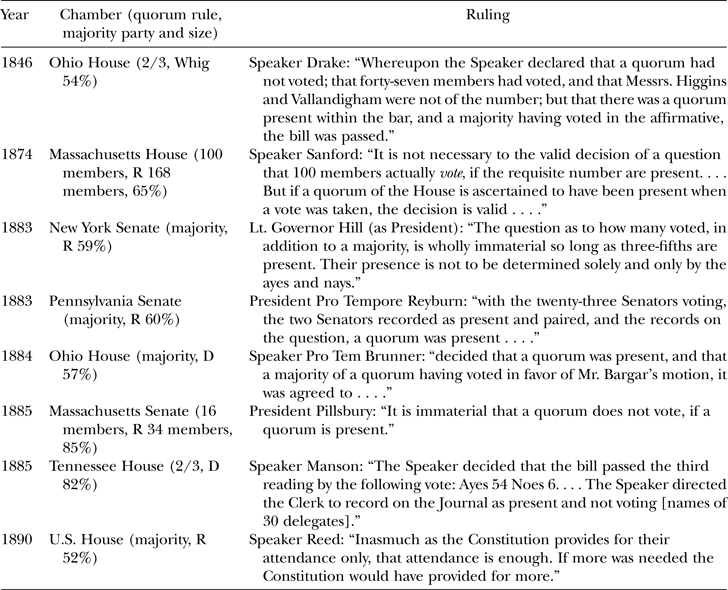
Occasionally a presiding officer would seek a parliamentary resolution to the problem, usually triggering a political firestorm. For instance, an angry observer of proceedings in the Georgia House fulminated over, “if it was necessary in order to make a quorum, that the Speaker should overrule one of his own decisions, to wit: that no member would be considered in the Hall while sitting under the galleries.”Footnote 41 The earliest parliamentary ruling against a disappearing quorum cited by Speaker Reed was from the Ohio House in 1846, as shown in Table 2. The House was voting on an amendment to a state bank bill. According to the journal, “Whereupon the Speaker declared that a quorum had not voted; that forty-seven members had voted, and that Messrs. Higgins and Vallandigham were not of the number; but that there was a quorum present within the bar, and a majority having voted in the affirmative, the bill was passed.”Footnote 42 Decades later the speaker recalled having announced “that no quorum had voted, but a quorum was present, and majority of the whole had voted affirmatively, and that the bill was passed.”Footnote 43 In citing this example, Reed shortened the speaker's quote to a more pithy “no quorum had voted, but a quorum was present.”Footnote 44 But the fact that Reed also cited another Ohio House decision made thirty-eight years later suggests this initial decision actually had problems sticking. Indeed, it appears that there had been a regular struggle against disappearing quorums in Ohio. In defending the 1884 ruling, a group of eleven lawmakers noted, “In Congress, it is true, members often refuse to vote, and thus the House is brought to a stand-still for want of a quorum, but in the Ohio Legislature the rule has been different.” They went on to cite several other instances in recent sessions when speakers had been called on to make similar rulings.Footnote 45
Notable Parliamentary Rulings against Disappearing Quorums
Sources: Asher C. Hinds, Hinds’ Precedents of the House of Representatives of the United States Including References to Provisions of the Constitution, the Laws, and Decisions of the United States Senate, vol. 4 (Washington, DC: U.S. Government Printing Office, 1907), 67; House Journal of the Forty-Fourth General Assembly of the State of Tennessee, Which Convened at Nashville, on the First Monday in January, A. D. 1885 (Nashville, TN: Albert B. Tavel, 1885), 566; Journal of the House of Representatives of the Commonwealth of Massachusetts (Boston: Wright & Potter, 1874), 584; Journal of the Senate for the Year 1885 (Boston: Wright & Potter, 1885), 584; Journal of the House of Representatives of the State of Ohio; Being the First Session of the Forty-Fourth General Assembly, Held in the City of Columbus, Commencing on Monday, December 1, 1845 (Columbus, OH: C. Scott and Co, 1846), 216; Journal of the House of Representatives, of the State of Ohio, for the Regular Session of the Sixty-Sixth General Assembly, Commencing Monday, January 7 th, 1884 (Columbus, OH: G. J. Brand & Co., 1884), 140–41; Journal of the Senate of the Commonwealth of Pennsylvania, for the Extraordinary Session Begun at Harrisburg, on the 7 thDay of June, 1883 (Harrisburg, PA: Lane S. Hart, 1883), 146; Journal of the Senate of the State of New York: At their One Hundred and Sixth Session (Albany, NY: Weed, Parsons & Co., 1883), 363.
Reed referred only in passing to a decision rendered by Massachusetts House Speaker Sanford in 1874. This was unfortunate, because in making his ruling Sanford gave the first substantial analysis of the problem. A bill regarding “the descent and distribution of real and personal property” had lost on a vote of 42 to 43. A representative raised a point of order that a quorum was not present. A count revealed 118 members in the chamber, sufficient for a quorum. The representative then raised another point of order requesting a second vote on the bill. Speaker Sanford ruled against the request, determining, “It is not necessary to the valid decision of a question that 100 members actually vote, if the requisite number are present. . . . But if a quorum of the House is ascertained to have been present when a vote was taken, the decision is valid.”Footnote 46
In their analyses both Reed and Hinds (Reed's clerk and compiler of parliamentary precedents in the House) placed great weight on the decision handed down by Lieutenant Governor Hill acting as president of the New York Senate in 1883.Footnote 47 The previous year, Hill's predecessor had ruled that because a required two-thirds quorum had not voted on a railroad commission bill, the measure had failed, even though more than two-thirds of the members had been present in the chamber.Footnote 48 But when the Senate voted on final passage for a measure to create an office of the Commissioner of the New Capitol, Hill had ten senators listed as “present but refuses to vote,” thereby establishing a quorum and allowing the bill to pass. Hill subsequently stated that “The action of the Senate just taken requires a ruling from the chair, and an explanation of that ruling is proper at this time.” Following a lengthy examination, he concluded, “The question as to how many voted, in addition to a majority, is wholly immaterial so long as three-fifths are present. Their presence is not to be determined solely and only by the ayes and nays.”Footnote 49
Reed briefly cited several other precedents. He noted that “If any one desires to see a model statement of the case [against the disappearing quorum], let him look at President Pillsbury's decision in the Massachusetts Senate in 1885.”Footnote 50 On a measure dealing with the “granting of licenses for the sale of intoxicating liquors in a building near a public school,” Pillsbury had determined that it lost on a vote of 4 to 7 (in a body with forty members). He then ruled against a point of order that a quorum had not voted, leading off his explanation by observing simply, “It is immaterial that a quorum does not vote, if a quorum is present.”Footnote 51
Both Reed and Hinds also pointed to the speaker's decision against a disappearing quorum in the Tennessee House in 1885.Footnote 52 On a contentious voter registration bill, the journal recorded that “The Speaker decided that the bill passed the third reading by the following vote: Ayes 54 Noes 6. . . . The Speaker directed the Clerk to record on the Journal as present and not voting [names of 30 representatives].”Footnote 53 They cited this precedent not only because it fit with Reed's ruling, but because it was also an example of a Democratic speaker ruling against Republicans (although unnoted, this was also true of the 1884 Ohio incident). But Reed and Hinds ignored several critical bits of information. First, although a local news headline the following day said that there was “A Lively Discussion Over the Registration Bill Vote,” no member appeared to protest the speaker's ruling.Footnote 54 Second, the registration bill later died in the Senate because Republicans exited the chamber, blocking a quorum. When the measure was resurrected during a special session, House Republicans killed it, again by leaving rather than staying silent. Finally, during the next legislative session in 1887, on two separate occasions Republican House members refused to express votes on a resolution that would have institutionalized the ruling against the disappearing quorum. Both times the speaker held that he had no power to compel members to respond with a vote, and he substantiated his decision with an extended analysis, citing examples from the U.S. House.Footnote 55
Reed drew his favorite example from the Pennsylvania Senate, claiming “in 1880, occurred an incident which adorns with an illumination quite picturesque the doctrine of constructive absence.” In Reed's rendition,
There had been much filibustering of the congressional sort during the session, the Democrats refusing to vote. Senator Rayburn [sic], in the chair, decided that those Democrats who demanded the yeas and nays were present. There was much disatisfaction, and one day when a Democrat was in the chair the same question arose, and he promptly decided that those who demanded the yeas and nays were not there. Thereupon the friends of tyranny of that period, in the person of Mr. Cooper, made the point that the Chair was present, and the Chair decided that he was not! It was felt, however, that the great principle had somehow or other then and there received a great stain, and the Senate thereafter behaved and obstruction ceased.Footnote 56
This story was repeated by Follett in her history of the U.S. House speakership, and she cited it as the “reductio ad absurdum” of the disappearing quorum.Footnote 57
In this instance the actual details of the incident got badly mangled in Reed's telling. Pennsylvania's 1874 constitution had moved the legislature to biennial sessions, and there was no meeting in 1880. The incident in question actually took place in 1883 when President Pro Tempore Reyburn held that a resolution on the scheduling of Senate sessions had passed even though a quorum had not voted because three members present in the chamber who were paired with three members who were not present had failed to formally vote. Reyburn determined that members of paired votes who were present in the chamber should be counted toward a quorum. That decision was appealed in writing by five members who were present but had not voted. As the appeal was heard, Reyburn stepped down, handing the gavel to Senator Kennedy, who was one of the senators who had not voted. During a vote on whether to uphold Reyburn's ruling, Acting President Pro Tempore Kennedy counted 21 in support of the ruling, 0 in opposition, and 2 members paired and present, thereby concluding that less than a quorum had voted, with Kennedy himself being among those again not recording a vote and thereby blocking a quorum. (The journal and newspaper accounts do not say if Senator Cooper, who was there and voting, commented on the absurdity of Kennedy's actions.) After a call of the Senate established that thirty-four members were present, Reyburn returned to the podium. Again the question was asked, “Shall the decision of the chair [on counting paired and present members] stand as the judgment of the Senate?” The vote this time was 21 in favor, 2 opposed, 9 “Present, but not Voting,” and 2 “Present and Paired.” With “Less than a quorum appearing to have voted,” Reyburn “directed the clerk to call the names of the Senators who signed the appeal from the decision of the chair . . . and make a record of the same; which was done.” Then Reyburn held “that with the twenty-three Senators voting, the two Senators recorded as present and paired, and the records on the question [raised by the five senators], a quorum was present . . . .”Footnote 58
With his pronouncement, Reyburn effectively ruled out the use of the disappearing quorum. Democratic leaning newspapers lambasted him for “rascally decisions from the chair,” but his ruling was not as revolutionary as Reed, Follett, and political partisans wished to make it appear.Footnote 59 Pennsylvania Senate rule XXXVI, which was referenced during the debate, stated that “if it is ascertained that a quorum is present, either by answering to their names, or by their presence in the Senate, the President shall again order the yeas and nays, and if any Senator or Senators present refuse to vote, the name or names of such Senator or Senators shall be entered on the Journal as ‘present but not voting’ and such refusal to vote shall be deemed a contempt . . . .”Footnote 60 Moreover, in a subsequent listing of Pennsylvania Senate precedents only Reyburn's ruling on counting paired votes as contributing to a quorum was noted.Footnote 61
What impact did Speaker Reed's well-publicized ruling have on subsequent behavior in American legislatures? First, it is important to note that when Democrats retook control of the U.S. House in 1893 they did not adopt Reed's quorum counting rule. The former speaker spent the next two years seeking to goad the Democrats into accepting his earlier decision, eventually nudging them most of the way in that direction. When the GOP regained control of the House in 1895 they fully reinstated Reed's ruling on counting a quorum.Footnote 62
The ruling's influence on state legislatures was mixed. In a few states it was referenced and implemented. In 1891, the Republican speaker of the Connecticut House invoked it to end a two-month-long disappearing quorum the Democrats had used to prevent action in that body.Footnote 63 The following year the Iowa Senate's presiding officer cited it to end a disappearing quorum; his House counterpart followed suit four years later.Footnote 64 An analysis of Michigan House rules in 1905 revealed that Reed's precedent had been adopted in 1893 “and its efficacy in restraining filibustering is unquestioned.”Footnote 65 But elsewhere disappearing quorums lived on, with Democrats refusing to vote on judicial nominations in Rhode Island in 1891 and Republicans joining with “free silver and gold” Democrats to prevent Kentucky from electing a U.S. Senator in 1897.Footnote 66 In 1907, the Wisconsin Senate president refused to recognize the Reed rule, instead sidestepping the problem by drawing on a chamber rule directing senators who were present to vote.Footnote 67 But, improving legislative attendance patterns and more cohesive majorities made disappearing quorums less viable. Legislatures also adopted rules explicitly prohibiting the practice. In the Washington House, for example, rule 10 in 1897 held “For the purpose of determining whether a quorum be present, the speaker . . . shall count all members present, whether voting or not.”Footnote 68 Thus, by 1918 an analysis of state legislative procedures could conclude that “Speaker Reed's famous ruling of 1890, is now generally accepted by the states, even finding a place in the rules of a few.”Footnote 69 These developments collectively caused the disappearing quorum to eventually disappear.
BOLTING QUORUMS
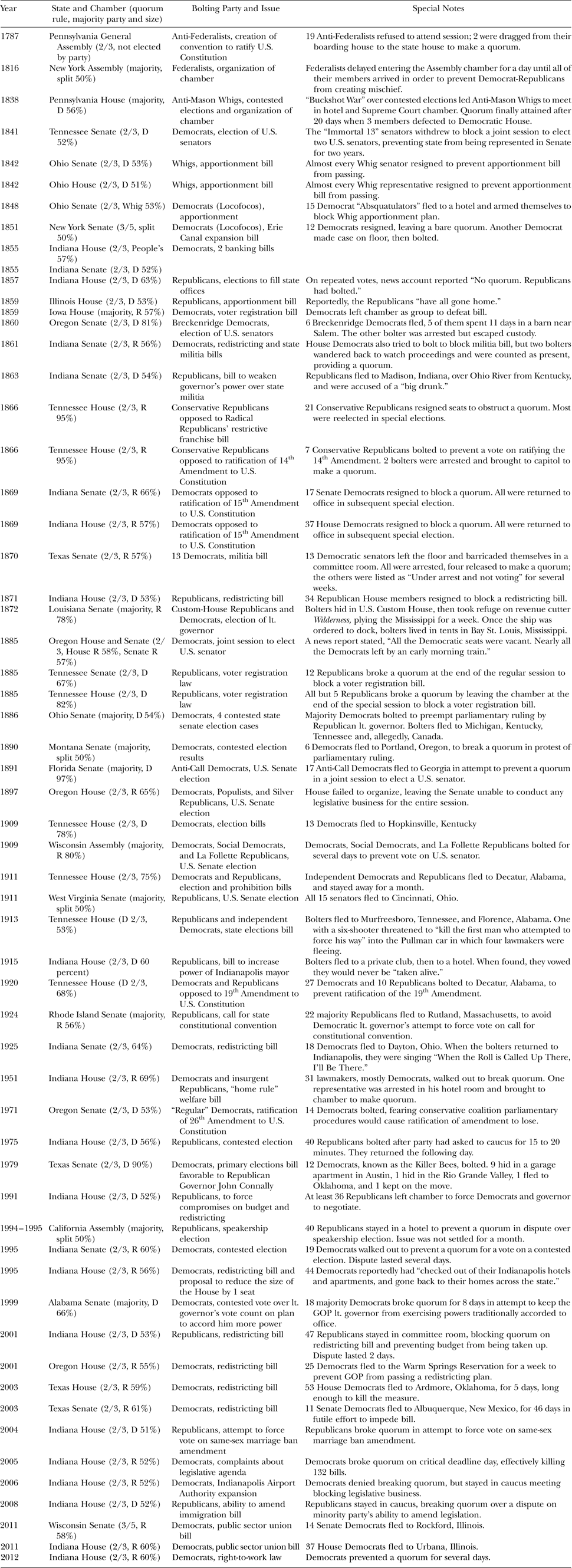
Disappearing quorums were prominent through the nineteenth century, although they were sufficiently subtle to often remain out of public view. In contrast, bolting quorums drew public attention to arcane quorum standards because of their drama and visibility. Although legislative journals often gloss over bolts, newspapers cannot resist highlighting such behavior. Thus, by combing journals and news accounts the incidents of bolting quorums can be compiled. As documented in Table 3, there is a long tradition of them in American history.
Notable Bolting Quorums
Sources: Appendix to the Senate Journal for the Session of 1848–9 (Columbus, OH: S. Medary, 1849), 182–91; Appletons’ Annual Cyclopedia and Register of Important Events of the Year 1885 (New York: D. Appleton and Company1889), 747; Appletons’ Annual Cyclopedia and Register of Important Events of the Year 1897 (New York: D. Appleton and Company, 1898), 659–60; Austin American-Statesman (Texas), “In 1979, The Buzz was about Killer Bees,” June 10, 1994; Brevier Legislative Reports, Embracing Short-Hand Sketches of the Journals and Debates of the General Assembly of the State of Indiana, Convened in Regular Session on the 10th Day of January, 1861 (Indianapolis, IN: Daily Indiana State Sentinel, 1861), 343–46; Brevier Legislative Reports: Embracing Short-Hand Sketches of the Journals and Debates of the General Assembly of the State of Indiana (Indianapolis, IN: South Bend Forum Job Office, 1863), 237; Charles W. Calhoun, “‘Incessant Noise and Tumult’: Walter Q. Gresham and the Indiana Legislature during the Secession Crises,” Indiana Magazine of History 74 (1978): 223–51; Commercial Advertiser (NY), “From the Courier of this Morning,” February 2, 1816; Kevin Corcoran and Michele McNeil, “Dems Boycott All Day, Dooming 132 Bills,” Indianapolis Star, March 2, 2005; Daily Alta California, “Montana Senators in Oregon,” February 14, 1890; Daily Capital Journal (OR), “Mitchell,” January 21, 1897; Dawson's Daily Times (IN), “Coercion in Indiana,” March 11, 1861; James Walter Fertig, The Succession and Reconstruction of Tennessee (Chicago: University of Chicago Press, 1898), 77–79; Fort Wayne Daily Sentinel (IN), “Legislative Summary,” February 24, 1871; Fort Wayne Sentinel (IN), “Indiana Legislature,” February 14, 1857; Fort Wayne Sentinel (IN), “Evidence of Premeditated Determination to Defeat Necessary Legislation by the Republican Senate,” June 13, 1857; Fort Wayne Sentinel (IN), “Republican Anarchy,” February 26, 1859; William Dudley Foulke, Life of Oliver P. Morton (Indianapolis, IN: Bowen-Merrill, 1899), 239; T. T. Geer, Fifty Years in Oregon, (New York: Neale Publishing, 1912), 399; Douglas Heider and David Dietz, Legislative Perspectives: A 150-Year History of the Oregon Legislatures from 1843 to 1993 (Portland, OR: Oregon Historical Society Press, 1995), 28–29; F. I. Herriott, “Iowa and the First Nomination of Abraham Lincoln,” Annals of Iowa 8 (1907): 186–220; Hopkinsville Kentuckian, “Tennessee Legislators in Refuge Here,” March 2, 1909; In Assembly, Journal of Proceedings of the Forty-Ninth Session of the Wisconsin Legislature (Madison, WI: Democrat Printing Company, 1909), 360–77; Indianapolis Star, “Republican Walkout Puts Budget in Limbo,” April 29, 2001; Indianapolis Star, “Other Walkouts and Standoffs,” February 23, 2011; Journal of the House of Representatives of the State of Indiana, During the Forty-Seventh Regular Session of the General Assembly, Commencing Thursday, January 5, 1871 (Indianapolis: R. J. Bright, 1871), 959–61, 967; Journal of the House of Representatives of the State of Indiana During the Forty-Sixth Regular Session of the General Assembly, Commencing Thursday, January 7, 1869 (Indianapolis, IN: Alexander H. Conner, 1869), 893; Journal of the House of Representatives of the State of Indiana, During the Special Session of the General Assembly, Commencing Thursday, April 8, 1869 (Indianapolis, IN: Alexander H. Conner, 1869), 599–605; Journal of the House of Representatives of the Twenty-First General Assembly of the State of Illinois, at Their Regular Session, Begun and Held at Springfield, January 3, 1859 (Springfield, IL: Bailhache & Baker, 1859), 883–88; Journal of the House Proceedings of the Legislative Assembly of Oregon, during the First Regular Session Thereof, Begun September 10th, and Ended October 19th, 1860 (Salem, OR: Asahel Bush, 1860), 26; Journal of the Senate of the Commonwealth of Pennsylvania, Session of 1838-9, Which Commenced at Harrisburg on the Fourth Day of December, 1838 (Harrisburg, PA: E. Guyer, 1838-39), 62–81, 142–43; Journal of the Senate of the Legislative Assembly of the State of Oregon for the Nineteenth Regular Session (Salem, OR: W. H. Leeds, 1898), 85–86, 146–48, 274; Journal of the Senate of the State of Indiana During the Forty-Sixth Session of the General Assembly, Commencing Thursday, January 7, 1869 (Indianapolis, IN: Alexander H. Conner, 1869), 685–86; Journal of the Senate of the State of Ohio; Being the Adjourned Session of the Fortieth General Assembly, Held in the City of Columbus, Commencing on Monday, June 25, 1842 (Columbus, OH: Samuel Medary, 1842), 418–19; Journal of the Senate of the State of Ohio, for the Regular Session of the Sixty-Seventh General Assembly, Commencing on Monday, January 4, 1886 (Columbus, OH: Myers Brothers, 1886), 515–19; Kokomo Tribune (IN), “GOP Pushes Through Its ‘Home Rule’ Bills,” October 6, 1951; Legislative Reference Library of Texas, “2003–2004 Congressional Redistricting Chronology,” updated April 26, 2004; Los Angeles Herald, “Democrats Bolt Again,” March 2, 1909; Minutes of the Third Session of the Eleventh General Assembly of the Commonwealth of Pennsylvania, which Commenced at Philadelphia, on Tuesday, the Fourth Day of September, in the Year of Our Lord One Thousand Seven Hundred and Eighty-seven (Philadelphia: Hall and Sellers, 1787), 244–45; Dan Morain, “Assembly in Disarray Over Speakership: Politics: Brown Declares Himself ‘Presiding Officer.’ Republicans Boycott Session, Say They Will Stay Away Until Jan. 4,” Los Angeles Times, December 7, 1994; Nashville Union and American, “An Invention to Plague the Inventor,” March 1, 1871; Nation “The Custom-House which Mr. Casey ‘Has Taken Out of Politics,’” January 25, 1872; New-York Daily Tribune, “Things in Ohio,” August 20, 1842; New York Daily Tribune, “The Senate Disorganized,” April 18, 1851; New York Daily Tribune, “An Address to the People of the State of New-York,” April 23, 1851; New York Times, “News from the Pacific,” October 2, 1860; New York Times, “The West,” February 24, 1871; New York Times, “Tennessee Senators Run Away,” April 7, 1885; New York Times, “A Legislative Deadlock,” June 13, 1885; New York Times, “Ohio's Senatorial Exiles,” May 7, 1886; New York Times, “Call Declared Elected,” May 27, 1891; New York Times, “Runaway Senators Return,” March 6, 1909; New York Times, “Washington,” January 19, 1911; New York Times, “Vote in Tennessee to Clinch Suffrage Despite Big Bolt,” August 22, 1920; New York Times, “Senate Exiles Due In Rhode Island,” January 3, 1925; New York Times, “Democrats Bolt From the Indiana Senate, Breaking Quorum to Take Refuge in Ohio,” February 26, 1925; New-York Tribune, “Can't Kidnap Lawmakers,” April 2, 1913; New-York Tribune, “Tenn. Antis Defend Breaking of Quorum,” August 24, 1920; Niles’ Weekly Register, “Ohio,” August 27, 1842, 403–7; Erwin H. Price, “The Election of 1848 in Ohio,” Ohio Archaeological and Historical Quarterly 36 (1927): 188–311; Proceedings of the High Court of Impeachment, in the Case of the People of the State of Tennessee, vs. Thomas N. Frazier, Judge, etc. (Nashville, TN: S. C. Mercer, 1867), 5; Report of the Select Committee Appointed to Inquire into the Cause of an Armed Force, Being Brought to the Capitol of Pennsylvania, Whether any Disturbance Took Place in the Senate Chamber on the 4th December, 1838, &c. (Harrisburg, PA: E. Guyer, 1839); Bill Ruthhart, “Immigration Bill Spurs GOP Walkout,” Indianapolis Star, February 22, 2008; Sacramento Daily Union, “The Oregon Legislature—Organization—Breckinridge Senators Bolting—The United States Senators—The Willamette Valley,” September 18, 1860; Mary Beth Schneider, “Senate GOP Makes It Legal in 2nd Vote to Oust Mrvan,” Indianapolis Star, January 25, 1995; Senate Journal of the Forty-Fourth General Assembly of the State of Tennessee, Which Convened at Nashville, on the First Monday in January, A.D. 1885 (Nashville, TN: Albert B. Tavel, 1885), 627–41; Senate Journal of the Twelfth Legislature, State of Texas (Austin, TX: Tracy, Siemering & Co, 1870), 250–73; Cam Simpson and Joe Fahy, “House Democrats Get Angry and Go Home,” Indianapolis Star, March 24, 1995; Michele McNeil Solida, “Republicans Again Leave House Session,” Indianapolis Star, February 27, 2004; Peverill Squire and Gary Moncrief, State Legislatures Today: Politics Under the Domes (Boston: Longman, 2010), 127–31, 178–80; Standard (IN), “No Elections,” March 29, 1855; Sun (NY), “Democrats go Fishing” May 6, 1886; Sun (NY), “Ohio's Runaway Senators,” May 8, 1886; Patrick J. Traub, “GOP Walkout, Demo Rebuke Highlight Latest Match,” Indianapolis Star, May 25, 1991; U.S. House, The Executive Documents Printed by Order of the House of Representatives During the Second Session of the Forty-Second Congress (Washington, DC: U.S. Government Printing Office, 1872), 49–52, 73–74; Justin E. Walsh, The Centennial History of the Indiana General Assembly, 1816-1978 (Indianapolis, IN: Select Committee on the Centennial History of the Indiana General Assembly, 1987), 189, 192, 208, 217–18, 346–48; 636–37; Richard D. Walton, “Sponsor: Bill Riling Dems to be Changed,” Indianapolis Star, January 28, 2006; Weekly Louisianian, “Extraordinary Proceedings,” January 7, 1872; Henny Willis, “Rap of Gavel Ends Three-Day Paralysis of Oregon Senate,” Eugene Register-Guard (OR), June 3, 1971; “Wisconsin Investigation to Go On?” La Follette's Weekly Magazine, March 13, 1909.
Perhaps the earliest bolting quorum in the national era occurred in the unicameral Pennsylvania General Assembly in 1787. The legislature operated under a two-thirds quorum, leaving it susceptible to abuse. During the morning session on Friday, September 28, on a vote of 43 to 19 the Assembly passed a resolution to call a convention to consider ratification of the federal constitution, which had been submitted to the states just that day. When the afternoon session convened a roll call revealed it was short of a quorum, with nineteen members missing. Of those missing, eighteen had been on the losing side in the morning, members we can take to be anti-federalists attempting to slow down the rush to ratify. The “Serjeant at Arms” was sent to retrieve the missing members and, finding them gathered at a boarding house, learned that they refused to attend the session. In light of this information, the General Assembly adjourned for the day. The next morning a quorum again failed to materialize and again the Serjeant at Arms was dispatched to round up the missing members, joined this time by the assistant clerk. They found some of the absentees walking the streets, while others managed to dodge them. In their most important report, the assistant clerk told the chamber that at the “house of Major Alexander Boyd” he saw “Mr. M cCalmont and Mr. Miley.” After informing them of his responsibility to bring them to the chamber, the assistant clerk stated that, like the other bolters, “they answered, they would not attend.”Footnote 70
This last episode is of interest because, after a long paragraph detailing the various failed attempts to get the bolters to show up, the journal's next entry is a benign statement that “Mr. M cCalmont and Mr. Miley appeared in the Assembly-Chamber, and there being a quorum, the House resumed consideration of the remainder of the motion postponed yesterday.”Footnote 71 The mysterious appearance of the two avowed bolters was explained in a letter written by the anti-federalists that appeared in Philadelphia newspapers a few days after the incident. Signed by sixteen bolters, the letter listed their objections to the controversial resolution and then went on to claim,
Thus circumstanced and thus influenced, we determined the next morning, again to absent ourselves from the House, when James McCalmont, Esquire, a member from Franklin, and Jacob Miley, Esquire, a member from Dauphin, were seized by a number of citizens of Philadelphia, who had collected together for that purpose, their lodgings were violently broken open, their clothes torn, and after much abuse and insult, were forcibly dragged through the streets of Philadelphia to the state house, and there detained by force . . . .Footnote 72
With a quorum thus present the majority was able to proceed to complete the work necessary to pass the resolutions calling for the ratification convention.
Lawmakers continued to seek opportunities to exploit quorum standards during the first half of the nineteenth century. Perhaps most infamously, in 1840, several young Whig members of the Illinois House, Abraham Lincoln among them, jumped out of a window in Springfield's First Methodist Church, which was being used because the new capitol had yet to be finished, in a futile effort to deny the majority Democrats a quorum.Footnote 73 A news account noted scornfully, “This gymnastic performance of Mr. Lincoln and his flying brethren did not occur until after they had voted and consequently the House did not interfere with their extraordinary feat.”Footnote 74 Lincoln's particular quorum-breaking tactic was not altogether unusual. A Texas legislative journal noted that during a squabble over a broken quorum in the House, “the Sergeant-at-arms was dispatched after Mr. Dancy, who made his escape through the window,” while in the Louisiana House there was a move to expel two members “for their conduct in scaling the railing and breaking a quorum.”Footnote 75 Nor was Lincoln the only future president to engage in such shenanigans. In 1841, his successor in the White House, Andrew Johnson, then a Democratic member of the Tennessee Senate, was one of the “immortal thirteen” who blocked a quorum in the legislature's joint session to elect the state's two U.S. senators. The Democrats’ successful efforts prevented the state from being represented in the U.S. Senate for two years and kept the state legislature from passing any legislation of note during the entire legislative session.Footnote 76
As Table 3 shows, bolting became more common as the nineteenth century progressed. This could be an artifact of the increased reporting of these incidents, but it is probably the case that as parties became more institutionalized and more cohesive the option to bolt became, under certain circumstances, more appealing. In any event, since the middle of the nineteenth century there have been a number of notable bolts, with an overwhelming proportion of them taking place in legislatures operating under two-thirds quorums, particularly in Indiana and Tennessee. The former is an example of quorum exploitation in a competitive two-party system while the latter occasionally demonstrated how even a one-party system could suffer such abuse.
A review of nineteenth-century politics in Indiana commented that, “A ‘bolt’ is not an uncommon thing.” This was because the state's two-thirds standard allowed “a minority of more than one-thirds to put a veto upon any specially obnoxious measure by running away, and thus stopping all legislation.”Footnote 77 How common was bolting in Indiana? During an 1867 debate over a measure to inhibit it, one lawmaker said in reference to opponents of the bill, “Who was it that broke a quorum in 1855? Who was it—time and again—in 1857? Who was it that broke a quorum in 1859? Who was it who broke a quorum in 1858 and 1861?”Footnote 78 The legislator conveniently failed to mention his own party's bolt in 1863. Indeed, breaking quorum was so frequent that Indiana lawmakers sometimes took it with humor. During a bolt in 1861, the legislative records reported the following discussion in the Senate:
The PRESIDENT. I would ask if the Doorkeeper found the absentees?
The Assistant Doorkeeper. (From the Doorkeeper's chair at the door.) I saw them pretty nearly all in a batch, and the answer was “Tell them to go to hell.”
Mr. WHITE. I move that we don't do that.
The motion was agreed to.Footnote 79
After having pondered possible solutions to the quorum problem for several years, Indiana legislators passed the 1867 measure, referred to as the “bolting bill.” The legislation was broad in scope, directed against both bolting and disappearing quorums,
That whenever it shall happen that a quorum shall not be present, or voting, in the Senate or the House of Representatives of the State of Indiana, by reason of the wilful, or intentional absence of any member of the same, or of their refusing to vote, or to answer to their names on any vote or roll call, any member of the General Assembly so refusing to vote, to be present, or to answer to his name, with the intent to defeat, delay, or obstruct legislation, or legislative action, shall be deemed guilty of a misdemeanor, and, upon conviction thereof, shall be fined one thousand dollars.
Giving teeth to the measure was its second section that granted original jurisdiction over all offenses arising under the law to the Marion Criminal Circuit Court.Footnote 80 Not surprisingly, Democrats, who were in the minority, opposed the bill, with one senator promising ominously that if it passed, “Under no circumstances will I ever bolt or break a quorum. If measures are introduced here, which I think are intended to override all reason, I will at once hand to the Governor my resignation.”Footnote 81
That threat came to pass in 1869. As the regular session drew to a close both houses were set to take up ratification of the Fifteenth Amendment to the U.S. Constitution. Democrats opposed the measure and they conspired to break quorum in the House and Senate. Thus, on March 4, thirty-seven representatives and seventeen senators submitted their resignations to the governor. That same day the governor scheduled special elections to fill the vacant seats for March 23.Footnote 82 Not all of the Democrats in the General Assembly had resigned; three senators and six representatives claimed that their colleagues asked them to stay to look after their party's interests. Republicans charged that they did not resign because they feared they would not be reelected. The Democrats’ calculations were correct: When the special elections were held, all of their members who had resigned were returned.Footnote 83
The abrupt close of the regular session forced by the resignations put the state in a bind because the legislature had failed to pass the bills necessary to fund the government. This omission forced the governor to call a special session. In his address to the reassembled legislature the governor began by protesting that three times in the previous twelve years a bolt had ended a legislative session before the appropriations bills had passed.Footnote 84 During the special session the appropriations measures were taken up first, and once they were well on their way to being finished and other bills establishing a women's prison and Purdue University had passed, House and Senate Democrats decided to again resign to block a quorum, thereby preventing a vote on ratification of the Fifteenth Amendment. Thus sixteen senators and forty-one representatives submitted their resignations.Footnote 85 But this time the Democrats made two mistakes. First, while the senators turned in their resignations to the governor's office, they did not make sure that information was transmitted expeditiously to the Senate. Second, a number of the senators who thought they had resigned ventured to the Senate chamber to gauge their colleagues’ reactions. The Republican leadership took advantage of both errors; refusing to take cognizance of the resignations in the absence of proper notification from the governor and then counting the supposedly resigned senators in attendance for the purpose of determining the presence of a quorum. When the Democrats shouted that they had resigned and could not be counted, the Republicans countered that only senators were allowed to speak on the floor, therefore they must still be members of the body. The final vote on ratification showed 27 in favor, 1 opposed, and 10 “present but declined voting.”Footnote 86 The situation in the House, where the resignations were formally acknowledged, was solved by a novel parliamentary ruling, the speaker holding that the two-thirds quorum requirement applied only to passing legislation, not to ratifying constitutional amendments. Thus, the House ratified the Fifteenth Amendment with far fewer members than a quorum in attendance.Footnote 87
There was considerable fallout from the events in Indiana. First, the mass resignations spawned a heated debate over the whether a quorum should be calculated from the legal number of seats in a chamber or only the seats actually filled at a particular point in time. The latter position was taken by Indiana's Republican U.S. Senator Oliver Morton in a lengthy analysis that gained national attention.Footnote 88 Arguing that Morton's approach would potentially allow legislatures with very few members to make decisions, Democrats derided it as “foolish and almost insane.”Footnote 89 The Indiana courts were asked to rule on the legislature's actions, although the case brought was focused on an appropriations measure, not on the ratification vote. The representatives who resigned had done so after the House had passed the appropriations bill and sent it on to the Senate. The Senate amended the appropriations bill and returned it to the House, which, under the same circumstances as with the ratification vote, concurred in the amendments. The Indiana Supreme Court held that where a statute was signed by the presiding officer of each house, the court would take the signatures as sufficient evidence that appropriate procedures (and quorum standards) had been followed.Footnote 90 In Illinois, the state constitutional convention that met a few months after the Indiana resignations cited them as justification for reducing their legislative quorum to a majority from two-thirds.Footnote 91 Finally, as appalled as Indiana Republicans said they were by the resignations, two years later, in what the then Democratic Speaker characterized as “hot haste at midnight,” they used the same tactic to block a quorum on what they saw as an objectionable redistricting plan.Footnote 92
Like Indiana, Tennessee also has witnessed a number of bolting quorums. And like Indiana (and before either of them, both chambers of the Ohio legislature), the Tennessee House also suffered from a mass resignation to block a quorum. But unlike the situation in Indiana, in Tennessee the majority party often enjoyed margins well beyond the required two-thirds needed for a quorum. Still, quorum problems occasionally developed. For example, although almost every member in each house was elected as a Republican in 1866, strong factionalism surfaced, prompting those in the minority to exploit the quorum rule. Initial attempts by Conservative Republicans to prevent a vote on a restrictive voter franchise bill pushed by the majority Radical Republicans centered on the use of the disappearing quorum. Because of this tactic, passions in the chamber grew so heated that at one point the speaker threw his gavel (“the hammer”) at an obstreperous colleague in what was characterized as an “exciting but unparliamentary proceeding.”Footnote 93 Eventually, a number of Conservative Republicans bolted, were arrested, brought back to the chamber, and released. Several of them then made “defiant speeches” opposing the registration bill, after which the dissenters opted to resign en masse to prevent a quorum and thereby block a vote on the measure.Footnote 94 The governor quickly scheduled special elections to fill the vacant seats. Almost all of the representatives who had resigned were returned to office. A few weeks later, after considerable wrangling over acceptance of the newly re-elected members’ credentials, a quorum was again attained and both chambers quickly passed the franchise bill.Footnote 95
The Tennessee legislature next met a few months later in a special session to take up ratification of the Fourteenth Amendment to the U.S. Constitution. The session was called for July 4, but many members dawdled in getting to the capital, probably because they opposed the measure and wanted to impede it. On July 11 the Senate finally got a quorum and ratified the amendment. The House, however, did not get a quorum until July 19. As early as July 11 the House speaker issued warrants for the arrest of absent members.Footnote 96 On July 16, one missing representative was arrested at his home and brought to the capitol and held there under guard. Another representative was arrested and brought to the House floor two days later. The two arrested members added to those members in attendance provided a sufficient number for a quorum. But on the day of the second arrest, the first arrested member was granted a writ of habeas corpus by a local judge. The House, however, refused to accept the writ and to hand over the member.Footnote 97 Instead, the two arrested members were kept in a committee room just off the floor. They refused a request to attend the session being held in the chamber. The speaker ruled that without their presence on the floor there was no quorum, but admitted, “It would give him no offense if he was not sustained.” Following that invitation his decision was appealed and overturned. The House then ratified the amendment on a vote of 43 in favor, 11 opposed, and 2 refusing to vote, meeting the necessary quorum.Footnote 98 The drama, however, did not end with ratification. The next year, the legislature, still controlled by Radical Republicans, voted to impeach and convict the judge who had issued the writ, removing him from office.Footnote 99 His banishment, however, did not last long. Under a provision of the Tennessee Constitution of 1870, the judge was allowed to serve again, and he was immediately returned to the bench by the voters.Footnote 100
Tennessee continued to suffer from bolting quorums over the next several decades. As noted earlier, after an 1885 attempt to pursue a disappearing quorum was rebuffed, Republican senators bolted at the end of the regular session to block a voter registration bill, and their House counterparts did likewise at the end of the subsequent special session for the same reason. Tennessee lawmakers bolted again in 1909, 1911, 1913, and 1920; in several instances majority party members joined with the minority to break quorum. Oregon also suffered from multiple bolts, with lawmakers leaving to block quorums in 1860, 1885, 1897 (cancelling an entire legislature), 1971, and 2001. After the mass resignations in 1871, Indiana suffered bolts in 1915, 1925, 1951, 1975, 1991, 1995, 2001, 2004, 2005, 2006, 2008, 2011, and 2012, alone accounting for more than a third of all such incidents. Indiana, Oregon, Tennessee, and Texas (with notable bolts in 1870, 1979, and 2003) are states that have always had a two-thirds quorum standard, empowering the minority. As hypothesized, of the fifty-nine notable bolts listed, forty-seven, or 80 percent, occurred in the small number of legislatures with a two-thirds or three-fifths quorum.
Curiously, there have been three episodes of majority party lawmakers bolting, each time to thwart unfavorable decisions by a presiding officer from the minority party. In 1886, majority Democrats in the Ohio Senate ran away to preempt a parliamentary ruling on four contested election cases in the GOP's favor by the Republican lieutenant governor. The bolters fled to Michigan, Kentucky, Tennessee, and, allegedly, Canada.Footnote 101 More notoriously, in 1924, a dispute in the Rhode Island Senate between the minority Democrats and the majority Republicans over the former's attempt to call for a constitutional convention led to an all-night session. Tensions ran so high that the Democratic lieutenant governor feared to vacate his seat as the presiding officer because it might give the Republicans a chance to commandeer the floor. As the battle dragged on into the morning hours, GOP senators were desperate to end the session but they could not get recognized by the lieutenant governor to do so. The meeting was finally brought to an abrupt conclusion when gas fumes generated by a lit saturated newspaper—characterized in the press as a “gas bomb”—filled the chamber. Save for one member, the Republicans, who alleged that the Democrats had packed the public gallery with “well-known thugs” to intimidate them, fled to Rutland, Massachusetts, where they were beyond the Senate's legal reach. They stayed there for the rest of the legislative session, almost six months. Democrats were prevented from pursuing their agenda because the remaining GOP senator was available to raise a point of order that a quorum was not present.Footnote 102 The final example occurred in 1999, when Democrats in the majority in the Alabama Senate broke quorum for eight days during a struggle over the powers accorded to the Republican lieutenant governor as the body's president.Footnote 103 There was almost a fourth case. Republicans in the California Assembly thought they had a majority following the 1994 elections, but one of their members switched his affiliation to Independent, depriving his former colleagues of control of the chamber and initiating a monthlong battle over the speakership. The remaining Assembly Republicans initially responded to their changed circumstances by boycotting several legislative sessions, preventing a quorum.Footnote 104
Finally, it is worth noting that on rare occasion it was not party machinations that led to a broken quorum, but rather the designs of a lobbyist. On March 21, 1901, the Texas House was scheduled to take up a Galveston Commission bill. A former secretary of state, D. H. Hardy, wanted to defeat the measure. He seized on the appearance of an opera, advertised as the “very best of its kind—comic opera—that ever came to this State,” securing tickets for a large number of representatives and cajoling the manager of the theater to refuse entry to the sergeant-at-arms when he showed up to retrieve the errant lawmakers. In its investigation of the incident, a special legislative committee concluded in breaking quorum “That no member of this House was guilty of any conduct unbecoming a gentleman and a Representative of Texas.” Instead, they found “that D. H. Hardy was desirous that the House have no session on the said night.”Footnote 105
Is any political price paid for bolting? No doubt bolters are selective in deciding where to flee, picking places where if discovered they will not be forcibly returned. Not surprisingly, then, residents of the areas to which they have fled have welcomed them with open arms. The Ohio senators who took off to Covington, Kentucky, in 1886 had local politicians there “helping to make their exile pleasant. They were given an excursion . . . along the Kentucky shore of the [Ohio] river on the towboat Alexander Montgomery, and . . . carriages were provided and they were driven over some of the sightly roads upon the bluffs.”Footnote 106 The Tennessee senators who bolted to Hopkinsville, Kentucky, in 1909 were reported to be “getting along pleasantly” and “making many acquaintances in the city.”Footnote 107 When Tennessee House members bolted to Alabama eleven years later, the fleeing representatives were invited to “spend their ‘exile’” in Montgomery, and the citizens in Athens, Alabama, were said to be “prepared to throw open their homes to them for as long as necessary for them to remain away from Tennessee to break a quorum.”Footnote 108 The Rhode Island Republican senators who stayed in “healthful and picturesque” Rutland, Massachusetts, for almost six months in 1925 were “copiously guarded at their comfortable hotel by a force of ‘constables’.”Footnote 109
There also is no evidence that the voters back home were concerned about the bolters’ actions. According to a news report, when the Tennessee senators who had left the state returned in 1909, “The runaways received a rousing reception when they stepped from their train, and were escorted to the Capitol by their friends.”Footnote 110 Even more impressively, as noted earlier, almost all of the Tennessee representatives who resigned in 1866 were immediately returned to office by voters, as were all of the Indiana senators and representatives who resigned three years later. Much more recently, of the eight Wisconsin Democratic senators who were targeted for recall in 2011 because they had bolted, only three were actually forced to a ballot, and all of them survived their elections quite comfortably. When given the opportunity, the voters do not choose to punish bolters.
Finally, even though punishments have been threatened ever since the first broken quorum in 1689, it appears that nonbolting lawmakers almost never follow through with them. For instance, Republican senators in Indiana sought indictments of their Democratic colleagues who fled in 1925, asking penalties of $1,000 for their actions.Footnote 111 But, when GOP leaders promised not to press the redistricting bill that had triggered the bolt, the absent senators agreed to return, and they were granted amnesty.Footnote 112 Similarly, Texas senators who left the state in 2003 were threatened with fines and had their cell phones and parking privileges taken away. But when they returned, all was forgiven, and their lost privileges and phones returned.Footnote 113 In Indiana, however, it appears that on occasion, bolters have lost their per diems and pro-rated salary. It seems likely that punishments are rescinded or softened for two reasons. First, there is apt to be a desire among the majority to promote comity and thereby an opportunity to get the legislative process functioning again in an obviously fractured institution. Moreover, in many cases, the majority can afford to be magnanimous because the bolters failed to achieve their ultimate goal. In the recent high-profile bolts in Texas and Wisconsin, for example, the majority was eventually able to push through the measures the bolters opposed. Second, those who did not break the quorum may wish to reserve the right to do so in the future without having to pay a high price.
CONCLUSIONS
Both the use and abuse of quorum rules have long and illustrious histories in the American experience. Lawmakers have long understood the strategic opportunities offered by quorum rules and how they could be exploited for partisan purposes. Disappearing quorums were in vogue in the nineteenth century. Because they were relatively costless to invoke, it was rational to deploy them on any measure. Thus, the precedents against them cited in Table 2 were more often than not triggered by votes on seemingly minor bills. Eventually, parliamentary rulings, chamber rules, more cohesive majority parties, and majority quorum standards supported by better attendance made disappearing quorums highly unlikely to succeed.
In contrast to disappearing quorums, bolting quorums are more costly to pursue, with both a need for highly coordinated action to remove a sufficient number of lawmakers from the floor and, in many cases, to locate a place to secret them away from those sent to retrieve them. Given their costs, bolts are almost always reserved for opposition to very high-profile measures (as documented in Table 3), and they disproportionally involve redistricting bills, ratification of constitutional amendments, and contested elections.
The prescription for preventing bolting quorums seems obvious. There has to be a confluence of unusual circumstances for legislatures with majority quorum requirements to suffer quorum problems. Bolting is only a serious issue in legislatures with supermajority standards. Legislatures that have moved away from requiring supermajorities for a quorum have seen bolting disappear. But it is worth noting that the two-thirds standards are deeply rooted in the states that still employ them. The rule appeared in the original state constitutions in Indiana, Oregon, Tennessee, and Texas (as did the supermajority requirements in Vermont for tax bills and Wisconsin for budget bills). Indeed, the standard in Texas goes all the way back to the 1836 Republic of Texas constitution, and provisional assemblies in Oregon used it prior to the territory even being established.
There is one final observation to offer. Legislators from all parties—Democrats and Republicans of every stripe, Federalists, Anti-Federalists, Whigs, Social Democrats, and Populists—have exploited quorum rules when, given the opportunity, it has suited their purposes. Indeed, there is remarkable uniformity to the roles played by each side in these disputes. Those breaking the quorum always center their defense on the need to protect the minority from majority tyranny. In turn, the majority always blasts those breaking quorums for their “revolutionary” actions. Importantly, the parties making these charges are, over time, interchangeable. Legislative rules may not exist to be broken, but they do present irresistible opportunities for exploitation by all involved in the process.