


As the recent Grenfell tragedy and similar disasters elsewhere remind us, fire was and remains a major threat to city dwellers. Yet the history of urban fires is most often told as a story in two parts: a period when wooden towns burned repeatedly followed, in more recent times, by one when they did not, once flammable building materials were replaced by stone and brick. Such a two-part schema revives a division between ‘pre-modern’ cities and ‘modern’ ones that has been seriously questioned in almost every other domain. It risks perpetuating a perception, current since the nineteenth century and noted by a number of recent scholars, that large urban fires belong in an unenlightened European past, and that their continued occurrence in other parts of the world is evidence of the less civilized nature of those societies.Footnote 1
This survey offers a different overview of what a fire history of European towns, from the late medieval period to the late nineteenth century, might look like. Stephen Pyne, the pre-eminent historian of fire, has pithily defined a ‘fire history’ as ‘the explanation of why particular kinds of fires exist in particular places at particular times’.Footnote 2 Climate and weather play a role, but at the most basic level the incidence of fires is influenced primarily by three things: sources of ignition, the fuel available and the preventive or control measures undertaken. The second and third of these are also crucial in determining the scale of a fire. In urban environments, the building materials represent part of the supply of fuel, but a fire history also needs to consider the uses made of fire, the flammable substances people used and stored, the precautions they took (or did not take) and the way they responded when fires broke out.
A fire history of cities helps explain not only how and why conflagrations occurred, but also how changing uses of fire have shaped urban history more generally. It is not exclusively concerned with great conflagrations, but rather with fires in general and with the changing human behaviours underpinning them. The treatment in this survey is necessarily very general, focusing on the major factors that influenced the risk of accidents and on some of the impacts that changes in fire had on European cities. Each location to some degree had its own ‘fire regime’, a particular combination of factors that determined the way fires happened, but those differences are beyond the scope of this survey.Footnote 3 The study is further complicated by the fact that the vast majority of fires were small and many were never reported, so that even in the nineteenth century the statistics are unreliable. Furthermore, attributions of causes often reflect social and political preoccupations of the day: fires attributed to arson or to ‘moral failings’ such as tobacco smoking and drunkenness may have had other causes, and the negligence of servant girls and apprentices was so routinely blamed as to strain credulity. Nevertheless, the extant sources – the deliberations of municipal councils, fire regulations, urban chronicles, diaries, newspapers, official reports, claims for compensation and later the records of insurance companies – enable us to identify the contexts and probable causes of a large number of fires, as well as the circumstances in which small fires became large ones.
There has been fine historical work on certain aspects of urban fire, particularly on large blazes. Valuable studies have documented their impact on urban planning and morphology, and the displacement of religious explanations for disasters by secular ones, accompanied by a greater investment in prevention, fire-fighting and insurance. There has been fine work on arson, and excellent studies of the social divisions revealed by disastrous conflagrations.Footnote 4 But little attention has been given to the wider nature of urban fire, perhaps because its causes and destructive progress seem evident and perennial. A candle left unattended; a baker's oven burning overnight; a torch carelessly carried through night streets: any of these might set alight crowded wooden buildings. As already noted, these causes of fire are generally perceived to be characteristic of older cities, coming to an end as flammable building materials were replaced with fire-resistant ones and as new technologies of fire-fighting and prevention were developed. All this fits neatly into a narrative of state development, industrialization, even (in popular histories of fire-fighting) of ‘progress’.
A few studies take a different approach, although they retain this key turning point in the incidence of large blazes. Lionel Frost and Eric Jones documented the appearance of a ‘fire gap’, when the number of big fires ceased to follow the curve of population growth and instead declined.Footnote 5 Frost and Jones identified this gap as opening up, in Britain, North America and Australia, in the mid-nineteenth century, at the very moment when industrial cities were expanding rapidly. They attributed it, in Britain, primarily to fire-resistant building materials, and in the New World mainly to the larger sizes of urban building lots. The chronology suggested by Frost and Jones has been questioned: Robin Pearson has placed the ‘fire gap’ in the late eighteenth century and Cornel Zwierlein has argued, using a huge statistical base covering the years 1000–1939, that in central Europe it appeared in the first half of the eighteenth century.Footnote 6 Critiques of the methodology used by Frost and Jones have also led some authors to reject the whole hypothesis of a ‘fire gap’, at least in certain cities.Footnote 7 Despite these disagreements over chronology and interpretation, however, new materials and forms of building continue to be widely seen as the crucial determinants of the impact fire had on cities.
Stephen Pyne also identifies these two factors as crucial, but takes an entirely different approach. He describes a shift from one fire ecology to another, driven primarily by technologies of fire and of construction. Until flammable materials were replaced with fire-resistant ones, urban fire functioned in the same way as wildfire, because the fuel was essentially the same. Subsequently, industrialization enclosed fire in steam engines, furnaces and stoves, while electricity later removed flames almost entirely from workplaces and homes.Footnote 8 Pyne thus emphasizes changes in the uses of fire, as well as in building materials, although his basic periodization remains the same.
A few historians have recently suggested other factors that significantly shaped the fire histories of cities and towns. Zwierlein's remarkable study has demonstrated that the greatest number of fire disasters in central Europe were related to war, but that there were also peaks linked to climate.Footnote 9 Greg Bankoff, Uwe Lübken and Jordan Sand take a more comparative approach, in an innovative collection on cities in different parts of the world that undermines any notion of a single, universal history of urban fire. Their introduction nevertheless suggests a broad link between government responses to fire and the dominant modes of production: where governments had a strong investment in the wealth of cities, because of their political or economic dependence on merchant capital, they acted to limit fire. Where governments were more feudal, they took little action and fires were far more frequent and disastrous.Footnote 10
This survey builds on all of these insights. While acknowledging the importance of building materials as a fuel source, it suggests that even their history is complex. Focusing on larger urban centres where the problems were often most acute, it considers the role played by technologies of fire and by the responses of city governments and populations to the danger of conflagration, and it argues that the nature of urban communities and their connections to other parts of the world are also important. When all these factors are considered, we can see the long-term history of urban fire in Europe not as a linear story in two parts, but as one with multiple turning points. In some ways, large fires did decline as a product of urban modernity, yet in other ways, they mutated and posed new challenges, at the very moment when improved prevention and control of fire were reducing older dangers.
Risk factors: climate and flammability
The starting point for a fire history must be climate. Stephen Pyne has identified three distinct European fire ‘provinces’, as well as numerous local variations. The south had wet winters and long, hot, mostly dry summers when strong winds were common: that was when most woodland fires occurred. The northern climes had long winters, but the short summers could be warm and dry and were when forest fires typically broke out. The zone in between was characterized by a more restricted temperature range and by rainfall fairly evenly distributed across the year, higher in the west and lower in the east. In central Europe and the eastern interior, the climate was warmer in summer and colder in winter. Where towns were largely constructed of flammable materials, they were subject to the same calendar as woodland environments.Footnote 11 Hence in Stockholm, largely built of wood until the late eighteenth century, between 1500 and 1800 only 2 out of 36 serious fires (those that burned more than 40 houses) took place during the winter months, whereas 13 happened in summer. This was despite the fact that heating and lighting were needed far more during the colder part of the year. In Vienna too, where the winters were cold, both large and small fires occurred mainly in spring and summer, with far fewer in winter. The seasons made less difference in cities like London or Paris, where both rainfall and fires were fairly evenly distributed across the year.Footnote 12
Yet climate is not constant, and the Little Ice Age introduces another variable into the history of urban fire. Heavy snowfalls and wetter summers made fires less likely, but required people to use heating for more of the year. We cannot measure the impact of those factors, but the effects of so-called ‘anomalies’ that accompanied climatic change are clear. Despite the overall fall in temperatures that began in the late Middle Ages and lasted until around the early nineteenth century, much of Europe experienced unusual fluctuations at particular moments. Thus, 1540 and 1666 had exceptionally long, dry, hot summers, and Cornel Zwierlein has shown that these were the years when the largest numbers of bad fires occurred in central Europe. In 1666, the Great Fire of London followed six weeks of unusually hot weather that dried out wooden roofs and helped to limit supplies of water for fire-fighting.Footnote 13
Climate aside, fire risk was determined first and foremost by the fuel available, and the primary fuel in towns was the buildings. The shift from wood and thatch to brick, stone and later iron and glass was indeed a key turning point, although that transformation was less clear-cut and dramatic than it is often represented. It was also accompanied by changes in the form of buildings and in the other kinds of fuel available in the urban environment.
There is no universal chronology. By the fifteenth century, stone had largely replaced timber not only in Spain and Italy but in some towns further north – in Freiburg, for example – while brick was common in central Spain, Flanders and the Hansa ports around the Baltic, and was spreading in England.Footnote 14 But it appears that in many places, the rapid population growth of the early modern period encouraged a return to wooden construction. Only with the growing prosperity of the late seventeenth and eighteenth centuries, combined with new architectural styles and stricter building regulation, did rebuilding see brick, stone and plaster once more replace wood on a large scale. This generally happened earlier in southern and western Europe, where timber for building was in short supply, and later in northern and eastern Europe. In Vienna, some wooden shingle roofs remained in the early eighteenth century, even when most houses were built of stone, while across Scandinavia and Russia, timber was still widely used in the nineteenth century.Footnote 15
Yet the growing use of inflammable materials did not entirely prevent large conflagrations, although it did make them less likely and slowed their progress. In London, the century after the Great Fire witnessed at least five very large blazes in areas that had been rebuilt in brick. Each one destroyed 50 to 100 houses. This was perhaps partly explained by the addition of further storeys in timber, yet it was also because even brick houses made extensive use of wood for frames, roof supports, floors and stairs. The quality of the bricks was often poor, and single brick walls would fall once the wooden frame burned, showering the neighbourhood with embers. Furthermore, substantial hardwood timbers like oak were becoming scarce almost everywhere in Europe, and were replaced with lighter softwoods that ignited far more easily. On the inside, rooms were often lined with panels of wood or leather.Footnote 16 Hence, stone and brick houses could and did burn, as many did in Edinburgh in 1824. Even stone cities, furthermore, contained many wooden buildings in courtyards and in the suburbs outside the walls, as population and social segregation increased.Footnote 17 There is a broad correlation between pressure on housing and shoddy, fire-prone construction that continues today in the absence of effective regulation, as the Grenfell Tower disaster again demonstrates.Footnote 18
Other factors, however, might be just as important as building materials in determining the nature of urban fires. Glazing, for example, widely adopted across seventeenth-century Europe, could change the way a fire developed, since if the doors and windows were tightly closed it was deprived of oxygen. Water thrown onto it would turn to steam and help dampen the flames. On the other hand, if the glass shattered, the flames would get a sudden injection of air and would explode outwards.Footnote 19
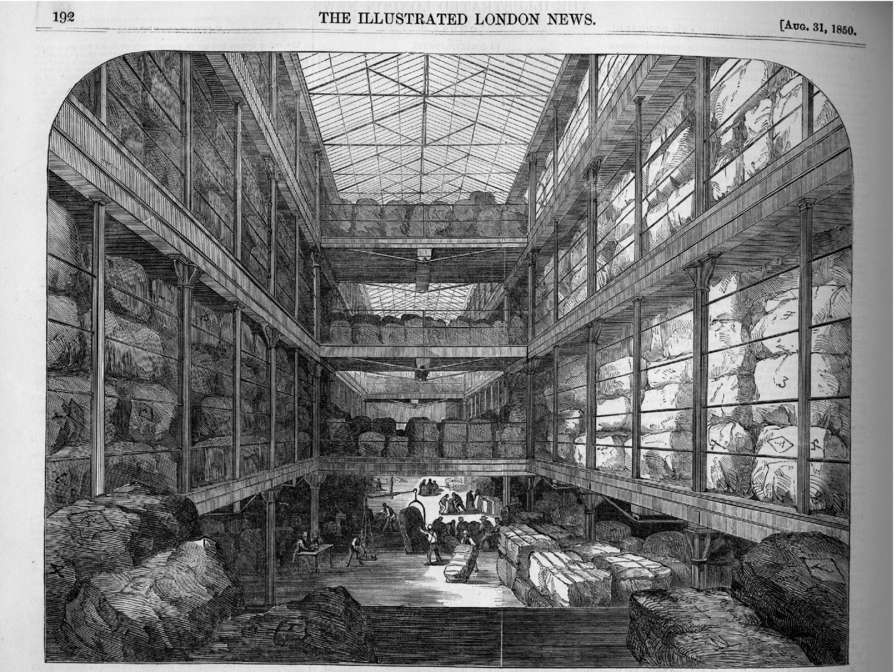
The height, volume and design of buildings might be as important as the materials they were made of. As land prices rose and populations grew, houses became taller: there were only 26 five-storey houses in Vienna in 1664 but 376 in 1795, while in Paris, residential buildings of six to eight storeys became common in the eighteenth century.Footnote 20 This made it harder for fire-fighters to get at the flames. In buildings with a single, open stair-well, convection currents would quickly spread a fire upwards. For this reason, James Braidwood, commander of the London Fire-Engine Establishment, was critical of the new ‘monster’ warehouses that developed after the mid-1820s, built with open wells and stairways (Figure 1).Footnote 21
London warehouse, Illustrated London News, 31 Aug. 1850. Rare Book Room, Monash University.
The buildings themselves, however, were only one source of fuel. Their contents were equally important, and here too great changes were taking place. Even in humbler dwellings, the boom in consumer products that began in the seventeenth century – earlier in certain social groups – led to a proliferation of flammable goods. People of all ranks owned more clothes and furnishings. Curtains became far more common: easily set alight by a carelessly positioned candle, they were the source of many fires that then spread to wooden furniture and walls. Flammable textiles such as linen, cotton and silk competed with more fire-resistant wool, and were used not only for clothing but in bedding, furnishings and wall linings. In mid-nineteenth-century London, women's dresses catching alight was perhaps, thought Braidwood, the largest single cause of fire deaths (Figure 2).Footnote 22 Homes packed with consumer items were vulnerable, even in the nineteenth century when more buildings were relatively fire-resistant. In Paris between 1850–4 and 1875–9, the population almost doubled but the number of recorded fires (excluding chimney fires) increased 2.4 times.Footnote 23 A similar increase took place in Glasgow.Footnote 24
James Gillray, ‘Advantages of wearing Muslin dresses’ [1802].

Yet domestic houses contained far fewer flammable materials than shops, warehouses and manufactories, and these too have a history. The rise in consumption and in trade across the early modern period led to growing concentrations of dangerous products. Little sugar was consumed in fifteenth-century Europe but a great deal by the eighteenth. In major port cities, the expansion of trade required growing quantities of naval stores: pitch, tar and turpentine for waterproofing, hemp for sails and timber for shipbuilding.Footnote 25 Firewood and coal consumption was driven by population growth but later by industrial uses, while dangerous chemicals such as hydrochloric, sulfuric and nitric acid became far more widespread in the late eighteenth century. Manchester became notorious for the fires that broke out in its cotton factories and warehouses. By the mid-nineteenth century, gasometers represented a huge danger to entire neighbourhoods, as the inhabitants of London discovered in 1865 when the Nine Elms gas factory exploded, killing 12 people and destroying 100 houses.Footnote 26
It was not only the nature of the products that enormously increased the fire risk, but the ever larger quantities stored. A series of fires in Liverpool in the 1830s and 1840s consumed vast quantities of goods stored in huge warehouses, including cotton and turpentine, while the Tooley Street fire in London in 1861 burned through several warehouses and caused an astronomical two million pounds of damage.Footnote 27 Any fire that broke out in these new structures was likely to be huge and to reach higher temperatures than an ordinary house fire: Braidwood urged the use of brick pillars in large warehouses, rather than cast iron ones that would melt in large fires and fracture when water was pumped in.Footnote 28
The fuel available for urban fires, therefore, did not only take the form of building materials, and nor did less flammable buildings always result in a reduction in the fuel available. As the nature of the buildings and their contents changed, the type of fires also evolved.
The uses of fire
A second crucial element in a fire history is the uses that urban dwellers made of flame. Heating and lighting were primary necessities, and the technologies of both underwent very significant transformations. Fireplaces with chimneys appeared in the late medieval period, replacing fires lit in an open hearth, usually in the middle of the main room, whose smoke escaped through windows or through a hole in the roof. Ordinary houses in Paris, London and Venice probably acquired chimneys in the 1300s. Elsewhere, they arrived later: they are mentioned in Stockholm in the 1460s and in a Prague fire ordinance of 1524. The earliest record of chimney sweeps in the German cities seems to occur in Frankfurt in 1464, indicating that tall chimneys were sufficiently common to keep them in business. By 1612, Vienna had 100 sweeps.Footnote 29
Chimneys heated more efficiently, but often increased the fire danger. The chimneys themselves were initially made of timber, probably covered in daub or plaster, and until chimney-pots came into common use, the upward draught bore sparks onto neighbouring roofs of thatch or wood.Footnote 30 In later times, stone or brick chimneys were often used to support roof and floor beams or were set against wooden walls, and in sixteenth-century Vienna they were the most common cause of fire. Even in the mid-nineteenth century, hearths placed on wooden floors or joists caused many fires in cheap housing in Glasgow.Footnote 31
Chimneys made it possible to multiply the fireplaces in a building, particularly on the upper floors, as population growth encouraged multi-dwelling apartment houses. Cooking could then be done within living spaces, rather than in the separate ground-floor kitchens common in the medieval period. By the seventeenth century, fireplaces were appearing in bedrooms and small apartments, producing innumerable tragedies when people – especially women wearing long skirts – fell asleep by the fire, or when small children stumbled into the flames. Another risk was exacerbated, in the later seventeenth century, by narrower flues that facilitated multiple hearths. The hot pipes often ran through roof spaces used to store hay or wood. If not swept regularly, they easily became blocked with soot that could catch alight, sometimes setting the whole house ablaze.Footnote 32
Chimneys, then, offer an example of a new technology that made life more comfortable but that in practice increased the fire risk. Certain simple changes in lighting, on the other hand, gradually decreased it, notably the use of enclosed lamps. Since naked candles caused a huge number of fires, even the makeshift lanterns of greased paper or cloth that became widespread in the seventeenth century probably saved many lives. In the eighteenth century, lamps with protective horn or glass became available (see Figure 3, below), but they remained expensive until the nineteenth. By the 1830s, in the larger cities, wealthier people were acquiring gas lights. These too were enclosed, they did not sputter, and because they were far brighter, people did not need to move about with candles and risk setting fire to furnishings, papers or curtains. On the other hand, a gas leak could be disastrous.Footnote 33 Here again, there is no simple, linear chronology.
William Hogarth, Night (1738), 2nd of 2 states. National Gallery of Victoria, Melbourne. Gift of John H. Connell, 1917 (843–3).

It was not only the technologies of heating and lighting that were changing, however, but also the times and the ways they were used. Beginning in the seventeenth century with growing numbers of nocturnal court festivities, the social elites began keeping ever-later hours. This was a form of conspicuous consumption, since balls, theatres, gambling establishments and cafes were brightly lit and sometimes well heated.Footnote 34 Gradually, curfews disappeared. In Hamburg, until 1771 the law required house doors to be closed at nightfall and all fires and lights to be extinguished by 11p.m. In 1800, the deadline was midnight, but by 1841 it had been completely abandoned. At the same time, institutions like cafes, which had first appeared in the late seventeenth century, were permitted to stay open later. Street lighting accompanied, and no doubt further encouraged, growing use of the night hours.Footnote 35 The same pattern can be found in all the major European cities.
The leisure activities of the rich required their servants and others to spend the night working. But night work was becoming more widespread, across the eighteenth century, for other reasons. The growing cities required food to be brought during the night so it would be in the shops by morning. Increased concern about hygiene intensified efforts to clean city streets, but more traffic made it difficult to do so during the day. Night-soil – first recorded in print with reference to Westminster in 1721 – was (as the name suggests) increasingly collected during the hours of darkness.Footnote 36 Cities were very gradually becoming twenty-four-hour environments, and the fire danger increased correspondingly, even with no changes in technology or in building materials.
The danger was growing for other reasons, too. Alongside heating and lighting, the main application of fire in early modern cities was for industry, in an astonishing variety of trades. Metal-workers of all kinds used fire, not only blacksmiths and founders but also nail-makers, pewter manufacturers, kettle-makers and goldsmiths. Ovens or kilns were used by bakers and other food industries, but also by potters, tile- and brick-makers, enamellers and lime-burners. Brewers, laundrywomen, dyers and candle-makers and many others used cauldrons in their daily work. Many of these trades existed in medieval towns, but across the early modern period the growth and movement of populations, and rising consumption, led some industries to expand considerably, creating new fire hazards. A good example is brewing. It was particularly hazardous, since the boilers had to be kept going for long periods and large stocks of fuel and dry grain (and later hops) were required. In England, brewing shifted from home-based production to become, after 1500, an urban industry requiring larger plant. The number of commercial brewers in London grew from a handful in the early sixteenth century to around 200 by 1700, then declined as the industry was concentrated in fewer hands. In Vienna too, beer grew in popularity in the sixteenth century and around 1800 finally exceeded wine in the quantity consumed. Brewing was subsequently to become an export industry and one of the leading sectors of the industrial revolution. By 1812, the Barclay factory in London had huge boilers in which the beer was stirred by ‘rakes’ powered by a steam engine. By the second half of the nineteenth century, there was a similar plant in Venice. Everywhere, insurance companies recognized breweries as one of the greatest urban fire hazards.Footnote 37 Three London breweries burned in 1721–22 alone, and a large fire in the London dockside suburb of Shadwell that destroyed over 100 houses in 1763 also began in a brewery.Footnote 38
The best example of a largely new industry that created a major fire risk, first in the Atlantic ports and later in cities all over Europe, is sugar-refining. Until the sixteenth century, sugar was an expensive commodity imported from the Middle East, although there was some production in Sicily and Spain. Once Atlantic slavery made sugar relatively cheap, refining began to be done in northern Europe, initially in the Low Countries, but London rapidly became the most important centre. It faced competition from Hamburg and in the eighteenth century from the French Atlantic ports, although Orleans soon became the most important refining centre in France. In Stockholm, the first refinery dated from the 1640s, and the Vienna sugar-bakers’ guild was formed in 1744, but only in the early nineteenth century did large refineries proliferate in both cities. A further revolution took place in the early 1800s when, prompted by the British blockade of French ports, scientists managed to produce sugar from beet that could be grown locally. Refineries then multiplied in Paris and other inland cities.Footnote 39 Since the refining process involved boiling down the sugar syrup, then drying the crystals, it required prolonged use of fire as well as large quantities of fuel, and the refined sugar itself was highly flammable. English fire insurance companies quickly identified sugar-refining as one of very high risk. In 1701, a fire in a London sugar house reportedly caused 2,000 pounds worth of damage. No fewer than 14 refineries burned in Hamburg between 1795 and 1802.Footnote 40
Other significant industries increased the fire risk, particularly in larger cities. Glass production expanded massively from the late 1600s, and spread across Europe. As towns grew, brick and tile kilns proliferated, as did those producing mortar and plaster.Footnote 41 New chemical industries, beginning in the late eighteenth and early nineteenth centuries, contributed to a greatly increased danger of explosion and fire. Sulphuric and hydrochloric acid were produced in huge boilers, for an ever-wider variety of manufacturing uses. Oil-based varnishes invented for furniture-making in the eighteenth century were applied to military helmets during the revolutionary wars and caused a number of bad fires in Paris.Footnote 42 Well before steam and gas arrived on the scene, therefore, new industries and vastly expanded production in older ones were creating a new era in the fire history of Europe's cities. Although the chronology varied from region to region, the pattern was broadly similar. Not only was the scale of industry greater, but the hazardous nature of many products caused blazes that were larger and more fierce, and in the case of oil-based products, water-resistant. These changes were driven in part by new technologies, partly by greater industrial concentration, but most fundamentally by growing consumer demand.
Meanwhile, the growth of early modern states was also producing new fire risks. Fireworks began to be used for civic displays in Italian cities in the fifteenth century, and became common in the sixteenth to mark royal entries and military victories. They subsequently became a spectacular tool of absolutist states.Footnote 43 Squibs and rockets also became enormously popular among individuals, their spread reflecting the growing availability of gunpowder. They caused numerous urban fires.Footnote 44 Their history parallels that of the bonfires that the inhabitants were encouraged to light for civic and royal celebrations, as well as for certain religious festivals. In London in the 1660s, Samuel Pepys considered the number of fires an indication of the popularity of the king, queen or government.Footnote 45 By the eighteenth century, official opinion had turned against their use and they were widely banned.
Even more dangerous were the forms of fire used in the new theatres and opera houses. These were enclosed spaces that depended heavily on lighting so that audiences could see the performers (and each other, since they too were places for display). Coloured flames and fireworks were used for dramatic effect. The earliest permanent theatres (since ancient times) appeared in the sixteenth century and the one in front of the Carità monastery in Venice was among the first to burn, in 1569. The number of theatre fires followed their spread, particularly in the nineteenth century: 99 went up in flames in the 1860s alone.Footnote 46 Theatres and opera houses were initially products of civic pride and princely patronage, but became social markers that – according to the types of productions they hosted – distinguished the cultured elites from the masses. In this instance, urban fire mapped the spread of particular social and cultural practices.
Many other conflagrations, however, had their roots in political and social conflict: war was one of the most widespread causes of destructive town fires. Its incidence, however, was highly regional. The Thirty Years’ War in the German states produced a peak in town fires in the 1640s, but elsewhere they occurred in other periods. The Danes burned Stockholm several times in the early sixteenth century, while Turkish armies set fire to Vienna in 1529 and 1683. An over-arching chronology, however, was shaped by military technology. The relatively long-range iron rockets attributed to William Congreve, used by the British to burn Copenhagen in 1807, were undoubtedly far more effective incendiary devices than earlier ones.Footnote 47
Responses to fire: prevention and fire-fighting
If urban blazes were primarily caused by human uses of fire and fed by fuel in the form of buildings, consumer goods and manufactures, human responses to fire risk also influenced the incidence and nature of urban fires. Preventive measures and developments in fire-fighting have all been amply documented by historians, although once again the story told has often been one of linear progress. While the growing power of states and city authorities and their greater willingness to intervene in defence of public safety were certainly crucial, we must also recognize that the nature and scale of the task they confronted changed considerably across the centuries.
From early times, city ordinances attempted to restrict the use of flammable building materials, to regulate the construction of chimneys and to require firewalls. London introduced preventive building regulations very early, and a major ordinance of 1212 also banned bakers and brewers from working at night and required them to plaster the walls of their premises.Footnote 48 Other towns followed suit in the fourteenth century, often after a disaster, as in Munich where a terrible fire in 1327 eventually led to stricter building rules in 1342.Footnote 49 The later chronology of fire regulations similarly corresponds partly to the occurrence of bad fires, but equally to the development of government and municipal authority. Thus, they often appeared in the sixteenth century and multiplied in the seventeenth.Footnote 50
Many fire regulations, particularly after 1600, parallel what has been termed the ‘civilizing process’, aiming to get people to take quite simple precautions.Footnote 51 As Hogarth's famous print (Figure 3) reminds us, it was often carelessness that started fires. Ordinances therefore warned people never to carry a naked flame into attics or to smoke in stables full of hay, and required them to stack wood well away from the oven. Bans on burning straw mattresses in the street and on private use of fireworks were found across Europe by the 1700s.Footnote 52 Yet preventive measures also responded to shifts in the nature of the threat. The spread of stoves and of new types of chimneys led to rules for their construction and installation, while the arrival of firework-making as a sedentary urban trade sparked widespread restrictions on its practice. Tobacco-smoking only became common in the seventeenth century and thereafter was a key target of fire regulations.Footnote 53
The story of fire prevention is further complicated by uneven enforcement. Regular inspections of houses were ordered in Vienna in 1432, but were rarely systematic before the eighteenth or even the nineteenth century. Even after the Great Fire of London, when very stringent rules were introduced, they applied just to part of the metropolis, only to new buildings, and in any case were not always obeyed.Footnote 54 Nevertheless, the cumulative impact of these measures was significant. Some of the medieval regulations seem to have had an effect, at least for a while, but once again it was generally the growth of absolutist states in the seventeenth century, and of paternalist governments influenced by enlightened ideas in the eighteenth, that produced more effective regulation. In Vienna, bakers had been relocated to the suburbs by the late seventeenth century, and by the early eighteenth the city magistrates were making strenuous efforts to enforce building regulations. In Paris, the new police organization of the late seventeenth century saw more rigorous enforcement of preventive measures, including exiling dangerous industries from the city centre, although the growing power of industrialists during the French Revolution and early nineteenth century undermined this policy. Across England, stone party walls and more frequent inspections seem to have helped reduce the numbers of multi-house fires in the later eighteenth century.Footnote 55
Ironically, some of the most effective measures against fire were not introduced primarily for that purpose. Stone buildings were status symbols, and rulers often attempted to aggrandize their capitals by banning other materials, at least on the main streets. The creation of broad avenues provided fire-breaks, yet similarly resulted from the sixteenth- and seventeenth-century princely taste for magnificent processional routes and vistas. The more general widening of thoroughfares and the clearing of flammable rubbish and wooden street stalls, particularly in the eighteenth century, was largely an attempt to improve traffic flow but was influenced by new medical concerns about miasmas concentrating in narrow streets.Footnote 56
Fire-fighting has a similarly complex history. There is a widespread perception that before the Enlightenment, Europe's inhabitants were fatalistic about fire. This is often based on sermons and official pronouncements, and occasionally on the supposed absence of precautions, yet it is contradicted by the measures that urban authorities put in place. Innumerable ordinances, from the Middle Ages onwards, ordered householders to keep buckets and water in readiness. Local officials were deputed to organize the population to fight fires, and to supply buckets, ladders, fire-hooks and, by the 1500s, hand-pumps. Larger pumps mounted on carts were described in the late sixteenth century and were in use by the early seventeenth. By the late 1600s, improved engines were deployed in southern German cities and in the Netherlands, and after 1672, flexible fire hoses gave them greater reach.Footnote 57 Almost everywhere, building workers were required to assist, since they knew how to scale buildings and if necessary demolish them to prevent a fire from spreading. Many cities had other groups who specialized in fighting fires. In Venice, it was the workers of the Arsenal; in Paris and Vienna, friars from specific religious orders; while in Valladolid, the Moorish community played a key role. Other places reorganized the city watch to double as a fire service.Footnote 58
It is true that early modern people were helpless in the face of really large conflagrations, but in most places those were rare, and when smaller fires occurred populations were anything but fatalistic. Neighbours mobilized to draw water from wells, form bucket chains and operate pumps. There is both direct and circumstantial evidence that they were generally successful. This was one reason why London seems to have experienced no big multi-house fires between 1212 and 1630, and why only one such fire (in 1621) is recorded in Paris between the late Middle Ages and 1871.Footnote 59 There is no doubt that the introduction of professional firemen, in stages from the early sixteenth century in some cities, enabled house fires to be put out more quickly, and by the late eighteenth century, they were sometimes able to extinguish larger blazes. As they grew more practised, crowd management became more important to stop bystanders getting in the way. Nevertheless, until well into the nineteenth century, most fire brigades continued to rely heavily on public assistance.Footnote 60
Permanent, professional fire services (paid or volunteer) became important for another reason. Older methods were less effective as city buildings grew taller and were not much use against the new kinds of fires that were taking place in nineteenth-century factories, large warehouses and theatres. Growing use of chemicals accelerated the pace and heat of fires, and made explosions likely. Meanwhile, greater expertise and more specialized equipment were required to handle fires in large spaces filled with flammable materials, and to evacuate larger buildings. Eighteenth-century concert halls and theatres were mostly small, whereas nineteenth-century ones became huge, and the possible consequences were demonstrated by the appalling fire in the Ringtheater in Vienna in 1881 that saw over 600 people die as they tried desperately to escape.Footnote 61
This discussion of measures to prevent and combat fires reminds us that a fire history is inseparable from that of urban political and financial institutions. Paid firemen and expensive equipment required developed forms of finance. So did the provision of ready supplies of water, an increasingly scarce commodity in early modern towns with rapidly growing populations, but without which fighting fires was impossible.Footnote 62 Effective implementation of preventive measures was also expensive. Much depended, therefore, on the nature of city government. Where it was able and willing to introduce effective fire prevention and fire-fighting, fires were usually kept small. There was no single type of civic culture that was better at this than others: effective measures were sometimes introduced by absolute rulers, as in Paris, and sometimes by the oligarchies of city-states like Venice.
It is also important to note that institutional responses to fire risk did not come solely from governments. ‘Civil society’ bodies also played a key role, and the ability of insurance associations and sometimes manufacturers to liaise with municipalities was often crucial. Most early fire insurance schemes were mutual societies, while the later ones were mostly joint stock companies, but both types had a strong interest in reducing fire damage. In London, insurance companies established their own fire brigades, while in Stockholm, the state-sponsored insurer, the Brandkontor, was very active in fire prevention. The creation of these bodies, and their particular form, depended on the cultural and economic character of each city, but they came into being at around the same time, in the eighteenth century, and by the early nineteenth were to be found almost everywhere.Footnote 63
Some conclusions
The history of urban fire in Europe is not a linear story divided into two acts: a first, long period when cities were made of wood and where candles and open fires posed a constant threat, followed by a modern moment when fire was controlled and older building materials were replaced with less flammable ones. Rather, the nature and incidence of urban fire changed repeatedly over the centuries. It is true that in Europe, spectacular city-wide fires became rare in the nineteenth century, confined mainly to wars, yet the apparently clear turning point represented by the shift to stone, brick and iron is less simple than it seems.
Huge and costly fires continued to occur. The new building materials caught fire less easily, but brick and iron allowed much larger structures whose volume and design often facilitated the rapid spread of fires. When combined with the new types of wares they contained, this produced devastating blazes that were harder to contain than most earlier ones. The cost was often huge. Robin Pearson has calculated that in England, while multi-building fires declined in frequency after the mid-eighteenth century, insurance losses increased.Footnote 64 And if we measure cost not in monetary terms but in human life, the new kinds of blazes were often far worse: in London, some 383 people died from burns during the entire period from 1654 to 1735, including seven or eight in the Great Fire of 1666, whereas in 1881 alone, 609 died from asphyxiation or were trampled when the Ringtheater in Vienna burned, and 200 died in similar circumstances at the Nice Opera House.Footnote 65
The history of urban fire was fashioned not only by factors internal to cities, such as building materials and population growth, but also by influences far beyond their boundaries. Climatic change reduced the fire risk in cold, wet periods, yet greatly increased it when the anomalous conditions associated with the Little Ice Age produced hot, dry weather. Another wider factor was the growth in commerce, particularly maritime trade, which brought new industries and highly inflammable products like sugar, cotton and tobacco to European cities. In other words, the fire history of European cities was profoundly influenced by long-term shifts in their relationship with other parts of the world. Each product and industry had its own chronology, and different cities and towns were affected at different moments, but the cumulative impact, from the seventeenth to the nineteenth century, was enormous.
It is not, however, simply a question of periodization. Making the everyday uses of fire an object of study, rather than looking solely at disasters, offers a different way of understanding the history of European cities. Fire was not, as Stephen Pyne has pointed out, ‘an interruption of normal history, a breakdown of order’, but part of the everyday existence of city-dwellers and one of the forces that shaped their lives.Footnote 66 Until the advent of electricity, and sometimes even after that, people handled fire every day. Yet their relationship to fire has a complex history. It was shaped partly by technology – I have pointed to the way that chimneys improved people's lives yet created new risks. But fire use was inseparable from social, cultural and political practices. Both lighting and heating became forms of social display and differentiation, enabling the rich to extend their activity into the night hours. This had profound implications for the entire urban population, as cities gradually became twenty-four-hour environments. The ability of governments to turn night into day, temporarily in the case of fireworks and more permanently as street lighting improved, were expressions of power and authority that also entailed new risks. More disastrous were military uses of fire, also linked to state formation, not only in wartime but equally through the production and storage of gunpowder that produced many spectacular explosions: in Paris in 1563, in London in 1650, in Vienna in 1752.Footnote 67 Other socially and politically determined factors, however, reduced the fire danger: the prestige of stone construction and of processional avenues inadvertently contributed to fire prevention.
A focus on fire also reveals another side of the consumer boom of the early modern period. It is generally seen as a positive phenomenon, producing greater comfort for many people and driving economic growth. Yet the adoption of items like curtains and more flammable textiles, in wooden-panelled rooms crowded with wooden furniture, greatly increased the danger of fire. Ironically, the ease provided by improved heating – as more efficient fireplaces proliferated and glazing better contained the warmth – encouraged people to wear lighter, more flammable fabrics. In certain respects, sparsely furnished early modern houses were less dangerous than nineteenth-century ones packed with consumer goods.
As fire risk shifted, city authorities responded with new strategies. Stringent building rules, the exiling of dangerous industries from city centres and bans on fireworks were not a tardy response to an ever-present danger, but efforts to deal with a new situation. New forms of fire-fighting, from the seventeenth to the nineteenth century, were also a response to increased danger. Indeed, the need to deal with fire was one of the drivers of change in municipal governments. They began to interfere with private property by stipulating how people could construct their houses; intervened in the economy by regulating industry and attempted to modify individual behaviour with, for example, bans on smoking. They imposed new taxes to meet the high cost of fire pumps, firemen and more effective prevention. Fire thus played a key role in the development of urban government and in changing the relationship between municipalities and populations. It also, in many places, encouraged the development of community and private-sector financial institutions, with the growth of mutual and joint-stock fire insurance companies, themselves to become lobby-groups for urban reform.
Finally, this brief survey has suggested that early modern fire-fighting was more effective than is generally recognized. Urban populations were rarely fatalistic in the face of fire and they succeeded in preventing many small fires from spreading. Combatting fires was a civic responsibility, and a further dimension of the self-regulating nature of urban communities. It helped to cement them, even if not everyone participated. Yet the changing nature of fires, of urban buildings and of fire-fighting were making it increasingly important for firemen to be specialists. Older methods of fire management, based on the participation of the population, became less effective. As in the case of prevention, the new, more professional fire services were a response not to an old problem but to a new one.
Many aspects of this urban fire history deserve more attention than is possible in a short survey. There was enormous variation between individual towns and cities. Far more work remains to be done on the links between climate change and urban fire. Comparison with other parts of the world will be fruitful: several fine studies point to fascinating differences in the kinds of fires and the responses of governments.Footnote 68 Recognition of the changing place and nature of fire, and of its relationship to human behaviours, can enhance our understanding both of the histories of particular cities and of urban history more broadly.



