Introduction
Attention deficit hyperactivity disorder (ADHD) is a disorder characterised by inattention, hyperactivity and impulsivity whose symptoms persist until adulthood in up to two-third of cases (Kooij et al. Reference Kooij, Bejerot, Blackwell, Caci, Casas-Brugué, Carpentier, Edvinsson, Fayyad, Foeken, Fitzgerald, Gaillac, Ginsberg, Henry, Krause, Lensing, Manor, Niederhofer, Nunes-Filipe, Ohlmeier, Oswald, Pallanti, Pehlivanidis, Ramos-Quiroga, Rastam, Ryffel-Rawak, Stes and Asherson2010), but which retains diagnostic criteria in only about a fifth of cases (Agnew-Blais et al. Reference Agnew-Blais, Polanczyk, Danese, Wertz, Moffitt and Arseneault2016). Individuals that retain greater symptomatology are likely to have a greater symptom burden, functional impairment and psychiatric co-morbidity (Lara et al. Reference Lara, Fayyad, De Graaf, Kessler, Aguilar-Gaxiola, Angermeyer, Demytteneare, De Girolamo, Haro, Jin, Karam, Lépine, Mora, Ormel, Posada-Villa and Sampson2009). Recent evidence supports a significant number presenting for the first time in adulthood (Agnew-Blais et al. Reference Agnew-Blais, Polanczyk, Danese, Wertz, Moffitt and Arseneault2016). It is recognised that ADHD in adults is a multidimensional disorder that, by definition, impairs individuals’ functioning in numerous areas, including academic and occupational areas of their lives, but also has adverse effects in friendships, family relationships and even predisposes individuals to longer-term psychological problems such as low self-esteem (American Psychiatric Association, 2013; Cook et al. Reference Cook, Knight, Hume and Qureshi2014).
While it is recognised that the adult disorder is characterised by a persistence in the attention domain and a remission in hyperactivity (Biederman et al. Reference Biederman, Mick and Faraone2000; Faraone et al. Reference Faraone, Biederman and Mick2006), there is considerable heterogeneity across presentations in adults with ADHD (Mostert et al. Reference Mostert, Onnink, Klein, Dammers, Harneit, Schulten, Van Hulzen, Kan, Slaats-Willemse, Buitelaar, Franke and Hoogman2015). This makes diagnosis difficult, especially among clinicians who perhaps feel that they are insufficiently trained in assessment. Not only this, the variation in presenting symptoms can lead to symptoms being attributed to other disorders, which may or may not be co-morbid. Borderline personality disorder (BPD) and ADHD are known to share several characteristics, in particular impulsivity (Lampe et al. Reference Lampe, Konrad, Kroener, Fast, Kunert and Herpertz2007) and it is estimated that 38% of individuals with a diagnosis of BPD also have ADHD (O’Malley et al. Reference O’malley, Mchugh, Mac Giollabhui and Bramham2016). These individuals have greater therapeutic needs than those suffering with just one of these disorders (Asherson et al. Reference Asherson, Young, Eich-Höchli, Moran, Porsdal and Deberdt2014). A study comparing impulsivity in co-morbid ADHD and BPD versus ADHD alone found that individuals with co-morbid ADHD and BPD exhibit higher level of impulsivity and lower levels of academic and psychosocial functioning (O’Malley et al. Reference O’malley, Mchugh, Mac Giollabhui and Bramham2016). It is therefore evident that co-morbidity is a common occurrence which needs to be addressed to optimise treatment for either disorder, and for this to happen, psychiatrists need to be proficient in diagnosing both disorders.
Furthermore, ADHD has always been a contentious diagnosis, even more so its occurrence in adults, and many psychiatrists remain sceptical about the existence of ADHD in adults (Asherson et al. Reference Asherson, Chen, Craddock and Taylor2007). Part of the scepticism around adult ADHD may be rooted in the gaps in the evidence for a biological basis to this disorder. These gaps are gradually being closed, leading to a clearer picture of what ADHD looks like through a biological lens.
This integrative review targets psychiatrists without a background in neuroscience and aims to describe common ideas and concepts from recently published material on the neurobiological basis for ADHD, with particular attention towards adult ADHD.
Methods
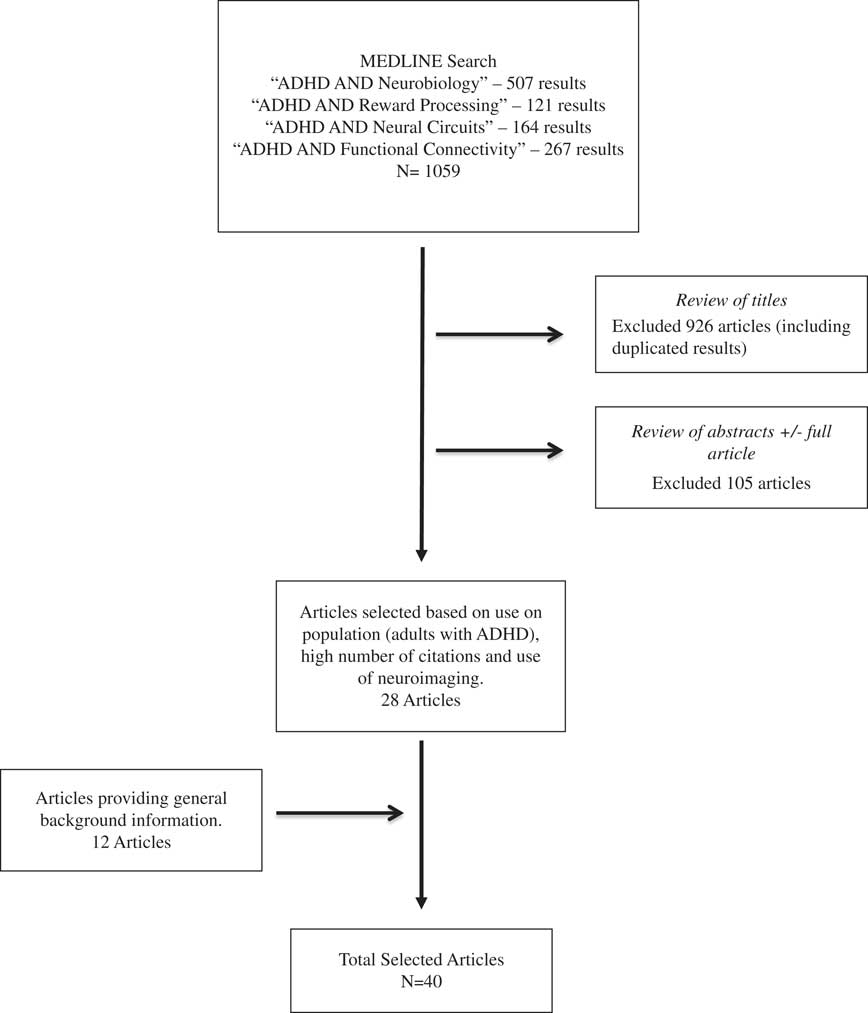
A PubMed search using MEDLINE database was used to identify articles most relevant to the research objective. Following a preliminary review of the literature around pathophysiology of ADHD, the following search terms were identified: ‘ADHD AND neurobiology’, ‘ADHD AND reward processing’, ‘ADHD AND neural circuits’ and ‘ADHD AND functional connectivity’. This search yielded 507, 121, 164 and 267 results, respectively.
The abstracts, and where necessary the full articles, of selected papers were read and relevant articles included.
The following set of criteria were applied to these search results:
1. Use of neuroimaging in methodology.
2. Studies pertaining to adult participants; there was a lower threshold for inclusion of studies pertaining to adult participants, as there is a relative dearth of research in this area. Articles relevant to childhood populations were included for the purpose of contextualising and understanding general concepts around ADHD.
3. Preferential selection of articles with high number of citations. Citation count was a loose criterion used to identify highly influential articles, but was not an absolute criterion. Articles with over 100 citations were considered strongest but weight was also assigned towards modestly cited articles (>10). A more modest citation threshold (>10) was applied to more recently published articles (after 2014).
The final articles selected were read in their entirety. In total, 40 articles were selected for inclusion; 28 articles focussed on the neurobiological basis for ADHD (10 including adult participants) and the rest provided general background information (e.g. rate of remission, co-morbidity, etc.) (Fig. 1).
Flow diagram of article selection process.

Conceptualising ADHD: what are the possibilities?
Many theories for ADHD have been postulated. For the purpose of conceptualising these theories, the material reviewed for this article will be explored under the following headings: Maturational Delay and Neural Network Dysfunction [executive, attention, reward and default mode networks (DMN)].
Research, which historically focussed largely on frontal lobe dysfunction (Dickstein et al. Reference Dickstein, Bannon, Castellanos and Milham2006) is now moving away from searching for discrete anatomical abnormalities and towards functional connectivity in neural networks (Posner et al. Reference Posner, Park and Wang2014; Castellanos & Aoki, Reference Castellanos and Aoki2016). This research has evolved with the tool of functional brain imaging eg functional magnetic resonance imaging (fMRI) and positron emission tomography (PET), which has enabled researchers to delineate dysfunctional brain networks, rather than just discrete locations. These studies are demonstrating that it is the proverbial journey rather than the destination that matters when it comes to ADHD.
A matter of maturity?
The theory of maturational delay is one that has been replicated as a neuropathological feature in brains of individuals with ADHD. This theory suggests that ADHD is a delay, rather than an abnormality, of normal brain development. The rationale behind this was that children with ADHD often behaved like their younger peers and has been supported by various findings demonstrating that some parts of ADHD brains are measurably smaller than average (Rubia, Reference Rubia2007). More recently, with the aid of functional brain imaging, researchers have been able to explore the possibility of an immaturity of functional connectivity that corresponds to the already described structural immaturity. Kessler et al. (Reference Kessler, Angstadt and Sripada2016) describes a process of charting delays in functional connectivity in the brain in much the same way as a paediatrician charts growth delays. Using this method, the authors demonstrated reduced functional connectivity in children for whom attentional problems would subsequently be clinically confirmed. Findings from this study demonstrated a potential method – albeit impractical – of predicting attentional problems using biological measurements.
The concept of maturational delay has recently taken a further advance as it was traditionally thought to be of pathophysiological significance for only certain parts of brain, mostly cortical structures, but Hoogman et al. provides new evidence that maturational delay also affects a range of subcortical structures, as well as the well-established cortical structures (Hoogman et al. Reference Hoogman, Bralten, Hibar, Mennes, Zwiers, Schweren, Van Hulzen, Medland, Shumskaya, Jahanshad, Zeeuw, Szekely, Sudre, Wolfers, Onnink, Dammers, Mostert, Vives-Gilabert, Kohls, Oberwelland, Seitz, Schulte-Rüther, Ambrosino, Doyle, Høvik, Dramsdahl, Tamm, Van Erp, Dale, Schork, Conzelmann, Zierhut, Baur, Mccarthy, Yoncheva, Cubillo, Chantiluke, Mehta, Paloyelis, Hohmann, Baumeister, Bramati, Mattos, Tovar-Moll, Douglas, Banaschewski, Brandeis, Kuntsi, Asherson, Rubia, Kelly, Martino, Milham, Castellanos, Frodl, Zentis, Lesch, Reif, Pauli, Jernigan, Haavik, Plessen, Lundervold, Hugdahl, Seidman, Biederman, Rommelse, Heslenfeld, Hartman, Hoekstra, Oosterlaan, Polier, Konrad, Vilarroya, Ramos-Quiroga, Soliva, Durston, Buitelaar, Faraone, Shaw, Thompson and Franke2017). Sripada et al. supports this in a study that reports a ‘lag’ in maturation between networks (slowed development of connectivity) in children and young adults with ADHD (Sripada et al. Reference Sripada, Kessler and Angstadt2014). These findings highlight that maturational delay, while it is just one of a number of theories, plays an even larger pathophysiological role than was initially thought.
Network dysfunction
A poorly executed process? The prefrontal cortex (PFC) and the executive network
The PFC is the region in the anterior portion of the frontal lobe whose functions include organisation and planning (Mills et al. Reference Mills, Goddings, Clasen, Giedd and Blakemore2014) in addition to playing a role in other processes such as value-based decision making (Dixon & Christoff, Reference Dixon and Christoff2014). It is therefore not surprising that its dysfunction was considered the main culprit in ADHD, in both children and adults. Historically, it was the symptomatic similarities between ADHD and frontal lobe brain injuries that first prompted some early studies to look towards this region of the brain as an explanation for ADHD (Bush, Reference Bush2010).
Dickstein et al. (Reference Dickstein, Bannon, Castellanos and Milham2006) described a number of differences in frontal brain regions between healthy controls and individuals with ADHD that were present during task-based imaging. These findings were largely in keeping with a picture of hypofrontality in those with ADHD, who were less likely to activate frontal regions compared with healthy controls.
The hypoactive PFC model of ADHD is a neat and would be all-encompassing explanation for the syndrome of ADHD, if it were considered to be merely a disorder of inattention and disorganisation. However, the multiple dimensions of this illness cannot be explained by dysfunction localised to one area.
The Utah-criteria outline a number of domains, outside the better known inattention–hyperactivity–impulsivity triad, which highlight the shape of the syndrome in adults (Marchant et al. Reference Marchant, Reimherr, Robison, Robison and Wender2013). These criteria are inattention, hyperactivity, disorganised behaviour, impulsivity, emotional lability, disturbances of affect control and stress oversensitivity. If we now consider this to be a more inclusive representation of the adult ADHD picture, the PFC can no longer be the overriding biological offender.
Researchers therefore branched out to determine other mechanisms that explain this syndrome, in both adults and children. As previously discussed, this surge in research has unmasked a disorder that is no longer confined to discrete abnormalities of the PFC, but has expanded to include multiple cortical and subcortical areas, which are structurally and functionally connected to each other to form parallel and intersecting pathways. These pathways are usually described based on their anatomical parameters, but they may be better understood if described using their functional significance. In addition to the prefrontal/executive model described above, we could loosely describe other theories as attention, reward and mind-at-rest models.
Attention model
Ventral attention network (VAN) and dorsal attention network (DAN) are pathways that are demonstrated to be under and overactive in ADHD. In a meta-analysis, Cortese et al. describes that these networks involve a complex system of cortical and subcortical structures, including the temporoparietal junction, the supramarginal gyrus, frontal operculum, and anterior insula (VAN) and the intraparietal sulcus and the frontal eye field (DAN) (Cortese et al. Reference Cortese, Kelly, Chabernaud, Proal, DI Martino, Milham and Castellanos2012). They go on to describe that the VAN, when functioning optimally, enables individuals to direct attention towards salient external stimuli (e.g. a person talking in conversation) and to exclude irrelevant stimuli and background noise (e.g. the sound of a door opening). For example, when engaged in a discussion-based classroom activity, an individual should be able to switch attention from one speaker to another but should also be able to ignore, or promptly dismiss, voices coming from outside their group. Engaging with some stimuli and ignoring others would seem to be at odds, and therefore requires a refined balancing act to accomplish. The VAN achieves this task by activating certain regions and suppressing others in order coordinate these activities. The role of the DAN is to select external sensory stimuli that are compatible with personal goals and experience, and so both the DAN and VAN need to be in full working order for the system to operate optimally. Dysfunction of these pathways is hypothesised to cause symptoms that comprise the inattention domain (Cortese et al. Reference Cortese, Kelly, Chabernaud, Proal, DI Martino, Milham and Castellanos2012), meaning that an individual with ADHD may be unable to select important stimuli, unable to direct attention towards those stimuli or unable to filter out unimportant external stimuli.
Reward model
Working alongside the attention model is the reward model, whose dysfunction can contribute to problems with attention and impulsivity. Reward processing contributes to the way in which both children and adults manage their responses on a moment by moment basis.
Impulsivity is a core symptom of ADHD which can manifest as behavioural or emotional dysregulation. Reduced response inhibition (Oosterlaan & Sergeant, Reference Oosterlaan and Sergeant1998) and aberrant reward processing are hypothesised to cause disorders of impulsivity. The striatum, anterior cingulate cortex and orbitofrontal cortex are central to reward processing but numerous other structures feed into this system (Ortiz et al. Reference Ortiz, Parsons, Whelan, Brennan, Agan, O’connell, Bramham and Garavan2015). Reward processing enables individuals to balance short-term rewards with long-term goals, a process which facilitates both attention and impulse control; functional imaging studies using monetary rewards have found that children and adults with ADHD preferentially opt for immediate rewards over delayed rewards, even if the magnitude of immediate reward is smaller (Bitsakou et al. Reference Bitsakou, Psychogiou, Thompson and Sonuga-Barke2009). This anomalous reward functioning, which is thought to be secondary to an uncomfortable aversion to delayed reward, appears to lead to a failure to assign significance towards longer-term goals, for example reacting to a current situation without offsetting against future goals (Tripp & Wickens, Reference Tripp and Wickens2008). A study of 21 adult participants with ADHD observed, using task-based fMRI, a combination of increased and reduced activation, with hypo-activity in the striatum for reward anticipation and increased activity in the dorsolateral PFC and orbitofrontal cortex for reward receipt (Ortiz et al. Reference Ortiz, Parsons, Whelan, Brennan, Agan, O’connell, Bramham and Garavan2015).
Reward hypotheses are supported by evidence from PET imaging, which demonstrates dopaminergic changes in one of the reward centres of the brain (the ventral striatum) following treatment with methylphenidate, which correlates with clinical improvement in symptoms (Volkow et al. Reference Volkow, Wang, Tomasi, Kollins, Wigal, Newcorn, Telang, Fowler, Logan, Wong and Swanson2012).
‘Mind-at-rest’
The brain is not always engaged in tasks but is, of course, always active. The DMN operates when the mind is not engaged in another task, or is ‘at rest’ (Raichle, Reference Raichle2015). The DMN is responsible for entities such as mind-wandering, day-dreaming, contemplating and reflecting on oneself and one’s life. It follows that the DMN becomes deactivated when the brain engages in a task (Castellanos & Proal, Reference Castellanos and Proal2012). Taking, as an example, driving a car: the DMN should be deactivated when changing lanes but may become activated when sitting in a traffic jam. Following on from that, if the traffic starts moving and a driver’s DMN remains activated, the sound of a horn from another car would quickly deactivate the DMN and other ‘activity’ networks would be engaged. This is a particularly relevant example, as adults with ADHD are known to be at a higher risk of road traffic accidents (Barkley & Cox, Reference Barkley and Cox2007). The DMN is not a single anatomical structure, but comprises connections between different areas including the anterior medial PFC and posterior cingulate cortex, the dorsomedial PFC subsystem and the medial temporal lobe subsystem (Castellanos & Proal, Reference Castellanos and Proal2012). Dysfunction of the DMN is observed in both children and adults with ADHD, where the individual is slow to ‘switch-off’ the DMN and ‘switch-on’ task-positive networks, leaving them in a mind-wandering state for longer than average (or until they are exposed to a more potent sensory stimulus, e.g. the car horn). This has been demonstrated using functional imaging examining regions of the brain that comprise the DMN (Castellanos et al. Reference Castellanos, Margulies, Kelly, Uddin, Ghaffari, Kirsch, Shaw, Shehzad, DI Martino, Biswal, Sonuga-Barke, Rotrosen, Adler and Milham2008). This inability to deactivate or ‘switch-off’ the DMN or mind-wandering is found to be exacerbated with more cognitively challenging tasks (Fassbender et al. Reference Fassbender, Zhang, Buzy, Cortes, Mizuiri, Beckett and Schweitzer2009). Furthermore, in individuals with ADHD, functional imaging studies not only demonstrate a difference in DMN regions compared with healthy controls, but also, a return towards normal functioning when treated with psychostimulant medication, namely methylphenidate (Peterson et al. Reference Peterson, Potenza, Wang, Zhu, Martin, Marsh, Plessen and Yu2009).
Discussion
There are many unanswered questions about adult ADHD.
One question which arises, now that we have established that ADHD is not caused by a discrete anatomical abnormality, is whether ADHD comprises a top-down dysfunction (incorrect instructions from cortical structures) or a bottom-up (erroneous response and feedback from subcortical structures) phenomenon. While recent literature leaves many questions yet to be answered, it is clear from the evidence gathered in this article that ADHD is caused by a combination of top-down and bottom-up processes. Given the degree of clinical heterogeneity observed in ADHD, it stands to reason that the neurobiology would also vary, that individuals with differing presentations also have different biological anomalies and that some individuals are more top-down than others (Francx et al. Reference Francx, Oldehinkel, Oosterlaan, Heslenfeld, Hartman, Hoekstra, Franke, Beckmann, Buitelaar and Mennes2015).
Perhaps more intriguing than the question of what causes the symptoms is the question of what causes symptoms to change over time. Studies seek to describe the course of neurodevelopmental maturation in ADHD, from childhood to adulthood. Why do some children ‘grow out’ of ADHD? Is adult ADHD a different phenomenon to childhood ADHD?
Is adult ADHD a different phenomenon to childhood ADHD?
In the wake of emerging research in the area, researchers are beginning to direct their attention towards the possibility of three separate categories of ADHD: childhood ADHD that remits, childhood ADHD that persists and adult-onset ADHD. Traditionally, diagnosis of ADHD required evidence of symptoms before the age of seven, although this has now been increased to age 12 (American Psychiatric Association, 2013). Chandra et al. describes a group of apparent adult-onset ADHD individuals who have less symptomatology but an equal functional burden, compared to persistent childhood ADHD (Chandra et al. Reference Chandra, Biederman and Faraone2016). They suspect that the apparent late-onset is likely due to poor recall of childhood symptoms, but nonetheless it leaves the door open for the possibility of a true adult-onset disease. In support of this possibility, Moffitt et al. (Reference Moffitt, Houts, Asherson, Belsky, Corcoran, Hammerle, Harrington, Hogan, Meier, Polanczyk, Poulton, Ramrakha, Sugden, Williams, Rohde and Caspi2015) demonstrated surprising findings in a study comparing adults diagnosed with ADHD in childhood versus those diagnosed with ADHD in adulthood. Of 61 individuals diagnosed with ADHD in childhood, only three retained diagnosis in adulthood and of 31 individuals diagnosed with ADHD in adulthood (average age 38), only three reported childhood symptoms (Moffitt et al. Reference Moffitt, Houts, Asherson, Belsky, Corcoran, Hammerle, Harrington, Hogan, Meier, Polanczyk, Poulton, Ramrakha, Sugden, Williams, Rohde and Caspi2015). Once again, this could not be considered proof of a true adult-onset disorder due to the effect of recall bias but supports the interesting and unexpected possibility that such a disorder might exist. In an expert commentary on the subject, Castellanos suggests that the increasingly plausible possibility of adult-onset ADHD requires further exploration, but that this cannot be fully executed as current longitudinal ADHD cohorts are still maturing (Castellanos, Reference Castellanos2015).
Why do some children ‘grow out’ of ADHD?
If some children experience total remission of ADHD and others experience morbidity and functional impairment throughout their life, there must be a neuroanatomical explanation for the juxtaposed natural histories of the illness between individuals. Fassbender & Schweitzer (Reference Fassbender and Schweitzer2006) demonstrated that functioning in the VAN and DAN, while remaining suboptimal in adults with ADHD, deviate less from the norm than in childhood subjects, indicating that they play a role in compensation over time (Fassbender & Schweitzer, Reference Fassbender and Schweitzer2006).
Findings from a study examining reward processing found abnormalities in reward processing in adult participants that were not present in children. This, along with the findings from studies of symptomatology over time (Moffitt et al. Reference Moffitt, Houts, Asherson, Belsky, Corcoran, Hammerle, Harrington, Hogan, Meier, Polanczyk, Poulton, Ramrakha, Sugden, Williams, Rohde and Caspi2015; Chandra et al. Reference Chandra, Biederman and Faraone2016) raises the interesting possibility that some pathological changes may be caused by the disease process over time, rather than being part of the developmental abnormality (Kappel et al. Reference Kappel, Lorenz, Streifling, Renneberg, Lehmkuhl, Ströhle, Salbach-Andrae and Beck2015).
But to really answer the question of why some individuals mature out of ADHD, we look again towards the original suspect: the PFC. We have now established that the PFC is not the only structure whose pathology is responsible for ADHD, but there is no doubt that the immature PFC is central to the disorder in many childhood sufferers. And, as the PFC is known to be one of the last neural structures to reach maturation – not reaching developmental maturity until early adulthood (Mills et al. Reference Mills, Goddings, Clasen, Giedd and Blakemore2014) – we would expect the clinical decline in symptomatology in early adulthood to coincide with this timeframe, which it does (Agnew-Blais et al. Reference Agnew-Blais, Polanczyk, Danese, Wertz, Moffitt and Arseneault2016). When considering the evidence that there appears to be some normalisation of frontal pathology compared with extra-frontal and subcortical structures, and that the timeline of this fits with the decline in prevalence in early adulthood, it would follow that the neuropathology of childhood remittent cases could be attributed largely to disease of the maturing frontal lobe and that the neuropathology of persistent cases is more linked to pathology in extra-frontal and subcortical structures (Francx et al. Reference Francx, Oldehinkel, Oosterlaan, Heslenfeld, Hartman, Hoekstra, Franke, Beckmann, Buitelaar and Mennes2015).
In a sense, some of these findings do suggest that adult ADHD is a different entity to childhood ADHD but the most robust evidence to date suggests that these neurobiological abnormalities exist as part of a continuum, with common treatments, namely stimulants, being an effective treatment for both disorders. The field of adult ADHD is rapidly evolving, with new understandings paving the way for more treatment options. If anything can really be taken from emergent findings, it is that future research is needed to further illuminate the biological similarities and distinctions between childhood and adult ADHD, a process that will hopefully lead to better treatments and outcomes for ADHD.
Conflicts of Interest
None.
Ethical Standards
The authors assert that all procedures contributing to this work comply with the ethical standards of the relevant national and institutional committee on human experimentation with the Helsinki Declaration of 1975, as revised in 2008.
Financial Support
This research received no specific grant from any funding agency, commercial or not-for-profit sectors.