

Introduction
The copper alloy dagger is one of the most iconic artefacts associated with Early Bronze Age barrows and was among the key artefact types used by Piggott (Reference Piggott1938) to define the Wessex culture and its relationships with the Continent. Since then, copper alloy daggers and other artefacts such as composite necklaces have often been interpreted as denoting the growing importance of individual status or demarcating certain lineages in the landscape beneath mounds (Barrett Reference Barrett1990; Reference Barrett1994; Mizoguchi Reference Mizoguchi1992).
However, despite important new research into classic Wessex burials and their contents (Needham & Woodward Reference Needham and Woodward2008; Needham et al. Reference Needham, Lawson and Woodward2010) this approach is potentially problematic, not least because the majority of barrows on the Wessex chalk were excavated prior to radiocarbon dating and few ‘classic’ Wessex burials have associated radiocarbon determinations, which means that their contents are still comparatively poorly-dated. To date only one ‘Wessex I’ burial, West Overton G1, Wiltshire, is associated with a radiocarbon determination (Needham et al. Reference Needham, Lawson and Woodward2010), which makes the chronology imprecise (Wall Reference Wall1987).
Despite these limitations, the character of burial rites and the contents of barrows in other areas have often been explained by reference to practices in Wessex. However, recent study and synthesis of the Early Bronze Age in other regions has begun to reveal diversity in Early Bronze Age funerary practices (Garwood Reference Garwood2007, 148–55; Lewis Reference Lewis2007; Bradley & Fraser Reference Bradley and Fraser2010; Morigi et al. Reference Morigi, Schreve, White, Hey, Garwood, Robinson, Barclay and Bradley2011, 218–45). In the south-west peninsula, where analysis has been undertaken on cremation burials, these have often found to be either token or to represent several individuals (Jones & Quinnell Reference Jones and Quinnell2008; Jones et al. Reference Jones, Marley, Quinnell and Hartgroves2011). In spite of these advances, very few burial deposits associated with ‘classic’ Early Bronze Age artefacts such as daggers have been securely dated, and few burial deposits associated with these artefacts have been closely examined to establish whether they represent partial, whole, or multiple individuals.
The current project developed after it was established that several Early Bronze Age cremation deposits from barrows in the south-west peninsula (Devon and Cornwall) were available in the collections of the Royal Albert Memorial Museum (Exeter) and the Royal Cornwall Museum (Truro) which were associated with daggers/knives and objects held to be ‘typical’ of Early Bronze Age burial traditions across southern Britain. Five sites associated with copper alloy daggers/knife-daggers and a finely-worked flint knife were assessed as having the potential to contain suitable human remains for dating: Upton Pyne and Huntshaw in Devon and Rosecliston, Pelynt 2, and Fore Down in Cornwall. As part of this assessment the history of each cremation deposit was considered since its recovery and no reasons were found to indicate any lack of integrity. Osteological study was carried on the human remains to shed further light on the quantity and make up of the cremation deposits. The objectives of the project were to establish the chronology of the dagger/knife associated burials in the south-west and to reconsider the contexts in which they are found.
Background to the Study of Early Bronze Age Copper Alloy Daggers and Knives in Britain and the South-West Peninsula
Britain
From the earliest antiquarian investigations, copper alloy daggers have formed a cornerstone for the understanding of Early Bronze Age burials in Britain. This is partly because they were commonly found and noticed in the barrows which were opened by early barrow diggers (for example, Hoare Reference Hoare1821; Thurnam Reference Thurnam1871) and are widely distributed around Britain (Henshall Reference Henshall1968; Gerloff Reference Gerloff1975; Pearce 1982). Copper and subsequently copper alloy, daggers/knives have a long chronology, from the earliest Beaker graves (Fitzpatrick Reference Fitzpatrick2011, 210) through to the middle of the 2nd millennium cal bc (Needham Reference Needham1996), when large-scale barrow building ceased. This chronology lent itself to successive attempts to create typological series that would enable sites with daggers/knives to be put within a temporal framework that could assist with the dating of other forms of artefact (for example, Montelius Reference Montelius1908; Piggott Reference Piggott1938).
ApSimon (Reference ApSimon1954) identified two series of daggers within the post-Beaker and Wessex graves. He argued that the earliest daggers were slender-bladed, akin to the Breton Amorican daggers, usually with six rivets, which he termed ‘Bush Barrow’ series. Subsequently the term Armorico-British daggers has been used to include similar daggers from beyond Wessex (for example, Gerloff Reference Gerloff1975). Bush Barrow series daggers are associated with ‘Wessex I’ inhumation burials, as typified by the Bush Barrow burial (Hoare Reference Hoare1821; Needham et al. Reference Needham, Parker Pearson, Tyler, Richards and Jay2010). Beyond Wessex, blades of this type have been found at Towthorpe in Yorkshire (Mortimer Reference Mortimer1905, 5) and an actual ‘Armorican’ example has recently been found at Lockington in Leicestershire (Hughes Reference Hughes2000).
ApSimon's second group comprised shorter triangular-shaped ogival blades with two or three rivets, midrib, and rounded heel. This group became known as Camerton-Snowshill daggers and were associated with the Wessex II cremation burials. They have a far wider currency than the Wessex I daggers and are found across the British Isles, usually with cremation but occasionally with inhumation burials (Gerloff Reference Gerloff1975; Annable & Simpson Reference Annable and Simpson1964). ApSimon considered that the Bush Barrow type daggers preceded those of the Camerton-Snowshill series, although he was uncertain how much overlap there was between the two series. His paper was hugely influential and was used to support a twofold division of Early Bronze Age graves throughout the 1950s and 1960s (Ashbee Reference Ashbee1960, 98–102; Annable & Simpson Reference Annable and Simpson1964, 22–5).
The most important work subsequent to that of ApSimon was that of Gerloff (Reference Gerloff1975) which provided an outline chronology for the entire Chalcolithic to Early Bronze Age dagger sequence. Her study of the corpus of British daggers/knives placed them into a typological and chronological sequence ranging from the earliest tanged copper knives and flat riveted blades of the 3rd millennium cal bc, through to the Camerton-Snowshill daggers. Knife-daggers, that is blades under 0.10 m long, were treated separately, although as Gerloff (Reference Gerloff1975, 159) noted, the distinction between daggers and knife-daggers is arbitrary. Early copper knives have recently been reviewed by Stuart Needham (Reference Needham2011, 122–7) and the term knife-dagger is used in this paper to refer to copper alloy blades with rivet holes (for example, Fore Down) which post-date the Beaker period.
Gerloff was writing at a time when there were still few radiocarbon determinations. However, the National Museum of Scotland's radiocarbon dating programme (Baker et al. Reference Baker, Sheridan and Cowie2003; Sheridan Reference Sheridan2007) and determinations on material closely associated with individual daggers (for example, Needham Reference Needham1999, 187–92; Hughes Reference Hughes2000; Lambrick & Allen Reference Lambrick and Allen2004, 30; Fitzpatrick Reference Fitzpatrick2011; Melton et al. Reference Melton, Montgomery, Knüsel, Batt, Needham, Parker Pearson, Sheridan, Heron, Horsley, Schmidt, Evans, Carter, Edwards, Hargreves, Janaway, Lynnerup, Norhover, O'Connor, Ogden, Taylor, Wastling and Wilson2010) have largely confirmed the sequence outlined by Gerloff, and her terminology has been retained by this paper. Since the publication of Gerloff's corpus, Stuart Needham (Reference Needham1996) has greatly advanced the understanding of the British Bronze Age through his review of radiocarbon determinations with artefactual associations and his periodisation (and subsequent refinements) is used in the discussion below.
Nonetheless, some issues with dating remain, as the dagger/knife sequence was largely formulated from an understanding of Wessex barrow assemblages, which is, as discussed above, mainly without radiocarbon dates. However, the ‘Wessex I’ dagger from West Overton G1 now has an associated determination (SUERC-26203, 3550±35 bp, 2020–1770 cal bc) thereby falling in Period 3 (Needham et al. Reference Needham, Parker Pearson, Tyler, Richards and Jay2010) and now supported by comparable dates from graves elsewhere in Britain with material considered to be contemporary (for example, Sheridan Reference Sheridan2007).
‘Wessex II’ Camerton-Snowshill daggers also lacked precise radiocarbon determinations. The barrow at Edmondsham, Dorset (Proudfoot Reference Proudfoot1963) produced two dates on charcoal and charred bone, the former (BM-709) falling in the period 1939–1669 cal bc and the latter (BM-708), 1435–1212 cal bc; neither date can be considered reliable. A radiocarbon date (BM-2909) of 3410±35 bp, 1872–1619 cal bc was obtained on unburnt bone associated with a ‘transitional dagger’ (intermediate between Armorico-British and Camerton-Snowshill) from the Norton Bavant Borrow pit barrow in Wiltshire (Butterworth Reference Butterworth1992; Needham Reference Needham1996). Another radiocarbon determination (SUERC-18311) of 3460±35 bp, 1882–1691 cal bc (Alison Sheridan pers. comm.) has recently been obtained on cremated bone associated with a barrow containing a Camerton-Snowshill dagger at Gallows Hill on Arreton Down, Isle of Wight. This determination could fall in either Periods 3 or 4; but the dagger was not directly in contact with the cremated bones (Alexander et al. Reference Alexander, Ozanne and Ozanne1960, 274). Three determinations on charcoal associated from the Cowleaze cremation enclosure, Dorset, covered much of the 2nd millennium cal bc and none of the submitted material directly related to or dated the Camerton-Snowshill dagger (Woodward Reference Woodward1991, 67). However, a recent determination on cremated bone directly associated with the dagger has produced (SUERC-41363) a date of 3525±30 bc, 1935–1756 cal bc (Reference Jones, Quinnell, Woodward and RandallJones et al. forthcoming), which falls within Wessex I or Period 3.
There have always been questions about the absolute chronology of Wessex itself. Piggott (Reference Piggott1973, 351) was unsure whether Wessex I and Wessex II were really chronologically distinct, and Gerloff (Reference Gerloff1975, 17) noted the difficulty in assigning a date to specific classes of daggers and knives. More recently, several writers have questioned the length of time the Wessex Early Bronze Age represents (Taylor Reference Taylor2005) and it has been recently suggested by Martin (Reference Martin2011) that differences in Wessex grave assemblages may reflect contrasts between competing communities.
The south-west
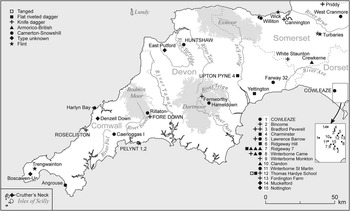
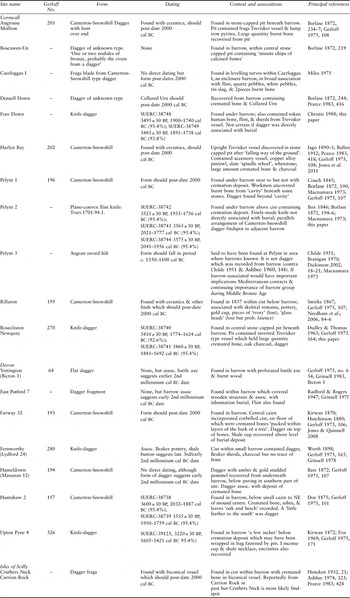
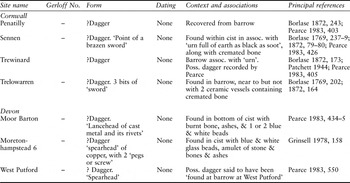
Nineteen daggers and knives have been recorded in the south-west peninsula, with a further seven possible lost examples without adequate records (Tables 4 & 5 below) (Fig. 1). Despite having reasonable concentrations of finds-spots compared to other areas of Britain beyond the Wiltshire chalk (Gerloff Reference Gerloff1975, pl. 29; Pearce Reference Pearce1983, maps 13 & 14), those from the south-west peninsula are generally less well documented than other parts of southern Britain and only two have been excavated under modern conditions. These are the knife-dagger from Rosecliston (Dudley & Thomas Reference Dudley and Thomas1965) and the fragment from a Camerton-Snowshill dagger from Caerloggas I (Miles Reference Miles1975). Prior to this project no radiocarbon determinations were available from any of the daggers or knife-daggers from the south-west.
Map showing the location of dagger finds in south-west Britain (for details for Cornwall & Devon see Table 4): Pelynt 3 in the broad area of Pelynt 1 & 2 (details for Dorset & Somerset from Gerloff Reference Gerloff1975; Pearce Reference Pearce1983; and recent issues of the Proceedings of the Dorset Natural History & Archaeological Society). Sites for which new radiocarbon dates have been obtained shown eg, ‘FORE DOWN’.

As a class of finds, the region's daggers and knives have been under-studied. This is partly because poor levels of preservation and evidence for prehistoric fragmentation have made classification difficult, as at Boscawen-un where only rivets appear to have been deposited (Borlase Reference Borlase1872, 219). This meant that antiquarian excavators often made a wide interpretative leap to identify what they had found. Furthermore, the burials accompanying daggers are frequently poorly-preserved and many have only been recorded in a cursory way. As a result, the relationship between the burials and daggers/knives has not been studied in the same way as in other parts of Britain (for example, Barrett Reference Barrett1994, chap. 5; Lucas Reference Lucas1996). Also, not all the specimens (for example, Fore Down) were available, or were too fragmentary, for inclusion within Gerloff's corpus, which meant that they have been overlooked in subsequent studies.
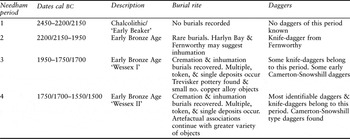
Despite the limitations with the corpus of daggers/knives from the south-west, some initial conclusions can be made from the existing data (Table 1). In particular, it is evident that early forms (flat copper and copper alloy knives/daggers) belonging to Periods 1 and 2 are almost completely absent from the south-west (Needham Reference Needham2011, 122). With the exception of the knife found with a Beaker at Fernworthy in Devon (Worth Reference Worth1898; Gerloff Reference Gerloff1975, no. 280, 165) and possibly the flat dagger from Bicton 1 (Gerloff Reference Gerloff1975, no. 64, 54), none of the copper alloy daggers/knives from the south-west peninsula is likely to pre-date 2000 cal bc. This scarcity probably reflects the rarity of detectable burial traditions in the south-west before the start of the 2nd millennium, and the widespread paucity of daggers from outside of burial contexts across the country (Needham Reference Needham1988). Evidence that communities in the south-west were, to some extent, familiar with early copper alloy dagger forms is, perhaps, suggested by the discovery of the beautifully worked lozenge-shaped flint dagger recovered from tree roots at Trengwainton (Tyacke Reference Tyacke1993), which is of a type found elsewhere with Beaker burials (Grimes Reference Grimes1931; Clarke Reference Clarke1970, 438–47; Green et al. Reference Green, Houlder and Keeley1982). Needham's Period 3 Amorico-British/Bush Barrow type daggers are entirely absent from the region but some knife-daggers without other artefactual associations could belong to this period.
Outline Chronology For Dagger Burials In South-West Britain

Periodisation after Needham et al. Reference Needham, Parker Pearson, Tyler, Richards and Jay2010
After c. 1800 cal bc, in Needham Period 4, larger numbers of barrows and other monuments appear (Jones Reference Jones2011) and a few Camerton-Snowshill daggers are found, as well as some knife-daggers.
One supposed find from Cornwall lies outside the British dagger series. The hilt from a sword found at Pelynt 3 was first mentioned by W.C. Borlase in the 1870s (Macnamara Reference Macnamara1973). In the 1950s it was suggested by Gordon Childe (Reference Childe1951) that the find was of Aegean type and had come from a barrow at Pelynt. This find-spot was subsequently repeated by other writers such as Ashbee (Reference Ashbee1960, 148). However, although further research confirmed that the sword is of Aegean type (Branigan Reference Branigan1970), study of the archives revealed that it was not found in one of the barrows at Pelynt (Macnamara Reference Macnamara1973), and only possibly came from the area. On current knowledge the hilt should date to c. 1350–1100 cal bc (Dickinson Reference Dickinson2002, 18–21). This is much later than any dagger-associated barrow burials in the south-west, and if it has any association with a barrow in the Pelynt area it must have been a later insertion into a mound.
The Early Bronze Age Dagger Project; 5 Case Studies
The following section contains brief descriptions of the five sites dated as part of this project. A brief account of the site and of the relationship between the dagger/knives and the cremation deposits and any associated artefacts is given.
Fore Down (National grid ref: SX27966918) (Fig. 2)
The Fore Down barrow was excavated by Croft Andrew in 1942 after some disturbance just prior to excavation (Christie Reference Christie1988, 132). It is an isolated site located to the south of major concentrations of barrows and other ceremonial monuments around Craddock Moor and Caradon Hill (Johnson & Rose Reference Johnson and Rose1994, map 1). It measured approximately 7.9 m in diameter by 0.9 m high. The barrow mound appears to have comprised an earthen upper part, with a cairn beneath it. A token cremation burial and sherds from a Trevisker vessel were recovered from the barrow. The blade, which is approximately 0.1 m long, is a knife-dagger with central midrib, but its relationship to the burial deposit was not recorded. Flints were also recovered from the site.
The Fore Down knife-dagger

Dates on cremated bone: SUERC-38748, 3495±30 bp (1900–1740 cal bc) and SUERC-38749, 3485±30 bp (1891–1738 cal bc at 93.8%). The radiocarbon determinations provide a date for the burial in the first quarter of the 2nd millennium cal bc, but it not entirely certain how the knife-dagger related to the main burial deposit. Although part of the tip is missing and the blade heavily cleaned of corrosion products, the blade is near complete. However, it is has been extensively conserved and so certainty as to how worn it was at the time of burial is not possible.
Huntshaw 2 (SS5202215) (Fig. 3)
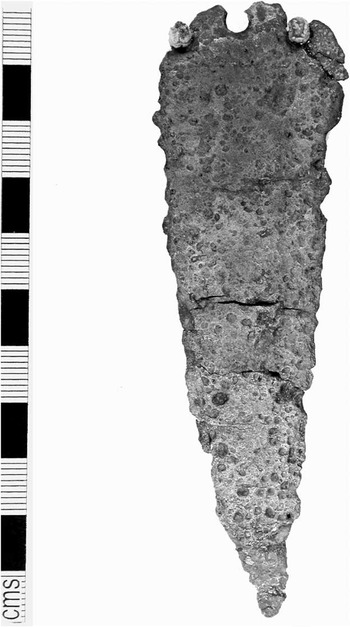
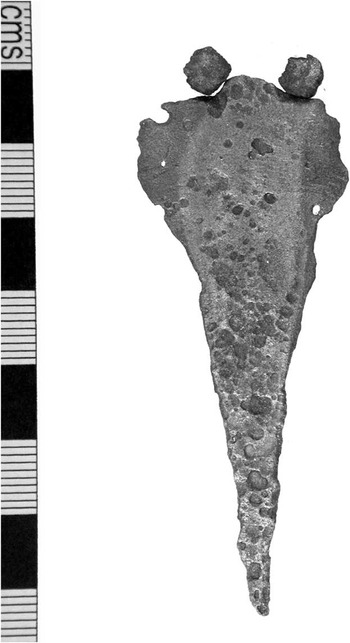
Huntshaw 2 is one of a pair of barrows recorded at Huntshaw, on Exmoor (Doe Reference Doe1875; Grinsell Reference Grinsell1970), and was excavated by Doe in 1875. It measured c. 8 m in diameter by 0.9 m high. The barrow mound appears from the description to have comprised a capping of clay covering alternate layers of charcoal and earth. To the north- east of the centre of the mound was a cairn of stones covering a deposit of cremated bones; an imperfectly formed chamber or cist also containing oak and birch leaves and a Camerton-Snowshill dagger (Gerloff Reference Gerloff1975, no. 157), measuring 0.23 m long with traces of the handle and a sheath still surviving.
The Huntshaw 2 Camerton-Snowshill dagger (© Royal Albert Memorial Museum, Exeter)

Dates on cremated bone: SUERC-38738, 3600±30 bp (2032–1887 cal bc) and SUERC-38739, 3535±30 bp (1950–1759 cal bc). The radiocarbon determinations fall within the first quarter of the 2nd millennium and provide a direct date for the dagger which was found with the main burial deposit. The dagger was in near perfect condition and does not appear to be worn.
Pelynt 2 (SX200500) (Fig. 4)
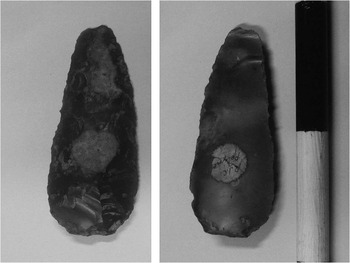
The investigation of this barrow was recorded by Jonathan Couch in 1845. It was one of a group of barrows. Upon excavation a flint ‘celt’ was found at the centre of the mound a few centimetres above a well constructed cist with covering slabs (Box Reference Box1846). The cist was recorded above a bed of gravel at the bottom of the mound and contained a cremation burial which is likely to represent a complete single male, possibly aged 25–35 years, buried with a small amount of animal bone (Higgins below). The flint artefact is a finely made plano-convex knife with a blade measuring 8.7 mm long by 36 mm wide at the butt end and 0.90 mm at the tip, which is slightly damaged.
The Pelynt 2 plano-convex flint knife

One of the other barrows in the group produced a Camerton-Snowshill dagger (Gerloff Reference Gerloff1975, no. 196, 107), which was found near to, but not with, a cremation deposit (Couch Reference Couch1845).
Dates on cremated bone: SUERC-38742, 3525±30 bp (1935–1756 cal bc), SUERC-38743, 3565±30 bp (2021–1777 cal bc), and SUERC-38744, 3575±30 bp (2041–1956 cal bc). The radiocarbon determinations provide a date for the burial and the deposition of the flint knife in the first quarter of the 2nd millennium.
Rosecliston (SW81405930) (Fig. 5)
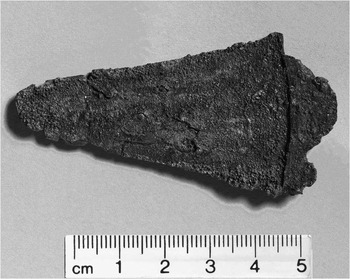
The Rosecliston barrow was excavated by Dudley and Thomas in the 1960s (1965). It is one of a number of burial mounds to be found in the area. The full extent of the barrow was not uncovered but it was thought to be approximately 15 m in diameter with an encircling V-shaped ditch over 1 m wide and 1 m deep. The barrow had been ploughed down to less than 0.3 m high, and the surviving mound material appears to have been clay. A stone capped pit was found in the approximate centre of the site. The pit contained an inverted Trevisker vessel which rested directly on a stone. The contents of the vessel included a cremation burial, which is likely to represent an older adult (Higgins, below), charcoal, and a badly corroded knife-dagger (Gerloff Reference Gerloff1975, no. 164, 270).
The Rosecliston knife-dagger (on loan in the Royal Cornwall Museum from the Newquay Old Cornwall Society)

Dates on cremated bone: SUERC-38740, 3410±30 bp (1774–1624 cal bc at 92.6%) and SUERC-38741, 3460±30 bp (1881–1692 cal bc). The radiocarbon determinations fall within the second quarter of the 2nd millennium and provide a direct date for the knife-dagger which was found with the main burial deposit. The blade is in poor condition and much of the edge is missing. Although it was suggested (Dudley & Thomas Reference Dudley and Thomas1965) to have become worn at the time of burial, what is left of the blade suggests that it was symmetrical and so not significantly worn when buried.
Upton Pyne 4 (SX91209930) (Fig. 6)
The Upton Pyne barrow 4 was excavated by Kirwan in 1870 (1872, 153). It is one of the 15 or so within a group of barrows (Fox Reference Fox1969; Pollard & Russell Reference Pollard and Russell1969; Grinsell Reference Grinsell1983). It measured c. 18 m in diameter by 0.9 m high. The barrow appears to have been badly reduced by ploughing and the surviving mound to have been a mixture of sand, clay, peat, and a few stones. At its approximate centre was a central compact heap of red clay, red ashes, and charcoal, described as being 4 ft (c. 1.2 m) in diameter and 3 ft (c. 0.9 m) in thickness, which had the appearance of a ‘cist’. Within this ‘cist’, at its top, were a cremation deposit and a copper alloy pin, which may have closed a bag holding the cremated human bone. A few centimetres beneath the cremation deposit was a knife-dagger (Gerloff Reference Gerloff1975, no. 326, 171). During the removal of the charcoal and human bone an accessory vessel was uncovered along with a composite necklace (see below). Given that the cremation burial and all the artefacts were found with the ‘cist’/heap of red clay, it may be presumed that they were deposited contemporaneously. The cremation deposit was reported to have to represented a youth or female individual (Powers in Fox Reference Fox1969), the presence of beads could support the suggestion that the burial was of a female (Sheridan & Shortland Reference Sheridan and Shortland2004). However, not enough bone survived for this to be confirmed (Higgins below).
The Upton Pyne 4 knife-dagger (© Royal Albert Memorial Museum, Exeter)

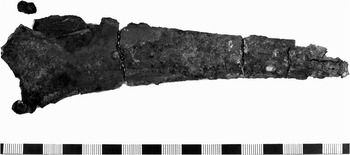
Date on cremated bone: SUERC-39125, 3220±30 bp (1605–1421 cal bc at 92.6%). This provides a date for the deposition of the knife-dagger which was found beneath the main burial deposit. The blade is symmetrical and does not show obvious signs of resharpening.
The Cremation Deposits by Jo Higgins
The cremated material was analysed in accordance with current established standards and guidance (Brickley & Mckinley Reference Brickley and McKinley2004; English Heritage 2002). Each cremation deposit was weighed, and the general condition and degree of fragmentation noted. A rapid inventory of identifiable fragments was made. Demographic data for each cremation deposit was recorded by macroscopic examination. This comprised an assessment of the minimum number of individuals present (MNI) and, where possible, the age and sex of individuals.
MNI was calculated using either duplication of identifiable skeletal elements/partial elements (for example, the presence of two mandibles), or the identification of elements of different bone size and development, representing individuals of clearly different age groups (adult/juvenile/infant). Age and sex estimations were made, where possible, according to methods described in Buikstra and Ubelaker (Reference Buikstra and Ubelaker1994). Pathological conditions were also noted and evidence for pyre technology and funerary ritual assessed, based on criteria outlined by McKinley (Reference McKinley2000).
Demography and pathology
Demographic and pathological results for each cremation deposit are presented in Table 2.
Summary Of Demographic Data

Pelynt 2
This deposit comprised a quantity of predominantly white, calcined/oxidised bone. Fragment size was generally large, with 83.1% of the total deposit measuring greater than 10 mm. The remaining fragments measured 5–10 mm (4.5%), with 12.4% less than 5 mm. The bone fragments were generally well-preserved and sharp-edged with no evidence of pre-depositional erosion, but some evidence of post-excavation fragmentation was indicated by ‘fresh’ fractures.
The weight of cremated bone (2788 g) is within the expected range (57–3000 g) for an undisturbed burial of a single cremated adult from an archaeological context, but above the average (1525.7 g) for the Bronze Age (McKinley Reference McKinley1997; Reference McKinley2000). In total, 76% of the deposit (2123 g) comprised identifiable fragments. No regions of the skeleton were duplicated, and no fragments diagnostic of juvenile or infant remains were present, indicating the burial represented an adult individual. All regions of the skeleton (skull, axial, upper limb, lower limb) were well represented. A large proportion of the bones of the hands and feet were present, also suggesting the deposit represented the ‘whole body’ of an adult.
Pelvic morphology, assessed from large fragments of pubic symphysis and sacrum, suggested the individual was of male sex and, although observable, cranial sexually dimorphic traits were scored as either female or probable female, the morphology of the pelvis is considered more reliable. In addition, the general robusticity of the skeleton is consistent with a male. However the individual has been assigned as probable male. A fully accurate estimation of age at death was not possible but the fusion of the spheno-occipital suture and completed eruption of the maxillary dentition, including the 3rd molar, indicate an age of at least 20–25 years, and the right pubic symphysis (stage III) a probable age of 22–35 (mean 28.7) years. Taken together with several other contra-indicators of advanced years the estimated age at death is 22–35 years.
Rosecliston
This cremation deposit, which weighed 504.7 g, comprised a small quantity of white, calcined bone, which was highly fragmented. All fragments were greater than 5 mm in size, the majority over 10 mm (90.5%), and were generally well-preserved and sharp-edged with no evidence of pre-depositional erosion or post-excavation damage. A total of 45.9% (232 g) were identifiable fragments. No regions of the skeleton were duplicated, all regions were represented, and no fragments diagnostic of juvenile or infant remains were present, suggesting the burial represented the whole body of a single adult.
There were insufficient sexually dimorphic elements preserved to provide an estimation of sex. Those criteria used for sex estimation in the original bone report (Cornwall Reference Cornwall1965), with the exception of the supraorbital ridge of the frontal bone, are no longer considered reliable indicators. Although there were insufficient indicators preserved to provide a more accurate estimation of age, a tooth with very worn enamel, a fragment of auricular surface characteristic of an older adult, and the presence of spinal pathologies usually associated with older adults, comprising osteoarthritic porosity of a cervical vertebra (articular facet), and osteophytosis of several vertebrae, are consistent with an adult of more advanced years. A broad estimate of >40 years was therefore attributed to this individual.
Fore down
This cremation deposit comprised a small quantity (25.9 g) of white, fully calcined bone. All fragments were smooth and eroded, suggesting a period of exposure. A majority (59%) of fragments measured over 10 mm. Considering the circumstances of excavation (Christie Reference Christie1988), exposure and erosion may have occurred. No fragments were duplicated, suggesting only one individual was represented. However, due to the circumstances of the excavation an accurate MNI is not possible. Identifiable fragments (12%) comprised two fragments of cranial vault and one vertebral fragment. No sexually dimorphic elements or age indicators were present. Cranial suture closure, used for age estimation in the original bone report (Stead Reference Stead1988), is no longer considered a reliable ageing technique (Brickley & McKinley Reference Brickley and McKinley2004).
Huntshaw 2
This cremation deposit comprised a small quantity (114 g) of white, highly calcined bone, with some yellow discolouration apparently derived from soil staining. The bone fragments were slightly eroded, possibly from post-excavation handling. Most fragments (86.5%) were greater than 10 mm in size and the majority (86.5%) were identifiable. All regions of the skeleton were represented and no elements were duplicated. It is not possible to ascertain whether the complete cremation deposit was recovered in the excavation, or whether any material was lost during subsequent curation of the human bones and, therefore, an accurate MNI is not possible. The surviving fragments of maxilla (upper jaw) indicate an adult individual but it was not possible to determine sex.
Upton pyne 4
The majority of this cremation deposit has been lost since the original analysis was conducted in the 1960s (Powers in Fox Reference Fox1969), which suggested the remains represented an adult individual, possibly a female or ‘youth’. Surviving bone available for analysis comprised a single fragment of vertebral body adhered to a copper pin. No conclusions regarding the MNI, age or sex of the individual were possible.
Pyre technology and funerary rites
Cremation burials are the end product of a ritual process involving the construction of a pyre, the burning of the body, the collection of the remains, and, in the Bronze Age, the deposition of those remains. Meaningful interpretation of the pyre technology and funerary rites associated with a cremation burial is dependent on the full recovery and recording of the cremated bone and associated deposits (McKinley Reference McKinley2000).
None of the cremation deposits re-assessed here was excavated to modern standards, and there is considerable doubt in some cases as to whether the surviving human remains represent full recovery of the burials during excavation. In addition, the extended period of curation of the remains, particularly for those excavated in the mid-19th century, may have led to further fragmentation and even loss of bone. However, some comments and observations were possible based on the osteological evidence combined with the excavation reports, with the cremation deposits from Pelynt 2 and Rosecliston having the greatest potential.
All of the bone material analysed comprised either exclusively or predominantly, white well-calcined/oxidised bone. In addition to the examination of pyre sites and pyre debris, inferences regarding pyre technology are often drawn from the variation in colour of the cremated bone which is related to the temperature achieved during the cremation process, with white bone an indication of full oxidation with temperatures in excess of 600°C. Anthropological study indicates that achievement of high temperatures and, consequently, efficient and thorough cremation of remains, is desirable both from a biological (removing potential sources of putrefaction and disease) and spiritual (ideas of cleansing, release of spirit) viewpoint, and considerable knowledge and care are employed in the construction and management of such pyres (McKinley Reference McKinley2000). Therefore a cremation deposit composed of primarily white calcined/oxidised bone, is assumed to have undergone efficient cremation on a well-constructed and tended pyre.
However, for bone from archaeological contexts this simplistic interpretation is often problematic for a number of reasons. Even assuming 100% recovery and recording, archaeological bone has invariably undergone a number of other processes prior to excavation. Initial collection of bone from the cooled ashes of the pyre may have led to a predilection for the recovery of white bone, which would have been more visible amongst the black ashes of the fire. In addition, even if the less well-oxidised brown, black, and blue bone was recovered, following interment, less well-oxidised bone is likely to be more susceptible to post-depositional degradation, particularly in acidic burial environments. Therefore, the presence of one or both of these factors would cause a bias in the surviving bone recovered, and can lead to erroneous conclusions regarding pyre efficiency/technology and ‘token’ burials.
Although all of the burials comprised predominantly well-calcined bone, this does not necessarily indicate highly advanced pyre technology was used. Some degree of efficiency can be assumed, however. Where the weight of cremated bone is well below average but the skeleton as a whole is well-represented, although the deliberate selection of a token deposit of bone is a possibility, loss and/or decay of poorly oxidised bone fragments should be considered.
None of the cremation deposits studied here was suitable for detailed fragment/fragmentation analysis due to the circumstances of recovery. However, the presence of U-shaped and concentric fissures on the Pelynt 2 and Rosecliston remains, which are very distinctive even in small fragments, are indicative of the cremation of a non-dehydrated (fresh, either fleshed or de-fleshed) bone (McKinley Reference McKinley2000). These specific fissure types were not observed for the Fore Down, Huntshaw 2, and Upton Pyne 4 cremation deposits. However, this should not necessarily be taken as evidence of the cremation of dry bone, but more likely the result of the limited amount of the bone remaining for analysis.
The relatively high weight of the Pelynt 2 deposit, together with very good representation of all areas of the skeleton, indicated the thorough collection of the remaining bone fragments following cremation of the body. The relative robusticity of the individual probably contributed to the overall survival and efficient collection of bone fragments, many of which would have been initially quite large. However, the collection of most of the small bones of the hands and feet, and the clean nature of the bone on excavation, which was noted to have no associated soil or charcoal, suggests that very careful attention was given to this procedure. In comparison to other time periods, it has been noted that Bronze Age cremation burials are consistently of greater weight (average 1525.7 g), and suggested that the time expended collecting bone fragments reflected the ‘status’ of the deceased. The time and care expended on this process is perhaps an indication of the high status of the Pelynt 2 individual.
When excavated, the Pelynt 2 cist burial was noted to contain a large quantity of very clean bone, with no soil or charcoal present at all, as a result of a very tightly sealed burial cist (Borlase Reference Borlase1872, 194–6). This was confirmed by macroscopic examination, assuming the bone had not been washed since excavation. Anthropological sources detailing pyre cremation note that, in some cultures, following collection of the bone from the pyre when it has sufficiently cooled, the bone is also ritually washed, although it has been noted that bone fragments are usually left very ‘clean’ following the cremation process (McKinley Reference McKinley2000). It is possible that the Pelynt 2 bone was ‘ritually washed’ prior to interment.
A number of animal bone fragments were also commingled with the Pelynt 2 individual. These fragments appeared well-calcined/oxidised, and may relate to food offerings included on the pyre, or to the use of unmodified animal bone as tools, personal decoration, or fastenings for skins or other textiles. Animal bone is relatively uncommon in Bronze Age cremation burials (16%), and may, again, be an indicator of status.
However, this attention to detail and inclusions of animal bone may not be related to status but to entirely different ideological explanations. In addition, the tightly sealed burial cist created an optimum preservation environment, resulting in minimal post-depositional degradation of the burial which, together with an efficient cremation process resulting in well-calcined bone, may also have contributed to the relatively high weight of the bone.
Conversely the urned cremation burial from Rosecliston was of lower than average weight for a Bronze Age cremation deposit and well below the minimum expected for an adult from modern cremation (about 1000 g), although all regions of the skeleton were represented. This relatively low weight may, in part, be due to reduced bone mass of the individual through advanced age and/or osteoporosis. Incomplete collection of bone fragments following the cremation process may also be a factor. The collection of bone fragments appears random, but not subject to extensive expenditure of time, resulting in the collection of only the larger, more obvious fragments. No attempt was made to clean the remains, as they were intermixed with charcoal, which may have been scraped up with an implement, rather than ‘picked’ from the ashes, before being placed in the vessel, then inverted into a pit. However, the representation of all regions of the skeleton suggests this was not a ‘token’ deposit, but more likely a result of the attempted collection of all fragments but perhaps with limited time expended. This apparent lack of care may also have implications regarding the status of the individual, or perhaps reflect a difference in ideology to those responsible for the burial of the Pelynt 2 individual. Though the excavation report suggests the burial was undisturbed some bone could have been lost when the pot was recovered.
The Fore Down excavation report suggests similarities to Rosecliston, in that there was some associated charcoal, and the remains were placed in a vessel. However, there are insufficient records to determine any further details. The remaining excavation reports were also inconclusive and it is not possible to draw any conclusions regarding pyre technology.
Radiocarbon Dating
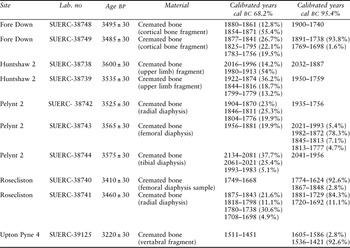
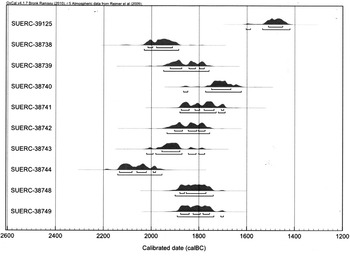
Ten samples of cremated human bone were submitted (Table 3) to the Scottish Universities Environmental Research Centre for accelerator mass spectrometry dating (AMS). Where possible, multiple radiocarbon determinations were obtained from each site in order to increase the level of precision of the determinations. These new radiocarbon determinations were calibrated using OxCal 4.1 (Table 3 and Fig. 7).
Radiocarbon Determinations Obtained From The Dagger Project

Radiocarbon determinations associated with daggers from the south-west

Radiocarbon dates and the chronology of other associated artefacts
Significant artefacts, to which the new radiocarbon dates relate, are the Trevisker vessels from Fore Down and Rosecliston, and the accessory vessel, composite necklace, and the fragment of copper alloy pin from Upton Pyne 4.
The surviving fragment of the copper alloy pin from Upton Pyne 4 was attached to the cremated vertebra sampled for dating. It is now 25 mm in length and narrows from 3–1.5 mm in width: the fragment probably comes from close to the pin's point. It is now very much corroded with a longitudinal split which shows in the original drawing (Kirwan Reference Kirwan1872, Fig. 3). This shows the pin 70 mm in length, in several adjoining fragments and probably complete up to the head, which has broken off. Spiral twisting is depicted for some 20 mm below the break from the head. It is not known when the upper part of the pin was lost, but probably before Fox examined the Upton Pyne 4 material in 1969. It is therefore unclear whether subsequent authorities, notably Gerloff (Reference Gerloff1975, no. 326, 171) and Proudfoot (Reference Proudfoot1963, appendix 5), observed this spiral twist or were using Kirwan as their source. Several copper alloy pins with twisted shafts are known from Early Bronze Age barrow contexts, notably those from Scratchbury, from Brigmerston and Kennet Hill, all in Wiltshire (ibid.). Copper alloy pins in general have, in works using the traditional phasing of Early Bronze Age barrows, been allocated to the latter part of the period (Burgess Reference Burgess1980, 124; Gerloff Reference Gerloff1975, 110–2) and have been regarded as relating to central European finds of Reinecke Bz A3, for which recent dendrochronological dates indicate a range of 1750–1550/1500 bc (Gerloff Reference Gerloff2007). The radiocarbon determination SUERC-39125, 1605–1421 cal bc appears appropriate and is closely tied to the cremation.
Both the Trevisker vessels from Fore Down and from Rosecliston are large, have cord-impressed decoration and ribbon/ring handles and belong to Trevisker Style 1 as defined first by ApSimon and then by Parker Pearson (Quinnell Reference Quinnell2012). Both are known to be made of Lizard gabbroic clay with some additional added material, to be that is of ‘gabbroic admixture’ fabric. Fore Down has numerous inclusions of quartz and some flecks of mica (Williams Reference Williams1988), Rosecliston additions of serpentine (Parker Pearson Reference Parker Pearson1990, no. 14). Style 1 vessels have, from ApSimon's initial presentation of the Trevisker ceramic style (ApSimon & Greenfield Reference ApSimon and Greenfield1972) onward, been viewed as belonging to its earlier centuries and are frequently found in barrow depositions: work by Woodward and Cane (Reference Woodward and Cane1991) demonstrates the style continued through until the early part of the Middle Bronze Age. The determinations SUERC-38748, 1900–1740 cal bc and SUERC-38749, 1891–1738 cal bc from Fore Down and SUERC-38740, 1774–1624 cal bc and SUERC-38741, 1881–1692 cal bc from Rosecliston are, with one exception, the first dates on cremated bone or short-lived charcoal for this style (Quinnell Reference Quinnell2012, table 2).
The accessory vessel from Upton Pyne 4 is 65 mm in diameter, slightly waisted, with two perforation through the vessel wall on one side. It is decorated on the rim top and on the exterior of the wall and base with thick twisted cord impressions. It has some similarities with the only other known accessory vessel from Devon, that from Farway 21: these consist of the decoration on the base and the two closely set perforations (Jones & Quinnell Reference Jones and Quinnell2008, Fig. 4). However, the Farway vessel produced Wk-20899, 1939–1751 cal bc on the cremated bone it contained (ibid., 32). This comparatively early date is supported by a date for a vessel from Colliford in Cornwall, HAR-2991, 2191–1696 cal bc (Ellison Reference Ellison1984) and by a range of dates from Scotland (Sheridan Reference Sheridan2007). The Colliford vessel is decorated with coarse twisted cord of the same type as Upton Pyne 4. These dates indicate a rather earlier start for these vessels than that around 1800–1700 cal bc suggested by Needham (Reference Needham1996). The Upton Pyne 4 determination SUERC-39125, 1605–1421 cal bc now appears comparatively late for an accessory vessel, and this, together with some similarities between the Upton Pyne, Farway and Colliford vessels, could indicate that the Upton Pyne 4 vessel had been curated.
The composite necklace, as it survives, comprises 50 small discs described as lignite, two larger annular and one biconical lignite bead, one of apparent red ceramic, and one fossil echinoid (Fox Reference Fox1969). The report by Kirwan (Reference Kirwan1872, 157) describes one bead being found in ‘rubbish’, presumably spoil from the excavations, and the remainder from sifting through this spoil again, makes it quite possible that more beads were present than were recovered. Kirwan's illustration (Reference Kirwan1872, Fig. 2) shows over 100 beads! There are now three composite necklaces known from the Devon Bronze Age, the others a 19th century find from North Molton (Fox & Stone Reference Fox and Stone1951) and a recent discovery from a cist on Whitehorse Hill, North Dartmoor (Jones et al. Reference Jones, Marchand, Sheridan, Straker and Quinnell2012). Current research into the three Devon necklaces by Alison Sheridan will be published in the report on the Whitehorse Hill cist. More generally research is now showing that composite necklaces may be made up of items with varied ages, biographies, and degrees of curation (Woodward et al. Reference Woodward, Hunter, Ixer, Maltby, Potts, Webb, Watson and Jones2005, 49–53) and that dates of deposition extend over much of the Early Bronze Age (Gardiner et al. Reference Gardiner, Allen, Powell, Harding, Lawson, Loader, McKinley, Sheridan and Stevens2007, 47): the date from Solstice Park, Amesbury, GRA-22371, 3240±40 bc, is almost identical to that from Upton Pyne 4 (ibid., table 9).
Discussion
The following discussion will focus on four key areas of the results from the project. These are the chronology of the daggers/knives, evidence of their condition and curation, the manner in which they were deposited and their possible role in barrow sites.
Chronology
The radiocarbon dating produced an interesting, if slightly surprising series of results. The earliest determinations were associated with the Camerton-Snowshill dagger from Huntshaw 2 (SUERC-38738 and SUERC-38739), the knife-dagger from Fore Down (SUERC-38749 and SUERC-38748), and the flint plano-convex knife from Pelynt 2 (SUERC- 38742, SUERC- 38743 and SUERC- 38744), all of which fall into the first two centuries of the 2nd millennium cal bc or Needham's Period 3. The most surprising of these determinations are the pair of statistically consistent dates from Huntshaw 2, which fall in the period c. 2000–1800 cal bc. These are very similar to the date from the burial associated with the Armorico-British dagger from West Overton G1 (Needham et al. Reference Needham, Parker Pearson, Tyler, Richards and Jay2010), and are nearly identical to the date from the Cowleaze cremation enclosure (Reference Jones, Quinnell, Woodward and RandallJones et al. forthcoming). Given that the cremation from Huntshaw 2 was quite a small deposit, it is possible that, since there is plenty of evidence for the curation of objects (Woodward Reference Woodward2002), and for disturbance/disarticulation of human remains within graves (Harding & Healy Reference Harding and Healy2007, 228–9), the dates are from curated cremated human bone which had been in circulation for some time prior to burial. If this were the case, it would make the dagger appear to be earlier than it really was. Nonetheless, it would be unwise to definitely interpret the two Huntshaw determinations in this way and they therefore lend support to the argument that there was a greater chronological overlap between dagger types than has previously been supposed.
The determinations on cremated bone from the barrows associated with the knife-dagger from Fore Down and the plano-convex flint knife from Pelynt 2 also fell into the first quarter of the 2nd millennium cal bc, c. 2000–1750 cal bc. The early dates from the Fore Down knife-dagger are of interest, as although not recorded by Gerloff (Reference Gerloff1975), it was subsequently grouped with the Camerton-Snowshill daggers from the south-west (Christie Reference Christie1988, 136); the blade has a central midrib and is not much shorter than the Camerton-Snowshill dagger from Harlyn Bay. If this were the case, it would also suggest that knife-daggers with Camerton-Snowshill features were appearing much earlier than thought. Unfortunately the association between the cremated bones and the Fore Down dagger was not recorded. It is possible that as at Rosecliston, the knife-dagger was closely associated with the vessel and the burial deposit; however, several daggers in the south-west were, as at Pelynt 1, Hameldown, and Farway 32 (Table 4), not directly deposited with the human remains. This means that the dagger could pre-date or post-date the burial. The same reservation is also the case with the Pelynt 2 plano-convex flint knife, which was placed into the mound above the cist which contained the burial deposit. This knife appears to be only second of its kind to be found in a Early Bronze Age burial context in Cornwall or Devon, the other being found with a probable Food Vessel and a cremation burial at Pentire Glaze, St Minver (Patchett Reference Patchett1950, 57, Fig. 4).
The pair of determinations associated with the Rosecliston knife-dagger (SUERC-38740 and SUERC-38741) fell in the second quarter of the 2nd millennium cal bc, c. 1800–1650 cal bc. A late date was also associated with the Upton Pyne 4 knife-dagger (SUERC-39125; 1605–1586 cal bc (2.8%) and 1536–1421 cal bc (92.6%), very late in the dagger sequence. The true date for the burial may lie in the earlier part of the radiocarbon determination range. This is indicated by the accessory vessel, as a broadly similar vessel from Farway 21 in east Devon was recently radiocarbon dated to the period 1940–1750 cal bc (Jones & Quinnell Reference Jones and Quinnell2008) and Sheridan (Reference Sheridan2007) quotes a number of comparable dates. It may be relevant that the mound covering the burial was insubstantial. It has been suggested that this was due to ploughing (Grinsell Reference Grinsell1983), but small mounds are more typical of later round barrows found in the south-west and elsewhere (Jones Reference Jones2012) and the size may reflect its date. Nonetheless, the overall date range for knife-daggers from Rosecliston and Upton Pyne 4 is comparable to those recorded elsewhere (for example, Sheridan Reference Sheridan2007) and they confirm that knife-daggers continued to be associated with burials until the end of Period 4.
Despite some caveats concerning the possibility of the curation of human remains and the direct association between the knife-dagger and the plano-convex knife and human remains at Fore Down and Pelynt 2 respectively, the determinations provide a significant set of results. They confirm the basic sequence developed by Gerloff (Reference Gerloff1975) and largely uphold the periodisation developed by Stuart Needham (Reference Needham1996; Needham et al. Reference Needham, Parker Pearson, Tyler, Richards and Jay2010). They do, however, raise a question as to the chronology of Camerton-Snowshill daggers. The determinations from Huntshaw 2 suggest that Camerton daggers date before Period 4 (c. 1750 cal bc). This early dating is supported by the new date from the cremation deposit associated with the dagger from Cowleaze SUERC-41363, 3525±30 bp, 1935–1756 cal bc (Reference Jones, Quinnell, Woodward and RandallJones et al. forthcoming), almost identical with Huntshaw 2. These determinations suggest that Camerton-Snowshill daggers developed at an earlier date than supposed and overlapped with Wessex I Armorico-British daggers.
The dating has also shown that dagger-associated burials started a little earlier in the south-west than has recently been suggested (Jones Reference Jones2011). It now seems possible that daggers were involved in barrow-associated rites from around 2000–1800 cal bc, rather than belonging to the period after 1750 cal bc. This would means that daggers and knives were deposited from the onset of barrow building in the south-west down to around c. 1600–1500 cal bc.
Condition and curation
This project did not examine the blades for wear in detailed the way that some other studies have done (Wall Reference Wall1987; Woodward et al. Reference Woodward, Hunter, Ixer, Maltby, Potts, Webb, Watson and Jones2005). Burial of the daggers in the acidic soil conditions of the south-west peninsula makes the discussion of their condition more difficult than for those buried in more favourable conditions. Cleaning of the Rosecliston and Fore Down blades has also been rather heavy, which makes their condition more difficult to assess. Nonetheless, the visual inspection of the blades in this study reveals several interesting points.
None of the blades which survived in reasonable condition had worn asymmetrical profiles, and this is especially clear in the case of the well-preserved Camerton-Snowshill dagger from Huntshaw 2. This condition was found during the recent study of Camerton-Snowshill daggers from Wessex (Woodward et al. Reference Woodward, Hunter, Ixer, Maltby, Potts, Webb, Watson and Jones2005). The lack of wear means that it is unlikely that they had been used for cutting and that, if they had been used, a stabbing action (Gerloff Reference Gerloff1975, 76, 109; Wall Reference Wall1987) or ceremonial function is perhaps more likely (Woodward et al. Reference Woodward, Hunter, Ixer, Maltby, Potts, Webb, Watson and Jones2005). It also suggests that if these daggers had been in circulation for long periods, rather than being made shortly before burial, they had been carefully looked after. The same pattern of use also seems to be true for several of the daggers from the south-west, including those from Farway 32, Harlyn Bay, and the Hameldown barrow. A similar observation has recently been made for the Armorican-type arrowheads made from distinctive Grand Presigny flint found in Breton barrows: it is suggested these arrowheads were for display by a social elite rather than use (Clément Reference Clément2011). By contrast, beads found within Early Bronze Age barrows in Britain were frequently worn at the time of deposition and it is likely that they were exchanged and circulated for long periods prior to burial (Woodward Reference Woodward2002; Woodward et al. Reference Woodward, Hunter, Ixer, Maltby, Potts, Webb, Watson and Jones2005). These contrasting patterns of wear reveal distinctions between the biographies of different artefact types.
However, careful maintenance and lack of considerable use did not mean that daggers could not be broken during rites of deposition. Damaged blades were noted in the study of Wessex daggers (Woodward et al. Reference Woodward, Hunter, Ixer, Maltby, Potts, Webb, Watson and Jones2005), and in the south-west fragmentary daggers were placed in barrows or ring cairns at Caerloggas, Boscawen-Un, and at East Putford 7 (Table 4). At Angrouse, a dagger described as being ‘warped’, but more probably deliberately bent, was deposited with a cremation deposit (Fig. 8). These practices reveal that daggers, like other artefacts such as beads and pottery, could be fragmented, probably under ritualised conditions, before burial (Jones Reference Jones2011). This in turn implies that any status or perceived power residing in the dagger could be incorporated into the barrow context without the artefact being complete (see below).
The Angrouse Camerton-Snowshill dagger

Mode of deposition
The five dagger/knife associated burials which form the focus for this project are broadly representative of the range of burial practices which are found during the Early Bronze Age across the south-west peninsula (Jones Reference Jones2011). They include cremation burials representing single individuals, token deposits, and as at Huntshaw 2, the possibility of a cremation deposit which could have been made of small amounts of more than one person. In addition they are also found on sites without burials, with single inhumation burials, and large-scale multiple burial deposits (Tables 4 and 5).
Corpus Of Early Bronze Age Barrow-Associated Daggers From South-West England (numeration For Devon Sites Follow Grinsell Reference Grinsell1970; 1978; 1983)

Corpus Of Possible Early Bronze Age Barrow-Associated Daggers From South-West England

One limitation of the study was the lack of certainty about the age or gender of any of the burials. The burial at Pelynt 2 is likely to have been a young adult male, whereas that at Upton Pyne 4 was suggested to be a woman. The latter burial could not be assessed by this study, although the associated beads might indicate that the burial was indeed female (Sheridan & Shortland Reference Sheridan and Shortland2004). The burial associated with the Rosecliston knife-dagger was determined to be an older adult, but the gender and age of the remaining burials is unknown.
Direct evidence for an association between daggers and human remains were found at two of the analysed sites, although there were differences in the ways that the dagger related to the human bones at these sites. At Huntshaw 2 a complete dagger, possibly within sheath, was placed on a bed of leaves below a small cairn of stones. The cremated remains of the parts of one or possibly more persons were recorded within the cairn material. The implication here is that the central focus of the deposit was the dagger itself which was carefully laid to rest on a bed of leaves with bone and then stone being added to cover it. The cairn was in turn covered by alternate layers of clay, charcoal, and earth, which is suggestive of structured mound construction. By contrast, at Rosecliston the cremated bones of a complete individual were contained within a vessel and the dagger was placed with the burial. This type of burial is paralleled elsewhere in the south-west, at sites such as Harlyn Bay, and Cruthers Neck, although the number interred individuals is unknown (Table 4). In these instances, the burial of the individual was the focus for the burial and the dagger may have been added because of its associations (see below).
Similar variations are detectable at other sites in the south-west where daggers/knives and burial deposits are recorded as being together. For example, at East Putford 7 an incomplete dagger was placed beside an inhumed individual, whereas at Rillaton, the inhumation burial was with a dagger and a number of other ‘high status’ objects, including a gold cup. It seems likely this represents an attempt at displaying wealth (see below). By contrast, at Boscawen-Un the pit only contained a few chips of bone and the dagger was represented by ‘rivets’.
Daggers and knives were also deposited close to, but not directly associated with human remains. This was a feature of Pelynt 2, and there was a little separation at Fore Down, where the dagger was not found within the pot. At Pelynt 2 the burial was placed within the cist, and the flint knife appears to have been placed above the burial within the mound. A similar pattern is found at the adjacent barrow, Pelynt 1, where the Camerton-Snowshill dagger was beside the cairn containing the cremation deposit.
At Upton Pyne 4 the knife-dagger, an accessory vessel, and beads were gathered together, probably covered by a few centimetres of soil before the cremated bone and pin were placed on their top and the whole sealed within a small mound (the ‘cist’) of burnt clay. This pattern was reversed at Farway 32, where a cremation deposit was wrapped in tree bark and a Camerton-Snowshill dagger placed upon it. In all these cases the act of depositing the dagger was close to but kept distinct from that of that of the actual burial: in either case both human remains and the dagger had separate ‘identities’ which were maintained but bought together during funerary rites.
Function, symbolism and personhood
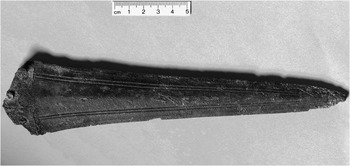
Daggers are extremely widely occurring objects, being found in graves across Britain and Europe, where they are also depicted in carvings and on statue-menhirs (Harding Reference Harding1999; Bradley Reference Bradley2011, 90). Traditionally they have been seen as weapons allied to a ‘dagger wielding warrior class’ (Ashbee Reference Ashbee1960, 103). It has been suggested that they were masculine items used as stabbing weapons during episodes of close inter-personal violence, or delivering the coup de grace to a wounded animal at the end of the hunt (Case Reference Case2007) or for cutting up meat at feasts. They would also have been distinctive objects that had potent display properties (Osgood Reference Osgood2000). As such, a straightforward reading would be that they were deployed in graves to mark the status of a warrior elite (Heath Reference Heath2009, 88). It is certainly the case that several of the daggers in the south-west, such as those from Hameldown Down (Fig. 9) and Huntshaw 2 (Fig. 3, above) were finely-made items, which may have been high status objects made for display.
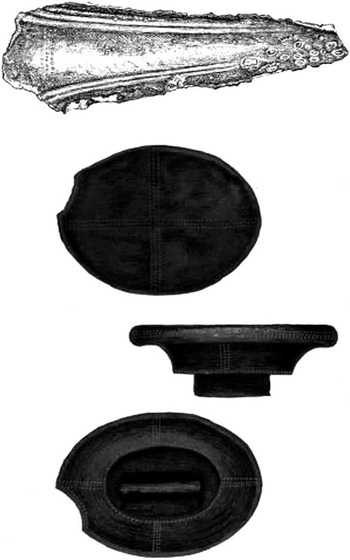
The Hameldown Camerton-Snowshill dagger (after Bate 1872)

Julian Thomas (Reference Thomas1991) and John Barrett (Reference Barrett1994, 126–7) suggested that during the Early Bronze Age grave-associated objects were arranged and ordered by the living to create a particular set of potentially fictionalised meanings which could be ‘read’ by mourners at the graveside, and Joanna Brück (Reference Brück2004) has argued that grave-goods and other objects, such as animal remains, could have represented the relationships between the deceased and the people who were organising the burial. In south-west Britain it is possible that several examples could have marked or defined the graves of individuals associated with a ‘warrior identity’ or were strongly associated with activities linked with male ‘gender roles’. They include the daggers from Rillaton barrow and Hameldown. The inhumation burial found with the Rillaton dagger and its associated objects, including the gold cup, would have spoken of distant contacts (Needham et al. Reference Needham, Parfitt and Vardell2006). These objects could have been used to create a particularly vivid grave-side image. Likewise, the Hameldown dagger was a piece so far unique with a pommel of amber studded, and later mended, with gold pins. The burial of this object with the cremation deposit is likely to have carried a distinct set of meanings and its deposition would have rendered the burial a memorable event.
The study of the wear on 34 Wessex dagger blades revealed that, although most were fresh, many had displayed signs of having been damaged and the hilts and pommels were broken and removed before burial (Woodward et al. Reference Woodward, Hunter, Ixer, Maltby, Potts, Webb, Watson and Jones2005). This pattern is also found in the south-west region, where pommels are uncommon and several daggers broken or incomplete (Table 4). This might imply that many daggers in the south-west were deposited under ritualised conditions, and were not deposited with human remains in a complete condition, as might be expected if they were solely associated with warrior status and display.
In common with other regions in Britain, such as Yorkshire (Lucas Reference Lucas1996), many of the knives and daggers from the south-west were, as at Pelynt 1 and possibly Fore Down and Upton Pyne 4, not directly associated with the burial deposit, but instead were located to one side or above it. This implies a greater ranger of meanings than as male status symbols. At other sites, as at Harlyn Bay, the dagger was deposited into a vessel with objects which might be more strongly associated with females, including a copper alloy pin, and a spindle whorl. The association between the knife-dagger and beads at Upton Pyne 4 may indicate a female, rather than male, burial. Daggers were also deposited on sites which have no or very small quantities of human bone, as at Caerloggas 1 and Boscawen-Un, which indicates that daggers had meanings which lay outside of their role as indicators of individual status. In these cases it is possible that the properties of the dagger or the materials which they were made from were most important to the rituals which took place on the barrow site. This is perhaps also indicated by the flint knife from Pelynt 2, which although not of copper alloy, may have carried the meaning of the dagger symbolism through its form.
It is therefore possible that daggers may have been polyvalent and associated with other meanings, such as fertility or specialist knowledge of metal working. These meanings might have depended on context that the dagger was deposited into. It has been argued, for example that copper alloy daggers within Bronze Age graves in northern Italy may, because of their phallic shape and their luminosity (when new), have been associated the shining of the sun and could have therefore have been imbued with supernatural properties (Keates Reference Keates2002). Perceived properties of this type might help explain why dagger blades were frequently deposited within barrows without their pommels. In other words, in common with other forms of artefact which were deposited into barrows in the south-west, such as quartz pebbles, individual beads, or broken sherds of pottery, it was the properties which they were thought to hold which was important for barrow-associated rituals.
Daggers may therefore, according to the circumstance, have been used to define a particular type of social identity or ‘personhood’ (Fowler Reference Fowler2004, 73–6), and relationships between people, or have been included because they contained properties, which were necessary to ensure the success of the rituals which were taking place. Put simply, the daggers/knives might not always have belonged to the deceased, but may instead have been deployed to imbue, or provide indicators of, particular ‘qualities’ which were being created during rites at the barrow site. This might explain the variability of association with human bone within the individual barrows which is found across the south-west region.
Conclusion
The four copper alloy daggers/knives which have been dated as part of this project are a representative sample of the 26 examples which currently form the south-west corpus. Importantly the results from the project suggest that daggers and knives were deposited over a period of 400–500 years, from c. 2000/1900 cal bc to 1600/1500 cal bc. The study also indicated that Camerton-Snowshill daggers may have been deposited into burial context prior to 1700 cal bc which is earlier than established models have suggested.
Given the large number of large number of excavated barrows dating to this period without daggers (Jones Reference Jones2005, chap. 3; Quinnell 1988), this broad span means that they were only infrequently included within the burial repertoire. Given this rarity, it is likely that their presence was intended to draw upon and create particular sets of meanings.
Significantly, this study has also shown that daggers, knife-daggers, and flint knives were all being deposited over the same period and that there is a great deal of diversity in the way that they were placed into barrows. This is important because it reveals that an ‘international’ artefact had polyvalent qualities which were worked into localised systems of practice, and suggests that the size or material they were made from may have been less important than the symbolism of the form.
In the south-west region, the dagger or knife was often placed with human remains but the act of depositing was frequently kept distinct from them. In these cases the intention may have been the bringing together but maintenance of two potent symbols, which were being highlighted, the remains of a person and the dagger with its resonances of status and fertility and perhaps ‘luminosity’. This role of the dagger as a symbol in its own right was also indicated at a number of sites, such as Caerloggas, where no human remains were deposited at all. In these cases, the symbol of the dagger itself may have been more central to activities on the site.
Acknowledgments
Andy Jones and Henrietta Quinnell would like to thank the following for their help and co-operation: The British Academy for funding the analyses and radiocarbon dating, Jane Read for her illustrations, and Anna Tyacke for photographing the daggers in the Royal Cornwall Museum. Special thanks go to Jane Marley of the Royal Cornwall Museum and Tom Cadbury of Royal Albert Memorial Museum, Exeter for providing access to the Museum's archives and photographs of Upton Pyne and Huntshaw. We are also grateful to Alison Sheridan for commenting on the draft text. Finally we would like to thank the anonymous referees for their comments.