Introduction
Squamous cell carcinoma (SCC) of the lip is the most common lip malignancy. The main risk factor is ultraviolent radiation.Reference Ariyawardana and Johnson1 The cancer has a predilection for the lower lip.Reference Onerci, Yilmaz and Gedikoglu2
The prognostic factor most affecting long-term survival and disease-free time is the presence or absence of neck or distant metastases, which has been shown to decrease survival to around 50 per cent.Reference Zitsch, Park, Renner and Rea3
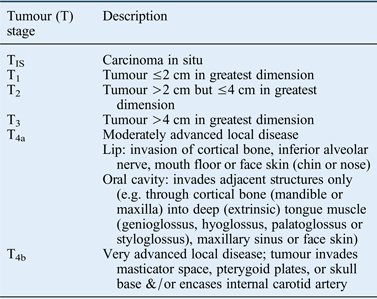
The American Joint Committee on Cancer (tumour–node–metastasis (TNM)) staging system is the current system used for staging lip SCCs.Reference Edge, Byrd and Compton4 This staging system groups lip with oral cavity cancers, and utilises maximal tumour size when assessing the prognosis of T1–3 staged tumours (Table I). There have been few studies investigating factors other than those included in TNM staging for assessing the prognosis of such cancers.
AJCC staging of lip and oral cavity squamous cell carcinomaReference Edge, Byrd and Compton4

AJCC = American Joint Committee on Cancer
Previous research has investigated tumour depth of invasion and tumour grade in relation to the likelihood for recurrence or local spread.Reference Onerci, Yilmaz and Gedikoglu2, Reference Frierson and Cooper5, Reference Onerci6 These studies have suggested that alternative factors are helpful, in addition to TNM staging, in providing valuable prognostic information.
There is no apparent consensus on how to manage an N0 neck in a patient with a lip SCC. Onerci et al. suggest that the risk of nodal spread for tumours greater than 5 mm is sufficient to undergo suprahyoid neck dissection.Reference Onerci, Yilmaz and Gedikoglu2 Najim et al. found that tumours with a thickness of greater than 4 mm had a three-fold increased risk of nodal spread, and therefore required close follow up or prophylactic neck dissection.Reference Najim, Cross, Gebski, Palme, Morgan and Veness7 Further studies have suggested close clinical follow up or elective neck dissection for T2a tumours (larger than 3 cm), or only undergoing surgery in the presence of known nodal spread.Reference Najim, Cross, Gebski, Palme, Morgan and Veness7–Reference Yilmaz and Ercocen9
This study aimed to review whether other features (histological or demographical) could identify those patients at risk of developing locoregional spread of SCC. We hypothesised that increased maximal tumour thickness is a risk factor for nodal spread and may identify patients at risk, some of whom would otherwise have early staged disease (T1 or T2). In addition, patients who live further from treatment centres may present for treatment with more advanced disease and may even have a higher risk of nodal spread because of delayed treatment.
Based on our salvage neck dissection experience, the five-year survival rate in metastatic SCC patients is approximately 78 per cent. Therefore, identifying those patients most at risk of nodal spread is essential for close monitoring to ensure early intervention. The identification of patients at risk will help encourage those living far from medical services, who may access medical services infrequently, to seek regular follow up.
The Darling Downs district covers a vastly expansive area (over 77 388 km2). Government incentives that bring doctors to more rural and remote regions of Queensland attempt to ensure that the healthcare standards of rural communities and access to care resembles metropolitan counterparts.
Materials and methods
A retrospective review of all patients with lip SCC discussed at the Darling Downs regional head and neck unit multidisciplinary meeting and operated on at the Toowoomba General Hospital was undertaken. Data for the years 2005 to 2013 were obtained.
Inclusion criteria included: an histological appearance consistent with SCC; the lip identified as the primary site of disease; data for excision or biopsy performed to determine the thickness of tumour invasion; histological data (tumour thickness, differentiation, stage and so on) based on original excision or biopsy, and not re-excision data; and the availability of adequate documentation indicating the site of SCC, the presence of a pathology report, and noted follow up for at least 12 months post-surgical excision or a return to the care of the referring physician without noted prior recurrence.
A chart review of the patients was undertaken. Relevant information was obtained regarding tumour depth, initial staging, perineural invasion, tumour differentiation, maximal tumour size (largest size of the tumour in any dimension), smoking status, treatment undertaken, location at the time of diagnosis and signs of recurrence.
Smoking status categories were: current smoker (including daily smokers and occasional smokers), ex-smoker (smoker previously for more than 1 pack year, or more than 100 cigarettes smoked but not currently a smoker) and non-smoker (patient who has never smoked or smoked less than 100 cigarettes in their lifetime, or has smoked less than 1 pack year and is not currently smoking).
Tumour thickness was defined as the distance between the surface and the deepest level of invasion.
The dataset was collected and collated. A statistical analysis was performed to provide a demographic summary of the patient group and identify statistically significant risk factors for nodal spread.
A Kolmogorov–Smirnov test of normality was conducted to establish whether the continuous variables (age, tumour size, tumour thickness and distance from the treatment centre) could be assumed to be from a normally distributed population. The null hypothesis for the Kolmogorov–Smirnov test was that the data had been sampled from a normally distributed population. The null hypothesis was assessed at alpha = 0.001.
Parametric statistics (mean and standard deviation (SD)) were used to describe the data variables found to be normally distributed; alternatively, non-parametric statistics were used. The choice of parametric or non-parametric statistical hypothesis testing techniques to address the research questions was made in a similar manner.
The difference between mean tumour thickness in patients with nodal metastasis versus those without spread was calculated and analysed utilising the Mann–Whitney U test.
Results
A total of 72 patients with SCC of the lip were discussed at the Darling Downs head and neck multidisciplinary meeting or operated on at the Toowoomba General Hospital between the years 2005 and 2013. Sixty-eight of these patients met the inclusion criteria, with adequate documentation and clinical information available.
From this group of 68 patients, 12 had evidence of lymphatic spread (3 at the time of initial diagnosis and 9 diagnosed during follow up). Of the 9 patients with nodal metastasis diagnosed during follow up, the mean time was 11 months (SD ± 3.2 months) following initial excision of SCC. Four of these patients underwent initial surgery at other centres. One case of nodal metastasis was to the parotid region from upper lip SCC.
Test of normality
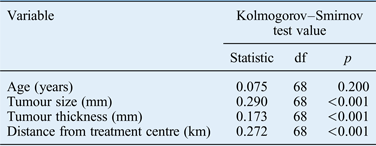
A Kolmogorov–Smirnov test of normality was conducted to establish whether the continuous variables in the study (age, tumour size, tumour thickness and distance from the treatment centre) could be assumed to be from a normally distributed population. The test results, shown in Table II, indicated that, except for age, none of the continuous variables could be assumed to be from a normally distributed population at a 0.001 level of significance. Therefore, the subsequent use of non-parametric statistics and techniques is justified for the analysis of tumour size, tumour thickness and distance from the treatment centre.
Test of normality findings
Df = degrees of freedom
Demographic and clinical characteristics
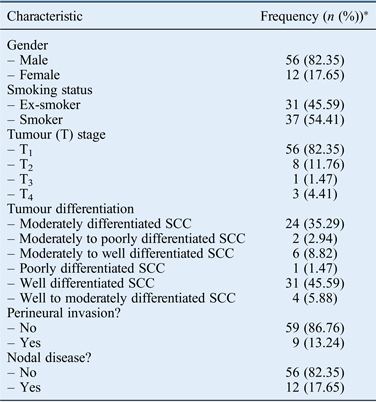
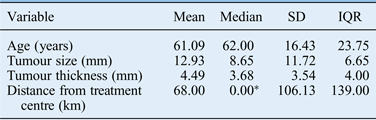
The demographic and clinical characteristics of the patients are shown in Tables III and IV. There were 68 patients in total. The average age of the patients at the time of the examination was 61.09 years (SD = 16.43 years), with a range of 17–89 years. The vast majority of patients (n = 56, 82.35 per cent) were male. Over half of the patients were smokers or ex-smokers (n = 37, 54.41 per cent).
Patients' demographic and clinical characteristics
*Total n = 68. SCC = squamous cell carcinoma
Patient age, tumour size, tumour thickness and distance from treatment centre
*Approximately equal. SD = standard deviation; IQR = interquartile range
The median tumour size was 8.65 mm (interquartile range = 11.72 mm) and median tumour thickness was 3.68 mm (interquartile range = 4.00 mm).
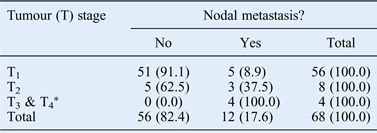
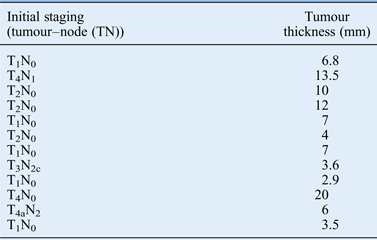
For most patients, the tumour stage was T1 (n = 56, 83.5 per cent). Eight patients (11.76 per cent) had stage T2 tumours, one patient (1.47 per cent) had a stage T3 tumour and three patients (4.41 per cent) had stage T4 tumours. The tumour classification was T1N0 for all T1 patients, T2N0 for all T2 patients and T3N2C for all T3 patients. For the three patients with a stage T4 tumour, the tumour classifications were T4aN2, T4N0 and T4N1.
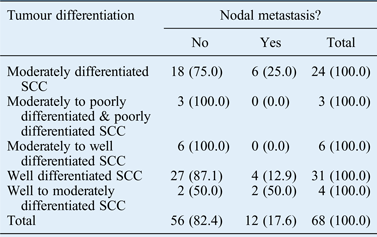
The largest cohort of patients had a tumour differentiation classification of well differentiated SCC (n = 31, 45.59 per cent). This was followed by a classification of moderately differentiated SCC (n = 24, 35.29 per cent). Two patients (2.94 per cent) had moderately to poorly differentiated SCC. Six patients (8.82 per cent) had moderately to well differentiated SCC. One patient (1.47 per cent) had poorly differentiated SCC. Four patients (5.88 per cent) had well to moderately differentiated SCC.
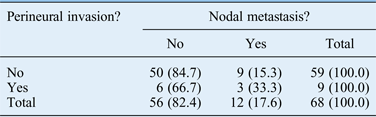
The vast majority of patients had no perineural invasion (n = 59, 86.76 per cent) and no nodal disease (n = 56, 82.35 per cent). Most patients lived very close to the treatment centre (median = 0 km (approximately equal), interquartile range = 139 km).
Hypotheses testing
The data for tumour size, tumour thickness and distance from the treatment centre were compared between patients with and without nodal metastasis using a Mann–Whitney U test (Table V). The results indicated that the median tumour size (U (68) = 163.50, p = 0.005), median tumour thickness (U (68) = 103.50, p < 0.001) and median distance from the treatment centre (U (68) = 199.00, p = 0.018) were significantly greater for patients with nodal metastasis compared to the patients without nodal metastasis, at a 0.05 level of significance.
Tumour size, tumour thickness and distance from treatment centre by nodal metastasis
Df = degrees of freedom; IQR = interquartile range
Spearman's rank non-parametric correlation co-efficient was used to test for a statistically significant association between tumour size and distance from the treatment centre. The results indicated that this correlation was not significant at the 0.05 level of significance (r = 0.095, p = 0.44).
The joint frequency distribution of various pairs of categorical variables from this study was analysed with the chi-square test, to check for a statistically significant association. A chi-square test of independence was performed to examine the association between smoking status and nodal metastasis. The relation between these variables was not significant (chi-square = 0.114; n = 68; p = 0.735). The chi-square test of independence could not be performed to examine the associations between perineural invasion and nodal metastasis, between tumour differentiation and nodal metastasis, or between tumour stage and nodal metastasis, as the assumption of large expected frequencies was violated. The cross-tabulations for these pairs are summarised in Tables VI–VIII.
Perineural invasion by nodal metastasis
Data represent numbers (and percentages) of cases within the dataset.
Tumour differentiation by nodal metastasis
Data represent numbers (and percentages) of cases within the dataset. SCC = squamous cell carcinoma
Tumour stage by nodal metastasis
Data represent numbers (and percentages) of cases within the dataset. *Locally advanced tumours
The mean tumour thickness in the patients with nodal spread was 8.3 mm (SD = 3.19), with a range from 3.5 mm (T1) to 20 mm (T4) (Table IX). The mean tumour thickness in patients without nodal spread was 3.72 mm (SD = 1.69), with a range from 0.5 mm (T1) to 15 mm (T2). Using the Mann–Whitney U test, the difference in mean tumour thickness was found to be statistically significant (U (68) = 572, p = 0.001).
Depth of invasion in lip SCC cases with nodal metastasis
SCC = squamous cell carcinoma
Discussion
Squamous cell carcinoma of the lip usually presents early and follows an indolent clinical course, with a five-year survival rate between 85 and 95 per cent.Reference Hosal, Onerci, Kaya and Turan10 Our study findings are consistent with those of most patients presenting at an early stage of disease.
Currently, most centres advocate neck dissection or radiotherapy when nodal disease is detected either at the time of diagnosis or during follow up. For the N0 neck, there is no consensus regarding management; multiple studies have attempted to formulate criteria for prophylactic neck dissection.
Studies have recently indicated that tumour thickness is an important prognostic indicator for predicting nodal spread. Onerci et al. indicated that prophylactic neck dissection should be considered for tumours over 5 mm.2 Najim et al. found that the risk of lymphatic metastasis was significantly increased for tumours over 4 mm thick, warranting close observation or consideration of further treatment (e.g. radiotherapy and/or prophylactic neck dissection).Reference Najim, Cross, Gebski, Palme, Morgan and Veness7 Vanderlei et al. focused on current TNM staging, and suggested that tumours larger than 3 cm in their greatest dimension also be considered for prophylactic neck dissection.Reference Vanderlei, Pereira-Filho, da Cruz, de Mello, Kruschewsky Lde and de Freitas8
The statistical analysis in the current study indicated an increased risk of nodal spread from lip SCC in those with a larger median tumour size (U = 163.50; degrees of freedom = 68; p = 0.005) or increased median tumour thickness (U = 103.50; degrees of freedom = 68; p < 0.001), and in those who live further from the specialist treatment centre (U = 199.00; degrees of freedom = 68; p = 0.018). This analysis suggests that tumour depth of invasion, overall tumour size and distance from treatment centre may be helpful in predicting which patients have tumours that are at higher risk of nodal spread; these patients should receive closer review or be considered for further treatment. Larger prospective studies are needed in this area.
The risk of nodal disease was not associated with smoking status, presence of perineural invasion or degree of tumour differentiation. However, the analysis of perineural invasion as a risk factor for nodal metastasis was underpowered because of low numbers.
In our experience, patients with metastatic lip SCC have a five-year survival rate of approximately 78 per cent. Therefore, we prefer an approach focused on close clinical and radiological observation.
With regard to our current approach to the N0 neck, for those with tumours less than 4 mm, wide local excision alone is recommended. For patients with tumours larger than 4 mm (known pre-operatively), a neck ultrasound should be conducted prior to excision, with fine needle aspiration if indicated. For patients with tumours larger than 4 mm (identified post-operatively), management should entail close clinical follow up, with a low threshold for neck ultrasound. For patients with aggressive tumours greater than 6 mm thick or larger than 3 cm in size, or for patients unreliable for follow up, consider discussion of levels I–III neck dissection, or recommend close clinical follow up with ultrasound, with fine needle aspiration if indicated.
• Lip squamous cell carcinoma (SCC) usually presents at an early stage
• It has a low five-year mortality rate, which decreases to around 50 per cent in the presence of nodal metastasis
• It is currently staged using the tumour–node–metastasis system, but alternative prognostic indicators may be helpful in identifying patients at risk
• Patients with lesions over 4 mm deep have an increased risk of nodal metastasis, highlighting the need for close follow up
• The relationship between distance from specialist care and likelihood for nodal disease from lip SCC indicates an ongoing gap in healthcare equality
The finding that patients who live further from treatment centres have a higher risk of nodal spread suggests that, despite attempted advancement in rural and regional access to healthcare, a rural–metropolitan gap is still present. Increased attention to rural healthcare, particularly from specialist departments, is suggested.