Introduction
A desire for hastened death (DHD) is one of the most serious problems in terminally ill cancer patients. DHD is defined as a reaction to suffering in the context of a life-threatening condition, from which the patient may believe there is no other way to cope than to accelerate his/her death (Balaguer et al., Reference Balaguer, Monforte-Royo and Porta-Sales2016). Several studies indicate that 17–44% of advanced cancer patients have DHD at least occasionally, and 1.5–12% of them have severe DHD (Chochinov et al., Reference Chochinov, Wilson and Enns1995; Breitbart et al., Reference Breitbart, Rosenfeld and Pessin2000; Morita et al., Reference Morita, Sakaguchi and Hirai2004; Rodin et al., Reference Rodin, Zimmermann and Rydall2007; Wilson et al., Reference Wilson, Dalgleish and Chochinov2016). Both quantitative and qualitative data show many reasons and factors related to DHD. Depression is often reported as one of the most important factors of DHD (Chochinov et al., Reference Chochinov, Wilson and Enns1995; Breitbart et al., Reference Breitbart, Rosenfeld and Pessin2000; O'Mahony et al., Reference O'Mahony, Goulet and Kornblith2005; Villavicencio-Chávez et al., Reference Villavicencio-Chávez, Monforte-Royo and Tomás-Sábado2014; Parpa et al., Reference Parpa, Tsilika and Galanos2019). In recent studies, demoralization which is distinct from depression has been shown as an important mediator of suicidal thoughts and DHD (Robinson et al., Reference Robinson, Kissane and Brooker2017; Vehling et al., Reference Vehling, Kissane and Lo2017). Existential distress (e.g., loss of autonomy and meaninglessness) (McClain et al., Reference McClain, Rosenfeld and Breitbart2003; Morita et al., Reference Morita, Sakaguchi and Hirai2004; Mystakidou et al., Reference Mystakidou, Parpa and Katsouda2006) and physical symptoms (e.g., pain and dyspnea) are also predictors of DHD (Breitbart et al., Reference Breitbart, Rosenfeld and Pessin2000). Recent trends toward legalization of euthanasia and physician-assisted suicide (PAS) have highlighted the need for more information about DHD. The presence of severe and consistent DHD is associated with requests for euthanasia and PAS (Chochinov et al., Reference Chochinov, Wilson and Enns1995; Breitbart et al., Reference Breitbart, Rosenfeld and Pessin2000; Morita et al., Reference Morita, Sakaguchi and Hirai2004; Wilson et al., Reference Wilson, Dalgleish and Chochinov2016). There may be common reasons and factors related to the desire for euthanasia/PAS and DHD in terminally ill cancer patients (Ganzini et al., Reference Ganzini, Harvath and Jackson2002, Reference Ganzini, Goy and Dobscha2008; Suarez-Almazor et al., Reference Suarez-Almazor, Newman and Hanson2002; Wilson et al., Reference Wilson, Chochinov and McPherson2007). As DHD may be associated with a wide range of distress, the assessment and management of DHD are essential skills for palliative care professionals.
Previous studies have shown that patients have different coexisting factors associated with DHD (Morita et al., Reference Morita, Sakaguchi and Hirai2004; Wilson et al., Reference Wilson, Chochinov and McPherson2007). The expression of DHD often indicates underlying multidimensional distress. Although there have been many observational studies of terminally ill cancer patients with DHD (Chochinov et al., Reference Chochinov, Wilson and Enns1995; Breitbart et al., Reference Breitbart, Rosenfeld and Pessin2000; Morita et al., Reference Morita, Sakaguchi and Hirai2004), common patterns of coexisting factors remain unclear. These complex phenomena make it difficult for palliative care professionals to manage DHD.
Cluster analysis is a widely used statistical method that classifies cases into similar patterns of subgroups and has been used in many research areas (Eisen et al., Reference Eisen, Spellman and Brown1998; Logan et al., Reference Logan, Hall and Karch2011; Lochner et al., Reference Lochner, Keuthen and Curley2019). However, to our knowledge, no empirical studies have adopted this method to palliative cancer patients with DHD. The aims of the present study were (1) to identify the proportion of terminally ill cancer patients with DHD, (2) to identify the reasons for DHD, and (3) to identify common patterns of subgroups in terminally ill cancer patients with DHD.
Methods
Procedure
This was part of a multicentre observational study. Participants were terminally ill cancer patients admitted to 23 palliative care units (PCUs) throughout Japan during January 2017–June 2018. Patients were consecutively enrolled, but in the specific periods, when the research was not performed due to practical reasons, e.g., unavailability of researchers on certain days of the week, over the weekends or holidays, or due to staff rotations, we allowed each institution to skip patient enrollment for the specific periods and the numbers of the patients were recorded. Those aged 17 years or less were excluded. Patients who planned to be discharged within 1 week or those who did not want to be enrolled were also excluded. This study was conducted in accordance with the ethical standards of the Helsinki Declaration and the ethical guidelines for epidemiological research presented by the Ministry of Health, Labour and Welfare in Japan. This was a noninvasive observational study. Written consent was waived according to the guideline, as all interventions were performed within routine clinical practice, each patient had no additional burden (e.g., no questionnaires needed to be completed by patients), and obtaining the information from all patients was vital for this study aim (selection of the consented patients would lead to the lack of validity of this study). The study protocol was approved by the research ethics committees of all institutions involved in the study.
Variables
The primarily responsible physician most involved with the patient obtained prospective data from daily clinical practice. Demographic data, including age, sex, marital status, religion, past illness history, current medication, and primary cancer site, were obtained from patients’ medical charts. Consciousness level at admission was assessed using the Modified Richmond Agitation–Sedation Scale (RASS) (Imai et al., Reference Imai, Morita and Mori2016). Eastern Cooperative Oncology Group (ECOG) performance status (Oken et al., Reference Oken, Creech and Tormey1982) and palliative performance status (PPS; Anderson et al., Reference Anderson, Downing and Hill1996) at admission were assessed by the primarily responsible physician. Cognitive function was assessed using the Abbreviated Mental Test (Hodkinson, Reference Hodkinson1972). Physical and psychological symptoms were assessed using the Integrated Palliative care Outcome Scale (IPOS; Sakurai et al., Reference Sakurai, Miyashita and Imai2019). Patients’ awareness and preparedness were assessed using the Good Death Scale (GDS; Yao et al., Reference Yao, Hu and Lai2007). We categorized the reason why the patient chose to enter a PCU according to a list of potential reasons that we developed, referring to a previous study (Gomes et al., Reference Gomes, Higginson and Calanzani2012). Medical procedures such as opioid prescriptions and the presence or absence of initiation of continuous deep sedation (CDS) were recorded.
Desire for hastened death
Similar to our previous study, the presence of DHD was defined as patient's expressions of DHD to family member or medical professionals during the patient's stay at the PCU (Morita et al., Reference Morita, Sakaguchi and Hirai2004). Reasons for DHD were also recorded depending on the statements of patients. From a list of possible reasons we developed, we selected the main 12 reasons, referring to previous studies (Chochinov et al., Reference Chochinov, Wilson and Enns1995; Ganzini et al., Reference Ganzini, Harvath and Jackson2002; Morita et al., Reference Morita, Sakaguchi and Hirai2004; Wilson et al., Reference Wilson, Chochinov and McPherson2007, Reference Wilson, Dalgleish and Chochinov2016). The reasons included (1) dependency, (2) burden to others, (3) loss of autonomy, (4) meaninglessness/loss of value, (5) inability to engage in any pleasant activities, (6) hopelessness, (7) loneliness, (8) dyspnea, (9) pain, (10) other physical symptoms, (11) fear of death, (12) profound fatigue, and (13) no specific reasons. The presence or absence of an explicit wish for administration of lethal drugs was also recorded (Chochinov et al., Reference Chochinov, Wilson and Enns1995; Morita et al., Reference Morita, Sakaguchi and Hirai2004; Wilson et al., Reference Wilson, Dalgleish and Chochinov2016). In Japan, physician-assisted suicide and euthanasia are illegal, but some patients expressed their strong desire for earlier death using this term.
The presence/absence of DHD and reasons for DHD were evaluated by a primarily responsible palliative care specialist after a patient's death. Although we had acknowledged the limitation of the proxy rating, we had decided to adapt this method on the assumption that palliative care specialists examine the patients at least once a day, usually two times or more (morning and evening), every day during the in-patient care periods. Furthermore, an interdisciplinary conference is held among healthcare workers at PCUs. Participating physicians from all the study sites attended an orientation session to review the study objectives and data collection forms. Moreover, the principal investigator and lead investigators at each site provided longitudinal support during the study period to ensure accurate and complete data collection. To examine proxy bias, we planned to explore the concordance of physician ratings with bereaved family's ratings in a post-bereavement survey. Bereaved family survey demonstrated acceptable concordance between physician-reported and family-reported prevalence of desire for hastened death (kappa = 0, 50 among 458 family members responded, unpublished data).
Statistical analysis
Of the patients who died in PCUs, data from those who were alert (RASS score of zero) at admission were included in the analysis. Descriptive analysis was used to show participant characteristics. The chi-square test was used to compare the proportions of variables between two groups with and without DHD; Fisher's exact test was used when the expected cell count was less than 5. The t-test was used to compare mean values of continuous variables. P-values were obtained from these tests. We used two-tailed tests in each analysis, and a p-value less than 0.05 was considered as statistically significant. For cases with DHD, the proportions of the 12 reasons for DHD were calculated. A hierarchical cluster analysis using Ward's methods was conducted based on reasons for DHD. Cluster distance was determined using squared Euclidean distance. The number of clusters was determined by referring the results of scree plots and clinical interpretability of the characteristics of each cluster. To compare the statistical difference between each cluster pairs, multiple comparison was performed by using Fisher's exact test with Hochberg method for categorical variables and Tukey–Kramer test for continuous variables to adjust P-values. In addition, we explored a linear trend in proportions in patients with DHD and the wish for lethal drug administration according to the severity of depression using the Cochran–Armitage test. All statistical calculations were performed using IBM SPSS Statistics version 24 (IBM SPSS Inc., Armonk, NY, USA) and R version 3.6.1.
Results
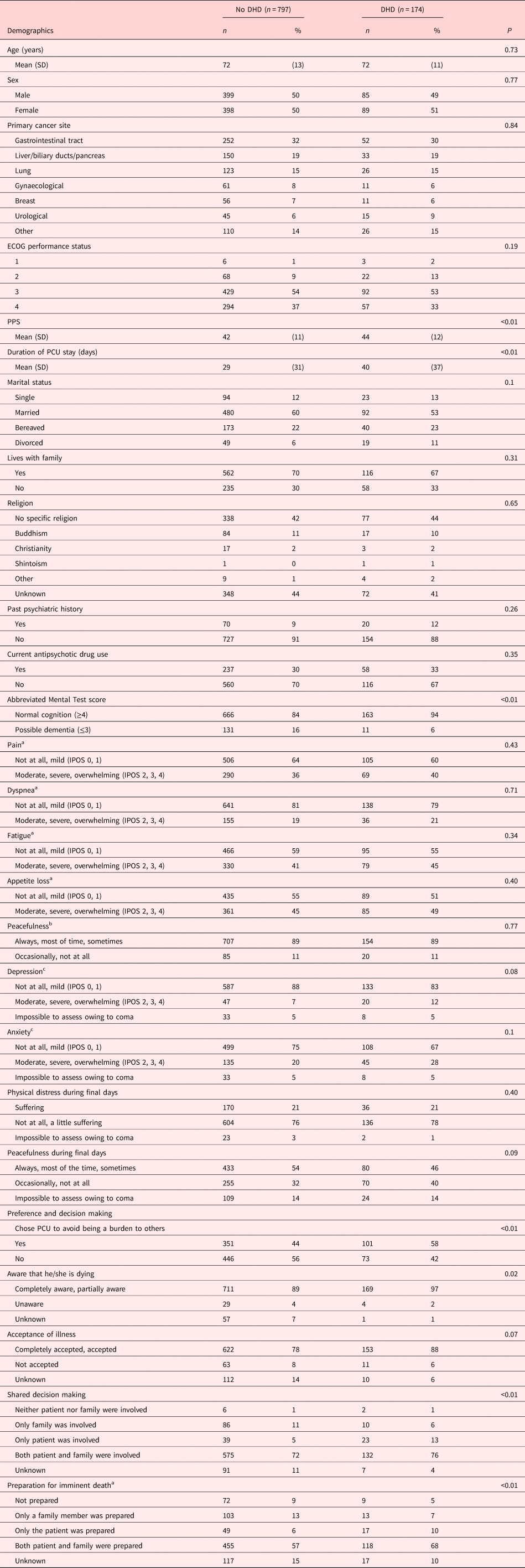
A total of 1,633 of 1,896 participants died in PCUs during the study period. Of these, data from 971 patients with RASS scores of zero at admission were analyzed. Table 1 shows participant characteristics. The average age was 72 years [standard deviation (SD) = 12]. Common primary cancer sites were gastrointestinal tract (31%), liver/biliary ducts/pancreas (19%), and lung (15%). ECOG performance status was 3 or 4 for more than 80% of patients. The average survival time in the PCU was 31 days (SD = 33). Of 971 patients, 174 (18%: 95% CI, 16–20) had DHD. Of patients who had DHD, 79 (46%: 95% CI, 38–53) had an explicit wish for lethal drug administration. A comparison of characteristics between patients with or without DHD showed that PPS was significantly better in the group with DHD than in the group without DHD (44 vs. 42; P < 0.01). The duration of PCU stay was significantly longer in the group with DHD than in the group without DHD (40 days vs. 29 days; P < 0.01). The prevalence of any symptoms was not significantly different between the groups. Regarding preference and decision making, patients with DHD were more likely to choose PCU to avoid being a burden to others. Patients with DHD were more likely to be aware that they were dying, more likely to be involved with decision making and more prepared for their imminent death than patients without DHD.
Characteristics of participants with/without DHD

SD, standard deviation; ECOG, Eastern Cooperative Oncology Group; PPS, palliative performance scale; IPOS, Integrated Palliative care Outcome Scale; PCU, palliative care unit; RASS, Richmond Agitation–Sedation Scale; DHD, desire for hastened death.
Data for 971 participants with RASS score of 0 at admission were included.
a Data for one participant in the group with no desire for death were missing.
b Data for five participants in the group with no desire for death were missing.
c Depression and anxiety were assessed 1 week after admission for 828 patients.
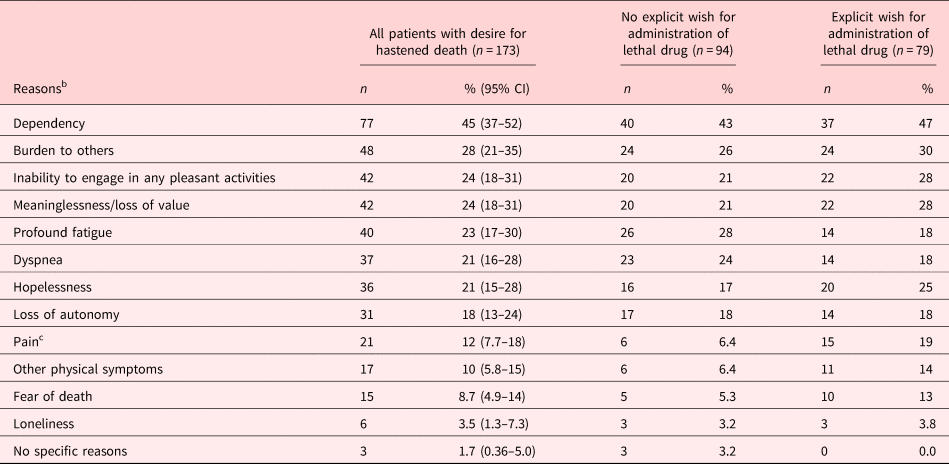
Table 2 shows the proportion of each DHD reason. Dependency was the most frequent DHD reason (45%: 95% CI, 37–52), followed by burden to others (28%: 95% CI, 21–35), inability to engage in any pleasant activities (24%: 95% CI, 18–31) and meaninglessness/loss of value (24%: 95% CI, 18–31). Pain was significantly more frequent in patients who desired lethal drug administration than in those who did not.
Reasons for desire for hastened death (n = 173)a

a Data were missing for 1 of 174 participants with a desire for death.
b Multiple choices were allowed.
c Chi-square test showed a statistically significant difference between the two groups (P < 0.05).
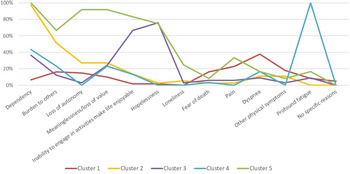
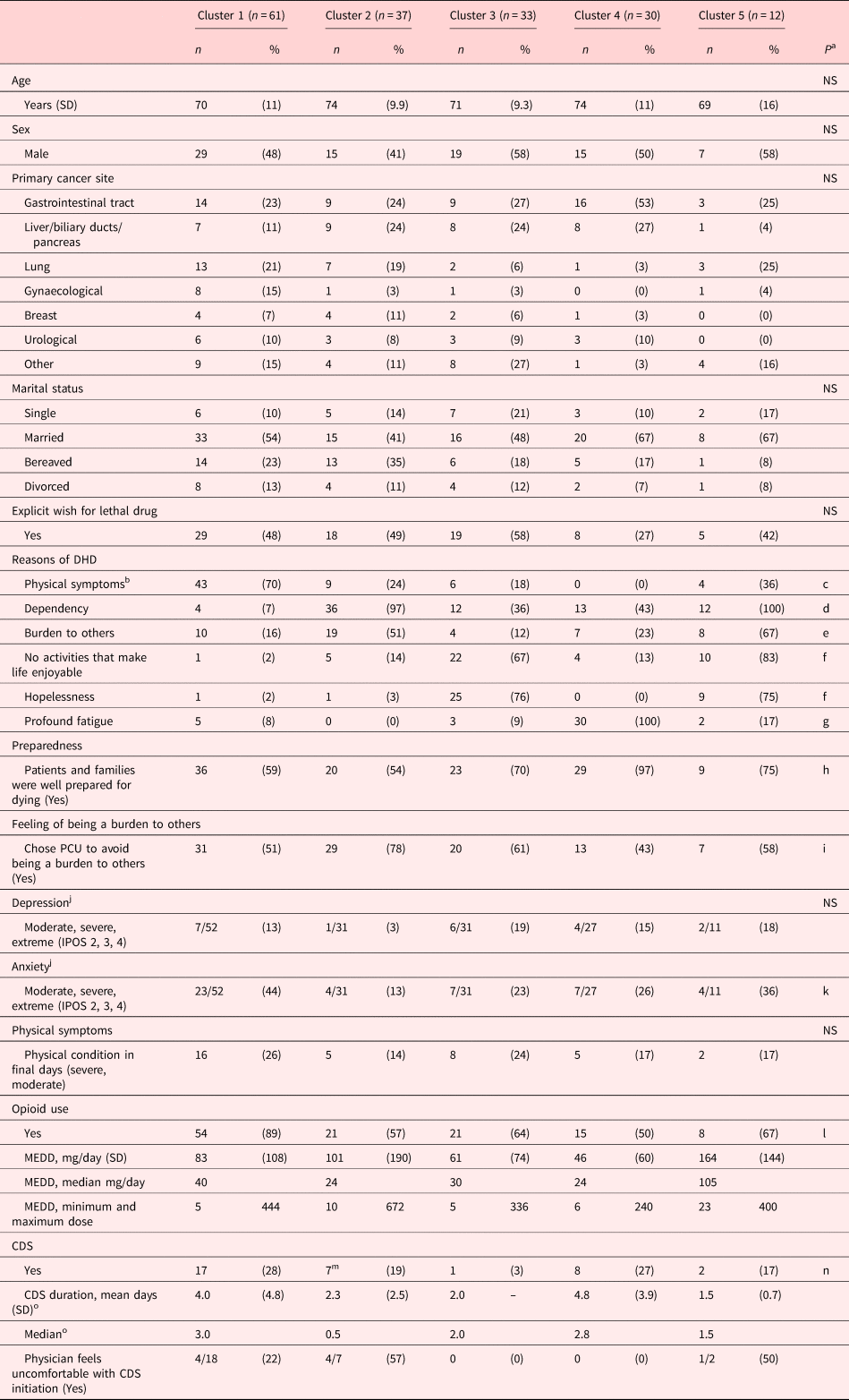
We used a hierarchical cluster analysis to classify subgroups among patients with DHD. A dendrogram was created based on the patterns of DHD reasons. We referred the scree plots to determine the number of clusters (Supplementary Figure S1). Finally, five distinct clusters were obtained. Figure 1 shows the patterns of DHD reasons for the five clusters. Table 3 shows the characteristics of the five clusters. Patients in cluster 1 (“physical distress” 35%, 61/173) were more likely to have physical distresses such as dyspnea (38%), pain (23%), and other physical symptoms. The proportion of patients who expressed at least one physical symptoms as a reason for DHD was highest (70%) in cluster 1 among all clusters. Most patients (89%) in cluster 1 were using opioid. Cluster 2 (“dependent and burdensome” 21%, 37/173) consisted of patients who expressed DHD owing to the distress of dependency (97%) and being a burden to others (51%). Patients in cluster 2 were more likely to have entered the PCU to avoid being a burden to others. Cluster 3 (“hopelessness” 19%, 33/173) was characterized by a high proportion of hopelessness (76%) and distress owing to the inability to engage in any pleasant activities (67%). They were more likely to be depressed and desire lethal drug administration (not statistically significant). In cluster 4 (“profound fatigue” 17%, 30/173), most patients had profound fatigue and were well prepared for death. Opioid dosage was lowest in this group. Cluster 5 (“extensive existential suffering” 7%, 12/173) consisted of patients who had wide range of distress including existential sufferings, hopelessness, and physical symptoms.
Cluster analysis of reasons for desire for hastened death.

Characteristics of five clusters of patients with desire for hastened death (n = 173)

SD, Standard Deviation; PCU, Palliative Care Unit; MEDD. Morphine Equivalent Daily Dosage; CDS, Continuous Deep Sedation; NS, No Significant Differences Between Any Groups; DHD, desire for hastened death.
a Multiple comparisons were calculated by Fisher exact test with Hochberg Method and Tukey–Kramer test.
b At least one of pain, dyspnea, or other physical symptoms.
c Cluster 1 was significantly larger than cluster 2, 3, and 4; Cluster 4 was significantly smaller than clusters 2 and 5.
d Clusters 2 and 5 were significantly larger than clusters 1, 3, and 4; Cluster 1 was significantly smaller than clusters 3 and 4.
e Clusters 2 and 5 were significantly larger than clusters 1 and 3.
f Clusters 3 and 5 were significantly larger than clusters 1, 2, and 4.
g Cluster 4 was significantly larger than clusters 1, 2, 3, and 5.
h Cluster 4 was significantly larger than clusters 1 and 2.
i Cluster 2 was significantly larger than cluster 4.
j Depression and anxiety assessed 1 week after admission; 152 participants were assessed.
k Cluster 1 was significantly larger than cluster 2.
l Cluster 1 was significantly larger than clusters 2 and 4.
m CDS data is missing in cluster 2 (37 to >36) 7/16 = 19.4%.
n Cluster 1 was significantly larger than cluster 3.
o Thirty-six sets of data from patients who received CDS were analyzed.
In addition, we explored a linear trend in proportions in patients with DHD and the wish for lethal drug administration according to the severity of depression using the Cochran–Armitage test (Supplementary Figure S2). There was a statistically significant linear trend in the proportion of patients with DHD and patients who desired lethal drug administration across ordered severity categories of depression (P < 0.01; P < 0.01, respectively).
Discussion
This study demonstrated five interpretable subgroups of terminally ill cancer patients with DHD. Many quantitative and qualitative studies have shown DHD-related factors in terminally ill cancer patients (Chochinov et al., Reference Chochinov, Wilson and Enns1995; Breitbart et al., Reference Breitbart, Rosenfeld and Pessin2000; McClain et al., Reference McClain, Rosenfeld and Breitbart2003; Morita et al., Reference Morita, Sakaguchi and Hirai2004; O'Mahony et al., Reference O'Mahony, Goulet and Kornblith2005; Mystakidou et al., Reference Mystakidou, Parpa and Katsouda2006; Rodin et al., Reference Rodin, Zimmermann and Rydall2007; Villavicencio-Chávez et al., Reference Villavicencio-Chávez, Monforte-Royo and Tomás-Sábado2014; Wilson et al., Reference Wilson, Dalgleish and Chochinov2016; Robinson et al., Reference Robinson, Kissane and Brooker2017; Vehling et al., Reference Vehling, Kissane and Lo2017; Parpa et al., Reference Parpa, Tsilika and Galanos2019). However, the use of cluster analysis is not common in palliative care research. The five clusters we found showed different characteristics.
About one-third of patients with DHD were in cluster 1 (physical distress). This group was characterized by a high proportion of physical distress, such as dyspnea and pain. Dyspnea and pain are reported as refractory symptoms in terminally ill cancer patients who eventually needed palliative sedation (Maltoni et al., Reference Maltoni, Scarpi and Rosati2012). Many patients in cluster 1 also had anxiety. Although the relationship between anxiety and pain is controversial, some reports indicate an association between physical distress and psychological distress (McMillan et al., Reference McMillan, Tofthagen and Morgan2008; Li et al., Reference Li, Xiao and Yang2017; McKenzie et al., Reference McKenzie, Zhang and Chan2020). Additional research is needed to alleviate these refractory symptoms in terminally ill cancer patients.
Almost all patients in cluster 2 (dependent and burdensome) experienced distress related to dependency and more than half were distressed about being a burden to others. As cancer advances, patients lose their independence and need more help from others. Other studies have shown that feeling a burden to others is one of the main reasons for both DHD and requests for euthanasia in advanced cancer patients (Suarez-Almazor et al., Reference Suarez-Almazor, Newman and Hanson2002; Morita et al., Reference Morita, Sakaguchi and Hirai2004; Wilson et al., Reference Wilson, Chochinov and McPherson2007; Akazawa et al., Reference Akazawa, Akechi and Morita2010). Indeed, 78% of cluster 2 patients chose to enter a PCU to avoid being a burden to their family. These cognitive and behavioral patterns may be common in terminally ill patients worldwide. Further research for the development of effective care for such existential distress is needed.
Cluster 3 (hopelessness) consisted of patients with hopelessness and distress related to the inability to engage in any pleasant activities. This is also consistent with the findings of previous empirical research to explore the reasons of request of PAS in the patients (McClain et al., Reference McClain, Rosenfeld and Breitbart2003; Wilson et al., Reference Wilson, Chochinov and McPherson2007). Hopelessness has been confirmed as a unique contributor to DHD that is distinct from depression (Breitbart et al., Reference Breitbart, Rosenfeld and Passik1996; Chochinov et al., Reference Chochinov, Wilson and Enns1998). Our findings may support these previous evidences for an association between hopelessness and DHD among terminally ill cancer patients. The proportion of explicit wish for lethal drug in cluster 3 was highest. As shown in Supplementary Figure S2, wish for lethal drug may be associated with severe depression. The patients in this cluster may be at high risk of suicidal attempt. Further research is needed to identify how patients cope with their hopelessness and depression during the end phase of terminal illness.
Cluster 4 (profound fatigue) also showed unique characteristics. Most of the patients in this cluster had profound fatigue. On the other hand, they were well prepared for dying. Cancer-related fatigue is often induced by the progression of cachexia (Peixoto da Silva et al., Reference Peixoto da Silva, Santos and Costa E Silva2020). For patients who are prepared for their own death, worsened cachexic symptoms could make them realize their imminent death. Expression of DHD from the patients in cluster 4 may represent their readiness for dying. Patients in cluster 5 (extensive existential suffering), smallest proportion among all clusters, were characterized by a wide range of distress. Further qualitative studies are needed to investigate how these distresses are interacting and how DHD is induced by these coexisting distresses.
The second important finding was that we identified the prevalence of the main reasons for DHD in terminally ill cancer patients. Similar to previous study findings, dependency and feeling a burden to others were the most common reasons for DHD (Wilson et al., Reference Wilson, Chochinov and McPherson2007). Meaninglessness and loss of autonomy were also identified as major reasons for DHD. These findings are consistent with previous findings (McClain et al., Reference McClain, Rosenfeld and Breitbart2003; Morita et al., Reference Morita, Sakaguchi and Hirai2004). Despite recent advances in pharmacotherapy, physical symptoms remain an important source of distress and a reason for DHD. These results highlight the importance of symptom management in cancer patients.
Study limitations
We should mention several limitations. First, all subjective data were assessed by the primarily responsible physicians. A total of 87 clinical physicians participated throughout the study period (an average of four physicians participated per site, and an average of 21 patients’ data were retrieved by one physician). We acknowledge that this methodology may be related to low inter-rater reliability. However, the primarily responsible palliative physician, who obtained the presence/absence of DHD, evaluated patients almost every day and participated in daily interdisciplinary conference. Also, the principal investigator and lead investigators provided constant support for participating physicians during the study period to ensure accurate data collection. Such situations and the acceptable concordance between physician-reported and family-reported prevalence of DHD may contribute to the reliability of data. Second, in this study, we did not use validated tools to assess DHD. The identification of DHD depended on the patient's expression. DHD is considered as a graded phenomenon, and validated scales exist to assess the severity of DHD (Chochinov et al., Reference Chochinov, Wilson and Enns1995; Rosenfeld et al., Reference Rosenfeld, Breitbart and Stein1999; Wilson et al., Reference Wilson, Dalgleish and Chochinov2016). The use of validated measures is important to improve internal validity and to assess DHD that would never be expressed unless asked. Assessing patients’ subjective distress without validated tools may have led to low data validity and reliability. However, responding to many questionnaires is often stressful for advanced cancer patients, and this may be linked with high attrition rates, especially in studies of palliative patients with deteriorating conditions (Chochinov et al., Reference Chochinov, Wilson and Enns1995; Breitbart et al., Reference Breitbart, Rosenfeld and Pessin2000; McClain et al., Reference McClain, Rosenfeld and Breitbart2003). The participant inclusion criteria in this study were not strict, and data were obtained prospectively from multiple centers across the country. These may help medical providers to apply the results of this study to the real-world clinical cases. Third, the robustness of the causal relationship between the variables measured and DHD was weak. The presence or absence of DHD was assessed at any time up to death. We did not record when DHD was assessed. There was more chance for physicians to identify expressions of DHD in patients with longer PCU stays (see Table 1: PPS and survival time were better for patients with DHD than for patients without DHD). A longitudinal study is needed to assess the causal relationships between DHD expression and potential DHD factors and outcomes. Fourth, the classification of patients with DHD was based on only the 12 reasons that we identified. Although we selected these categories carefully, there may be other factors not assessed here that are associated with DHD such as demoralization and entrapment (Gilbert and Allan, Reference Gilbert and Allan1998; Robinson et al., Reference Robinson, Kissane and Brooker2017; Vehling et al., Reference Vehling, Kissane and Lo2017). That might change the subgroup characteristics if added to the analysis.
Clinical implications
DHD in terminally ill cancer patients is a complex phenomenon and often involves multilayered distress. The clustering of terminally ill cancer patients with DHD into subgroups may be useful for the assessment of their suffering. Further study is required to develop efficient care strategies for these patients.
Supplementary material
The supplementary material for this article can be found at https://doi.org/10.1017/S1478951521000080.
Funding
This study was supported by a Grant-in-Aid from the Japan Hospice Palliative Care Foundation and was partially supported by JSPS KAKENHI Grant Number JP16KT0007.
Conflict of interest
The authors declare no conflict of interests.