An important, even defining, symptom of schizophrenia is delusions, abnormal beliefs that are held with fixed conviction and are not susceptible to counter-argument. While several different kinds of delusions can be distinguished based on their content, two of the most important types are persecutory and referential. These have additionally, from the time of Kraepelin (Reference Kraepelin1913) and Bleuler (Reference Bleuler1911), been considered to be closely related, with ideas about being observed, talked about and followed gradually giving way to a belief about a plot to harm the patient.
For many years research into delusions has been exclusively psychological, consisting of attempts to demonstrate cognitive deficits or biases associated with the presence of the symptom (for reviews see Freeman, Reference Freeman2007; McKenna, Reference McKenna2017). However, in recent years functional imaging has begun to identify brain regions potentially associated with delusional thinking. Most research to date has focused on Kapur's (Reference Kapur2003) ‘aberrant salience’ theory of delusions, which proposes that functionally increased brain dopamine will induce a state where salience (i.e. predictive value for future reward) is erroneously attributed to neutral stimuli in the environment. According to the theory, such a state is essentially equivalent to delusional mood, and it facilitates the development of delusions of reference and other delusions. A meta-analysis of 23 studies examining brain activations during anticipation of monetary reward in patients with schizophrenia spectrum disorders (Radua et al., Reference Radua, Schmidt, Borgwardt, Heinz, Schlagenhauf, McGuire and Fusar-Poli2015) found pooled evidence for reduced activation in the ventral striatum, a dopamine-innervated region with key functions in reward processing (Hollerman, Tremblay, & Schultz, Reference Hollerman, Tremblay and Schultz2000; Jauhar et al., Reference Jauhar, Fortea, Solanes, Albajes-Eizagirre, McKenna and Radua2021; Oldham et al., Reference Oldham, Murawski, Fornito, Youssef, Yucel and Lorenzetti2018; Schultz, Tremblay, & Hollerman, Reference Schultz, Tremblay and Hollerman2000). However, in this meta-analysis there was no evidence of a relationship with positive symptoms or delusions. The direction of the abnormality, i.e. towards reduced rather than increased salience associated activation, also goes against the predictions of the aberrant salience theory, at least in its simple form (for a discussion see McKenna, Reference McKenna2017).
Another way to investigate the brain functional correlates of delusions would be to scan patients while they performed tasks that elicit delusional thinking. Only one study of this type has so far been carried out: Menon et al. (Reference Menon, Schmitz, Anderson, Graff, Korostil, Mamo and Kapur2011) scanned 14 schizophrenic patients who had prominent referential delusions and 15 healthy controls while they saw sentences like ‘He is lazy’ or ‘She likes to drink coffee’, and had to indicate if they felt the sentences were specifically about them (not just that the characteristic described them). The patients showed significantly less activation than the controls in the superior part of the medial frontal cortex, the ventral striatum and the insula. A positive correlation between task-related activations and scores on delusions of reference was also found in the ventral striatum and the insula.
Referential thinking can also be induced by the use of virtual reality paradigms, which by virtue of their immersive nature are known to induce a tendency to respond to situations and events as if they were real. Freeman et al. (Reference Freeman, Pugh, Antley, Slater, Bebbington, Gittins and Garety2008) examined healthy subjects while they wore goggles displaying a three-dimensional environment which simulated a journey in a London Underground carriage. During the journey computer-generated ‘avatars’ looked in different directions at random and were programmed to smile if their gaze met that of the subject. It was found that the subjects often reported referential ideation, feeling that the avatars were deliberately looking at them, making gestures towards them, etc. Later, the authors showed that the same paradigm elicited persecutory and referential thinking in deluded patients, at a higher frequency than in healthy subjects (Freeman, Pugh, Vorontsova, Antley, & Slater, Reference Freeman, Pugh, Vorontsova, Antley and Slater2010).
We have recently developed a version of the Freeman et al. (Reference Freeman, Pugh, Antley, Slater, Bebbington, Gittins and Garety2008) task for use in conjunction with functional magnetic resonance imaging (fMRI). We hypothesized that experience of such a virtual reality environment would be associated with differences in brain activity between patients with schizophrenia and healthy controls, and that some of these differences would reflect the presence of referential and/or persecutory delusions.
Method
Participants
The patient sample consisted of 90 right-handed patients with a DSM-5 diagnosis of schizophrenia or schizoaffective disorder recruited from four different hospitals in the Barcelona area (Benito Menni CASM, Hospital de Sant Rafael, Hospital Sagrat Cor de Martorell, Hospital Mare de Déu de la Mercè). Diagnosis was made by means of clinical interview and review of casenotes. Patients were excluded if they (a) were younger than 18 or older than 65 years, (b) had a history of brain trauma or neurological disease or (c) fulfilled DSM-5 criteria for alcohol or substance use disorder at any level of severity (i.e. mild, moderate, severe) within 12 months prior to participation. Patients with a current IQ below 70 (see below) were also excluded from the study.
Twenty-eight right-handed healthy controls, recruited from non-clinical staff working in the hospitals, their relatives and acquaintances and independent sources in the community, were also included. They met the same exclusion criteria as the patients and they were additionally interviewed using the SCID (Structured Clinical Interview for DSM-IV, First, Spitzer, Gibbon, & Williams, Reference First, Spitzer, Gibbon and Williams2002) to exclude current and past psychiatric disorders. They were also excluded if they reported a history of treatment with psychotropic medication beyond non-habitual use of night sedation, or if they reported a history of psychiatric disorder in a first-degree relative.
The patients and controls were recruited to be matched for age, sex and estimated IQ (premorbid IQ in the patients). This latter was measured using the Word Accentuation Test (Test de Acentuación de Palabras, TAP) (Del Ser, Gonzalez-Montalvo, Martinez-Espinosa, Delgado-Villapalos, & Bermejo, Reference Del Ser, Gonzalez-Montalvo, Martinez-Espinosa, Delgado-Villapalos and Bermejo1997; Gomar et al., Reference Gomar, Ortiz-Gil, McKenna, Salvador, Sans-Sansa, Sarro and Pomarol-Clotet2011), which requires reading aloud Spanish words whose accents have been removed (in Spanish, accents are used to indicate deviation from the rules of pronunciation). It is conceptually similar to the English-language National Adult Reading Test (NART) (Nelson & Willison, Reference Nelson and Willison1991) and the Wide Ranging Achievement Test (WRAT) (Wilkinson & Robertson, Reference Wilkinson and Robertson2017). Current IQ was measured using four subtests of the WAIS III (Vocabulary, Similarities, Matrix Reasoning and Block Design).
All participants gave written informed consent prior to participation. All the study procedures complied with the ethical standards of the relevant national and institutional committees on human experimentation and with the Helsinki Declaration of 1975, as revised in 2008. The study was approved by the ethical committee of the Hermanas Hospitalarias group of hospitals. Healthy controls received a gift-card for their participation in the study.
Clinical assessment
The Psychotic Symptom Rating Scales, delusions subscale (PSYRATS-D, Haddock, McCarron, Tarrier, & Faragher, Reference Haddock, McCarron, Tarrier and Faragher1999) was used to assess the presence and severity of delusions. This has six items referring to frequency, duration, conviction, severity and intensity of distress, and disruption caused by the delusional beliefs. The content of the delusions is also recorded.
To assess the presence and severity of ideas of reference, we used the Ideas of Reference Interview Scale (IRIS) (Wong et al., Reference Wong, Hui, Tang, Chiu, Lam, Chan and Chen2012), a semi-structured interview with 15 items referring to different self-referential experiences that are scored based on their occurrence, severity, conviction and frequency. Three different scores can be calculated: total score (sum of the scores in every dimension assessed by the scale); pervasiveness (a measure of the degree of presence of self-referential ideas in the patient's daily life) and discrepancy (a measure reflecting the specificity of self-referential experiences, i.e. how likely the patient considers the experience to be directed specifically towards him/her).
The PANSS (Kay, Fiszbein, & Opler, Reference Kay, Fiszbein and Opler1987) was also administered. This was employed mainly to provide an indication of overall levels of psychopathology in the patient group. However, information obtained from it, along with the diagnostic interview and review of casenotes, was also used to explore the nature of the patients' beliefs, in particular whether or not they had persecutory delusions (see below).
Procedure
Participants were first screened and interviewed for clinical and IQ assessment. Next, they were scanned while performing the metro task. In this, the participants viewed a virtual reality carriage modelled on the Barcelona underground (the ‘Metro’). The task lasted 11 min and consisted of alternating blocks of ‘full’ and ‘empty’ carriages; there were six blocks of each condition. In the ‘full’ condition (60 s), several virtual people entered the train and performed actions such as moving, making hand gestures, crossing their legs or looking around, including in the participant's direction. The people and their actions were different in each block. Their actions were not openly aggressive or hostile, but were designed to be ambiguous enough so as to be able to evoke referentiality and/or paranoia. In the ‘empty’ condition (30 s) the participant was alone in the carriage. To compensate for the greater visual complexity of the ‘full’ blocks, especially the presence of human faces, during control blocks the participant saw adverts in the carriage walls containing pictures of human faces and ceiling monitors played videos of people speaking (as in the real Metro), although their voices could not be heard; these videos were different each time. The transitions between conditions involved the train entering a station, the doors opening and people entering or leaving according to the condition; these transitions lasted 10 s. Throughout the task, the participant could hear sound effects corresponding to the train's motion and the doors opening/closing. Examples of the two conditions are shown in Fig. 1.
Virtual reality metro task. The task simulates a journey in the Barcelona Metro from a first-person perspective, with blocks where the participant was accompanied by virtual characters, and blocks where the participant was alone.

The task was displayed through MRI-compatible VisuaStim goggles (Resonance Technology, Inc., California, USA). The resolution was 800 × 600 pixels with a refresh rate of 60 Hz (giving high picture quality), and there was a 30-degree horizontal field of view. The task's scenario was developed with the Distributed Immersive Virtual Environment. The carriage environment and the avatars representing the passengers were created with 3D Studio Max for Windows. The passengers' movements were created using an optical motion capture system.
Immediately after exiting the fMRI scanner, participants completed the State Social Paranoia Scale (SSPS) (Freeman et al., Reference Freeman, Pugh, Green, Valmaggia, Dunn and Garety2007), a 20-item self-report questionnaire developed for use with Freeman and co-workers' virtual reality Underground paradigm (Freeman et al., Reference Freeman, Pugh, Antley, Slater, Bebbington, Gittins and Garety2008, Reference Freeman, Pugh, Vorontsova, Antley and Slater2010). The scale has 10 items concerning persecutory and referential ideation, such as ‘Someone had bad intentions towards me’, ‘Someone stared at me in order to upset me’ and ‘Someone was trying to intimidate me’. There are also five neutral items (‘I wasn't really noticed by anybody’) and five positive items (‘Someone had kind intentions towards me’). Following Freeman et al. (Reference Freeman, Pugh, Green, Valmaggia, Dunn and Garety2007) only the persecutory/referential items were included for calculation of overall SSPS scores.
Image acquisition and analysis
Images were acquired with a 3T Philips Ingenia scanner (Philips Medical Systems, Best, The Netherlands). Functional data were acquired using a T2*-weighted echo-planar imaging sequence with 245 volumes and the following acquisition parameters: TR = 2000 ms, TE = 30 ms, flip angle = 70°, in-plane resolution = 3.5 × 3.5 mm, FOV = 238 × 245 mm, slice thickness = 3.5 mm, inter-slice gap = 0.75 mm. Slices (32 per volume) were acquired with an interleaved order parallel to the AC–PC plane. We also acquired a high-resolution anatomical volume with a fast field echo sequence for anatomical reference and inspection (TR = 9.90 ms; TE = 4.60 ms; flip angle = 8°; voxel size = 1 × 1 mm; slice thickness = 1 mm; slice number = 180; FOV = 240 mm).
Preprocessing and analysis was carried out with the FEAT module included in FSL (FMRIB Software Library) software (Smith et al., Reference Smith, Jenkinson, Woolrich, Beckmann, Behrens, Johansen-Berg and Matthews2004). The first 20 s (10 volumes) of the sequence, corresponding to signal stabilization, were discarded. Preprocessing included motion correction (using the MCFLIRT algorithm), co-registration and normalization to a common stereotactic space (MNI, Montreal Neurological Institute template). For accurate registration, a two-step process was used. First, brain extraction was applied to the structural image, and the functional sequence was registered to it. Then the structural image was registered to the standard template. These two transformations were used to finally register the functional sequence to the standard space. Before group analyses, normalized images were spatially filtered with a Gaussian filter (FWHM = 5 mm). To minimize unwanted movement-related effects, individuals with an estimated maximum absolute movement >3.0 mm or an average absolute movement >0.3 mm were excluded from the study.
Statistical analysis was performed by means of a general linear model (GLM) approach. For each subject, separate regressors were created for the ‘full’ and ‘empty’ blocks, with the motion parameters obtained from the realignment added as nuisance covariates. Transition periods between task conditions were not modelled. GLMs were fitted to generate individual activation maps for the contrast full > empty. Second level (group) analyses were performed within the FEAT module by means of mixed-effects GLMs (Beckmann, Jenkinson, & Smith, Reference Beckmann, Jenkinson and Smith2003). All statistical tests were carried out at the cluster level with a corrected p value of 0.05 using Gaussian random field methods. In line with current recommendations (Eklund, Nichols, & Knutsson, Reference Eklund, Nichols and Knutsson2016), a threshold of z > 3.1 (p < 0.001) was used to define the initial set of clusters.
We examined the distributions of scores on the PSYRATS and the IRIS to determine the best way to examine the association with different delusion/referentiality scores within the patient group, i.e. by analysis of correlations or by separation of groups with and without the symptom. Where the latter was chosen (as in all cases, see below), symptomatic and non-symptomatic patients were compared using multiple regression with a binary regressor coding for group (deluded v. non-deluded) and a second regressor coding the effect of symptom severity (with zeroes for the non-deluded patients and the mean-centred scale scores for patients with delusions). In this way it was possible to examine group differences in delusion status while taking into account symptom severity.
Results
The final sample of 90 patients was selected from an initial sample of 107 patients who underwent scanning: 12 were excluded due to excessive head motion, two for having a current IQ below 70, two because of incidental MRI findings and one because, after review, the diagnosis was felt to be uncertain. The 28 healthy controls were drawn from an initial sample of 48: three did not provide valid fMRI data, two were excluded for excessive motion, one for an incidental MRI finding and four for having a family or personal history of psychiatric disorder; another 10 were discarded in order to permit matching for age, sex and TAP-estimated IQ with the patients.
Demographic and clinical findings
Demographic, clinical and treatment data are shown in Table 1. The groups did not significantly differ in sex distribution, age or TAP-estimated (premorbid) IQ; however, the schizophrenic patients had a significantly lower current IQ than the healthy controls. All the patients were on antipsychotic medication: five typical antipsychotics, 70 atypical antipsychotics and 13 both types (missing data for two patients). Mean dosage in chlorpromazine equivalents and the range are also shown in Table 1.
Demographic and clinical data for the schizophrenia and control samples

Values are means and standard deviations (s.d.), or medians and inter-quartile ranges (IQR) for obviously skewed distributions.
The metro task evoked referential ideation, as rated by the SSPS questionnaire, in both the patients and the healthy controls. Mean scores and ranges were closely similar in the two groups [M patients = 17.11 (s.d. = 10.36), range = 10–46; M controls = 17.75 (s.d. = 10.22), range = 10–44, t = 0.29, p = 0.77]. A total of 8/28 (29%) of the healthy controls reported no referential/persecutory ideation on any of the items and 5/28 (19%) endorsed only the ‘agree a little’ rating. The remaining 15 (54%) had scores for one or more of the items on ‘agree moderately’, ‘agree very much’ and ‘totally agree’. Among the patients, 35/90 (39%) reported no persecutory/referential ideation in any item, 16/90 (18%) rated on ‘agree a little’, and 39/90 (43%) scored on the remaining items. Histograms for the SSPS scores for patients and controls are shown in online Supplementary Fig. S1.
Within the patient group, SSPS scores were significantly correlated with scores in the IRIS global score (r Spearman = 0.41, p < 0.001), and at a similar level with pervasiveness (r Spearman = 0.36, p < 0.001) and discrepancy (r Spearman = 0.46, p < 0.001). There was also a trend to significant correlation with scores on the PSYRATS-D (r Spearman = 0.19, p = 0.07).
Task-related activation in the patients and controls
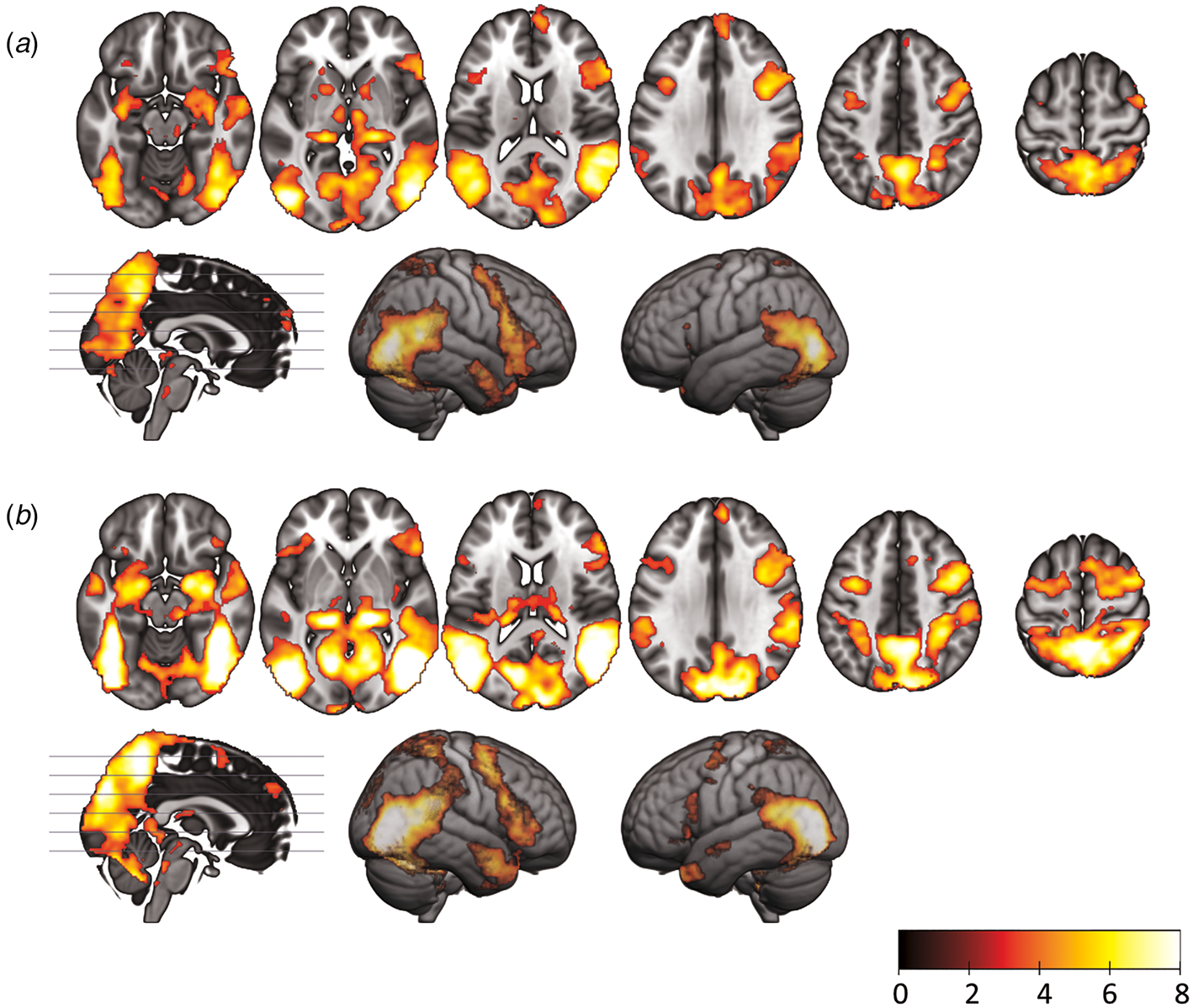
Mean activation maps for the contrast of interest (full > empty) were broadly similar in the patients and the controls (see Fig. 2 and online Supplementary Table S1). They included extensive areas in the occipital cortex, the fusiform gyrus, the cuneus and precuneus, the middle and superior temporal cortex and the supramarginal gyrus. Activation was also seen in the precentral gyrus, the inferior frontal cortex, the temporal pole and portions of the superior medial frontal cortex. Subcortical activity was observed in the thalamus and midbrain, hippocampus and amygdala and in the basal ganglia in the controls. For most regions the activation pattern was bilateral and symmetrical. Group comparison showed no clusters of significant differences between the patients and the controls.
Brain activation patterns for the full > empty contrast in healthy individuals (a) and patients with schizophrenia (b). Images are shown in neurological convention (right is right). Colour bar depicts z values.

Relationship with referentiality in the patient group
Referentiality/persecution ideation during the task
Scores on the SSPS were used to separate patients who reported experiencing referential/persecutory ideation during the task (n = 54, 35 males and 19 females, who scored 11 or more on the scale and thus had some level of referential experience) and those that did not (n = 35, 20 males and 15 females, who scored 10, which is the minimum score and indicates no positive ratings on any items of the scale). The two groups were similar in terms of sex (χ2 = 0.25, p = 0.61), age (M non-referential = 45.00, M referential = 41.80; t = 1.31, p = 0.20) and premorbid IQ (M non-referential = 99.09, M referential = 98.41; t = 0.33, p = 0.75), although current IQ was lower in the patients with referentiality (M non-referential = 96.63, M referential = 90.42; t = 2.09, p = 0.04). There were no clusters of significant difference between the two groups. The results remained the same when current IQ was entered as a covariate in the analysis.
Referentiality as rated using the IRIS
Inspection of scores on the IRIS revealed that 37 of the patients were free of ideas of reference (global score = 0), and 52 patients experienced ideas of reference at varying levels of severity (global score ⩾0.5) (see online Supplementary Fig. S2 for a histogram). The two groups were trend-level imbalanced in sex distribution (with referentiality: 16 males, 19 females; without referentiality: 36 male, 16 female; χ2 = 3.02, p = 0.08), but were well matched for age (M no-IOR = 42.86, M IOR = 43.48; t = 0.25, p = 0.80), premorbid IQ (M no-IOR = 98.44, M IOR = 98.50; t = 0.03, p = 0.98) and current IQ (M no-IOR = 92.72, M IOR = 92.59; t = 0.04, p = 0.96).
No significant differences in brain activation were observed between these two groups. Inclusion of sex as a covariate did not change the results. Repeating the analysis using IRIS pervasiveness or discrepancy scores rather than IRIS global scores did not alter the results.
Relationship with delusions in the patient group
Within the patient group, inspection of the distribution of scores on the PSYRATS-D, revealed clear evidence of bimodality, with 46 patients scoring 0 on all items and 42 scoring greater than 6 (6 would be the usual minimum score for patients with any degree of delusionality) (see online Supplementary Fig. S2 for a histogram). These two groups did not differ significantly in sex distribution (χ2 = 0.61, p = 0.43), age (M non-deluded = 43.43, M deluded = 42.55; t = 0.38, p = 0.73), premorbid IQ (M non-deluded = 97.68, M deluded = 99.00; t = 0.66, p = 0.51) and current IQ (M non-deluded = 93.45, M deluded = 91.68; t = 0.61, p = 0.54).
Comparison of the deluded and non-deluded patients revealed no clusters of significant difference.
From the 42 deluded patients, we were able to identify 28 who had persecutory delusions (with themes involving harm, harassment, being talked about disparagingly, etc.) based on the content of delusions as identified through the initial clinical interview and rating with the PANSS and PSYRATS-D. These patients also did not differ from the 46 non-deluded patients in sex distribution (χ2 = 0.56, p = 0.45), age (M harm = 41.50, M non-deluded = 43.43, t = 0.74, p = 0.46), premorbid IQ (M harm = 98.26, M non-deluded = 97.68, t = 0.24, p = 0.81), or current IQ (M harm = 90.21, M non-deluded = 91.98, t = 0.52, p = 0.61). This time, comparison of the two groups revealed a cluster of hypoactivation in the patients with persecutory delusions in the right posterior middle temporal and middle occipital cortex (MNI coordinates x, y, z = 48, −74, 22; z = 4.16; cluster size = 158 voxels; p = 0.004) (see Fig. 3).
Region in the right posterior middle temporal and middle occipital cortex showing hypoactivation in the patients with persecutory delusions compared with patients without delusions.

Discussion
In this study, healthy controls and schizophrenic patients showed a pattern of widespread brain activations while they viewed a virtual reality scene that evoked referential ideation in a proportion of both groups. Task-related activations were seen in the occipital cortex, as expected given the greater amount and complexity of visual stimuli in the full carriage condition, but also in the cuneus and precuneus/posterior cingulate cortex, the inferior parietal cortex (supramarginal gyrus), the angular gyrus, - posterior parts of the middle and superior temporal cortex overlapping with temporoparietal junction bilaterally, as well as several other regions. There were no activation differences between the schizophrenic patients and the healthy controls, and in the patients no association was found between activations and referentiality or presence of delusions in general. However, patients with persecutory delusions showed reduced activation compared to those without current delusions in a cluster in the right posterior temporal/lateral occipital cortex.
Prominent among the regions activated by the metro task in both groups were bilateral clusters involving the extreme posterior portion of the temporal lobe cortex, the supramarginal gyrus and part of the occipital cortex. This area included part of the region conventionally referred to as the temporoparietal junction, which has attracted interest because of its apparent role in a diverse set of high-level cognitive functions (Decety & Lamm, Reference Decety and Lamm2007; Eddy, Reference Eddy2016). These include awareness of one's body and its location in space, imitation of actions, sense of agency, theory of mind (Eddy, Reference Eddy2016) and possibly other aspects of social cognition as well (Decety & Lamm, Reference Decety and Lamm2007).
Another prominent region of activation was the precuneus/posterior cingulate cortex. Along with the medial frontal cortex – which also showed small clusters of activation in both the patients and the controls – this region forms a key part of the so-called default mode network, a series of brain regions that normally de-activate during performance of a wide range of attention-demanding tasks (Buckner, Andrews-Hanna, & Schacter, Reference Buckner, Andrews-Hanna and Schacter2008; Buckner & DiNicola, Reference Buckner and DiNicola2019). Rather than producing de-activation, a small number of tasks have been found to activate the default mode network; these include autobiographical recall, thinking about the future, making moral judgements, making self-judgements and performing theory of mind tasks (Spreng, Mar, & Kim, Reference Spreng, Mar and Kim2009). It is interesting to note that the combination of activation in the default mode network and the temporoparietal junction is typically found during performance of theory of mind tasks (Molenberghs, Johnson, Henry, & Mattingley, Reference Molenberghs, Johnson, Henry and Mattingley2016). Our findings therefore seem consistent with the view that some of the activations induced by the metro task reflect theory of mind-type operations taking place in response to the presence of other people in the carriage and their actions.
We found no differences in activation between the schizophrenic patients and the healthy controls during metro task performance. If it is true that some of the activations the task produced reflected theory of mind operations taking place, this lack of difference is surprising. For example, a meta-analysis by Kronbichler, Tschernegg, Martin, Schurz, and Kronbichler (Reference Kronbichler, Tschernegg, Martin, Schurz and Kronbichler2017) which pooled activations during performance of theory of mind tasks in schizophrenia found reduced activation in the medial frontal cortex plus a pattern of hypoactivation in some regions of the temporoparietal cortex and hyperactivation in others. Another meta-analysis (Vucurovic, Caillies, & Kaladjian, Reference Vucurovic, Caillies and Kaladjian2020) found reduced activation in the left temporoparietal cortex during attribution of intentions or beliefs, although not during attribution of emotions. Reduced activation in the temporoparietal junction in schizophrenia has also been found during performance of a task involving attribution of intentions to inanimate objects (moving triangles) (Das, Lagopoulos, Coulston, Henderson, & Malhi, Reference Das, Lagopoulos, Coulston, Henderson and Malhi2012) and in a task designed to evoke a sense of agency (Salgado-Pineda et al., 2022), as well as in a task that required reflection about the attitudes and behaviour of a known person (Fuentes-Claramonte et al., Reference Fuentes-Claramonte, Martin-Subero, Salgado-Pineda, Santo-Angles, Argila-Plaza, Salavert and Salvador2020). In the present state of knowledge, it is not easy to explain why we failed to find activation differences between patients with schizophrenia and healthy controls in these regions. One possibility, however, might involve the fact that any theory of mind processes engaged by the metro task will have occurred spontaneously and automatically rather than during performance of an attention-demanding task. Frith (Reference Frith2004) has made the point that performance in the context of the latter would likely place a greater burden on working memory and on metacognitive processes, and noted that there was some experimental evidence indicating that such ‘off-line’ as opposed to ‘on-line’ performance is more difficult.
Within the patient group, we found no evidence of brain activations associated with the experience of referentiality: there were no activation differences between those with high and low scores on the IRIS or between those who reported experiencing referential ideation during the task and those who did not. Accordingly, the metro task cannot be considered to identify a pattern of activation uniquely associated with the experience of pathological referentiality in patients with schizophrenia. Our findings here are different to those of Menon et al. (Reference Menon, Schmitz, Anderson, Graff, Korostil, Mamo and Kapur2011) in their study using presentation of statements about personality traits to elicit referential ideation. They found that viewing statements that evoked referentiality was associated with activations in two default mode network regions, the posterior cingulate cortex/precuneus and the medial frontal cortex. This finding is not dissimilar to what we found, although the medial frontal cortex activation in their study was much more extensive than in ours. Also like us, Menon et al. (Reference Menon, Schmitz, Anderson, Graff, Korostil, Mamo and Kapur2011) found no difference in activations between schizophrenic patients and - healthy controls. However, in the patients, statements that evoked referential ideation were associated with greater activation in the medial prefrontal cortex, the insula and the ventral striatum. It should be noted that the relevant finding (a group × endorsement interaction) was only present at an uncorrected significance level, raising the possibility that it was a false positive. Beyond this, the discrepancy between Menon et al.'s (Reference Menon, Schmitz, Anderson, Graff, Korostil, Mamo and Kapur2011) and our findings could also reflect the considerable differences in the paradigms, with the fact that, as argued above, their task required explicit task performance whereas in ours activations were spontaneous and automatic.
In our study, presence of delusions in general was not associated with altered activations during the metro task. However, when the subgroup of patients with persecutory delusions was compared to those without any delusions, reduced activation was seen in a cluster in the right posterior middle temporal and middle occipital cortex, an area close to and to some extent encroaching on the temporoparietal junction. This finding would need to be confirmed in further studies, but provisionally it suggests that holding persecutory, but not other kinds of delusions is associated with impaired activity of a part of the brain involved in, among other things, theory of mind (Decety & Lamm, Reference Decety and Lamm2007; Eddy, Reference Eddy2016). Such a finding fits in with Frith's (Reference Frith1992) influential proposal that persecutory and referential delusions reflect an impaired ability to correctly interpret the mental states of others, leading to faulty inferences about their intentions.
In conclusion, this study is, as far as we know, is one of only two that have examined brain correlates of referential thinking using paradigms designed to evoke this experience. Performance of the metro task produced activations in two cortical regions that have previously been implicated in self-directed thought and/or theory of mind, the posterior midline node of the default mode network and the temporoparietal junction. While the paradigm did not identify any activations associated with the experience of referentiality, it was found that persecutory delusions were associated with reduced activation in or around the temporoparietal junction. Clearly, this finding needs to be interpreted with caution as it was only obtained in a post-hoc analysis. Another limitation of the study is that the activations produced by metro task performance included large areas of the visual cortex, plausibly linked to the higher visual complexity in the ‘full’ compared to the ‘empty’ condition. Accordingly, it might make senses to employ an alternative (or additional) control condition in future studies, with similar visual complexity to the condition of interest.
Supplementary material
The supplementary material for this article can be found at https://doi.org/10.1017/S0033291722001751.
Acknowledgements
This work was supported by the CIBERSAM and the Catalonian Government (2014-SGR-1573 and 2017-SGR-1271 to FIDMAG). Also by a grant from the Plan Nacional de I + D + i 2013–2016: Juan de la Cierva-formación contract (FJCI-2015-25278 to PF-C) and Sara Borrell to PF-C. And by the Instituto de Salud Carlos III, co-funded by European Union (ERDF/ESF, ‘Investing in your future’): Miguel Servet Research contracts (CPII13/00018 to RS and MS10/00596 to EP-C), and Research Project Grants (PI14/01151 to RS, PI14/01148 to EP-C and PI14/01691 to PM).
Conflict of interest
All authors declare that they have no conflicts of interest.