Introduction
The late Katian (Late Ordovician) bryozoans from the Erfoud region, the eastern-most edge of Moroccan Anti-Atlas, display the highest diversity among the invertebrates that thrived on the mixed siliciclastic-carbonate platform developed in the region. This mixed platform is an exception within the Anti-Atlas region, which remained dominated by siliciclastic sedimentation during the late Katian (Álvaro et al., Reference Álvaro, Vennin, Villas, Destombes and Vizcaïno2007). Bryozoans from this setting are the highest paleolatitude inhabitants of its phylum known during the whole Ordovician, living close to or beyond the Antarctic Polar Circle during the latest Ordovician (Jiménez-Sánchez and Villas, Reference Jiménez-Sánchez and Villas2010; Harper et al., Reference Harper, Rasmussen, Liljeroth, Blodgett, Candela, Jin, Percival, Rong, Villas and Zhan2013). In a first systematic study of these bryozoans from the Khabt-el-Hajar Formation, Termier and Termier (Reference Termier and Termier1950) described five trepostomate species and recently Jiménez-Sánchez et al. (Reference Jiménez-Sánchez, Vennin and Villas2015) have described another 11 species of the trepostomate families Amplexoporidae and Monticuliporidae, analyzing the possible polar gigantism of three of these species. As a continuation of the work initiated in the latter paper, from the same localities and horizons, we describe 10 species belonging to six genera of the trepostomate families Atactotoechidae, Halloporidae, Heterotrypidae, and Trematoporidae. We also compare the zooecial sizes of the recorded species with other congeneric species from the temperate-cold Mediterranean bryozoan province and the warm Baltic and Laurentian-Siberian bryozoan provinces (Jiménez-Sánchez and Villas, Reference Jiménez-Sánchez and Villas2010). The aim of this comparison is to test previous results that relate temperature and zooid size, especially among Ordovician trepostomates (Jiménez-Sánchez et al., Reference Jiménez-Sánchez, Taylor and Gómez2013).
Geographical and Geological Setting
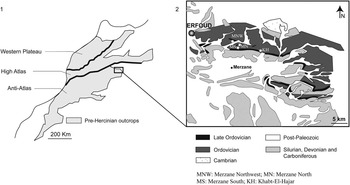
The study area is near Erfoud, in the eastern-most edge of Moroccan Anti-Atlas (Fig. 1). At this particular region, a mixed siliciclastic-carbonate platform developed during the late Katian, dominated by bryozoans and rare echinoderms, trilobites, brachiopod, and gastropods (Álvaro et al., Reference Álvaro, Vennin, Villas, Destombes and Vizcaïno2007). It is represented by the Khabt-el-Hajar Formation (Destombes et al., Reference Destombes, Hollard and Willefert1985), consisting of two-mixed siliciclastic-carbonate units separated by a marly unit in distal areas and a major disconformity in proximal areas. A preliminary sedimentologic and stratigraphic study of the succession was presented by Meddour et al. (2010). A more detailed stratigraphic and sedimentologic description can be found in Jiménez-Sánchez et al. (Reference Jiménez-Sánchez, Vennin and Villas2015). The studied bryozoans have been collected from different horizons at the Merzane South (MS) and Merzane North (MN) sections, described in the latter paper (Figs. 2 and 3). Most of the bryozoans are from the intermediate unit of the Khabt-el-Hajar Formation (horizons MS3, MS4, and MN3-5), made up of marls to fine-grained limestones, which shows large lateral variations in thickness. It disappears toward the northeast, where it is replaced by a major erosional surface in Khabt-el-Hajar (Fig. 1). The bryozoan biofacies that characterizes this unit is made up of delicate-branching bryozoans, forming meter-scale patches and bioaccumulations embedded in a marly substrate developed in outer ramp environments. The rest of the studied bryozoans have been collected from the lower unit of the formation at the Merzane South section (horizons MS1 and MS2), which is characterized by a bryonoderm biofacies dominated by thick crinoids and robust-branching bryozoans. The unit developed in mid-ramp settings and corresponds to pelmatozoan-bryozoan meadows degraded by wave activity with an input of siliciclastic material (Jiménez-Sánchez et al., Reference Jiménez-Sánchez, Vennin and Villas2015).
(1) General map of the east area of Erfoud (Anti-Atlas, Morocco), with (2) the location of the studied stratigraphic sections. Taken from Jiménez-Sánchez et al. (in 2015).

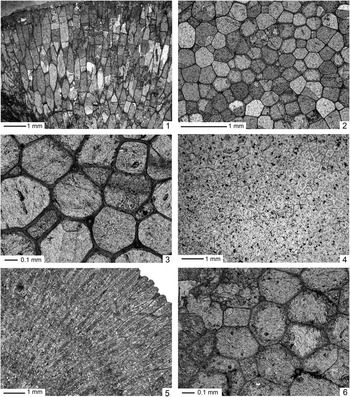
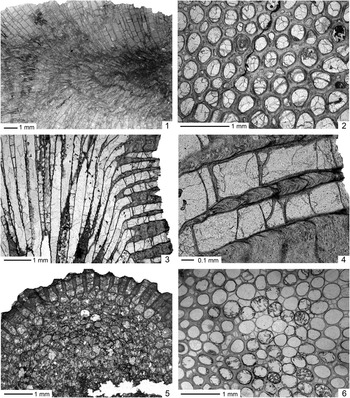
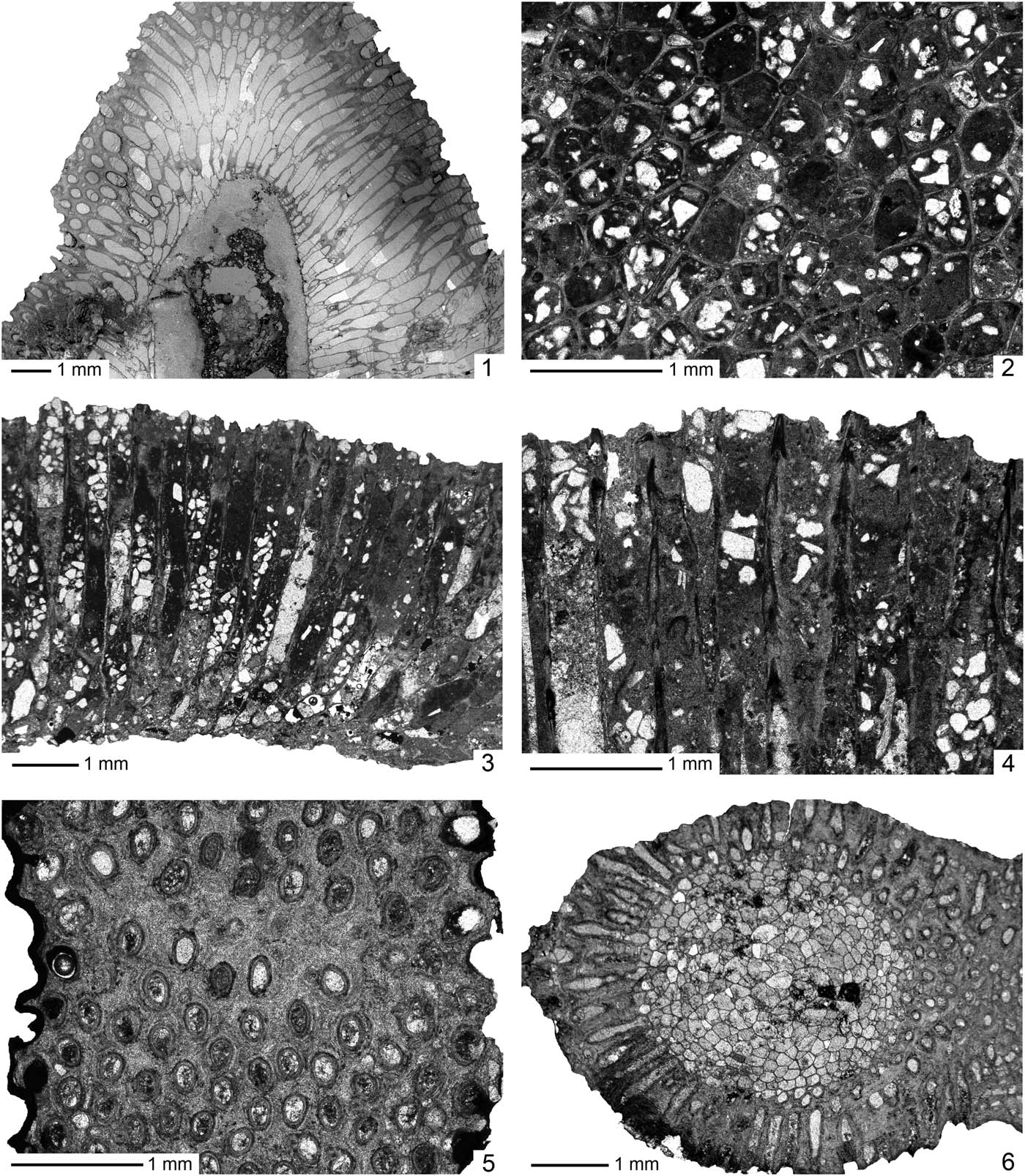
(1–3) Cyphotrypa magna Boulange, Reference Boulange1963; (1) longitudinal section of the specimen MPZ 2013/142 showing diaphragms in endozone and exozone; (2) tangential section of the specimen MPZ 2013/146 showing the irregularly pentagonal and hexagonal autozooecia in cross section, with the young autozooecia evenly distributed in the colony; (3) detailed tangential section of the specimen MPZ 2013/142 showing the composition an distribution of the acanthostyles. (4–6) Cyphotrypa regularis new species, (4) and (5) specimen MPZ 2013/155 (holotype) in tangential and longitudinal section respectively; (4) view of the irregularly pentagonal and hexagonal autozooecia; (5) regular distribution of diaphragms both in endozone and exozone; they are placed at similar height in neighboring autozooecia; (6) detailed tangential section of the specimen MPZ 2013/154 showing acanthostyles and young autozooecia. Specimens MPZ 2013/142 and 146 from horizon MN3; specimen MPZ 2013/154 from horizon MN5. Specimen MPZ 2013/155 from horizon MS1.

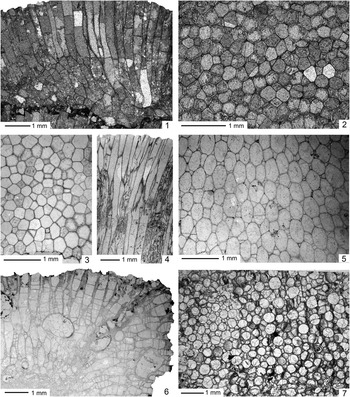
(1, 2)Cyphotrypa sp.1; (1) longitudinal section of the specimen MPZ 2013/156 showing the irregular distribution of diaphragms; (2) tangential section of the specimen MPZ 2013/157 showing the irregularly polygonal autozooecia cross section and the small acanthostyles in the corner of them. (3, 4)Cyphotrypa? sp.2; (3) tangential section of the specimen MPZ 2013/160 showing the irregularly polygonal autozooecia cross section, as well as the absence of acanthostyles; (4) longitudinal section of the specimen MPZ 2013/163 showing the scarcity of diaphragms. (5, 6)Calloporella aff. expressa (Bassler, Reference Bassler1911) (MPZ 2013/141); (5) deep tangential section showing autozooecia and mesozooecia in cross section; (6) longitudinal section showing the distribution of autozooecia and mesozooecia, as well as the autozooecial and mesozooecial diaphragms. (7) Diplotrypa languedociana Dreyfuss, Reference Dreyfuss1948; tangential section of the specimen MPZ 2013/167 showing a large number of autozooecia completely surrounding by mesozooecia. Specimen MPZ 2013/141 from horizon MS3; specimens MPZ 2013/156, 157 and 167 from horizon MN5; specimen MPZ 2013/160 from horizon MN3.

Systematic paleontology
A total of 88 thin sections cut from 43 colonies were studied in this systematic work using a transmitted light petrographic microscope. The measurements were taken from the thin sections, either directly through the microscope with micrometer or from scaled photographs. The material described here is housed in the Museo de Ciencias Naturales of the University of Zaragoza (Spain) with catalog numbers MPZ 2013/X, where “X” is the identification number for each specimen. These numbers appear in the description of the species. Table 1 shows the stratigraphic section and horizon where each specimen was collected.
Stratigraphic distribution of the specimens described in the text.

MNx refers to Merzane North section, and MSx to Merzane South section, where “x” is the level in which the specimen has been collected.
Class Stenolaemata Borg, Reference Borg1926
Order Trepostomata Ulrich, Reference Ulrich1882
Family Atactotoechidae Duncan, Reference Duncan1939
Genus Cyphotrypa Ulrich and Bassler, Reference Ulrich and Bassler1904
Type species
Cyphotrypa acervulosa (Ulrich, Reference Ulrich1893). Galena shales, Upper Ordovician of Iowa (USA).
Diagnosis
Following the original diagnosis (Ulrich and Bassler, Reference Ulrich and Bassler1904) this genus is characterized by having a massive zoarium with low monticules; autozooecial apertures polygonal with thin walls; complete diaphragms, more abundant in exozone; acanthostyles well developed; and mesozooecia absent.
Occurrence
This genus has a broad distribution both temporal and spatial, being present in materials from the Middle Ordovician to the Upper Devonian in North America, Europe, Asia, and Australia.
Cyphotrypa magna Boulange, Reference Boulange1963
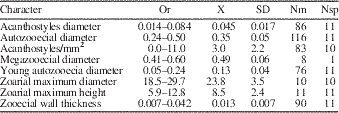
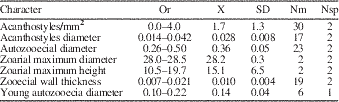
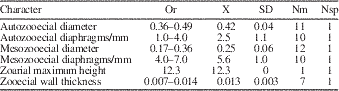
Summary of the statistical analysis of Cyphotrypa magna Boulange, Reference Boulange1963.
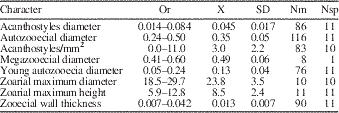
All measurements in millimeters.
Nm=total number of measurements, Nsp=number of colonies on which measurements have been taken, Or=observed range, SD=standard deviation, and X=mean value.
1963Cyphotrypa magna Boulange, p. 36, pl. I, figs. 3a,b.
Holotype
Specimen N166 is stored in the Institut Catholique de Toulouse, France.
Description
Zoaria massive with a maximum diameter of 23.8 mm and a maximum height of 8.5 mm. The external surface is eroded in most cases, but in some zoaria monticules are easily visible and are composed of autozooecial apertures both larger and smaller than those in the intermonticular area. Autozooecial apertures irregularly hexagonal and pentagonal, with an average diameter of 0.35 mm in intermacular areas, and 0.49 mm in monticular areas; small zooecial apertures (0.13 mm of average diameter) irregularly triangular or quadrangular and evenly distributed in the colony, interpreted here as young autozooecia. Numerous diaphragms are present throughout autozooecia, with a distance between them that ranges from less than one to three times the autozooecial diameter; they are mainly straight although inclined, slightly concave or convex, and cystoids diaphragms can also be seen. Acanthostyles large (0.045 mm of average diameter) with a density of 3.0/mm2; they are composed of a hyaline core surrounded by thin dark sheets and are located mainly in autozooecial corners, although some of them are seeing inflecting the autozooecial apertures. Autozooecial walls 0.013 mm of average thickness and slightly undulated. Mesozooecia absent.
Occurrence
Cyphotrypa magna occur in Glauzy Formation (Upper Ordovician, middle Katian) in Montagne Noire (France), and in the Khabt-el-Hajar Formation in the horizons MN3 and MN5, eastern Moroccan Anti-Atlas (Upper Ordovician, upper Katian).
Material
Ten zoaria in longitudinal and tangential sections (MPZ 2013/142, MPZ 2013/145–153); one zoarium in tangential section (MPZ 2013/144); and one zoarium in longitudinal section (MPZ 2013/143). In all of them the external morphology has been also studied.
Remarks
Material described here fits well with Cypotrypa magna Boulange, Reference Boulange1963, as defined by him in the Upper Ordovician of the Montagne Noire (France). Both materials share the shape and size of the autozooecial apertures, the density and composition of acanthostyles, and the presence of diaphragms through all the length of the autozooecial tube, although in Cyphotrypa magna diaphragms are more narrowly spaced. We consider the small variation in the number of diaphragms only of secondary importance, and include these Moroccan zoaria in Cyphotrypa magna.
Cypotrypa magna is close to Cyphotrypa acervulosa (Ulrich, Reference Ulrich1893) as described by Brown (Reference Brown1965) in the Middle Ordovician of Kentucky, and to Cyphotrypa bulbosa (Billings, Reference Billings1865) as described by Bassler (Reference Bassler1927) in the Upper Ordovician of Anticosti Island (Canada), but it can be distinguished from Cyphotrypa acervulosa because it has less and larger acanthostyles (in Cyphotrypa acervulosa acanthostyles are present in almost all autozooecial corners and they look like small dark points in tangential section); from Cyphotrypa bulbosa can be distinguished because this species has smaller acanthostyles than Cypotrypa magna and diaphragms are more numerous in the exozone.
Cyphotrypa regularis new species (by Jiménez-Sánchez)
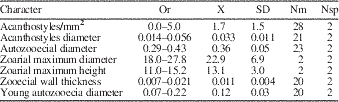
Summary of the statistical analysis of Cyphotrypa regularis new species.
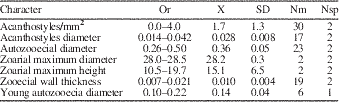
All measurements in millimeters.
Nm=total number of measurements, Nsp=number of colonies on which measurements have been taken, Or=observed range, SD=standard deviation, and X=mean value.
Types
Holotype—MPZ 2013/155. Paratype—MPZ 2013/154.
Diagnosis
This species is characterized by having scarce diaphragms throughout autozooecia and placed at very similar height in all autozooecia, and by the presence of small, scarce but clearly defined acanthostyles.
Occurrence
Cyphotrypa regularis is exclusive from the Khabt-el-Hajar Formation in horizons MN5 and MS1, eastern Moroccan Anti-Atlas (Upper Ordovician, upper Katian).
Description
Zoaria massive, dome-shaped, growing over a small massive bryozoan colony; with a maximum diameter of 28.2 mm and a maximum height of 15.1 mm. Zoarial surface without monticules, but with large autozooecia grouped forming maculae. Autozooecial apertures irregularly hexagonal and pentagonal, with an average diameter of 0.36 mm; small zooecial apertures (0.14 mm of average diameter), irregularly triangular or quadrangular and evenly distributed in the colony, are interpreted here as young autozooecia. Diaphragms present throughout autozooecia, located at similar height in neighboring tubes and with a spacing between them of almost five times the autozooecial diameter, although some of them can be as close as 1.5 diameters; they are mainly straight, although inclined, and slightly concave or convex can also be seen. Acanthostyles present, but scarce (1.7/mm2) and small in size (0.028 mm of average diameter), seen mainly in tangential section; they are composed of a small hyaline core surrounded by thin dark sheets and are located mainly in autozooecial corners. Autozooecial walls 0.010 mm of average thickness, but thicker in some regions and slightly undulated. Mesozooecia absent.
Etymology
After the very regular organization of autozooecial diaphragms.
Material
Two zoaria studied in longitudinal and tangential section as well as its external morphology (MPZ 2013/154 and MPZ 2013/155).
Remarks
The specimens described fit well in the definition of the genus Cyphotrypa because they share the massive growth habit, the polygonal autozooecial apertures in cross-section, the thin walls sometimes undulated, the presence of complete diaphragms and acanthostyles, as well as the absence of mesozooecia. So, this material is assigned to this genus. However, none Cyphotrypa species known until now has the particularly regular distribution of diaphragms or the very small, scarce but clearly defined acanthostyles observed in these specimens. Cyphotrypa regularis is defined here to include this Moroccan material.
Cyphotrypa regularis shares with Cyphotrypa magna Boulange, Reference Boulange1963 (up to now the only species of Cyphotrypa known from the Mediterranean region, described by Boulange in the Upper Ordovician of the Montagne Noire [France], and also in this work) the size of the autozooecial apertures and the density of acanthostyles, but the two species can be easily distinguished because in Cyphotrypa magna diaphragms are much more numerous and acanthostyles are larger (0.014–0.084 mm in Cyphotrypa magna vs. 0.014–0.042 mm in Cyphotrypa regularis). Cyphotrypa regularis is closely related to Cyphotrypa osgoodensis Ulrich and Bassler, Reference Ulrich and Bassler1904, as described by Perry and Hattin (Reference Perry and Hattin1960) in the Lower Silurian of Indiana. Both species have few autozooecial diaphragms, sometimes completely absent in the American species, autozooecial cross-section hexagonal or pentagonal and acanthostyles well defined; but, when present, the distribution of diaphragms is not regular in Cyphotrypa osgoodensis, autozooecia are larger in cross-section and acanthostyles are much more numerous than in Cyphotrypa regularis.
Cyphotrypa sp.1
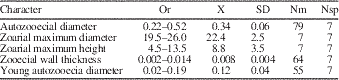
Summary of the statistical analysis of Cyphotrypa sp.1.
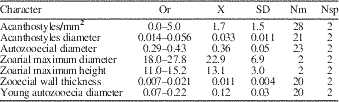
All measurements in millimeters.
Nm=total number of measurements, Nsp=number of colonies on which measurements have been taken, Or=observed range, SD=standard deviation, and X=mean value.
Description
Zoaria massive, with a maximum diameter of 22.9 mm and a maximum height of 13.1 mm. Zoarial surface without monticules, but with groups of large autozooecia forming maculae. Autozooecial apertures irregularly pentagonal, hexagonal and even heptagonal, with an average diameter of 0.36 mm; small zooecial apertures (0.12 mm of average diameter) irregularly triangular, quadrangular, or pentagonal, evenly distributed in the colony and interpreted here as young autozooecia. Autozooecial diaphragms present in the outer endozone and in exozone, although more numerous in inner exozone; in the exozone, the first diaphragms appear at a very similar height in all autozooecia; the separation between them is very irregular, from less than one autozooecial diameter to more than three; they are mainly straight although slightly concave or convex can also be seen, or even so strongly inclined that they are visible inside autozooecial apertures in tangential section. Acanthostyles irregularly distributed, very abundant in some regions of the colony and almost absent in others; without taking into account this irregular distribution, there are an average of 1.7/mm2; they are located mainly in autozooecial corners, have an average diameter of 0.033 mm and are composed of a small hyaline core surrounded by thin dark sheets. Autozooecial walls 0.011 mm of average thickness, but thicker in some regions due to the presence of acanthostyles; slightly undulated and crenulated in some parts of the colony. Mesozooecia absent.
Occurrence
Cyphotrypa sp.1 is exclusive from the Khabt-el-Hajar Formation in horizons MN5 and MS2, eastern Moroccan Anti-Atlas (Upper Ordovician, upper Katian).
Material
Two zoaria studied in longitudinal and tangential section (MPZ 2013/156 and MPZ 2013/157) and one zoarium studied in longitudinal section (MPZ 2013/158). In all cases, the external morphology has also been studied.
Remarks
This material presents all the diagnostic characters that define the genus Cyphotrypa, but the distribution of its diaphragms, present in inner endozone and in all exozone is not observed in any of the species previously included in this genus. The two zoaria here described have part of their internal anatomy obliterated due to crushing during burial, both in vertical and horizontal directions, and not many autozooecia can be seen from the base of the colony to the upper surface of it. This is why we think the definition of a new species is not appropriate in these conditions. So, these specimens are included in the genus Cyphotrypa, but we leave them in open nomenclature to specific level.
Cyphotrypa sp.1 is closely related to Cyphotrypa regularis, described here, by both having few acanthostyles and diaphragms, but in Cyphotrypa regularis diaphragms are even less numerous than in Cyphotrypa sp.1 and have a very much regular distribution. From Cyphotrypa magna it can be easily distinguished because diaphragms are less numerous and ancanthostyles are smaller in Cyphotrypa sp.1 (0.014–0.084 mm in Cyphotrypa magna vs. 0.014–0.056 mm in Cyphotrypa sp.1).
Cyphotrypa? sp.2
Summary of the statistical analysis of Cyphotrypa sp.2.
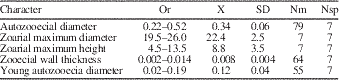
All measurements in millimeters.
Nm=total number of measurements, Nsp=number of colonies on which measurements have been taken, Or=observed range, SD=standard deviation, and X=mean value.
Description
Zoaria massive with a high degree of diagenetic and tectonic alteration affecting external and internal features; maximum diameter of 22.4 mm and a maximum height of 8.8 mm. In the upper surface low circular monticules can be observed. Autozooecial apertures irregularly polygonal with five to eight sides and an average diameter of 0.34 mm; small zooecial apertures (0.12 mm of average diameter) irregularly triangular, quadrangular, or rhomboidal and evenly distributed in the colony interpreted here as young autozooecia; groups of slightly larger autozooecia than the average form maculae. Longitudinal characters have been only observed in the specimen MPZ 2013/163. In it, diaphragms are scarce with no more than one or two per autozooecia and mainly concave or convex. Autozooecial walls thin, 0.008 mm of average thickness, and slightly undulated in some parts of the colony. Acanthostyles and mesozooecia absent.
Occurrence
Cyphotrypa? sp.2 is exclusive from the Khabt-el-Hajar Formation in the horizons MN3 and MN5, Eastern of Moroccan Anti-Atlas (Upper Ordovician, upper Katian).
Material
Seven zoaria studied in longitudinal and tangential section (MPZ 2013/159–165). In the specimens MPZ 2013/160, MPZ 2013/162, and MPZ 2013/165 the external morphology has been also studied.
Remarks
The preservation of the specimens described here is not good, but most of the identified characters fit well with the definition of the genus Cyphotrypa sharing with it the massive growth habit, the polygonal autozooecial apertures in cross-section, the thin walls sometimes undulated, the presence of complete diaphragms, and the absence of mesozooecia. But Moroccan specimens have an important difference with respect to the diagnosis of the genus: they lack acanthostyles, whereas this structure is present in all known species of Cyphotrypa.
Cyphotrypa? sp.2 can be easily distinguished from Cyphotrypa magna, Cyphotrypa regularis, and Cyphotrypa sp.1 previously described, because of the absence of acanthostyles and by the scarcity of diaphragms in it.
Family Halloporidae Bassler, Reference Bassler1911
Genus Calloporella Ulrich, Reference Ulrich1882
Type species
Calloporella harrisi Ulrich, Reference Ulrich1883. Richmond Formation, Upper Ordovician of Ohio and Indiana (USA).
Diagnosis
Following Pushkin (Reference Pushkin1981) Calloporella is characterized by a laminated zoarium with encrusting free habit of life; endozone restricted to recumbent part of autozooecia; autozooecial apertures circular, oval or irregularly polygonal; zooecial walls with laminated structure; autozooecia with diaphragms, but very variable in number and distribution inside autozooecia; mesozooecia abundant, sometimes isolating autozooecia, and densely tabulated by diaphragms.
Occurrence
This genus is present from the Middle Ordovician to the Upper Ordovician of Europe, in the Upper Ordovician of North America and North Africa, as well as in the Middle Silurian of China.
Calloporella aff. expressa (Bassler, Reference Bassler1911)
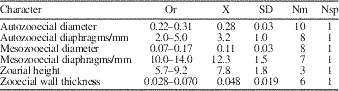
Summary of the statistical analysis of Calloporella aff. expressa (Bassler, Reference Bassler1911).
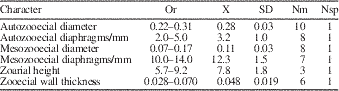
All measurements in millimeters.
Nm=total number of measurements, Nsp=number of colonies on which measurements have been taken, Or=observed range, SD=standard deviation, and X=mean value.
aff. 1911Calloporella expressa (Bassler), p. 200, text fig. 108.
Description
Zoarium with laminar habit of growth having an average height of 7.8 mm and a maximum length of 40.0 mm; external surface eroded, but monticules can be distinguished, although not their composition. Autozooecial apertures circular or subcircular in shallow tangential sections and irregularly polygonal in deeper ones, where they have an average diameter of 0.28 mm. Autozooecial diaphragms present in endozone and exozone, with an average of 3.2/mm; they are mainly straight, but inclined forms resting in the lower diaphragm are also present. Mesozooecia developed from the base of the colony, but at least 50% of them do not reach the upper surface; they are irregularly polygonal with an average maximum diameter of 0.11 mm. Mesozooecial diaphragms abundant (12.3/mm), mainly straight and producing a narrowing in mesozooecia when they join to the wall. Autozooecial walls laminated and thin in endozone and internal exozone, with an average thickness of 0.048 mm; considerably thicker when mesozooecia disappear, since part of the space left by them is occupied by the thickened wall.
Occurrence
The species to which we are referring the Moroccan specimen has been described in the Kuckers Shale (Middle-Upper Ordovician, upper Darriwilian-lower Sandbian) in Reval, Estonia, and in the Khabt-el-Hajar Formation in horizon MS3, eastern Moroccan Anti-Atlas (Upper Ordovician, upper Katian).
Material
One zoarium studied in tangential and longitudinal sections; external morphology has been also studied (MPZ 2013/141).
Remarks
The features of this specimen agree with the emended diagnosis of Pushkin (Reference Pushkin1981) for the genus Calloporella. It shares the laminar habit of growth; the shape of autozooecial apertures; the structure of zooecial walls; the presence of numerous mesozooecia; and the presence of diaphragms both in autozooecia and mesozooecia, being more abundant in the latter.
This specimen is closely related to Calloporella expressa (Bassler, Reference Bassler1911) as it was described by this author in the Kuckers Shale (Upper Ordovician) of Estonia. It has the key diagnostic character of this species: mesozooecia that disappear in the internal exozone. However, in Calloporella expressa, autozooecial diaphragms are more abundant and in the external exozone these diaphragms have morphologies similar to cystiphragms. The presence of this type of diaphragms prevents us from assigning this specimen to Calloporella expressa. However, material described here is no enough to define a new species, so because this specimen has the key diagnostic character of Calloporella expressa is here referred to this species.
In the Mediterranean region, Dreyfuss (Reference Dreyfuss1948) described Calloporella ornata in the Upper Ordovician of Petit Glauzy and Grange-du-Pin (France). This species can be distinguished from Calloporella aff. expressa because mesozooecia are much more abundant (in the French species autozooecia are completely isolated by mesozooecia while in Moroccan species most autozooecia contact each other), and autozooecial diaphragms are scarcer, being absent in some autozooecia in Calloporella ornata. Jiménez-Sánchez (Reference Jiménez-Sánchez2009), in the Upper Ordovician of the Iberian Chains, Spain, described a taxon assigned to Calloporella, but left it in open nomenclature to the specific level. Calloporella sp. can be distinguished from Calloporella aff. expressa because the former has larger autozooecial apertures (0.27–0.40 mm in Calloporella sp. vs. 0.22–0.31 mm in Calloporella aff. expressa), more mesozooecia, and diaphragms are very scarce in autozooecia.
Genus Diplotrypa Nicholson, Reference Nicholson1879
Type species
Monticulipora petropolitanus Nicholson, Reference Nicholson1879. Middle Ordovician of Sweden.
Diagnosis
Following Key (Reference Key1991), Diplotrypa is characterized by having massive or massive-ramose zoaria, sometime with maculae composed of a cluster of megazooecia and mesozooecia that can be slightly elevated. Endozone and exozone poorly differentiated. Zooecia can be heterogeneously distributed in the colony; they gradually expand distally through early ontogeny and curve outward toward colony surface. Zooecia are characterized by the ontogenetic progression of mesozooecia into autozooecia. Mesozooecia with more closely spaced diaphragms in the exozone; in some species, they completely isolate autozooecia. Autozooecia cross-section large and circular, sometime polygonal; autozooecial diaphragms planar, concave, convex, or cystoidal, with a variable density. Zooecial walls thin throughout colony, composed of microlaminae. Acanthostyles and mural spines absent.
Occurrence
This genus has a wide temporal and spatial distribution, being present from the Lower Ordovician to the Upper Silurian in North America, Europe, and Asia, as well as in the Upper Ordovician of North Africa.
Diplotrypa languedociana Dreyfuss, Reference Dreyfuss1948
(1) Diplotrypa languedociana Dreyfuss, Reference Dreyfuss1948; longitudinal section of the specimen MPZ 2013/167 showing the distribution of autozooecia and mesozooecia, as well as the autozooecial and mesozooecial diaphragms. (2–5) Parvohallopora cystata new species; (2) tangential section of the specimen MPZ 2013/241 showing the circular to subcircular autozooecial cross section and the small size of mesozooecial cross section; (3) longitudinal section of the same specimen showing the crenulated autozooecial walls in the endozone, the distribution of the autozooecial and mesozooecial diaphragms and the strong zooecial angle with the zoarial surface; (4) detailed tangential section of the specimen MPZ 3013/240 (holotype) showing the cystoidal diaphragms as well as the zooecial wall laminations; (5) cross section of the specimen MPZ 2013/243 showing the narrow exozone. (6) Parvohallopora sp. (MPZ 2013/251), deep tangential section showing the autozooecial and mesozooecial cross-sections. Specimen MPZ 2013/167 from horizon MN5; specimens MPZ 2013/240, 241 and 251 from horizon MN3; specimen MPZ 2013/243 from horizon MS3.

Summary of the statistical analysis of Diplotrypa languedociana Dreyfuss, Reference Dreyfuss1948.
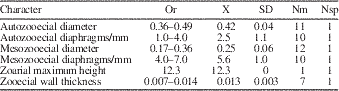
All measurements in millimeters.
Nm=total number of measurements, Nsp=number of colonies on which measurements have been taken, Or=observed range, SD=standard deviation, and X=mean value.
1948Diplotrypa languedociana Dreyfuss, p. 31, pl. 3, figs. 1–3.
1990Diplotrypa sardoa Conti, p. 98, pl. 7, figs. 7–8, pl. 8, figs. 1–2, pl. 9, fig. 7.
2007Diplotrypa languedociana Dreyfuss; Ernst and Key, p. 27, pl. 8, figs. 14–16, pl. 9, figs. 1–2.
Description
Zoaria with massive growth habit, amorphous in shape and with a maximum height of 12.3 mm; external surface is eroded and monticules cannot be distinguished. Autozooecial apertures subcircular or subpolygonal with maximum diameter of 0.42 mm on average. Autozooecial diaphragms present in endozone and exozone with an average of 2.5/mm, but with an inhomogeneous distribution in both zones; they are mainly straight, but concave, convex, inclined, and cystoidal morphology are also present. Mesozooecia developed from the inner endozone, so abundant than most autozooecia are isolated by them; irregularly polygonal in shape, with an average maximum diameter of 0.25 mm, but variable in size; Mesozooecial diaphragms evenly distributed in endozone and exozone, with an average density of 5.6/mm. Generation of autozooecia from mesozooecia occurs, but it is not common; the process involves the union of several mesozooecia at a point where all of them have diaphragms at the same level; from there on, diaphragm production ceases and a small autozooecium with a basal diaphragm develops; this process takes place in the exozone and it is the only difference between endozone and exozone. Zooecial walls thin throughout the colony, with an average thickness of 0.013 mm and without a discernible microstructure. Acanthostyles absent.
Occurrence
Diplotrypa languedociana is known exclusively from the Mediterranean region, being reported in the Gabian Formation (Upper Ordovician, upper Katian) in the Montagne Noire, France; in the Uggwa Formation, Silstone/sandstone Member (Upper Ordovician, middle Katian) in Valbertad, Italian Carnic Alps; in the Unit e (Upper Ordovician, middle Katian) in Sardinia, Italy; and in the Khabt-el-Hajar Formation in the horizon MN5, eastern Anti-Atlas of Morocco (Upper Ordovician, upper Katian).
Material
One zoarium in tangential and longitudinal sections (MPZ 2013/167). The external morphology has also been studied.
Remarks
The external and internal morphology of this specimen agree with the amended diagnosis made by Key (Reference Key1991) for Diplotrypa. It has a massive habit of growth; endozone and exozone poorly differentiated; development of autozooecia from mesozooecia; autozooecia with a large subpolygonal cross-section; autozooecial diaphragms present in endozone and exozone, with different morphology; Mesozooecia so numerous that completely isolate autozooecia in most parts of the colony, with a high density of diaphragms in endozone and exozone; zooecial walls thin throughout the colony; and absence of acanthostyles. So this specimen is included in this genus.
The study of the species belonging to Diplotrypa shows that this material fits well with Diplotrypa languedociana, which has a broad distribution in the Upper Ordovician of the Mediterranean region. In addition to all diagnostic characters for the genus, they share the mechanism by which mesozooecia become autozooecia, the size of autozooecial cross-section, the morphology of autozooecial diaphragms and their irregular distribution, the distribution and morphology of mesozooecia, and the distribution of diaphragms. So, this Moroccan zoarium is assigned to Diplotrypa languedociana. Ernst and Key (Reference Ernst and Key2007) point out that acanthostyles can be either present or completely absent in this species. This structure was described in specimens of Diplotrypa languedociana from the Upper Ordovician of France and the Italian Carnic Alps, but they are completely absent in the zoaria from the Upper Ordovician of Sardinia (Italy). In the only zoarium studied is this work, acanthostyles are absent.
In the Mediterranean region, other Diplotrypa species, Diplotrypa gemmata (Conti, Reference Conti1990), has also been described in the Upper Ordovician of Sardinia (Italy) by this author and in the Upper Ordovician of the Iberian Chains by Jiménez-Sánchez (Reference Jiménez-Sánchez2009). This species can be easily distinguished from the Diplotrypa languedociana described here because the former has well-differentiated endozone and exozone due to the different distribution of autozooecial diaphragms, maculae formed by a group of mesozooecia are present, and zooecial walls are thicker (0.01–0.03 mm in the Iberian Diplotrypa gemmata vs. 0.007–0.014 in Diplotrypa languedociana).
Genus Parvohallopora, Singh, Reference Singh1979
Type species
Monticulipora ramosa d’Orbigny, Reference d’Orbigny1850. Lower Silurian of Cincinnati, Ohio, USA.
Diagnosis
Following Singh (Reference Singh1979), the genus Parvohallora is characterized by having a ramose zoarium with smooth surface or monticules regularly spaced; exozone well developed; autozooecia forming sharp angles with the zoarial external surface; autozooecial cross-section irregularly polygonal in endozone and polygonal or circular to subcircular in exozone; autozooecial diaphragms present in endozone and exozone, although they can be absent in the exozone in some species; autozooecial diaphragms perpendicular to autozooecial walls or curved, but rarely cystoidal; mesozooecia present and numerous, circular to subcircular in cross-section and with a diameter less than a half of that of autozooecia; mesozooecial diaphragms numerous and perpendicular to mesozooecial walls or curved; zooecial walls laminated with an inverse U or V pattern.
Occurrence
Middle–Upper Ordovician and Lower Silurian of North America, Upper Ordovician of South America and North Africa, Upper Ordovician and Lower Silurian of Europe, and Upper Ordovician and Lower Silurian of Mongolia.
Remarks
Accordingly with Singh (1979) Parvohallopora can be distinguished from Hallopora because the former has smaller autozooecial apertures, mural spines are absent in autozooecia, mesozooecia are smaller and more abundant, cystoidal diaphragms are rare or absent in autozooecia and absent in mesozooecia, and zooecial walls are laminated with an inverse U or V patterns, which in Hallopora are rarely present.
Parvohallopora cystata new species (by Jiménez-Sánchez)
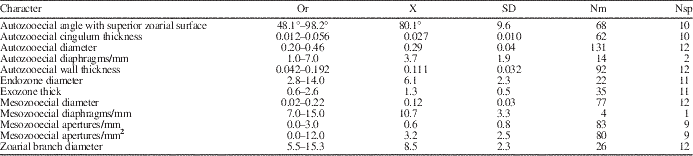
Summary of the statistical analysis of Parvohallopora cystata new species.
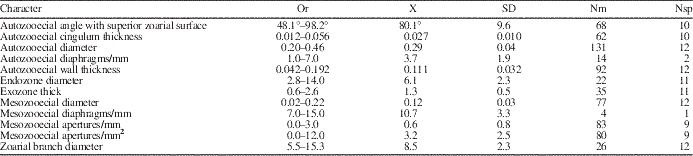
All measurements in millimeters.
Nm=total number of measurements, Nsp=number of colonies on which measurements have been taken, Or=observed range, SD=standard deviation, and X=mean value.
Types
Holotype—MPZ 2013/240. Paratypes—MPZ 2013/241 and MPZ 2013/243.
Diagnosis
This Parvohallopora is characterized by the presence of numerous autozooecial cystoidal diaphragms in the exozone, by having crenulated autozooecial walls in the internal endozone, and by the scarcity of mesozooecia.
Occurrence
Parvohallopora cystata is exclusive from the Khabt-el-Hajar Formation in the horizons MN4, MS3, and MS4, eastern Moroccan Anti-Atlas (Upper Ordovician, upper Katian).
Description
Ramose zoaria with circular branches dichotomously divided; individual branches have an average diameter of 8.5 mm; external surface smooth and apparently without maculae. In tangential section, circular or subcircular autozooecial apertures with an average diameter of 0.29 mm and surrounded by a thick cingulum of 0.027 mm of average thickness. Mesozooecial apertures circular or subcircular, with an average diameter of 0.12 mm and not abundant (0.6/mm and 3.2/mm2). Zooecial walls thick (0.111 mm of average thickness) and with a clear laminated structure. In longitudinal section, autozooecia are seen as large and long tubes growing parallel to the growth direction of the branch in the axial endozone and gently curving in the peripheral endozone; curvature in the internal exozone becomes stronger, forming an angle of up to 80° with the zoarial surface; autozooecial diaphragms present in endozone and exozone, but in the former their distribution is very irregular; in the same zoarium, some autozooecia have diaphragms in both the axial and peripheral endozone whereas others only in one of them; in this part of the colony, diaphragms are never closer than 1.5 autozooecial diameters and they are thin and perpendicular to the walls; in exozone diaphragms, are more abundant (4/mm) and their morphology is more varied: perpendicular to the walls, inclined, concave and convex and also cystoidal; here some diaphragms are very thick and with a clear laminated structure, which becomes part of the wall lamination. Mesozooecia developed in the peripheral endozone and finely tabulated by diaphragms, with an average of 10.7/mm; these diaphragms are perpendicular to the walls, thick, and with a laminated structure that in some cases also becomes part of the wall lamination; in external exozone, some mesozooecia are filled with calcitic deposits and others become autozooecia by increasing its diameter and developing diaphragms. Autozooecial wall in endozone varies from strongly crenulated to slightly undulated; it is thin, increasing its thickness in the transit endozone-exozone; in the exozone zooecial walls, show a clear laminated structure with an inverse V pattern. In cross-section, the endozone has an average diameter of 6.1 mm and the exozone an average thickness of 1.3 mm; in endozone, autozooecia are irregularly polygonal and with a wide range of sizes, but they tend to be larger in the internal part than in the external one.
Etymology
After the frequency of cystoidal diaphragms in autozooecia.
Material
Twelve specimens in different sections and external morphology (MPZ 2013/240–250 and MPZ 2013/253).
Remarks
This material has been included in the genus Parvohallopora because it presents most of the diagnostic characters: sharp angle of the autozooecia with the zoarial external surface, autozooecial cross-section irregularly polygonal in endozone and polygonal or circular to subcircular in exozone, autozooecial diaphragms in endozone and exozone, mesozooecia present with the same morphology and size as well as the lamination of the zooecial walls with an inverse V pattern. However, in the specimens described here, mesozooecia are not so abundant as in the other species included in the genus, cystoid diaphragms are common and autozooecial walls are crenulated in endozone, characters that also makes this material different from the rest of Parvohallopora species. So, we define the new species Parvohallopora cystata to include the specimens that present these characters: autozooecial cystoid diaphragms, mesozooecia not abundant, and crenulated autozooecial walls.
Parvohallopora cystata can be easily distinguished from the other two Parvohallopora species described in the Mediterranean region (Parvohallopora onealli [James, Reference James1875], described by Ernst and Key [Reference Ernst and Key2007] in the Upper Ordovician of the Montagne Noire [France], and Parvohallopora cf. ramosa [d’Orbigny, Reference d’Orbigny1850], described by Jiménez-Sánchez [Reference Jiménez-Sánchez2009] in the Upper Ordovician of the Iberian Chains [Spain]) because Parvohallopora onealli has smaller branch cross-section (2.3–2.8 mm vs. 5.5–15.3 in the new species), a smaller autozooecial angle with the zoarial surface (35°, whereas in the new species this angle is always higher than 48°), very scarce or no cystoid diaphragms, and abundant mesozooecia. From Parvohallopora cf. ramosa can be distinguished because this species has smaller branch cross-section (2.3 mm of average diameter vs. 8.5 mm of average diameter in the new species), more abundant mesozooecia and more narrowly tabulate by diaphragms, more abundant autozooecial diaphragms in endozone and exozone, and no cystoid diaphragms.
Parvohallopora sp.
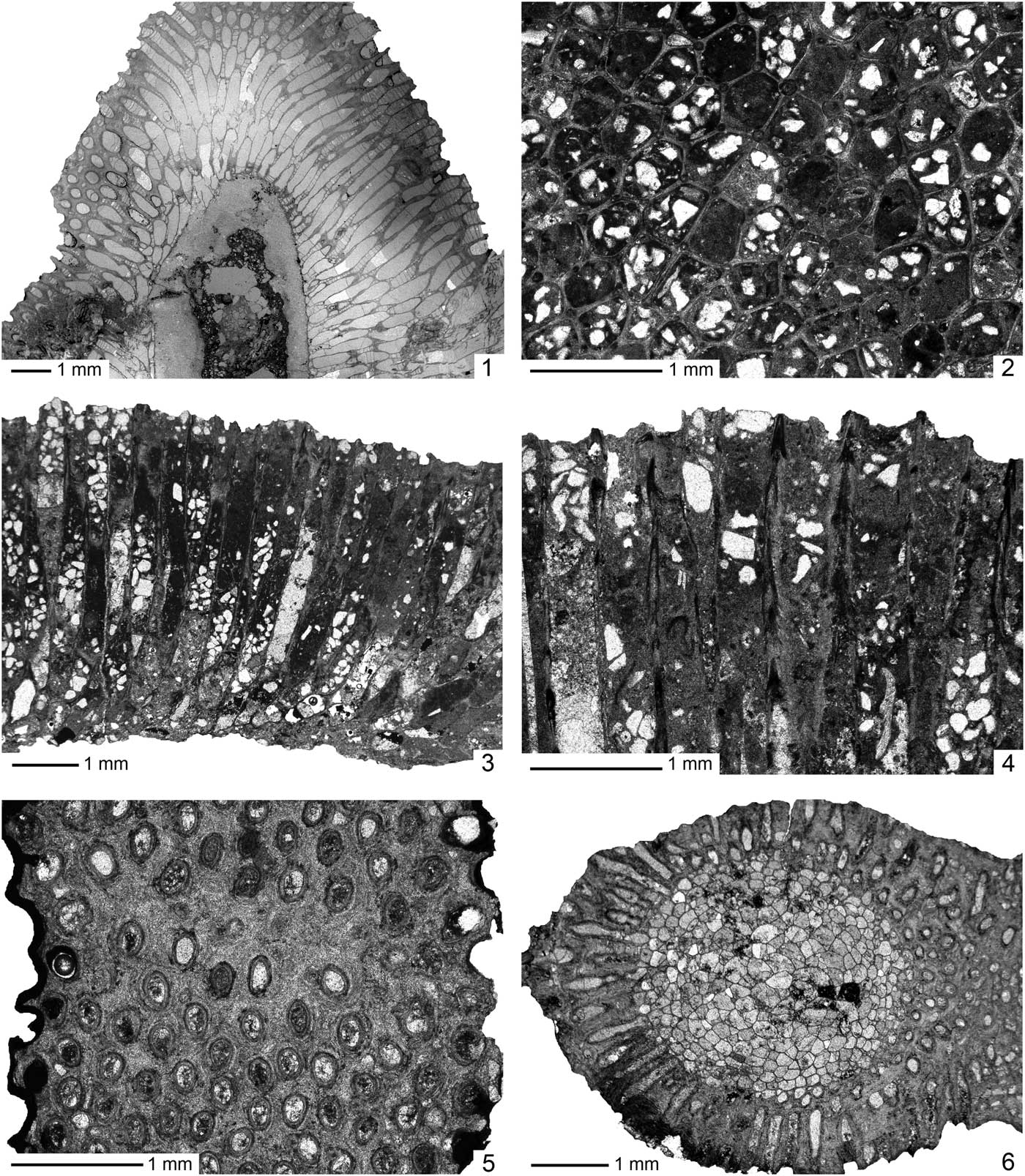
(1) Parvohallopora sp. (MPZ 2013/251), longitudinal section of the colony in the initial massive growth stage. (2–4) Dekayia sp. (MPZ 2013/166); (2) tangential section showing the irregularly polygonal autozooecial cross section, the scarce number of mesozooecia, as well as the abundance and large size of the acanthostyles; (3) longitudinal section showing the absence autozooecial structures and the large longitudinal development of acanthostyles; (4) detailed view of acanthostyles in longitudinal section showing its irregular thickening. (5, 6)Aostipora elongate new species (MPZ 2013/235, holotype); (5) tangential section showing the macula composed by solid calcitic deposit and the oval autozooecial cross sections surrounding by a thick cingulum; (6) general view of a colony cross section showing the largest autozooecia in the inner endozone. Specimens MPZ 2013/166 and 251 from horizon MN3; specimen MPZ 2013/235 from horizon MN4.
Summary of the statistical analysis of Parvohallopora sp.
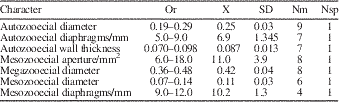
All measurements in millimeters.
Nm=total number of measurements, Nsp=number of colonies on which measurements have been taken, Or=observed range, SD=standard deviation, and X=mean value.
Description
Zoaria with an initial massive habit of growth that becomes ramose in a later stage; external surface smooth, but with maculae composed of larger than normal autozooecia. In tangential section circular or subcircular autozooecial apertures with an average diameter of 0.25 mm for intermacular autozooecia and 0.42 mm for macular ones. Mesozooecial apertures rounded in shallow tangential sections and subpolygonal in deeper ones, where they fill the space left by autozooecia; in shallow sections, they have an average diameter of 0.11 mm. Autozooecial walls of 0.087 mm of average thickness and with a distinct laminated structure. In longitudinal section, autozooecia are seen as large long tubes growing slightly inclined with respect to the growth direction of the branch from the axial endozone; in internal exozone curvature becomes stronger, forming and angle close to 90° with the zoarial surface; autozooecial diaphragms absent in endozone and with a density of 6.9/mm in exozone, but much more numerous in external exozone; they are mainly perpendicular to the walls, but inclined and even cystoidal morphologies are also present; an important number of diaphragms are very thick and with a distinct laminated structure, which becomes part of the wall lamination. Mesozooecia developed in the internal exozone and are finely tabulated by diaphragms, with an average of 10.2/mm; these diaphragms are perpendicular to the walls, thick and, as in the case of autozooecial diaphragms, with a laminated structure that can become part of the wall lamination; in external exozone, some mesozooecia are filled with calcitic deposits. Autozooecial walls slightly undulated and thin in endozone, increasing their thickness in the transit endozone-exozone; in exozone, zooecial walls with a distinct laminated structure with an inverse V pattern.
Occurrence
Parvohallopora sp. is exclusive from the Khabt-el-Hajar Formation in the horizon MN3, eastern Moroccan Anti-Atlas (Upper Ordovician, upper Katian).
Material
One specimen studied in external morphology and in tangential and longitudinal sections (MPZ 2013/251).
Remarks
This specimen has been included in the genus Parvohallopora because it presents most of the diagnostic characters: sharp angle of autozooecia with the zoarial external surface, autozooecial apertures circular or subcircular in the exozone, autozooecial diaphragms present, although they are absent in endozone; mesozooecia abundant with cross-sections ranging from rounded to irregularly polygonal; and zooecial walls with a laminated structure showing an inverse V pattern. However, this specimen neither fits well in any of the Parvohallopora species nor we have enough material and sections to describe a new species, so we leave it in open nomenclature to the specific level.
Parvohallopora sp. can be distinguished from the new specie Parvohallopora cystata, previously described here, because mesozooecia are much more abundant (11.0/mm2 in Parvohallopora sp. vs. 3.2/mm2 in Parvohallopora cystata), cystoidal diaphragms are very scarce (while they are a diagnostic character in Parvohallopora cystata), and macula are present in Parvohallopora sp. and absent in Parvohallopora cystata.
Family Heterotrypidae Ulrich, Reference Ulrich1890
Genus Dekayia Milne-Edwards and Haime, Reference Milne-Edwards and Haime1851
Type species
Dekayia aspera Milne-Edwards and Haime, Reference Milne-Edwards and Haime1851, Upper Ordovician of North America.
Diagnosis
Following Ernst and Key (Reference Ernst and Key2007). Zoarium ramose, encrusting or massive, generally with low monticules. Very few diaphragms, typically absent in endozone and widely sparse or absent in exozone. Zooecial walls crenulated to undulating and irregularly thick in exozone. Mesozooecia rare or absent in intermonticular area. Acanthostyles present in endozone and exozone and placed mainly in zooecial corners.
Occurrence
Upper Ordovician of North America, Europe, North Africa, and China and Lower Carboniferous of Russia.
Dekayia sp.
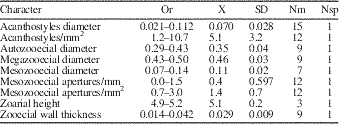
Summary of the statistical analysis of Dekayia sp.
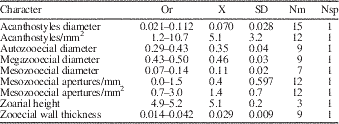
All measurements in millimeters.
Nm=total number of measurements, Nsp=number of colonies on which measurements have been taken, Or=observed range, SD=standard deviation, and X=mean value.
Description
Zoarium with lenticular growth habit, with a maximum diameter of 19.5 mm and an average height of 5.1 mm. Maculae compose of a small number of megazooecia. Autozooecial apertures irregularly polygonal with four, five, or six sides and 0.35 mm of average diameter; diaphragms scarce, present only in some autozooecia and with no more than one per autozooecium, placed in the endozone or in the exozone. Mesozooecia scarce, an average of 0.4/mm and 1.4/mm2; three- or four-sided in shape and with an average maximum diameter of 0.11 mm; developed in the endozone-exozone boundary and without diaphragms; only a small number of mesozooecia in macula are observed. Megazooecia polygonal in shape, with an average diameter of 0.46 mm and present only in maculae. Acanthostyles abundant, 5.1/mm2, and placed mainly in corners of autozooecial apertures; circular in shape and with an average diameter of 0.07 mm, although with a large variability (0.02–0.11 mm); composed of a central hyaline core and dark sheaths surrounding it; acanthostyles can be present in endozone and exozone and in longitudinal section they have an irregular thickness. Zooecial walls thick, 0.029 mm on average in exozone and slightly thinner in endozone; strongly modified by the inclusion of acanthostyles; when not modified, autozooecial walls undulated and with irregular thickness.
Occurrence
Dekayia sp. is exclusive from the Khabt-el-Hajar Formation in Merzane North section in the horizon MN3, eastern Moroccan Anti-Atlas (Upper Ordovician, upper Katian).
Material
One complete zoarium (MPZ 2013/166) studied in tangential and longitudinal section.
Remarks
The low number of mesozooecia; the scarcity of diaphragms, completely absent in the mesozooecia; the presence of large and numerous acanthostyles in the corners of the autozooecia, located both in endozone and exozone; the flat shape of macula; and the undulated and irregular thickness of autozooecial walls are the characters that have allowed us to assign this specimen to the genus Dekayia. However, it has not been possible to include this specimen in any of the known Dekayia species, because this specimen has distinctive acanthostyles with a very irregular thickness. The fact of having only one specimen prevents us from testing if this type of acanthostyles is a diagnostic character of the Dekayia population described in the Upper Ordovician of Morocco, so we leave this specimen in open nomenclature to the specific level.
This material is closely related to Dekayia semipilaris Ulrich, Reference Ulrich1883, sharing with it the growth habit, the scarcity of autozooecial diaphragms, the presence of large and numerous acanthostyles, as well as their distribution in the endozone and exozone and their emplacement mainly in autozooecial corners, and the presence of macula composed of megazooecia and acanthostyles; however, our material can be easily distinguished from this species because acanthostyles in Dekayia semipilaris do not have irregular thickness and mesozooecia are absent.
Family Trematoporidae Miller, Reference Miller1889
Genus Aostipora Vinassa de Regny, Reference Vinassa de Regny1921
Type species
Aostipora cystata (Bassler, Reference Bassler1911), Middle Ordovician of Estonia.
Emended diagnosis
Zoarium ramose with long autozooecia, growing parallel to the branch axis in endozone and curving in exozone to form an angle of up to 90° with the zoarial surface. Autozooecial cross-section irregularly polygonal in endozone and rounded-polygonal or oval in exozone. Autozooecial diaphragms scarce or absent in endozone and exozone. Autozooecial walls thin in endozone and progressively thicker in exozone, showing a distinct fine lamination. Mesozooecia present, partitioned by both diaphragms and cysts in the same mesozooecium, and sometimes also filled with vesicular tissue; usually mesozooecia are covered by calcitic deposits in the external exozone. Acanthostyles rare or lacking.
Occurrence
Middle Ordovician of Estonia (Kuckers Shale) and Argentina (San Juan Formation) and Upper Ordovician of North Africa.
Aostipora elongata new species (by Jiménez-Sánchez)
Figures 5.5–5.6, 6.1–6.2, Table 11
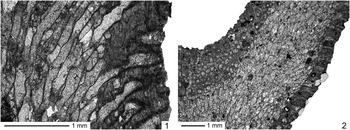
(1, 2)Aostipora elongate new species; (1) detailed longitudinal section of the holotype (MPZ 2013/235) showing some mesozooecia filled by cyst structures and vesicular tissue in the internal exozone and filled by solid calcitic deposits in the external exozone; (2) longitudinal section of the specimen MPZ 2013/237. Specimen MPZ 2013/237 from horizon MN3; specimen MPZ 2013/235 from horizon MN4.

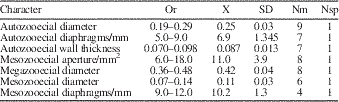
Summary of the statistical analysis of Aostipora elongate new species.

All measurements in millimeters.
Nm=total number of measurements, Nsp=number of colonies on which measurements have been taken, Or=observed range, SD=standard deviation, and X=mean value.
Types
Holotype—MPZ 2013/235. Paratypes—MPZ 2013/236 and MPZ 2013/237
Diagnosis
This Aostipora is characterized by the elongated shape of their maculae, composed exclusively by calcitic deposits, and arranged perpendicular to the branch axis; and by lacking true acanthostyles (these structures, denominated here as tubules, are not abundant, are only present in the external exozone and are seen as thick dark lines perpendicular to the growth direction of the branch).
Occurrence
Aostipora elongata is exclusive from the Khabt-el-Hajar Formation in the horizons MN3 and MN4, eastern Moroccan Anti-Atlas (Upper Ordovician, upper Katian).
Description
Ramose zoaria with branches dichotomously divided; individual branches have an average diameter of 4.6 mm; external surface shows elongated-flattened maculae, composed of extrazooecial solid calcitic deposits and placed perpendicular to the branch growth direction; some of these macula are belt-like since they surround completely the zoarium. In tangential section oval autozooecial apertures, with average maximum and minimum diameters of 0.22 mm and 0.14 mm, respectively, and surrounded by a thick cingulum of 0.022 mm of average thickness; separation between adjacent autozooecia is generally larger than its minimum diameter and this space is occupied by calcitic deposits or mesozooecia (depending on the depth of the tangential section). Mesozooecial apertures subcircular or subpolygonal, but only seen in deep tangential sections, where they have an average diameter of 0.08 mm. Tubules present, but so scarce that their density has not been measured; they are seen as structureless dark points in a shallow tangential section with an average diameter of 0.047 mm. Autozooecial walls not distinguishable from the cingulum. In longitudinal section autozooecia are seen as large and long tubes growing parallel to the growth direction of the branch in the axial endozone and gently curving in the peripheral endozone; in the internal exozone curvature becomes stronger, forming an average angle of 78° with the zoarial surface; autozooecial diaphragms are present in endozone and exozone, but no more than four per autozooecia; autozooecial walls thin in endozone (0.009 mm of average thickness) and irregularly undulated. Mesozooecia developed in the peripheral endozone, but from the base of exozone they are filled with a calcitic laminar deposit, so their internal structure is mostly hidden; when the internal structure is visible mesozooecia are tabulated by diaphragms in external endozone (here walls are constrained in the points where diaphragms join them) and filled by cyst structures and vesicular tissue in internal exozone. Tubules are thick dark lines developed perpendicular to the branch axis; they are formed by the distortion of the laminar structure present in the calcitic deposits covering mesozooecia. In cross-section the endozone has an average diameter of 2.8 mm and the exozone an average thickness of 1.0 mm; autozooecia are larger and show a more irregular morphology in the axial endozone than in the peripheral one.
Etymology
After the elongated shape of their maculae.
Material
One zoarium in tangential, longitudinal and cross-sections (MPZ 2013/235); one zoarium in tangential and longitudinal sections (MPZ 2013/237); and one zoarium in longitudinal section (MPZ 2013/236). In all of them the external morphology has also been studied.
Remarks
The main characters that have allowed us to include this material in the genus Aostipora are the presence of numerous mesozooecia filled with calcitic deposits, what prevents seeing them in the external colonial surface, and the presence of diaphragms, cystic structures, and vesicular tissue inside these mesozooecia. Besides, the rest of characters that define this genus are also present in these specimens, making its generic assignation doubtless. However, none of the three species included in Aostipora have the elongated macula described here and not too much is known about the type of acanthostyles present in two of its species: Aostipora cystata (Bassler, Reference Bassler1911) and Aostipora kuckersina (Bassler, Reference Bassler1911), described by Bassler (Reference Bassler1911) in the Middle Ordovician of Estonia. In Aostipora cystata, the author described acanthostyles as “numerous” (although no quantitative information was given), which clearly separates this species from the Moroccan material. The third species of the genus, Aostipora sanjuanensis Carrera and Ernst, Reference Carrera and Ernst2010, described in the Middle Ordovician of San Juan, Argentina, have acanthostyles with a clear core, which also separates this species from the material here described. So, the new species Aostipora elongata is proposed to include specimens with solid elongated macula and “false” acanthostyles.
The new species Aostipora elongata is most closely related to Aostipora cystata, as illustrated by Bassler (Reference Bassler1911), sharing the internal morphology of mesozooecia filled by cyst structures and vesicular tissue, and the autozooecial angle with the zoarial surface, but both species can be distinguished because in Aostipora cystata macula are not elongated, large zooecia are also present in macula and autozooecial diaphragms are absent.
Changes in trepostomate bryozoan zooid size with temperature
Jiménez-Sánchez et al. (Reference Jiménez-Sánchez, Taylor and Gómez2013) studied the morphological differences between Upper Ordovician bryozoans living in cold-temperate waters and those living in warm waters, using the paleolatitude as a proxy for water temperature. For that purpose, they studied a total of 154 samples belonging to 104 species assigned to 10 genera included in four orders; the morphological data were statistically analyzed with multivariate discriminant and univariate analysis. They concluded that there are significant differences in the size of the different polymorphs that form the colony between high (and middle-high) latitude and low (and middle-low) latitude congeneric species. In more than 90% of the cases, the diameter or the polymorphs is larger in cold-water than in warm-water bryozoans and the difference in size is most obvious in Trepostomata congeneric species. The phenomenon observed for the Ordovician trepostomates by Jiménez-Sánchez et al. (Reference Jiménez-Sánchez, Taylor and Gómez2013) is well known among fossil and recent Cheilostomata, whose zooid sizes are repeatedly found to be inversely proportional to the temperature of the ambient water under both field and controlled laboratory conditions (O’Dea and Okamura, Reference O’Dea and Okamura2000a). Jiménez-Sánchez et al. (Reference Jiménez-Sánchez, Taylor and Gómez2013) also used multivariate ordination techniques to test whether the different samples could be grouped according to the Upper Ordovician bryozoan province in which they developed (Jiménez-Sánchez and Villas, Reference Jiménez-Sánchez and Villas2010) and, in affirmative cases, if these provinces were organized following a temperature gradient. The results of these ordination analyses were inconclusive: only for some genera did the samples group according to the province they belong to, and only for the genus Ceramoporella were samples from provinces arranged following a temperature gradient (Jiménez-Sánchez et al. Reference Jiménez-Sánchez, Taylor and Gómez2013, fig. 7).
The purpose of this section is to expand the study made by Jiménez-Sánchez et al. (Reference Jiménez-Sánchez, Taylor and Gómez2013) and test whether differences in polymorph size can be detected in the congeneric species of trepostomate Moroccan genera. As was the case in Jiménez-Sánchez et al. (Reference Jiménez-Sánchez, Taylor and Gómez2013), the term sample is here used for a species from a single locality, i.e., the same species described in two different localities is considered as two different samples.
Material
We studied a total of 244 samples belonging to 11 genera, all of them of the order Trepostomata. These genera are considered eurythermic because they have species from both high and low paleolatitudes: Anaphragma (20 samples assigned to 16 species), Atactoporella (13 samples assigned to 10 species and one species in open nomenclature), Calloporella (13 samples belonging to 12 species and one species in open nomenclature), Cyphotrypa (19 samples assigned to 14 species and two species in open nomenclature), Dekayia (27 samples assigned to 22 species and three species in open nomenclature), Diplotrypa (27 samples assigned to 23 species and one species in open nomenclature), Homotrypa (30 samples assigned to 24 species a one species in open nomenclature), Monotrypa (16 samples belonging to 13 species and one species in open nomenclature), Monticulipora (19 samples assigned to 16 species), Parvohallopora (20 samples assigned to 15 species and one species in open nomenclature) and Prasopora (40 samples belong to 32 species and one species in open nomenclature). The genera Diplotrypa and Monticulipora were already included in the former study by Jiménez-Sánchez et al. (Reference Jiménez-Sánchez, Taylor and Gómez2013). Of these samples, 190 come from the low and middle-low latitudes of the Avalonia region and the Baltica and Laurentia-Siberia provinces, whereas 54 samples come from the high and middle-high latitudes of the Mediterranean province. The genus Aostipora, also identified in the Upper Ordovician of Morocco, has not been taken into account in this statistical analysis because of the small number of samples (only four have been found in the literature). The species Anaphagma mirabile, Monotrypa jewensis, Monotrypa osgoodensis, Monticulipora kolaluensis and Prasopora falesi have been recorded in regions of low and middle-low latitude provinces as well as in high and middle-high latitude regions of the Mediterranean province.
A table containing the values for each measured character in all the samples is provided as Supplemental Data 1. Data for the Moroccan species and for the species from the Iberian Chains (Spain) described in Jiménez-Sánchez (Reference Jiménez-Sánchez2009, Reference Jiménez-Sánchez2010) have been collected directly from thin sections, while the rest have been taken from the literature (either as data provided by the authors or from scaled photographs).
Methodology
To carry out this study, we measured characters related to the size of the colony (branch diameter [BchD] and zoarial diameter [ZD]) and also characters related to the size of the different polymorphs that form the colony (autozooecial diameter [AzD], acanthostyles diameter [AthD], exilazooecial diameter [ExiD], and mesozooecial diameter [MzD]). These measurements have been analyzed with univariate statistical techniques using the PAST v. 2.17c paleontological software (Hammer et al., Reference Hammer, Harper and Ryan2013).
For carrying out the univariate statistical analyses, the 244 samples (i.e., species from a single locality) were grouped by genera and each measured character was analyzed independently. As in Jiménez-Sánchez et al. (Reference Jiménez-Sánchez, Taylor and Gómez2013), the a priori knowledge of the paleogeographical position of each paleocontinent in the Upper Ordovician has been used to subdivide each group of samples (i.e., all samples from all localities belonging to the same genus) into two subgroups: a temperate-cold water subgroup (Mediterranean province) and a warm water subgroup (Avalonia region and the Baltica and Laurentia-Siberia provinces).
When a character is missing in less than 10% of a subgroup of samples (cold-water subgroup or warm-water subgroup) we have used for this missing value the arithmetic mean of the character in the subgroup of samples belonging to the same temperature range (cold- or warm-water). On the contrary, when the value for one character is missing in more than 10% of one subgroup of samples, the sample in which this character is missing has been eliminated from the subgroup.
The purpose of the statistical univariate analysis performed here is to test whether the cold-water subgroup and the warm-water subgroup for each genus show morphological differences (based on the study of the mean and the variance of the analyzed characters in each subgroup). As in Jiménez-Sánchez et al. (Reference Jiménez-Sánchez, Taylor and Gómez2013), if the measured character in both subgroups of a genus is Shapiro-Wilk normally distributed, the “t” test of equality of means and the “F” test of equality of variances have been performed. However, if the character in either of the two subgroups of the genus is not Shapiro-Wilk normally distributed, two non-parametric tests have been performed: the Mann-Whitney test for the equality of the means and the Kolmogorov-Smirnov test for the equality of distributions. Normality has been tested for a level of significance of 5% (i.e., the null hypothesis of an underlying normal distribution was rejected if the p-value is smaller than 0.05).
Results
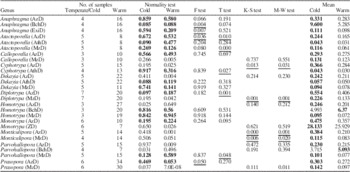
Table 12 shows the results of the univariate analyses. In the first column, the genus and the analyzed character are given. The second column gives the number of studied samples per genus, divided in two subgroups (temperate/cold water and warm-water). The third column shows the results of the normality test for both subgroups, expressed in terms of p values. As we mentioned before, a significance level of 5% has been chosen, which means that p value less than 0.05 indicate that the sample (one or both subgroups) does not pass this test (the distribution of the subjacent population is not normal). The fourth column gives the result of the “F” test and the fifth column the result of the “t” test, but only when both subgroups pass the normality test. The sixth and seventh columns show the results of the Kolmogorov-Smirnov (K-S) and Mann-Whitney (M-W) tests, respectively; these tests have been performed when at least one subgroup does not pass the normality test. The last column gives the arithmetic mean of each analyzed character in the temperate/cold water and warm-water subgroups.
Results of the univariate statistical analysis.

AthD=acanthostyles diameter, AzD=autozooecial diameter, BchD=branch diameter, ExiD=exilazooecial diameter, MzD=mesozooecial diameter. Bolded values in Normality test column indicate that both subsamples (cold and warm) passed this test; underlined values in F test, T test, K-S test and M-W test columns indicate that sample pass the test; and bolded values in Mean column indicate which subsample has the highest mean.
The results summarized in Table 12 show that the autozooecial diameters of the cold-water populations of Atactoporella, Cyphotrypa, Diplotrypa, Monticulipora, and Prasopora are significantly larger than those of congeneric warm-water populations, and that the cold- and warm-water populations can be statistically distinguished at the 95% significance level. The mesozooecial diameters of the cold-water populations of Atactoporella, Diplotrypa, Monticulipora, and Parvohallopora, as well as the exilazooecial diameter of the genus Anaphragma, are also significantly larger than those of congeneric warm-water populations and, as in the case of the autozooecia, the statistical analysis also allows to separate both populations. In the genera Calloporella, Homotrypa, and Monotrypa, the univariate analysis does not allow to separate their populations according to paleolatitude (temperature), but the autozooecial and mesozooecial diameters in these genera are slightly larger in cold-water populations than in warm-water ones. These results add new examples of bryozoan zooids following the tendency to be larger bodied with increasing latitude, in line with what is well known among fossil and recent cheilostomate bryozoans (O’Dea and Okamura, Reference O’Dea and Okamura2000a). This tendency is known as Bergmann’s rule (Bergmann, Reference Bergmann1847) or the temperature-size rule (Atkinson, Reference Atkinson1994) in many other taxa, including both ectotherm, endotherm, solitary, and colonial animals.
New evidence of gigantism in trepostomate zooids from high and low latitudes
Occasionally, the increment in body size with latitude is especially large and the phenomenon is known as polar gigantism. It is well known for many taxa of marine organism (Moran and Woods, Reference Moran and Woods2012), although the most outstanding examples are within the arthropods (Chapelle and Peck, Reference Chapelle and Peck1999; Woods et al., Reference Woods, Moran, Arango, Muller and Shields2009). Polar gigantism is not known among recent bryozoans. Even more, bryozoans with calcium carbonate zoaria are not expected to get gigantic sizes. They share this feature with other carbonate-shelled animals, because of the high metabolic expenses to build and maintain a calcium carbonate skeleton in cold water with high proportions of dissolved CO2 (Arnaud, Reference Arnaud1974). Nevertheless, Jiménez-Sánchez et al. (Reference Jiménez-Sánchez, Vennin and Villas2015) have suggested that the trepostomate monticuliporid species Atactoporella moroccoensis Jiménez-Sánchez (2015), from the same associations, horizons and localities that the trepostomate studied herein, as well as Atactoporella magnopora Ernst and Key (Reference Ernst and Key2007), from correlative horizons of the Montagne Noire, represent cases of polar gigantism. Both species display autozooecial mean diameters in the top 5% of the genus, criteria postulated by Chapelle and Peck (Reference Chapelle and Peck1999) to categorize a species as giant. According to Jiménez-Sánchez et al. (Reference Jiménez-Sánchez, Vennin and Villas2015), the larger autozooid size of those species could have provided them respiratory benefits in the cold, sub-polar waters where they thrived. Atactoporella is among the genera listed in Table 12 having autozooecial diameters significantly larger in cold-water populations than in warm-water populations. Thus, the gigantism of the zooids of Atactoporella moroccoensis and Atactoporella magnopora expands the validity of the temperature-size rule to include the trepostomate bryozoans. But Bergmann’s rule seems to be also valid for trepostomate bryozoan at the species level. According to Jiménez-Sánchez et al. (Reference Jiménez-Sánchez, Vennin and Villas2015), the population of Anaphragma mirabile Ulrich and Bassler, Reference Ulrich and Bassler1904 from the high latitude platforms of the North African margin of Gondwana displays autozooecial diameters 35% larger than those in colonies from the warm paleocontinent of Laurentia (Ulrich and Bassler, Reference Ulrich and Bassler1904; Boardman, Reference Boardman1960).
The study herein of a larger sample of trepostomate bryozoans from the same environments and localities studied by Jiménez-Sánchez et al. (Reference Jiménez-Sánchez, Vennin and Villas2015), augmented by the trepostomate genera Eridotrypa, Hallopora, and Trematopora (Jimenez Sanchez et al., 2013, Table 2), and the comparison of their zooid size with those of congeneric species of low latitude shed new light on the gigantism within the group. In total, we have compared the autozooecial diameter of 289 samples belonging to 14 genera (Supplemental Data 2). Of these samples, 213 (74%) come from the warm-water paleocontinents of Baltica, Laurentia and Siberia and from the Avalonia region, while 76 samples (26%) come from the temperate/cold-water Mediterranean region of the Gondwana margin (represented by the Moroccan Anti-Atlas, the Iberian Chains, Sardinia, and the Montagne Noire; Jiménez-Sánchez and Villas, Reference Jiménez-Sánchez and Villas2010).
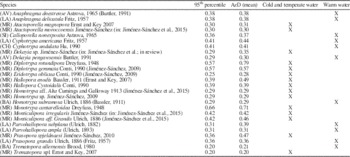
New species with gigantic autozooids (that is, with autozooecial mean diameters in the 95th percentile of the normal distribution of their known species) have been identified among the trepostomate families Amplexoporidae, Monticuliporidae, Atactotoechidae, Halloporidae, Heterotrypidae, and Trematoporidae. Most of the species with gigantic autozooids, 15 of the total 26 identified (Table 13), are from the temperate- to cold-water Mediterranean bryozoan province (14 of them are endemic), representing 20% of all the cold-water samples. Following the arguments stated in Jiménez-Sánchez et al. (Reference Jiménez-Sánchez, Vennin and Villas2015) they all could be considered cases of polar gigantism. Nevertheless, the gigantism in the autozooecia of the remaining 11 species (Table 13), representing 5% of the warm-water samples (known exclusively from the late Katian warm-water Baltic and Laurentian-Siberian provinces) is more difficult to interpret in relation to concrete environmental factors.
List of species whose autozooecial diameter larger than 95th percentile.

AV=Avalonia; BA=Baltica; LA=Laurentia; MR=Mediterranean region; Si=Siberia.
Recent cheilostomate bryozoan species display seasonal trends in zooid size, being temperature and food supply the two most likely environmental influences that may explain them (Okamura, Reference Okamura1987). Although temperature seems to be the primary control variable on zooecium size variations (O’Dea and Okamura Reference O’Dea and Okamura2000a,Reference O’Dea and Okamurab; O’Dea, Reference O’Dea2005), there are laboratory studies on recent cheilostomates concluding that food concentration can also have an effect on zooecium size (Hageman et al., Reference Hageman, Needham and Todd2009). Studies on fossil cheilostomates have also demonstrated that some species do not show an uniform response to environmental change, occasionally with smaller autozooid in regions considered to be colder (Berning et al., Reference Berning, Moissette and Betzler2005); this is one of the rare exceptions to the general Bergman’s rule. Berning et al. (Reference Berning, Moissette and Betzler2005) suggested that nutrients might also play a role in controlling morphology and morphometry of those bryozoans. Salinity and the interaction of temperature and salinity have also been found to significantly influence zooid length and area of recent cheilostomates (O’Dea and Okamura, Reference O’Dea and Okamura1999). Accordingly, it can be expected that any of these environmental factors, different from temperature, can explain the large size observed in the trepostomate species from low latitudes listed in Table 13. In any case, for almost all these recorded species from low latitudes with large, even gigantic autozooecia there are other high latitude species within the same genus, even larger. It is so, for instance, for the Avalonian species Dekayia pengawsensis Buttler, Reference Buttler1991 with an autozooecial mean diameter of 0.30 mm, and its Moroccan counterpart, Dekayia sp., with an autozooecial mean diameter of 0.35 mm. Another example is the Laurentian Prasopora grandis Ulrich, Reference Ulrich1886 (described by Fritz, Reference Fritz1957) with an autozooecial mean diameter of 0.36 mm, and its Mediterranean counterpart, Prasopora spjeldnaesi Jiménez-Sánchez, Reference Jiménez-Sánchez2010, with an autozooecial mean diameter of 0.47.
Some of the exceptions identified among the trepostomates to the general rule of the inverse relationship between zooid size and temperature must be pointed out. It is the case of the populations of Anaphragma dnestrense Astrova, Reference Astrova1965 from Avalonia (Buttler, Reference Buttler1991), and Anaphragma delicatula Fritz, Reference Fritz1957 from Laurentia, which display gigantic autozoecia (Table 13) and are larger than the Mediterranean populations of Anaphragma mirabile Ulrich and Bassler, Reference Ulrich and Bassler1904 and Anaphragma undulata Jiménez-Sánchez (in Jiménez-Sánchez et al., Reference Jiménez-Sánchez, Vennin and Villas2015). Jiménez-Sánchez et al. (Reference Jiménez-Sánchez, Vennin and Villas2015) suggested that the thick zooecial wall of the Anaphragma species prevented their zooecial diameter to grow beyond a certain threshold in cold waters, because of the metabolic expenses to build and maintain a carbonate skeleton in cold CO2-charged waters. In line with this hypothesis is the occurrence of the gigantic species Anaphragma dnestrense in Avalonia and Anaphragma delicatula in Laurentia, as well as Anaphragma rectum Pushkin, Reference Pushkin1976 and a population of Anaphragma dnestrense in Siberia (Astrova, Reference Astrova1965), with autozooecia as large as, or larger than, those of Mediterranean species. In the warm waters of those paleocontinents, the species of this genus of thickly walled zooecia was not as constrained in its zooid growth as the cold-water ones. Summing up, our analyses corroborates that also the trepostomate bryozoan zooid size was inversely proportional to the temperature of the ambient water where they thrived, although other environmental factors, besides temperature, must have influenced its size significantly, at least in low latitudes. Our data also give further support for considering the zooecia wall thickness as a limiting factor for the zooid size in latitude gradients in the trepostomates.
Acknowledgments
We would like to acknowledge the financial support to the project EXLIZ CZ.1.07/2.3.00/30.0013, co-financed by the European Social Fund and the state budget of the Czech Republic, as well as to the project CGL2012-39471 of the Spanish Ministry of Economy and Competitiveness. It is also a contribution to the project E-17 “Heritage and Paleontological Museum,” from the Department of Science, Technology and University of the Government of Aragón, with participation of the European Social Fund, and the IGCP 591 project “The Early to Middle Paleozoic Revolution.” We also thank the technician support to the University of Huelva (Spain) and to the Servicio General de Apoyo a la Investigación-SAI, Universidad de Zaragoza and to the referees Marcus Key and Caroline Buttler for improving the final manuscript. Finally, thanks to Zarela Herrera and Pierre Clement for field assistance.
Supplemental data
Supplemental data deposited in Dryad data package: http://dx.doi.org/10.5061/dryad.742qf