Introduction
Postnatal depressive symptoms in fathers are associated with behavioural and emotional problems in children (Ramchandani et al. Reference Ramchandani, Stein, Evans and O'Connor2005, Reference Ramchandani, Stein, O'Connor, Heron, Murray and Evans2008b ; Davé et al. Reference Davé, Sherr, Senior and Nazareth2008; Fletcher et al. Reference Fletcher, Feeman, Garfield and Vimpani2011), but there is limited understanding about the underlying mechanisms that explain these associations. Childhood behavioural and emotional problems are associated with poor outcomes during adulthood, including academic underachievement, psychiatric problems, relationship difficulties, substance abuse and dependency on services (Caspi et al. Reference Caspi, Moffitt, Newman and Silva1996; Fergusson et al. Reference Fergusson, John Horwood and Ridder2005). This causes considerable burden on public services and has huge costs on society (Scott et al. Reference Scott, Knapp, Henderson and Maughan2001; Snell et al. Reference Snell, Knapp, Healey, Guglani, Evans-Lacko, Fernandez, Meltzer and Ford2013). Improved understanding of how paternal depressive symptoms influence children's behavioural and emotional outcomes during childhood may improve theoretical understanding about the transmission of risk from parents to children and might provide targets for interventions involving fathers (Ramchandani & Murphy, Reference Ramchandani and Murphy2013; Garfield, Reference Garfield2015).
Using longitudinal data form the Millennium Cohort Study (MCS), Malmberg & Flouri (Reference Malmberg and Flouri2011) found that paternal depressive symptoms at 9 months old predicted behavioural problems in children when they were 3 years old via lower overall quality (lower warmth and higher conflict) in father–child relationship. Using another large cohort study (Longitudinal Study of Australian Children; LSAC), Giallo et al. (Reference Giallo, Cooklin, Wade, D'Esposito and Nicholson2014b ) reported that paternal depressive symptoms during infancy were associated with children's emotional and behavioural problems at 4–5 years old, and the association was mediated via increased hostile parenting. Child gender did not appear to moderate this association. In both studies, fathers’ parenting and children's outcomes were measured at the same time point, therefore causality cannot be assumed. Finally, a study of fathers with children aged 5–9 years old found that inconsistent discipline practices mediated the association between paternal depressive symptoms and their sons’ hyperactivity, but not their daughters’ (Dette-Hagenmeyer & Reichle, Reference Dette-Hagenmeyer and Reichle2014). Although there was a longitudinal element to this study, paternal depressive symptoms and parenting were measured simultaneously and the measure of child outcomes was collected 6 months later, making the analysis almost cross-sectional.
Evidence suggests that poor emotion regulation in children may be associated with increased externalizing and internalizing behavioural problems (Eisenberg et al. Reference Eisenberg, Spinrad and Eggum2010). Difficulty with regulating anger and impulsivity (under-regulation) has been linked with externalizing problems, whereas inability to control cognition and attention (over-regulation involved in rumination and negative bias) has been associated with internalizing problems (Gross, Reference Gross1998). Studies have also focused on the effects of maternal depression on children's emotion regulation, and have reported that children of depressed mothers have poorer emotion regulation compared with children of non-depressed mothers (Silk et al. Reference Silk, Shaw, Skuban, Oland and Kovacs2006). This may be due to the environmental influence of depressed mothers’ inability to parent sensitively or children modelling mothers’ maladaptive emotion-regulation strategies (Eisenberg et al. Reference Eisenberg, Losoya, Fabes, Guthrie, Reiser, Murphy, Shepard, Poulin and Padgett2001; Hoffman et al. Reference Hoffman, Crnic and Baker2006). Although there have been studies on the importance of fathers to the development of emotion regulation among children (Cabrera et al. Reference Cabrera, Shannon and Tamis-LeMonda2007; Wilson et al. Reference Wilson, Havighurst and Harley2014; Kiel & Kalomiris, Reference Kiel and Kalomiris2015), to our knowledge there are no studies that examine the association between paternal depressive symptoms and children's emotion regulation.
There are some studies that provide evidence for the potential mechanisms by which paternal depressive symptoms may influence children's emotional and behavioural problems. One hypothesis proposes that paternal depressive symptoms may influence children's development via fathers’ impaired parenting (Ramchandani & Psychogiou, Reference Ramchandani and Psychogiou2009). Depression in parents has been associated with negative parent–child interactions (Psychogiou & Parry, Reference Psychogiou and Parry2014; Sethna et al. Reference Sethna, Murray, Netsi, Psychogiou and Ramchandani2015) and a meta-analysis of 28 studies reported paternal depressive symptoms to be associated with increased negative (intrusive, hostile, harsh, controlling, and critical) and decreased positive parenting behaviours (sensitive responding, accepting, warm, affectionate, and supporting) towards children (Wilson & Durbin, Reference Wilson and Durbin2010). One study found that fathers’ disengaged parenting when their infants were 3 months old predicted externalizing problems at 1 year in their sons, but not daughters (Ramchandani et al. Reference Ramchandani, Domoney, Sethna, Psychogiou, Vlachos and Murray2013). Another meta-analysis consisting of six studies reported that father–child conflict mediated the association between paternal depressive symptoms and children's emotional problems (Kane & Garber, Reference Kane and Garber2004). However, the studies in this meta-analysis included children with a wide age range (from 3 to 14 years) and most studies were cross-sectional. To infer mediation, it is necessary to study the exposure of paternal depressive symptoms, fathers’ parenting and children's outcomes longitudinally (Selig & Preacher, Reference Selig and Preacher2009). Thus, the variables need to be measured at different time points. Additionally, given that there were only six studies on father–child conflict, mediation requires further investigation.
Although studies have found a link between paternal depressive symptoms and children's behavioural and emotional problems (Ramchandani et al. Reference Ramchandani, Stein, Evans and O'Connor2005, Reference Ramchandani, Stein, O'Connor, Heron, Murray and Evans2008b ; Davé et al. Reference Davé, Sherr, Senior and Nazareth2008), there are mixed findings about the influence of paternal depressive symptoms regarding child gender-specific pathways of risk transmission. Postnatal depressive symptoms in fathers 8 weeks after child birth were associated with children's psychopathology at 3 and 7 years old in the UK Avon Longitudinal Study of Parents and Children (ALSPAC) (Ramchandani et al. Reference Ramchandani, Stein, Evans and O'Connor2005, Reference Ramchandani, Stein, O'Connor, Heron, Murray and Evans2008b ); sons of fathers with high depressive symptoms were reported to display more conduct problems compared with daughters. In contrast, findings from the LSAC suggested that the daughters of fathers with high depressive symptoms in the first postnatal year were more likely to have emotional and conduct problems when they were 4–5 years old, whereas sons were more likely to exhibit hyperactivity problems and lower levels of prosocial behaviour (Fletcher et al. Reference Fletcher, Feeman, Garfield and Vimpani2011). Exploring gender-specific pathways may help explain the possible father to child transmission of risk which may subsequently enable us to identify whether girls and/or boys are more vulnerable to their fathers’ depressive symptoms. This could influence the content and direction of interventions with depressed fathers.
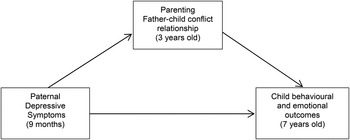
This study aims to address these gaps in the current literature using a large representative sample of fathers from the MCS in the UK. The primary objective is to test the proposed model (Fig. 1) and investigate whether father–child conflict mediates the association between paternal depressive symptoms and children's emotional and behavioural outcomes. The exposure of paternal depressive symptoms during infancy has been identified as a potential sensitive period where paternal depressive symptoms may influence children's later outcomes (Ramchandani et al. Reference Ramchandani, O'Connor, Evans, Heron, Murray and Stein2008a ). The mediator variable father–child conflict was measured at 3 years old during the preschool year when fathers become more involved in parenting their children (MacDonald & Parke, Reference MacDonald and Parke1986; Bruce & Fox, Reference Bruce and Fox1999; Grossmann et al. Reference Grossmann, Grossmann, Fremmer-Bombik, Kindler and Scheuerer-Englisch2002). Previous literature has associated father–child conflict with paternal depression and negative outcomes in children (Kane & Garber, Reference Kane and Garber2004, 2009). Additionally, using the MCS dataset, a recent study found an association between paternal depressive symptoms and father–child conflict, but not father–child warmth or fathers’ involvement in parenting activities, suggesting that father–child conflict may be an important construct that is influenced by paternal depressive symptoms (Nath et al. Reference Nath, Russell, Kuyken, Ford and Psychogiou2015). Children's outcomes were measured at 7 years old. This is a developmentally challenging period as children learn new behaviour and emotion-management skills and problems with adjustment at this age predict poor outcomes in adulthood (Pianta et al. Reference Pianta, Steinberg and Rollins1995; Fergusson et al. Reference Fergusson, John Horwood and Ridder2005). Given that maternal depression, marital conflict, child temperament, child gender and family socio-economic status (SES) may be associated with fathers’ depressive symptoms, parenting and children's emotional and behavioural outcomes (Goodman, Reference Goodman2004; Kiernan & Huerta, Reference Kiernan and Huerta2008; Hanington et al. Reference Hanington, Ramchandani and Stein2010, Reference Hanington, Heron, Stein and Ramchandani2012; Malmberg & Flouri, Reference Malmberg and Flouri2011; Flouri et al. Reference Flouri, Midouhas and Joshi2014; Gutierrez-Galve et al. Reference Gutierrez-Galve, Stein, Hanington, Heron and Ramchandani2015), we controlled for these factors in our models. Our secondary objective was to test the moderating influence of child gender on any potential associations. We predicted that higher father–child conflict at 3 years old would mediate the association between higher paternal depressive symptoms at 9 months old and children's increased behavioural–emotional outcomes at 7 years. We expected that child gender would moderate this mediation, but did not expect a specific direction given the mixed literature.
Proposed mediation modelling showing the effect of paternal depressive symptoms on child behavioural and emotional outcomes.

Method
Participants
This secondary data analysis was conducted using the first (S1), second (S2) and fourth (S4) sweeps of the MCS, when children were 9 months, 3 years and 7 years old. The MCS is a large-scale survey of infants (n = 19 519) born in four constituent countries of the UK (Dex & Joshi, Reference Dex and Joshi2005). The sample design allowed for over-representation of families living in areas with high rates of child poverty or high proportions of ethnic minorities in England and the three smaller countries in the UK (Northern Ireland, Wales and Scotland). Full details of the survey, objectives, content of survey and sampling strategy can be found in the documentation attached to the data deposited with the UK Data Archive and elsewhere (Plewis & Ketende, Reference Plewis, Ketende and Ketende2006; Hansen, Reference Hansen2014).
The first wave (S1) of data was collected from 2001 to 2002 on 18 533 families, with a total of 18 819 infants aged between 9 and 11 months. The same sample were then invited to follow-up with 15 590 families in the second wave (S2) when the children were approximately 3 years old and 13 857 in the fourth wave (S4) when children were approximately 7 years old.
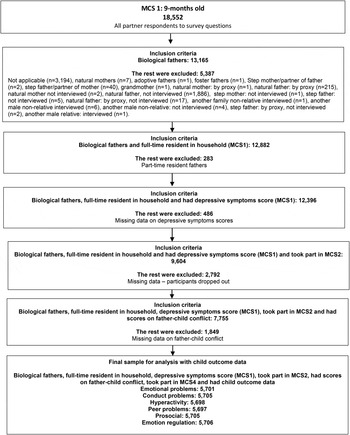
The MCS collected data from main respondents (usually mothers) and partner respondents (fathers, stepfathers, same-sex partners). For the current study, the sample was limited to biological fathers (partner respondents) and mothers (main respondents). Fathers who were main respondents were excluded to simplify analysis as main and partner questions were not identical. Part-time resident and stepfathers were also excluded due to insufficient numbers. A small sample of twins and triplets was excluded to avoid the need to include an extra level of analysis that would have accounted for intra-family variability. Thus, only one child per family (the first cohort member) was studied. For details of eligibility, sample size at each stage and final sample used for main analysis, see Fig. 2.
Eligibility flowchart for fathers in the sample. MCS, Millennium Cohort Study.

Measures
Paternal depressive symptoms
Rutter's nine-item Malaise Inventory (S1; 9 months old) was used as an indicator for depressive symptoms in S1 completed by fathers (Rutter et al. Reference Rutter, Tizard and Whitmore1970; Dex & Joshi, Reference Dex and Joshi2004). This is the shortened version of the Rutter's 24-item Malaise Inventory self-completion questionnaire measuring psychological distress (Rutter et al. Reference Rutter, Tizard and Whitmore1970; Bartley et al. Reference Bartley, Kelly, Schoon, Hope, Dex and Joshi2004; Johnson, Reference Johnson2012). The nine-item short form included items ‘feel tired most of the time’, ‘feel miserable or depressed’, ‘worried about things’, ‘often get into a violent rage’, ‘suddenly become scared for no good reason’, ‘easily upset or irritated’, ‘constantly keyed up and jittery’, ‘every little thing gets on nerves and wears you out’, and ‘heart race like mad’. Scores from these were summed to create a continuous scale. This scale has been used in previous studies as an indicator of depressive symptoms (Kiernan & Huerta, Reference Kiernan and Huerta2008; Malmberg & Flouri, Reference Malmberg and Flouri2011). Using Cronbach's α coefficient the internal consistency of the scale was 0.75 for mothers and 0.71 for fathers, which is similar to previous validation studies on the scale (Rodgers et al. Reference Rodgers, Pickles, Power, Collishaw and Maughan1999). The original scale has also shown acceptable validity [area under the curve (AUC) = 0.74 with mental health problems, AUC = 0.77 with psychiatric diagnosis, AUC = 0.87 with depression] (Rodgers et al. Reference Rodgers, Pickles, Power, Collishaw and Maughan1999).
Fathers’ parenting: father–child conflict
Fathers’ parenting was measured using the Child–Parent Relationship Scale reported by fathers (CPRS; short form; Pianta & Steinberg, Reference Pianta and Steinberg1992; Johnson, Reference Johnson2012). In this study, father–child conflict refers to the communication and relationship between the parent and the child which is measured by eight self-report items on a five-point Likert scale (ranging from 1 = definitely does not apply to 5 = definitely applies). All items were summed to create a continuous scale. Items include ‘child and I always seem to be struggling with each other’, ‘child uncomfortable with physical affection or touch by me’, ‘child easily becomes angry with me’, ‘child remains angry/resistant after discipline’, ‘dealing with my child drains my energy’, ‘when child wakes up in bad mood, I know we're in for a long and difficult day’, ‘child's feelings towards me can be unpredictable or change suddenly’ and ‘child is sneaky or manipulative with me’. This scale has been used by other studies as an indicator of parenting (Kiernan & Huerta, Reference Kiernan and Huerta2008; Mensah & Kiernan, Reference Mensah and Kiernan2011; Nath et al. Reference Nath, Russell, Kuyken, Ford and Psychogiou2015) and the items originate from attachment theory, Attachment Q-set and literature on parent–child relationships to form a subscale looking at negative approaches towards the father–child relationship (conflict). Higher scores on the scale indicated higher conflict in the relationship. Fathers’ reports are comparable with mothers’ reports and have been validated against observational data on parent–child interactions which has shown conflict ratings on the CPRS to correlate with observational codings of hostility (Driscoll & Pianta, Reference Driscoll and Pianta2011). The scale has adequate internal consistency (α = 0.73).
Child behavioural and emotional problems
The Strengths and Difficulties Questionnaire (SDQ; Goodman, Reference Goodman2001) completed by mothers was used to assess child emotional and behavioural problems (S4, 7 years old). The SDQ is validated for children aged 3–16 years old and was developed as a clinical tool to identify psychopathology. There are 25 items in total consisting of five continuous subscales: emotional symptoms, conduct problems, hyperactivity, peer problems and prosocial behaviour. The scores for each subscale range between 0 and 10. All subscales were used in the analysis. Higher scores indicate greater problems on the emotional, conduct, hyperactivity and peer problems, whereas higher scores on the prosocial scale indicate more prosocial behaviour. The internal consistencies from the MCS were: conduct problems α = 0.55; emotional problems α = 0.68; hyperactivity α = 0.78; peer problems α = 0.59; and prosocial behaviour α = 0.71. These are similar to internal consistencies reported in other studies using non-clinical samples of children (Muris et al. Reference Muris, Meester and van den Berg2003; Niclasen et al. Reference Niclasen, Teasdale, Andersen, Skovgaard, Elberling and Obel2012). The scale has also been reported to have sufficient validity against diagnostics of Diagnostic and Statistical Manual of Mental Disorders, fourth edition (DSM-IV) disorders (specificity = 96%, sensitivity = 49%) (Goodman, Reference Goodman2001) and the Child Behaviour Check List (r = 0.76) (Stone et al. Reference Stone, Otten, Engels, Vermulst and Janssens2010).
Child emotion regulation
The MCS team selected items from the Child Social Behaviour Questionnaire (Hogan et al. Reference Hogan, Scott and Bauer1992; Johnson, Reference Johnson2012) that were completed by mothers and used to generate three continuous subscales: (1) self-regulation defined as children's ability to adapt to situations independently; (2) emotion dysregulation defined as children's inability to deal with difficult/frustrating situations; and (3) cooperation defined as children's ability to cooperate with others. The self-regulation and the reverse of emotion dysregulation scales were significantly correlated (r = 0.32, p < 0.001) and were summed to create an emotion-regulation scale for the analysis. The cooperation subscale was not used because it does not belong to the emotion-regulation construct. Higher scores on the emotion-regulation scale indicated more adaptive emotion regulation. The internal consistency of the scale was α = 0.72. This scale devised by the MCS team has been used in other studies to measure emotion regulation (Flouri et al. Reference Flouri, Midouhas and Joshi2014).
Family context covariates
Maternal depressive symptoms (S1; 9 months) were measured using the Rutter Malaise Inventory as above (Rutter et al. Reference Rutter, Tizard and Whitmore1970; Dex & Joshi, Reference Dex and Joshi2004; Johnson, Reference Johnson2012). Children's temperament (S1; 9 months) was measured with mothers’ reports on the Carey Infant Temperament Scale (Carey & McDevitt, Reference Carey and McDevitt1978). Fourteen items from the original scale were selected by the MCS team to measure regularity (four items), approach withdrawal (three items), adaptability (two items) and mood (five items), and has also been used in other studies as an indicator of child temperament (Kiernan & Huerta, Reference Kiernan and Huerta2008; Flouri & Malmberg, Reference Flouri and Malmberg2012). Items were on a five-point scale (almost never, rarely, usually does not, often, almost always). All scores were on a continuous scale ranging from 14 to 70, consisting of the total score of all items. Higher scores indicated easier infant temperament and lower scores indicated more difficult temperament. The internal consistency of the scale was α = 0.66. Marital conflict (S1; 9 months) was measured using the modified version of the Golombok Rust Inventory of Relationship State (Rust et al. Reference Rust, Bennun, Crowe and Golombok1990). The original 28-item questionnaire had high content validity and reliability of Cronbach's α = 0.91 (men) and 0.87 (women). The MCS selected seven items at S1 and S2, and three items at S4 (Johnson, Reference Johnson2012). These were summed to create continuous scales where higher scores indicate higher levels of relationship conflict.
SES
Households were classed as living in poverty if their income was equal to or less than 60% of the median household income for the UK (dichotomous scale), the definition of poverty set by the UK government (Ketende & Joshi, Reference Ketende, Joshi, Hasan and Joshi2008). Paternal education was reported by fathers and was categorized into two groups: no qualification or school level, degree and higher degree (National Vocational Qualification level or equivalent, undergraduate and postgraduate degree).
Statistical analysis
Structural equation modelling (SEM) using Stata for Windows version 13 (USA) was used to test the mediation model illustrated in Fig. 1, i.e. whether ‘father–child conflict’ (3 years) mediated the association between ‘paternal depressive symptoms’ (9 months) and ‘child outcomes’ at 7 years old (conduct problems, emotional problems, hyperactivity, peer problems, prosocial behaviour and emotion regulation). The model estimated standardized direct, indirect and total effects, as well as adjusting for a number of relevant covariates (maternal depressive symptoms, marital conflict, child temperament, child gender and SES) (model 1). Outcomes that were significantly associated with paternal depressive symptoms in model 1 were taken forward into a multi-group SEM analysis. This investigated whether child gender moderated the associations between ‘paternal depressive symptoms’ and ‘child outcomes’ mediated by ‘father–child conflict’ while controlling for maternal depressive, symptoms, marital conflict, child temperament and SES (model 2). The SEM mediation model was run again using interaction terms to further investigate whether gender interacted with the exposure or mediator to influence the outcome child variables while controlling for maternal depressive symptoms, marital conflict, child temperament and SES (model 3). Finally, we further controlled for marital conflict in subsequent sweeps to increase the validity of any associations found in model 3 (model 4).
As the sample was stratified, sampling weights were used in all analyses to adjust for the disproportionate number of participants from ethnic minority and low-SES backgrounds initially recruited into the sample at S1. Weights aimed to return the sample to the structure of the UK population and also to account for the effect of attrition and multi-stage cluster sampling strategy used by the MCS. The use of the weights is recommended by the MCS team and available with the dataset. Missing data were not analysed. Only data with complete cases on variables of interest across time points were included in the analysis. In order to check that the results in the ‘complete cases’ model were robust to the effects of attrition, missing data were imputed from all variables included in the analysis. A sensitively analysis was conducted to check that results were broadly replicated when missing data were imputed.
Ethical standards
All procedures contributing to this work comply with ethical standards of the relevant national and institutional committees on human experimentation. More specifically, the MCS had informed consent from participants and ethical approval (Hansen, Reference Hansen2012). Our work was a secondary analysis of anonymized data that is publically available on the website (http://discover.ukdataservice.ac.uk/series/) requiring no direct contact with the individual participants, so further ethical approval was not required.
Results
Descriptive statistics
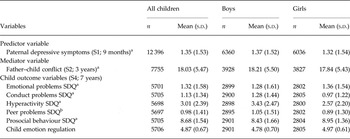
Table 1 shows descriptive statistics for the study main measures (exposure, mediator and outcomes). Logistic regression analyses were used to test for gender differences. Compared with boys, girls had lower odds of conflict with their fathers [odds ratio (OR) 0.99, 95% confidence interval (CI) 0.98–0.98, p = 0.011], conduct problems (OR 0.84, 95% CI 0.80–0.87, p ⩽ 0.001), hyperactivity (OR 0.85, 95% CI 0.83–0.88, p ⩽ 0.001) and peer problems (OR 0.92, 95% CI 0.89–0.96, p ⩽ 0.001), but higher odds of prosocial problems (OR 1.25, 95% CI 1.21–1.30, p ⩽ 0.001) and adaptive emotion regulation (OR 1.54, 95% CI 1.41–1.68, p ⩽ 0.001). There was no significant associations between child gender and fathers’ depressive symptoms (OR 0.98, 95% CI 0.95–1.01, p = 1.135) or child emotional problems (OR 1.03, 95% CI 0.99–1.07, p = 0.100).
Sample size, and predictor, mediator and outcome variables for all children, boys and girls

s.d., Standard deviation; SDQ, Strengths and Difficulties Questionnaire; S1, sweep 1; S2, sweep 2; S4, sweep 4.
a Higher scores indicate more severity of symptoms.
b Higher scores indicate less severity of symptoms.
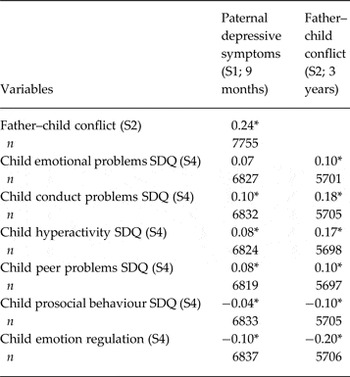
The predictor (paternal depressive symptoms), mediator (father–child conflict) and outcomes (child emotional and behavioural problems) were significantly correlated, a necessary requirement for mediation to occur (Table 2).
Intercorrelations for predictor, mediator and outcomes used in model

S1, Sweep 1; S2, sweep 2; SDQ, Strengths and Difficulties Questionnaire; S4, sweep 4.
* p < 0.001.
Attrition and missingness
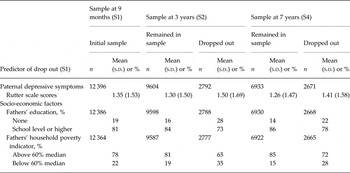
Attrition [i.e. fathers who did not take part in sweeps 2 (3 years) and 4 (7 years)], and missingness (i.e. fathers who did not provide complete answers to survey questions) were associated with low sociodemographic factors (Table 3). Fathers had higher odds of dropping out by both follow-up sweeps if they were below the 60% median of the poverty indicator (S2: OR 3.14, 95% CI 2.63–3.74, p ⩽ 0.001; S4: OR 2.31, 95% CI 1.96–2.72, p ⩽ 0.001) and had lower odds if they were educated (S2: OR 0.45, 95% CI 0.35–0.50, p ⩽ 0.001; S4: OR 0.63, 95% CI 0.53–0.75, p ⩽ 0.001). Fathers with higher depressive symptoms also had higher odds of dropping out (S2: OR 1.08, 95% CI 1.06–1.11, p ⩽ 0.001; S4: OR 1.07, 95% CI 1.04–1.10, p ⩽ 0.001).
Descriptive statistics of variables that predict drop out

S1, Sweep 1; S2, sweep 2; S4, sweep 4; s.d., standard deviation.
Covariates
All family and socio-economic covariates that were associated with higher paternal depressive symptoms, father–child conflict and child outcome were controlled for in the analysis models (see online Supplementary Tables S1 and S2).
Mediation model
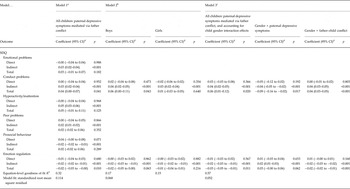
Table 4 (model 1) shows that after adjusting for relevant covariates (maternal depressive symptoms, child temperament, marital conflict, child gender and family SES), higher father–child conflict mediated the association between high paternal depressive symptoms at 9 months and children's increased conduct problems, and emotion dysregulation at age 7 years old. The estimated total effects of paternal depressive symptoms on children's emotional, hyperactivity, prosocial behaviour and peer problems were not significant and therefore were not taken forward into model 2. Table 4 shows the coefficients for each outcome (model 1).
Adjusted mediation models showing the effect of paternal depressive symptoms at 9 months on children's behavioural and emotional development at 7 years via father–child conflict at 3 years old

CI, Confidence interval; SDQ, Strengths and Difficulties Questionnaire.
a Sample size was 3514.
b Sample size was 3520 (sample size increased because from model 1 and 2, non-significant variables were not taken forward). As Stata runs complete case analysis, the dropping of variables emotional problems, hyperactivity, peer problems and prosocial increased the sample size because maybe these variables had incomplete/missing data.
c Sample size was 3520.
d All coefficients were standardized.
Moderation by gender
Model 2 tested for child gender moderator effects (Table 4). This model included significant outcomes from model 1 (conduct problems and emotion regulation) and also adjusted for maternal depressive symptoms, marital conflict, child temperament and SES. Higher father–child conflict mediated the association between higher paternal depressive symptoms and boys’ increased conduct problems (Table 4, model 2). This association was also marginally significant for emotion regulation. No significant effects were found for girls, suggesting that paternal depressive symptoms may have an effect via conflict on conduct and emotion-regulation problems in their sons but not in their daughters.
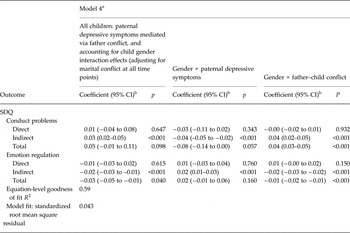
After testing for interaction effects (model 3), high father–child conflict still significantly mediated the association between higher postnatal paternal depressive symptoms and boys’ conduct problems and emotion regulation. Table 4 (model 3) shows the standardized coefficients for each outcome according to gender interaction with the exposure paternal depressive symptoms and mediator father–child conflict. For conduct problems, child gender interacted with both paternal depressive symptoms and father–child conflict while for emotion regulation, child gender interacted significantly with father–child conflict. After further adjusting the model for marital conflict at all time-points (Table 5, model 4), higher father–child conflict still significantly mediated the association between high postnatal paternal depressive symptoms and emotion regulation, but the association between paternal depressive symptoms and child conduct problems became non-significant. In this model, child gender interacted significantly with father–child conflict, but not paternal depressive symptoms in the association between paternal depressive symptoms and child emotion regulation. The model fit statistics show that model 4 is the best fit. The final overall model (model 4) explained 59% of the variance (R 2 = 0.59).
Adjusted mediation models showing the effect of paternal depressive symptoms at 9 months on children's behavioural and emotional development at 7 years via father–child conflict at 3 years old after controlling for maternal depressive symptoms, child temperament, socio-economic status (9 months) and marital conflict at all time-points

CI, Confidence interval; SDQ, Strengths and Difficulties Questionnaire.
a Sample size was 3147.
b All coefficients were standardized.
Sensitivity analysis
The sensitivity analysis using imputed data replicated the findings in the main analysis in that all effects remained significant. In fact, significant findings increased in the main analysis model 1 (see online Supplementary Table S3). Therefore, this suggests that we have underestimated the effects of paternal depressive symptoms on children's emotional and behavioural problems via father–child conflict; therefore further analysis was not undertaken using the imputed datasets on models 2, 3 and 4.
Discussion
As hypothesized, higher paternal depressive symptoms at 9 months were significantly associated with children's emotion regulation at 7 years old, via higher father–child conflict when children were 3 years old. Thus, depressive symptoms in fathers may influence their mood. Therefore these fathers may struggle with conflict resolution with their toddlers and this negative interaction may later have an impact on their children's emotional development during early school years. These findings extend previous studies investigating the association between paternal depressive symptoms, fathers’ parenting and children's emotional and behavioural problems (Ramchandani et al. Reference Ramchandani, Stein, Evans and O'Connor2005, Reference Ramchandani, Stein, O'Connor, Heron, Murray and Evans2008b ; Kane & Garber, Reference Kane and Garber2009; Malmberg & Flouri, Reference Malmberg and Flouri2011; Dette-Hagenmeyer & Reichle, Reference Dette-Hagenmeyer and Reichle2014; Giallo et al. Reference Giallo, Cooklin, Wade, D'Esposito and Nicholson2014b ) and add to literature by using longitudinal data from key time points. This study is also the first to our knowledge that has investigated the association between paternal depressive symptoms and children's emotion regulation. Our findings also extend the literature by adding that father–child conflict may mediate this association path. Furthermore, we found that gender had an interaction effect with father–child conflict and not fathers’ depressive symptoms. These findings suggest that father–child conflict may be an important factor that could be targeted to reduce emotional and behavioural problems in sons of fathers suffering from depression. Our finding that boys with poorer emotion-regulation abilities had higher externalizing problems is also in line with previous research (Eisenberg et al. Reference Eisenberg, Spinrad and Eggum2010).
Parental socialization provides an environmental explanation for our findings (Eisenberg et al. Reference Eisenberg, Losoya, Fabes, Guthrie, Reiser, Murphy, Shepard, Poulin and Padgett2001). Previous studies have shown that maternal depression has a negative impact on their daughters’ emotion-regulation abilities but not sons’ (Silk et al. Reference Silk, Shaw, Skuban, Oland and Kovacs2006). As emotion-regulation abilities are learnt from socialization with parents during early development, these results may indicate that same-gendered parents have a greater influence on their children in this process (Eisenberg et al. Reference Eisenberg, Losoya, Fabes, Guthrie, Reiser, Murphy, Shepard, Poulin and Padgett2001). Compared with mothers, fathers have been reported to respond more harshly and provide less support towards their son's emotional expressions, which according to role model theory may subsequently be imitated by boys (Fischer, Reference Fischer2000; Chaplin et al. Reference Chaplin, Cole and Zahn-Waxler2005; Brody & Hall, Reference Brody, Hall, Lewis, Haviland and Barrett2008; Brown et al. Reference Brown, Craig and Halberstadt2015; Sanders et al. Reference Sanders, Zeman, Poon and Miller2015). This may cause conflict interactions between fathers and their sons, which may lead to emotional and behavioural problems (Kane & Garber, Reference Kane and Garber2004, 2009). An alternative explanation is that our findings could be due to genetic heritability or an interplay between genes and the environment (Ramchandani & Psychogiou, Reference Ramchandani and Psychogiou2009; Natsuaki et al. Reference Natsuaki, Shaw, Neiderhiser, Ganiban, Harold, Reiss and Leve2014). Sons of depressed fathers could be genetically predisposed to developing depressive symptoms and also exposed to the family environmental factors associated with paternal depressive symptoms (Rutter et al. Reference Rutter, Dunn, Plomin, Simonoff, Pickles, Maughan, Ormel, Meyer and Eaves1997; Rutter, Reference Rutter2009; Gutierrez-Galve et al. Reference Gutierrez-Galve, Stein, Hanington, Heron and Ramchandani2015), which may increase father–child conflict and child emotional problems. However, more research is needed to support both of these explanations. As the current study could not control for genetic influences, this is something that could be addressed by future research.
We also found that higher paternal depressive symptoms at 9 months were significantly associated with children's conduct problems at 7 years old, via higher father–child conflict when children were 3 years old after controlling for maternal depressive symptoms, marital conflict, child temperament and family SES, which was in line with previous literature (Ramchandani et al. Reference Ramchandani, Stein, Evans and O'Connor2005, Reference Ramchandani, Stein, O'Connor, Heron, Murray and Evans2008b , 2013). However, after further controlling for marital conflict at all time points, the overall associations between paternal depressive symptoms and child conduct problems became non-significant. One explanation for this could be that marital conflict may have a stronger influence on children's behavioural problems (Hanington et al. Reference Hanington, Heron, Stein and Ramchandani2012; Braithwaite et al. Reference Braithwaite, Steele, Spjut, Dowdle and Harper2015) compared with paternal depressive symptoms (predictor variable). Additionally, marital conflict and father–child conflict (mediator variable) are closely related variables that may jointly be influencing the association between paternal depressive symptoms and child outcomes within the model (Margolin et al. Reference Margolin, Oliver, Medina, Grych and Fincham2001; Cummings & Miller-Graff, Reference Cummings and Miller-Graff2015). Therefore, future studies should aim to differentiate and disentangle the effects of different conflictual relationships within the family in relation to child adjustment, perhaps with observational rather than self-report measures.
The current study has a number of strengths. First, the MCS is a unique dataset with a large representative sample of UK fathers (Plewis & Ketende, Reference Plewis, Ketende and Ketende2006; Hansen, Reference Hansen2014). Second, the MCS collected a large number of measures on mothers, fathers and children, most of which were well validated and reliable and we tested children's outcomes longitudinally (Johnson, Reference Johnson2012). Third, our findings are further strengthened by child outcomes being reported from mothers, decreasing any variances produced by same informant reporter bias of predictors and outcomes. Finally, the MCS (like other cohort datasets) is subjected to attrition and missing data. However, research indicates that even when dropouts are taken into account, regression models with large cohort studies are still robust (Wolke et al. Reference Wolke, Waylen, Samara, Steer, Goodman, Ford and Lamberts2009). In addition, our analysis accounted for attrition/missing data by utilizing sampling weights recommended by the MCS team (Ketende & Jones, Reference Ketende and Jones2011). This increased the representativeness and accounted for missing data/attrition rates that might have influenced or biased the results. We further conducted a sensitivity analysis using multiple imputation, a statistical method used in recent years to account for attrition in cohort studies (Sterne et al. Reference Sterne, White, Carlin, Spratt, Royston, Kenward, Wood and Carpenter2009; Niarchou et al. Reference Niarchou, Zammit and Lewis2015). This replicated our main finding, and if anything suggests that we have underestimated the effects.
There were also some limitations. First, we lacked data on clinical diagnoses of depressive episodes using interview methods, which some might argue would be more informative. Parenting was also measured using self-reports, which might not be accurate due to biased reporting of positive parenting and inter-association with fathers reporting high depressive symptoms and higher conflict parenting. Parenting is often measured using observational methods of parent–child interactions (Aspland & Gardner, Reference Aspland and Gardner2003). However, in both cases conducting studies using observational and interview methods with such a large sample size would be expensive, time-consuming and impractical. Thus, the study of the influence of depressive symptoms is useful as results can later be tested experimentally using smaller clinical samples. Second, the coefficient effect sizes of the associations were small. Previous studies investigating mediation effects using large cohort studies have also reported small effect sizes of maternal and paternal depressive symptoms on child outcomes (Malmberg & Flouri, Reference Malmberg and Flouri2011; Giallo et al. Reference Giallo, Cooklin, Wade, D'Esposito and Nicholson2014a , Reference Giallo, Cooklin, Wade, D'Esposito and Nicholson b ). Given that the MCS consisted of a normal population of fathers, clinically relevant high levels of depressive symptoms would have been underestimated due to the likelihood of depressed fathers being less motivated to participate and therefore might have resulted in small effect sizes. A smaller-scale study consisting of a clinical sample of depressed fathers may yield larger effect sizes. This is something for future studies to investigate. However, given the huge challenges with recruiting depressed fathers to participate in research with their children (Sherr et al. Reference Sherr, Davé, Lucas, Senior and Nazareth2006; Garber et al. Reference Garber, Ciesla, McCauley, Diamond and Schloredt2011; Pilowsky et al. Reference Pilowsky, Wickramaratne, Poh, Hernandez, Batten, Flament, Stewart, Blier and Weissman2014), the findings from large cohort studies such as the MCS offers useful insight into the possible associations in this field of limited literature (Fagan, Reference Fagan2014; Niarchou et al. Reference Niarchou, Zammit and Lewis2015). These findings, if replicated with a clinical population, could suggest targets for development of clinical interventions.
We also assumed causal direction due to the data originating at different time points across the child's life. We are assuming linear relationships when in fact the interrelationships between parental mental health, parenting and children's development is likely to be complex and these factors may amplify and feedback on each other. Therefore, our findings need to be replicated experimentally to draw firm conclusions about causal direction. This could only be done by using treatment trials for paternal depression which provide an opportunity to see if father–child conflict and child emotional/behavioural problems are reduced among fathers who respond compared with those who do not respond to treatment.
Finally, we acknowledge that there are more statistically advanced techniques for testing mediation using cross-lagged panel modelling and latent growth mediation modelling (Selig & Preacher, Reference Selig and Preacher2009). These techniques account for autoregressive controls, reverse causality and trends (slopes and intercepts) between associations (Cole & Maxwell, Reference Cole and Maxwell2003; Maxwell & Cole, Reference Maxwell and Cole2007; Maxwell et al. Reference Maxwell, Cole and Mitchell2011). These methods have been used to investigate moderation and mediation in maternal depression, mothers’ parenting and children's behavioural outcomes (Beauchaine et al. Reference Beauchaine, Webster-Stratton and Reid2005; Eisenberg et al. Reference Eisenberg, Zhou, Spinrad, Valiente, Fabes and Liew2005; Belsky et al. Reference Belsky, Pasco Fearon and Bell2007). However, these statistical techniques require all variables to be available at all time-points (Selig & Preacher, Reference Selig and Preacher2009), which was not the case in the MCS, restricting the analysis method we could utilize. Specifically with regards to our research question, it would be important to investigate family context factors that may change over time such as maternal and paternal depressive symptoms. Thus, future research work could expand the statistical analysis of this paper by using longitudinal multivariate analysis with more statistically advanced techniques to build on the findings of this paper once appropriate samples are available.
Despite some of the limitations, the findings of this study add to theoretical understanding of indirect effects of fathers’ postnatal depressive symptoms to their children's outcomes. Postnatal paternal depressive symptoms were associated with boys’ emotion-regulation problems at 7 years old via higher father–child conflict at 3 years old. This association still remained significant after accounting for maternal depressive symptoms, child temperament, SES and marital conflict (at all time points). There are some specific implications that can be taken from the current study to inform parenting interventions. For example, parenting interventions could help with managing conflict parent–child relationships between depressed parents and their children. This may have potential to break the intergenerational transmission of risk. Parenting interventions involving fathers have been found to lessen behavioural problems in children mainly due to the change in fathers’ parenting (Wilson et al. Reference Wilson, Havighurst and Harley2014), therefore involving depressed fathers in such interventions maybe beneficial. Like maternal depression, studies have shown paternal depression to have a cost on public health care services (Edoka et al. Reference Edoka, Petrou and Ramchandani2011), but intervention programmes are still primarily targeted at mothers (Panter-Brick et al. Reference Panter-Brick, Burgess, Eggerman, McAllister, Pruett and Leckman2014). In light of our findings we would encourage more research with fathers and involvement of fathers in parenting programmes of depressed parents.
Supplementary material
For supplementary material accompanying this paper visit http://dx.doi.org/10.1017/S0033291716000234
Acknowledgements
We would like to thank the MCS families and MCS team at the Centre of Longitudinal Studies, Institute of Education, London, UK for the use of these data, and the UK Data Archive and Economic and Social Data Service for making them available.
The contributions of the authors were as follows. S.N.: conception and design, data analysis, interpretation of data, write up of article, revising it critically for important intellectual content and final approval of the version to be published. G.R.: conception and design, provided guidance with data analysis, interpretation of data and analysis, revising it critically for important intellectual content and final approval of the version to be published. W.K.: interpretation of data and analysis, revising it critically for important intellectual content and final approval of the version to be published. L.P.: conception and design, interpretation of data and analysis, revising it critically for important intellectual content and final approval of the version to be published. T.F.: conception and design, interpretation of data and analysis, revising it critically for important intellectual content and final approval of the version to be published.
Declaration of Interest
None.