Introduction
With a lifetime prevalence of 11.5% in Germany and up to 16.9% in the USA, major depression is one of the most frequent disorders (Andrade et al. Reference Andrade, Caraveo-Anduaga, Berglund, Bijl, de Graaf, Vollebergh, Dragomirecka, Kohn, Keller, Kessler, Kawakami, Kiliç, Offord, Ustun and Wittchen2003). In addition to affective symptoms such as altered mood and behaviour, cognitive function is also often impaired. Disturbances in concentration represent a standard operational criterion for the diagnosis of major depression according to DSM-IV criteria (APA, 1994). Impairments of cognitive function have been found across a range of cognitive domains, including memory (Bearden et al. Reference Bearden, Glahn, Monkul, Barrett, Najt, Villarreal and Soares2006), attention (Zihl et al. Reference Zihl, Grön and Brunnauer1998) and executive functions (Stordal et al. Reference Stordal, Lundervold, Egeland, Mykletun, Asbjørnsen, Landrø, Roness, Rund, Sundet, Oedegaard and Lund2004).
Ascertaining whether cognitive impairments diminish or persist despite improvement of psychopathological symptoms is a fundamental issue for optimizing treatment in depressed patients. There is substantial evidence for the persistence of cognitive deficits even after remission of depressive symptoms (Marcos et al. Reference Marcos, Salamero, Gutierrez, Catalan, Gasto and Lazaro1994; Weiland-Fiedler et al. Reference Weiland-Fiedler, Erickson, Waldeck, Luckenbaugh, Pike, Bonne, Charney and Neumeister2004; Neu et al. Reference Neu, Bajbouj, Schilling, Godemann, Berman and Schlattmann2005; Reppermund et al. Reference Reppermund, Zihl, Lucae, Horstmann, Kloiber, Holsboer and Ising2007). Neu et al. (Reference Neu, Bajbouj, Schilling, Godemann, Berman and Schlattmann2005) reported persistent cognitive deficits in verbal memory and verbal fluency in middle-aged depressed patients after treatment, even after being in a euthymic state for at least 6 months. In contrast, Weiland-Fiedler et al. (Reference Weiland-Fiedler, Erickson, Waldeck, Luckenbaugh, Pike, Bonne, Charney and Neumeister2004) found no evidence of impaired visual memory and learning in drug-free, remitted patients in comparison with healthy controls. However, they suggest deficits in sustained attention as a vulnerability marker for major depression. Although there is no cognitive function that is solely impaired in remitted patients, all of these studies indicate that cognitive dysfunction is trait-dependent and not merely an epiphenomenon of psychopathological symptoms (Murphy et al. Reference Murphy, Sahakian, O'Carroll, Ebert and Ebmeier1998; Austin et al. Reference Austin, Mitchell and Goodwin2001).
Neuroimaging studies suggest that depression is associated with abnormal changes in different brain structures including the prefrontal cortex, anterior cingulate, striatum and medial temporal lobe (Bench et al. Reference Bench, Friston, Brown, Frackowiak and Dolan1993; Dolan et al. Reference Dolan, Bench, Brown, Scott and Frackowiak1994; Ebmeier et al. Reference Ebmeier, Donaghey and Steele2006). It is possible that cerebral dysfunction does not necessarily recover completely and may therefore contribute to persistent neuropsychological impairments (Holthoff et al. Reference Holthoff, Beuthien-Baumann, Zündorf, Triemer, Lüdecke, Winiecki, Koch, Füchtner and Herholz2004; Strakowski et al. Reference Strakowski, Adler, Holland, Mills, DelBello and Eliassen2005).
Moreover, previous studies investigating cognitive functioning in depression suggest that cognitive impairment may predict the further course of illness. Executive dysfunctions in particular were claimed to be predictive of poor treatment response, non-remission and elevated risk to relapse (Alexopoulos et al. Reference Alexopoulos, Meyers, Young, Kalayam, Kakuma, Gabrielle, Sirey and Hull2000; Majer et al. Reference Majer, Ising, Künzel, Binder, Holsboer, Modell and Zihl2004). Alexopoulos et al. (Reference Alexopoulos, Meyers, Young, Kalayam, Kakuma, Gabrielle, Sirey and Hull2000) found that deficits in executive function (abnormal initiation, perseveration) predict relapses and recurrences of depressive episodes 2 years after discharge. However, cognitive assessment was solely based on a screening instrument and their study included elderly patients only. Majer et al. (Reference Majer, Ising, Künzel, Binder, Holsboer, Modell and Zihl2004) observed generalized cognitive impairments across all cognitive domains. However, they regarded the impairment of divided attention as a more specific deficit within the domain of attention because neither reduced sustained attention nor impaired selective attention accounted for this impairment. As particularly non-responders showed impaired divided attention on admission, the authors speculated whether this deficit might represent a marker for predicting the further course of depression. However, they found only a trend for the association between impaired divided attention and an elevated risk to relapse. Weiland-Fiedler et al. (Reference Weiland-Fiedler, Erickson, Waldeck, Luckenbaugh, Pike, Bonne, Charney and Neumeister2004) found sustained attention to be a possible predictor for the course of depression.
Although it is now widely accepted that cognitive dysfunction is a genuine feature of depression, the nature and specificity of cognitive deficits in depression remain unclear. Whereas Fossati et al. (Reference Fossati, Amar, Raoux, Ergis and Allilaire1999) found predominantly executive dysfunctions, others reported primarily memory disturbances (Lemelin et al. Reference Lemelin, Baruch, Vincent, Laplante, Everett and Vincent1996; Basso & Bornstein, Reference Basso and Bornstein1999; Sweeney et al. Reference Sweeney, Kmiec and Kupfer2000) or rather generalized impairments in most cognitive domains (Majer et al. Reference Majer, Ising, Künzel, Binder, Holsboer, Modell and Zihl2004). Thus, a consistent and clear-cut profile of cognitive impairments has not been established hitherto. Some authors (Mialet et al. Reference Mialet, Pope and Yurgelun-Todd1996; Zihl et al. Reference Zihl, Grön and Brunnauer1998) have therefore interpreted the rather unspecific cognitive deficit pattern as a final common pathway disorder, emphasizing the particular role of deficits in intensity and selectivity of attention and its executive components. The idea of a final common pathway disorder is based on the assumption that mainly supramodal functional networks are affected, which represent the highest and final level of integration of regional cognitive networks subserving, e.g. information processing, attention and memory. This idea is further supported by brain imaging studies in normal (Kane & Engle, Reference Kane and Engle2002) and in depressed subjects (Austin et al. Reference Austin, Mitchell and Goodwin2001; Rogers et al. Reference Rogers, Kasai, Koji, Fukuda, Iwanami, Nakagome, Fukuda and Kato2004), which have shown that the prefrontal cortex plays the dominant role as final common pathway.
To date, very few longitudinal studies exist that have assessed associations between cognitive function and the course of depression. Due to small sample sizes, restriction to elderly patients and the failure to control for practice effects, findings should be regarded as preliminary. Furthermore, the majority of investigations are confined to exploring single domains rather than defining a comprehensive cognitive profile of depression.
The present study examined cognitive performance in young to middle-aged depressed in-patients in acute status, after remission of psychopathological symptoms following treatment, and 6 months after remission in order to determine the nature and specificity of cognitive dysfunctions as well as its relevance for the further course of depression. We investigated whether there is a significant relationship between cognitive dysfunction and psychopathology or whether cognitive dysfunction represents an independent syndrome complex. In addition, we examined whether remission of depression is related to remission of cognitive dysfunction. Finally, we investigated the role of cognitive disorders as a potential neuropsychological marker for the course of depression. To address these research questions, we applied a comprehensive neuropsychological assessment comprising the domains of information processing/attention, memory, and executive functions.
Methods
Subjects
Fifty-three depressed in-patients (28 female, 25 male), admitted to the Max Planck Institute of Psychiatry in Munich, were included. Inclusion criterion was unipolar depression with either a first episode of major depression (n=16) or recurrent depression (n=37). The mean age of subjects was 43.5 (range 22–58) years. Depression in patients was diagnosed by trained psychiatrists according to DSM-IV criteria. Depression ranged from moderate to severe, scoring a minimum of 14 points (mean 25.1,s.d.=5.1) on the Hamilton Rating Scale for Depression (HAMD; Hamilton, Reference Hamilton1960).
Subjects with depression secondary to a neurological or physical illness, electroconvulsive therapy within the past 3 months, current substance abuse, dementia, insufficient visual or auditory functions, or German language capabilities were excluded from the study. Patients were treated according to the doctor's choice with different kinds of antidepressants, with dosage adjusted according to clinical improvement and plasma levels. At initial assessment all but three subjects received antidepressive medication.
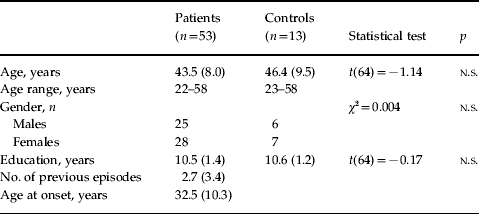
Additionally, 13 control subjects (seven female, six male) from a Munich-based community sample with no lifetime history of psychiatric Axis I disorders were recruited. The groups were matched for age, gender and education (see Table 1); absence of Axis I disorders was ascertained by computer-assisted interviews with a modified version of the Munich Composite International Diagnostic Interview (DIA-X/M-CIDI; Wittchen & Pfister, Reference Wittchen and Pfister1997).
Demographic and clinical characteristics of participants

n.s., Non-significant.
Values are given as mean (standard deviation), range or as n.
The study was approved by the ethics committee of the Ludwig-Maximilians-University (Munich, Germany), and all subjects gave written informed consent prior to study inclusion.
Study design
Cognitive and psychopathological assessments were performed twice, i.e. on admission (within 3–10 days following admission to the hospital) and prior to discharge (last week before discharge). Cognitive tests were administered in the forenoon. To avoid fatigue effects, neuropsychological assessments were performed on 2 consecutive days. Course and severity of depressive symptoms and response to the pharmacological treatment were assessed using the HAMD by trained psychiatrists and psychologists. The mean interval between the first and second cognitive assessment was 9 (s.d.=4.8) weeks.
An additional cognitive and psychopathological assessment was carried out in a subsample of 20 patients (10 female, 10 male; mean age 41.7,s.d.=7.1 years), who were remitted at the time of discharge; these patients were re-examined about 6 months (mean=5.6 months) thereafter.
To estimate the effects of test repetition, control subjects were assessed twice with the same cognitive tests at intervals of 4.4 weeks (s.d.=0.6 weeks). This time interval corresponds to the shortest hospitalization period of the patient group.
Neuropsychological assessment
Cognitive functions were assessed in a fixed sequence with the following standardized tests.
Information processing/attention
The subtest ‘Alertness’ of the ‘Testbatterie zur Aufmerksamkeitsprüfung’ (TAP; Zimmermann & Fimm, Reference Zimmermann and Fimm1993) measures alertness in terms of responses to a visual stimulus with and without a warning tone. Performance is assessed by measuring reaction time (ms).
The ‘Zahlenverbindungstest’ (ZVT; Oswald & Roth, Reference Oswald and Roth1987) is a trail-making test and was used to assess speed of information processing. It consists of four matrices, each comprising numbers from 1 to 90 arranged pseudorandomly on a sheet of paper. The subjects were instructed to join the numbers in ascending order as quickly as possible. In the present study, two matrices were administered (ZVT-A, ZVT-B), and the average time was used as a measure of cognitive speed performance.
The ‘Aufmerksamkeits-Belastungstest d2’ (Brickenkamp, Reference Brickenkamp2002) is a paper-and-pencil speed cancellation test to assess selective visual attention. The subjects were asked to search for the target stimulus among non-targets as quickly as possible and to cancel out as many targets as possible within 4 min and 40 s. Performance score was calculated by subtracting commission errors from the number of correctly cancelled items.
Divided attention was tested by administering the subtest ‘Divided attention’ (TAP), i.e. a dual-task paradigm. This task requires attending to visual and acoustic stimuli simultaneously. Performance was measured by obtaining the mean reaction time for target present trials.
Memory
Verbal short-term memory was assessed using the ‘Digit span forward’ of the revised German version of the Wechsler Memory Scale (WMS-R; Wechsler, Reference Wechsler2000). Subjects were required to repeat increasing strings of single digits in the order as given by the examiner. The number of correctly reproduced sequences was used as the test score.
‘Digit span backward’ (WMS-R) was used to assess verbal working memory performance. The number of correctly reproduced sequences in backward order was used as test score.
Free reproduction of two stories read aloud by the examiner, each containing 25 items (‘Logical memory’; WMS-R), was used to test immediate and delayed verbal recall. The number of correct reproduced items was used as the performance measure.
Executive functions
Cognitive flexibility was tested by simple and alternate verbal fluency tasks (‘Regensburger Wortflüssigkeits-Test’; Aschenbrenner et al. Reference Aschenbrenner, Tucha and Lange2000). In each subtest, subjects are required to produce as many words as possible: (1) beginning with a particular initial letter; (2) belonging to a specific semantic category; (3) alternating between words with a particular initial letter; and (4) alternating between semantic categories within 2 min each. The number of valid responses was calculated, excluding repetitions and intrusion errors.
The Raven Standard Progressive Matrices (SPM) test (Raven et al. Reference Raven, Court and Raven1988) was used to test visual problem solving. Its five subtests contain 12 items each, which are marked by different levels of complexity. The number of correctly solved items served as a measure of visual problem-solving ability.
Three subtests of the Cambridge Neuropsychological Test Automated Battery (1999; CeNeS Pharmaceuticals plc, Cambridge, UK), namely Delayed Matching to Sample (DMS), Intradimensional/Extradimensional Attentional Set Shifting (ID/ED) and Spatial Working Memory (SWM) were used to assess working memory and cognitive flexibility.
In the ‘DMS’ task, subjects were confronted with a complex abstract pattern and then asked to identify this pattern in a selection of four similar stimuli. This selection was presented after 0, 4 or 12 s in a random order. The number of correct identifications at each condition was used as the test score.
The ‘ID/ED’ task involves nine visual discrimination levels, with subjects proceeding to the next stage once a criterion of six consecutive correct responses had been attained. The critical test conditions involve novel stimuli and subjects had to learn new examples which belong to the same dimension (ID shift). Then, the rule was reversed so that the previously learned shape becomes irrelevant (ED shift). Thus, the ability to inhibit a previously learned rule and adopt a new rule by shifting attention from one dimension to another was tested.
In the ‘SWM’ task, subjects were required to search for tokens hidden in a spatial array of boxes. The number of boxes increased from four to six to eight. A strategy score was derived from the number of search sequences which were started with the same box.
All tests were administered also at follow-up, except three cognitive tasks (‘Aufmerksamkeits-Belastungstest d2’, Logical memory and Raven SPM test) for practicability reasons.
Statistical analyses
Statistical analyses included paired-sample t tests and McNemar's test for assessing change in psychopathology and cognitive function, and independent t tests and χ2 tests for comparing age, education and gender between groups. To control for possible effects of medication on cognitive performance, we pooled sedative drugs (tricyclic antidepressants, Mirtazapine) and non-sedative drugs (selective serotonin re-uptake inhibitors, noradrenergic and specific serotonergic antidepressants, selective noradrenaline re-uptake inhibitors, monoamine oxidase inhibitors). Analyses of covariance (ANCOVAs) controlling for age, gender, type of medication (sedative antidepressants, non-sedative antidepressants, use of benzodiazepines, neuroleptic treatment) and education were used to detect differences in the cognitive performance between remitting and non-remitting patients and between patients with a first depressive episode and recurrent depression. Change scores in cognitive performance between admission and discharge were computed as regression residuals controlling for baseline values. In addition, non-parametric Mann–Whitney U tests using regression residuals of the cognitive tests corrected for the same covariates as in the ANCOVAs were applied for analysing differences between diagnostic subgroups and for patients with follow-up data. Multiple regression analyses were applied to determine practice effects, considering age, gender and education as possible confounding variables. Effect sizes were computed as Cohen's d for t tests and Cohen's f for ANCOVAs. Partial correlations, controlling for age, gender, type of medication and education, were used to determine relationships between cognitive function and severity of depression.
The level of significance was set to p=0.05 (two-tailed). No correction for the number of neuropsychological tests was applied to avoid a disproportional loss of power, as the different tests display highly interrelated facets of the same phenotype of cognitive performance. All statistical analyses were performed using SPSS version 13.0 (SPSS Inc., Chicago, IL, USA).
Results
All patients fulfilled the DSM-IV criteria for a major or recurrent unipolar depression. Seven patients had psychotic features. The average hospitalization time was 9.3 weeks (s.d.=4.8 weeks). Remission of depression was defined by a HAMD score of ⩽9 prior to discharge. According to this criterion, 43 patients were assessed as remitted and 10 as not remitted at discharge. The analysis of change in symptom severity revealed a significant reduction of the HAMD score [25.1,s.d.=5.1 on admission and 6.3,s.d.=5.1 at discharge; t(52)=19.15, p<0.001].
Follow-up assessments were available in 20 remitted patients; seven of them (five female, two male; mean age 44.1,s.d.=10.2 years) suffered a relapse and 13 (five female, eight male; mean age 40.3,s.d.=4.7 years) remained in remission.
Cognitive functions
Impaired cognitive performance was defined as having a test score that is more than one standard deviation below the mean score of the normative samples according to age and gender.
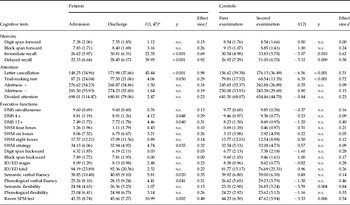
Table 2 displays the results of cognitive assessments for patients and controls.
Results of cognitive assessment for patients (n=53) and controls (n=13)

n.s., Non-significant; DMS, Delayed Matching to Sample; SWM, Spatial Working Memory; ID/ED, Intradimensional/Extradimensional Attentional Set Shifting; SPM, Standard Progressive Matrices.
Values are given as mean (standard deviation).
a Controlled for sedative antidepressants, non-sedative antidepressants, benzodiazepines, neuroleptic treatment, and mood stabilizers.
Patients were impaired in all cognitive domains (information processing/attention, memory, and executive functions) on admission as well as at discharge. Significant improvements were found for 10 (immediate and delayed recall, letter cancellation, trail-making test, DMS with 4 and 12 s delay, SWM strategy score, semantic and phonological verbal fluency, and the Raven SPM test) of 25 cognitive tests.
Cognitive improvement after correcting for practice effects
We observed significant practice effects in the control group for immediate and delayed recall, letter cancellation, trail-making test, semantic flexibility, and the Raven SPM test. Patients showed improvements in five of these cognitive tests, which may at least partly result from practice rather than treatment effects, with the exception of semantic flexibility where only control subjects improved significantly (see Table 2).
To correct for practice effects, we evaluated the effects of test repetition in the control group with respect to baseline performance, age, gender and education by multiple regression. We reanalysed changes in patients' performance in these five cognitive tests with residuals of the test performance at discharge corrected for the practice effects observed in controls. The ANCOVAs did not reveal significant improvement in all five tests after controlling for practice effects (all p>0.05). Thus, cognitive improvement in patients seems to be confined only to those five tests unbiased by practice (DMS with 4 and 12 s delay, SWM strategy score, semantic and phonological verbal fluency).
Impairment rates
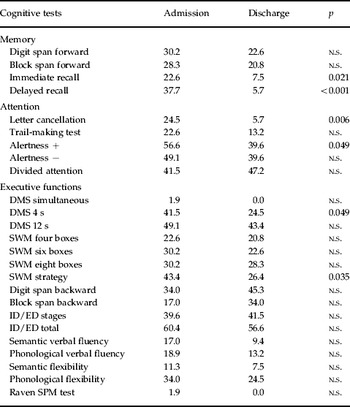
The frequency (%) of patients with impaired cognitive performance is shown in Table 3. We observed a significant decrease in the number of impaired patients in six cognitive tests (immediate and delayed recall, letter cancellation, alertness +, DMS 4 s, and SWM strategy). The highest rate of impairment was found in the ‘ID/ED’ task, which predominantly requires executive functions. More than half of patients (56.6%) also showed impaired performance in the alertness task on admission. This rate decreased to 39.6% at discharge, indicating that only about 15% of patients improved while the majority of patients were impaired in alertness.
Percentage of patients with impaired cognitive performance on admission and at discharge (n=53)

n.s., Non-significant; DMS, Delayed Matching to Sample; SWM, Spatial Working Memory; ID/ED, Intradimensional/Extradimensional Attentional Set Shifting; SPM, Standard Progressive Matrices.
Cognitive functions and course of depression
For investigating the relationship between cognitive deficits and remission of depression, an ANCOVA was computed to determine whether the independent variable (reaching remission or not) was related to cognitive performance on admission. We found no significant differences between remitters and non-remitters (all p>0.05). Thus, no cognitive function could be identified to serve as a predictor for the course of depression between admission and discharge.
To further examine associations between cognitive function and psychopathological outcome, 20 patients who were remitted at discharge were re-examined about 6 months later; seven patients suffered a relapse while 13 patients were still remitted. ANCOVA controlling for age, gender, education and medication revealed no significant differences between the two groups at discharge (all p>0.05). The only significant difference was found for alertness, where relapsed patients performed significantly poorer at follow-up [277.79,s.d.=16.5 versus 239.08, s.d.=23.0; F(1, 11)=7.07, p=0.02]. Considering the small and uneven sample size of the two groups, we reanalysed the data with a non-parametric Mann–Whitney U test using regression residuals of alertness corrected for the same covariates as in the ANCOVA. We replicated the finding of a worse alertness performance in relapsed patients at follow-up (Mann–Whitney U=16.0, p=0.019).
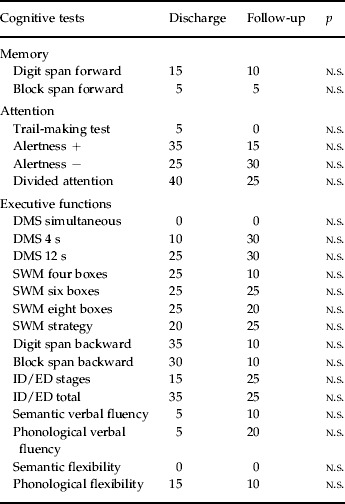
Regarding the rate of impaired patients, there was no significant reduction in any test between discharge and follow-up (Table 4).
Percentage of patients with impaired cognitive performance at discharge and follow-up (n=20)

n.s., Non-significant; DMS, Delayed Matching to Sample; SWM, Spatial Working Memory; ID/ED, Intradimensional/Extradimensional Attentional Set Shifting.
Partial correlations did not reveal any significant correlation between cognitive function and severity of depression, except for a weak association between cognitive performance in the SWM test (six-box condition) and HAMD score on admission (r=−0.34, p=0.02). This single correlation was no longer present at discharge. Furthermore, cognitive test results did not significantly differ between patients suffering from a first episode and those with recurrent depression, either on admission or at discharge (all p>0.05).
In addition, we compared cognitive performance between patients with and without psychotic symptoms by applying the Mann–Whitney U test using regression residuals of the cognitive tests corrected for the same covariates as in previous analyses. The only differences were found for ‘DMS’ (4 s delay), where patients without psychotic symptoms showed a better performance (mean psychotic: 7.71,s.d.=1.50, mean non-psychotic: 8.98, s.d.=1.06; Mann–Whitney U=75.0, p=0.022), and in ‘Digit span backward’, with a better performance of patients with psychotic symptoms (mean psychotic: 8.0,s.d.=1.53, mean non-psychotic: 6.07, s.d.=1.77; Mann–Whitney U=81.0, p=0.035). There was no significant difference at discharge in any test performance (all p>0.05).
Discussion
As reported by other authors (Austin et al. Reference Austin, Mitchell and Goodwin2001; Stordal et al. Reference Stordal, Lundervold, Egeland, Mykletun, Asbjørnsen, Landrø, Roness, Rund, Sundet, Oedegaard and Lund2004; Neu et al. Reference Neu, Bajbouj, Schilling, Godemann, Berman and Schlattmann2005), we found impairments in information processing/attention, memory, and executive functions in patients with acute depression. After remission, performance improved in some cognitive tests but was still impaired in a high proportion of patients (up to 57%). There were no significant differences in cognitive performance between remitted and non-remitted patients. Furthermore, among 25 cognitive measures, only one measure was correlated with depression severity, indicating a dissociation between cognitive function and psychopathological symptoms. This observation is consistent with previous findings (Degl'Innocenti et al. Reference Degl'Innocenti, Agren and Bäckman1998; Fossati et al. Reference Fossati, Amar, Raoux, Ergis and Allilaire1999; Majer et al. Reference Majer, Ising, Künzel, Binder, Holsboer, Modell and Zihl2004; Bearden et al. Reference Bearden, Glahn, Monkul, Barrett, Najt, Villarreal and Soares2006). Thus, we suggest a core cognitive dysfunction which exists independently of psychopathological status. Further evidence for this assumption stems from the absence of any significant reduction of the number of impaired patients between discharge and follow-up. Impairments were found in all cognitive domains we assessed, indicating a non-specific deficit pattern. Our data do not confirm a predominance of executive or memory deficits as suggested by others (e.g. Veiel, Reference Veiel1997; Fossati et al. Reference Fossati, Amar, Raoux, Ergis and Allilaire1999; Sweeney et al. Reference Sweeney, Kmiec and Kupfer2000). Our results suggest a generalized, unspecific impairment profile rather than the existence of selective impairments in specific cognitive domains. However, a high number of patients were impaired in basic attentional tasks (e.g. 56.6% in alertness). These attentional deficits might be responsible for impairments in other cognitive domains, since attention, memory, and executive functions are interrelated cognitive processes (Lezak et al. Reference Lezak, Howieson and Loring2004). If a sufficient attentional level cannot be reached or maintained, a global, unspecific reduction of performance in all cognitive domains may result. Furthermore, attentional functions depending on executive control, e.g. selective and divided attention, may particularly affect cognitive capacities that depend crucially on these attentional functions (e.g. Cohen & O'Donnell, Reference Cohen, O'Donnell and Cohen1993; Mialet et al. Reference Mialet, Pope and Yurgelun-Todd1996; Zihl et al. Reference Zihl, Grön and Brunnauer1998). Although impaired attention is a core symptom of depression, detailed empirical evidence on this issue is, unfortunately, still limited. Taken together, these results support the hypothesis that cognitive dysfunction represents a trait marker rather than simply being an epiphenomenon of acute depression (Austin et al. Reference Austin, Mitchell and Goodwin2001; Reppermund et al. Reference Reppermund, Zihl, Lucae, Horstmann, Kloiber, Holsboer and Ising2007). In addition, our data support the final common pathway disorder hypothesis (Mialet et al. Reference Mialet, Pope and Yurgelun-Todd1996; Zihl. et al. Reference Zihl, Grön and Brunnauer1998). Seen from this neurobiological viewpoint, cognitive impairment results from any type of dysfunction of the underlying network(s), irrespective of whether it is caused by morphological, physiological or biochemical alterations.
Although evidence on the neuropathology of depression is still preliminary, it is rather likely that functional or even morphological changes contribute to the dysfunction of the neural networks that regulate mood and associated cognitions; in depression, these changes have been observed particularly in the prefrontal brain (Harrison, Reference Harrison2002). However, our observations of the dissociation between affective and cognitive symptoms underline the importance of distinguishing between different, regional frontal subsyndromes. By referring to Duffy & Campbell (Reference Duffy and Campbell1994), we suggest that the main functional networks affected in depression are those subserving executive function in cognition (‘dorsal convexity system’), and motivation and emotion (‘mesial frontal system’). Because of the dissociation between cognitive impairments and psychopathological symptoms, one might speculate whether subtypes of depression exist, which can be described as follows: (i) presence of severe psychopathological symptoms with only mild cognitive deficits; (ii) cognitive symptoms with only mild to moderate psychopathological symptoms; and (iii) a combination of severe depressive symptoms and cognitive dysfunction. These subtypes correspond to the apathetic mesial frontal syndrome, the dysexecutive dorsal convexity syndrome, and a combination of both.
In contrast to Majer et al. (Reference Majer, Ising, Künzel, Binder, Holsboer, Modell and Zihl2004) and Weiland-Fiedler et al. (Reference Weiland-Fiedler, Erickson, Waldeck, Luckenbaugh, Pike, Bonne, Charney and Neumeister2004) we did not find a relationship between cognitive function and further course of depression. In addition, we did not find significant differences between remitters and non-remitters nor between patients suffering a relapse and those who remained in remission 6 months after discharge. Differences across studies regarding patients' characteristics, age, gender, education, treatment settings and the consideration of practice effects may account for these inconsistent findings. Our findings demonstrated the importance to consider practice effects in neuropsychological studies. In one-quarter of the tests we administered, we identified practice effects. However, due to the small sample size of our control sample, the results concerning practice effects should be carefully interpreted; further studies are required to investigate practice effects in larger samples.
There is still no uniform explanation for the occurrence and persistence of cognitive impairments in affective disorders. Depression can be accompanied by a variety of neurobiological alterations; it is, therefore, unlikely that one factor alone causes cognitive impairment. Cognitive deficits have been linked, for example, to hypometabolism in specific brain areas, in particular within the prefrontal cortex (Bench et al. Reference Bench, Friston, Brown, Frackowiak and Dolan1993), to hypercortisolaemia (Bremner et al. Reference Bremner, Vythilingam, Vermetten, Anderson, Newcomer and Charney2004), and to dysfunctional interactions of the serotonergic system and the hypothalamic–pituitary–adrenocortical system (McAllister-Williams et al. Reference McAllister-Williams, Ferrier and Young1998). Egeland et al. (Reference Egeland, Lund, Landrø, Rund, Sundet, Asbjørnsen, Mjellem, Roness and Stordal2005) and Gomez et al. (Reference Gomez, Fleming, Keller, Flores, Kenna, DeBattista, Solvason and Schatzberg2006) reported that higher cortisol levels are associated with deficits in executive function and memory whereas processing speed is associated with severity of depressive symptoms. These observations indicate differential effects of cortisol and psychopathology on cognition: hypercortisolism may affect complex cognitive capacities whereas the influence of affective symptoms on cognition may be restricted to ‘low-level’ functioning. In summary, different subtypes of depression might exist which share a particular pattern of psychopathological symptoms but differ with respect to the presence and severity of cognitive impairments, and neurobiological (Nestler et al. Reference Nestler, Barrot, DiLeone, Eisch, Gold and Monteggia2002) and genetic (Goldberg, Reference Goldberg2006) features. Combining neuropsychological assessments, functional brain imaging and neuroendocrine measures might be a promising strategy for illuminating the neurobiological correlates of the occurrence and persistence of cognitive impairments.
One limitation of the present study is that all patients were under medication during neuropsychological assessments, which might have influenced the results. We have tried to cope with this limitation by including the types of medication as covariates. Yet, since the first cognitive assessment was carried out 3–10 days following admission, an adjustment of treatment and dosage might have influenced the results.
Many studies have shown that the impact of antidepressants on cognitive performance may be marginal or non-existent (Podewils & Lyketsos, Reference Podewils and Lyketsos2002; Ferguson et al. Reference Ferguson, Wesnes and Schwartz2003; Siepmann et al. Reference Siepmann, Grossmann, Mück-Weymann and Kirch2003). A recent treatment study with sertraline demonstrated that the effect of antidepressant treatment alleviated psychomotor slowing and was beneficial with respect to executive functions (Constant et al. Reference Constant, Adam, Gillain, Seron, Bruyer and Seghers2005). Nevertheless, it is important to replicate our results in medication-free patients. Porter et al. (Reference Porter, Gallagher, Thompson and Young2003) examined depressed patients who had been drug-free for at least 6 weeks. In comparison with healthy controls, patients were impaired in attention, memory, and executive functions. In a follow-up investigation 2 to 6 months after the first assessment, reduced psychomotor dysfunctions and greater improvement in verbal memory were observed in remitted compared with non-remitted patients (Gallagher et al. Reference Gallagher, Robinson, Gray, Porter and Young2007). In line with our findings, these studies demonstrate that cognitive impairments are not (or at least not completely) secondary to the effects of medication.
Moreover, it has been suggested that ruminative thoughts could be at least partly responsible for cognitive impairments (Hertel, Reference Hertel1998; Watkins & Brown, Reference Watkins and Brown2002). However, cognitive deficits are still existent in the remitted state of depression where rumination is no longer present.
A further limitation is that our sample consisted of moderately to severely depressed, middle-aged in-patients. Thus, the results cannot be generalized to other subgroups such as mildly depressed out-patients or geriatric patients. There is evidence suggesting that hospitalized patients have more pronounced cognitive deficits (Christensen et al. Reference Christensen, Griffiths, Mackinnon and Jacomb1997). However, we found an association between cognitive performance and severity of depression for only one cognitive measure.
Cognitive deficits affect not only everyday life activities but also the patient's ability to work and they also delay re-employment. As a clinical implication, it is thus important to consider additional neuropsychological treatment. In patients suffering from schizophrenia it has been shown that systematic neuropsychological training leads to improvement in cognitive functioning and, as a consequence, to higher social competence and self-confidence (Sartory et al. Reference Sartory, Zorn, Groetzinger and Windgassen2005). In combination with pharmacological treatment and psychotherapy, this approach may help to prevent relapses.
Acknowledgements
The study is part of the Munich Antidepressant Response Signature (MARS) project (http://www.mars-depression.de). We thank Dr S. Kloiber, Dr S. Horstmann, Dr T. Dose, Dr A. Menke, Dr J. Hennings and Dr P. G. Unschuld for providing the psychopathological data. We are most grateful to Susanne Schuett for the excellent revision.
Declaration of Interest
None.