Countries around the world, as well as Middle Eastern countries, such as Saudi Arabia, Iran, Qatar, and United Arab Emirates, have faced tremendous problems arising from disasters in recent times. Disasters are defined as those abrupt and unpredictable events that occur due to natural or man-made interventions with a consequence capable of adversely affecting human lives and properties, putting significant demand on resources.Reference Coppola 1 The United Nations International Strategy for Disaster Reduction (UNISDR) estimates that between 2000 and 2012, disasters, both natural and man-made, cost US$1.7 trillion in damages, affected 2.9 billion people, and killed 1.2 million globally. 2 According to the UNISDR report, 2 countries around the world experienced 3,455 floods, 2,689 storms, 470 droughts, and 395 extreme temperature-related disasters between 1980 and 2011. Given the increase in these events and their associated costs, it is imperative for hospitals and community services to be adequately prepared to manage these events if they occur.Reference Arab, Zeraati, Akbari Haghighi and Ravangard 3 Hospital preparedness is the development of knowledge and capacity in every area required by hospitals to effectually anticipate, respond to, and deal successfully with the negative consequences associated with potential disaster situations.Reference Coppola 1
Four stages of managing disasters have been identified as mitigation, preparedness, response, and recovery.Reference Abd elazeem, Adam and Mohamed 4 Abd elazeem et al.Reference Abd elazeem, Adam and Mohamed 4 indicate that the mitigation phase focuses on reducing the effects of a disaster; preparedness is about getting ready for its actual occurrence; response centers act appropriately to preserve lives and properties; and the recovery stage concentrates on bringing normal life to the affected society. The significance of hospitals’ preparedness for disasters cannot be overemphasized. A hospital’s capacity and its preparedness to respond to disaster events are crucial to preserving lives through the provision of primary emergency medical attention to victims of such disasters.Reference Khorram-Manesh, Hedelin and Örtenwall 5 According to Li et al.,Reference Li, Huang and Zhang 6 lives that may have been lost could be saved if hospitals are sufficiently ready for disasters. Li et al.Reference Li, Huang and Zhang 6 highlight that the effective preparedness of hospitals includes structural furnishings, human resource, appropriate policies, protocols, equipment, and supplies. Hospitals should also be adequately prepared and equipped to care for the additional patients arising from disasters without compromising their usual health care delivery service to their community.Reference Li, Huang and Zhang 6
Although countries in the Middle East have stepped up their public awareness of the need for hospitals to be adequately prepared for disasters, especially after the event of the terrorist attack of September 11, 2001, empirical evidence suggests that more still needs to be done in this area.Reference Li, Huang and Zhang 6 – Reference Adini, Goldberg and Laor 8 Several previous studies have suggested that the preparedness of hospitals in the Middle East nations for disaster events is generally inadequate.Reference Al Khalaileh, Bond and Alasad 9 – Reference Zaboli and Sajadi 11 For example, an assessment of preparedness of hospitals in Jeddah, Saudi Arabia, for disaster by Bajow and AlkhalilReference Bajow and Alkhalil 12 shows that practical training and management are required for the efficient management of such incidents. According to Mahdaviazad and Abdolahifar,Reference Mahdaviazad and Abdolahifar 10 hospitals must invest in areas such as personnel capacity and other valuable resources to enhance their preparedness to respond adequately to disasters that can occur when least expected.
The primary aims of this integrative literature review are to investigate the level of preparedness, the factors influencing the preparedness level, and the measures that could be used to improve the preparedness for disasters among hospitals in the Middle East.
METHODS
This study was conducted using an integrative review methodology based on the Preferred Reporting Items for Systematic and Meta-Analyses (PRISMA) guidelines.Reference Moher, Liberati and Tetzlaff 13 This approach is being adopted widely within health research to facilitate the synthesis of the existing empirical literature on particular issues with the goal of improving the quality of health care.Reference Whittemore and Knafl 14 This study adopted the processes recommended by Whitemore and Knafl,Reference Whittemore and Knafl 14 which include problem identification, literature search, data evaluation, data analysis, and presentation. The advantage of conducting an integrative literature review over other related techniques (eg, systematic literature review) is that it can be applied effectively to examine the findings of studies that have used diverse research methodologies.Reference Johnson, Fogarty and Fullerton 15 This research method has been described as the most rigorous means of conducting a diverse literature review and deducing important evidence for further studies. 16
The comprehensive literature search was conducted primarily by drawing on articles indexed in 4 main databases, including Health and Medical Complete (PROQUEST), PubMed, Google Scholar, and the Cumulative Index to Nursing and Allied Health Literature (CINAHL). The search strategy was based on searching for several primary key terms that include disaster preparedness OR disaster management OR emergency response AND Middle East AND hospitals. For all of the databases, the publication date was set between 1/1/2005 and 31/12/2015 to ensure a large pool of potential studies. Furthermore, references used in the articles searched originally were also checked through Google Scholar online databases for additional empirical evidence. The process of searching for the articles followed the suggestion of Whittemore and Knafl,Reference Whittemore and Knafl 14 which is the combination of computerized databases, journal hand searching, and searching research registries. According to Whittemore and Knafl,Reference Whittemore and Knafl 14 it is crucial to combine multiple methods to address irregular search terminology and indexing issues that are particular to computerized databases.
The articles were included if (1) they have been indexed in the chosen databases, (2) they have been written in English language, (3) their titles related to hospitals’ preparedness for disasters in any of the Middle East countries, (4) they have been published in peer-reviewed journals, (5) they were published between 2005 and 2015, and (6) they have findings that could be widely generalized. Those articles that did not meet the above inclusion criteria were removed from the review. For example, articles that had only their abstracts available were published in Arabic only, were based on expert opinions, and were previous literature reviews; studies that covered disaster preparedness in a single hospital setting were not included. Consideration was not given to whether the articles reported on natural or man-made disasters.
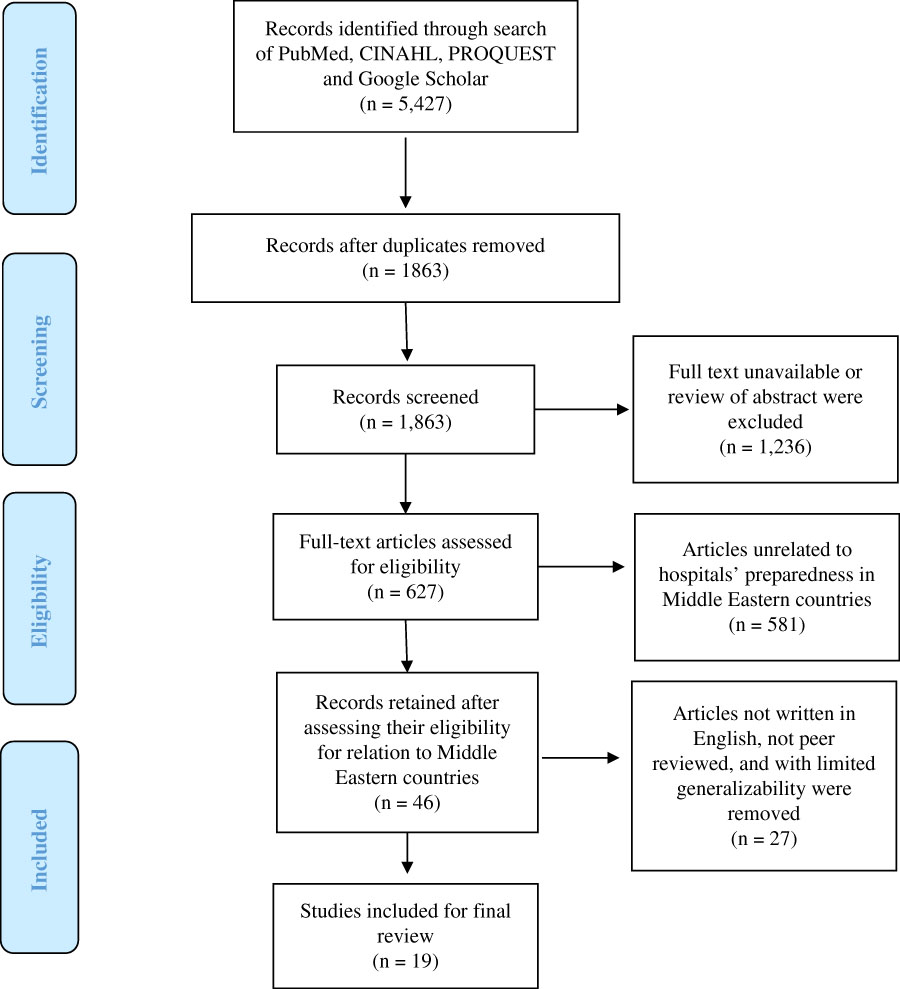
Following the preliminary search of the relevant databases undertaken by the researcher by reading through the abstracts, 5,427 articles were identified. Figure 1 presents the summary of the search strategy.
Search Strategy.

Grading and Quality Assessment
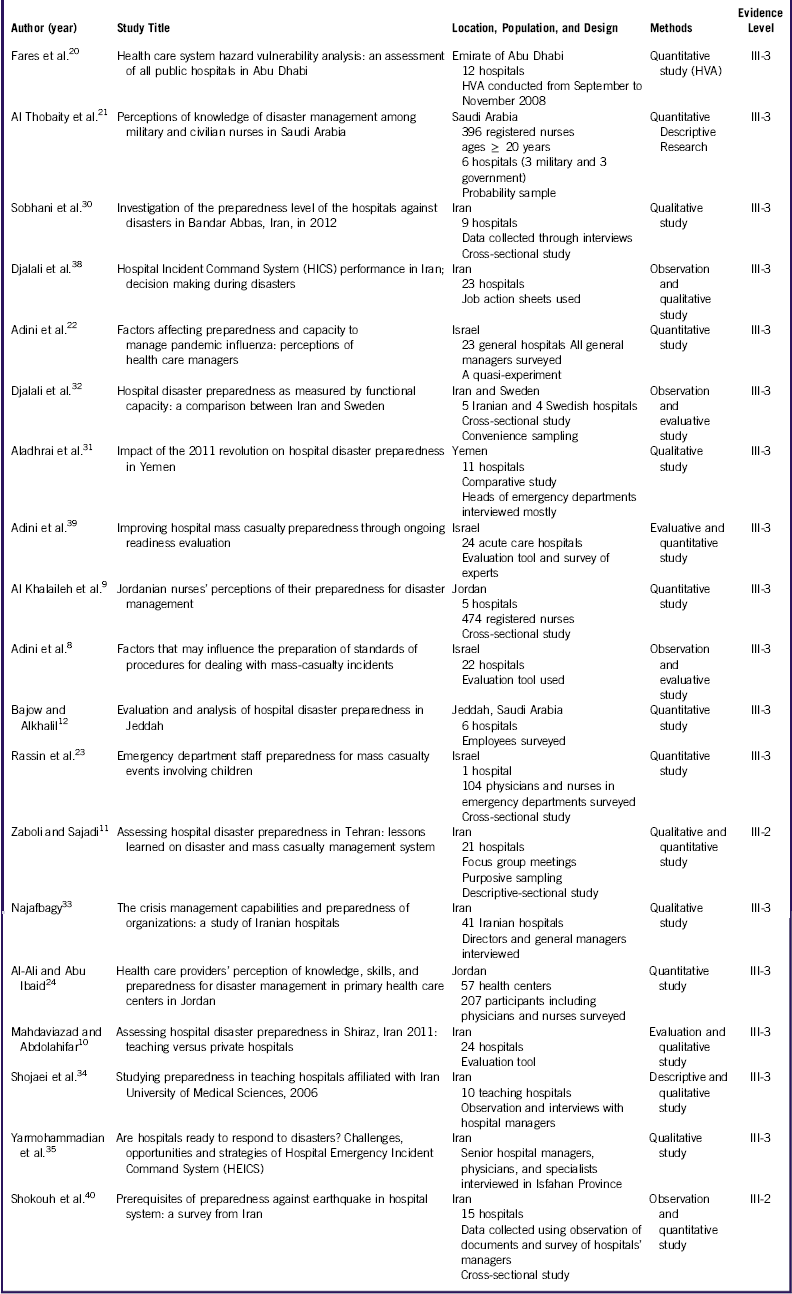
The level of evidence is necessary to determine the validity of study designs and their degree of being free from bias. 16 Several methods are used to measure the quality of evidence presented in empirical articles. For example, the Strength of Recommendation Taxonomy method has been suggested for determining the level of evidence published in the medical science literature.Reference Ebell, Siwek and Weiss 17 Also, BurlsReference Burls 18 recommends an assessment tool known as the Critical Appraisal Skills Programme (CASP). However, the 19 reviewed articles in this study were graded according to the level of evidence recommended by the National Health and Medical Research Council (NHMRC) in Australia. 19 The grading criteria are depicted in Table 1. In addition, Table 2 presents an overview of the articles according to the levels of evidence in line with NHMRC guidelines. Even though many of the articles were evaluated as less than a moderate level of evidence, all were included due to the small number of articles that met the inclusion criteria.
NHMRC Levels of Evidence Criteria

Table of Evidence: An Overview of Reviewed Articles

Background of the Reviewed Studies
Types of Designs Used in the Studies
The reviewed studies used a broad range of valid methods to determine the level of preparedness for disasters within the examined hospitals. Seven of the reviewed studies were based on quantitative research methodology in which questionnaire surveys were administrated to the respondents that included senior hospital managers, medical practitioners, registered nurses, and other levels of health professionalsReference Al Khalaileh, Bond and Alasad 9 , Reference Bajow and Alkhalil 12 , Reference Fares, Femino and Sayah 20 – Reference Al-Ali and Abu Ibaid 24 ; Quantitative research, regarded as experimental, empiricist, or deductive,Reference Gomm 25 – Reference Robson 28 involves the collection of quantifiable data to describe a specific situation or occurrence,Reference Kumar 27 or to examine relationships between variables to determine cause-and-effect connections.Reference Kothari 29
The six qualitative studies used mainly interview techniques.Reference Sobhani, Khammarnia and Hayati 30 – Reference Yarmohammadian, Atighechian and Shams 35 In qualitative methodology, the experiences of the participants captured in words and actions are described in a narrative or descriptive manner to explain the phenomenon being studied.Reference Eriksson and Kovalainen 36 The major strength of qualitative research is its ability to provide complex textual descriptions of how people experience a specific research issue.Reference Creswell 37
A number of the reviewed studies (n=6)Reference Adini, Goldberg and Laor 8 , Reference Mahdaviazad and Abdolahifar 10 , Reference Zaboli and Sajadi 11 , Reference Djalali, Castren and Hosseinijenab 38 – Reference Shokouh, Anjomshoa and Mousavi 40 used a mixed-methods approach, which involves combining 2 or more approaches such as focus groups, interviews, questionnaire survey, evaluation tools, and observation to explore the research objectives and questions.Reference Creswell 37
Participants and Methodologies
Various numbers of hospitals were covered and participants involved in the reviewed studies. However, in 1 study, Yarmohammadian et al.,Reference Yarmohammadian, Atighechian and Shams 35 neither indicated the number of hospitals or health centers covered nor participants involved. This study only suggested that they interviewed senior hospital managers, physicians, and specialists without mentioning the size. For those studies that indicated the number of hospitals or health centers covered, Al-Ali and Abu IbaidReference Al-Ali and Abu Ibaid 24 included the highest number of 57, with the lowest number of 1 being reported in Rassin et al.Reference Rassin, Avraham and Nasi-Bashari 23 Also, the numbers of participants in the reviewed studies ranged from 28 in Adini et al.Reference Adini, Laor and Aharonson-Daniel 22 to 474 in Al Khalaileh et al.Reference Al Khalaileh, Bond and Alasad 9 Table 3 provides a detailed summary of the demographic characteristics of the reviewed studies.
Demographic Characteristics of the Incorporated Studies

a Includes midwife.
b Includes senior managers, directors.
c Includes health centers.
The reviewed studies used a broad range of valid methods to determine the level of preparedness for disasters within the examined hospitals. The highest number of the reviewed studies (n=7) used quantitative research methodology in which questionnaire surveys were administrated to the respondents that included senior hospital managers, medical practitioners, registered nurses, and other levels of health professionals. These 7 studies are Al Khalaileh et al.,Reference Al Khalaileh, Bond and Alasad 9 Bajow and Alkhalil,Reference Bajow and Alkhalil 12 Fares et al.,Reference Fares, Femino and Sayah 20 Al Thobaity et al.,Reference Al Thobaity, Plummer, Innes and Copnell 21 Adini et al.,Reference Adini, Laor and Aharonson-Daniel 22 Rassin et al.,Reference Rassin, Avraham and Nasi-Bashari 23 and Al-Ali and Abu Ibaid.Reference Al-Ali and Abu Ibaid 24 The method used mostly by this group of reviewed studies for collecting their quantitative data was survey (eg, Al Khalaileh et al.,Reference Al Khalaileh, Bond and Alasad 9 Adini et al.,Reference Adini, Laor and Aharonson-Daniel 22 and Shokouh et al.Reference Shokouh, Anjomshoa and Mousavi 40 ), whereas only Fares et al.Reference Fares, Femino and Sayah 20 conducted their study by adopting a hazard vulnerability analysis. Quantitative research is regarded as traditional, essentialist, objectivist, positivist, experimental, empiricist, or deductive.Reference Flick 26 – Reference Robson 28 The quantitative methodology involves the collection of quantifiable data to describe a specific situation or occurrence scientifically.Reference Robson 28 The significance of this method is that it describes as well as examines the relationships between variables and determines cause-and-effect connections between them.Reference Kothari 29
Six of the studies were qualitative because they collected their data using mainly interview techniques. The studies in this category include Sobhani et al.,Reference Sobhani, Khammarnia and Hayati 30 Aladhrai et al.,Reference Aladhrai, Djalali and Della 31 Djalali et al.,Reference Djalali, Castren and Khankeh 32 Najafbagy,Reference Najafbagy 33 Shojaei et al.,Reference Shojaei, Maleki and Bagherzadeh 34 and Yarmohammadian et al.Reference Yarmohammadian, Atighechian and Shams 35 Qualitative methodology is also known as constructivist, relativist, naturalistic, phenomenal, experimental, interpretive, post-positivist, postmodern, or inductive.Reference Gomm 25 – Reference Robson 28 In qualitative methodology, experiences of the participants captured in words and actions are described in a narrative or descriptive manner to explain the phenomenon being studied.Reference Eriksson and Kovalainen 36 The major strength of qualitative research is its ability to provide complex textual descriptions of how people experience a specific research issue.Reference Creswell 37
Similarly, a number of the reviewed studies (n=6) used a mixed-methods approach, which involves combining 2 or more instruments such as focus groups, interviews, questionnaire survey, evaluation tool, and observation to explore the research objectives and questions.Reference Creswell 37 The 6 studies identified to have used this approach are Adini et al.,Reference Adini, Goldberg and Laor 8 Mahdaviazad and Abdolahifar,Reference Mahdaviazad and Abdolahifar 10 Zaboli and Sajadi,Reference Burls 18 Djalali et al.,Reference Djalali, Castren and Hosseinijenab 38 Adini et al.,Reference Adini, Laor and Hornik-Lurie 39 and Shokouh et al.Reference Shokouh, Anjomshoa and Mousavi 40 These studies used 2 or more techniques to investigate disaster management issues. For example, Djalali et al.Reference Djalali, Castren and Hosseinijenab 38 used evaluation tool and observation, whereas Adini et al.Reference Adini, Laor and Hornik-Lurie 39 used evaluation and survey. Table 4 presents an overview of the methods used in the reviewed studies.
Methodologies Used by Reviewed Studies

RESULTS
The results of this integrative review are summarized in this section. Essentially, the main results reported in the reviewed articles are examined and compared. The outcomes reported in relation to the nature of disasters, level of preparedness, factors influencing, as well as the measures for improving the level of preparedness are discussed.
Nature of Disasters
The majority of the reviewed articles (n=12) reported on both natural and man-made disasters (see Table 5).
Nature of Disasters

Level of Preparedness
The summary of the level of hospital preparedness reported by the authors of the studies reviewed is displayed in Table 6. Thirteen, representing 68% of the reviewed articles, clearly ranked the level of preparedness for disasters among their examined hospitals to be generally very poor, poor, or moderate using different factors such as staff’s knowledge and training on disaster, command and control, disaster management plan, and control, among others. The studies in this class include Al Khalaileh et al.,Reference Al Khalaileh, Bond and Alasad 9 Zaboli and Sajadi,Reference Zaboli and Sajadi 11 Bajow and Alkhalil,Reference Bajow and Alkhalil 12 Fares et al.,Reference Fares, Femino and Sayah 20 Al Thobaity et al.,Reference Al Thobaity, Plummer, Innes and Copnell 21 Rassin et al.,Reference Rassin, Avraham and Nasi-Bashari 23 Al-Ali and Abu Ibaid,Reference Al-Ali and Abu Ibaid 24 Sobhani et al.,Reference Sobhani, Khammarnia and Hayati 30 Aladhrai et al.,Reference Aladhrai, Djalali and Della 31 Djalali et al.,Reference Djalali, Castren and Khankeh 32 Najafbagy,Reference Najafbagy 33 Yarmohammadian et al.,Reference Yarmohammadian, Atighechian and Shams 35 and Djalali et al.Reference Djalali, Castren and Hosseinijenab 38 Fares et al.Reference Fares, Femino and Sayah 20 rated most of the 12 hospitals covered in their study as poor and not at all prepared for natural disaster. Also, they established the level of preparedness of the hospitals to be moderate, poor, or zero for man-made disasters such as technological and human hazards based on the participants’ overall assessment. Sobhani et al.Reference Kothari 29 reported the level of disaster preparedness to be generally poor in the areas of reception, evacuation plans, traffic, safety and security, communication, human resources management, and command and control. However, the study found the hospitals’ preparedness as moderate in terms of emergency services, and training and logistics.
Disaster Preparedness

Furthermore, based on interviews with heads of emergency departments, Aladhrai et al.Reference Aladhrai, Djalali and Della 31 found the preparedness of 7 out of the 11 included hospitals to be unacceptable in the aspects of efficiency of contingency plans, resources availability, training of staff members, drills, availability of funds, and disaster management guidelines. Moreover, Shojaei et al.Reference Shojaei, Maleki and Bagherzadeh 34 measured the level of preparedness in terms of security, supplies and equipment, evacuation, and communication to be poor among the hospitals investigated. In the study conducted by Djalali et al.,Reference Djalali, Castren and Hosseinijenab 38 disaster preparedness of the studied hospitals was found to be poor, using determinants that included information management, local databases, and disaster handling procedures.
The remaining 6 reviewed articles reported the level of preparedness for disasters to be very good or good in most of the hospitals assessed. Three of the studies that found the preparedness level to be positive in their examined hospitals were conducted in Israel. Likewise, the remaining 3 studies in this category were carried out in Iran. This outcome indicates that hospitals in Iran and Israel are making good progress in their level of preparedness for disasters when compared with other Middle East nations. Adini et al.Reference Adini, Laor and Aharonson-Daniel 22 suggested the level of preparedness for pandemic influenza by 91% of the 23 Israeli hospitals included in their study to be very good in the capacity to manage disaster and the staff’s knowledge and training. According to the study, 87% of the hospitals were identified as fully capable of dealing with the outbreak whenever it occurs. In addition, 86.7% of the 15 hospitals considered in Shokouh et al.Reference Shokouh, Anjomshoa and Mousavi 40 were found to be highly prepared for earthquake disaster using factors comprising safety of equipment, evacuation and field treatment effectiveness, management of environmental health proceedings, workers’ training on disasters, and support services. The study established that these hospitals were highly ready for mitigation of construction hazards while their level of preparedness for providing vitals services was also assessed as good.
Factors Influencing Level of Preparedness
Five (26%) of the reviewed articles suggested several factors influencing the level of preparedness for disasters among the studied hospitals. Djalali et al.Reference Djalali, Castren and Khankeh 32 suggested that the moderate level of preparedness among the Iranian hospitals studied was due to a lack of contingency plans as well as the insufficient availability of resources. Resources of both human and non-human (such as equipment, management plans) are crucial in forging an excellent response to natural and artificial disasters.Reference Khorram-Manesh, Hedelin and Örtenwall 5 Also, Djalali et al.Reference Djalali, Castren and Khankeh 32 discussed the importance of a hospital having effective contingency plans that can be used to deal with changing the dynamics of disasters. Aladhrai et al.Reference Aladhrai, Djalali and Della 31 identified issues relating to command and control communication as impacting on the preparedness level of the assessed hospitals in their study. According to the study, these problems can lead to a situation where the studied hospitals are unable to meet the required safety and security standards.
Another factor indicated as affecting the hospitals’ level of preparedness for disasters was the lack of adequate training for the personnel to handle effectively such emergency situations.Reference Adini, Laor and Hornik-Lurie 39 The study by Adini et al.Reference Adini, Laor and Hornik-Lurie 39 found large hospitals to have adequate training in place for their staff unlike small ones. The authors suggested that this disparity accounted for why the large and medium-sized hospitals studied were better prepared for disasters than small hospitals. This factor is also echoed by Al Khalaileh et al.,Reference Al Khalaileh, Bond and Alasad 9 who found the lack of sufficient training and education of personnel as influencing the preparedness level of the hospitals included in the study.
Al-Ali and Abu IbaidReference Al-Ali and Abu Ibaid 24 also examined several factors impacting the preparedness level of hospitals analyzed in their research. They concluded that 3 factors were critical, the first issue being the personnel’s lack of awareness of emergency management and operational emergency procedures in the hospitals. Al-Ali and Abu IbaidReference Al-Ali and Abu Ibaid 24 indicated that hospitals whose staff are aware of emergency management plans and its operational processes are more prepared to confront disasters. The second factor identified by Al-Ali and Abu IbaidReference Al-Ali and Abu Ibaid 24 was lack of experience. The study indicated that most of the staff of the hospitals assessed had little or no previous experience about disaster situations, and therefore do not have basic knowledge of how to assist disaster victims. The last determinant mentioned by Al-Ali and Abu IbaidReference Al-Ali and Abu Ibaid 24 was the absence of disaster training programs for hospital staff.
Measures for Improving Preparedness for Disaster
Ten of the reviewed articles, representing 53%,recommended a number of measures that can be used to improve the level of preparedness in the Middle East hospitals. Most of these studies (n=6) suggested that professionals involved in the management of disasters, such as nurses, physicians, occupational health and safety officers, and paramedics, should be provided with ongoing training, education, and drilling exercises to enhance their preparedness for disasters. The studies identified to have made this suggestion include Al Khalaileh et al.,Reference Al Khalaileh, Bond and Alasad 9 Bajow and Alkhalil,Reference Bajow and Alkhalil 12 Al Thobaity et al.,Reference Al Thobaity, Plummer, Innes and Copnell 21 Aladhrai et al.,Reference Aladhrai, Djalali and Della 31 Adini et al.,Reference Adini, Laor and Hornik-Lurie 39 and Yarmohammadian et al.Reference Yarmohammadian, Atighechian and Shams 35 Other studies reviewed in this current research did not make any recommendations on how the hospitals could develop or improve their disaster preparedness.
Four of the studies suggested that hospitals’ level of preparedness for disasters can be significantly improved if an effective hospital incident command system is put in place. This was proposed by Fares et al.,Reference Fares, Femino and Sayah 20 Sobhani et al.,Reference Sobhani, Khammarnia and Hayati 30 Aladhrai et al.,Reference Aladhrai, Djalali and Della 31 and Yarmohammadian et al.Reference Yarmohammadian, Atighechian and Shams 35 According to Fares et al.,Reference Fares, Femino and Sayah 20 hospitals with highly functional incident command systems are better organized and fully aware of the dynamics of a disaster’s occurrence. For instance, such systems can promote effective communication and assist staff to respond rapidly to disasters with much clarity and accountability.Reference Fares, Femino and Sayah 20 This opinion was also expressed by Sobhani et al.Reference Sobhani, Khammarnia and Hayati 30 with an additional suggestion that incident command systems can enhance division of labor across hospitals toward responding better to disasters.
Other actions were recommended by the reviewed studies for improving the preparedness level for disasters. For example, Fares et al.Reference Fares, Femino and Sayah 20 stressed the importance of better risk assessment, engagement of external stakeholders such as the communities, and provision of disaster management programs. Like Fares et al.,Reference Fares, Femino and Sayah 20 Bajow and AlkhalilReference Bajow and Alkhalil 12 emphasize the need for local communities to be sensitized about their potential exposure to disasters, and that their capacity to be able to interpret early warning signs to take timely actions and gather necessary resources for rapid response should be enhanced. Moreover, Sobhani et al.Reference Sobhani, Khammarnia and Hayati 30 added that disaster preparedness of hospitals could be improved through proper organization of human resources, an effective division of labor, and the establishment of a single line of control. Aladhrai et al.Reference Aladhrai, Djalali and Della 31 also suggested that a uniform protocol be set up to address any disparity that may exist in the methods and processes being used in disaster management. The study also underscored the importance of practical communication strategy toward improving the preparedness level for disasters. However, the study did not provide details of issues that should be addressed within the communication plans.
DISCUSSION
This integrative literature critiqued a total of 19 articles to evaluate the preparedness for disasters among the hospitals in the Middle East. In addition, the review of the literature aimed to establish the factors influencing the preparedness level of the hospitals, and the measures that could be used to improve their preparedness. Given the high cost of disasters in the Middle East, both direct and indirect, it is important to develop a deeper understanding of the related issues as a means of developing practical strategies for improving hospital preparedness for disasters in the future.
Key findings from this review suggest that limited research has covered the issue of the hospitals’ preparedness for disasters in the Middle East, despite the importance of this area to this region. This problem was brought to the fore with only 19 articles identified to have addressed issues relating to hospital disaster preparedness in Middle East countries, as well as meeting inclusion criteria for review. Most of the research studies on hospitals’ preparedness for disasters in the Middle East have emanated from Iran (9) and Israel (4). Only 2 studies have been conducted in Saudi Arabia while there was no publicly accessible research carried out in other Middle East countries such as Oman, Bahrain, and Kuwait. This outcome suggests that more studies focusing on hospital preparedness in Middle East countries are still required. Conducting more studies in this area would reveal more issues that need to be addressed toward improving the preparedness and capacity of hospitals in Middle East nations to better deal with potential natural and man-made disasters in this region.
Many of the reviewed studies indicated the level of preparedness for disasters to be inadequate across the hospitals assessed in the Middle East nations in the areas like staff’s knowledge and training on disaster, command and control, disaster management plan, evacuation plans, traffic, safety and security, drills, communication, and human resources management (eg, Fares et al.,Reference Fares, Femino and Sayah 20 Bajow and AlkhalilReference Bajow and Alkhalil 12 ). This finding is similar to those of other global studies (eg, Kaji et al.,Reference Kaji, Langford and Lewis 41 Barbera et al.Reference Barbera, Yeatts and Macintyre 42 ), which reported that current preparedness of hospitals for disasters to be insufficient with a recommendation for an improved disaster management system. Only a few of the studies included in this review suggested that the preparedness level was adequate among their examined hospitals in aspects including safety of equipment, evacuation and field treatment effectiveness, management of environmental health proceedings, workers’ training on disasters, and support services.Reference Mahdaviazad and Abdolahifar 10 , Reference Aladhrai, Djalali and Della 31 , Reference Shokouh, Anjomshoa and Mousavi 40 The overall finding of this review gives an indication that there is a need for hospitals in the Middle East countries to enhance their level of preparedness for disasters because this is very crucial for the management of future disasters. This outcome appears to reflect the reality of preparedness for disasters among hospitals in this region. The affected hospitals may have to develop concerted efforts and seek for improved funding to build their capacity to deal with unexpected disaster events.
Of all 19 studies reviewed in this study, only 5 examined factors influencing the level of preparedness among the hospitals in the Middle East region, which are Al Khalaileh et al.,Reference Al Khalaileh, Bond and Alasad 9 Djalali et al.,Reference Djalali, Castren and Khankeh 32 Aladhrai et al.,Reference Aladhrai, Djalali and Della 31 Adini et al.,Reference Adini, Laor and Hornik-Lurie 39 and Al-Ali and Abu Ibaid.Reference Creswell 37 This finding suggests that research has not adequately explored the issues contributing to the preparedness of hospitals for disasters in these countries. Without broadly establishing matters affecting the preparedness levels of hospitals, effective measures for addressing this issue cannot be formulated. In this sense, more studies are required to investigate the factors contributing to the inadequate level of preparedness for disasters among hospitals in the Middle East countries. There has been an increase in research studies that have examined the issues affecting the hospital preparedness level for disasters around the world following the September 11 terrorist attack in the United States.Reference O’Sullivan, Dow and Turner 43 Studies by O’Sullivan et alReference O’Sullivan, Dow and Turner 43 Manley et al.,Reference Manley, Furbee and Coben 44 Fung et al.,Reference Fung, Loke and Lai 45 and Hammad et al.Reference Hammad, Arbon and Gebbie 46 have examined hospital disaster preparedness in Canada, United States, Hong Kong, and Australia.
Last, 10 of the studies reviewed recommended measures that hospitals in the Middle East could use to improve their preparedness level for disasters. It should be noted that most of the suggestions provided have been based on the opinions of the authors and not derived from health care professionals. This finding reflects the need for more studies that engage the health care industry professionals and other important stakeholders toward designing appropriate and validated measures that can be effectively applied to improve the hospitals’ preparedness for disasters in the region. It is apparent that evidence-based improvement methods are required to stimulate the preparedness of hospitals for disasters. Similar recommendations have also been put forward in studies conducted outside of the Middle East region such as O’Sullivan et al.,Reference O’Sullivan, Dow and Turner 43 Manley et al.,Reference Manley, Furbee and Coben 44 Fung et al.,Reference Fung, Loke and Lai 45 and Hammad et al.Reference Hammad, Arbon and Gebbie 46 According to them, there is need to seek unique collaborative efforts among core local stakeholders toward developing workable strategies to deal with disasters in each community around the world.
CONCLUSIONS
Despite the importance of hospitals in responding effectively to disasters, limited research has examined the preparedness level for disasters among those hospitals based in the Middle East nations. The objective of this integrative study was to determine how the preparedness of hospitals toward dealing with disaster events has been reported in the literature. All 19 studies reviewed have been conducted in Iran, Israel, Saudi Arabia, Jordan, Abu Dhabi, and Yemen, whereas other Middle East nations have not been covered in the existing literature. This indicates that there is still need for more studies that include other countries across this region. This review has also highlighted the importance of conducting more studies that utilize extensive data to provide a more accurate position on the preparedness of hospitals for disasters. Last, the review suggests that research should focus on identifying factors influencing the preparedness for disasters among hospitals in the Middle East to develop approaches to improving emergency management in this region.